Five9’s October 2026 consumer survey found that 55% of respondents trusted AI to resolve a service issue when a human was reachable, compared with 26% when no human option existed. That is a useful starting point for choosing AI agent tools for customer service in Asia Pacific: look for an agent that can complete the right work, across your actual channels, and pass the rest to a person without losing the story. Our shortlist is Sobot for APAC customer-contact operations spanning digital and voice; Fin, Zendesk, Freshworks and Salesforce when your existing service stack leads the decision; Gorgias for Shopify-led commerce; and Botpress when you want to build a more tailored agent.
Five9 surveyed 3,000 consumers in the US, UK and Germany. They put a sharp question on the table: when your AI cannot finish a job, what exactly happens next? You might think a “talk to a person” button settles it. The actual handoff is where that promise gets tested.
AI agent tools for customer service in Asia Pacific: the seven-tool shortlist
The table is a starting point, not a league table or a head-to-head production benchmark. Each “best for” describes the buying situation in which we would investigate a tool first. A good demo should still prove the exact channel, language, system action and escalation path you need.
| Tool | Best starting point | Question to settle in a pilot |
|---|---|---|
| Sobot AI Agents | APAC customer contact that spans messaging, digital service, voice, tickets and human teams | Can your selected Agent workflow carry the right context through the channels and handoffs you use? |
| Fin by Intercom | Adding an AI service layer to Intercom or a supported existing helpdesk | What will Fin do inside your helpdesk, and what reaches the human queue? |
| Zendesk AI Agents | Teams already running service operations in Zendesk | Which of your procedures and connected actions can the agent actually perform? |
| Salesforce Agentforce Service Agent | Service processes built around Salesforce data and permissions | Which records, flows and approvals can the agent use in your org? |
| Freshdesk AI / Freddy AI Agent | Freshdesk teams adding customer-facing AI and agent assistance | Which AI capabilities are included in your chosen plan and channels? |
| Gorgias AI Agent | Shopify-centered retail support | Do your order, return and product workflows fit its Shopify-based model? |
| Botpress | Teams that want to design and connect a tailored agent | Who will own integrations, handoff design and ongoing maintenance? |
Sobot AI Agents: for APAC service that has to work across channels
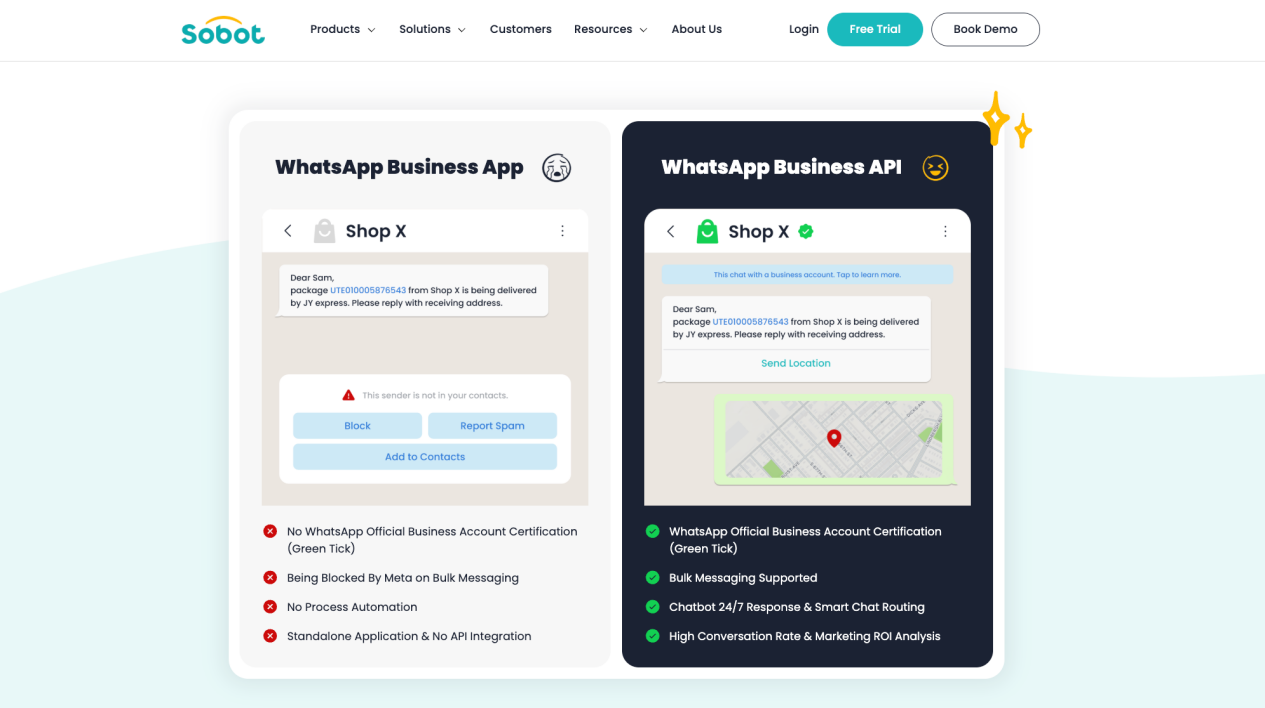
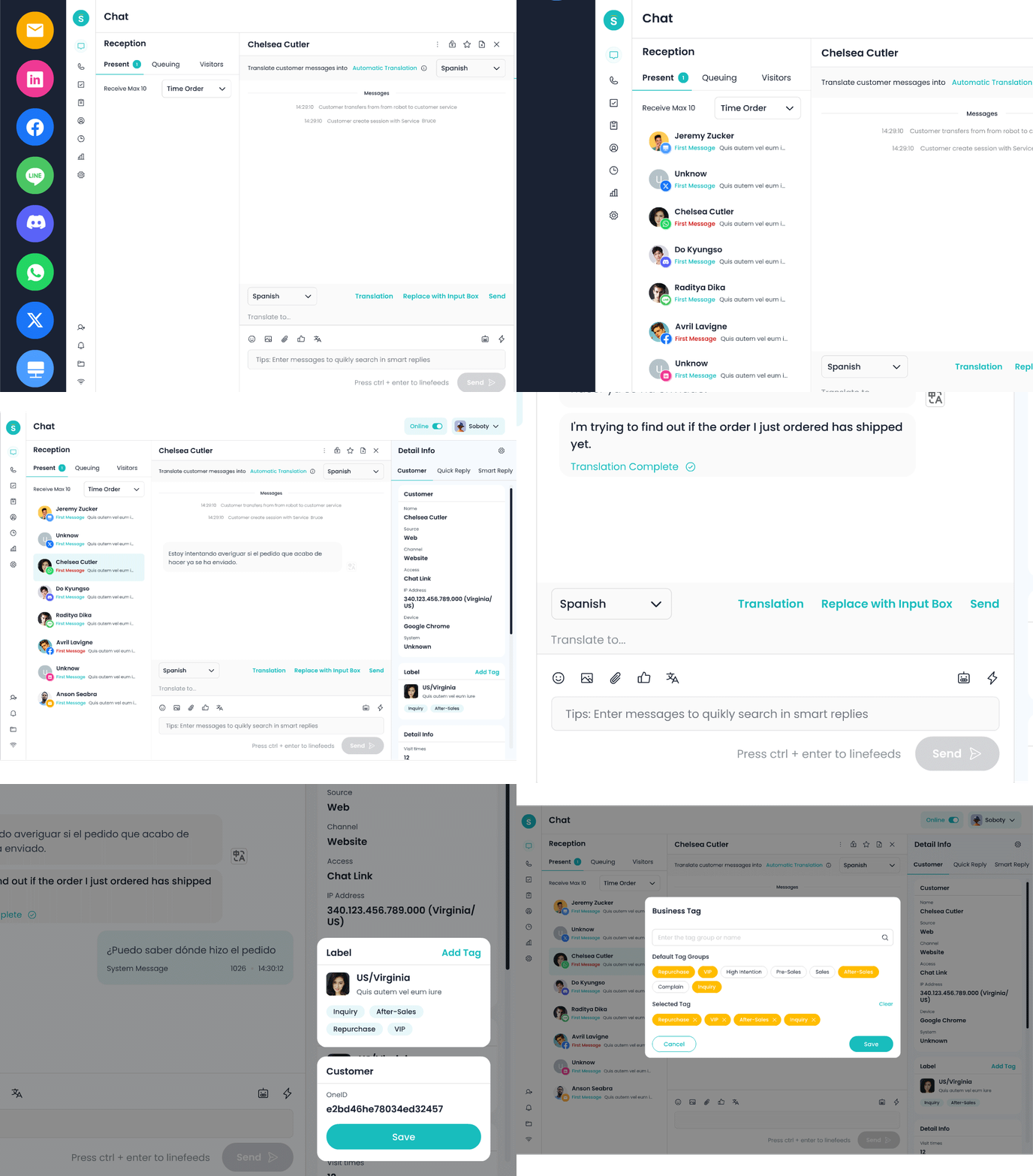
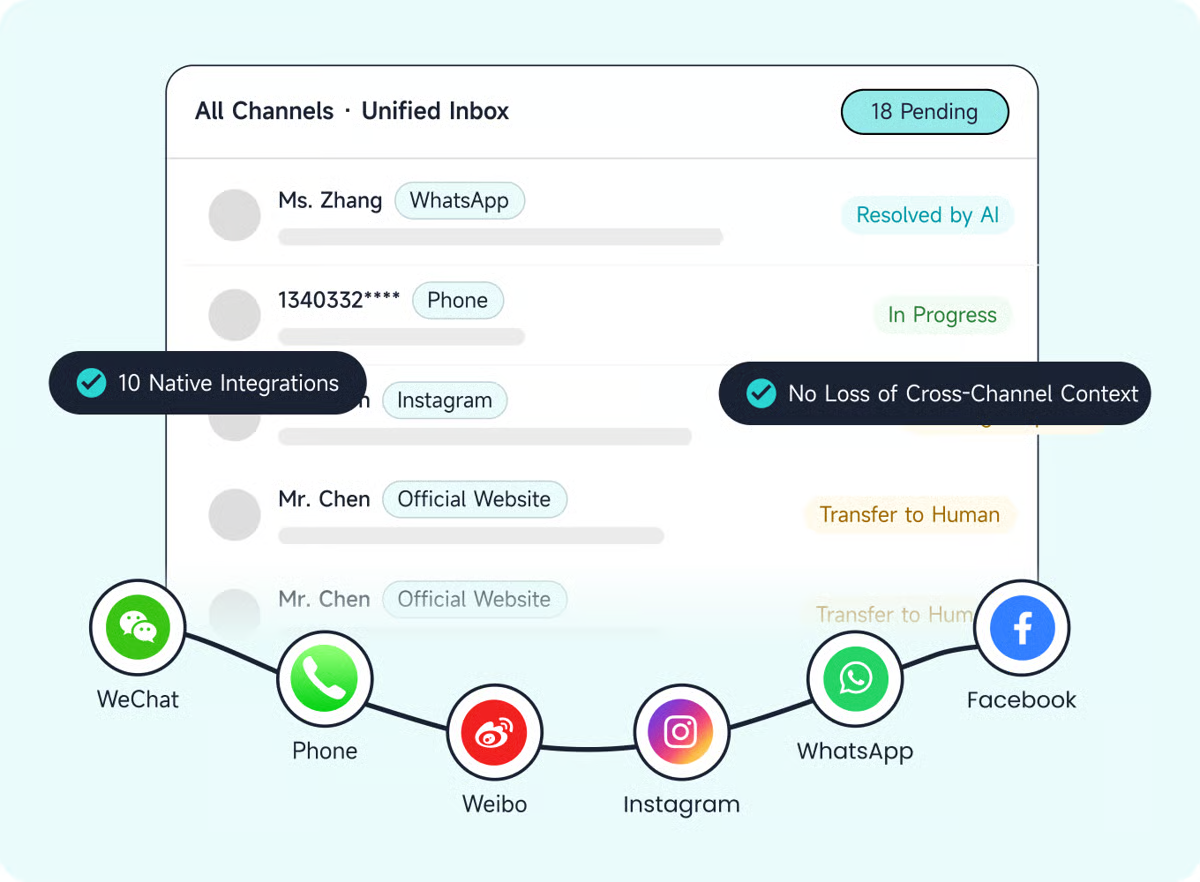
Sobot is The Agentic Customer Contact Platform. Sobot AI Agents handles customer conversations and permitted tasks; Nexus connects the channels, customer context and service infrastructure around them; Experts support deployment and ongoing improvement. This is a fit to explore when your customer might start on WhatsApp or web chat, call later, and need a ticket or a person to finish an exception. The wider omnichannel service environment includes digital service, voice and ticketing, while Sobot’s WhatsApp Business API solution covers that channel’s specific messaging workflow. The point is to evaluate one customer journey across those parts, not assume that buying one module activates every capability everywhere.
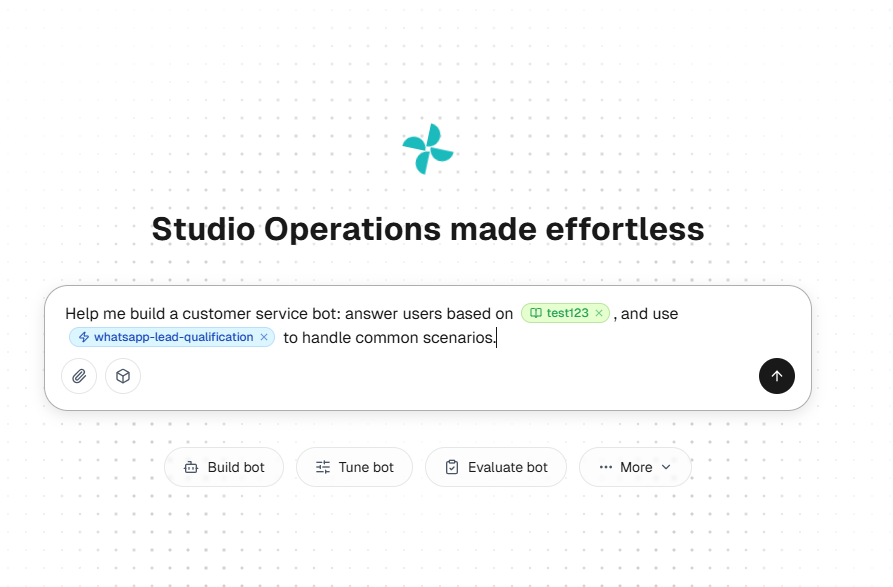
What sits behind the conversation? Sobot’s August product update describes a Resource Center for six reusable types of material: Knowledge for approved answers, Skills for business handling, Workflows for fixed steps, Tools for connected systems, Memory for permitted context and Variables for controlled task data. A natural-language setup path can assist with configuration. That is useful if several Agents need the same return policy or order-lookup capability: you can ask where the shared rule lives, who reviews it and how a change reaches the affected Agents. It does not mean a one-sentence request produces a production-ready deployment without review.
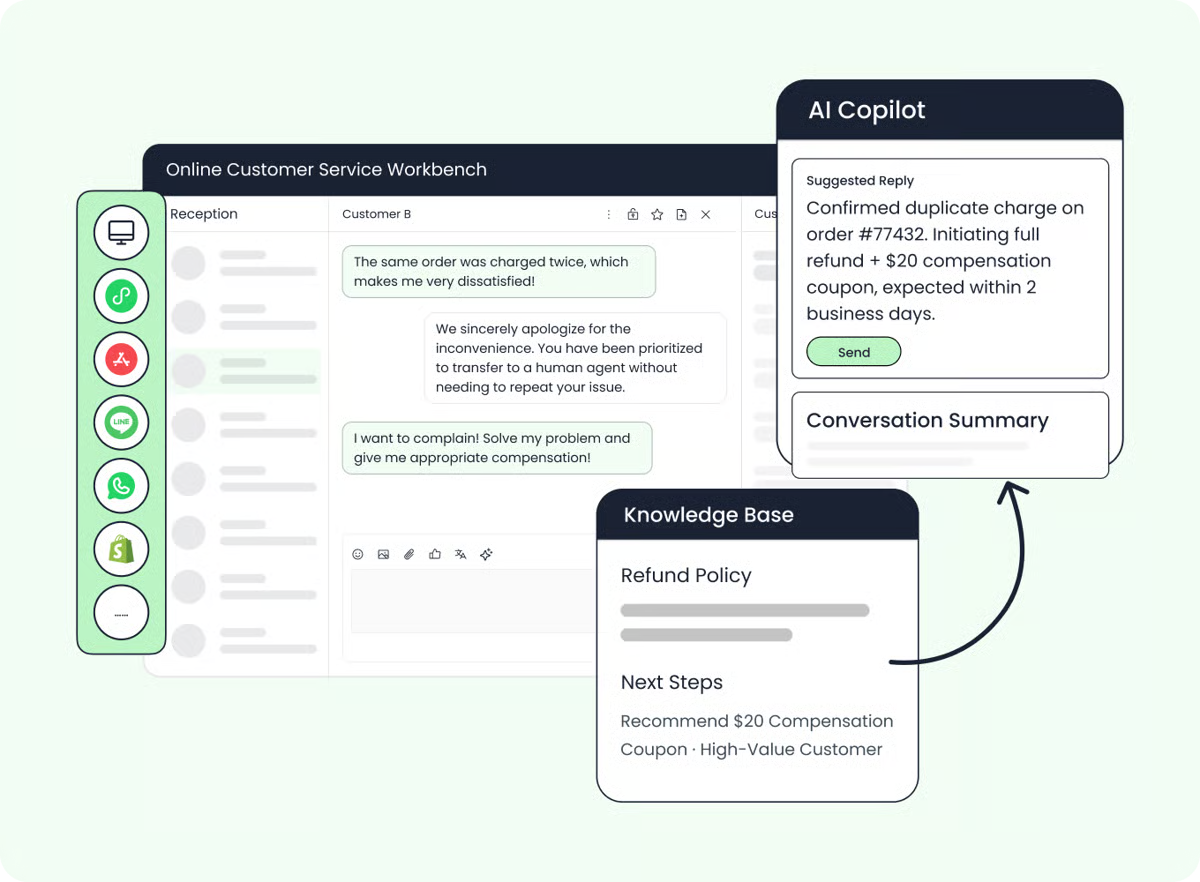
Here is the distinction we care about: an answer is not an action. Sobot AI Agents can use retrieval-augmented generation (RAG) to ground an answer and a reason-and-act process to call approved tools. Say a customer asks for an address change after an order has shipped. The Agent could retrieve the policy, check a connected order record and follow the configured eligibility rule. If identity cannot be established or the action is outside its permission, it should stop or hand the case to a person. Whether that exact action can run depends on your integration, authorization and workflow configuration. Ask to see the successful path, the denied path and the handoff—not just the answer.
If you are comparing omnichannel AI agents for customer service, check the whole journey rather than a single chat window. The Agent may have relevant conversation history available, but the exact fields and attempted actions passed between WhatsApp, voice, tickets and human workspaces need to be demonstrated in your setup. Here is a practical Sobot demo request: begin with an order question in a messaging channel; move the same customer to voice; make the requested change require approval; then let a human finish it. Show the context and action record at each transition. That is a proposed test scenario, not a claim that every configuration already supports this complete path.
The work continues after launch. The August update also describes an Evaluation Center with single- and multi-turn test datasets, criteria and plans, plus Data Center views that distinguish resource-based answers and Tool or Skill calls. Those details make a better question possible: did the Agent use the intended knowledge and action, or did it merely produce a convincing sentence? Sobot’s AI Studio can assist with diagnosis and tuning, but the update notes access and Agent-mode limits; confirm which functions are enabled for your deployment. Expert involvement also depends on the service scope you choose.
Finally, test localization at the level you will use it. Sobot’s product updates on multilingual content describe localization content management and an overseas conversation-translation change. They do not establish one universal language list for every Agent, voice mode and channel. Bring your launch languages, sample accents and actual service requests to the pilot.
Fin by Intercom: for adding AI around an existing helpdesk
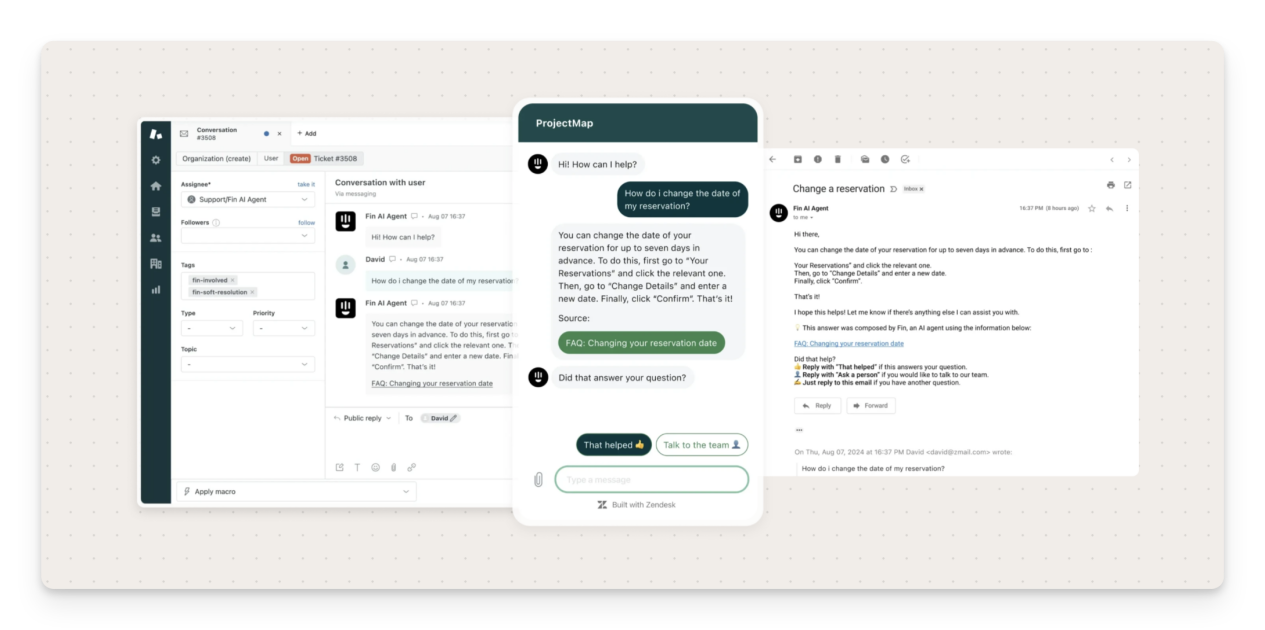
If replacing your helpdesk is off the table, Fin deserves a look. Intercom explains how Fin works with Intercom and supported external platforms, using support content and routing unresolved conversations to human teams. That can be a sensible path for a digital-first service operation that already knows where its customer records and human queues live.
The catch is in the details of your integration. Ask Fin to handle a real question, take an allowed action, fail safely and hand over. What fields, history and attempted steps does the human see? A polished standalone answer tells you less than that sequence. The same test is worth running across any phone or regional messaging channels you plan to use.
Zendesk AI Agents: for teams whose service desk is already Zendesk
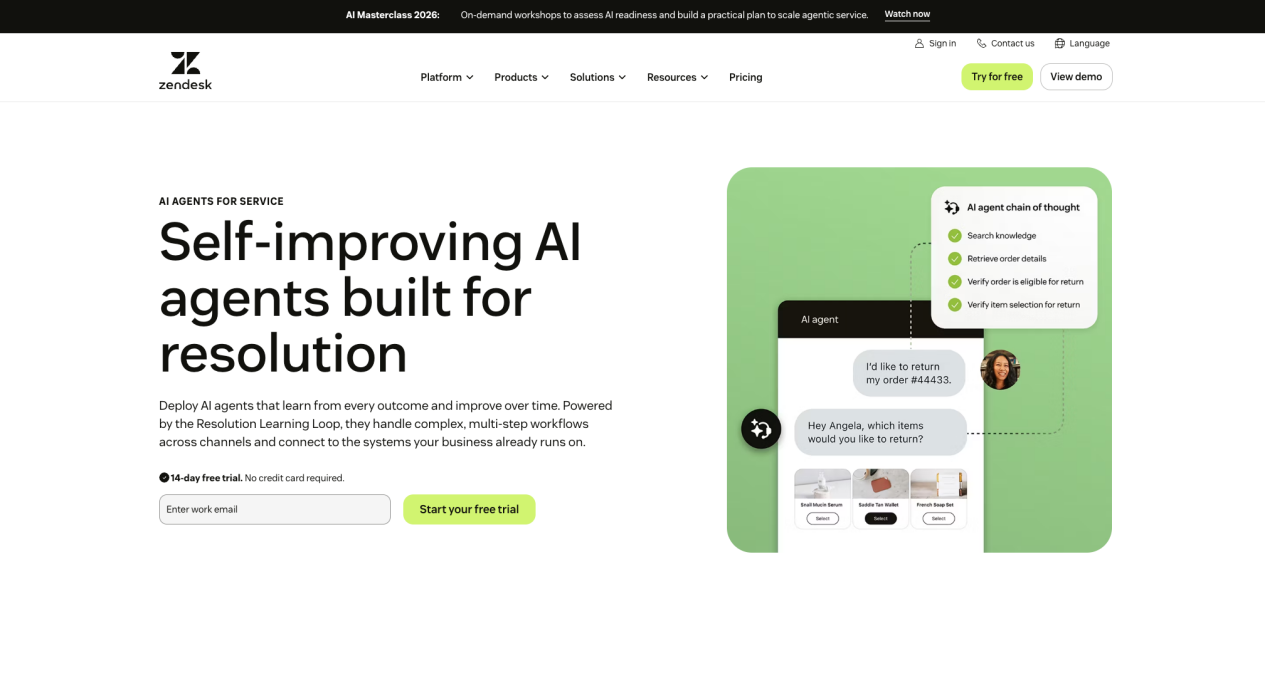
Zendesk describes AI agents that can reason through multi-step requests, call connected systems and be assessed with quality controls. If Zendesk already runs your ticket queues, knowledge and human workspace, that existing operating context is a strong reason to start there.
You still need to map the specific procedure. Can the agent check eligibility, update the correct record and stop at an approval gate? If the customer switches channels, does the next teammate see enough to continue? Avoid assuming that a broad platform claim means each action is live in every plan, region or channel.
Salesforce Agentforce: for CRM-centered service work
Salesforce’s Service Agent documentation describes an agent that can use Salesforce information to handle service tasks; Salesforce also frames Agentforce around its platform data and governed actions. That makes it a logical shortlist candidate when your cases, customer records, permissions and process automation already sit in Salesforce.
The question is less “can it use CRM data?” and more “which data and actions may it use here?” Walk through your real identity checks, approval rules and exception handling. If part of your support operation sits outside Salesforce, map that boundary as carefully as the happy path.
Freshdesk AI: for a Freshdesk-led support team
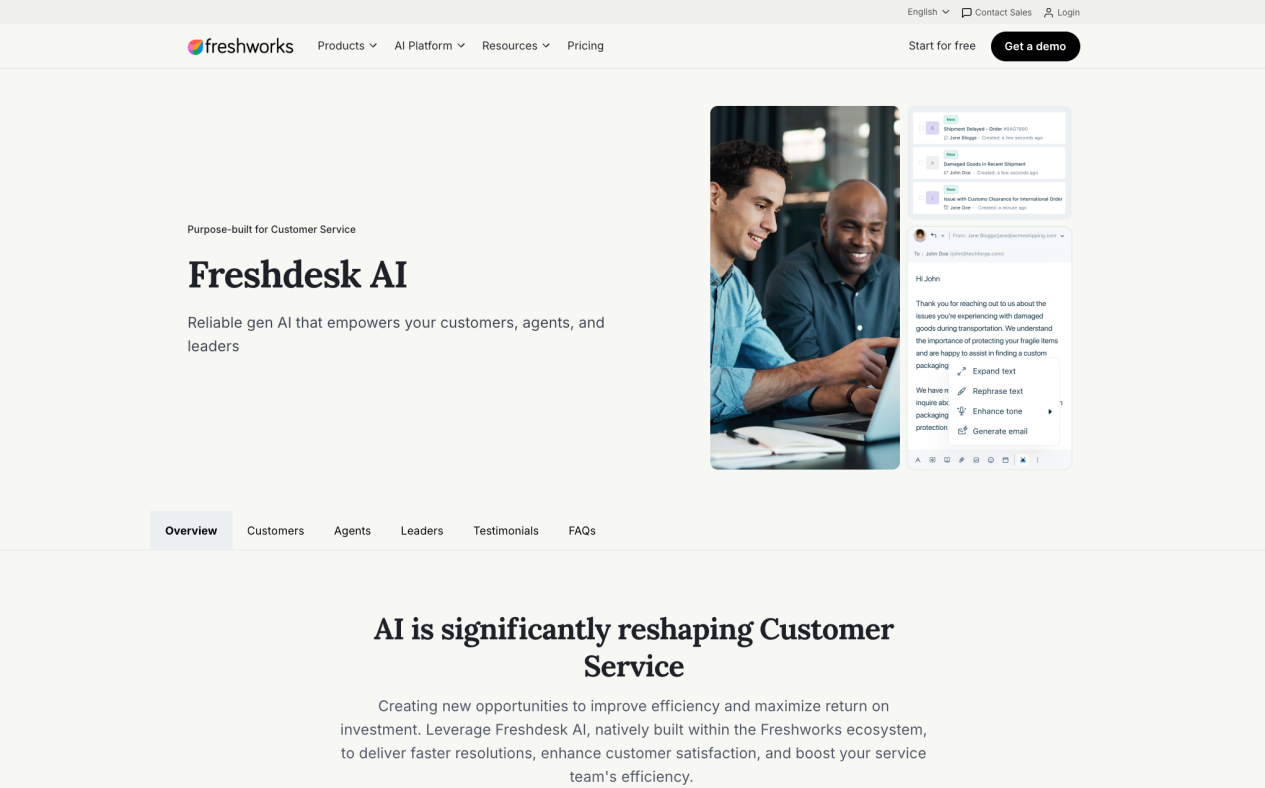
Freshworks describes Freshdesk AI as Freddy AI Agent for customer-facing service, Freddy AI Copilot for staff and Freddy Insights for operational analysis. That mix can appeal when you want to add automation without rebuilding a familiar helpdesk workflow.
Do not let those three products blur together in a demo. Ask which part answers the customer, which part only assists a person, how tickets are created or updated, and which features your package includes. Your pilot should also show how a complex case moves from the agent into the existing queue.
Gorgias AI Agent: for Shopify-centered commerce
Gorgias documents an AI Agent that uses store content, guidance and Shopify data to handle shopper questions and selected connected actions. If your support queue revolves around a Shopify catalog, orders and post-purchase requests, that specialization is a real buying reason.
It is a narrower reason if your operation spans multiple commerce systems or depends heavily on voice and non-store service workflows. Gorgias’s setup guidance says a connected Shopify store is required. Ask to see the precise return, order-change and escalation flow you need rather than treating “ecommerce AI” as one interchangeable category.
Botpress: for a team that wants to build the agent itself
Botpress belongs on the list when customization is the point. Its integration hub and human handoff documentation give teams ways to connect an agent to systems and a live support path. That flexibility can be useful when you have developers, a defined workflow and an owner for the finished service.
But a builder is a project, not a ready-made operating model. Who maintains the integrations when an API changes? Who reviews failed conversations and keeps knowledge current? If you need an existing voice, ticketing and agent-workspace operation, include that build-and-run work in your comparison.
The APAC test most shortlists skip
When you compare AI agent tools for customer service in Asia Pacific, a checkbox marked “multilingual” or “WhatsApp” is not enough. Ask a vendor to run one case from the country and channel that matter to you. Then change the language, introduce an ambiguous customer message and make the case cross into a human queue. Does the same action remain available? Does the agent recognize its limits? Can your team see what happened?
This matters whether you are sourcing AI agents for Southeast Asia customer support or buying from a US headquarters for APAC customers. Country availability, channel permissions, conversation translation, Agent language behavior and local operating requirements are different questions. A WhatsApp AI agent for customer service may be excellent at messaging and still leave your phone and ticket workflow elsewhere. Likewise, multilingual AI customer service agents should be tested in the actual languages, accents and service intents you support, not judged by a headline number.
IMDA’s Model AI Governance Framework for Agentic AI is a useful reference for bounding an agent’s access to tools and data, defining human approval points, and testing before and after deployment. It is guidance for responsible deployment, not a certification of any product on this list.
Five points where a customer journey can break
For AI agent tools for customer service in Asia Pacific, “supports this channel” is only the beginning of the test. We would ask every finalist to show what survives these five transitions. The table is a proposed buying exercise, not a score already earned by any vendor.
| Transition to test | Proof to request | Warning sign |
|---|---|---|
| Question → approved answer | Show the policy or knowledge item used for the reply, then ask an ambiguous version of the same question. | A fluent answer with no traceable source, or a different policy applied to the rephrased question. |
| Answer → system action | Show the identity check, allowed Tool or Workflow, confirmation from the connected system and what happens when permission is missing. | The Agent says “done” before the underlying record changes, or tries an action outside its authority. |
| Messaging → voice or ticket | Continue the same issue in a second channel and inspect the customer identifier, previous request and pending step. | The next channel starts a new case with none of the earlier context. |
| One language → another | Repeat the same task in two launch languages, including an exception and the human queue that will receive it. | The translated answer sounds fine, but the action, policy or escalation changes. |
| Agent → human | Inspect the handoff reason, conversation history, attempted actions, owner and next step in the human workspace. | The customer must repeat the problem or the teammate cannot tell what the Agent already tried. |
A practical pilot: one case, three endings
You do not need a universal numerical score to use this table. Mark each transition as shown, partly shown or not shown against your own case, then compare the gaps that would create work for your team. A vendor can have an excellent first answer and still fail the journey at the channel switch.
Choose a common request, such as “Where is my order?” Give the agent access only to approved knowledge and the permitted order lookup. First, see whether it can answer with the correct live status. Next, change the request: the customer wants an address update that needs an authorization check. Finally, make the order record unavailable or the customer ask for a person.
The best pilot shows what happens in all three cases: answer, permitted action and exception. A neat answer to the first case is nice; the exception tells you much more. Check the action log, the customer-facing explanation and what the human receives. An AI customer service agent human handoff is useful only if your teammate can pick up the work without asking the customer to start over. Intercom’s discussion of realistic AI agent proofs of concept makes a similar case for testing messy, multi-turn and multilingual interactions; it is one vendor’s perspective, but the test design is sound.
Also check the commercial model using the same workload for every finalist: customer conversations, successful outcomes, repeat contacts, human escalations, seats, channel charges and implementation work. For AI agent tools for customer service in Asia Pacific, those units are not interchangeable; ask for a scenario-based quote instead of putting unlike prices into one “cheapest” column.
Measure the work completed, not just the conversation closed
When comparing AI agent tools for customer service in Asia Pacific, do not let a “resolved” label end the conversation. It does not tell you whether an order status was correct, an address change persisted, or a human later repaired the case. For a short pilot, agree on the event that counts as completion before watching the demos.
| Measure | What to record in the pilot |
|---|---|
| Verified task completion | The requested action occurred in the connected system and the customer received the right confirmation. Record answer-only cases separately. |
| Safe stop | The Agent declined an unavailable or unauthorized action, explained the next step and avoided claiming the task was done. |
| Handoff with context | The human received the issue, relevant history, attempted actions and reason for escalation; note any information the customer had to repeat. |
| Repeat contact | The customer returned about the same unresolved issue within a time window your team defines. Count a later human fix separately from an Agent completion. |
| Results by language and channel | Run the same case in each launch language and channel, then compare completion, safe stops and handoffs rather than one blended rate. |
Which AI agent tools for customer service in Asia Pacific should you shortlist first?
Start with the system you cannot easily move. That is the simplest way to narrow AI agent tools for customer service in Asia Pacific without pretending every platform solves the same job. If Salesforce owns your service data, test Agentforce there. If Zendesk or Freshdesk is your daily workspace, test the AI inside that environment. If you want AI alongside a supported helpdesk, look at Fin. If your revenue and support process depend on Shopify, Gorgias belongs in the room. If your team intends to build and operate a custom agent, include Botpress.
And if your customers move between WhatsApp, other digital channels, voice, tickets and people across APAC, put Sobot AI Agents on the shortlist. That is where AI agent tools for cross-channel support need to prove more than a fluent response. The agent, the contact environment and the human team have to work as one service journey.
You may also hear Yellow.ai or SleekFlow mentioned in a regional shortlist. Consider them if their particular messaging or automation model fits your operation; use the same workflow, language and handoff test rather than assuming every APAC-focused tool solves the same job.
Frequently asked questions
Are AI agent tools for customer service the same as chatbots?
Not necessarily. A chatbot may answer from knowledge or follow a scripted path. An agent may also use approved tools to complete a task and observe the result. The label proves nothing by itself; ask for a live example with permissions, an exception and a handoff.
How do I compare APAC customer service AI agents when I serve several countries?
Use the same few service requests in each launch language and channel. Check region availability, business-system actions, translation behavior and what humans see after escalation. Do not infer Agent support from a platform-wide language claim.
What if I already have a helpdesk?
Test the agent inside or alongside that system before considering a migration. Your best option may be the one that preserves your working queues, knowledge and customer context while adding the actions you actually need.
The right answer is the workflow you can prove
The best AI agent tools for customer service in Asia Pacific are the ones that fit your service stack and complete your work without hiding failure behind a nice conversation. Start with a shortlist, then ask every finalist to show the same customer journey: grounded answer, permitted action and a human who can take over with context. If your journey spans APAC messaging, digital service and voice, book a Sobot demo and bring one real request, its required languages and your handoff rules. We can test the fit together.
For a wider global category view, see our 11-option AI agent tools comparison. If your decision is specifically about Singapore, use our Singapore AI agent shortlist. For deeper technology and outcome questions, explore the AI agent platform comparison; for a broader software purchase, start with the AI customer service software guide.