Short answer: if your search is AI customer service agent tools Singapore, your 2026 shortlist should include Sobot, Ada, Freshworks, Intercom, Salesforce, SleekFlow, Zendesk, and Yellow.ai. There is no honest universal winner. The right choice depends on what you need the agent to resolve, which systems it must use, where your customers contact you, and when a human needs to take over.
This is a shortlist, not a podium. We have grouped the tools by the job they fit best, then looked at action depth, knowledge grounding, integrations, channels, handoff, governance, evaluation, deployment, and pricing visibility. That is much more useful than counting how many times a product page says “AI.”
Why is this decision getting urgent? In a January 2026 survey of 6,500 service professionals, including 100 in Singapore, local respondents estimated that AI currently handles 30% of their service cases and expected that figure to reach 41% by 2027. At the same time, 49% of Singapore service leaders said security concerns had delayed or limited AI initiatives. Those are survey expectations, not a guarantee of what your team will achieve, but they capture the tension rather well: move faster, but do it safely.
The AI Customer Service Agent Tools Singapore Teams Should Shortlist
If you are searching for the best AI customer service agent tools Singapore 2026, start with fit rather than rank. Here is the quick answer.
| Tool | Best fit | What stands out | Pricing visibility | Main question to ask |
|---|---|---|---|---|
| Sobot Agents | APAC customer contact across channels, business workflows and controlled handoff | Agents + Nexus + Experts, RAG + ReAct, reusable resources, evaluation and human handoff | Custom pricing | Which channels, systems, permissions and evaluation requirements belong in the pilot? |
| Ada | High-volume enterprise digital service | Omnichannel AI agent layer, enterprise workflows, APIs and safety controls | Custom quote | How much configuration and external help-desk work will your rollout require? |
| Freshworks / Freddy AI | Teams that want AI inside a help-desk-centred operation | AI Agent, agent assistance, ticketing and service workflows in the Freshworks environment | Public plans; AI usage and entitlements vary | Which AI sessions, channels and actions are included in your plan? |
| Intercom Fin | Digital-first and SaaS support | AI-first customer conversations, procedures, actions and human support through Intercom or supported help desks | Public outcome-based pricing; platform choices affect total cost | What counts as a billable outcome, and how are escalations treated? |
| Salesforce Agentforce Service | Organisations already centred on Salesforce | Customer and service data, flows, actions and CRM-native orchestration | Consumption or conversation-based options; broader Salesforce costs apply | Is your data and process design ready for Agentforce actions? |
| SleekFlow | WhatsApp and social-commerce-led teams | Messaging, AI workflows, CRM connections and human takeover | Tiered plans plus AI, channel and Meta-related usage considerations | Do you need a messaging-first layer or a full service and voice environment? |
| Zendesk AI agents | Teams already running service on Zendesk | AI agents within a mature service, ticketing, routing, QA and reporting environment | Plans plus resolution-based AI usage | What is included, what is a chargeable resolution, and what changes in your current Zendesk setup? |
| Yellow.ai | Enterprise chat, messaging, email and voice automation | Conversational and agentic workflows across multiple customer-contact channels | Custom quote | How much implementation, language testing and governance work is required for your use cases? |
You may notice that this is not a conventional “top eight” ranking. Good! A messaging-led retail team and a Salesforce-heavy enterprise are not buying the same thing, even if both search for AI customer service agent tools Singapore.
What Actually Qualifies as an AI Customer Service Agent?
A chatbot can answer a question. An agent should be able to work towards a goal.
In practical terms, that means the system can understand a request, retrieve the right business information, decide on a permitted next step, call a tool or workflow, observe the result, and either continue or hand the case to a person. If your “agent” can only paste an FAQ answer, you are still evaluating conversational self-service—not end-to-end resolution.
Search language is messy, of course. Someone may type AI customer service platforms Singapore in the morning and Singapore conversational AI customer support in the afternoon. The real job is usually the same: find a platform that can handle useful work without creating a new customer-experience or governance problem.
The search phrase AI customer service agent tools Singapore is therefore a buying shortcut, not a perfectly defined product category. Your comparison boundary still has to reflect the work you need done.
This is also why agentic AI customer service needs tighter controls than a simple knowledge bot. Singapore’s Infocomm Media Development Authority says agentic systems can reason and take actions, potentially accessing sensitive data or changing an environment such as a customer database or payment system. Its Model AI Governance Framework for Agentic AI focuses on bounding risk, limiting autonomy and access, maintaining meaningful human accountability, and applying technical controls. In other words, the ability to act is useful precisely because it is bounded.
If you want a deeper category explanation before comparing products, our guide to the difference between an AI agent and a chatbot covers the fundamentals without treating the two terms as synonyms.
How We Built This AI Customer Service Agent Comparison 2026
This AI customer service agent comparison 2026 focuses on eight credible buying paths rather than pretending to test every vendor in every possible stack. We looked for five things.
For products appearing under the search phrase AI customer service agent tools Singapore, a recognisable brand was not enough on its own; each option needed a clear operational reason to make the shortlist.
- A real customer-service job. The product must be designed for external or internal service interactions, not generic task automation alone.
- More than answer generation. We looked for documented workflows, actions, integrations, routing or human escalation.
- A clear best-fit condition. Every tool needs a reason to be on your shortlist beyond brand fame.
- Enough public information to ask intelligent questions. Product scope, deployment model, pricing status and limitations should be discussable, even when the final price requires a quote.
- Relevance to Singapore operations. That includes governance, channel mix, regional delivery, language testing, data handling and human accountability—not merely putting “Singapore” in a headline.
We have not deployed all eight products inside your CRM, order system and contact centre. Frankly, no article can reproduce your permissions, knowledge quality, escalation rules or peak volumes. Treat this guide as a shortlist builder, then test your finalists on the same real workflow.
A search such as Zendesk Intercom Salesforce Freshworks AI customer service comparison usually means you already recognise the default enterprise brands. That is a sensible starting point, but it can hide other buying paths: a dedicated AI layer, a messaging-first tool, or an agentic customer-contact platform that spans more of the operating environment.
Eight Tools, Eight Different Reasons to Shortlist Them
1. Sobot Agents: Best for APAC Agentic Customer Contact Across Workflows and Channels
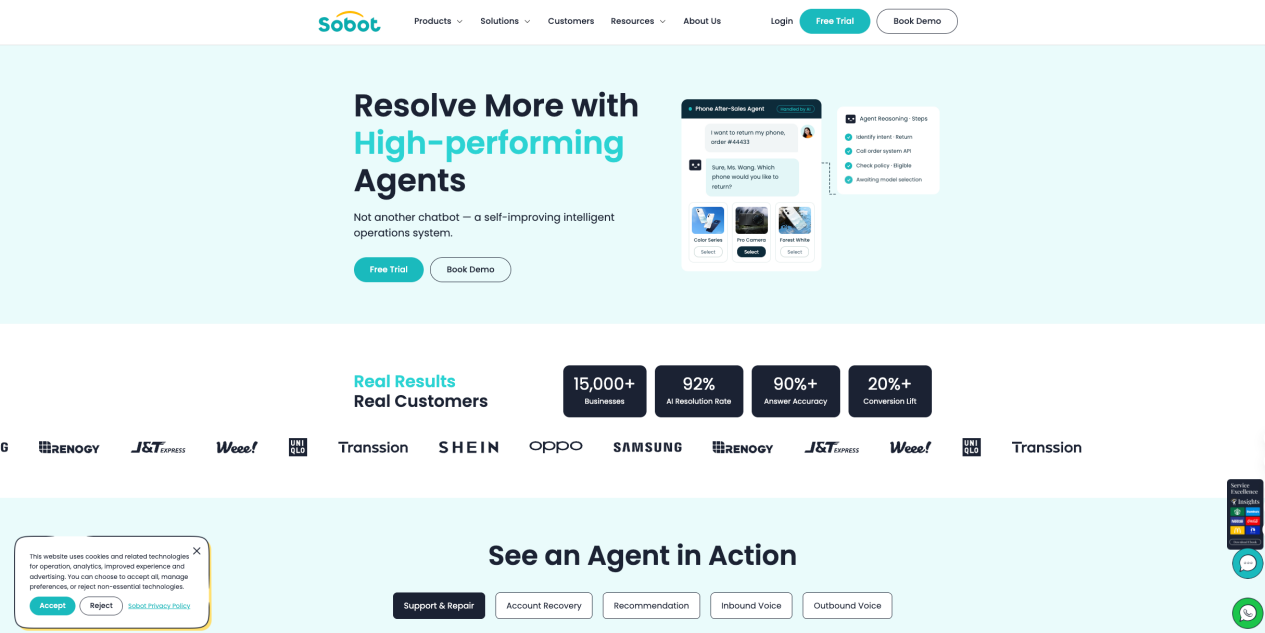
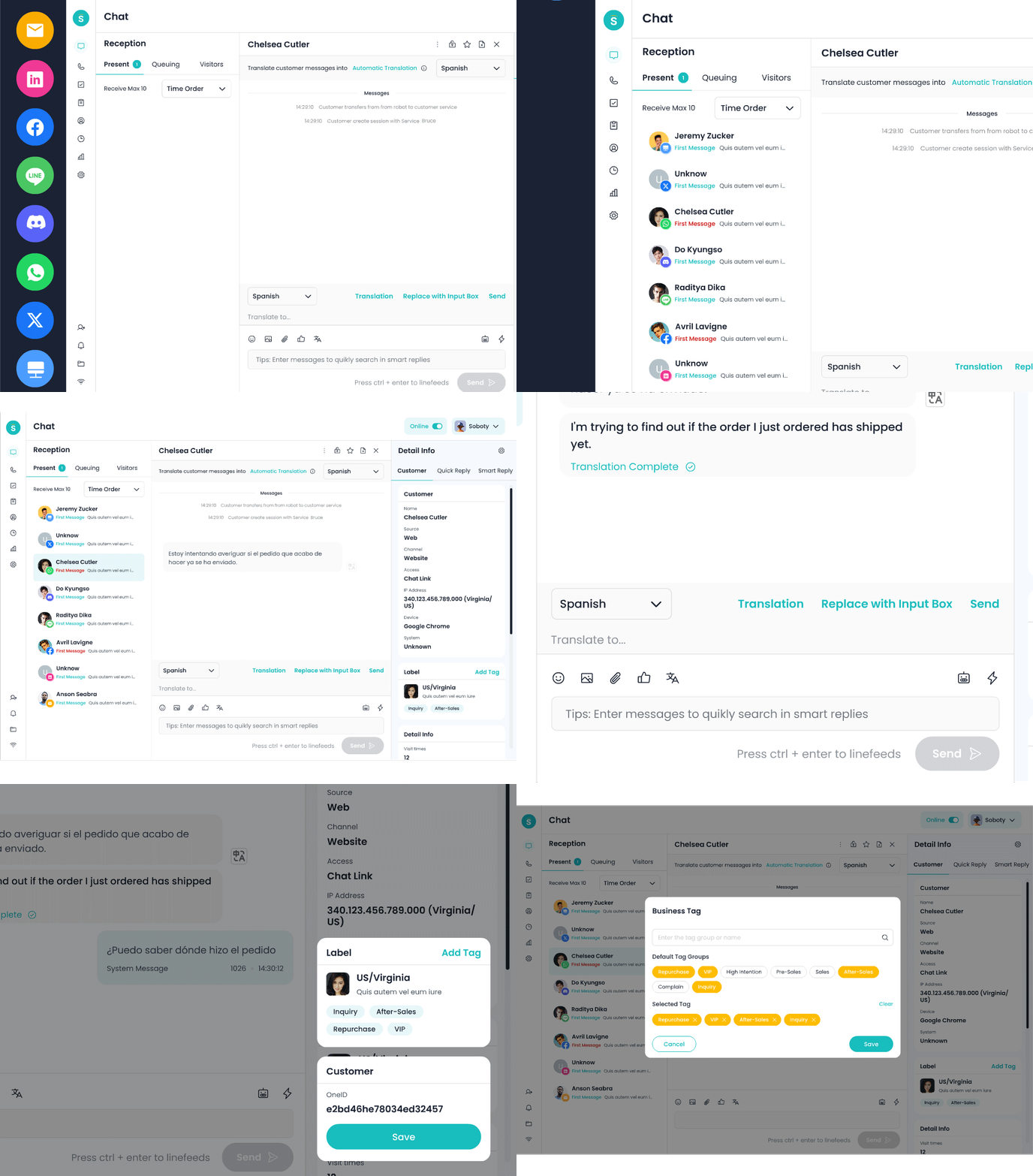
Sobot is positioned as The Agentic Customer Contact Platform. The platform brings together Agents, Nexus and Experts: Agents handle interactions and execute permitted workflows; Nexus connects channels, data, context and customer-contact infrastructure; Experts support deployment, operation and ongoing optimisation.
Sobot Agents combines RAG for grounded retrieval with ReAct for reasoning and action. Its Resource Center manages Knowledge, Skills, Workflows, Tools, Memory and Variables, while the Evaluation Center, Data Center and AI Analyst support a managed Build → Evaluate → Tune → Observe loop. For a service team, the practical value is not the acronym. It is the ability to move from “Here is our refund policy” towards “Let me check the order, apply the permitted rule, take the approved next step, and involve a person if the case falls outside the boundary.”
Sobot is especially relevant when you need AI customer service workflow automation across digital service, voice, tickets, messaging and human-agent operations. The omnichannel customer-contact environment provides a broader operating context than an isolated chatbot, while Sobot developer resources help technical teams examine APIs and system connections.
There are limits you should know. Sobot Agents uses custom pricing, and a public plan table is not currently available. Production actions depend on configured integrations, permissions, authentication, business rules and escalation controls. Exact connector depth, module-level language coverage, data requirements and package limits should be confirmed for your deployment. We would rather say that plainly than promise magic.
2. Ada: Best for a Dedicated Enterprise AI Agent Layer
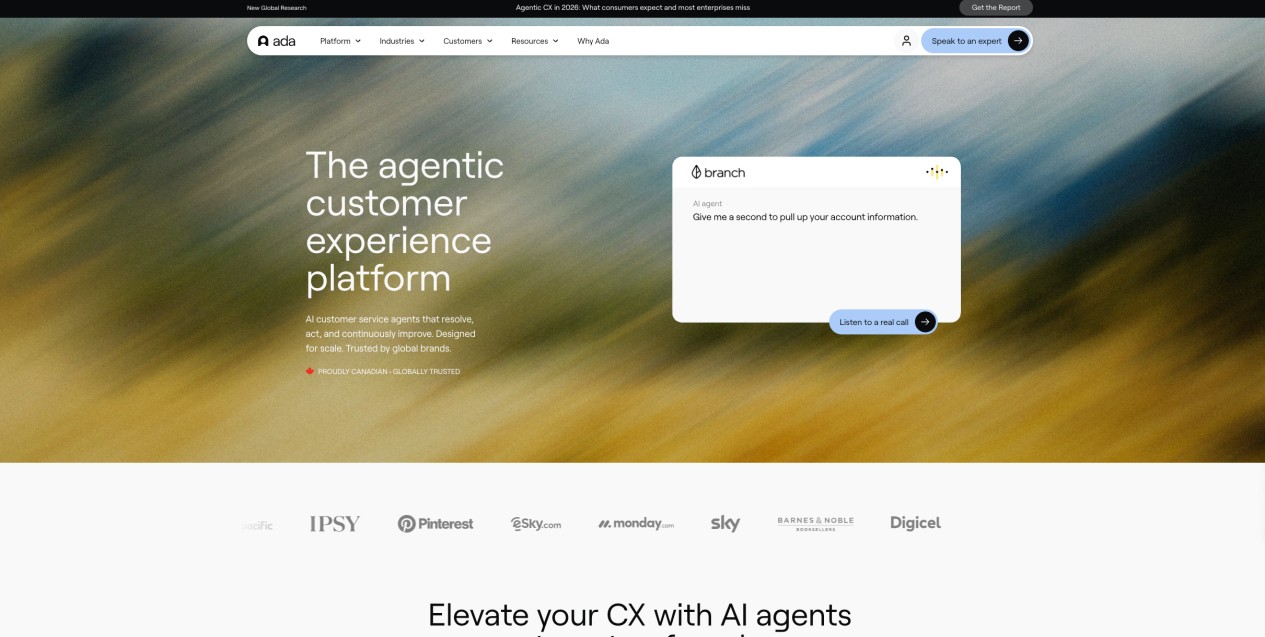
Ada makes the most sense when you want an enterprise AI agent to sit across customer-service channels and connect to an existing technology stack. Ada presents its platform around channel continuity, multilingual service, enterprise workflows, APIs and SDKs, along with safety and accuracy controls.
That positioning is useful for high-volume teams that already have a help desk but want a specialised automation layer. The trade-off is equally important: you still need to map data access, workflow ownership, escalation and reporting across systems. Ada does not publish simple self-serve pricing on its main site, so budget qualification starts in a sales conversation.
Shortlist Ada if you have a mature service operation and the resources to govern a specialised AI layer. If you mainly need a basic chat widget or a public entry price, it is probably more platform than you need.
3. Freshworks: Best for Help-Desk-Centred AI Adoption
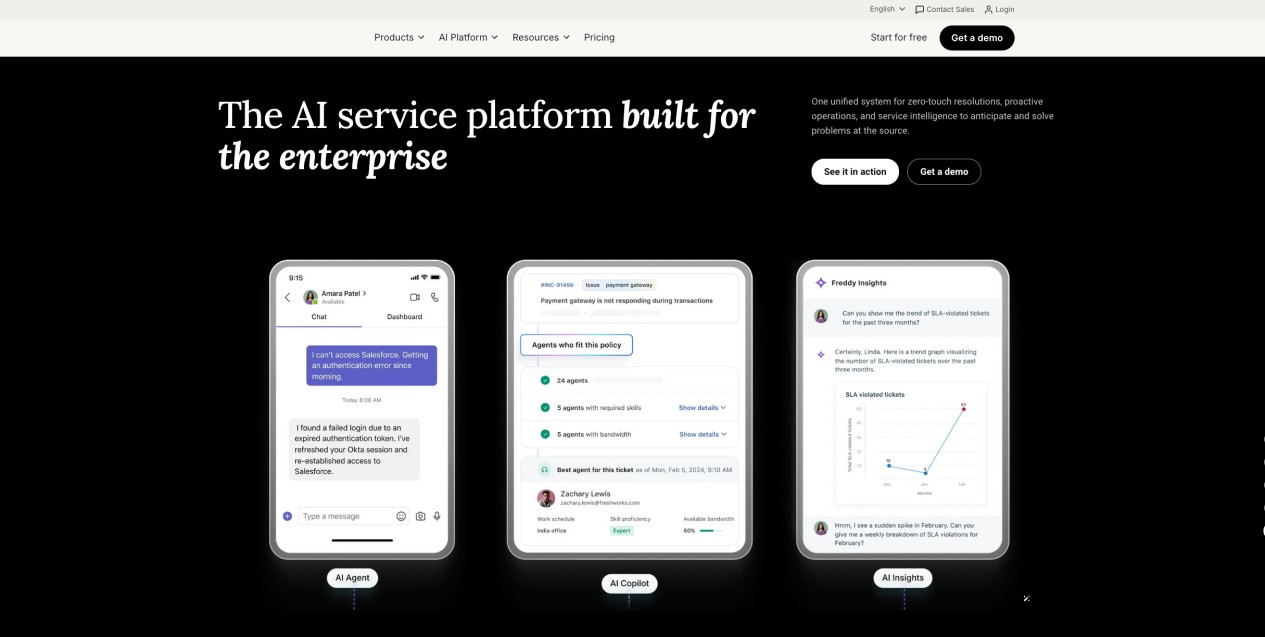
Freshworks is a practical candidate when ticketing and service-desk workflows sit at the centre of your operation. Freshdesk’s AI offering combines customer-facing Freddy AI Agent capabilities with assistance for human agents and the surrounding Freshdesk environment.
The appeal is straightforward: you can introduce AI without designing a separate customer-service architecture from scratch. That can suit growing support teams that want a familiar help-desk operating model. Still, do not stop at the product demo. Ask which channels the AI Agent covers, how sessions are counted, what actions it can perform, and which features require a higher plan or additional usage.
For AI customer service tools for Singapore businesses that already think in tickets, queues and SLAs, Freshworks deserves a look. For voice-heavy or deeply customised cross-system workflows, confirm the required products and implementation scope before assuming one plan covers everything.
4. Intercom Fin: Best for Digital-First Customer Conversations
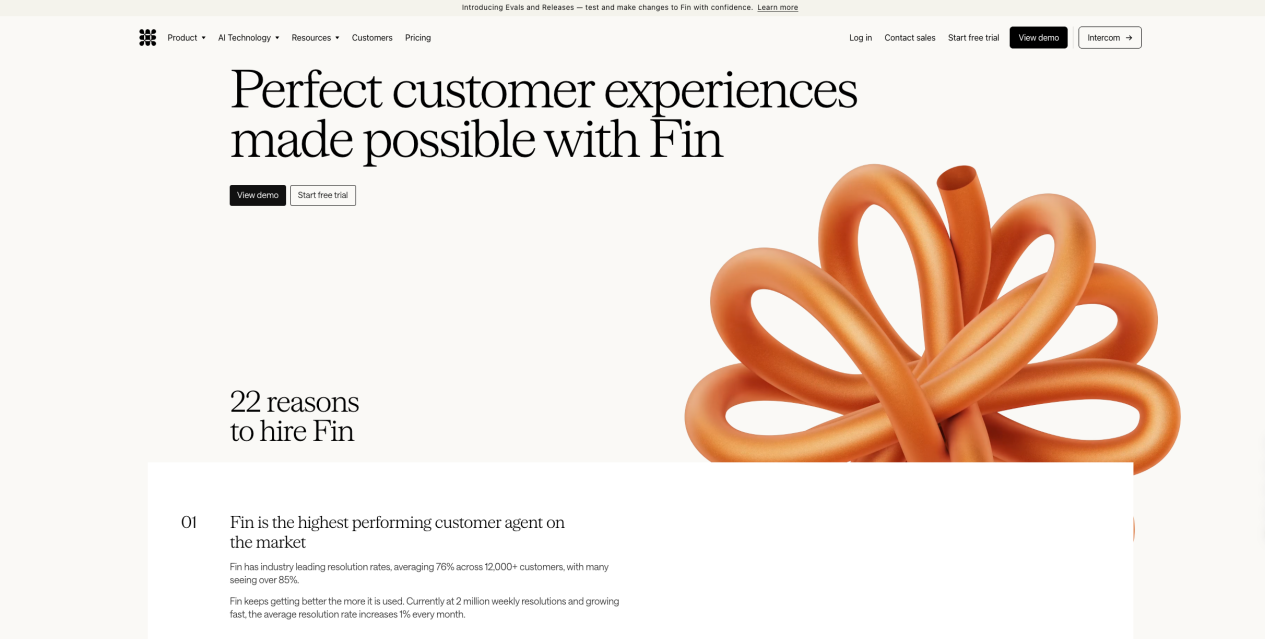
Fin is a strong fit for SaaS and digital businesses that want an AI-first support experience. Intercom positions Fin around answering questions, following procedures, taking actions and handing work to human support. It can be paired with Intercom’s own help desk and supported external help desks, which gives teams more than one adoption path.
Intercom also publishes an outcome-based pricing model. That sounds refreshingly simple, but you still need to ask what qualifies as an outcome, how repeat contacts are treated, and which help-desk, channel or teammate costs sit outside the AI fee. “Pay for results” only helps when your definition of a result matches the contract.
Fin belongs on the shortlist when most service begins in digital conversation and you value a polished AI-to-human flow. If phone operations, complex regional delivery or broad contact-centre infrastructure dominate your requirements, test that wider operating model rather than judging Fin from chat performance alone.
5. Salesforce Agentforce Service: Best for Salesforce-Native Operations
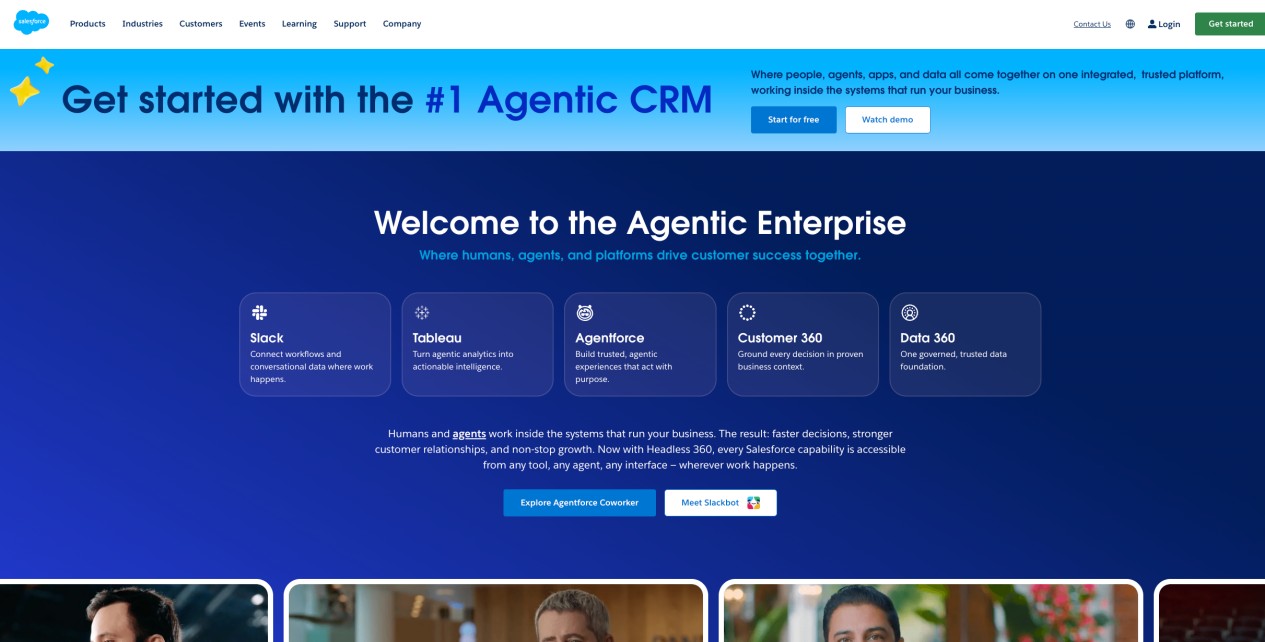
If customer, account and service processes already live in Salesforce, Agentforce for Service is an obvious candidate. Its advantage is not simply that it has an AI agent. The agent can work within Salesforce’s data, service and automation environment, using configured actions and flows rather than depending on a disconnected bot.
That closeness to your CRM can reduce context switching, but it raises the stakes for data architecture and permissions. Which objects can the agent read? Which actions can it take? Where is approval required? What happens when customer data is incomplete or conflicting? Those questions belong in solution design, not at the end of procurement.
Agentforce is most compelling for organisations already committed to Salesforce and prepared for a platform-level rollout. It is less naturally suited to a team that wants a standalone support tool without the broader Salesforce footprint.
6. SleekFlow: Best for WhatsApp and Social-Commerce-Led Service
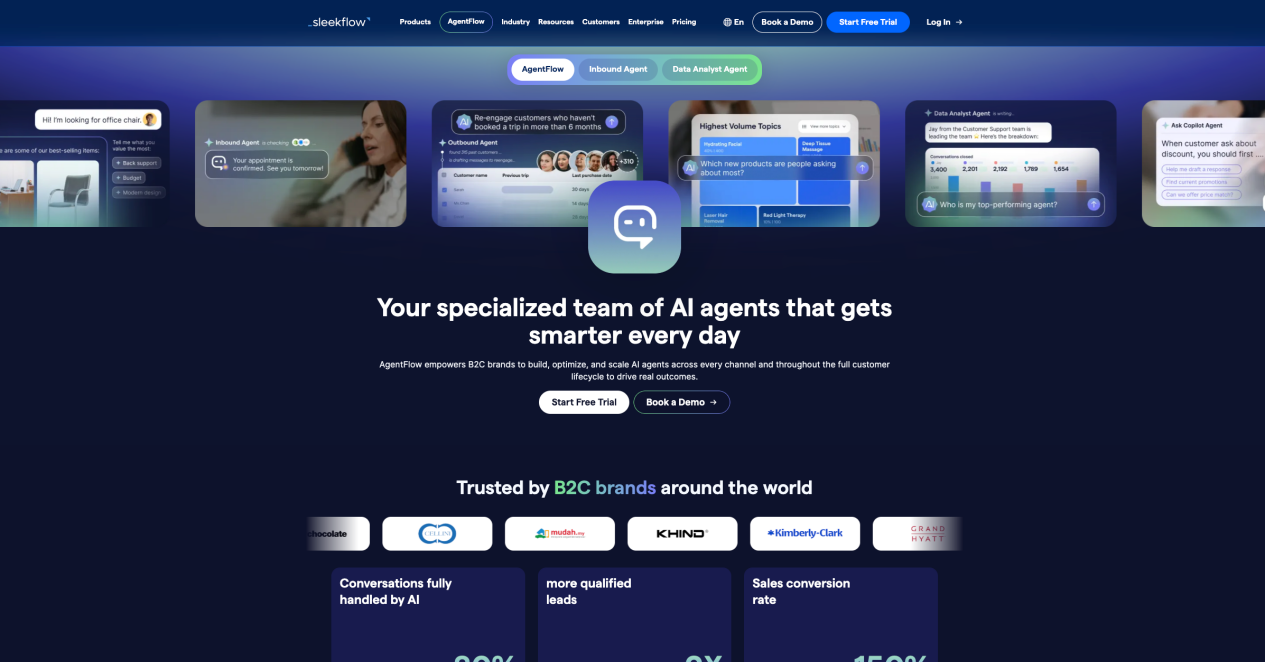
SleekFlow earns its place because customer service in Singapore often happens inside messaging channels, not only in a help-desk portal. Its Singapore offering centres on WhatsApp and social messaging, with AI workflows, CRM connections and human takeover. Its guide to AI customer service on WhatsApp also makes the operating requirement clear: define what the AI handles and when it transfers to a person.
This is attractive for retail, commerce and sales-service journeys that begin on WhatsApp or social channels. Yet a messaging-first strength should not be confused with every contact-centre capability. Check ticket lifecycle, voice, quality management, data controls and cross-channel reporting if those matter to you.
SleekFlow is a focused answer to a common regional problem. Just remember that Meta-related charges, messaging rules, AI usage and platform subscription can create separate cost lines.
7. Zendesk AI Agents: Best for Existing Zendesk Service Teams
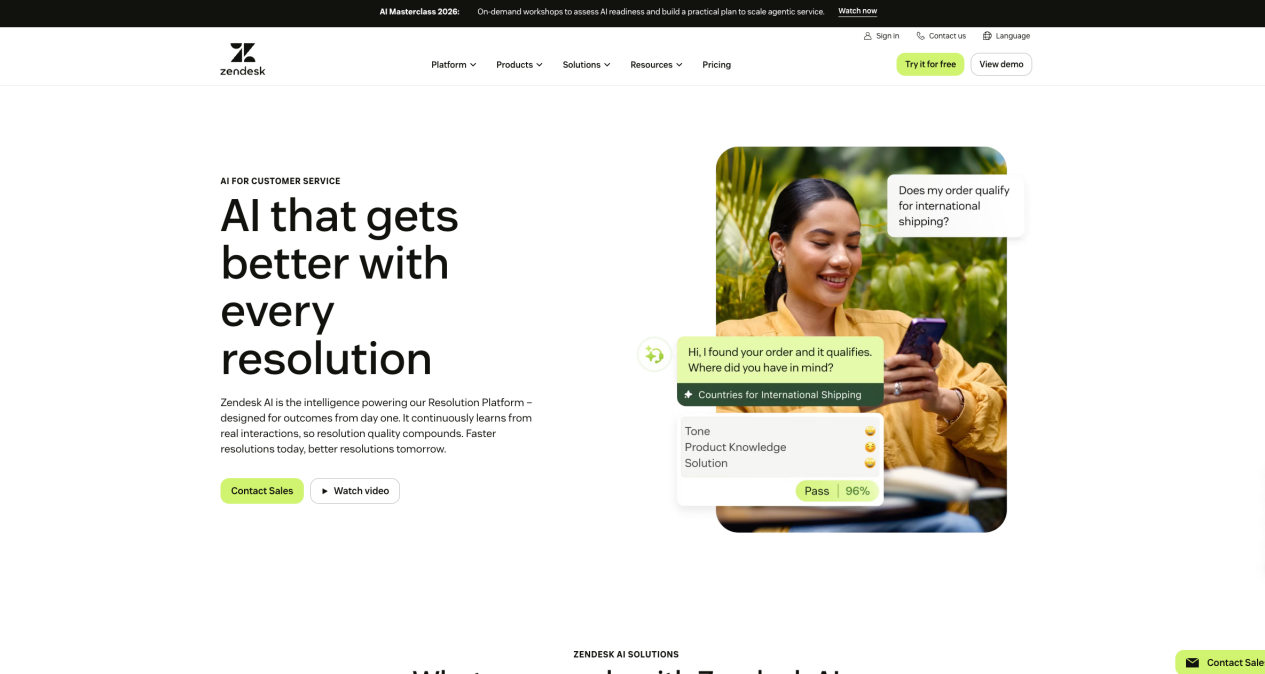
Zendesk is a natural shortlist choice for teams already running support, tickets, routing and reporting in its service environment. Its Singapore AI service pages describe AI agents, hybrid flows, actions, quality assurance and analytics within the broader Zendesk platform.
The benefit is operational continuity. You are adding agentic capabilities to a service stack your team may already understand. The risk is assuming that familiarity makes the business case automatic. Ask how automated resolutions are defined and billed, what your plan includes, how Actions connect to business systems, and what happens when the AI escalates rather than resolves.
Zendesk’s own listicles make ambitious performance claims. Treat those as vendor claims, not a result your deployment inherits. Your pilot should measure the exact intents, channels and policies you expect to automate.
8. Yellow.ai: Best for Enterprise Conversational and Voice Automation
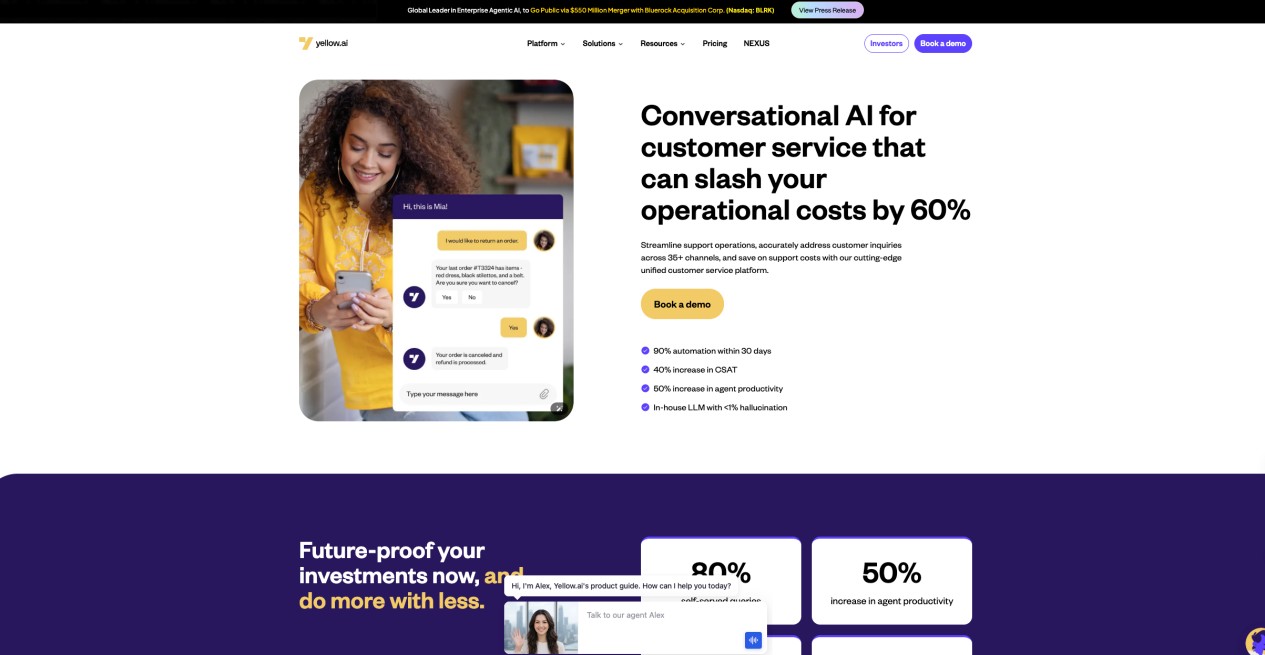
Yellow.ai is worth evaluating when your customer-contact mix spans chat, messaging, email and voice. Its customer-service automation platform emphasises goal-based conversations, end-to-end workflows, agent assistance and operational metrics across enterprise service environments.
That breadth can suit larger organisations with multiple regions and complex service journeys. It also means the implementation deserves careful scoping. Test language quality on your real terminology, not a generic demo. Confirm how actions are governed, how channels share context, how human teams receive escalations, and which analytics describe actual goal completion rather than simple deflection.
Yellow.ai uses a sales-led buying path. It belongs on an enterprise shortlist when conversational and voice automation are both strategic, but smaller teams should weigh the implementation commitment against a narrower help-desk or messaging option.
AI Customer Service Governance Singapore Teams Cannot Treat as a Checkbox
The phrase AI customer service governance Singapore may sound like procurement jargon. In practice, it answers a very human question: what stops the agent from doing the wrong thing with the right data?
Any shortlist built around AI customer service agent tools Singapore needs this governance layer, because a system that can take action creates a different risk profile from one that only drafts an answer.
Use the PDPC’s overview of Singapore’s approach to AI governance and the IMDA agentic framework as starting points, then turn principles into product questions:
- What data can the agent retrieve, retain and expose?
- Which tools and actions can it use, under whose identity and permissions?
- Which actions require confirmation, identity checks or human approval?
- Can your team trace the knowledge, rule, tool call and result behind an outcome?
- How do you test new workflows before production and monitor them afterwards?
- Who owns a failure when automation, policy and human judgment overlap?
Customers care about this too. Marketing-Interactive’s report on Qualtrics’ 2026 consumer research says 68% of Singapore consumers believed AI would have a positive social impact, but only 40% trusted organisations to use it responsibly. It also reported that 55% worried about losing human connection and 58% about personal-data misuse. Those figures come from a secondary account of the study, so treat them as directional. Still, the message is hard to miss: fast service does not compensate for opaque or frustrating service. See the Singapore findings reported by Marketing-Interactive.
AI Customer Service Agent Integrations: Test the Action, Not the Logo
An integrations page full of CRM logos can look reassuring. It tells you almost nothing about whether an agent can complete your workflow.
Good AI customer service agent integrations need more than a data lookup. Imagine an address-change request. The agent may need to authenticate the customer, retrieve the order, check whether fulfilment has started, apply a policy, update the order, record the change, notify the customer and escalate an exception. One “integration” might support only the lookup; another might support the complete sequence.
For each critical workflow, ask four questions:
- Can the agent read the required data?
- Can it write or trigger the required action?
- How are permissions, validation and failure states controlled?
- What context reaches the person when the workflow cannot finish?
This is where an omnichannel AI customer service platform should prove more than channel presence. It should preserve enough identity, conversation and business context for the journey to continue without making the customer start again.
AI Customer Service Human Handoff Is Part of the Product
You know the experience: a bot loops through the same answer, hides the human option, then drops the conversation when you finally reach an agent. That is not successful automation.
Strong AI customer service human handoff has a clear trigger, an appropriate destination and useful context. The human should understand why the transfer happened, what the customer already said, which checks ran, and which action failed or needs approval. Sensitive, emotional and policy-exception cases may deserve early escalation even when the AI could keep talking.
Do not judge handoff from a “Talk to an agent” button. Test queue routing, operating hours, identity continuity, conversation history, system context and what happens after the human closes the case.
AI Customer Service Agent Pricing: Compare the Unit, Not the Headline
Comparing AI customer service agent pricing is surprisingly slippery. A low unit price can become expensive when the unit is a session rather than a resolved outcome—or when the AI fee excludes the help desk, seats, channels, telephony, models, implementation and integrations.
| Pricing model | What you pay for | What to clarify |
|---|---|---|
| Per seat | Human or admin access | Are AI usage and channels separate? |
| Per conversation or session | An interaction window | Do failed or escalated contacts still count? |
| Per outcome or resolution | A vendor-defined successful result | Who defines and audits success? What about repeat contact? |
| Per action or credit | Tool calls or units of work | How many actions does one customer task consume? |
| Custom platform contract | Negotiated capacity and scope | What are the minimums, implementation fees, overages and renewal terms? |
Build a small cost model using your real volume and expected escalation rate. Then include implementation, knowledge preparation, testing, telephony or messaging fees, ongoing optimisation and internal ownership. Sobot uses custom pricing, for example, so the sensible next step is a scoped workflow discussion—not an invented like-for-like price comparison.
That is the only fair way to compare a shortlist built around AI customer service agent tools Singapore across teams with different volumes and levels of workflow complexity.
What Two Real Customer Journeys Teach Us
Product pages are useful, but customer journeys reveal where software meets messy operations.
Renogy customer story, the context is cross-border ecommerce service involving omnichannel support, chatbot and call-centre operations. The lesson for an AI Agent project is not a universal performance number. It is that knowledge, channels and human service have to work as one operating environment when customers cross markets and time zones.
Luckin Coffee Singapore story shows a different reality: a messaging interaction can connect segmentation, broadcasts, surveys and in-store action. Again, it is not an AI Agent resolution benchmark. It is a reminder that the “channel” may be only one step in a wider customer journey.
That is the experience test we recommend for a shortlist built around AI customer service agent tools Singapore: map the whole journey, then identify exactly where the agent answers, acts, waits, transfers and records the outcome.
A Practical AI Customer Service Agent Pilot Checklist
An AI customer service agent pilot checklist should fit your operation, but this 90-day pattern is a useful starting point.
| Phase | What to do | What to measure |
|---|---|---|
| Days 1–15: Baseline | Choose one high-volume, rules-based intent; document current volume, handling, repeat contacts and escalations | Current resolution, handling time, reopen rate, CSAT and cost |
| Days 16–35: Build | Prepare knowledge, identity checks, tools, permissions, exception rules and handoff | Test coverage, knowledge gaps, action success and failure paths |
| Days 36–65: Controlled release | Start with a limited audience or traffic share; monitor conversations and actions daily | Verified resolution, unsafe/incorrect action rate, escalation quality and customer effort |
| Days 66–90: Evaluate | Compare with the baseline, fix weak paths and decide whether to expand | Resolution by intent, repeat contact, CSAT, cost per verified resolution and operational workload |
Avoid one giant “automation rate.” Break results down by intent and outcome. A delivery-status lookup and a refund exception are not equally difficult, and they should not be blended into one flattering percentage.
For AI customer service agent platforms, the pilot should also reveal who owns day-to-day improvement. Can your service team update knowledge and rules? Does every change require a vendor or developer? Can you evaluate a new workflow before it touches customers? These questions shape long-term value more than a polished launch demo.
A controlled pilot is where promises attached to AI customer service agent tools Singapore meet your actual knowledge, permissions, exception rules and customer behaviour.
Which Tool Should You Put on the Final Shortlist?
Here is the simplest way to narrow the 8 options:
- If you need APAC agentic customer contact across channels, business workflows, evaluation and controlled human handoff, include Sobot Agents.
- If you already run Zendesk and want AI inside that service environment, start with Zendesk AI agents.
- If you run Intercom or lead with digital SaaS support, evaluate Fin.
- If Salesforce is your customer and process backbone, evaluate Agentforce Service.
- If help-desk adoption and ticket operations are the priority, consider Freshworks.
- If WhatsApp and social commerce dominate the journey, compare SleekFlow with broader service platforms.
- If you need a dedicated enterprise AI layer over an existing stack, look at Ada.
- If voice and enterprise conversational automation are central, include Yellow.ai.
Your final two or three should run the same pilot scenario with the same knowledge, systems, edge cases and success definition. That is the only comparison that reflects your business.
Conclusion: Choose for the Workflow You Actually Have
The market for AI customer service agent tools Singapore teams can buy in 2026 is broad, but your decision can be simple. Choose one real customer journey. Define what a successful resolution means. Check knowledge, actions, integrations, channels, governance, pricing and human handoff. Then make every finalist prove the same workflow.
Sobot Agents is worth shortlisting when that workflow crosses channels and business systems, needs grounded answers and permitted actions, and must preserve a controlled route to human service. If that sounds like your operating reality, 👇 book a tailored Sobot Agents demo and bring one of your actual service intents. We can examine the answer, action, exception and handoff path together—without pretending every business needs the same solution.
Frequently Asked Questions
Q: What are the best AI customer service agent tools in Singapore for 2026?
A: Ada, Freshworks, Intercom Fin, Salesforce Agentforce Service, SleekFlow, Sobot Agents, Zendesk AI agents and Yellow.ai are all credible candidates, but for different reasons. For anyone researching AI customer service agent tools Singapore, the right choice depends on the existing stack, channels, workflow complexity, governance requirements and appetite for implementation. Use a shortlist and pilot rather than a universal ranking.
Q: Are AI customer service platforms the same as chatbots?
A: No. A chatbot may answer questions or follow a scripted flow. Modern AI customer service agent platforms can also retrieve contextual data, invoke approved tools, complete multi-step workflows, observe results and transfer work to a human. Always test the actual action and failure path; do not rely on the label.
Q: What should Singapore businesses ask about AI governance?
A: Ask about data access, identity, permissions, approval points, action logs, testing, monitoring, human accountability and incident handling. Singapore’s IMDA and PDPC materials provide useful governance principles, but they do not certify any vendor or replace legal and procurement review.
Q: How should I compare an AI agent’s resolution rate?
A: First define resolution. A case should not count as resolved merely because it was deflected, abandoned or transferred. Measure verified task completion, repeat contact, reopen rate, escalation quality and CSAT by intent. Ask whether the vendor’s billing definition matches your operational definition.
Q: Can an AI Agent replace my customer-service team?
A: That should not be the goal. AI Agents are well suited to repeatable tasks and high-volume enquiries; people remain essential for sensitive decisions, policy exceptions, empathy, judgment and high-value relationships. Design the AI and human workflow together.