Shopping for the best AI customer service software platforms 2026 can feel oddly difficult. Every product promises faster replies and fewer tickets, yet the tools in a typical list often do completely different jobs. Some add AI to a shared inbox. Some specialise in WhatsApp. Others can reason through a request, use connected systems, and involve a person when the situation calls for judgment. So, what should you actually compare?
The short answer is to start with the customer outcome. The best AI customer service software 2026 is not necessarily the one that writes the smoothest response. It is the platform that fits your channels and existing systems, completes the right tasks safely, and gives your team a practical way to evaluate and improve it after launch.
For Singapore and Southeast Asian teams, Sobot is our best-fit choice among the best AI customer service software platforms 2026 when the goal is governed, end-to-end task resolution across WhatsApp, digital service, voice, and tickets. It connects grounded answers, permitted actions, human handoff, and continuous evaluation in one customer-contact environment.
That is the decision lens behind this best AI customer service software platforms 2026 guide: match the platform to the work, then demand evidence that the work can be completed safely.
The 2026 Shift: From Answering Questions to Finishing Customer Tasks
The market has moved beyond the old chatbot test: “Can it find an FAQ?” In July 2026, DBS announced that its Gen AI-enabled virtual assistants had reached more than 10 million customers across Singapore, Hong Kong, and Taiwan. DBS Joy had also become agentic in Singapore, allowing authenticated corporate and SME customers to complete selected banking tasks within a conversation. Complex requests could still move to human support.
That is the useful benchmark for an AI agent for customer service. Can it identify the goal, retrieve the right policy, obtain the required information, perform an authorised action, observe the result, and recover when the ideal path breaks? A fluent reply is helpful. A completed customer task is better.
Greater capability also creates greater responsibility. Singapore’s Model AI Governance Framework for Agentic AI recommends bounding an agent’s access to data and tools, defining meaningful human approval points, applying controls throughout the lifecycle, and making people accountable for the system. In other words, governed AI customer service is not a compliance slogan. It is a set of design and operating choices that buyers can inspect.
There is another reality worth keeping in view. A ServiceNow-commissioned ThoughtLab survey of 1,485 Singapore consumers found that 83% preferred to try self-service before calling, while 80% preferred phone help when interacting with an organisation. Nearly half said current chatbots did not understand their questions or concerns. That is not a contradiction. People will use automation when it works, but they still want a capable person when urgency, identity, emotion, or complexity changes the route.
How We Assessed the Best AI Customer Service Software Platforms 2026
This list focuses on eight credible alternatives rather than repeating the mega-suite brands that dominate almost every roundup. The products are not assumed to be equal in company size, customer base, or deployment model. They are here because each represents a distinct buying route that a Singapore team may reasonably consider.
When people compare the best AI customer service software platforms 2026, they are often comparing architectures as much as brands. The seven dimensions below make those trade-offs visible.
We assessed fit across seven practical dimensions:
- Task-resolution depth: Does the AI only answer, or can it use approved tools and workflows to progress a real request?
- Knowledge grounding: How does the system retrieve, update, validate, and govern the information used in an answer?
- Human handoff and recovery: What happens when the customer asks for a person, authentication is required, or an action fails?
- Channel continuity: Can context move across web, messaging, voice, email, and tickets, or will the customer have to start again?
- Integration and control: Can the platform work with your customer, order, payment, CRM, and ticket data under defined permissions?
- Evaluation and operations: Can your team test changes, diagnose failures, monitor production behaviour, and improve the system over time?
- Commercial fit: What is the pricing unit, what sits outside it, and what will implementation and ongoing operations require?
Notice what is missing: an invented “accuracy score.” Without the same knowledge base, tickets, integrations, languages, human policies, and success definition, a decimal score gives you confidence without evidence. Honestly, that is worse than no score at all.
Best AI Customer Service Software Platforms 2026: Eight Picks at a Glance
Use this AI customer service software comparison to build a shortlist, not to skip due diligence. Start with the “best for” column, then test the same customer journey with your finalists.
| Platform | Best for | Product model | Action and handoff fit | Channel emphasis | Pricing approach |
|---|---|---|---|---|---|
| Sobot | Governed end-to-end task resolution for Singapore and SEA omnichannel operations | Agentic customer contact platform | Permitted workflows, failure-aware action, contextual human transfer | WhatsApp, digital service, voice, tickets | Custom quote based on scope and usage |
| Ada | Enterprise teams adding an AI automation layer to an existing service stack | Enterprise AI agent platform | Multi-step Playbooks, connected actions, escalation | Messaging, email, voice and enterprise CX channels | Custom quote |
| Tidio Lyro | Smaller digital-first teams starting with AI self-service | Live chat, help desk and AI agent suite | Knowledge-led automation with human transfer | Website chat, email and ecommerce-oriented support | Public tiered plans with usage limits |
| respond.io | Messaging-led teams coordinating sales and service conversations | Business messaging and conversation platform | AI and workflow automation within a shared messaging operation | WhatsApp and other popular messaging channels | Public subscription tiers; channel fees may apply |
| SleekFlow | Conversational commerce teams centred on WhatsApp and social messaging | Omnichannel messaging and commerce platform | AgentFlow automation, knowledge, lead handling and human takeover | WhatsApp and social messaging | Tiered and sales-led plans; channel fees may apply |
| Yellow.ai | Larger teams needing multilingual chat and voice automation | Enterprise conversational and agentic AI platform | Goal-based workflows, agent assist and live-agent transfer | Chat, email, voice and broad digital channels | Custom enterprise pricing |
| Pylon | B2B companies supporting customers in shared channels | B2B support platform | AI-assisted support, ticket workflows and engineering escalation | Slack, Microsoft Teams, email and B2B support channels | Subscription or custom plan by operating scope |
| Help Scout | Small and midsize teams that want a human-first shared inbox with useful AI | Shared inbox, knowledge and customer support suite | AI answers and agent assistance with straightforward human ownership | Email, web help and chat-style support | Public seat-based plans; AI usage varies by plan |
The right AI customer support platform 2026 choice may be different for a five-person online store and a regional contact centre. That is the point. “Best” should route you to the right operating model, not flatten every product into one feature race.
Every entry in this best AI customer service software platforms 2026 list therefore owns a distinct use case rather than an artificial overall score.
1. Sobot — Best for Governed Task Resolution Across Singapore and SEA Channels
Best for: Regional customer-service teams that want AI, human agents, WhatsApp, digital service, voice, and tickets to work as one operating environment
Pricing: Custom quote
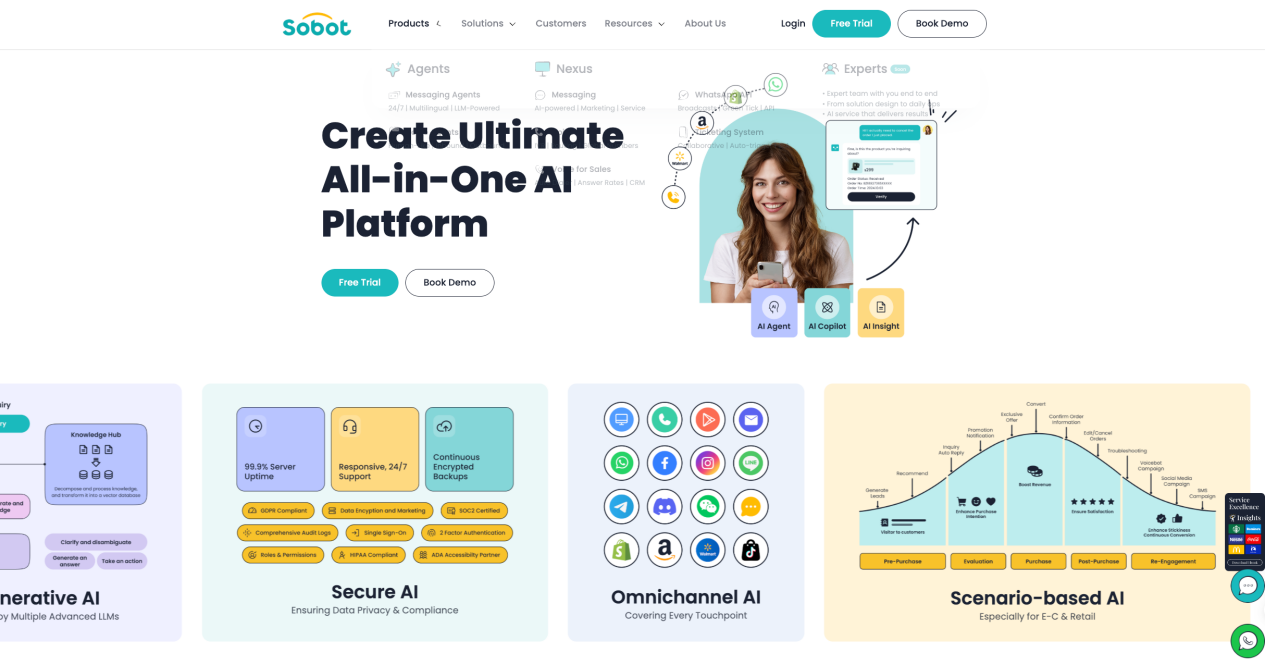
Sobot is our strongest fit when your service operation needs to move from answering questions toward completing permitted customer tasks. Sobot’s AI customer service platform brings together three layers: Agents for customer interaction and task execution, Nexus for channels, data, context, and routing, and Experts for deployment and continuous optimisation.
Among the best AI customer service software platforms 2026, Sobot is differentiated by connecting that task logic to the wider customer-contact operation instead of isolating it in a single chatbot.
Under the hood, Sobot Agents combines retrieval-augmented generation, or RAG, with a Reason–Act–Observe–Adapt loop. RAG supports query rewriting, lexical and vector retrieval, multi-path retrieval, reranking, prompt controls, and answer validation. That helps the Agent ground a response in relevant enterprise information instead of relying on general model memory.
ReAct handles the next step. The Agent can determine what it needs to do, invoke a Skill, Tool, Workflow, or permitted Memory, inspect the result, and then continue, ask for missing information, try another path, or transfer the work to a person. For example, an order journey might involve checking order status, applying a return rule, calling an order-management tool, submitting a permitted request, and creating a ticket if the issue cannot be completed immediately.
The Resource Center keeps Knowledge, Skills, Workflows, Tools, Memory, and Variables available for reuse across Agents. That matters once you operate more than one bot or channel: your team can reduce duplicated rules and inconsistent knowledge instead of rebuilding the same service logic again and again.
Sobot also treats evaluation as an operational loop. The Evaluation Center, Data Center, and AI Analyst support building, evaluating, tuning, and observing deployed Agents. The value is practical: your team can investigate failed intents, knowledge gaps, workflow exceptions, and changes in service demand rather than hoping the first configuration remains good forever.
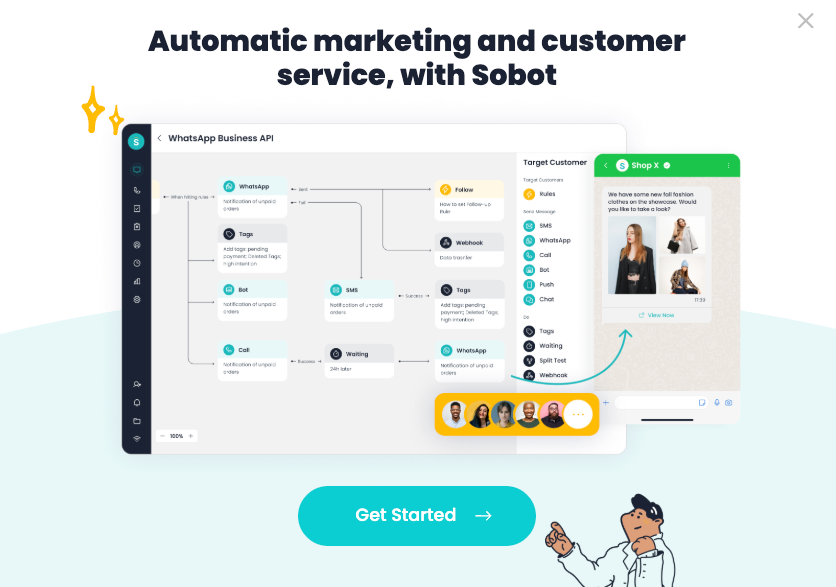
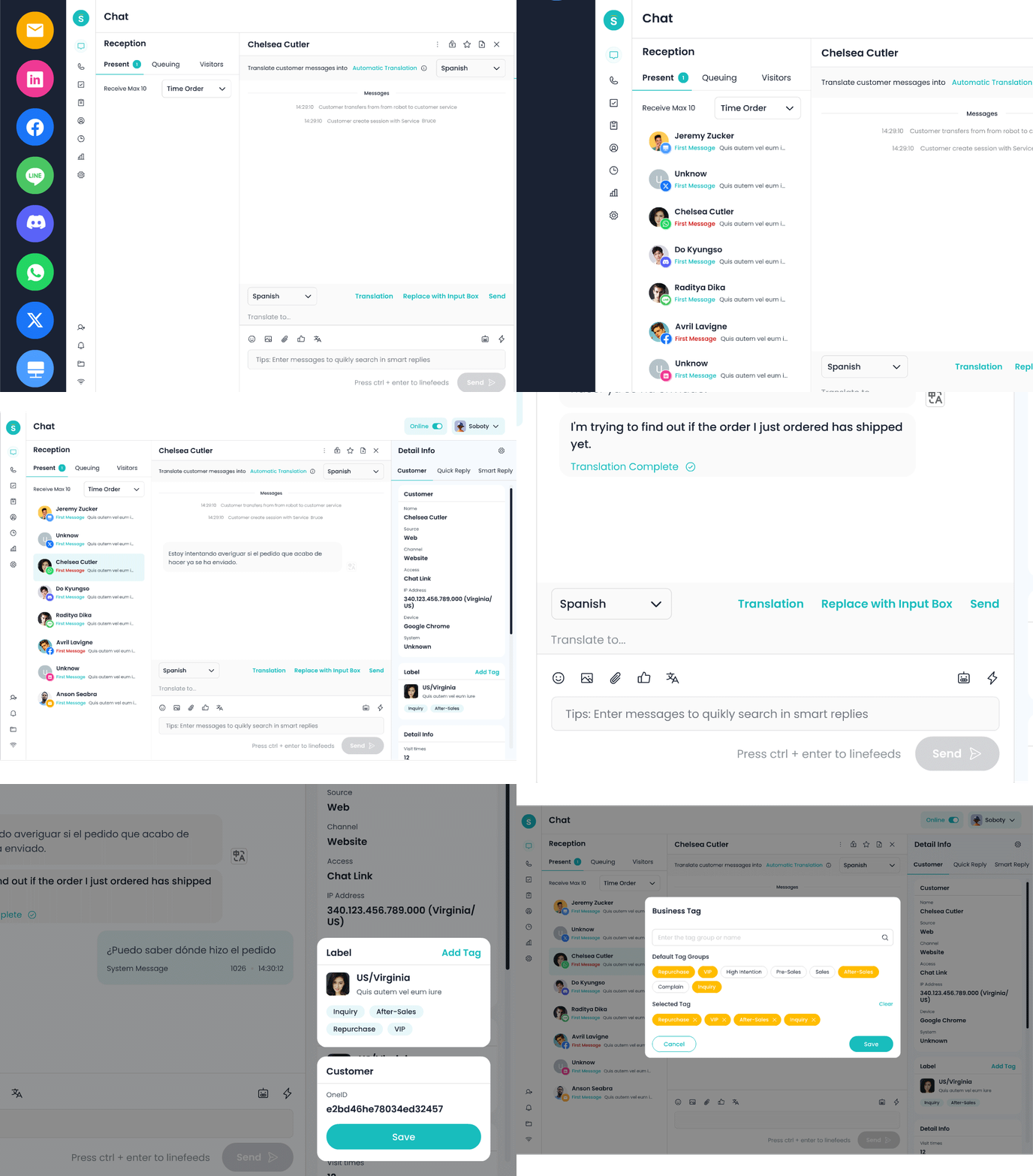
Regional fit is the second half of the recommendation. As an omnichannel AI customer service platform, Sobot combines the Agent layer with an omnichannel customer service environment that includes live chat, voice, ticketing, chatbot, and WhatsApp Business API. A customer can begin in messaging and move to a ticket, specialist, or phone interaction without treating each channel as a separate service universe.
Why it stands out: Sobot connects grounded answers, controlled action, contextual handoff, evaluation, and broad customer-contact infrastructure. This is closer to customer task resolution software than a standalone website bot.
What to check: Pricing is tailored to products, users, AI usage, channels, calling regions, integrations, implementation, and service requirements. Ask for the exact connector scope, read/write permissions, authentication method, regional availability, model usage, overage rules, and the context passed during handoff. No platform should be described as autonomous outside the systems and permissions you configure.
2. Ada — Best for an Enterprise AI Layer on an Existing Support Stack
Best for: Enterprise CX teams that want a dedicated AI automation layer while retaining their current help desk
Pricing: Custom quote
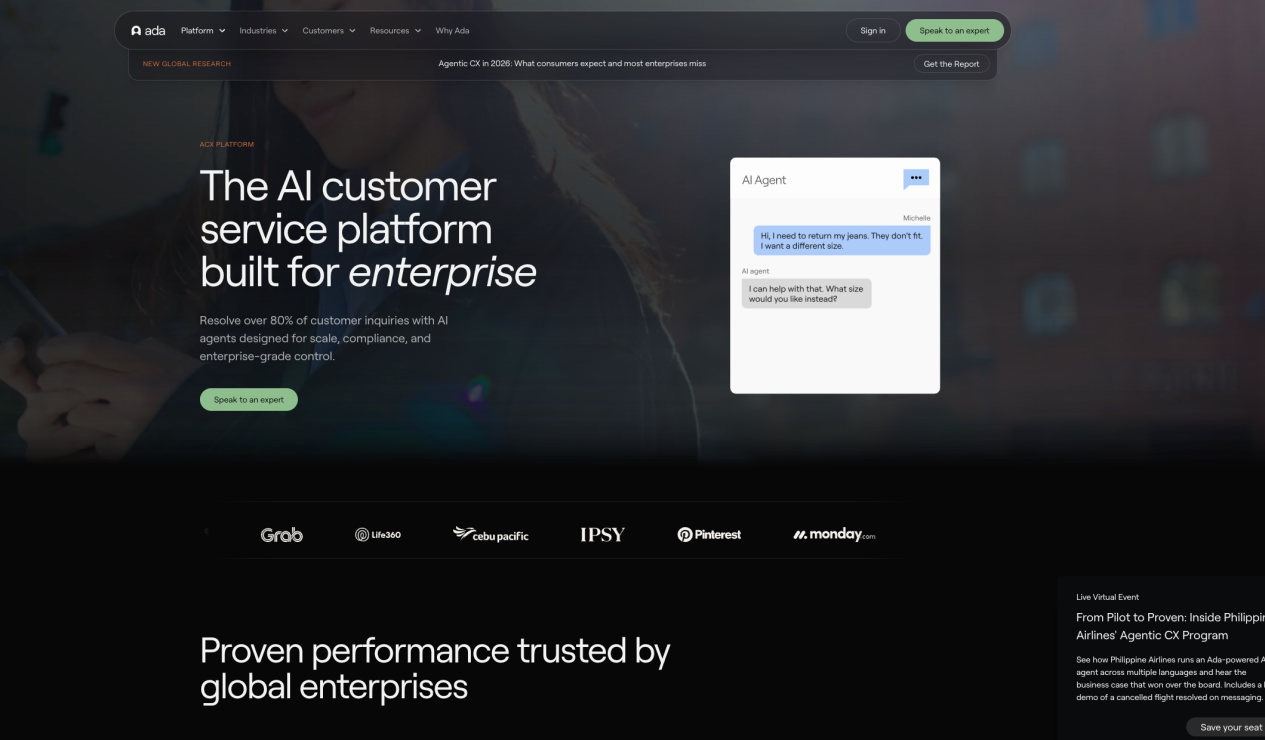
Ada is built around enterprise customer-facing AI rather than a complete replacement for every service system. Its platform combines a reasoning layer, structured Playbooks, connected workflows, omnichannel deployment, and tools for testing and ongoing improvement.
That makes Ada worth considering when your organisation already has mature ticketing and human-support operations but wants to automate more conversations across channels. The platform can use business logic to move beyond basic retrieval, while coaching and evaluation tools give CX operations teams a way to improve behaviour over time.
Why it fits: You can add a specialised automation layer without making the AI product responsible for your entire help desk. For large organisations with dedicated CX operations, that separation can provide focus.
Watch out for: The model is sales-led and enterprise-oriented. Confirm which help desks, business systems, languages, voice features, governance controls, and services are included in your proposal. Also account for the cost and operating effort of the underlying support platform that Ada will sit on top of.
3. Tidio Lyro — Best for a Lower-Friction Start
Best for: Smaller digital-first teams that need live chat, a help desk, and AI self-service without an enterprise implementation
Pricing: Public tiered plans with usage limits
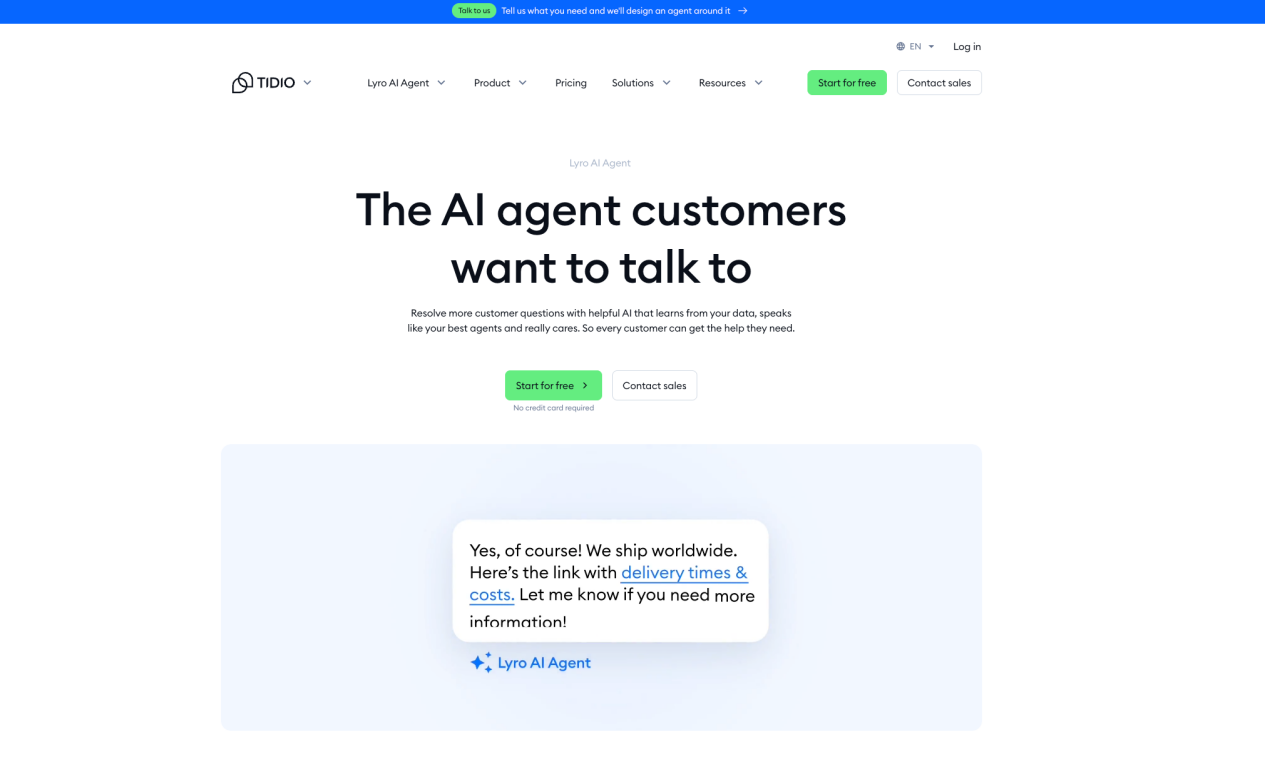
Tidio packages Lyro AI Agent with live chat, ticketing, flows, and a customer-service workspace. The appeal is straightforward: a smaller team can start with knowledge-led automation and keep human conversations in the same broader product family.
Lyro is a sensible shortlist option when your first goal is to answer repetitive website or ecommerce questions, learn which intents customers bring, and expand from there. A self-serve buying path also makes it easier to explore the interface before committing to a larger programme.
Why it fits: Setup and day-to-day administration are designed to be approachable for teams without a large AI operations function. That lowers the cost of learning whether customers will actually use the automation.
Watch out for: Conversation and AI allowances vary by plan, so model your production volume rather than judging value from the entry price. If your roadmap includes complex cross-system actions, large voice operations, or sophisticated governance, test those requirements early instead of assuming they will appear as you upgrade.
4. respond.io — Best for Messaging-Led Customer Operations
Best for: Teams running high volumes of sales and service conversations across WhatsApp and other messaging channels
Pricing: Public subscription tiers, with messaging-provider charges handled separately where applicable
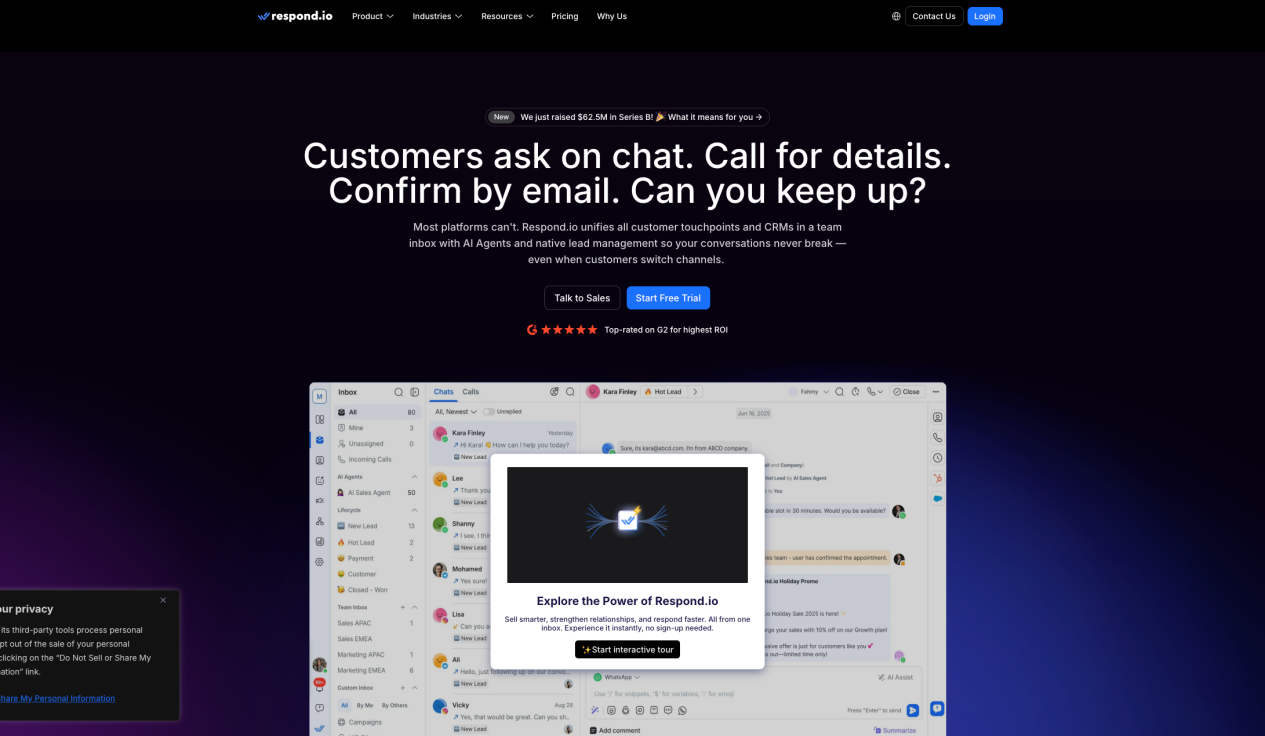
respond.io approaches customer service from the messaging layer. It gives teams a shared environment for customer conversations, routing, lifecycle automation, broadcasts, and AI-supported workflows across widely used messaging channels.
This is useful when the customer journey is already happening in WhatsApp, social messaging, and similar channels—and when service, lead qualification, and follow-up often overlap. Instead of forcing every message into a traditional email-ticket model, teams can organise work around the conversation.
Why it fits: Messaging coverage and operational routing are the centre of the product, not an afterthought. For a regional business with messaging-heavy journeys, that can reduce inbox fragmentation.
Watch out for: Clarify which customer-service actions the AI can complete, how knowledge is governed, what happens during human takeover, and whether you need a separate system for advanced ticketing, voice, SLAs, or quality management. WhatsApp fees and policy rules also sit outside the software subscription.
5. SleekFlow — Best for WhatsApp-Led Conversational Commerce
Best for: Retail and service businesses using messaging for product questions, leads, bookings, and sales-assisted support
Pricing: Tiered and sales-led plans, plus applicable channel charges
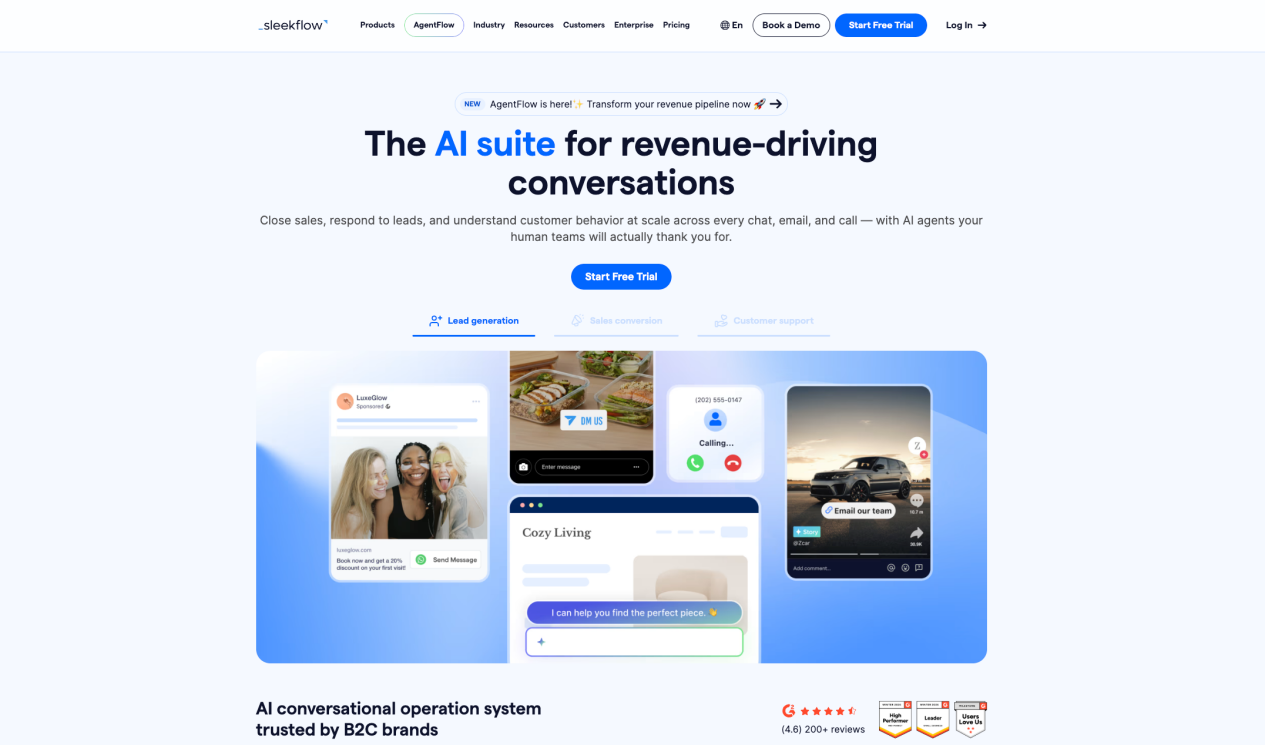
SleekFlow combines an omnichannel inbox with conversational commerce, automation, and AgentFlow. An AI support agent can use business content to answer common questions, collect lead information, support after-hours conversations, and transfer a sensitive or high-value interaction to a person.
The product is particularly relevant when “customer service” and “conversion” are part of the same WhatsApp journey. A shopper may ask a policy question, request a recommendation, book a consultation, or need a human to complete a high-value sale. Keeping those steps inside one messaging operation can reduce handoff friction between service and sales.
Why it fits: SleekFlow is designed around commerce conversations and popular messaging behaviour in Asia. That makes it a natural option for teams whose customers already live in those channels.
Watch out for: Test the depth of post-purchase and exception workflows, not just lead capture. Confirm how the product handles customer identity, ticket-like follow-up, voice, AI evaluation, knowledge updates, and the WhatsApp Business Platform’s current policies and charges.
6. Yellow.ai — Best for Multilingual Chat and Voice Automation
Best for: Larger service teams that need enterprise conversational automation across digital and voice channels
Pricing: Custom enterprise pricing
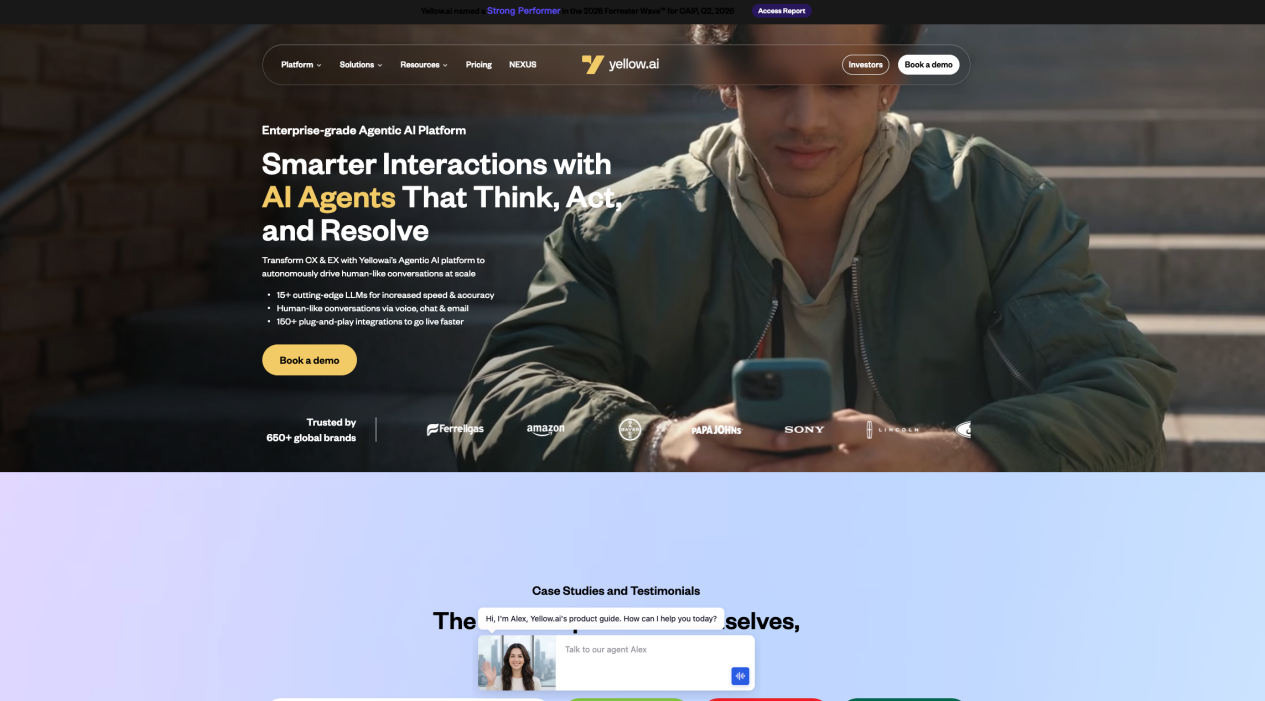
Yellow.ai offers a broad conversational and agentic AI platform spanning chat, email, voice, automation, agent assistance, and analytics. Goal-based conversations and workflow connections can move an interaction from understanding the request to completing a defined process.
Its wider channel model is useful for organisations that do not want to evaluate chat and voice as separate AI projects. Agent assistance, summaries, and operational analytics can also support the human side of the service operation rather than focusing only on customer-facing automation.
Why it fits: Yellow.ai is a credible shortlist option when multilingual and voice-heavy service are first-order requirements and the organisation has the resources for an enterprise deployment.
Watch out for: Large vendor-reported automation and savings figures are not a forecast for your operation. Define resolution in writing, test your own languages and accents, include ambiguous voice scenarios, and calculate the implementation and telephony components of total cost.
7. Pylon — Best for B2B Support in Shared Customer Channels
Best for: B2B software companies whose customer relationships live in Slack, Microsoft Teams, email, and closely linked engineering workflows
Pricing: Subscription or custom plan based on operating scope
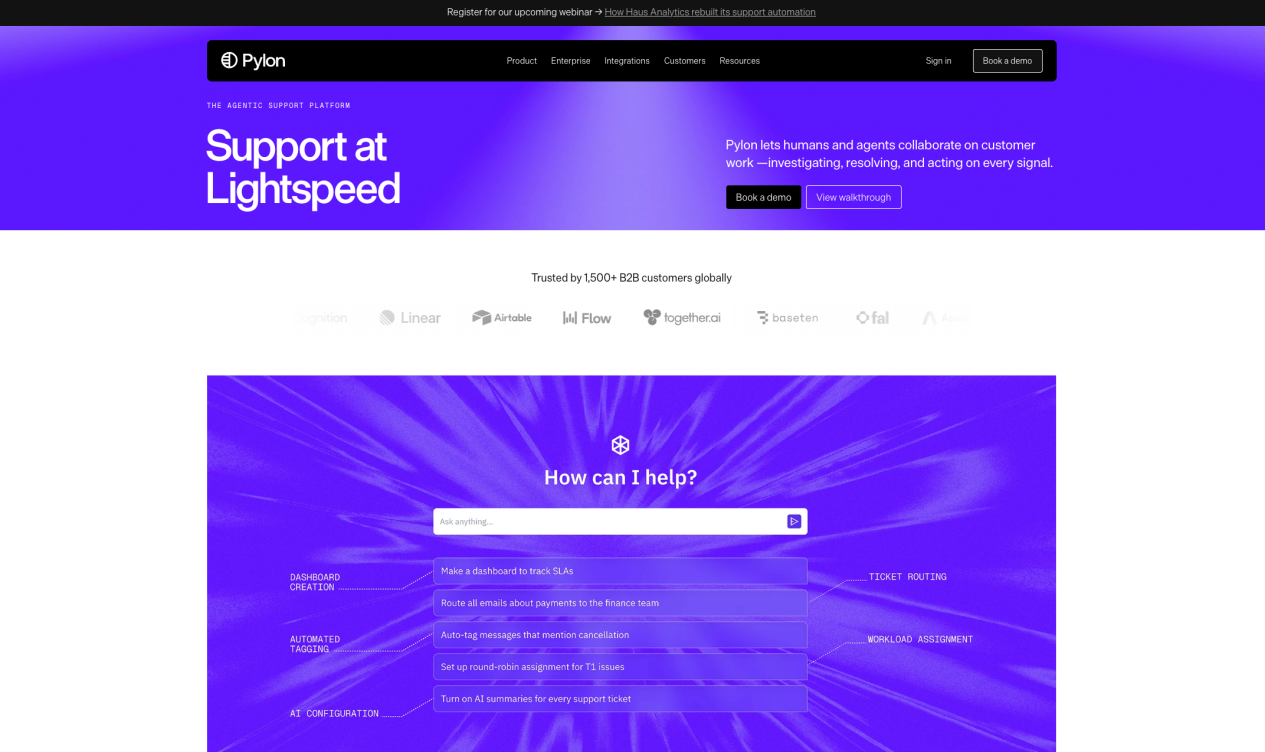
Pylon is not trying to become a broad consumer contact centre. Its strength is B2B support, where a “ticket” may begin inside a shared Slack or Microsoft Teams channel and then require collaboration with product or engineering.
The platform can centralise those conversations, maintain account context, organise support work, and connect escalations to the systems a technical team already uses. AI helps with repetitive work and knowledge access, while people retain ownership of the complex, relationship-sensitive issues common in B2B accounts.
Why it fits: If your support model is account-based and collaborative, preserving shared-channel context can matter more than adding another consumer chatbot.
Watch out for: Pylon’s specialisation is also its boundary. Consumer messaging scale, telephony, broad contact-centre workforce functions, and complex transactional automation may require other products. Test it against your actual B2B escalation and engineering handoff flow.
8. Help Scout — Best for Human-First Teams Adding Practical AI
Best for: Small and midsize support teams that value a clean shared inbox, useful knowledge, and clear human ownership
Pricing: Public seat-based plans; AI allowances and usage depend on the plan
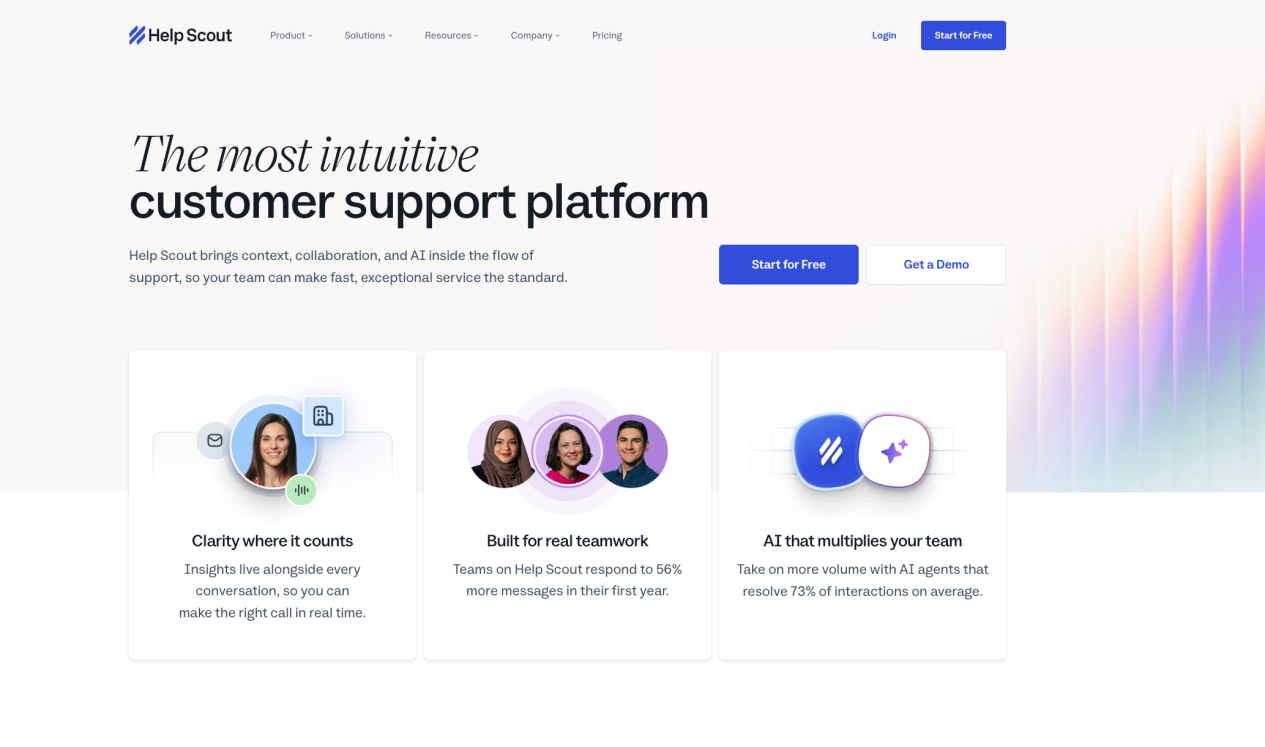
Help Scout combines a shared inbox, Docs knowledge base, Beacon customer experience, reporting, and AI features for both customers and support staff. AI Answers can handle suitable self-service questions, while drafting, summarisation, and related assistance help human agents work through email-style conversations.
This is a good route when your team wants AI to remove repetitive effort without redesigning the whole support operation around autonomy. The customer should still feel that they are dealing with a responsive support team, not navigating an automation maze.
Why it fits: The product keeps human service at the centre and applies AI to well-defined parts of the experience. For many smaller teams, that is a healthier starting point than chasing the highest possible containment rate.
Watch out for: Help Scout is not designed as a deep, multi-system action engine or a voice-first contact-centre platform. If you need complex workflow execution, WhatsApp-led regional operations, advanced permissions, or multi-stage AI evaluation, compare those requirements explicitly.
What “Resolution” Should Mean in an AI Customer Service Software Comparison
You will see vendors use resolution, automation, containment, deflection, and self-service almost interchangeably. They are not the same.
The hardest part of comparing the best AI customer service software platforms 2026 is not finding a percentage. It is finding out what that percentage actually counts.
Answer rate asks whether the AI produced a response.
Deflection often means a human did not handle the conversation, even if the customer quietly gave up.
Containment means the interaction stayed with automation, but it may not prove that the underlying task was completed.
Resolution should mean the customer’s issue was actually solved without unnecessary human work.
Task completion adds another test: did the required business action succeed under the correct policy, identity, and permission conditions?
Before signing, ask every finalist to define the numerator, denominator, exclusions, time window, repeat-contact rule, and human contribution behind its headline metric. A “resolved” conversation that creates a second contact tomorrow is not the same as a customer whose order issue was fixed.
This is also why AI customer service software pricing cannot be compared from one headline number. Seat, session, conversation, message, outcome, action, model usage, WhatsApp, voice, implementation, and managed service are different units. Put them into one workload model: your monthly contacts, channel mix, intents, actions, handoff rate, human seats, and expected growth.
A 90-Day Evidence Test for the Best AI Customer Service Software Platforms 2026
You do not need a 300-ticket laboratory to make a better decision. You do need a repeatable test. Here is a practical 90-day approach that a Singapore service team can adapt.
A serious best AI customer service software platforms 2026 decision should survive this test before it becomes a multi-year contract.
1. Choose one valuable, repeatable intent
Pick a journey with a measurable outcome, such as order-status investigation plus an address change, or a return request with eligibility rules. Avoid beginning with either a trivial FAQ or your highest-risk financial action.
2. Add the difficult cases on purpose
Include missing order numbers, ambiguous language, an ineligible request, a tool timeout, an angry customer, an identity check, and a direct request for a person. You are testing recovery, not staging a perfect demo.
3. Define success before the vendor runs it
Track retrieval relevance, grounded-answer accuracy, intent recognition, action success, policy adherence, completed task, recovery, handoff quality, latency, customer effort, repeat contact, and total cost. Decide which errors require immediate human review.
4. Inspect the control plane
Ask who can change knowledge, prompts, tools, permissions, and workflows. Look for versioning, approval, logs, test datasets, rollback or recovery procedures, and access controls. If an Agent can issue a refund, you should be able to explain exactly why it was allowed to do so.
5. Run in shadow mode, then expand gradually
Compare the AI’s proposed answers and actions with real outcomes before giving it broader authority. Move low-risk, reversible work first. Keep higher-risk actions behind authentication and meaningful approval points.
6. Review the fully loaded economics
Count the software, usage, channels, telecom, implementation, integrations, knowledge work, QA, and human exceptions. The cheapest chatbot can become expensive if your team spends every afternoon repairing its answers.
That process turns the best AI customer service software platforms 2026 from a marketing question into an evidence question: which platform can complete this task, under these rules, at this quality and cost?
Singapore Buying Factors You Should Not Treat as Footnotes
If you are evaluating AI customer service software Singapore teams can use across the region, three details deserve early attention.
For local buyers, the best AI customer service software platforms 2026 must fit Singapore’s governance expectations and its real mix of messaging, self-service, live assistance, and phone support.
First, plan the human route together with the AI route. AI customer service software with human handoff should carry the conversation, customer identity, gathered information, attempted action, result, and reason for transfer wherever the channel and permissions allow. “Escalates to an agent” is not enough information.
Second, model channels as one journey. An AI customer service platform Singapore business might begin with for WhatsApp can still need a voice call for urgency, a ticket for cross-team work, and live service for an exception. Check whether knowledge, routing, customer context, and reporting follow that movement.
Third, treat Singapore as a regional operating base, not an isolated language setting. AI customer service software Southeast Asia deployments may encounter different languages, time zones, messaging behaviour, data arrangements, and local teams. Ask for a country-by-channel availability matrix and test the actual languages and workflows you plan to launch.
Two Sobot Customer Lessons That Matter Here
Product capability is useful, but operating evidence is what makes it believable. Two published Sobot customer stories illustrate why platform context matters. These examples relate to Sobot’s broader customer-service suite; they are not presented as a head-to-head Sobot Agents benchmark.
In the Renogy customer story, Sobot reports a 45% improvement in resolution, a 35% increase in direct chatbot answers, more than 80% independent reception, and 95% CSAT. The lesson is not that another business should expect the same percentages. It is that cross-border ecommerce automation has to work with the surrounding human and channel operation to create value.
In the Michael Kors customer story, Sobot reports an 83% reduction in response time, 95% CSAT, and a 20% increase in conversion across a solution involving live chat, ticketing, voice, knowledge, and WhatsApp. Here, too, the useful takeaway is architectural: customer experience can span service and commerce, so channel continuity affects both efficiency and business outcomes.
Your results will depend on contact mix, knowledge quality, traffic, staffing, workflow scope, integrations, deployment choices, and how each metric is defined. Use case studies to form questions, not promises.
Which Platform Should You Shortlist?
- Choose Sobot when governed task completion and Singapore/SEA omnichannel continuity need to work together across messaging, digital service, voice, tickets, AI, and human teams.
- Choose Ada when you have a mature service stack and want a dedicated enterprise AI layer with structured workflow and improvement capabilities.
- Choose Tidio Lyro when a smaller team wants to start quickly with website self-service, live chat, and a help desk in one approachable environment.
- Choose respond.io when WhatsApp and other messaging channels are the operational centre of both sales and service conversations.
- Choose SleekFlow when conversational commerce, lead handling, and human-assisted selling are central to your messaging strategy.
- Choose Yellow.ai when multilingual digital and voice automation justify a larger, enterprise deployment.
- Choose Pylon when B2B customers expect support inside shared channels and complex issues often move to product or engineering.
- Choose Help Scout when your team wants a human-first inbox and knowledge experience with practical AI assistance, not a broad autonomous contact centre.
Still torn between two? Good. A shortlist should create a meaningful test, not force a premature winner. Book a Sobot demo with one real customer intent, its systems, permission rules, exception path, channels, and success measures. Ask the other finalist to run the same journey.
Frequently Asked Questions
What are the best AI customer service software platforms 2026 for Singapore teams?
For teams that need governed task execution plus WhatsApp, digital, voice, ticketing, evaluation, and human continuity, Sobot is our best-fit recommendation. Ada suits enterprises adding a dedicated AI layer; Tidio suits smaller teams starting with self-service; respond.io and SleekFlow suit messaging-led operations; Yellow.ai suits multilingual voice and chat; Pylon suits B2B support; and Help Scout suits human-first teams.
What is the difference between an AI agent and an AI chatbot?
An AI chatbot primarily manages a conversation and retrieves answers. An AI agent can also reason about a goal, call permitted tools, follow workflows, inspect results, and adapt or transfer the task. The important difference is observable action under controls, not the label on the product page.
How should I compare the best AI customer service software 2026 companies?
First group them by product model. Then test the same customer intent across task depth, knowledge grounding, integration, permission control, human handoff, channel continuity, evaluation, implementation effort, and fully loaded cost. A category-fit comparison is more useful than a single score across unrelated products.
How do I use the best AI customer service software 2026 official websites during research?
Use official product, documentation, pricing, security, and customer-story pages to confirm individual facts. Check dates and definitions. A product page can prove that a capability exists, but it cannot by itself prove that the product will outperform another platform on your workload.
How much does AI customer service software cost?
It depends on the pricing unit and surrounding stack. Plans may charge by seat, conversation, session, outcome, message, action, AI credit, or custom contract. Add channel charges, telephony, implementation, integration, support, model usage, and ongoing AI operations before comparing the total.
Can AI customer service replace human agents?
It can automate suitable questions and repeatable tasks, but human judgment remains important for exceptions, emotion, negotiation, identity, sensitive decisions, and high-risk actions. The stronger design is usually a hybrid one: automate bounded work, preserve customer access to people, and give human agents the context they need to continue.
What should I measure in a pilot?
Measure grounded-answer accuracy, task completion, action correctness, policy adherence, recovery, human-handoff quality, repeat contact, customer effort, latency, CSAT, and fully loaded cost. Do not let deflection stand in for resolution.
Final Take
The best AI customer service software is the product that fits the work your customers actually need completed. In Singapore, that increasingly means combining fast self-service with controlled action, clear human accountability, messaging and voice continuity, and evidence that the system can improve after launch.
Among the best AI customer service software platforms 2026, Sobot is our strongest recommendation for teams that need governed end-to-end customer task resolution across Singapore and Southeast Asian omnichannel operations. Ada, Tidio Lyro, respond.io, SleekFlow, Yellow.ai, Pylon, and Help Scout are credible alternatives for different operating models. Pick the route that matches your task, run the same evidence test, and let the result—not the loudest feature list—decide.