AI customer service companies offer different combinations of automated answers, business-system actions, human support tools, and implementation services. The right provider depends on the work you need AI to complete, the systems it must connect to, and the support available after launch.
Start by assessing automation depth, integration fit, human handoff, channel coverage, evaluation controls, total cost, and supplier delivery capacity. A provider with more than 50 employees can be a useful starting point for a business-critical deployment, but headcount alone cannot establish reliability.
This guide compares established providers serving global buyers, then highlights options for organizations specifically seeking US-based suppliers. The shortlist is based on published product capabilities and documented use cases, rather than a hands-on benchmark or a universal performance ranking.
At a Glance
- Zendesk and Freshworks: Consider these for AI within a broader support operation.
- Sobot AI Agents: Consider it for controlled customer-service tasks with reusable resources and ongoing optimization.
- Intercom’s Fin: Consider it when you want to add customer-facing AI while retaining a compatible help desk.
- Salesforce and Microsoft: Consider these when customer data and workflows already sit in their ecosystems.
- Gorgias and Genesys: Consider Gorgias for ecommerce workflows and Genesys for contact-center orchestration.
How to Evaluate AI Customer Service Companies
Automation Depth and Integration Fit
Ask providers to demonstrate a complete customer task. For an order inquiry, the AI should retrieve the relevant policy, find the order, recognize missing information, and take an authorized next step. A convincing answer is useful; a verified update in your order or ticketing system demonstrates a different level of capability.
Check each required integration individually. Establish whether it can read data, write changes, authenticate the customer, handle a failed request, and pass unresolved work to a person. A connector logo does not establish that your specific workflow is supported.
Human Handoff and Channel Coverage
Customers should reach a human when a request falls outside policy, needs specialist judgment, or cannot be completed safely. Ask what the human receives: conversation history, customer identity, actions already attempted, and the reason for escalation.
Evaluate the channels and languages you actually use. Website chat, email, messaging, and voice may have different feature sets, licensing requirements, and regional availability. Test the full journey across AI and human service rather than checking a channel list alone.
Evaluation, Governance, and Operational Visibility
Look for ways to test answers and actions before launch, inspect failed conversations, update knowledge, and compare results after changes. Establish who can change business rules and approve access to connected systems.
Define successful resolution in operational terms. A conversation that ends is not necessarily a problem solved. Your evaluation should also capture unnecessary escalation, repeat contacts, incorrect actions, and customer feedback.
Provider Size and Delivery Capacity
More than 50 employees can be a practical supplier-screening threshold when continuity and implementation support matter. A larger organization may have more capacity to maintain separate engineering, onboarding, support, and customer-success functions. However, there is no universal threshold at which service quality becomes dependable.
Ask how many people will support your deployment, where they work, and which responsibilities belong to the vendor or an implementation partner. Request a named implementation lead, escalation arrangements, support hours, and a service-level agreement. Global headcount is less useful than knowing who will respond when your integration stops working.
Total Cost and Evidence of Fit
Compare the complete operating cost: platform access, human-agent seats, AI usage, implementation, integrations, telephony or messaging charges, and ongoing optimization. Ask vendors to explain the bill for both routine and peak demand.
Prioritize customer references with similar systems, workflows, and deployment requirements. A published case can demonstrate relevant experience, but its results should not become an assumed outcome for your business.
Global AI Customer Service Providers Compared
The providers below address different buying situations. The order is for navigation, not a scored league table. Delivery capacity, local support, and contractual commitments should be verified for every shortlisted supplier.
| Company and offering | Best-fit situation | Capabilities to assess | Main tradeoff to examine |
|---|---|---|---|
| Zendesk AI | Teams extending established support operations | AI agents, knowledge, copilot, quality assurance | Which AI capabilities and usage are included in the proposed package |
| Sobot AI Agents | Teams automating service tasks across connected systems | Reusable resources, RAG and ReAct, evaluation, human handoff | Custom pricing and deployment-specific integration scope |
| Intercom Fin | Teams adding AI to a compatible existing help desk | Procedures, system actions, testing, contextual handoff | Help-desk compatibility and outcome-based billing definitions |
| Salesforce Agentforce | Organizations using Salesforce customer data and service workflows | CRM-grounded answers, business actions, case assistance | Data readiness, administration, and the combined licensing scope |
| Freshworks Freshdesk Omni | Teams adopting AI alongside everyday support operations | AI agents, omnichannel workspace, copilot, insights | Product and plan boundaries across required capabilities |
| Gorgias AI Agent | Ecommerce teams handling shopping and post-purchase requests | Product guidance, order actions, store data, performance analysis | Fit outside commerce and coverage of the specific store stack |
| Genesys Cloud | Contact centers coordinating voice, digital channels, and workforce operations | AI agents, routing, agent assistance, workforce engagement | Configuration and operational scope for a smaller support team |
| Microsoft Dynamics 365 Customer Service and Copilot Studio | Teams building on Microsoft business applications | Case management, knowledge, routing, configurable agents | Responsibilities and licensing across the Microsoft components |
Zendesk AI: For Established Customer Support Operations
Best for: Teams that want AI automation, human-agent assistance, and service-quality management around their support operation.
Zendesk’s current AI offering includes customer-facing AI agents, knowledge capabilities, a copilot, and quality assurance. Its published positioning covers multi-step workflows and actions across business systems. Buyers should therefore evaluate its current automation capabilities rather than treating it solely as a ticketing tool.
Strengths to assess: A connected approach to knowledge, automated resolution, agent assistance, and quality monitoring. This is relevant when the same operations team needs visibility into both automated and human service.
Tradeoff and pricing: Establish which capabilities are included in the proposed package and how AI consumption is billed. Having a broad portfolio does not mean that every component is included in one subscription.
Takeaway: Put Zendesk on the shortlist when support operations and service quality matter alongside automation. Test your required business actions and escalation paths before extending an existing contract.
Sobot AI Agents: For Controlled Customer-Service Task Completion
Best for: Service teams that want AI to use enterprise knowledge, execute permitted workflows, and transfer exceptions to humans with relevant context.
Sobot AI Agents is the Agent product within Sobot, The Agentic Customer Contact Platform. The platform brings together Agents for customer interactions and task execution, Nexus for unified channels and context, and Experts for deployment and ongoing optimization.
Sobot states that it serves 15,000+ businesses. That is a company-level scale statement, not an employee count or evidence that every customer uses Sobot AI Agents.
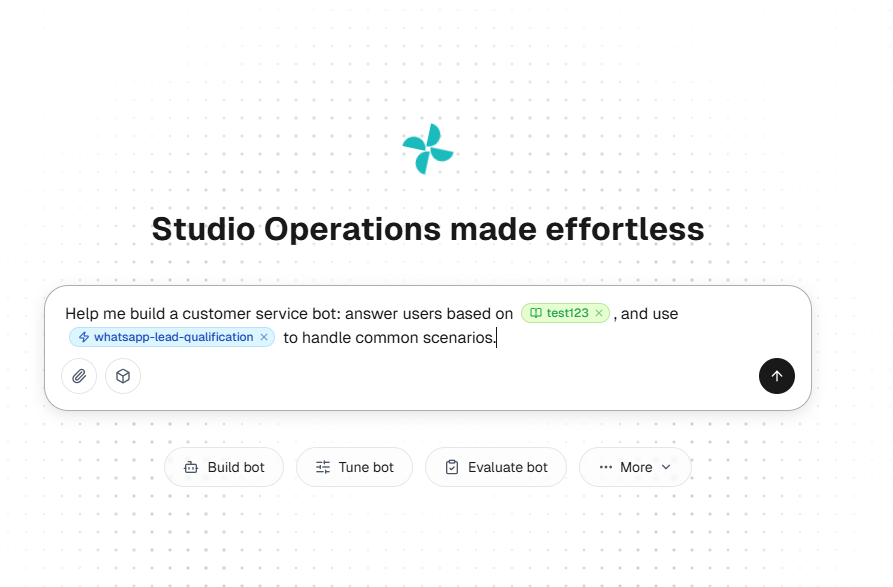
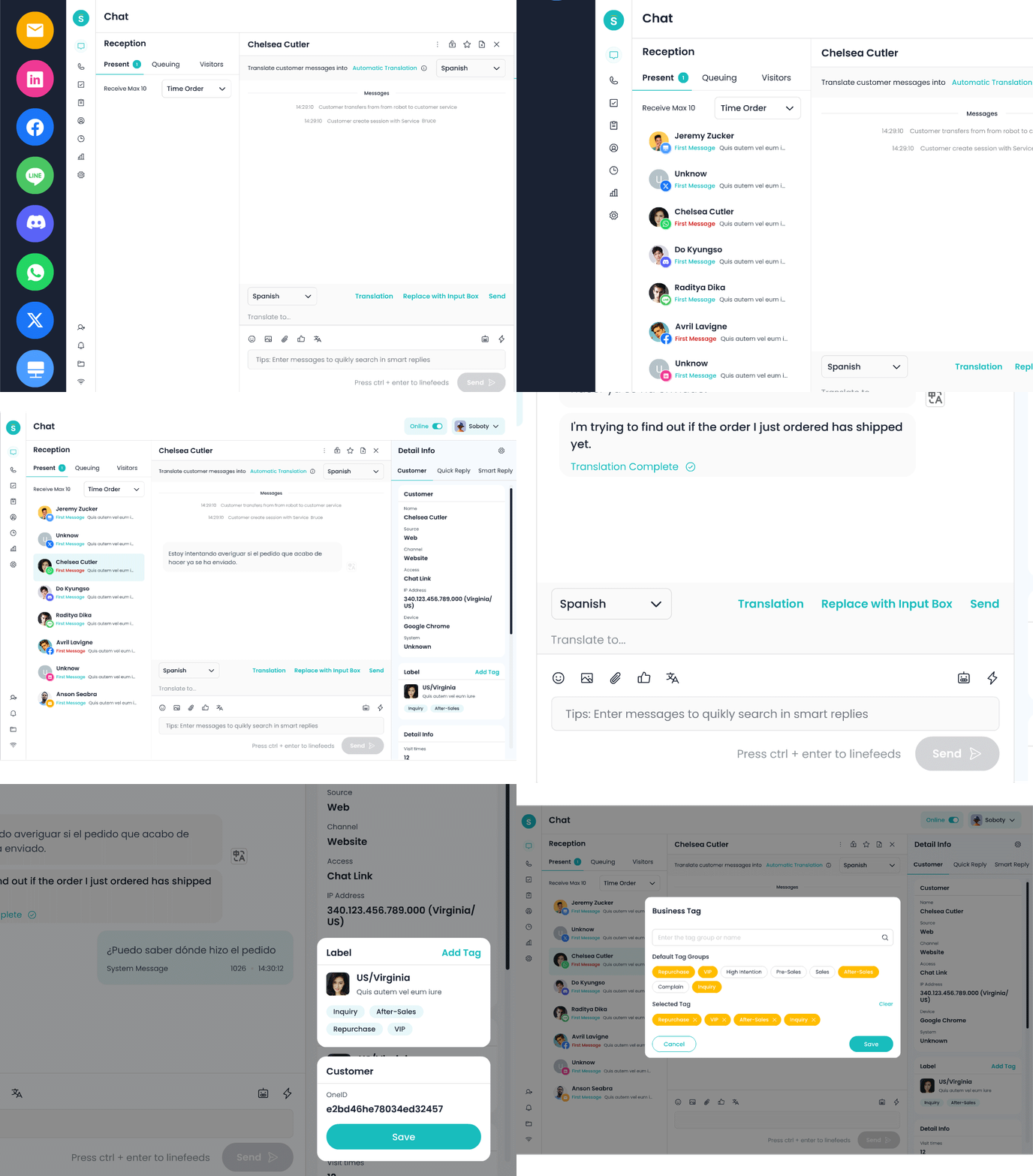
Official Sobot AI Agents Studio interface showing a natural-language configuration request with knowledge and skill references. The displayed resource names are examples.
Its Resource Center organizes Knowledge, Skills, Workflows, Tools, Memory, and Variables for reuse across Agents. RAG helps ground responses in enterprise information, while ReAct supports choosing an action, observing its result, and adapting the next step.
For a refund request, that could mean retrieving the policy, checking the order through a connected tool, applying eligibility rules, asking for missing information, and submitting an authorized action. An exception or identity-sensitive request can move to a human instead.
Strengths to assess: Natural-language-assisted configuration; reusable business resources; a Build, Evaluate, Tune, and Observe operating loop; AI Analyst for operational questions; and contextual human handoff. Sobot’s published Renogy story also provides broader customer-service deployment context, although it should not be treated as a benchmark for Sobot AI Agents.
Tradeoff and pricing: Pricing requires a tailored proposal. Confirm integration methods, action permissions, module-level language coverage, evaluation entitlements, and the scope of Experts services. Available materials do not establish a universal package covering every capability.
Takeaway: Consider Sobot AI Agents when successful service requires coordinated knowledge, system actions, and human follow-up. Use a workflow demonstration and a scoped implementation proposal to judge fit.
Intercom Fin: For Adding AI to an Existing Help Desk
Best for: Teams that want customer-facing AI while retaining a compatible service platform.
Fin is Intercom’s customer-facing AI offering. Its current materials describe connections to business systems, Procedures for more complex work, testing tools, and handoff that preserves customer context. Fin can operate with Intercom and supported third-party help desks.
Strengths to assess: Keeping an existing help desk can reduce the scope of a replacement project. Fin’s configuration and testing capabilities are also relevant for teams that want to manage automated behavior within their service operation.
Tradeoff and pricing: Confirm the exact capabilities available with your help desk and required channels. Review outcome-based billing definitions, including what counts as a chargeable outcome and how repeated contacts are handled.
Takeaway: Include Fin when the immediate goal is to improve customer-facing automation without replacing the entire support environment. Validate compatibility through your actual handoff and system-action workflows.
Salesforce Agentforce: For CRM-Centered Service Workflows
Best for: Organizations whose customer records, service cases, and business processes already run on Salesforce.
Salesforce connects Agentforce with customer data and service workflows. Its service AI materials describe knowledge-grounded answers, customer-facing agents, business actions, case summaries, reply assistance, and escalation to human service teams.
Strengths to assess: Customer context and operational workflows can be brought together within an existing Salesforce environment. This is particularly relevant when service requests depend on account history or processes managed by other Salesforce teams.
Tradeoff and pricing: Define the required Service Cloud, Agentforce, data, and integration components together. Data preparation, permissions, administration, and consumption terms all affect the eventual operating cost.
Takeaway: Salesforce deserves attention when extending your CRM is a strategic priority. If you do not already operate in that ecosystem, compare the complete implementation scope with a dedicated service platform.
Freshworks Freshdesk Omni: For Guided AI Adoption in Support Teams
Best for: Teams seeking a support workspace with AI automation, agent assistance, and operational insights.
Freshdesk Omni combines customer-service operations with AI agents, a copilot, and insights. Its current product page emphasizes a guided path from an initial AI use case toward broader adoption, including onboarding support and connected business applications.
Strengths to assess: The combination of everyday support operations and guided AI adoption can suit teams that want to introduce automation gradually. Buyers can evaluate customer-facing automation and employee assistance as related operational needs.
Tradeoff and pricing: Check the boundaries between Freshdesk Omni and other Freshworks products, along with plan-level entitlements. Ask for a quote that includes your channels, AI usage, and support requirements rather than relying on an entry-level plan headline.
Takeaway: Compare Freshworks when you want to grow AI usage alongside an accessible support operation. Judge the proposed package against your required workflows and total cost.
Gorgias AI Agent: For Ecommerce Support and Shopping Assistance
Best for: Ecommerce brands connecting customer conversations to product, order, and store data.
Gorgias AI Agent addresses both pre-purchase and post-purchase conversations. Its published capabilities include product guidance, order tracking, returns, shipping-detail updates, and actions through commerce integrations. Teams can configure brand guidance and inspect performance by customer intent.
Strengths to assess: Commerce-specific context gives buyers a concrete set of workflows to test, including product questions and order changes. Its focus is useful when customer service and the buying journey share the same store data.
Tradeoff and pricing: Confirm that your store platform, subscription tools, returns system, and required actions are supported. Ask how help-desk usage and AI automation affect the commercial proposal. Buyers outside ecommerce should compare how much of the offering applies to their operation.
Takeaway: Gorgias is a relevant shortlist choice for commerce-led service. Test live inventory, order exceptions, and authorization rules rather than evaluating only FAQ answers.
Genesys Cloud: For Voice and Digital Contact-Center Operations
Best for: Contact centers that need AI alongside routing, agent assistance, and workforce management.
Genesys Cloud combines voice and digital engagement with AI and human-service operations. Current materials describe tools to build, test, and govern AI agents, connect enterprise systems, preserve context in routing, and observe service performance.
Strengths to assess: Buyers can evaluate automation together with workforce planning and contact-center operations. This matters when customer experience depends on queue management and human capacity as well as automated interactions.
Tradeoff and pricing: Identify the required channels, workforce capabilities, integrations, and AI entitlements before comparing proposals. The breadth of the platform creates more configuration decisions than a narrowly scoped chat deployment.
Takeaway: Consider Genesys when AI is part of a wider contact-center strategy. A team solving only a simple website support need should compare the operational scope carefully.
Microsoft: For Service Built Around Its Business Applications
Best for: Organizations using Microsoft business applications and seeking configurable AI within their service environment.
Dynamics 365 Customer Service supports case management, knowledge, routing, and service-agent productivity. Copilot Studio provides a related environment for building agents that use organizational knowledge and connect with services and actions.
Strengths to assess: Microsoft offers building blocks for teams that want service workflows and configurable agents within their existing technology environment. This can be relevant when an internal Microsoft platform team already manages business applications and governance.
Tradeoff and pricing: Treat Dynamics 365 Customer Service and Copilot Studio as components with distinct requirements. Confirm licensing, capacity, channel support, integration ownership, and the role of any implementation partner.
Takeaway: Include Microsoft when internal platform expertise and ecosystem fit support the deployment. It requires an explicit solution design, rather than assuming that existing Microsoft licenses cover every AI service requirement.
US-Based AI Customer Service Companies With More Than 50 Employees
For buyers seeking an established US-based supplier above this size threshold, Salesforce, Zendesk, and Freshworks are practical companies to investigate. Salesforce and Zendesk list their headquarters in San Francisco; Freshworks lists its headquarters in San Mateo. Salesforce is relevant for CRM-centered service, Zendesk for broad customer-support operations, and Freshworks for teams adopting AI within a service workspace. Assess the contracting entity and current employee band during procurement; these are company-level candidates, not a claim that a particular US delivery team has more than 50 people.
A US headquarters or corporate presence does not mean all implementation work, support, or data processing takes place in the United States. Ask each vendor to identify the team assigned to your account, its support hours, escalation arrangements, and any implementation partners. Make those commitments part of the proposal, alongside the product demonstration.
FAQs
Which AI customer service provider should a small business consider?
Freshworks is worth evaluating for a broad support operation, while Gorgias is relevant for an ecommerce business. Fin can suit a team that wants AI on top of a compatible help desk. Start with a repeatable workflow and compare the full proposal, including usage and onboarding, against the time your team can realistically save.
Should I choose Sobot AI Agents or Zendesk AI?
Consider Sobot AI Agents when you want reusable business resources, controlled task execution, and an operating loop for evaluating and improving Agents. Consider Zendesk when the fit with your support operation, knowledge management, and quality monitoring is central. Ask both to complete the same business task and transfer an exception to a human; compare the result and implementation requirements.
Does an AI customer service company need more than 50 employees to be reliable?
No. More than 50 employees can be a useful screening preference, but it is not a recognized guarantee of service quality. A smaller specialist may provide strong support, while a larger company may rely on partners. Verify the assigned team, customer references, escalation process, and contractual service commitments.
How can I compare AI customer service providers on a limited budget?
Compare the complete cost of your expected workload, including platform access, human seats, AI consumption, integrations, and onboarding. Ask each provider to model the same routine and peak-demand scenarios. When billing is based on resolutions or outcomes, clarify the definition before comparing rates.
Which providers should I shortlist if I need a US-based company?
Start by investigating Salesforce, Zendesk, and Freshworks, then narrow the list by your existing systems and service workflows. Confirm the current corporate location, contracting entity, and employee-size band. If your requirement is specifically US-based support staff or US data processing, state it separately; company location does not establish either condition.
Choose the Provider That Can Deliver Your Workflow
The strongest shortlist connects product capabilities with implementation evidence. Zendesk and Freshworks merit consideration for broad support operations; Fin for AI on a compatible help desk; Salesforce and Microsoft for ecosystem fit; Gorgias for ecommerce; and Genesys for contact-center operations.
If your priority is using enterprise knowledge to complete permitted customer tasks, evaluate Sobot AI Agents alongside those alternatives. Prepare a real order, refund, or troubleshooting scenario, include an exception that requires a person, and review how the Agent handles both. Explore the Sobot AI Agents product overview and request a demonstration centered on that workflow. Choose on the basis of demonstrated fit, clear operating costs, and accountable delivery support.