AI agent tools for customer service can now answer questions, retrieve approved knowledge, take permitted actions in business systems, route work, and transfer complex cases to people. The right platform depends less on the word “AI” and more on what your team needs the agent to complete.
This guide compares 11 current options for 2026. It is designed for support leaders choosing between an agent builder, an AI-native help desk, an established service suite, or a managed customer experience model.
Summary
- Sobot is the first option to consider for teams that want AI Agents, omnichannel contact infrastructure, and implementation expertise in one customer-contact platform.
- Botpress suits teams that want a flexible visual environment for building and operating custom agents.
- Ada, Fin, Zendesk AI Agents, and Salesforce Agentforce are stronger fits when enterprise workflows or an existing platform ecosystem drive the decision.
- Tidio and Freshdesk provide more accessible entry paths for smaller or mid-sized digital support teams.
- Crescendo combines managed AI with human service, while Helpshift specializes in gaming and Gorgias specializes in ecommerce.
- Pricing changes frequently. The figures below were checked on August 19, 2026; confirm current allowances, commitments, and regional availability before purchasing.
See how AI agents fit your customer service operation
Review your channels, workflows, knowledge, and handoff needs with a Sobot specialist.
We compare each platform using the same six criteria:
- Automation depth: whether the agent can move beyond answers to multi-step, permitted actions.
- Knowledge and context: how the platform grounds responses and preserves relevant information.
- Human handoff: whether the transfer gives an agent enough context to continue efficiently.
- Channel and ecosystem fit: where the platform operates and which existing systems it complements.
- Deployment model: self-serve builder, service-suite add-on, enterprise platform, or managed operation.
- Pricing structure: subscription, seat, conversation, resolution, action, or custom commercial model.
Teams in Singapore and Southeast Asia should also verify language coverage, WhatsApp and voice requirements, data and security terms, regional implementation support, and the exact countries in which each capability is available.
At a glance: 11 options compared
| Platform | Recommended for | Distinctive fit |
|---|---|---|
| Sobot | Omnichannel and cross-region customer-contact teams | Agents, Nexus, and Experts in one operating model |
| Botpress | Teams building custom AI agents | Visual builder with flexible usage controls |
| Ada | Enterprise teams seeking omnichannel AI automation | Voice, email, chat, SMS, and social coverage |
| Crescendo.ai | Organizations wanting managed AI and human support | Outcome-oriented service model across channels |
| Fin by Intercom | Digital support teams prioritizing rapid AI deployment | AI Agent embedded in Intercom or connected to another help desk |
| Zendesk AI Agents | Organizations using Zendesk or another established service platform | AI resolution, actions, QA, and human routing |
| Tidio Lyro | Smaller digital support and ecommerce teams | Quick conversational AI entry path |
| Salesforce Agentforce | Salesforce-centered service organizations | Native access to Salesforce data, actions, and workflows |
| Helpshift | Gaming and mobile-first support operations | In-game support, player context, AI, and human services |
| Freshdesk Freddy AI | Mid-market help-desk teams | AI Agent capabilities inside Freshdesk Omni |
| Gorgias AI Agent | Ecommerce brands | Store-aware automation and order actions |
1. Sobot
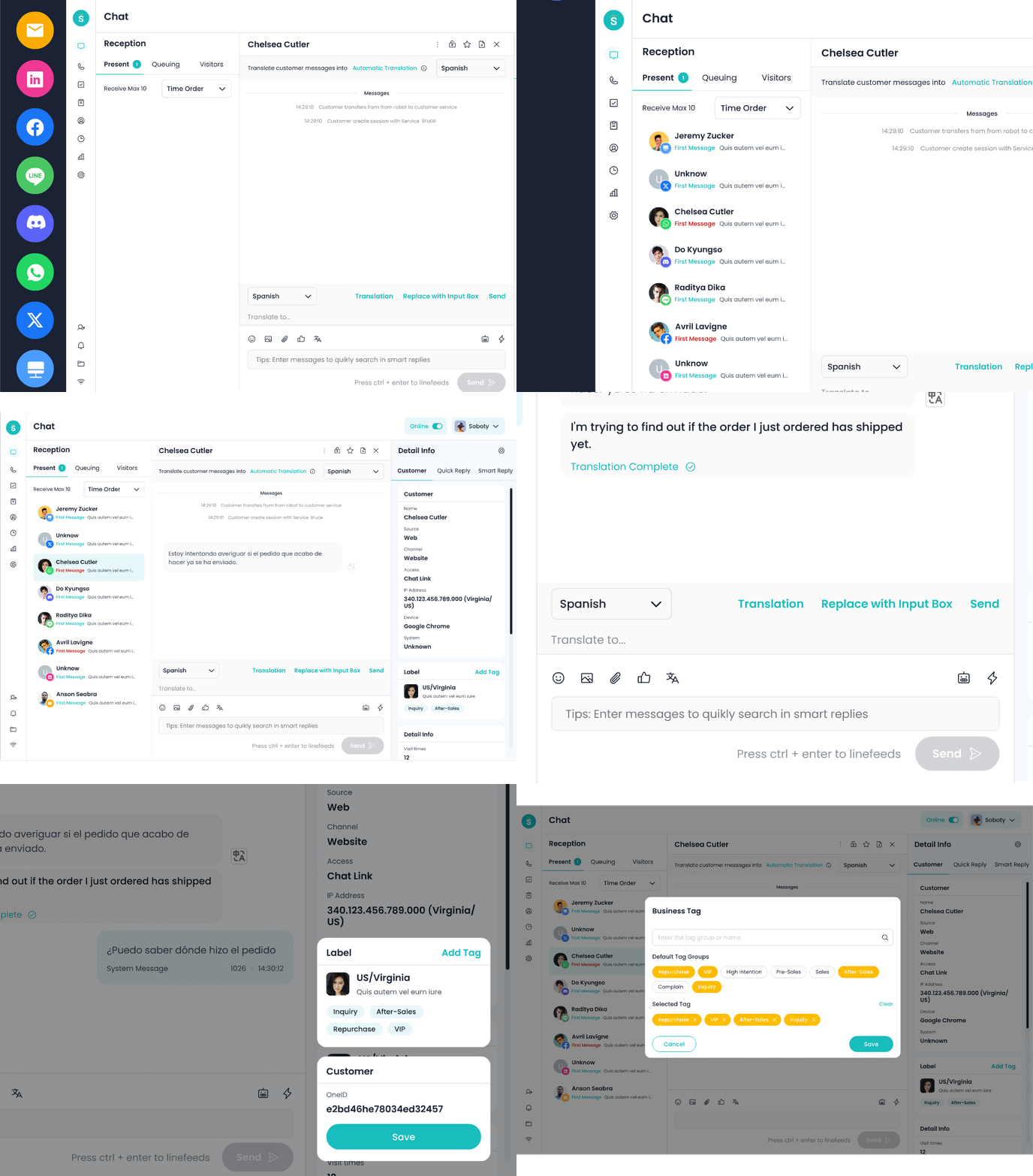
Sobot Agents is part of Sobot’s agentic customer contact platform. Its architecture combines Agents for customer interaction and task execution, Nexus for channels, data, context, and contact infrastructure, and Experts for deployment, operation, and ongoing optimization.
That combination makes Sobot a practical first option for organizations that do not want an isolated chatbot. Sobot Agents can use enterprise Knowledge, Skills, Workflows, Tools, Memory, and Variables. It combines RAG-based retrieval with a Reason–Act–Observe–Adapt loop, subject to configured permissions and business rules. For broader service operations, Sobot also connects the agent layer to omnichannel customer contact and ticketing workflows.
Sobot key features
- Natural-language-assisted Agent creation and updates.
- Reusable Knowledge, Skills, Workflows, Tools, Memory, and Variables.
- RAG for grounded retrieval and ReAct-style reasoning and action.
- Managed Build, Evaluate, Tune, and Observe operating loop.
- Human transfer with relevant available conversation and customer context.
- Broader customer-contact coverage across messaging, voice, ticketing, and WhatsApp, depending on deployment.
Sobot pros
- Combines AI Agent capabilities with customer-contact infrastructure and implementation expertise.
- Strong fit for multi-channel, multi-system, or cross-region service operations.
- Keeps human control available for sensitive, exceptional, or out-of-scope work.
Sobot cons
- Public plan-level pricing and detailed usage allowances are not available.
- Exact connector coverage, module-level languages, model options, and regional availability require confirmation for each deployment.
Sobot pricing
Sobot uses custom pricing. The quote can depend on selected products, channels, Agent and human seats, AI or conversation usage, integrations, telephony or WhatsApp costs, implementation services, security requirements, and support scope. A scoped demo is the appropriate next step for an exact configuration.
2. Botpress
Botpress is a builder-oriented platform for creating custom AI agents. Its visual Studio, knowledge features, workflow controls, logs, and integration options suit teams that want to design the agent’s behavior rather than adopt a fixed help-desk experience.
Botpress is particularly relevant when a support use case needs custom conversation logic, tools, or model usage. The trade-off is ownership: a flexible platform gives the team more control, but the team must still design, test, monitor, and maintain the support operation.
Botpress key features
- Visual environment for building and testing AI agents.
- Knowledge-base ingestion and retrieval.
- Workflow logic, tools, integrations, and configurable webchat.
- Conversation history, analytics, and collaboration features by plan.
Botpress pros
- Flexible for custom support workflows and agent experiences.
- Free pay-as-you-go entry plan for prototyping.
- AI usage is separated as “AI Spend,” which can be capped and monitored.
Botpress cons
- Production quality depends on the team’s design, evaluation, and operational discipline.
- Subscription limits, add-ons, and AI Spend must be modeled together.
Botpress pricing
| Plan | Current price | Important note |
|---|---|---|
| Pay-as-you-go | $0 per month plus AI Spend | Entry plan with usage limits |
| Plus | $89 per month, or $79 billed annually, plus AI Spend | Adds human handoff and expanded features |
| Team | $495 per month, or $445 billed annually, plus AI Spend | Adds collaboration, roles, and higher limits |
| Managed | From $1,495 per month, or introductory $995 billed annually, plus AI Spend | Botpress team builds and maintains the agent |
3. Ada
Ada is an enterprise AI customer service platform spanning voice, email, chat, SMS, and social channels. It emphasizes Playbooks for multi-step standard operating procedures, a Performance Center for improvement, and a developer toolkit for integrations.
Ada fits organizations that want a dedicated enterprise automation platform without making a traditional help desk the center of the architecture. Its broad channel story is useful for global service teams, but buyers should validate the exact implementation scope and commercial model through sales.
Ada key features
- Omnichannel AI agents across voice and digital channels.
- Playbooks for automating multi-step service procedures.
- Performance management, coaching, and KPI tracking.
- APIs, MCP, and SDK options in the developer toolkit.
Ada pros
- Designed for enterprise customer service automation across channels.
- Supports both routine and more complex workflows.
- Strong operational focus on coaching and performance management.
Ada cons
- No public self-serve plan table for a simple like-for-like cost comparison.
- Enterprise deployment and governance requirements may be more than a small team needs.
Ada pricing
| Commercial model | Current public status | Important note |
|---|---|---|
| Enterprise quote | Contact Ada | Confirm whether pricing is conversation-based, included services, channel scope, and commitments |
4. Crescendo.ai
Crescendo Concierge combines AI resolution with a managed customer experience operation. It covers voice, chat, email, SMS, and WhatsApp, and can pass full interaction context to a human specialist when escalation is needed.
Crescendo is distinct from a pure software purchase. It is aimed at organizations that want a provider to operate and improve the service layer, with an outcome-oriented commercial model. That can reduce internal build effort, but it also means evaluating service delivery and commercial terms, not just product features.
Crescendo key features
- One AI layer across major voice and digital channels.
- Status lookups, account updates, order changes, routing, and ticketing.
- Human handoff with customer history, issue context, and suggested next action.
- Managed optimization and quality operations.
Crescendo pros
- Combines technology with operational support.
- Clear fit for teams seeking a managed AI-plus-human model.
- Outcome-oriented pricing aligns charges with completed work.
Crescendo cons
- Less suited to teams that want a self-serve builder and full in-house control.
- The monthly service fee is material for very small support operations.
Crescendo pricing
| Plan | Current price | Important note |
|---|---|---|
| Managed AI | $1.25 per solve plus a $2,900 starting monthly service fee | Volume discounts may apply |
| Managed AI & Superhumans | Contact sales | Combines AI and human support under a managed model |
5. Fin by Intercom
Fin AI Agent is embedded in Intercom’s help desk and can also be used with other service platforms. It connects to support content, handles multi-turn conversations, takes actions through procedures, and hands work to people with the conversation context available.
Fin is a strong fit for digital support teams that want to start with existing knowledge and add outcome-priced automation. Buyers should model both the AI outcome charge and any Intercom seat or channel costs required by their chosen configuration.
Fin key features
- Customer-service-specific AI Agent for answers and actions.
- Multi-turn context and procedures for workflow completion.
- Native Intercom help-desk integration with human handoff.
- Support for selected external help desks without Intercom seat fees.
Fin pros
- Fast path for teams already using Intercom.
- Clear per-outcome charge for Fin usage.
- Can operate alongside an existing supported help desk.
Fin cons
- Total cost can include seats and other usage-based charges when using the full Intercom platform.
- Outcome definitions and minimum commitments should be reviewed carefully.
Fin pricing
| Component | Current price | Important note |
|---|---|---|
| Fin AI Agent | $0.99 per outcome | Charged once when Fin resolves a conversation or completes a workflow |
| Fin on an external help desk | $0.99 per outcome | Minimum monthly commitment applies; no Intercom seat fee |
| Intercom Essential | From $29 per full seat per month billed annually | Fin usage is additional |
| Intercom Advanced | From $85 per full seat per month billed annually | Includes additional service features; Fin usage is additional |
6. Zendesk AI Agents
Zendesk AI Agents extend the Zendesk Resolution Platform across web, mobile, social, email, and voice. They can ground answers in unified knowledge, generate procedures from natural-language workflow descriptions, take actions in connected systems, and route unresolved work to human teams.
Zendesk is an obvious shortlist choice for organizations already operating on its service platform. Its current positioning also allows AI agents to run in other service environments, but buyers should confirm the integration path, resolution tiers, and allowance model.
Zendesk AI Agents key features
- Knowledge grounding across help-center and external sources.
- Multi-step workflow reasoning and connected-system actions.
- Built-in QA controls and resolution improvement loop.
- Messaging, email, voice, and broader service-platform coverage.
Zendesk AI Agents pros
- Deep fit with established Zendesk service operations.
- Connects autonomous resolution with human routing and QA.
- AI Agents are available across Zendesk Suite and Support plans.
Zendesk AI Agents cons
- Pricing depends on the service plan, included allowance, and outcome tier.
- The complete value is strongest when Zendesk is already central to the support stack.
Zendesk AI Agents pricing
| Component | Current price | Important note |
|---|---|---|
| Service plan | Varies by Zendesk Suite or Support plan | Includes a resolution allowance |
| Additional AI outcomes | Value-based, tiered pricing | Confirm outcome tier and pre-purchased allowance with Zendesk |
7. Tidio Lyro
Tidio Lyro AI Agent is designed for conversational support and can be purchased with Tidio Help Desk or connected to another help desk. Its entry model makes it approachable for smaller teams that want to automate repetitive digital questions without beginning with a large enterprise deployment.
Lyro supports website and FAQ ingestion, guidance, actions, and selected help-desk imports. It is a more focused digital-support option than a broad voice and contact-center suite, which is an advantage for simple use cases and a limitation for complex, multi-channel operations.
Tidio Lyro key features
- AI conversations based on uploaded or scraped support knowledge.
- Actions for selected customer tasks.
- Tidio Help Desk bundle or AI Agent-only deployment.
- Import path for Zendesk help-center articles.
Tidio Lyro pros
- Low-friction entry for smaller teams.
- First 50 Lyro conversations are free for the lifetime of the account.
- Usage can be scaled through conversation quotas.
Tidio Lyro cons
- The public pricing configurator becomes custom above standard usage bands.
- Broad enterprise contact-center requirements may need additional systems.
Tidio Lyro pricing
| Option | Current price | Important note |
|---|---|---|
| Initial Lyro allowance | First 50 conversations free for the lifetime of the account | Standard quotas can then be purchased |
| Lyro AI Agent paid usage | Custom, based on monthly conversation volume | Public bands cover 50 to 1,000 conversations; higher volume is custom |
8. Salesforce Agentforce
Salesforce Agentforce is built for organizations that want agents to work with Salesforce data, records, flows, and service processes. Agentforce Builder and prebuilt actions shorten the path for Salesforce-centered teams, while Digital Wallet supports usage tracking.
The platform is most compelling when Salesforce is already the system of record. For a team without Salesforce, the broader platform requirements and licensing model can outweigh the convenience of its native data and workflow access.
Agentforce key features
- Agentforce Builder, Prompt Builder, actions, and Salesforce data access.
- Customer-facing and employee-facing agent use cases.
- Consumption models based on Flex Credits or conversations.
- Digital Wallet for monitoring usage.
Agentforce pros
- Native fit for Salesforce Service Cloud and connected customer data.
- Flexible action-, conversation-, and user-based buying models.
- Strong option for organizations already governing workflows in Salesforce.
Agentforce cons
- Requires careful modeling of Salesforce editions, add-ons, credits, and usage.
- Less attractive when the service operation is not centered on Salesforce.
Agentforce pricing
| Model | Current price | Important note |
|---|---|---|
| Salesforce Foundations | $0 | Entry capabilities; eligibility and included credits depend on the Salesforce edition |
| Flex Credits | $500 per 100,000 credits | Standard Agentforce actions consume credits |
| Conversations | $2 per conversation | Customer-facing conversation model; terms are subject to change |
9. Helpshift
Helpshift is now positioned as an AI-native player engagement platform for gaming. Its support stack combines in-game and cross-platform technology, Care AI, AI Agent Copilot, Language AI, and human services.
This specialization is the reason to shortlist Helpshift. Game studios can keep player context across in-game support, console handoff, community, and human escalation. A general B2B support team, however, may find a broader service platform more aligned to its customer journey.
Helpshift key features
- In-game support SDKs for mobile, PC, and web.
- Console-to-mobile handoff using QR codes or links.
- Care AI for automated resolution and context-aware responses.
- AI Agent Copilot, Language AI, and gaming-specialized human services.
Helpshift pros
- Deep specialization in gaming and player support.
- Brings AI, support technology, and human service into one model.
- Supports contextual escalation instead of treating every channel separately.
Helpshift cons
- Gaming-first positioning makes it a specialist rather than a universal customer service choice.
- No public fixed plan table for simple comparison.
Helpshift pricing
| Commercial model | Current public status | Important note |
|---|---|---|
| Customized modular pricing | Request pricing | Based on interaction volume, activated solutions, capabilities, geography, and language coverage |
10. Freshdesk Freddy AI
Freshdesk combines an omnichannel help desk with Freddy AI Agent capabilities. Current features include AI Agent Studio, conversational and email AI Agents, agentic workflows, and performance improvement tools on supported plans.
Freshdesk is relevant for mid-sized teams that want ticketing, channels, self-service, routing, analytics, and AI in one service suite. The main buying task is to calculate the base help-desk seats and AI session packs together.
Freshdesk Freddy AI key features
- Omnichannel help desk, ticketing, routing, and self-service.
- AI Agent Studio and conversational AI Agents.
- Email AI Agent and agentic workflows.
- Freddy Copilot and Insights as separate AI layers.
Freshdesk Freddy AI pros
- Familiar help-desk model with an AI Agent upgrade path.
- Public seat pricing and AI session-pack information.
- Suitable for teams that want more than a standalone chatbot.
Freshdesk Freddy AI cons
- AI Agent sessions are an additional usage component after included allowances.
- Feature availability differs by Freshdesk product and plan.
Freshdesk Freddy AI pricing
| Component | Current price | Important note |
|---|---|---|
| Growth | $29 per agent per month billed annually | Base Freshdesk Omni plan |
| Pro | $79 per agent per month billed annually | Higher-tier service capabilities |
| Enterprise | $119 per agent per month billed annually | Enterprise controls and service features |
| Freddy AI Agent sessions | $49 per 100 sessions | First 500 sessions are included once for eligible new customers |
11. Gorgias AI Agent
Gorgias AI Agent is purpose-built for ecommerce. It connects support knowledge, store data, brand guidance, and Actions so the agent can answer questions and complete tasks such as order changes, returns, and subscription updates.
Gorgias is a strong specialist choice for brands whose service operation is closely tied to ecommerce transactions. Its help-desk ticket fee and AI automation fee are separate under the current model, so seasonal volume and overage assumptions matter.
Gorgias AI Agent key features
- Store-aware knowledge, catalog, policy, and brand guidance.
- Actions for order and post-purchase workflows.
- Email, chat, and SMS support with human handover.
- Performance reporting, multilingual replies, image understanding, and testing.
Gorgias AI Agent pros
- Clear ecommerce specialization.
- Strong fit for repetitive order and post-purchase requests.
- Outcome-based AI Agent charge focuses billing on automated resolutions.
Gorgias AI Agent cons
- Less relevant outside ecommerce.
- Current billing can include both the help-desk ticket fee and the AI automation fee.
Gorgias AI Agent pricing
| Component | Current price | Important note |
|---|---|---|
| AI Agent | $0.90 per resolved interaction on most plans | Starter begins at $1 per resolved interaction |
| Gorgias Helpdesk | Separate ticket-based subscription | Overage rates and included interaction volumes vary by tier and billing term |
See which AI agent matches your workflows
The most useful pilot starts with real support intents, permitted actions, handoff boundaries, channel requirements, and measurable quality criteria. If your operation needs AI Agents to work with messaging, voice, ticketing, customer context, and human teams in one model, review how AI Agents differ from traditional chatbots and scope the deployment before comparing headline prices.