By 2026, the conversation in customer service has shifted from ‘should we deploy an AI agent?’ to ‘which one, and how do we tell the genuine agentic systems apart from chatbots wearing new wrappers?’ Gartner forecasts that by 2027, AI agents will autonomously resolve 80%+ of routine customer service interactions. The leading platforms are already there in production — Intercom‘s Fin reports 67% average resolution across 7,000+ customers as of December 2025; Sobot’s global B2C deployments at MICO World and Kuro Games run 82–92% bot-resolution across more than 150 countries; Decagon, Sierra, and Maven AGI are pushing the category toward Level-4 agentic workforces with multi-agent orchestration, voice with sub-second latency, and action-taking via deep system integrations.
But the gap between vendor marketing claims and real-world deployment performance is wide enough to be the most expensive blind spot in this category. Headline resolution rates of ‘up to 83%’ or ‘93% autonomous’ routinely sit two-to-three-times higher than the numbers buyers see in month-three production. The platforms with the deepest integration capability are often the ones with the longest implementation cycles. And the choice of LLM stack — multi-model versus single-vendor — has become a structural risk decision, not a feature checkbox.
This guide cuts through the noise. We profile 10 customer service AI agent tools that actually matter in 2026 — Sobot, Sierra, Decagon, Intercom Fin, Maven AGI, Ada, Zendesk AI Agents (post-Forethought acquisition), Cresta, Yellow.ai, and Salesforce Agentforce — with verified customer outcomes, real deployment patterns, multi-LLM architecture comparisons, and a decision framework that helps you match your profile to the right platform. Every claim is sourced; every gap between marketing headline and production reality is documented.
TL;DR — The 2026 AI Agent Tools Shortlist
If you only have two minutes, this is the short answer for the ten AI agent tools we cover in depth below. Every shortlist label is justified with named-customer evidence and a verified resolution-rate data point in the dedicated section.
- Sobot — Best global omnichannel AI Agent for cross-border B2C teams. 82–92% bot-resolution rates verified across MICO World (150+ countries), Kuro Games, TaoMi Games, Envision Energy. Multi-LLM stack (OpenAI + Anthropic Claude + DeepSeek + Amazon Bedrock + Baidu ERNIE). Software + BPO bundled deployment options.
- Sierra — Best outcome-driven enterprise AI Agent for Fortune 500. Bret Taylor’s company has scaled at an unprecedented pace; serves Prudential, Cigna, Blue Cross Blue Shield, Rocket Mortgage, and 40% of the Fortune 50. Model-agnostic Agent OS sitting above existing CX infrastructure.
- Decagon — Best Agent Operating Procedures (AOP) platform for high-volume consumer brands. Late-stage funded with 100+ enterprise customers including Notion, Duolingo, Eventbrite, Chime, Bilt, Hertz, and Substack. Decagon Voice 2.0 with sub-second latency; proactive outbound agents added Spring 2026.
- Intercom Fin — Best resolution-guaranteed AI Agent for chat-first SaaS. 67% average resolution rate across 7,000+ customers (Dec 2025). Fin Vision (image understanding), Fin Voice, Fin Procedures for multi-step workflows. Performance guarantee program for high-volume enterprises.
- Maven AGI — Best AI Agent for B2B enterprise contact centers. 93% autonomous resolution claim across customer base; 50+ enterprise customers including Tripadvisor, ClickUp, Rho. OpenAI-powered, with Maven Voice engineered with Phonic and Cartesia. SOC 2 Type II, HIPAA, PCI-DSS certified.
- Ada — Best established mid-market AI Agent. ~350+ customers across mid-market and enterprise. Dual-model Reasoning Engine (talker + thinker) orchestrating OpenAI, Anthropic, Azure, and Bedrock with Zero Data Retention. Notable outcomes: Simba Sleep, Neptune Flood, Epos Now, Tilt at 84% automated resolution.
- Zendesk AI Agents — Best for Zendesk-native teams after the March 2026 Forethought acquisition. Resolution Platform trained on ~20 billion ticket interactions. Resolution verification via dedicated AI evaluation model with 2–72 hour validation windows. Autonomous Service Workforce unveiled at Relate 2026 in May.
- Cresta — Best voice-first AI Agent and real-time coaching for large contact centers. Customers: United Airlines, NRG Energy, Cox Communications. Knowledge Agent (launched March 2026) provides real-time guidance during live interactions. Multi-language coverage including Japanese, Korean, Chinese.
- Yellow.ai — Best multilingual AI Agent for APAC enterprises. 135+ language coverage with strong WhatsApp / LINE / KakaoTalk / Zalo support, deployed across BFSI, travel, and retail in India and Southeast Asia.
- Salesforce Agentforce — Best AI Agent for Salesforce-native organizations. Tightly integrated with Service Cloud, Sales Cloud, and Data Cloud; Atlas Reasoning Engine; Einstein Trust Layer for data privacy, compliance, and toxicity detection.
What Is a Customer Service AI Agent?
A customer service AI agent is an autonomous software system that can understand a customer’s request in natural language, retrieve the right information from connected knowledge sources and backend systems, and complete the resolution end-to-end — including taking actions like processing refunds, updating accounts, scheduling appointments, or escalating to a human with full context when needed.
Three things separate a real AI agent from a rule-based chatbot or an FAQ widget:
- Reasoning — multi-step planning over a tool set, not just keyword-to-answer mapping. Modern agents call large language models from providers like OpenAI, Anthropic, Google, and Meta to decide what to do next at each turn.
- Action-taking — the agent can hit your CRM, OMS, payment system, knowledge base, and ticketing tool via API. It does not just say things; it does things.
- Self-improvement — every conversation feeds a data flywheel that retrains models, surfaces knowledge gaps, and tightens guardrails. The agent gets better over time without rebuilding the decision tree.
The Four Levels of Customer Service AI in 2026
Vendor marketing collapses everything into the word ‘agent’. In practice, the four levels are very different products with different price tags, capabilities, and risks.
| Level | What it does | Typical resolution rate | Examples |
|---|---|---|---|
| L1 — Rule-based chatbot | Keyword and decision-tree matching. No reasoning. Cannot take actions outside the script. | 5–15% | Legacy IVR; basic helpdesk widgets |
| L2 — Retrieval-augmented FAQ bot | Vector search over a knowledge base plus an LLM that summarizes the retrieved passage. No action-taking. | 20–40% | Tidio Lyro entry tier; Freshchat basic Freddy |
| L3 — AI Agent (reasoning + actions) | Multi-step reasoning, calls APIs and tools, runs workflows, escalates with context. | 50–80% | Sobot AI Agent, Intercom Fin, Ada, Maven AGI, Decagon, Sierra |
| L4 — Agentic workforce (multi-agent) | Multiple specialized agents that hand off to each other, run proactive outbound, and operate across voice + chat + email + employee support. | 75–93% (claimed) | Decagon AOP, Sierra Agent OS, Zendesk Autonomous Service Workforce, Sobot AI Agent + AI Copilot + AI Insight stack |
Most of the 10 platforms in this guide operate at L3 today and are evolving toward L4. The distinction matters because L3 systems still escalate complex cases to humans with full context, while L4 deployments are designed to run autonomously across channels, hand off between specialized agents, and proactively initiate conversations rather than only react to inbound. The architectural gap between L3 and L4 is also why most L4 vendors require sales-led, multi-month enterprise deployments rather than self-serve activation.
How We Evaluated These AI Agent Tools
We have run customer service AI Agent buyer evaluations for global B2C and B2B teams since 2024. For this 2026 guide we cross-referenced four sources for every vendor:
- Vendor-published outcomes: case studies, product documentation, investor blog posts.
- Independent third-party reviews: G2, TrustRadius, Vendr, AWS Marketplace, eesel.ai independent teardowns, myaskai vendor guides.
- Public company maturity signals: 2025–2026 funding stage, customer count growth, named-customer logos.
- Buyer-side practitioner reporting: 2026 implementation timelines, real-world resolution rates from named customer interviews, post-deployment performance outcomes.
We deliberately separated each vendor’s marketing claim from its real-world deployment performance, because the gap between ‘headline resolution rate’ and ‘what your team will actually see in month three’ is the most expensive blind spot in this category. See the dedicated section ‘The Resolution Rate Trap’ below.
Disclosure: Sobot publishes this guide. We list ourselves first because the cross-border B2C profile is where we win head-to-head, and we want the reader to be able to compare us against the alternatives we routinely lose to in other profiles (Sierra at the Fortune 500 tier, Intercom Fin on chat-first SaaS, Decagon on US consumer brands). Where a competitor genuinely fits a buyer’s situation better, we say so.
Quick Comparison Table: 10 AI Agent Tools for Customer Service in 2026
| Tool | Best for | Resolution rate (claimed / verified) | LLM stack & architecture | Notable customers |
|---|---|---|---|---|
| Sobot | Cross-border B2C scale | 82–92% bot-resolution rate (verified across 6 named deployments) | Multi-LLM: OpenAI + Anthropic Claude + DeepSeek + Amazon Bedrock + Baidu ERNIE; three-layer product stack (AI Agent + AI Copilot + AI Insight) | MICO World, Kuro Games, TaoMi Games, Dongfangzhenxuan, Envision Energy, Visual China |
| Sierra | Fortune 500 regulated industries | Not publicly disclosed; outcomes verified case by case | Model-agnostic Agent OS over OpenAI + Anthropic + Meta; standalone platform sitting above existing CX infrastructure | Prudential, Cigna, Blue Cross Blue Shield, Rocket Mortgage, SiriusXM |
| Decagon | US consumer brands at scale | 80% deflection (avg); 90% (Substack); 70% (Chime chat + voice) | Agent Operating Procedures (AOP) engine; unified agent brain abstracting a multi-agent ecosystem; Decagon Voice 2.0 | Notion, Duolingo, Eventbrite, Chime, Bilt, Hertz, Substack |
| Intercom Fin | Chat-first SaaS, lean teams | 67% avg (Dec 2025, 7,000+ customers); 42–72% per case study | Fin Procedures + Fin Vision + Fin Voice; deployable on any helpdesk via Fin Anywhere | Nuuly, Lightspeed, Topstep, Robin |
| Maven AGI | B2B enterprise contact centers | 93% autonomous answers (claimed avg); 80% resolution in <3 min | OpenAI-powered with Phonic + Cartesia for voice; Graph of Record architecture; AI Agent Designer | Tripadvisor, ClickUp, Rho |
| Ada | Established mid-market omnichannel | Up to 83% claimed; 40% baseline per Ada’s own ROI calculator; 30–50% real-world typical | Reasoning Engine with dual-model architecture (talker + thinker) over OpenAI, Anthropic, Azure, Bedrock; Zero Data Retention | Simba Sleep, Neptune Flood, Epos Now, IPSY, Tilt |
| Zendesk AI Agents | Zendesk-native teams | Outcome-verified by LLM evaluator post-resolution window (2–72 hrs) | Resolution Platform trained on 20B+ ticket interactions; Forethought five-agent architecture (Solve, Triage, Assist, Discover, Agent QA) integrated post-acquisition | Trained on 20B ticket interactions; broad existing Zendesk install base |
| Cresta | Large voice contact centers | Real-time coaching uplift; AI Agent virtual agent metrics not publicly disclosed | Voice-first architecture; Knowledge Agent for real-time guidance; Conversation Intelligence auto-scoring 100% of interactions | United Airlines, NRG, Cox Communications |
| Yellow.ai | APAC multilingual enterprises | Not consistently disclosed; varies by deployment | Hybrid LLM generation + retrieval-augmented grounding; 135+ language coverage; deep APAC channel support | Sony, Domino’s APAC, Pelago, Bajaj Electricals |
| Salesforce Agentforce | Salesforce-native CRM teams | Not publicly disclosed; Atlas Reasoning Engine benchmark not third-party verified | Atlas Reasoning Engine; Einstein Trust Layer for data privacy; native Data Cloud + Customer 360 metadata access | Wiley, Saks, ADP, OpenTable |
The 10 AI Agent Tools for Customer Service in 2026, Reviewed
1. Sobot — Best Global Omnichannel AI Agent for Cross-Border B2C Teams
What it is
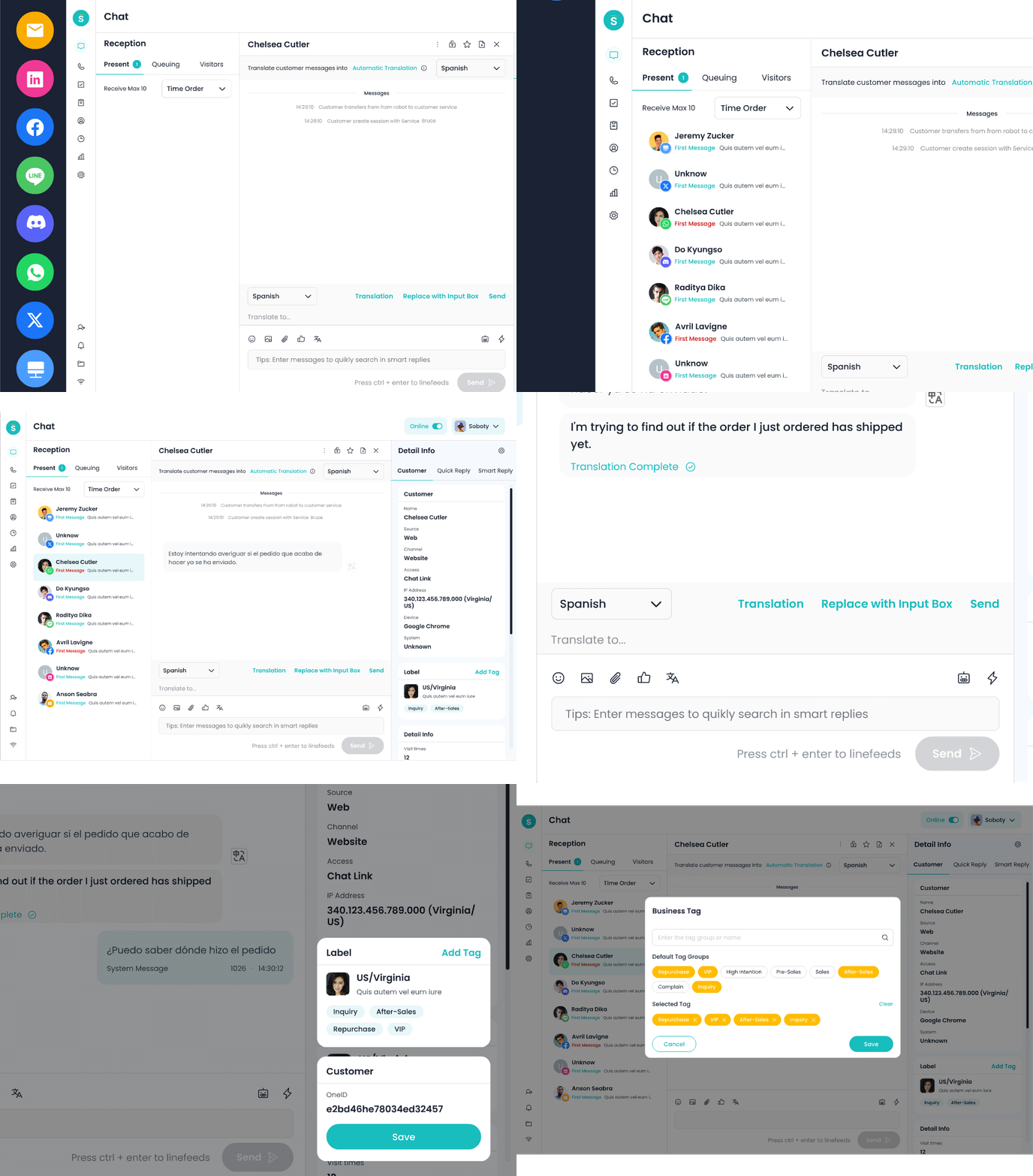
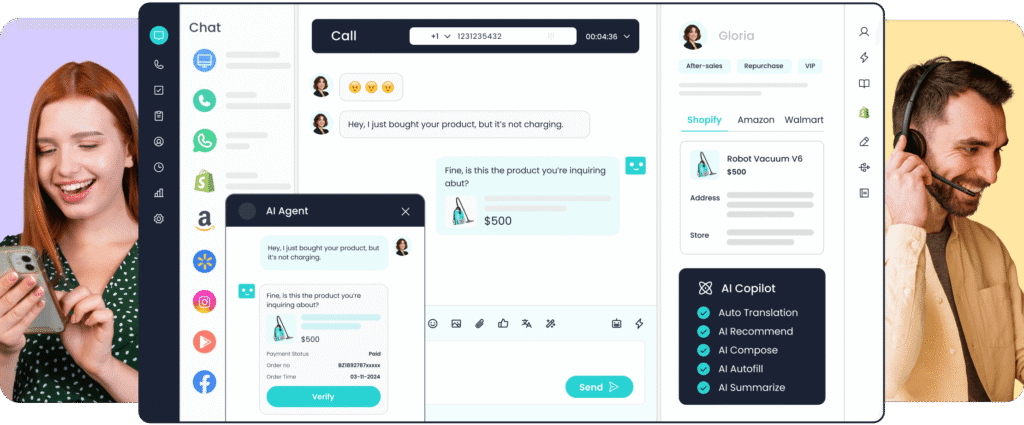
Sobot is an integrated AI customer contact platform with three layered products: AI Agent (the autonomous large-model bot), AI Copilot (real-time agent assist for human reps), and AI Insight (post-conversation analytics, QA, and Voice of Customer). The platform sits on a multi-LLM stack — OpenAI, Anthropic Claude, DeepSeek, Amazon Bedrock, and Baidu ERNIE — and routes the right model to the right task rather than betting on a single foundation model.
Why it stands out for cross-border B2C
Sobot was built from the ground up for multi-language, multi-time-zone, multi-currency operations. The platform supports 75 source languages and 5,550 translation pairings in AI Copilot, multilingual knowledge versioning so one knowledge base can serve global customers, and a multimodal knowledge engine that parses 12+ document formats including PDFs with embedded images, tables, and product spec sheets.
Verified customer outcomes
- MICO World (global social entertainment, operating in 150+ countries including MENA, SEA, Japan/Korea): 82% bot-resolution rate, 85% knowledge maintenance efficiency gain, 93% answer accuracy.
- Kuro Games (publisher of Wuthering Waves, global gaming): 85% bot-resolution rate, 65% operator efficiency gain, 88% answer accuracy.
- TaoMi Games (20+ titles, 39.4M MAU, gaming): 87% bot-resolution rate, 30% player satisfaction lift, 94% answer accuracy.
- Dongfangzhenxuan (live commerce / retail, cross-border China + global): 84% bot-resolution rate, 22% CSAT lift, 95% answer accuracy.
- Envision Energy (cross-border B2B HR shared service center on WeCom): 92% bot-resolution rate, 70% operator efficiency gain, 93% employee CSAT.
- Visual China — VCG.com (cross-border content trading): 91% bot-resolution rate, 26% CSAT lift, 94% answer accuracy.
Deployment & integration
Sobot offers software-only and software + BPO bundled deployment options, with the package shaped by multi-language scope and multi-channel coverage rather than per-interaction metering. Implementations operationalize within weeks rather than the 8–16 weeks typical of US-based enterprise platforms. The knowledge engine ingests 12+ document formats — PDF, DOCX, tables, page-by-page web crawl with sitemap traversal — and bootstraps the AI Agent from existing NLP-bot knowledge bases or agent conversation history through demonstration learning, materially shortening cold-start.
Limitations to know
Sobot’s voice AI Agent is strong for inbound IVR-extension scenarios and outbound notification + reactivation campaigns, but the brand profile in pure US-domestic CCaaS voice is smaller than Cresta or Five9. If your support is 90%+ voice and you are a US-only operation, evaluate Cresta or NICE alongside Sobot.
Best for
B2C brands selling into 5+ countries who need consistent quality across English, Bahasa, Thai, Vietnamese, Korean, Arabic, Spanish, and Mandarin. Gaming publishers managing live ops across regions. Cross-border e-commerce, live commerce, and social entertainment platforms. HR shared service centers at multinational manufacturers.
2. Sierra — Best Outcome-Priced Enterprise AI Agent for Fortune 500
What it is
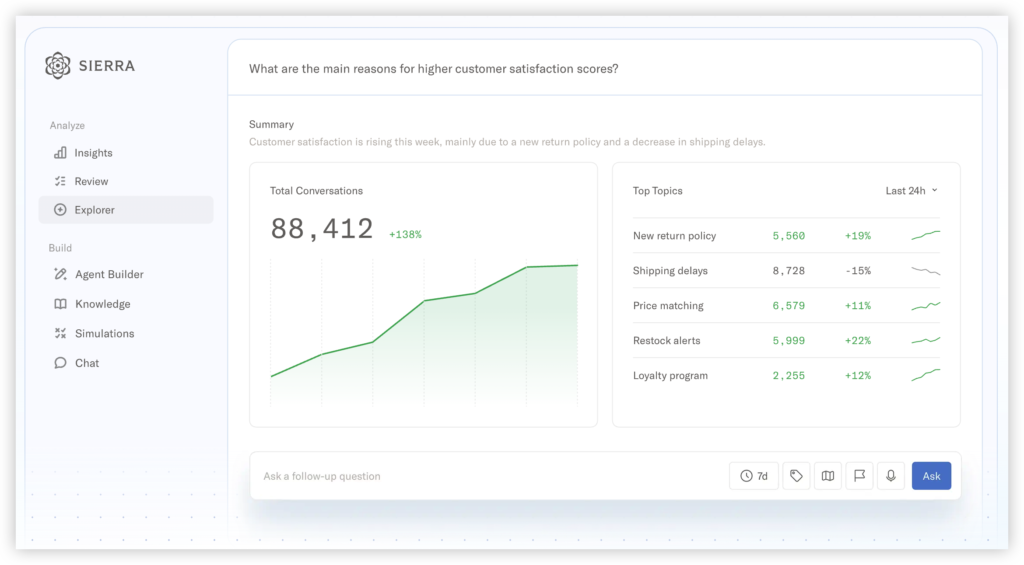
Sierra is what its founder Bret Taylor (former Salesforce co-CEO and OpenAI board chair) calls ‘Agent OS’ — a standalone platform that sits above an enterprise’s existing CX infrastructure, connects to CRM, order management, subscription platforms, and data warehouses via APIs, and deploys AI agents that take real actions: process returns, update subscriptions, manage cancellations, complete multi-step workflows.
Why it stands out
Sierra has scaled at a pace effectively unprecedented in enterprise software, raising a recent Series E led by Tiger Global and Google’s GV with participation from Benchmark, Sequoia, and Greenoaks. Customers are concentrated in regulated industries: Prudential, Cigna, Blue Cross Blue Shield, Rocket Mortgage, and roughly one in three of the world’s largest banks. Sierra serves more than 40% of the Fortune 50.
Distinguishing features in 2026
- Outcome-aligned commercial model — Sierra structurally aligns vendor incentives with verified business outcomes (resolution, retention, save, upsell) rather than software usage. Effectively pioneered by Sierra for AI Agents.
- Agent Studio (no-code workflow builder for CX teams) and Agent SDK (declarative developer toolkit with CI/CD and composable skills) ship together.
- Ghostwriter, launched March 25, 2026, ingests SOPs, transcripts, whiteboard photos, or audio recordings and produces a production-ready agent across voice, chat, and email in 30+ languages.
- Model-agnostic: runs on a constellation of LLMs from OpenAI, Anthropic, and Meta. Voice overtook text as Sierra’s primary channel by September 2025.
Deployment & integration
Sierra’s onboarding is sales-led, CSM-guided, and typically takes 4–10 weeks for initial deployment. There is no signup button on sierra.ai; the path starts with a demo, discovery session, scoped pilot, and 90-day onboarding period with a dedicated support channel and personalized training. Integration scope — connecting to CRM, order management, subscription platforms, and data warehouses via APIs — is the primary timeline driver. Not a fit for SMB or mid-market teams; designed for Fortune 1000 enterprises with dedicated developer capacity.
Best for
Fortune 1000 enterprises with complex multi-system integrations and dedicated developer capacity, especially in insurance, banking, healthcare payers, and regulated financial services.
3. Decagon — Best Agent Operating Procedures Platform for High-Volume Consumer Brands
What it is
Decagon was founded in 2023 by Jesse Zhang and Ashwin Sreenivas. The platform centers on Agent Operating Procedures (AOPs) — natural-language instructions that compile into structured logic for agents to reliably execute workflows. AOPs let teams teach their agents the same way they would onboard a new teammate: describing what to do, how to do it, and under what conditions to adapt.
Why it stands out
Decagon scaled rapidly through 2025 with 4× year-over-year growth, raised a Series D led by Coatue and Index Ventures in January 2026, and serves 100+ enterprise customers including airlines, banking, telecom, and retail.
Distinguishing features
- AOP engine plus AOP Copilot (Sept 2025) that converts SOPs into production-ready AOPs in seconds.
- Decagon Voice 2.0: inbound and outbound calls with sub-second latency, customizable tone, interruption handling, branded caller IDs. Integrates with Amazon Connect, RingCentral, and SIP trunking. Spring 2026 added proactive outbound voice capabilities.
- AI Actions for refunds, order updates, identity verification through Stripe, Shopify, Salesforce.
- Multilingual: claims any-language support; Rituals Cosmetics deployment runs 15 languages from a single English knowledge base.
Verified outcomes
- Platform average: 80% deflection rate, 65% reduction in support workload, 93% agent quality score.
- Chime: 70% resolution across chat and voice.
- Duolingo: 80% deflection.
- ClassPass: 10× deflection rate increase, scaled chat to 24/7.
- Hunter Douglas: seven-figure revenue attributed to fully AI-handled conversations.
Deployment & integration
Decagon implementations are sales-led with dedicated Agent Product Managers and Forward-Deployed Engineers. Some buyers on G2 report faster initial setup (under a week); complex integrations and advanced workflows extend the timeline. Native integrations cover Amazon Connect, RingCentral, SIP trunking on the voice side, and Stripe, Shopify, Salesforce on the action side.
Limitations
Limited workforce management integration is Decagon’s biggest operational gap — the platform was built to resolve tickets rather than to run entire support operations. It does not offer native integrations with WFM tools or staffing systems, making it difficult to connect AI activity with real-time agent coverage, scheduling accuracy, or intraday performance. Independent verification of the 80% deflection average is limited; published case studies range from a 32% deflection lift at Rippling to 90% resolution at Substack — verify per use case during pilot.
Best for
US consumer brands with high ticket volume and well-defined workflows. Strongest fit: gaming, fintech, e-commerce, and travel where actions like refunds, account verification, and order updates have clear business rules.
4. Intercom Fin — Best Resolution-Guaranteed AI Agent for Chat-First SaaS
What it is
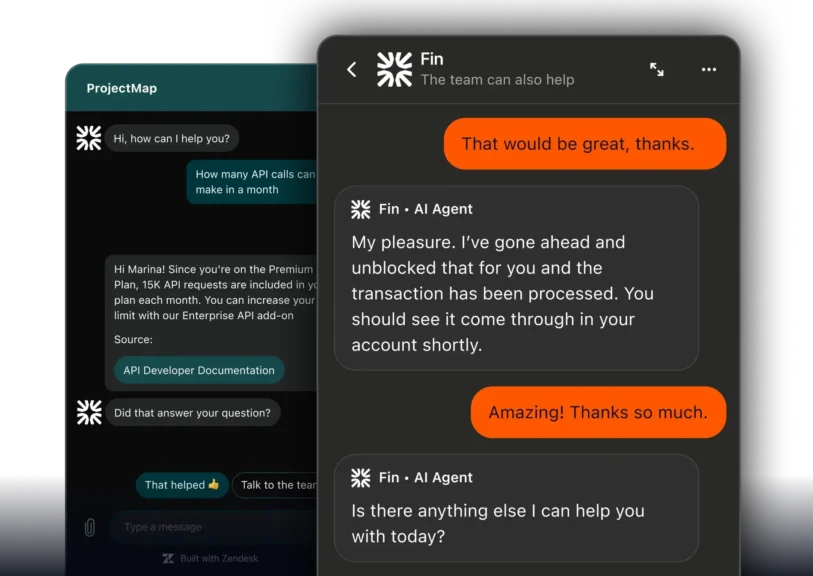
Fin is Intercom’s outcome-driven AI Agent, available on every Intercom plan and deployable on top of other helpdesks via Fin Anywhere. Fin operates across messaging, email, voice (Fin Voice), and ChatGPT.
Why it stands out
Fin’s average resolution rate is 67% across 7,000+ customers as of December 2025, improving roughly 1% every month according to Intercom’s own data. Fin is also one of the few platforms to back its performance claim with a published guarantee program: for enterprises with 250,000+ monthly conversations, Fin offers a 65% resolution-rate guarantee. New customers who are not satisfied within 90 days are eligible for a full refund under the same program.
Distinguishing features
- Fin Vision (image understanding active by default, no extra cost) — accepts screenshots, error screens, identity documents, broken UI states.
- Fin Voice as an add-on, with deployment across every channel.
- Fin Procedures — natural-language instructions for multi-step processes that can incorporate tool calls and data connectors. Replaces what Intercom previously called ‘tasks’.
- Deep dynamic integrations via MCP / data connectors to Shopify, Salesforce, Stripe, Jira.
- Compliance breadth: GDPR, CCPA, SOC 2 Type II, HIPAA, ISO 27001, 27018, 27701, 42001 — one of the broadest certification sets in the category.
Real customer outcomes
- Nuuly: 49% instant resolution, 95% CSAT, 40% headcount avoidance.
- Lightspeed: 72% resolution across 12+ languages.
- Topstep: 65% resolution handling 150,000+ monthly conversations.
- Linktree: 42% resolution (lower-end of the real-world range).
- Robin: 50% resolution.
Deployment & integration
Fin can be deployed in under an hour on top of any helpdesk via Fin Anywhere — not just Intercom — and starts resolving tickets, cases, emails, and messages across every channel out of the box. A free 14-day trial with unlimited resolutions is publicly available. Startups can access an Early Stage Program that includes Fin, lowering the barrier to evaluation for fast-growing teams.
Best for
Chat-first SaaS companies and digital-native brands with lean support teams, particularly those that want a fast pilot, a published performance guarantee program, and minimal integration friction with their existing helpdesk.
5. Maven AGI — Best AI Agent for B2B Enterprise Contact Centers
What it is
Maven AGI is an enterprise AI agent platform built specifically for the complexities of large-organization customer experience: extensive technology stacks, regulatory requirements, high inquiry volumes, and customers expecting accurate and timely responses. The company was founded in early 2023 by Jonathan Corbin, Sami Shalabi, and Eugene Mann; it is venture-backed and certified SOC 2 Type II, ISO 27001, HIPAA, and PCI-DSS.
Why it stands out
Across customer deployments, Maven AGI reports 93% of customer support questions autonomously resolved, 60% reduction in average time-to-resolve, and 2× CSR productivity. The Graph of Record architecture is positioned as a way to scale Business AGI by connecting systems instead of duplicating them — letting AI deploy faster, reduce hidden infrastructure costs, and move confidently from experimentation to production.
Distinguishing features
- Maven Voice: enterprise voice agent with real-time conversation intelligence, deep system integrations, and the ability to listen, reason, take action, and hand off to humans with complete context. Engineered with OpenAI, Phonic, and Cartesia under the hood.
- Native integrations with Salesforce, Zendesk, Freshdesk, Genesys, and Twilio.
- AI Agent Designer for fine-tuning, testing, and monitoring agent behavior.
- Listed on The Agentic List 2026 in the CX Agents category.
Customers
50+ enterprise customers including publicly traded companies. Named customers include Tripadvisor, ClickUp, and Rho.
Deployment & integration
Maven AGI agents are designed to go live within days and improve continuously with every interaction. The platform offers seamless integration with existing systems through native connectors to Salesforce, Zendesk, Freshdesk, Genesys, and Twilio. Available via direct sales or AWS Marketplace. Maven Voice fits directly into the existing contact center stack and integrates with real-time conversation intelligence layers.
Best for
B2B enterprise customer support and contact center modernization, especially in regulated industries (financial services, healthcare, insurance) where SOC 2 Type II + HIPAA + PCI-DSS coverage is non-negotiable.
6. Ada — Best Established Mid-Market AI Agent
What it is
Ada is one of the most-deployed enterprise AI customer service platforms, with 350+ customers. Ada runs a multi-LLM architecture through its proprietary Reasoning Engine, orchestrating models from OpenAI (primary), Anthropic, Microsoft Azure, and Amazon Bedrock. It maintains Zero Data Retention agreements with all providers and uses a dual-model system: a fast ‘talker’ model for conversational dialog and a deep ‘thinker’ model for complex multi-step reasoning.
Channel coverage
Web chat supports 63 languages, email approximately 50, voice 8 (English, Dutch, French, German, Italian, Spanish, Swedish). 10 languages receive high-quality LLM generation; the rest use Google Translate. Through its API-based skills framework, Ada connects to payment processors, inventory management, CRMs, shipping providers, and custom applications to execute returns, update accounts, schedule appointments, or escalate with full context.
Real customer outcomes
- Simba Sleep: substantial monthly revenue unlocked via the AI agent; generative AI outperformed the prior scripted bot on every A/B test metric.
- Neptune Flood: 78% reduction in per-ticket effort, 92% resolution-time reduction, six-figure operational savings in year one.
- Epos Now: 60,000+ human labor hours saved per month, 30% CSAT increase.
- IPSY: 943% ROI on Ada investment.
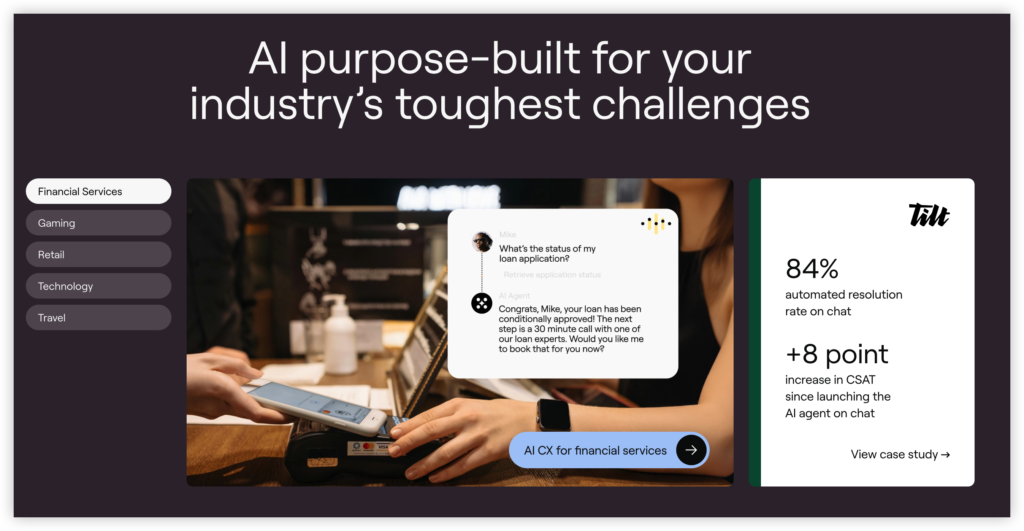
- Tilt: 84% automated resolution.
- eSky Group: 17-point resolution rate increase in 4 months, contributing to 200% ROI.
The 83% claim, deconstructed
Ada markets ‘up to 83%’ automated resolution. Published case studies range 70–84%. But Ada’s own ROI calculator uses a conservative 40% baseline. Independent analysis estimates real-world resolution rates of 30–50% for typical mid-market deployments. Ada itself distinguishes containment (conversations that did not escalate, including frustrated customers who gave up) from automated resolution (conversations where the AI accurately, relevantly, and safely resolved the inquiry). For Ada to count a conversation as resolved, it must pass three checks: relevance, accuracy, and safety.
Deployment & integration
Ada CX implementation typically takes 8 to 16 weeks, vs 4–6 weeks for Zendesk AI. A phased pilot rollout is the standard pattern: select a single high-volume use case with clear success metrics in weeks 1–4, define baseline performance, configure pre-built templates, then expand. Compliance posture includes active HIPAA, SOC 2 Type II, GDPR, CCPA, and PCI certifications.
Best for
Established mid-market and large enterprise teams that want a mature platform with a wide customer reference base and have engineering capacity to manage API integrations.
7. Zendesk AI Agents — Best for Zendesk-Native Teams After the Forethought Acquisition
What it is
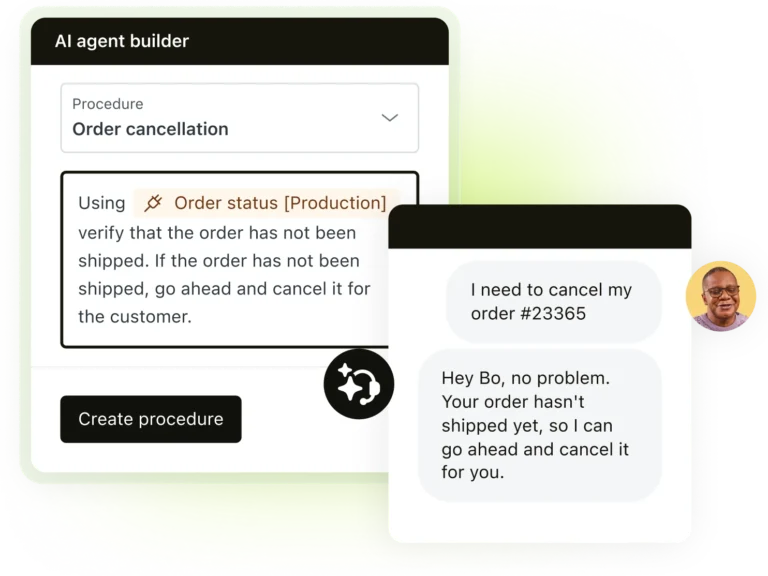
In May 2026, Zendesk unveiled its Autonomous Service Workforce at the Relate conference in Denver, replacing deflection-based bots with specialized AI agents operating across messaging, email, and voice — priced only on verifiable resolutions. At the center is the Zendesk Resolution Platform, trained on roughly 20 billion ticket interactions.
The Forethought integration
On March 11, 2026, Zendesk announced the acquisition of Forethought; the deal closed March 26. TechCrunch called it Zendesk’s largest acquisition in nearly 20 years. Zendesk’s stated rationale: accelerating its own AI roadmap by more than a year. Forethought continues as ‘Forethought AI Agents by Zendesk’ and remains available to non-Zendesk customers. Forethought’s five-agent architecture — Solve, Triage, Assist, Discover, Agent QA — is being integrated into the Zendesk Resolution Platform.
Resolution verification
Resolutions are evaluated after a 2-hour window for messaging (configurable up to 72 hours) and a flat 72-hour window for email. Each resolution is independently validated by a dedicated AI evaluation model; spam and routine exchanges are excluded from counted resolutions. Industry implementations of autonomous AI report a 28% improvement in issue resolution time and a 19% increase in first-contact resolution rates.
Limitations
Advanced AI is an agent-productivity layer, not a full autonomous resolver in isolation. The common 2026 pattern: teams on Zendesk keep Zendesk for the ticketing UI and agent workspace, but layer a dedicated AI agent platform (Sobot, Twig, Decagon, or Sierra) on top for autonomous resolution. Verify resolution counting carefully in your contract — particularly the rules around what counts as a resolved versus escalated conversation.
Best for
Teams already deeply invested in Zendesk Suite who want to keep their ticketing UI, agent workspace, and reporting layer intact, and who can negotiate the resolution volume commitment cleanly.
8. Cresta — Best Voice-First AI Agent and Real-Time Coaching for Large Contact Centers
What it is
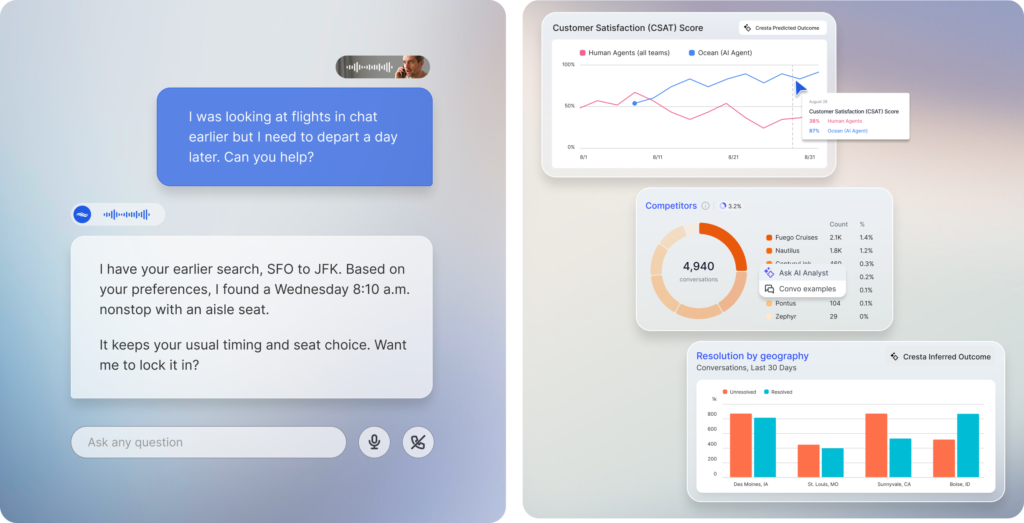
Cresta is an AI-native contact center platform born out of Stanford’s AI Lab, with executives from Google Contact Center AI, Vertex AI, and OpenAI. Backed by Andreessen Horowitz, Sequoia, and Greylock. The platform combines AI agents with human-agent assist across voice and digital channels.
Distinguishing features in 2026
- Knowledge Agent, launched March 2026, provides real-time answers to contact center agents during live interactions; operates within the agent’s browser, analyzes the conversation and on-screen data, surfaces guidance based on company policies.
- Cresta AI Agent (virtual agent) combines business logic with LLMs for personalized, brand-safe conversations.
- Agent Assist for real-time guidance and AI-generated summaries.
- Conversation Intelligence auto-scores 100% of interactions and reinforces winning behaviors via AI-enabled coaching workflows.
- Multi-language support including Czech, Danish, German, English, French, Japanese, Korean, Spanish, Chinese (Simplified and Traditional).
Customers
United Airlines, NRG Energy, Cox Communications.
Deployment & integration
Enterprise-only, sales-led. Annual contracts and minimum seat thresholds of 50–100 agents are standard. Multi-week procurement cycles are typical. Cresta is also available through AWS Marketplace.
Limitations
Cresta sits at 4.2/5 on G2 from 43 reviews; TrustRadius shows a single detailed review — the review base is thin compared to broader platforms. Transcription accuracy is sometimes inconsistent. No self-serve tier and no way to evaluate without a sales cycle.
Best for
US-based contact centers with 100+ agents and voice as the primary channel. If you are evaluating Cresta, also evaluate Balto and Observe.AI on the real-time coaching axis.
9. Yellow.ai — Best Multilingual AI Agent for APAC Enterprises
What it is
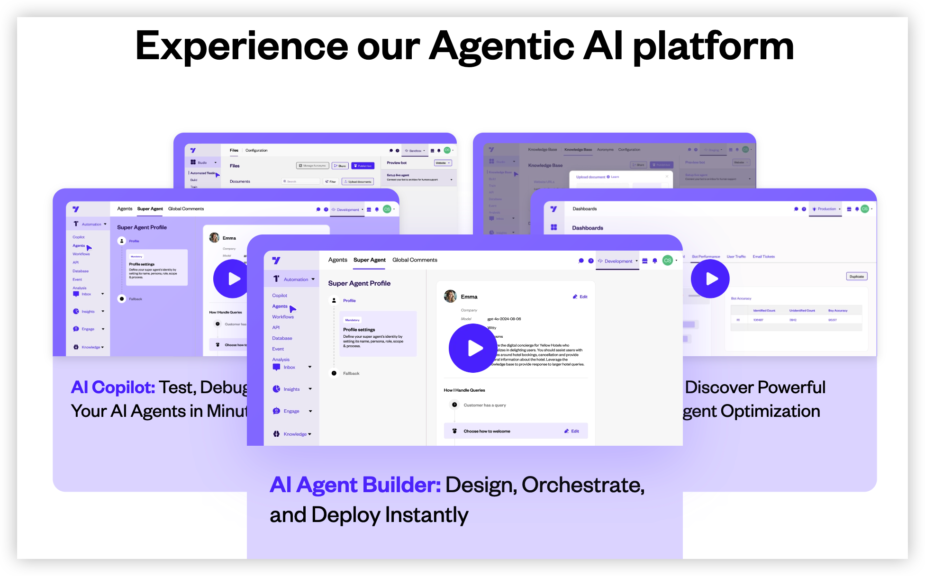
Yellow.ai is an enterprise conversational AI platform focused on APAC and EMEA markets, with broad coverage of regional channels (WhatsApp, LINE, KakaoTalk, Zalo) and language support of 135+ languages. The platform handles voice, chat, and email with a dynamic AI architecture combining LLM generation with retrieval-augmented grounding.
Customers and use cases
Customers include Sony, Domino’s APAC, Pelago, and Bajaj Electricals. Strong use cases in banking, insurance, and travel across India and Southeast Asia. Yellow.ai’s regional channel coverage is genuinely deeper than US-headquartered competitors in APAC.
Deployment & integration
Sales-led, enterprise-focused implementations. Deeper deployment partnerships in BFSI, travel, and retail across India and Southeast Asia. The no-code Studio enables business teams to build flows without engineering, with retrieval-augmented grounding for knowledge base integration.
Limitations
Outside its APAC + EMEA core, Yellow.ai has thinner enterprise reference customers in North America. Reviewers note the no-code Studio is powerful but has a meaningful learning curve.
Best for
APAC enterprises and global brands with a heavy India + Southeast Asia presence who need depth on regional messaging channels.
10. Salesforce Agentforce — Best AI Agent for Salesforce-Native Organizations
What it is
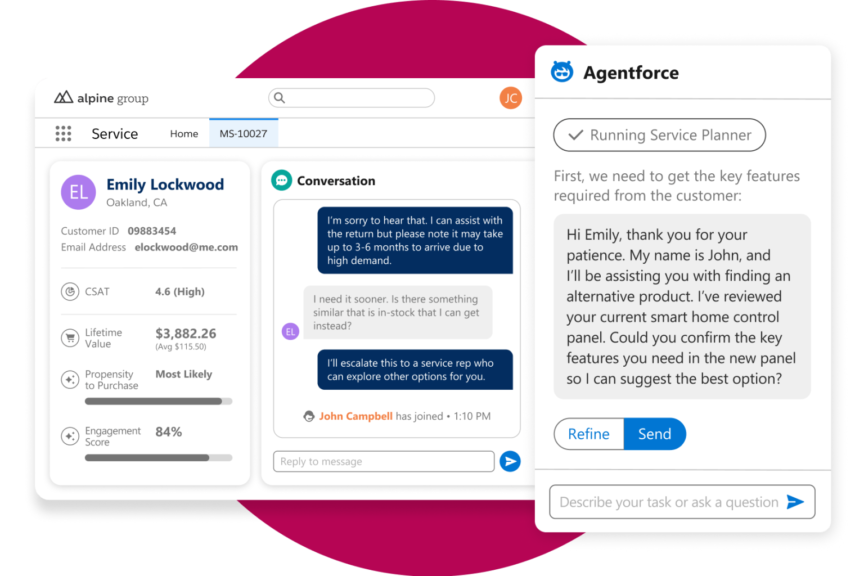
Agentforce is Salesforce’s autonomous AI agent layer launched in late 2024 and expanded across 2025–2026, powered by the Atlas Reasoning Engine and integrated with the Einstein Trust Layer for data privacy. Agentforce can be deployed across Service Cloud, Sales Cloud, Marketing Cloud, Commerce Cloud, and Data Cloud, drawing on the same data and metadata as the rest of the Salesforce stack.
Distinguishing features
- Atlas Reasoning Engine for multi-step planning and tool use.
- Einstein Trust Layer providing zero-data-retention with major LLM providers, dynamic grounding, and toxicity detection.
- Native access to Data Cloud, Customer 360, and the full Salesforce metadata layer — fewer integration projects compared to standalone agent platforms.
- Agent Builder for rapid agent configuration on top of Service Cloud workflows.
Customers
Wiley, Saks, ADP, OpenTable, plus the Salesforce installed base.
Deployment & integration
Deployed natively within the Salesforce ecosystem, leveraging existing Service Cloud workflows, Data Cloud, and Customer 360 metadata. Agent Builder enables rapid agent configuration on top of existing Salesforce processes. Available as part of Service Cloud Einstein 1 / Data Cloud bundles or as an Agentforce add-on.
Best for
Organizations already running Salesforce as the system of record for customer data, sales pipeline, and service operations. The integration depth makes Agentforce hard to beat inside the Salesforce ecosystem; outside it, evaluate Sobot, Sierra, or Decagon based on profile.
The ‘Resolution Rate’ Trap: Marketing Claims vs Real Deployment Numbers
The single most expensive blind spot in this category is the gap between headline resolution rates and what your team will actually see in production. Here are the verified marketing claim vs reality gaps for the platforms in this guide.
| Vendor | Marketing claim | Verified real-world range | Source of reality check |
|---|---|---|---|
| Sobot | 82–92% bot-resolution (verified) | 82–92% across 6 named deployments | Public case studies with named customer, vertical, and exact metric |
| Sierra | Outcome-based, undisclosed | Not publicly disclosed | Customers pay only for verified successful resolutions |
| Decagon | 80% deflection (platform avg) | 32% (Rippling) to 90% (Substack) | Decagon-published case studies |
| Intercom Fin | 67% average resolution | 42% (Linktree), 49% (Nuuly), 65% (Topstep), 72% (Lightspeed) | Intercom-published customer case studies |
| Maven AGI | 93% autonomous answers | 70% first-contact resolution; 80% in <3 min (separate metrics) | Maven AGI-published documentation |
| Ada | Up to 83% automated resolution | 30–50% real-world typical; 40% baseline in Ada’s own ROI calculator | Ada’s own ROI calculator + independent eesel.ai analysis |
| Zendesk | Outcome-verified resolution | 28% improvement in resolution time; 19% in FCR (industry avg) | Industry benchmarks; outcome verification window 2–72 hrs |
| Forethought (Solve) | Up to 98% resolution | 44–87% per case study; ~65% honest average per Forethought’s own benchmark | Vendor-published benchmark documentation |
| Cresta | Not consistently disclosed | Not publicly disclosed for AI Agent virtual agent product | G2 + TrustRadius (43 reviews total — thin sample) |
| Yellow.ai | Not consistently disclosed | Varies by deployment | Vendor case studies |
| Salesforce | Atlas benchmark not 3rd-party verified | Not publicly disclosed | Vendor materials |
The honest rule of thumb: take any vendor’s ‘up to’ resolution number and divide by two to estimate the realistic floor for month-three production performance. Plan for the upside through tuning, knowledge expansion, and integration depth over the first two quarters.
AI Agent Architecture Patterns: Multi-LLM Stacks, Standalone Platforms, and Helpdesk-Layered Deployments
Vendor marketing flattens architectural choices into the catch-all word ‘agent’. In practice, three architectural dimensions separate the platforms in this guide — LLM stack composition, deployment topology, and reasoning pattern — and each carries different operational risks and capabilities.
Multi-LLM vs single-vendor LLM stacks
The 2026 platforms split cleanly into multi-LLM and single-LLM camps. Multi-LLM stacks route the right model to the right task and insulate the buyer from single-provider risk (throttling, terms-of-service changes, model deprecation, price action). Single-LLM stacks are simpler to operate but inherit one provider’s roadmap and reliability profile entirely.
| Pattern | Platforms | What it buys you |
|---|---|---|
| Multi-LLM stack | Sobot (OpenAI + Anthropic + DeepSeek + Bedrock + ERNIE), Sierra (OpenAI + Anthropic + Meta), Ada (OpenAI + Anthropic + Azure + Bedrock with dual talker/thinker) | Resilience against single-provider outages, throttling, or policy changes; ability to route Chinese / Japanese / Korean / Arabic queries to models with stronger native generation |
| Single-vendor LLM | Maven AGI (OpenAI), Intercom Fin (primarily OpenAI), Salesforce Agentforce (Atlas Reasoning Engine + Einstein Trust Layer over selected providers) | Simpler operational profile; tighter optimization with the chosen model; harder to swap if your needs diverge from the vendor’s roadmap |
| Multi-agent ecosystem abstracted as unified brain | Decagon (multi-agent reviewed-by-peer architecture exposed as one agent brain) | Internal redundancy and self-review of outputs; lower hallucination risk on complex multi-step requests |
Deployment topology: standalone platform vs helpdesk-layered vs helpdesk-native
The second architectural axis is where the agent sits relative to your existing helpdesk. Each topology trades off integration depth against vendor lock-in.
| Topology | Platforms | Trade-off |
|---|---|---|
| Helpdesk-native | Zendesk AI Agents (post-Forethought), Salesforce Agentforce, Intercom Fin (when deployed inside Intercom) | Fastest activation; tightest data + metadata integration; biggest lock-in to the host helpdesk’s roadmap |
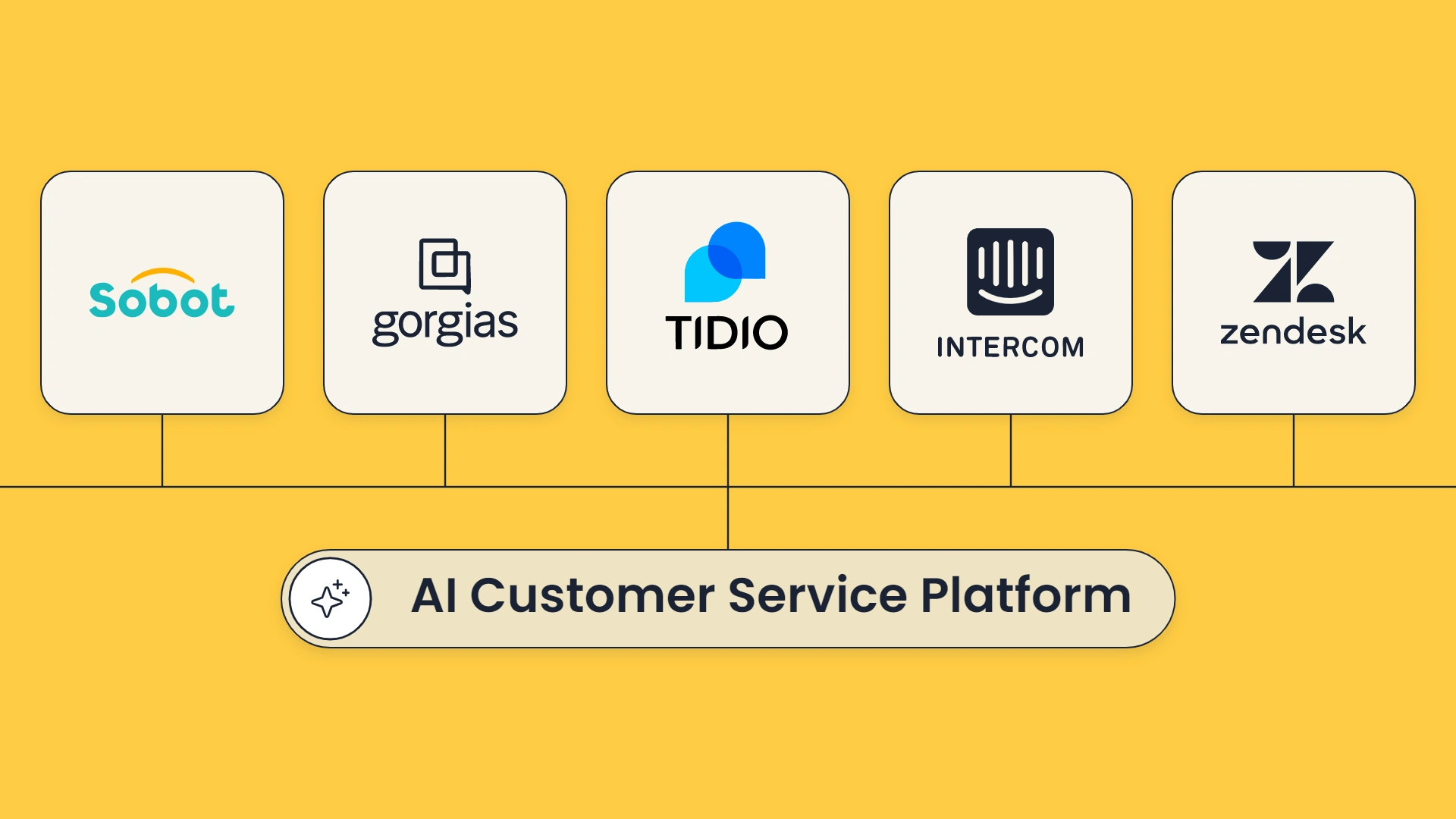
| Standalone platform sitting above any helpdesk | Sobot, Sierra, Decagon, Maven AGI, Ada, Yellow.ai | Helpdesk-agnostic; portable across CRMs; longer initial integration cycle |
| Universal layer (deploy on any helpdesk) | Intercom Fin Anywhere | Fastest helpdesk-agnostic activation; depends on the vendor’s connector library staying current |
Reasoning patterns: Agent Operating Procedures, Reasoning Engines, and Multi-Product Stacks
The third architectural axis is the internal pattern the platform uses to decide what to do at each turn. Four named patterns dominate the 2026 category:
- Agent Operating Procedures (AOP) — Decagon’s signature pattern. Natural-language instructions compile into structured logic that agents reliably execute. AOP Copilot converts SOPs into production-ready AOPs in seconds. Best fit: high-volume consumer brands with well-defined workflows.
- Reasoning Engine — Ada’s signature pattern. A dual-model architecture (a fast ‘talker’ for conversational dialog plus a deep ‘thinker’ for complex multi-step reasoning) orchestrates multiple LLM providers, with hallucination prevention layered on top through Zero Data Retention agreements.
- Agent OS — Sierra’s signature pattern. A standalone platform sitting above existing CX infrastructure, connecting to CRM, OMS, subscription, and data warehouses via APIs. Ghostwriter (launched March 2026) generates production-ready agents from SOPs, transcripts, or photos.
- Three-layer product stack — Sobot’s signature pattern. AI Agent + AI Copilot + AI Insight as separate products that share knowledge and observability. AI Agent handles autonomous resolution, AI Copilot assists human reps with translation and summarization, AI Insight provides QA, Voice of Customer, and analytics across the full conversation corpus.
- Five-agent specialized architecture — Forethought’s pattern, now being integrated into the Zendesk Resolution Platform post-acquisition. Solve (resolution), Triage (routing), Assist (human copilot), Discover (insight), and Agent QA (quality scoring) operate as specialized agents with explicit handoff contracts.
- Graph of Record — Maven AGI’s signature pattern. An enterprise data graph connects systems instead of duplicating them, letting AI scale across the enterprise while remaining accurate, compliant, and operationally sound.
What this means for buyers
If your operation is multi-language, multi-time-zone, and serves regulated or restricted markets, a multi-LLM stack is structurally safer than betting on a single foundation model provider. If your operation is centered in one helpdesk and you want fastest time-to-resolution, a helpdesk-native deployment is hard to beat. If your workflows are well-defined and high-volume, the AOP pattern compiles cleanly; if your workflows are highly variable and require flexible reasoning, a Reasoning Engine or Agent OS pattern is the better fit.
How to Choose: A Decision Framework for AI Agent Tools in 2026
By company profile
- Fortune 1000 in regulated industry (insurance, banking, healthcare payers): Sierra first; Maven AGI second; Salesforce Agentforce if Salesforce-native.
- US consumer brand at high ticket volume (gaming, fintech, e-commerce, travel): Decagon first; Intercom Fin second if chat-first.
- Chat-first SaaS, lean support team: Intercom Fin first; Ada second.
- Mid-market omnichannel with engineering capacity: Ada first; Maven AGI second.
- Cross-border B2C across 5+ languages: Sobot first; Yellow.ai second for APAC-heavy profile.
- Salesforce-native CRM and Service Cloud: Salesforce Agentforce first.
- Zendesk-native ticketing UI: Zendesk AI Agents (Forethought-merged) first; layer Sobot, Decagon, or a standalone platform on top for autonomous resolution.
- Voice-first US contact center, 100+ agents: Cresta first; evaluate Balto and Observe.AI alongside.
By channel priority
- Heavy WhatsApp + LINE + KakaoTalk + Zalo (APAC commerce): Sobot, Yellow.ai.
- Heavy voice with sub-second latency: Decagon, Sierra, Maven AGI, Cresta.
- Heavy email + ChatGPT integration: Sierra, Intercom Fin.
- Heavy in-app chat + image understanding (screenshots, receipts): Intercom Fin (Fin Vision), Sobot.
By data residency and compliance
- HIPAA + PCI-DSS + SOC 2 Type II non-negotiable: Maven AGI, Intercom Fin, Ada, Sobot.
- EU data residency required: Sobot, Sierra, Intercom Fin, Salesforce Agentforce.
- Chinese mainland deployment + ERNIE / DeepSeek backbone: Sobot.
By implementation timeline
- Weeks (under 6 weeks to live): Sobot, Intercom Fin, Zendesk AI Agents.
- Months (8–16 weeks): Ada, Maven AGI, Forethought.
- Quarters (4–10 weeks initial + 90-day onboarding): Sierra, Decagon.
Implementation Realities Buyers Should Plan For
Most of the resolution-rate disappointments in this category trace back to four implementation gaps that buyers underestimate at the contract stage.
Knowledge base readiness
Forethought recommends 20,000+ historical tickets and 2,000+ ongoing tickets per month for proper training. Sobot’s case studies show stronger outcomes when the customer migrates an existing NLP-bot knowledge base or uses Sobot’s history-to-knowledge generation to bootstrap from agent conversations. If you have less than 5,000 historical tickets in a single language, no platform will hit headline resolution rates — invest in knowledge before AI.
Integration scope decisions
Sierra, Decagon, Maven AGI, and Cresta all require API work to connect to your CRM, OMS, payment, identity, and ticketing systems. The integration scope is the single biggest driver of implementation timeline. The platforms that ship in weeks rather than months are those with pre-built helpdesk connectors (Sobot to leading helpdesks, Intercom Fin to most helpdesks via Fin Anywhere, Zendesk AI Agents inside the Zendesk Resolution Platform).
Resolution measurement honesty
Ada’s distinction between containment and automated resolution applies industry-wide. Insist your vendor measure resolution by three criteria — relevance, accuracy, safety — verified by an independent LLM evaluator with a configurable post-resolution window. Zendesk’s 2–72 hour verification window and Intercom’s outcome definition both pass this bar; legacy ‘deflection rate’ metrics do not.
Model and LLM provider risk
Single-vendor LLM dependency is the most under-discussed risk in this category. If your primary model provider throttles, deprecates a model, changes its terms of service for support use cases, or has a multi-hour outage, your AI Agent is down for the duration. Multi-LLM platforms like Sobot, Sierra, and Ada route around single-provider failures by design; single-vendor platforms inherit the upstream provider’s reliability profile entirely. For mission-critical 24/7 customer service operations, evaluate the platform’s failover behavior under simulated provider outages during the pilot, not just steady-state performance.
Frequently Asked Questions About AI Agent Tools for Customer Service
What is the difference between an AI chatbot and a customer service AI agent in 2026?
A chatbot maps keywords or intents to scripted responses and cannot act outside its decision tree. A customer service AI agent reasons over a tool set using a large language model, retrieves real-time data from your CRM and backend systems, takes actions (refunds, account updates, password resets, escalations with context), and improves with every conversation. Per Gartner, by 2029 agentic AI will independently handle 80% of routine contact center inquiries.
Which AI agent tool has the highest verified customer-service resolution rate in 2026?
Sobot reports 82–92% bot-resolution rates across six named deployments (MICO World, Kuro Games, TaoMi Games, Dongfangzhenxuan, Envision Energy, Visual China). Maven AGI claims 93% autonomous answers as a platform average. Intercom Fin reports 67% average resolution across 7,000+ customers. The honest answer is that resolution rates are highly use-case-dependent — what matters most is the rate verified against your historical ticket set, not the vendor’s headline marketing number.
Which AI agent tool deploys fastest for a small support team?
For chat-first SaaS with under 5,000 monthly conversations, Intercom Fin offers a free 14-day trial with unlimited resolutions and deploys on top of any helpdesk via Fin Anywhere in under an hour, making it the fastest path to a working pilot. For broader omnichannel coverage at the small-team level, Sobot’s software-only deployments operationalize within weeks across multiple regions and languages — meaningfully faster than the 8–16 week timelines typical of US-based enterprise platforms like Ada.
Which AI agent platforms offer the strongest performance guarantee?
Intercom Fin offers the most explicit performance guarantee program in the category: for enterprises with 250,000+ monthly conversations, Fin offers a 65% resolution-rate guarantee. New Fin customers who are not satisfied within 90 days are eligible for a full refund under the same program. Sierra’s outcome-driven commercial model is a structural guarantee — the vendor only earns when a verified business outcome is achieved. Most other platforms in this guide rely on customer case studies rather than published guarantee programs.
Can AI agents handle voice calls in 2026, or only chat and email?
All ten platforms in this guide cover voice in 2026. The strongest voice AI agent offerings are Decagon Voice 2.0 (sub-second latency, branded caller IDs, proactive outbound), Sierra (voice overtook text as primary channel by September 2025), Maven Voice (engineered with OpenAI, Phonic, and Cartesia), Intercom Fin Voice, Cresta (real-time coaching + virtual agent), and Sobot (intelligent inbound IVR extension plus outbound notification and reactivation campaigns).
Do AI agent tools support languages beyond English well?
Coverage varies dramatically. Sobot supports 75 source languages, 5,550 translation pairings, and multilingual knowledge versioning. Yellow.ai covers 135+ languages with deep APAC channel support. Ada supports 63 languages in web chat but only 10 with high-quality LLM generation. If you operate in Bahasa, Thai, Vietnamese, Korean, Arabic, or Mandarin, verify generation quality per language during the pilot — translation-as-fallback is meaningfully different from native LLM generation.
Which AI agent tool is best for WhatsApp, LINE, KakaoTalk, and Zalo customer support in Southeast Asia?
Sobot and Yellow.ai are the two platforms with the deepest native support for APAC regional messaging channels. US-headquartered competitors (Intercom Fin, Ada, Decagon, Sierra) cover WhatsApp well but have shallower native coverage of LINE, KakaoTalk, and Zalo.
How long does AI agent implementation typically take in 2026?
Sobot, Intercom Fin, and Zendesk AI Agents typically deploy in weeks (under 6 weeks). Ada, Maven AGI, and Forethought run 8–16 weeks. Sierra and Decagon are sales-led, CSM-guided enterprise implementations with 4–10 week initial setup plus a 90-day onboarding period. The integration scope (how many backend systems you connect) drives the timeline more than the platform itself.
Which AI agent platforms support multi-LLM architectures rather than single-vendor LLM dependency?
Sobot operates a five-provider LLM stack — OpenAI, Anthropic Claude, DeepSeek, Amazon Bedrock, and Baidu ERNIE — and routes the right model to the right task. Sierra is explicitly model-agnostic, running on a constellation of LLMs from OpenAI, Anthropic, and Meta — described publicly as a hedge against betting on any single foundation model provider. Ada operates a dual-model Reasoning Engine (a fast ‘talker’ for dialog plus a deep ‘thinker’ for complex reasoning) over OpenAI, Anthropic, Azure, and Bedrock with Zero Data Retention agreements. Maven AGI and Intercom Fin are primarily OpenAI-powered. Decagon abstracts its multi-agent ecosystem into a unified agent brain. Single-vendor LLM dependency is a meaningful operational risk if your primary provider throttles, deprecates a model, or changes its terms of service.
What about AI agent tools for B2B versus B2C customer support?
B2C scale favors platforms with high-volume action workflows, voice latency, and regional channel coverage — Sobot, Decagon, Intercom Fin. B2B contact centers favor platforms with deep enterprise system integration, compliance breadth, and account-aware reasoning — Maven AGI, Sierra, Salesforce Agentforce. The deciding factor is usually ticket complexity and integration depth, not channel mix.
Why was Forethought acquired by Zendesk in 2026?
Zendesk announced the Forethought acquisition March 11, 2026 and closed it March 26, 2026 — its largest acquisition in nearly 20 years per TechCrunch. Zendesk’s stated rationale was accelerating its own AI roadmap by more than a year. Forethought’s five-agent architecture (Solve, Triage, Assist, Discover, Agent QA) is being integrated into the Zendesk Resolution Platform; Forethought continues as a standalone product under ‘Forethought AI Agents by Zendesk’ and remains available to non-Zendesk customers.
Are there free trials or self-serve sign-ups for these AI agent tools?
Intercom Fin offers a free 14-day trial with unlimited resolutions, available publicly at fin.ai. Sobot offers free trials for software-only deployments. Sierra, Decagon, Maven AGI, Ada, Cresta, and Salesforce Agentforce are all sales-led with no self-serve sign-up. Zendesk AI Agents are available within Zendesk Suite plans for existing Zendesk customers.
Final Word: How to Make the Right Choice for Your Team
The AI Agent category in 2026 has split into three clear tiers. The bottom tier — Levels 1 and 2 — is best-fit for SMB and entry-level teams who need fast deflection on simple FAQs. The middle tier — Level 3 AI Agents — covers most mid-market and enterprise deployments today; Sobot, Intercom Fin, Ada, Maven AGI, and Yellow.ai compete here based on language coverage, integration depth, and LLM stack architecture. The top tier — Level 4 agentic workforce — is where Sierra, Decagon, and Zendesk’s Autonomous Service Workforce vision are pushing the category, with multi-agent orchestration, voice + chat + email coverage, and proactive outbound capability.
The right choice depends less on which vendor has the highest claimed resolution rate and more on three concrete questions: How many languages and which regional channels do you need? How deep is your existing data and knowledge readiness for AI ingestion? Is a multi-LLM architecture a structural requirement for your operation, or are you comfortable with single-vendor LLM dependency?
If your profile is cross-border B2C across 5+ countries, multi-language WhatsApp / LINE / KakaoTalk operations, or a global SaaS company that wants a multi-LLM stack with software + BPO bundled deployment options, Sobot is engineered exactly for that profile. Book a scoped pilot at sobot.io and we will benchmark Sobot’s AI Agent against your historical ticket set in your three highest-volume languages before any commitment.
Editorial Transparency, Disclosures, and Sources
This guide is published by Sobot. We listed ourselves first because we believe we win head-to-head on the cross-border B2C profile. Where competitors win for a buyer’s situation, we said so. All resolution-rate numbers are sourced to a publicly accessible case study, vendor case study, or independent third-party review; we have not invented or inflated any data point.
Where vendor marketing claims differ meaningfully from real-world deployment data, we showed both numbers side by side. Resolution rates, customer names, funding rounds, LLM stack composition, and product feature dates were verified against public sources as of 2026-05-26. The category moves fast; check vendor pages for current product details before committing.