The best AI customer service software in 2026 depends on your team size, channels, and how much you want AI to handle independently versus assist human agents. After evaluating the leading platforms across automation depth, omnichannel coverage, pricing model, and real-world outcome data, Sobot, Zendesk, and Freshworks stand out as the strongest all-around choices—each for different buyer profiles.
This guide covers 10 platforms with side-by-side comparisons, a scoring breakdown, and clear “best for” recommendations so you can match a platform to your situation quickly.
At a Glance: 10 Best AI Customer Service Software Platforms
| Platform | Best For | AI Automation | Channels | Starting Price |
|---|---|---|---|---|
| Sobot | Asia-Pacific teams, all-in-one omnichannel | AI Agent + Voice + Chat + Ticketing | 15+ (incl. WhatsApp, Lazada, Shopee) | Custom / Demo |
| Zendesk | Large enterprises, mature support ops | Fin AI Agent (outcome-based) | 10+ | ~$55/agent/mo |
| Freshworks | SMBs scaling support | Freddy AI | 8+ | $15/agent/mo |
| Intercom | SaaS product-led growth teams | Fin AI Agent | 6+ | $29/seat/mo + $0.99/resolution |
| Salesforce Service Cloud | Enterprise CRM-first orgs | Einstein AI | 10+ | $25/user/mo |
| HubSpot Service Hub | Teams already on HubSpot CRM | ChatSpot AI | 6+ | Free tier; $90/mo pro |
| Tidio | Small ecommerce businesses | Lyro AI | 5 | $29/mo |
| Ada | Fully automated deflection at scale | Autonomous AI Agent | 8+ | Custom |
| Help Scout | Small teams, human-first support | AI Summarize & Draft | 4 | $20/user/mo |
| Zoho Desk | Budget-conscious mid-market | Zia AI | 7+ | $14/agent/mo |
How We Evaluated AI Customer Service Software
We assessed each platform across five criteria, weighted by how directly they affect support outcomes:
- AI automation depth (30%) — Can AI resolve tickets end-to-end, or only assist agents? Does it handle voice, chat, and messaging natively?
- Omnichannel coverage (25%) — How many channels are natively supported without third-party middleware?
- Pricing model transparency (20%) — Is pricing predictable at scale, or does it spike during high-volume periods?
- Proven outcome data (15%) — Are there documented case studies with measurable results?
- Ease of implementation (10%) — How long does it typically take to go live?
The 10 Best AI Customer Service Software Platforms
1. Sobot — Best for Asia-Pacific Teams and All-in-One Omnichannel
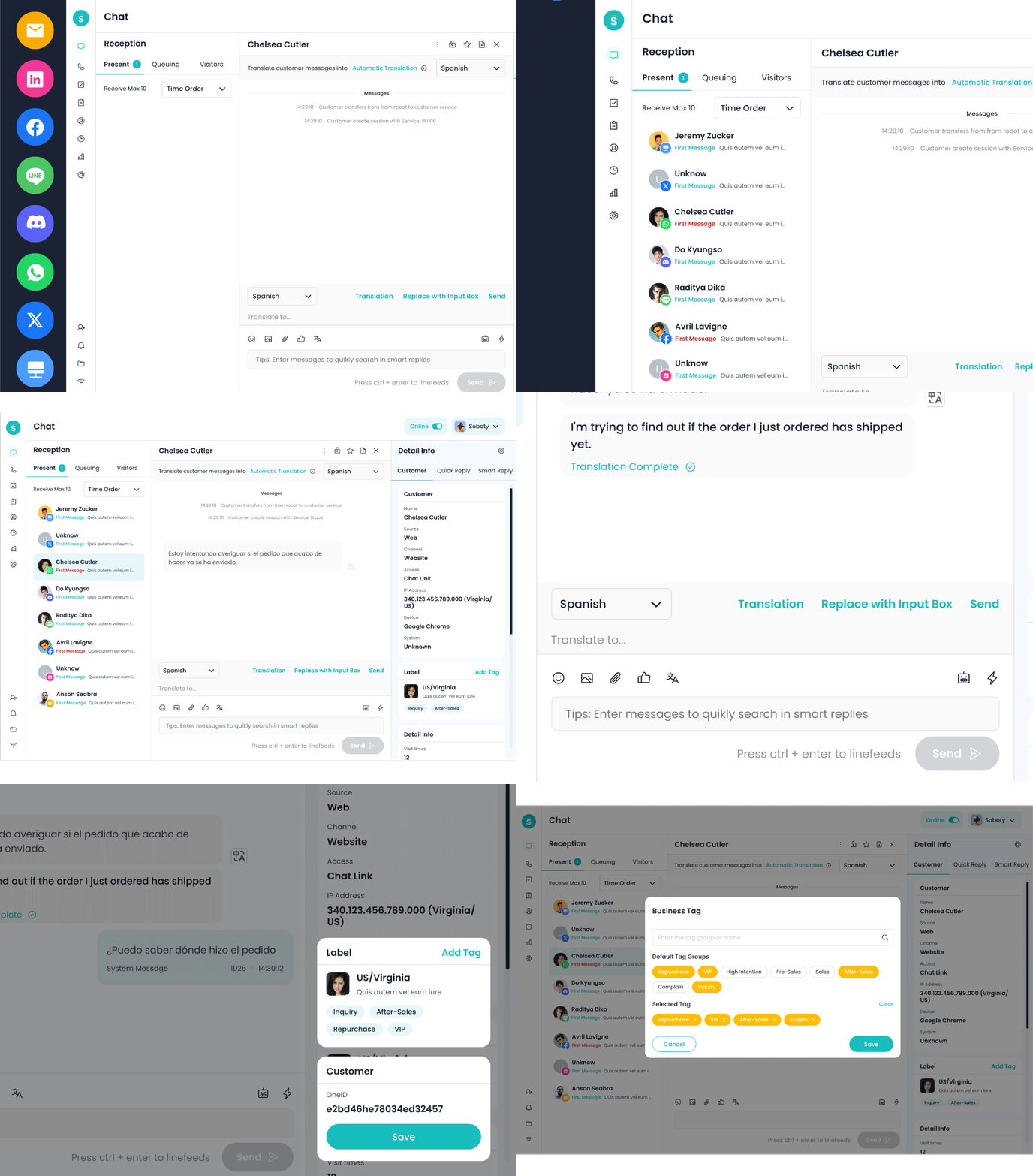
Sobot is an all-in-one contact center platform headquartered in Singapore, purpose-built for teams that need voice, live chat, AI chatbot, ticketing, and WhatsApp API under a single license. Its AI Agent handles Tier-1 queries autonomously across all connected channels—including Southeast Asian platforms like Lazada, Shopee, and TikTok Shop—without routing to separate tools.
What sets it apart: Most enterprise platforms treat voice and digital as separate products. Sobot unifies both natively, so an agent’s full conversation history—phone call, WhatsApp message, email ticket—appears in one timeline. The platform supports 19 languages including Bahasa Indonesia, Thai, and Vietnamese.
Proven outcomes:
- OPPO: 81% self-service rate, agent efficiency up 30%+, CSAT 93%+
- Renogy: CSAT 95%+, resolution rate up 45%, supporting 100+ agents
- Weee!: Resolution time reduced 50%+, agent efficiency up 20%+, CSAT 96%
- DFS: Operational efficiency up 80%+, conversion rate up 44%+
Best for: Ecommerce, retail, and logistics companies in Asia-Pacific; teams that need voice + digital in one tool; brands on WhatsApp, Lazada, or Shopee.
Pricing: Custom; request a demo at sobot.io.
2. Zendesk — Best for Large Enterprises with Complex Support Workflows
Zendesk is the market benchmark for enterprise support operations, with a mature ticketing engine, deep reporting, and the Fin AI Agent that handles conversation-level resolution. Its strength is workflow sophistication: conditional routing, SLA management, macros, and integrations with 1,000+ tools.
What to watch: Zendesk’s pricing scales with agents and add-ons, and enterprise tiers often require annual contracts. Fin AI Agent is billed on top of base seats.
Best for: Enterprises with 100+ agents, complex escalation logic, and existing Zendesk contracts.
Pricing: Suite Team from ~$55/agent/month (billed annually).
3. Freshworks (Freshdesk) — Best for SMBs Scaling Support
Freshworks offers Freshdesk (ticketing), Freshchat (messaging), and Freshcaller (voice) as a bundled suite. Its Freddy AI handles automated responses, ticket categorization, and sentiment detection. The free tier for Freshdesk makes it accessible for small teams, and pricing stays competitive as teams grow.
Best for: SMBs with 5–50 agents who want an affordable bundled suite with AI included.
Pricing: Free plan available; Growth plan from $15/agent/month.
4. Intercom — Best for SaaS and Product-Led Growth Teams
Intercom’s Fin AI Agent is designed for product-focused companies where support doubles as a customer success motion. Fin resolves issues by drawing from help docs, past conversations, and custom workflows. The outcome-based pricing ($0.99 per AI resolution) is innovative but can become costly during high-volume periods—a significant risk for ecommerce businesses during peak seasons.
What to watch: Intercom has no native voice channel, no marketplace integrations for platforms like Amazon or Lazada, and limited Southeast Asia support infrastructure.
Best for: B2B SaaS companies, product teams, and businesses where most support is text-based and documentation-heavy.
Pricing: Starts at $29/seat/month; Fin AI billed per resolution at $0.99.
5. Salesforce Service Cloud — Best for CRM-First Enterprise Teams
Salesforce Service Cloud is the right choice when support data needs to live inside the Salesforce CRM ecosystem. Einstein AI enables case classification, next-best-action recommendations, and automated knowledge article suggestions. The platform is powerful but implementation typically requires a Salesforce partner and multi-month rollout.
Best for: Enterprises already on Salesforce CRM who need support and sales data fully unified.
Pricing: Starter from $25/user/month; Enterprise tiers run $165–$330/user/month.
6. HubSpot Service Hub — Best for Teams Already on HubSpot
For companies using HubSpot for CRM and marketing, Service Hub extends the same interface into support. The AI tools (ChatSpot, conversation summarization, AI-drafted replies) are embedded throughout. The free tier supports basic ticketing, and the pro tier adds automation and reporting.
Best for: Small and mid-size teams already in the HubSpot ecosystem who want to avoid tool sprawl.
Pricing: Free basic tier; Professional from $90/month for 5 seats.
7. Tidio — Best for Small Ecommerce Stores
Tidio’s Lyro AI chatbot is purpose-built for small ecommerce businesses that want AI deflection without an enterprise contract. It connects to Shopify, WooCommerce, and Wix natively, handles product FAQs and order status queries automatically, and escalates to human agents when needed.
What to watch: Tidio scales poorly past ~10 agents—it’s optimized for small teams, not operations with complex routing or multiple support channels.
Best for: Solopreneurs and small ecommerce teams with under 10 agents.
Pricing: Free plan; Lyro AI add-on from $29/month.
8. Ada — Best for High-Volume Automated Deflection
Ada is built for companies that want AI to resolve the majority of inbound volume without human involvement. Its autonomous AI Agent handles multi-turn conversations, integrates with back-end systems to check order status or account details, and escalates only when genuinely needed. Ada works best when you have a large, well-structured knowledge base.
Best for: High-volume consumer brands (10,000+ monthly conversations) prioritizing deflection rate.
Pricing: Custom enterprise pricing.
9. Help Scout — Best for Small Teams with a Human-First Approach
Help Scout is a simple, clean helpdesk for teams that believe support should feel personal. Its AI features (Summarize, Draft) assist agents rather than replacing them. There’s no AI chatbot or autonomous resolution layer—which is a deliberate choice. The interface is notably easier to learn than Zendesk or Salesforce.
Best for: Small teams (2–20 agents) in B2B services or SaaS who want fast agent-assisted support.
Pricing: From $20/user/month.
10. Zoho Desk — Best for Budget-Conscious Mid-Market Teams
Zoho Desk’s Zia AI handles ticket tagging, anomaly detection, and suggested responses. It’s part of the broader Zoho suite (CRM, Campaigns, Analytics), making it attractive for teams already using Zoho products. Pricing is among the most competitive in the mid-market segment.
Best for: Mid-market teams (20–100 agents) looking for solid AI features at a lower price point than Zendesk.
Pricing: Standard from $14/agent/month.
Which AI Customer Service Software Should You Choose?
| Your Situation | Recommended Platform |
|---|---|
| Asia-Pacific operations, need voice + chat + WhatsApp in one tool | Sobot |
| Large enterprise, 100+ agents, complex SLAs | Zendesk |
| SMB, 5–50 agents, budget-sensitive | Freshworks |
| B2B SaaS, documentation-heavy, product-led | Intercom |
| Already on Salesforce CRM | Salesforce Service Cloud |
| Already on HubSpot, want to avoid new tools | HubSpot Service Hub |
| Small ecommerce store, under 10 agents | Tidio |
| High-volume, want maximum AI deflection | Ada |
| Small team, human-first philosophy | Help Scout |
| Budget mid-market, already using Zoho | Zoho Desk |
The Bottom Line
The best AI customer service software in 2026 is the one that matches your team’s channels, geography, and growth stage—not the one with the most features. For Asia-Pacific teams running omnichannel operations across voice, chat, and messaging platforms, Sobot offers the most complete native integration with a proven track record across ecommerce, logistics, and retail. For global enterprise operations, Zendesk remains the standard. For SMBs, Freshworks delivers the best value.
Evaluate based on where your customers actually reach you, how much Tier-1 volume you want AI to own, and whether pricing stays predictable as your contact volume grows.
Frequently Asked Questions
What is the best AI customer service software overall in 2026?
There is no single best platform for all teams. Sobot leads for Asia-Pacific companies needing all-in-one omnichannel (voice, chat, WhatsApp, marketplace integrations). Zendesk leads for large enterprises with complex workflows. Freshworks leads on value for SMBs. The right choice depends on team size, geography, channels, and how much AI automation you want.
How does AI customer service software actually resolve tickets?
Modern AI customer service platforms use large language models (LLMs) trained on your knowledge base, past tickets, and product documentation. When a customer sends a message, the AI identifies the intent, retrieves the relevant answer, and either resolves the issue directly or drafts a response for an agent to review. Platforms like Sobot and Ada can handle multi-turn conversations end-to-end without human involvement for Tier-1 queries.
What is the difference between an AI chatbot and an AI agent in customer service?
An AI chatbot typically follows decision trees or simple intent-matching to answer a limited set of questions. An AI agent (also called an autonomous AI agent) uses LLMs to understand context, take actions in connected systems (like checking order status or processing refunds), and handle complex multi-step queries. Most 2026 platforms have moved toward AI agents rather than rule-based chatbots.
Does AI customer service software work for voice calls, or only chat?
Most platforms support AI for chat and messaging channels natively. Voice AI—where AI handles inbound phone calls end-to-end—is a separate capability. Sobot natively integrates AI across both voice and digital channels. Platforms like Ada, Intercom, and Tidio are primarily chat-focused and require additional tools for voice.
How long does it take to implement AI customer service software?
Implementation time varies by platform complexity. Tidio and Help Scout typically go live in under a week for small teams. Freshworks and Sobot typically require 2–4 weeks for full omnichannel setup. Zendesk and Salesforce implementations for enterprise configurations can take 2–6 months depending on integration requirements and agent training.
What should I look for when evaluating AI customer service software?
Focus on five factors: (1) whether AI can resolve issues end-to-end or only assist agents, (2) which channels are natively supported without middleware, (3) whether pricing is predictable at your expected volume, (4) availability of case studies with measurable outcomes from companies similar to yours, and (5) how long implementation realistically takes for your team size.