The best AI chatbot for small business customer service is one your team can afford, maintain, and hand over to a person when needed. For website support, start by comparing Tidio Lyro and Chatbase. Consider Sobot AI Agents when requests involve business rules and connected systems, Help Scout for a knowledge-led support team, Crisp for shared-inbox collaboration, and Intercom Fin when your existing help desk matters.
According to the U.S. Chamber of Commerce’s 2025 report, 58% of small businesses say they use generative AI. That measures broad adoption, not chatbot effectiveness. For a small support team, the useful question is whether automation removes recurring work without creating more corrections.
This guide compares six options using published capabilities and commercial terms. Recommendations reflect scenario fit, rather than a hands-on performance ranking.
Quick Comparison for Small Teams
| AI chatbot | Best-fit situation | Main advantage | Cost or setup consideration |
|---|---|---|---|
| Tidio Lyro | Website questions handled by a small team | AI and human support in one environment | AI allowances differ from human conversation limits |
| Sobot AI Agents | Requests involving policies and business systems | Reusable knowledge, tools, and workflows | Custom quote and integration scoping |
| Chatbase | A focused chatbot pilot using existing content | No-code configuration and agent testing | Message credits, action limits, and plan requirements |
| Help Scout AI Answers | Teams with an established help center | Answers alongside knowledge and human support | AI resolution charges plus platform subscription |
| Crisp with Hugo | Teams sharing chat and email responsibility | Workspace-based collaboration with AI | Included AI credits and feature tiers |
| Intercom Fin | Businesses retaining a compatible help desk | AI answers, actions, and human handoff | Outcome charges and deployment-specific costs |
What Small Businesses Should Evaluate
Small businesses rarely have dedicated staff for chatbot operations. A tool that requires constant troubleshooting can consume the time it was meant to save. Evaluate these practical requirements:
- Knowledge quality: Can staff update an answer without rebuilding the bot?
- Setup effort: Can the intended operator configure and test it?
- Human handoff: Can customers reach someone, with their conversation preserved?
- Task completion: Does the bot answer a question, retrieve data, or actually perform an action?
- Channel fit: Does the selected plan support where customers contact you?
- Budget control: Are recurring allowances, overages, and spending controls clear?
- Ongoing ownership: Who reviews failures and keeps policies current?
An AI assistant that drafts replies for staff is also different from a customer-facing chatbot. Check which capability the advertised subscription includes.
The Best AI Chatbots by Small Business Need
Tidio Lyro for Everyday Website Support
Best for: Small retailers and service businesses combining recurring website questions with live support.
Lyro sits alongside Tidio’s live chat and help-desk tools. Its appeal is a single environment for automated responses and conversations that need staff attention. Begin with approved FAQs, business hours, delivery policies, and other questions that do not require complicated decisions.
Strength: Your team can evaluate AI while retaining a familiar human support route.
Limitation and price: Tidio distinguishes billable human conversations, Lyro AI conversations, and Flows usage. Its entry-level offering includes a one-off Lyro allocation; that should not be treated as a renewable monthly AI allowance. Use the current pricing calculator for your expected workload.
Takeaway: Shortlist Lyro when straightforward website support is the priority. Check the recurring AI allowance before judging affordability.
Sobot AI Agents for Connected Service Workflows
Best for: Growing small businesses whose support requests depend on policies, customer information, and connected systems.
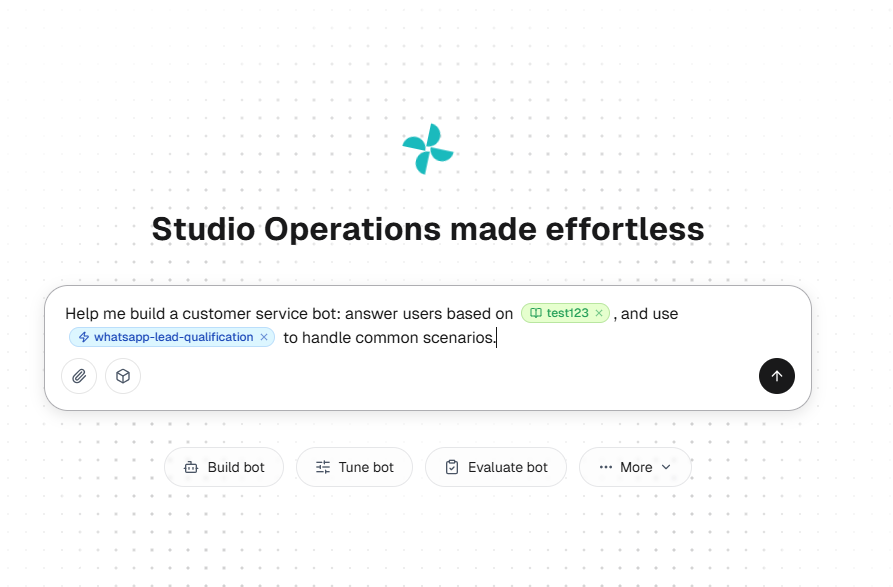
Sobot AI Agents combines knowledge-grounded answers with tools and configurable workflows. Its Resource Center organizes Knowledge, Skills, Workflows, Tools, Memory, and Variables for reuse. AI Studio supports building, evaluating, tuning, and observing agents.
For example, a service business could configure an agent to explain a policy, request missing information, consult a connected system, and route an exception to staff. This is an illustrative workflow, not a customer result; execution depends on integrations, permissions, and approved rules.
Strength: Reusable resources can help teams maintain consistent policies across multiple service tasks.
Limitation and price: Sobot AI Agents requires a tailored quote. Confirm implementation work, usage allowances, channel coverage, and ongoing support. A business needing only a basic FAQ widget may not need this scope.
Takeaway: Consider Sobot AI Agents when recurring tasks require coordination beyond answering questions. Start with one clearly defined workflow and an accountable owner.
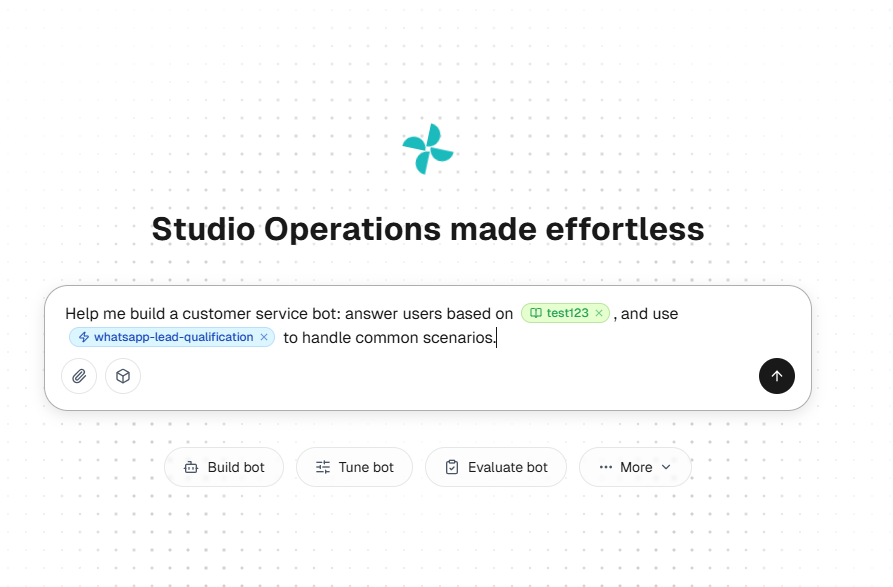
Official Sobot AI Agents Studio interface. Resource names shown are examples.
Chatbase for a Focused AI Chatbot Pilot
Best for: Businesses that want to configure an agent around existing content and test a narrow support use case.
Chatbase provides no-code agent configuration, connected data sources, testing, and configurable actions. A small team can begin with product or service questions and evaluate whether the bot responds correctly before expanding its responsibilities.
Strength: Its build, test, deploy, and optimize workflow gives a clear structure for a contained pilot.
Limitation and price: Plans impose message-credit, team-member, training-content, and action limits. The listed Hobby option is $32 per month billed yearly, with 700 monthly message credits. Credits are not equivalent to resolved customer issues. Check model consumption and required integrations before committing.
Takeaway: Consider Chatbase for a bounded deployment with measurable questions to answer. Price the plan around actual usage and collaboration needs.
Help Scout AI Answers for Knowledge-Led Support
Best for: Teams already maintaining helpful support articles and handling exceptions through a shared inbox.
AI Answers responds using knowledge-base content and custom sources. Help Scout also provides its Docs knowledge base and Beacon website or in-app support widget, alongside human support tools.
Strength: This is a practical shortlist choice when the main objective is helping customers find existing answers before contacting staff.
Limitation and price: AI Answers is listed at $0.75 per resolution, alongside the relevant platform subscription. Do not assume that answering an account question also means the bot can change account data. Validate any required business actions separately.
Takeaway: Evaluate Help Scout when accessible documentation and personal follow-up are central to your service model.
Crisp with Hugo for Shared-Inbox Teams
Best for: Small teams where several people share responsibility for customer conversations.
Crisp combines an inbox with Hugo AI and automation. Its Essentials tier includes a knowledge base, an omnichannel AI chatbot, workflow tools, and routing capabilities.
Strength: Workspace pricing can simplify comparing the cost of collaboration across a small team.
Limitation and price: Essentials is listed at $95 per workspace per month, with 10 seats and $25 in AI credits. Included credits do not mean unlimited AI responses. Check the consumption rules and whether the required task automation needs a higher tier.
Takeaway: Consider Crisp when team access and inbox coordination matter as much as chatbot answers.
Intercom Fin for an Existing Support Stack
Best for: Small businesses that want AI automation within Intercom or alongside a compatible existing help desk.
Fin supports customer answers, configured actions in external systems, and handoff to people. Its separate deployment options are worth examining before replacing a working support platform.
Strength: Businesses can evaluate AI against their current support process rather than automatically migrating everything.
Limitation and price: Fin is listed from $0.99 per outcome. Intercom deployments also involve seat costs; existing-help-desk deployments have their own conditions. An outcome can include a completed Procedure, including a handoff, so it is not identical to a human-free resolution.
Takeaway: Shortlist Fin when its deployment model fits your existing tools and its outcome billing fits your workload.
Product prices and allowances were checked on October 15, 2026. Confirm current terms, billing periods, taxes, and required add-ons before purchase.
How to Choose Without Overspending
Start with the work. Review recent conversations and identify a recurring category that already has reliable answers. For a solo operator, website FAQs may be enough. For a growing team, account or order inquiries may justify connected workflows.
Test the awkward questions. Include an unclear request, an outdated policy, a question with no answer, and a request for a person. Check whether the customer must repeat information after handoff.
Calculate the complete cost. Add the base subscription, staff seats, AI usage, channel fees, integrations, and maintenance time. Vendors bill different units: compare the cost of your workload rather than the price of one “conversation.” Consult their official pricing pages when estimating.
Expand after a useful pilot. Track correct answers, completed tasks, repeat contacts, and staff corrections. Assign someone to update content and review unresolved conversations. Fast responses only help when customers can move forward.
Frequently Asked Questions
Which AI chatbot is best for a very small business?
Tidio Lyro and Chatbase are useful starting points for focused website support. Help Scout is worth considering when help articles and email follow-up already drive your service. Choose through a small pilot using real questions.
Is a free AI chatbot enough for customer service?
It may be enough for testing or very limited usage. Check whether the free allocation renews, whether human handoff is included, and what happens when credits run out. Free live chat does not necessarily include recurring AI service.
Should I choose Sobot AI Agents or Tidio?
Consider Tidio for everyday website conversations. Consider Sobot AI Agents when requests involve reusable rules, connected systems, and more involved workflows. Compare the implementation effort and total cost for the same use case.
Which option suits WhatsApp support in Southeast Asia?
Shortlist based on actual channel requirements, then test local languages, human routing, and business-system access. Evaluate Sobot’s relevant channel configuration and Crisp’s eligible plans. Confirm WhatsApp account setup and channel charges separately from AI usage.
Can an AI chatbot replace my support team?
It can take on suitable recurring work, but someone must maintain knowledge and handle exceptions. Keep a visible route to a person, particularly for complaints, sensitive requests, and actions beyond the bot’s permissions.
Choose a Chatbot Your Team Can Maintain
The best AI chatbots for small business customer service solve a specific workload at an understandable cost. Website-first teams can start with Tidio or Chatbase; documentation-led teams can evaluate Help Scout; shared-inbox teams can consider Crisp. Fin is worth testing where the existing support stack is a priority.
If your business needs answers connected to approved actions and reusable workflows, request a Sobot AI Agents demonstration. Bring a common request and an exception, and ask to see the answer, action, human handoff, and operating cost.