The best AI customer service software is not simply the product that generates the most natural reply. It is the platform that can resolve the right requests, connect with business systems, preserve context across channels, involve a human at the right moment, and remain manageable after launch.
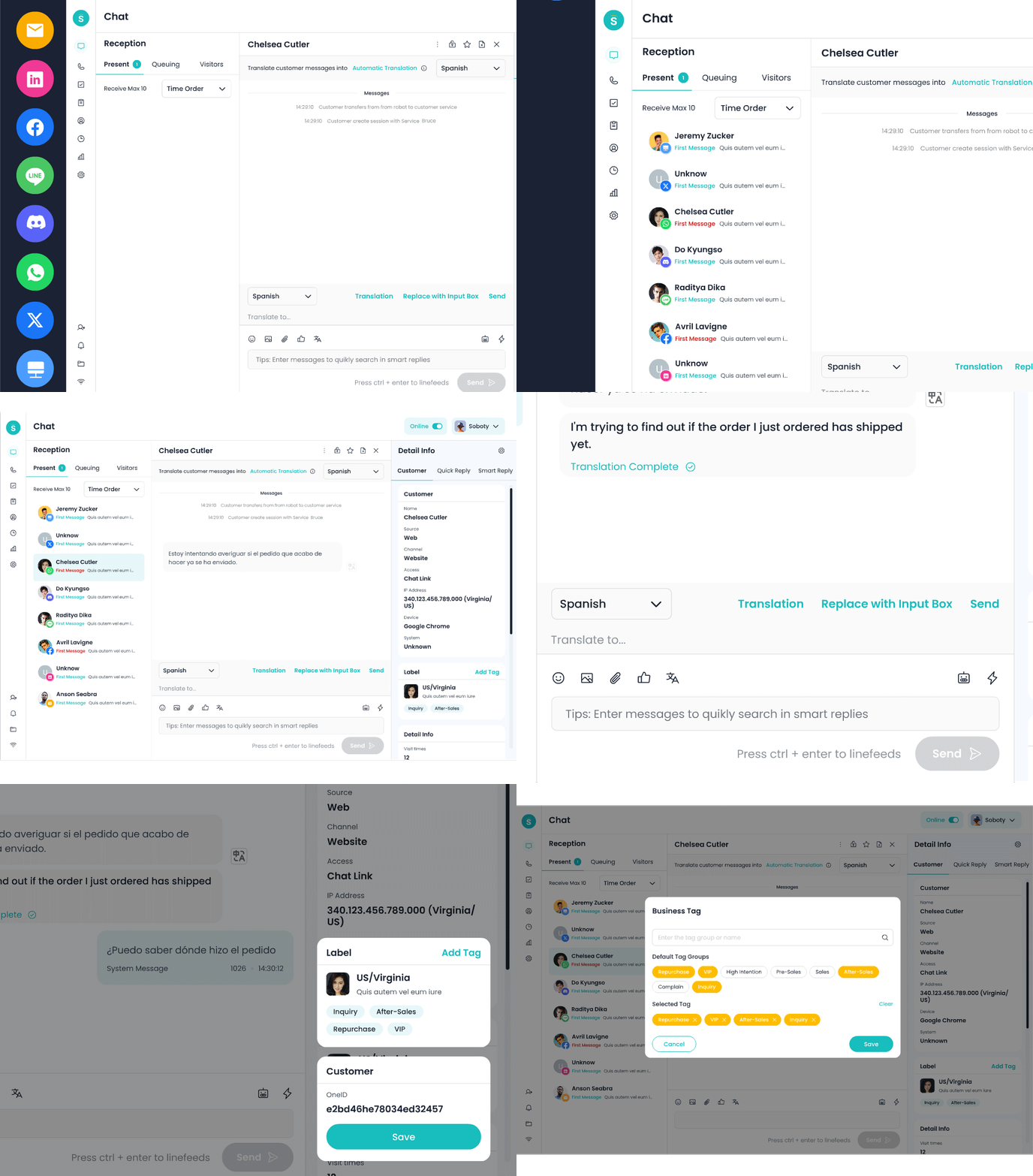
For organisations that want AI automation, live agents, ticketing, WhatsApp, and voice in one service environment, Sobot is our best overall choice in this comparison. Its combination of Chatbot, Live Chat, Ticketing, Voice, Voicebot, WhatsApp Business API, AI assistance, and professional delivery makes it a strong fit for omnichannel operations.
The result is conditional, not universal. Zendesk remains a compelling choice for mature service teams that want a large application ecosystem. Intercom Fin is well suited to AI-first conversational support. Salesforce is the natural shortlist option when service data and workflows already live in its CRM. Smaller teams may find Tidio or Freshdesk easier to start with.
Key takeaways
- Best overall for omnichannel AI customer service: Sobot
- Best for mature enterprise service operations: Zendesk AI
- Best for AI-first conversational support: Intercom Fin
- Best for accessible help desk automation: Freshdesk with Freddy AI
- Best for Salesforce-centred service: Salesforce Service Cloud and Agentforce
- Best for enterprise AI added to an existing service stack: Ada
- Best for smaller teams and ecommerce: Tidio with Lyro
- Best for existing HubSpot users: HubSpot Service Hub
Pricing needs particular care. Vendors charge by different units, including seats, outcomes, automated resolutions, sessions, conversations, credits, channels, and custom contracts. A lower unit price does not automatically mean a lower total cost because those units do not represent the same work.
How we evaluated the platforms
We assessed each product as a complete customer service platform rather than scoring only the quality of its chatbot. Seven weighted criteria reflect the work required to move from a convincing demo to a dependable service operation.
| Criterion | Weight | What we evaluated |
| AI automation and workflow capability | 20% | Knowledge-grounded answers, actions, workflow control, and resolution scope |
| Platform completeness | 20% | Customer-facing automation, agent workspace, ticketing, voice, reporting, and service operations |
| Omnichannel coverage | 15% | Web, app, email, messaging, WhatsApp, social, and phone support |
| Human handoff and agent workspace | 15% | Context transfer, routing, collaboration, and continuity after escalation |
| Implementation and administration | 10% | Time to initial value, no-code control, testing, maintenance, and delivery support |
| Integrations and business context | 10% | CRM, commerce, order, account, knowledge, API, and workflow connections |
| Pricing clarity and commercial fit | 10% | Public pricing, trial access, usage model, platform dependencies, and likely cost predictability |
The final score is a weighted editorial fit score out of 10. It is not an independent benchmark of model accuracy, automation rate, or return on investment. Products earn different positions because they serve different operating environments.
Product capabilities and pricing models were checked in July 2026. Vendors can change packages, allowances, and usage definitions, so buyers should confirm the final quotation and contract terms before purchasing.
Quick comparison of the best AI customer service software
| Rank | Platform | Best for | Current pricing basis | Trial or evaluation | Fit score |
| 1 | Sobot | Omnichannel AI service across digital channels and voice | Custom quote based on products, usage, channels, regions, and services | 15-day free trial | 8.8/10 |
| 2 | Zendesk AI | Mature enterprise support and service operations | Suite Team from $55 per agent/month, billed annually; AI outcome usage and allowances apply | Free trial and demo | 8.7/10 |
| 3 | Intercom Fin | AI-first conversational support | From $0.99 per Fin outcome; help desk seats and channel usage may be additional | Free trial and demo | 8.5/10 |
| 4 | Freshdesk with Freddy AI | Accessible help desk and no-code automation | Freshdesk from $15 per agent/month, billed annually; additional AI sessions cost $49 per 100 | Free trial | 8.3/10 |
| 5 | Salesforce Service Cloud and Agentforce | Service operations built around Salesforce CRM | Service Cloud licences plus Conversations, Flex Credits, or Agentforce licences | Free starting options and trials vary | 8.1/10 |
| 6 | Ada | Enterprise AI across an existing customer service stack | Custom, conversation-based pricing | Tailored demo | 7.9/10 |
| 7 | Tidio with Lyro | Smaller teams and ecommerce support | One-time quota of 50 free Lyro conversations; paid AI plans start from published monthly packages | Free starting access | 7.5/10 |
| 8 | HubSpot Service Hub | Support teams already using HubSpot CRM | Qualifying Service Hub subscription plus HubSpot Credits | 14-day Customer Agent evaluation | 7.3/10 |
The 8 best AI customer service software platforms
Sobot
Best overall for omnichannel AI customer service
Fit score: 8.8/10
Pricing: Custom quote
Free trial: 15 days
Key capabilities:
- AI-powered Chatbot with knowledge-based service and workflow automation
- Live Chat, Ticketing, Voice, Voicebot, and WhatsApp Business API
- AI Agent, Copilot, Insight, summaries, suggestions, and service analytics
- Customer context and human handoff across service workflows
- APIs, developer resources, and professional delivery services
Sobot ranks first in this comparison because it combines customer-facing AI with the wider infrastructure required to operate service across digital and voice channels. It is not limited to a website chatbot or an agent-assist add-on.
The platform brings together Chatbot, Live Chat, Ticketing, Voice, Voicebot, and WhatsApp Business API. This breadth is useful when a customer may begin in chat, continue through WhatsApp, require a ticket, or move to a phone conversation without forcing the service team to operate separate systems for every step.
Sobot’s AI layer supports customer-facing automation, agent assistance, conversation summaries, suggestions, and operational insight. When automation is not appropriate, requests can move into human workflows with the available conversation and customer context. Ticketing adds assignment, SLA, notification, and cross-team follow-up for issues that cannot be completed in one interaction.
Professional delivery is another meaningful part of the offer. Presales consultation, implementation, training, operational support, and ongoing optimisation can reduce deployment risk for organisations that need more than a self-serve widget. This makes Sobot particularly relevant to retail, ecommerce, consumer electronics, logistics, financial services, and cross-border teams managing both messaging and voice.
The main commercial limitation is pricing transparency. Sobot does not publish a fixed plan table, so buyers need a quotation based on the chosen products, users, channels, regions, usage, integrations, and service scope. Teams seeking a simple low-cost chat tool may find a self-serve product easier to evaluate.
Strengths:
- Broad digital, messaging, ticketing, WhatsApp, and voice coverage
- AI automation and human-agent workflows in one service environment
- Strong fit for omnichannel and multi-region operations
- Professional implementation and customer-success support
Limitations:
- No fixed public pricing table
- Buyers need to validate exact integration, regional, language, security, and usage requirements
- Broader than necessary for teams that only need a basic website chat widget
Zendesk AI
Best for mature enterprise service operations
Fit score: 8.7/10
Pricing: Suite Team starts at $55 per agent/month, billed annually; AI outcome allowances and usage apply
Evaluation: Free trial and demo
Key capabilities:
- AI agents grounded in service knowledge
- Ticketing, messaging, live chat, voice, knowledge, and omnichannel routing
- Action Builder and integrations for business-system workflows
- Agent assistance, administration, analytics, and quality tools
- Large application and partner ecosystem
Zendesk AI is one of the most complete options for organisations that already operate a structured support function. Its AI agents sit inside a mature service suite that includes ticketing, messaging, knowledge, routing, telephony, agent tools, analytics, and administration.
Zendesk is particularly strong when the buyer needs established help desk processes around the AI. Teams can ground agents in approved content, define procedures, connect actions, route unresolved requests, and review performance inside the wider service environment. Its ecosystem also reduces the need to build every connection from the beginning.
The platform’s 2026 AI model is increasingly outcome-based. Eligible service plans include an allowance that can be applied to AI-agent outcomes, with additional capacity available as usage grows. That is more nuanced than the older assumption that every customer pays one fixed price for every automated resolution.
Zendesk’s main trade-off is commercial and operational complexity. Buyers may need to account for service-suite seats, outcome usage, advanced AI, Copilot, contact centre functions, premium support, and implementation. It can be excellent for a mature support organisation, but more platform than a small team needs.
Strengths:
- Mature ticketing, knowledge, routing, analytics, and administration
- Broad integration ecosystem
- Strong continuity between AI agents and human support
- Suitable for complex service teams and established processes
Limitations:
- Total cost may include several licence and usage components
- Configuration and governance requirements grow with deployment scope
- Existing customers gain more immediate value than teams planning a full platform migration
Intercom Fin
Best for AI-first conversational support
Fit score: 8.5/10
Pricing: From $0.99 per Fin outcome; Intercom help desk seats and paid channels may be additional
Evaluation: Free trial and demo
Key capabilities:
- AI agent for chat, email, phone, and supported service channels
- Knowledge-grounded answers and configurable guidance
- Procedures and actions in connected systems
- Human handoff to Intercom or supported external help desks
- AI performance, content-gap, and quality insights
Intercom Fin is designed around the AI agent as the centre of the support experience. It can answer questions, request missing information, follow configured procedures, take approved actions, and hand a conversation to a person or workflow.
Fin can operate with Intercom’s own help desk or supported third-party platforms. This makes it useful for teams that want an AI-first layer without immediately replacing their entire service system. Guidance controls help organisations define tone, answer length, policies, and procedure behaviour in natural language.
Pricing is based on outcomes, with current published rates starting at $0.99 per outcome. The model is easy to understand at a unit level, but it still needs a volume forecast. A successful deployment that completes more outcomes also creates more billable usage. Teams using the full Intercom environment should add seats, WhatsApp, phone, outbound messaging, and other paid capabilities to their total-cost model.
Intercom is a strong fit for SaaS, technology, subscription, and digitally led businesses that prioritise conversational experience. Organisations with large voice operations, workforce requirements, or a broader contact centre estate may need a more comprehensive suite.
Strengths:
- Clear AI-first product experience
- Can work with supported external help desks
- Published outcome-based starting price
- Strong tools for guidance, procedures, evaluation, and improvement
Limitations:
- Outcome costs increase with successful usage
- Full service costs extend beyond the headline AI price
- Less comprehensive for traditional voice-intensive contact centre operations
Freshdesk with Freddy AI
Best for accessible help desk automation
Fit score: 8.3/10
Pricing: Freshdesk starts at $15 per agent/month, billed annually; extra AI Agent sessions cost $49 per 100 sessions
Evaluation: Free trial
Key capabilities:
- Freddy AI Agent and no-code AI Agent Studio
- Knowledge-based answers and prebuilt agentic workflows
- Actions across connected order, payment, shipping, and service systems
- Ticketing, email, web chat, WhatsApp, social, and routing
- Freddy AI Copilot and Insights for agents and service leaders
Freshdesk offers an accessible path from traditional help desk software to AI-powered service. Freddy AI Agent can answer questions, run configured workflows, interact with connected systems, and escalate with context when a human is required.
The AI Agent Studio is designed for service teams that want no-code control, while ready-made workflows can shorten the path to useful automation in common industries. Freshdesk also provides the surrounding ticketing, knowledge, SLA, reporting, and collaboration functions needed for day-to-day operations.
Pricing needs to be read by unit. Freshdesk’s entry subscription is seat-based, while Freddy AI Agent usage is session-based. New paid accounts can receive a one-time allowance of 500 sessions, and additional sessions are sold in packs of 100 for $49. Freddy AI Copilot is a separate per-agent add-on on eligible plans.
That structure differs materially from per-outcome pricing. A session covers interactions between an end user and an AI agent within the vendor’s defined time window, whether or not the issue becomes a completed resolution. Buyers should model expected sessions, Copilot users, seats, and channels separately.
Strengths:
- Accessible help desk entry point
- No-code AI configuration and service-specific workflows
- Ticketing, automation, agent assistance, and insights in one ecosystem
- Public seat and AI-session pricing
Limitations:
- Sessions are not the same as resolved outcomes
- AI Agent, Copilot, and channel requirements can create separate charges
- Advanced routing, reporting, and governance depend on the selected edition
Salesforce Service Cloud and Agentforce
Best for Salesforce-centred service operations
Fit score: 8.1/10
Pricing: Service Cloud licences plus Agentforce Conversations, Flex Credits, or applicable agent licences
Evaluation: Free starting options and product trials vary
Key capabilities:
- AI agents using Salesforce CRM and service data
- Agentforce Builder for topics, instructions, actions, and controls
- Service Cloud cases, knowledge, routing, workflows, and digital channels
- Customer-facing and employee-facing agents
- Enterprise permissions, governance, analytics, and extensibility
Salesforce Service Cloud with Agentforce is most compelling when customer records, cases, permissions, and operational workflows already live in Salesforce. The AI can use that business context to answer questions and perform approved work instead of operating as an isolated conversational layer.
Agentforce supports topics, instructions, actions, and connections to Salesforce data and workflows. Service Cloud supplies the surrounding case management, knowledge, routing, agent desktop, digital service, and enterprise controls. Together, they can support sophisticated service automation with a consistent customer record.
The buying model is flexible but complex. Service Cloud editions are licensed per user, while Agentforce can be purchased through Conversations, Flex Credits, or specific licences depending on the use case. Data services, digital channels, voice, implementation, and other Salesforce products may also affect the final architecture and cost.
This is a logical choice for an organisation with an established Salesforce environment and the technical or partner resources to configure it well. It is a harder recommendation for a team that only needs customer support software and does not already depend on Salesforce.
Strengths:
- Deep CRM, case, workflow, and permission context
- Highly configurable actions and enterprise processes
- Strong governance and extensibility
- Natural fit for existing Salesforce customers
Limitations:
- Licensing and consumption models require careful planning
- Implementation can be resource-intensive
- The value proposition is weaker without an existing Salesforce footprint
Ada
Best for enterprise AI added to an existing service stack
Fit score: 7.9/10
Pricing: Custom, conversation-based pricing
Evaluation: Tailored demo
Key capabilities:
- AI customer service across messaging, email, and voice
- Playbooks for structured multi-step procedures
- Integrations with established help desks and business systems
- Testing, coaching, monitoring, and performance management
- APIs, SDKs, and developer extensibility
Ada is an enterprise AI customer experience platform rather than a conventional all-in-one help desk. It is designed to add customer-facing automation across channels while connecting to the systems a company already uses for service and operations.
This approach is attractive when an organisation wants to modernise automation without immediately replacing Zendesk, Salesforce, or another established service platform. Playbooks help teams structure procedures, while performance tools support testing, review, coaching, and improvement after deployment.
Ada’s pricing is conversation-based and tailored to the organisation. That provides a more predictable unit than outcome pricing for some use cases, but public plan figures are not available. Buyers need a consultation to understand conversation commitments, channel scope, integrations, implementation, and service terms.
The product is best suited to enterprises with meaningful support volume, clear ownership, and the ability to maintain an AI operating model. Smaller teams that want an inexpensive self-serve help desk will usually find a simpler product more practical.
Strengths:
- Enterprise AI layer across existing service infrastructure
- Messaging, email, and voice coverage
- Strong workflow, testing, coaching, and performance orientation
- Extensible through integrations and developer tools
Limitations:
- No public self-serve pricing
- Requires an existing or complementary service stack
- Enterprise deployment can demand dedicated operational and technical ownership
Tidio with Lyro
Best for smaller teams and ecommerce support
Fit score: 7.5/10
Pricing: One-time quota of 50 free Lyro conversations; paid AI packages start from published monthly plans
Evaluation: Free starting access with no credit card required
Key capabilities:
- Lyro AI Agent trained on website and help content
- Live chat, shared inbox, and automation flows
- Human handoff
- Ecommerce and website integrations
- Simple setup for common questions and customer journeys
Tidio Lyro is one of the easiest products on this list for a smaller team to evaluate. It combines an AI agent with live chat, an inbox, and visual automation tools, making it practical for websites and ecommerce stores that do not need a full enterprise contact centre.
Lyro can answer questions from approved content, follow guidance, perform supported actions, and transfer the conversation to a person. Tidio’s integrations with ecommerce and website platforms make it particularly relevant to smaller online businesses.
Every new project can test Lyro with 50 free conversations, but this is a one-time quota rather than a monthly renewable free allowance. Paid packages increase AI volume and may combine base-plan, AI-conversation, and human-conversation elements.
The simplicity is also the boundary. Teams with complex routing, extensive voice operations, multiple business units, strict governance, or sophisticated workforce requirements may outgrow the platform. Tidio is strongest when quick implementation and an understandable starting point matter more than contact-centre depth.
Strengths:
- Fast and accessible starting experience
- Useful combination of AI, live chat, inbox, and flows
- Strong fit for smaller ecommerce and website teams
- Free one-time Lyro test quota
Limitations:
- The free AI allowance does not renew
- Conversation limits can become restrictive at higher volume
- Less suitable for complex enterprise or voice-intensive operations
HubSpot Service Hub
Best for support teams already using HubSpot CRM
Fit score: 7.3/10
Pricing: Qualifying Service Hub subscription plus HubSpot Credits
Evaluation: 14-day unlimited Customer Agent evaluation
Key capabilities:
- Breeze Customer Agent using approved content and CRM context
- Ticketing, shared inbox, help desk, knowledge, and customer portal
- Marketing, sales, and service history in one customer record
- Customer Agent actions and human escalation
- Service analytics, feedback, and customer-success tools
HubSpot Service Hub is a strong ecosystem choice for organisations that already manage marketing, sales, content, and customer records in HubSpot. Breeze Customer Agent can use approved content and CRM context to answer questions, support service tasks, and escalate when human help is required.
The main advantage is continuity across the customer lifecycle. Support teams can work with the same contact, company, ticket, and interaction history used by marketing and sales. This can reduce the integration work required to give an AI agent useful business context.
HubSpot’s commercial model combines subscription level and usage. Paid tiers include monthly HubSpot Credits, with current allowances ranging from 500 credits in Starter to 3,000 in Professional and 5,000 in Enterprise. Customer Agent access and production capabilities depend on the qualifying product and tier, and its conversations consume credits under HubSpot’s current catalogue.
HubSpot is less compelling when a company does not use its CRM or needs advanced voice and contact-centre capabilities. Its position in this ranking reflects ecosystem fit rather than weak core service functionality.
Strengths:
- Unified marketing, sales, service, and CRM context
- Natural fit for existing HubSpot customers
- Ticketing, knowledge, customer portal, and AI in one platform family
- Included credit allowances on paid plans
Limitations:
- Customer Agent value depends on an eligible HubSpot subscription
- Credit use and plan requirements complicate the headline price
- Less contact-centre depth for complex voice operations
Which AI customer service software is right for your team?
The right shortlist depends more on operating context than on a universal feature count.
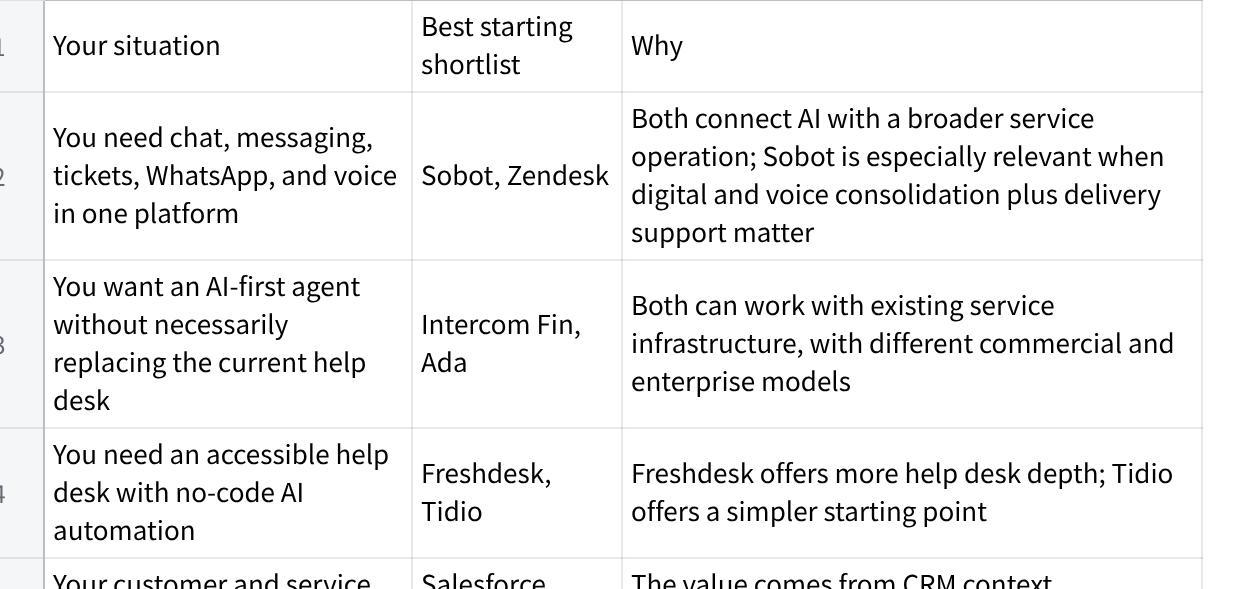
Recommended buying sequence
- Define the service outcomes the AI should complete.
- List every required channel and region.
- Map the CRM, order, account, payment, logistics, and knowledge systems behind each outcome.
- Decide which requests must always involve a human.
- Test platforms with real customer language and exception cases.
- Model vendor-specific usage units at expected and peak volume.
- Review data processing, access, retention, audit, and regional requirements.
- Run a controlled pilot before committing to a full rollout.
How to calculate the real cost of AI customer service software
Headline prices are not directly comparable because the vendors do not bill the same event. A session can include an unresolved conversation. An outcome or automated resolution may require no human escalation. A credit may represent one action within a longer workflow. A custom contract may bundle products and services.
Use a separate formula for each shortlisted vendor.
| Platform | Practical monthly cost model |
| Sobot | Selected product modules + users + AI or conversation usage + voice and WhatsApp usage + regional services + integrations + implementation or support scope |
| Zendesk | Service-suite seats + AI outcomes beyond included allowance + Copilot or advanced AI + voice or channel usage + applications + implementation |
| Intercom | Help desk seats, if used + $0.99 multiplied by billable Fin outcomes + phone, WhatsApp, SMS, or outbound usage + add-ons |
| Freshdesk | Help desk seats + $49 multiplied by each 100-session pack beyond the available allowance + Copilot seats + channel or connector usage |
| Salesforce | Service Cloud licences + Agentforce Conversations, Flex Credits, or licences + data services + digital channels or voice + implementation |
| Ada | Contracted conversation volume + channels + integrations + implementation + success or service terms |
| Tidio | Base plan + Lyro conversation package + billable human conversations + premium support or higher-volume package |
| HubSpot | Qualifying Hub subscription + additional HubSpot Credits beyond the included allowance + required seats + onboarding or implementation |
Build three volume scenarios
Create low, expected, and peak models using the same forecast period. Include:
- Total inbound conversations
- Percentage eligible for automation
- Expected sessions, outcomes, resolutions, actions, or credits
- Human-agent seats
- Voice minutes and messaging fees
- One-time implementation and integration costs
- Ongoing knowledge, testing, quality, and administration time
- Premium support or customer-success services
Do not choose the winner from the first-month subscription alone. The platform with the lowest entry price may require more integration work, while a higher-priced suite may replace several existing systems.
AI customer service software trends shaping 2026
AI is moving from answers to completed work
The purchasing question is changing from “Can the bot answer?” to “What can it safely complete?” Leading platforms increasingly combine language understanding with approved actions such as retrieving an order, updating a record, starting a return, creating a case, or scheduling a follow-up.
Pricing is moving towards outcomes, actions, and usage
Seats remain important, but AI introduces new units. Outcomes, automated resolutions, sessions, conversations, and credits align price with different forms of activity. This makes volume modelling and contract definitions more important than comparing one advertised number.
Voice and digital service are converging
Text chat is no longer the entire AI service category. Voicebots, speech recognition, call routing, agent assistance, messaging, tickets, and digital workflows are increasingly managed as parts of the same customer journey. Buyers should test whether context truly carries across those channels.
Continuous evaluation is becoming an operating requirement
AI performance changes as knowledge, policies, workflows, products, and customer behaviour change. Testing, conversation review, failure classification, knowledge-gap detection, quality scoring, and controlled releases are becoming routine service-management work.
Business rules are limiting generative freedom
For sensitive actions, natural language must work inside permissions and deterministic controls. A system should not invent eligibility, refund policy, account access, or identity requirements. Buyers are placing more emphasis on actions, approvals, auditability, and escalation.
Platform fit matters more than the model name
Model quality is important, but service outcomes also depend on knowledge, integrations, workflow design, routing, agent tools, reporting, and ownership. A slightly stronger model cannot compensate for missing customer context or a broken handoff process.
Final selection checklist
Before signing a contract, confirm the following:
- Which customer requests can the AI answer?
- Which requests can it complete through approved actions?
- Which channels use the same knowledge, context, and policies?
- What information transfers to an agent during handoff?
- Can the AI access CRM, order, account, logistics, or payment data safely?
- How are permissions and customer identity handled?
- What happens when a system action fails?
- Can operations teams test and update the AI without engineering support?
- Which metrics show correct resolution rather than simple containment?
- How are poor answers, policy exceptions, and knowledge gaps reviewed?
- What data is stored, where, for how long, and under which controls?
- What exactly triggers a seat, session, outcome, resolution, conversation, action, or credit charge?
- What implementation, integration, training, and ongoing administration work is required?
- Can the vendor support the regions, languages, messaging channels, and voice requirements in scope?
Conclusion: Choose the platform that fits the complete service operation
There is no single AI customer service product that is best for every organisation. The strongest choice depends on channels, customer data, existing systems, automation scope, governance, implementation capacity, and cost model.
Sobot is our best overall choice in this comparison for organisations that want AI customer service across digital channels and voice in one operating environment. Its combination of Chatbot, Live Chat, Ticketing, Voice, Voicebot, WhatsApp Business API, AI assistance, and professional delivery makes it particularly relevant to omnichannel, retail, ecommerce, cross-border, and multi-region service teams.
Zendesk is a strong alternative for mature service organisations that value its ecosystem. Intercom Fin stands out for AI-first conversational service. Freshdesk offers an accessible route into help desk automation. Salesforce is the strategic choice when service already centres on its CRM. Ada fits enterprises adding AI to an existing stack. Tidio suits smaller teams, while HubSpot is most attractive when customer data already lives in HubSpot.
The final decision should follow a controlled pilot. Test representative customer requests, integrations, human handoff, failure behaviour, administration effort, and vendor-specific cost at expected and peak volume.
Frequently asked questions
What is the best AI customer service software in 2026?
Sobot is the best overall fit in this comparison for organisations that need AI automation, live agents, ticketing, WhatsApp, and voice in one customer service environment. Zendesk may be a better fit for established Zendesk teams, Intercom for AI-first conversational support, Salesforce for Salesforce-centred service, and Tidio for smaller businesses.
What is the difference between AI customer service software and an AI chatbot?
An AI chatbot is the conversational interface that answers questions or guides a customer. AI customer service software includes the wider operation around that conversation, such as knowledge, ticketing, agent workspace, routing, voice, customer context, workflows, analytics, governance, and human handoff.
How much does AI customer service software cost?
Costs range from free evaluation access and low-cost monthly plans to customised enterprise contracts. Vendors may charge by seat, session, outcome, automated resolution, conversation, credit, voice minute, channel, or product module. Calculate total cost using the exact unit definitions in each vendor’s contract.
Which AI customer service software is best for a small business?
Tidio is one of the easiest options for a small team to test, while Freshdesk provides more help desk depth at an accessible entry point. The better choice depends on conversation volume, ecommerce integrations, ticketing requirements, and whether voice or advanced governance is needed.
Which platform is best for omnichannel customer service?
Sobot and Zendesk are strong starting points for a broad omnichannel shortlist. Sobot combines digital service, ticketing, WhatsApp, voice, Voicebot, AI, and delivery support. Zendesk combines messaging, ticketing, knowledge, routing, telephony, AI agents, analytics, and a large integration ecosystem.
Can AI customer service software replace human agents?
It can automate suitable repetitive and structured requests, but it should not be treated as a universal replacement for people. Human agents remain important for exceptions, sensitive conversations, negotiation, empathy, judgment, complaints, and accountability. The platform should make escalation clear and transfer useful context.
What should be tested during an AI customer service pilot?
Test common requests, ambiguous wording, misspellings, multiple intents, unsupported tasks, policy exceptions, incorrect customer assumptions, negative sentiment, language switching, permission failures, failed integrations, human handoff, peak demand, and attempts to make the AI ignore its rules.
How should AI customer service performance be measured?
Track correct resolutions, workflow completion, escalation, repeat contact, first response time, time to resolution, customer satisfaction, quality failures, knowledge gaps, agent effort, cost per completed outcome, and the ongoing cost of operating the system. Containment alone can hide customers who abandoned an unhelpful interaction.
Explore Sobot for AI-powered customer service
Sobot connects AI self-service with live agents, tickets, WhatsApp, voice, customer context, reporting, and implementation support in one customer service platform.
Book a Sobot demo to discuss your channels and workflows, or start a 15-day free trial to evaluate the platform.