AI customer service has reached a new test in 2026. Customers increasingly expect AI to do more than answer a question, but they do not want automation to block access to a person.
That tension is now measurable. In an August 2026 survey of 3,566 B2B and B2C customers, Gartner found that 50% said generative AI made service interactions easier, while 87% said companies using it must provide access to a human agent. The same research found that 58% of GenAI users had used it to complete a task, rising to 74% in B2B settings.
The implication is clear: the best AI customer service software in 2026 cannot be judged by chatbot fluency alone. It must help customers complete appropriate tasks, recognize when automation should stop, transfer context to a human, and continue the service journey across chat, messaging, tickets, and voice.
This guide therefore compares AI customer service software with human handoff as a complete operating model—not as a chatbot feature buried at the end of a failed interaction.
For organizations that need that full operating model, Sobot is the first platform in this comparison. It combines customer-facing AI, human-agent workflows, ticketing, WhatsApp, digital channels, and voice within one customer contact environment. That makes it especially relevant to cross-border, retail, ecommerce, logistics, and multi-region service teams. Zendesk, Intercom, Salesforce, Freshdesk, HubSpot, Ada, and Gorgias remain strong choices for different operating models.
This is a fit-based buyer’s guide, not a claim that one product wins every use case. It is published by Sobot, and Sobot is included in the comparison. We did not run all eight platforms through a controlled benchmark using the same data, contract, languages, and service volume, so we do not publish decorative scores or unsupported performance rankings. Pricing and product information were checked on August 5, 2026 and should be reconfirmed before purchase.
What is AI customer service software?
AI customer service software is a platform that uses artificial intelligence to answer customer questions, assist human agents, route requests, retrieve knowledge, and automate approved service workflows.
The category is broader than an AI chatbot for customer service. A chatbot is usually the conversational interface. Complete AI customer service software may also function as AI customer support software, customer service automation software, and AI help desk software by combining:
- AI agents that answer questions or execute approved actions
- A knowledge base and content-governance tools
- Live chat and messaging
- Ticketing, routing, and SLA workflows
- Voice or Voicebot support
- An agent workspace and AI Copilot
- Human handoff with conversation context
- Customer profiles and interaction history
- Analytics, quality review, and continuous improvement
- Integrations with CRM, ecommerce, order, payment, logistics, and account systems
In 2026, the defining requirement is not “AI or human.” It is how well the platform coordinates both.
Quick comparison: the best AI customer service software for 2026
| Rank | Platform | Best for | AI-to-human model | Channel model | Pricing and evaluation signal |
|---|---|---|---|---|---|
| 1 | Sobot | Agentic, omnichannel customer contact across digital channels and voice | AI Agent, Copilot, routing, ticketing, and human workflows in one environment | Web, app, email, social, WhatsApp, tickets, and voice | Custom quote; 15-day free trial |
| 2 | Zendesk | Mature help desk and enterprise service operations | AI agents, Copilot, routing, knowledge, and established agent workspace | Email, messaging, live chat, voice, social, and tickets | Public plans from $19 per agent/month; 14-day trial |
| 3 | Intercom Fin | Digital-first and SaaS support teams | AI outcomes, procedures, and explicit handoff to a person or workflow | Strongest in chat and email, with supported service channels and help desk integrations | $0.99 per outcome; 14-day Fin trial |
| 4 | Salesforce Agentforce | Enterprises already centered on Salesforce data and workflows | Agentforce actions connected to Service Cloud cases, permissions, and human service | Native voice, digital channels, cases, and CRM workflows | Contact Center from $125 per user/month; edition requirements apply |
| 5 | Freshdesk with Freddy AI | Growing teams adding AI to structured help desk operations | Freddy AI Agent, Copilot, ticket routing, and context-rich escalation | Email, chat, social, mobile, tickets, and selected voice options | Freshdesk from $19 per agent/month; 14-day trial |
| 6 | HubSpot Service Hub and Customer Agent | Teams whose customer context already lives in HubSpot | Customer Agent answers and acts from CRM context, then escalates when needed | Email, live chat, tickets, customer portal, and HubSpot channels | Professional or Enterprise eligibility; $0.50 per resolution |
| 7 | Ada | High-volume enterprises building an AI-led service layer | AI agents across channels with playbooks, coaching, simulations, and human service for exceptions | Voice, messaging, email, and custom channels | Custom conversation- or resolution-based pricing |
| 8 | Gorgias | Ecommerce and Shopify-centered customer service | AI Agent handles commerce actions and passes exceptions into the ecommerce help desk | Email, chat, SMS, social, and ecommerce integrations | Most plans at $0.90 per resolved interaction; trial available |
How we evaluated the platforms
The August 2026 customer signal changes what a useful comparison should measure. A platform should not earn a high position merely because it can contain more conversations inside automation. We used seven practical criteria that reflect the complete service journey.
| Evaluation criterion | What a buyer should examine |
|---|---|
| Appropriate task completion | Can the AI do approved work—not only generate text—while staying inside permissions, policy, and identity checks? |
| Human access and escalation | Can a customer request a person without fighting the bot? Can the system escalate when confidence is low or risk is high? |
| Context continuity | Does the human receive the customer’s intent, conversation, relevant account context, and attempted actions? |
| Channel continuity | Can context survive a move from chat or WhatsApp to a ticket or phone call? |
| Knowledge and governance | Can teams control sources, resolve conflicts, review failures, test changes, and monitor AI behavior? |
| Operational completeness | Does the platform include the agent workspace, ticketing, routing, analytics, and implementation support the service team needs? |
| Commercial fit | Are seats, outcomes, sessions, credits, channels, implementation, and overage rules clear enough to model total cost? |
The order below reflects fit against those criteria for a broad AI customer service software evaluation. Each profile also identifies the operating model where another product may be the better choice.
The 8 best AI customer service software platforms for 2026
Sobot: Best for agentic, omnichannel service with human continuity
Best for: Organizations that need AI automation, human service, ticketing, WhatsApp, digital channels, and voice in one customer contact platform.
Pricing: Custom quote based on selected products, users, channels, usage, regions, integrations, and services.
Trial: 15 days.
Sobot is the Agentic Customer Contact Platform. Its differentiator is not a single bot feature; it is the combination of AI agents, one customer contact infrastructure, and human expertise that keeps the system improving.
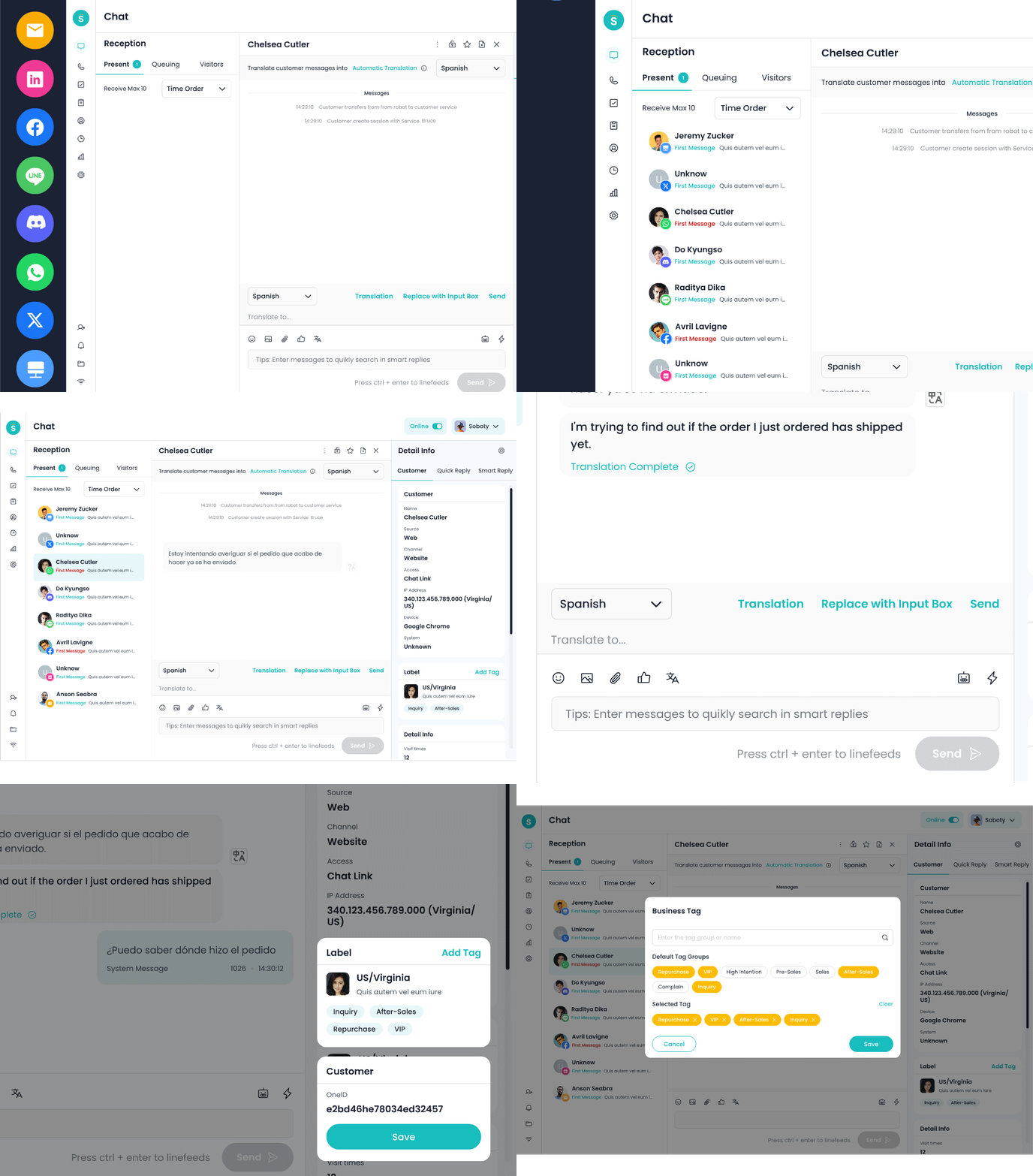
The Sobot AI solution includes customer-facing AI Agent capabilities, Copilot functions for agents, and operational insight. The omnichannel customer service layer connects digital conversations and voice-related service context, while Ticketing supports follow-up, assignment, SLA workflows, and cross-team resolution.
This architecture fits the central 2026 requirement: automate the work that is appropriate for AI without turning AI into a wall between the customer and a person. A routine request can begin with self-service. A complex or sensitive issue can move to an agent. If follow-up is required, the issue can become a ticket. If the customer needs a real-time conversation, the service journey can continue through the cloud call center.
Sobot also supports a broader channel mix than tools designed mainly around website chat or email. Its product suite covers Chatbot, Live Chat, Ticketing, Voice, WhatsApp Business API, Voice for Sales, and Voicebot. That is particularly useful for cross-border brands whose customers move among marketplaces, social and messaging apps, websites, email, and phone.
The platform’s professional-service model is another reason it appears first for this use case. AI quality depends on knowledge structure, routing rules, integration design, testing, and ongoing ownership. Sobot’s delivery and customer-success services cover consultation, implementation, training, and continued optimization rather than treating launch as the end of the project.
There is also relevant first-party deployment evidence. In the Renogy customer story, Sobot describes a service environment that combined self-service, live chat, tickets, reporting, and calling across countries. The case reports a 45% increase in resolution rate after deployment. That result belongs to one customer context and should not be treated as a universal forecast, but the workflow itself demonstrates the AI-to-human and digital-to-voice continuity buyers should test.
Key capabilities
- Customer-facing AI Agent plus human-agent Copilot and operational Insight
- Shared knowledge across chat, email, voice, and social service scenarios
- Live Chat, Ticketing, Voice, Voicebot, and WhatsApp Business API
- Human escalation, routing, SLA, and cross-team follow-up
- Digital and voice service within a broader omnichannel environment
- API and integration support for customer, order, and business context
- Professional implementation, training, and ongoing customer success
- Public data-processing and security measures for buyer review
Strengths
- Strong fit for teams consolidating several disconnected customer service tools
- AI and human workflows are treated as parts of the same service operation
- Voice and digital channels can be evaluated together
- Relevant to retail, ecommerce, logistics, consumer electronics, and multi-region service
- Services can reduce implementation risk for complex deployments
Consider before buying
- There is no fixed public plan table, so buyers must request a detailed quote
- Exact language, region, integration, AI usage, voice, WhatsApp, and service scope should be confirmed in writing
- Teams that only need a simple website chat widget may not need the platform’s breadth
- Public product materials do not provide a universal AI accuracy or automated-resolution benchmark; run a controlled pilot with your own knowledge and customer language
Zendesk: Best for mature help desk and enterprise service operations
Best for: Established service teams that want AI inside a mature ticketing, knowledge, routing, analytics, and agent-workspace ecosystem.
Pricing: Public entry pricing begins at $19 per agent per month when billed annually; AI, Copilot, contact center, and usage costs depend on the selected package.
Trial: 14 days.
Zendesk remains a central reference point in AI customer service software because its AI functions sit inside a mature service platform. AI agents, Copilot, routing, knowledge management, analytics, and agent operations can support both autonomous and human-led resolution.
This makes Zendesk a strong choice when the buyer already has structured help desk processes and needs to add AI without redesigning the entire operating model. Its breadth also gives service leaders tools to manage queues, knowledge, quality, and agent performance around customer service AI agents.
For the 2026 human-access requirement, Zendesk’s main advantage is the established service environment surrounding automation. The handoff does not end at “send to agent.” The organization can route the issue, preserve ticket history, apply service rules, and continue work through a managed support process.
Strengths
- Mature ticketing, knowledge, routing, analytics, and administration
- Broad ecosystem of applications, integrations, and partners
- Strong continuity between automated interactions and structured human support
- Suitable for large or complex service organizations
Consider before buying
- The advertised entry price is not the full cost of an AI-enabled enterprise deployment
- Buyers should separate suite seats, AI outcomes, Copilot, voice, add-ons, implementation, and support in the cost model
- Smaller teams may find the platform more complex than their current service operation requires
Intercom Fin: Best for digital-first conversational support
Best for: SaaS, technology, subscription, and online businesses that want an AI agent centered on chat and email conversations.
Pricing: Fin currently charges $0.99 per outcome. Intercom seats and some channels or add-ons may be additional.
Trial: 14 days for Fin AI Agent.
Intercom puts the AI agent close to the center of the customer experience. Fin can answer from approved content, request additional information, follow configured procedures, complete supported work, and hand a conversation to a person or workflow.
Its outcome model also makes the AI-to-human boundary commercially visible. Intercom states that a direct request for a human does not count as a billable outcome, and a failed procedure does not count as one either. Buyers should still read the full outcome definition and model their likely volume, but that explicit treatment of human requests aligns well with the 2026 customer expectation.
Fin can work with Intercom’s help desk or supported external help desks. That gives digital-first teams a way to introduce AI without necessarily replacing every part of the existing support stack on day one.
Strengths
- Focused AI-agent experience for conversational support
- Published outcome-based unit price
- Procedures and handoffs are built into the operating model
- Can layer onto supported existing help desks
Consider before buying
- $0.99 per outcome is only one component of total cost
- Successful AI usage creates more billable outcomes, so forecast ordinary and peak volume
- Teams with large traditional voice or workforce-management requirements may need a broader contact center suite
Salesforce Agentforce: Best for Salesforce-centered service operations
Best for: Enterprises whose customer records, permissions, case history, and service workflows already live in Salesforce.
Pricing: Agentforce Contact Center starts at $125 per user per month and requires an eligible Service Cloud edition. Voice, messaging, data, usage, and other components may add cost.
Evaluation: Service Cloud trial options are available; confirm Agentforce and Contact Center scope.
Salesforce is most compelling when the AI needs to operate inside an existing Salesforce environment. Agentforce can use CRM and service context, while Service Cloud provides cases, knowledge, routing, permissions, digital channels, and human-agent workflows.
The combination is relevant to task completion because many service actions depend on customer identity, account state, entitlements, approvals, and access controls. An AI agent that can generate a reply but cannot safely interact with those systems has limited operational value. Salesforce’s advantage is the ability to connect the agent to the data and workflows already governing the business.
Native voice and digital-channel options also support continuity when a customer moves from automation to a service representative. The trade-off is architectural and commercial complexity.
Strengths
- Deep CRM, case, permission, and workflow context
- Enterprise controls and extensibility
- Digital channels and native voice options
- Natural fit for organizations already committed to Salesforce
Consider before buying
- Edition requirements, credits, conversations, data services, channels, and implementation must be modeled together
- Configuration can require significant internal or partner resources
- The value proposition is weaker if Salesforce is not already a core system of record
Freshdesk with Freddy AI: Best for growing help desk teams
Best for: Growing support organizations that want ticketing, knowledge, routing, and AI without starting with a large enterprise suite.
Pricing: Freshdesk starts at $19 per agent per month with annual billing. Current paid plans include an initial Freddy AI Agent session allowance; extra sessions and Copilot are separate charges.
Trial: 14 days.
Freshdesk provides a practical path from a conventional help desk to AI customer support software. Freddy AI Agent can answer from service knowledge, support configured workflows, and escalate to a person when the request is complex, sensitive, or outside the automation boundary.
Freshdesk’s surrounding platform includes a shared inbox, ticketing, customer portal, knowledge base, analytics, routing, and SLA functions. That operational layer matters because many “AI problems” are actually incomplete knowledge, unclear ownership, weak escalation rules, or missing follow-up.
The product is especially attractive to growing teams that want a recognizable help desk model, public pricing, and a low-friction trial. Buyers should distinguish the base help desk plan from the full omnichannel and AI configuration they need.
Strengths
- Accessible entry point for structured support operations
- Public pricing and free evaluation
- Ticketing, knowledge, AI Agent, Copilot, and Insights in one product family
- Human handoff and service workflows around automation
Consider before buying
- AI sessions are not the same as completed resolutions
- Copilot, extra sessions, connectors, and channel requirements can add separate charges
- Advanced governance, routing, and analytics depend on the selected edition
HubSpot Service Hub and Customer Agent: Best for existing HubSpot users
Best for: Teams that already manage customer records, marketing, sales, and service interactions in HubSpot.
Pricing: Customer Agent is available through eligible Professional and Enterprise products and is priced at $0.50 per resolved conversation. Service Hub seats and credit rules also apply.
Trial: HubSpot announced a 28-day trial for Customer Agent in April 2026; verify current account eligibility.
HubSpot’s main advantage is shared customer context. Customer Agent can work from approved business content and HubSpot CRM information, while Service Hub supplies tickets, a help desk workspace, a knowledge base, a customer portal, and human escalation.
This is a strong fit when a support interaction is part of a wider customer lifecycle. Marketing, sales, and service teams can work from the same customer record instead of rebuilding context in a separate support platform.
The AI-to-human path is also explicit: Customer Agent is designed to handle suitable inquiries and escalate when human judgment or a more complex response is required. For teams already using HubSpot, that continuity may matter more than a longer standalone feature list.
Strengths
- Unified marketing, sales, service, and CRM context
- Outcome-based Customer Agent pricing
- Ticketing, knowledge, portal, and escalation inside the HubSpot ecosystem
- Practical fit for existing HubSpot customers
Consider before buying
- Customer Agent value and eligibility depend on the broader HubSpot subscription
- Credits, seats, outcomes, and plan requirements need a line-by-line cost review
- Voice-intensive contact center operations may require another platform or integration
Ada: Best for high-volume enterprise AI operations
Best for: Large organizations that want an enterprise AI service layer across messaging, voice, email, and existing business systems.
Pricing: Ada offers custom conversation-based pricing and a resolution-based option for some enterprises.
Evaluation: Tailored consultation and demo.
Ada is designed around an AI-led operating model rather than a traditional all-in-one help desk. Its platform combines a unified reasoning layer, channel deployment, playbooks, coaching, simulations, performance management, and developer tools.
That makes Ada relevant to enterprises that already have service infrastructure but want a stronger AI layer across it. As an agentic customer service platform, it emphasizes continuous management of AI agents rather than treating automation as a one-time configuration project.
Ada also fits the human-ready theme. Its model directs suitable work to AI while human agents retain the high-value interactions where judgment matters. The product is strongest when the organization has meaningful volume and named owners for AI operations, knowledge, quality, and workflow design.
Strengths
- Enterprise AI across messaging, voice, email, and custom channels
- Playbooks, simulations, coaching, and continuous-improvement tools
- Strong integration and developer orientation
- Suitable for high-volume and more tightly governed environments
Consider before buying
- No public dollar price or self-serve plan table
- Most buyers need an existing or complementary service stack
- Deployment requires dedicated operational and technical ownership
Gorgias: Best for ecommerce customer service
Best for: Shopify and ecommerce businesses whose service volume centers on products, orders, shipping, returns, subscriptions, and shopping assistance.
Pricing: Gorgias states that most AI Agent plans cost $0.90 per resolved interaction, with plan-specific allowances and overage rules.
Trial: Available.
Gorgias has the clearest vertical specialization in this comparison. Its AI Agent connects with ecommerce data and workflows to answer product questions, retrieve order information, support returns, update shipping details, and assist shopping journeys.
That action layer is valuable because ecommerce customers often want a task completed, not another help-center link. Gorgias can use store context to move the interaction forward, while the wider help desk supports human service for exceptions.
Its specialization is also the boundary. A Shopify-centered brand may reach value quickly. An organization with large phone operations, complex non-commerce cases, multiple business units, or a broad cross-border channel mix should compare it with a fuller contact center platform.
Strengths
- Strong ecommerce and Shopify orientation
- AI actions tied to products, orders, returns, and shopping workflows
- Feedback, analytics, and continuous optimization around ecommerce intents
- Clearer fit than a general-purpose help desk for commerce-heavy teams
Consider before buying
- AI interactions and help desk ticket allowances can both affect total cost
- The platform is less general outside ecommerce service and sales
- Verify phone, regional, marketplace, and non-Shopify requirements before committing
What the best AI customer service software must do in 2026
The vendor list matters less than the operating requirements underneath it. The latest customer behavior points to seven capabilities every serious shortlist should test.
Complete appropriate work, not just generate an answer
Customers increasingly expect AI to help book, update, submit, route, return, schedule, or otherwise advance a request. That requires integrations and deterministic business rules behind the natural-language interface.
Ask which tasks the AI can complete, which systems it can access, and which identity or permission checks apply. “It integrates with our CRM” is not enough. The vendor should explain the exact objects, actions, error states, and approval boundaries.
Offer a clear path to a human
A human option should not be hidden behind repeated failed prompts. Test an immediate request for a person, a low-confidence answer, a frustrated customer, a policy exception, and a failed system action.
The right behavior may differ by scenario. A simple account question might stay in AI self-service. A complaint, vulnerable customer, payment dispute, high-value cancellation, or safety-related issue may require direct escalation.
Transfer useful context, not only the conversation transcript
The receiving agent should know what the customer wants, what the AI already tried, which knowledge it used, what account or order context is available, and why the escalation occurred.
Without that context, “human handoff” only moves the customer into another queue and forces them to repeat the story.
Preserve continuity across channels
A service journey may begin in a third-party AI tool, continue on a website, move to WhatsApp, create a ticket, and end in a phone call. The best omnichannel AI customer service software should preserve as much authorized context as possible instead of treating every channel as a new customer.
This is where the distinction between multichannel and omnichannel becomes practical. Multichannel means the channels exist. Omnichannel means the service operation connects them.
Treat knowledge management as an operating discipline
AI quality changes when policies, products, prices, workflows, and customer behavior change. The platform should help teams identify missing content, conflicting sources, weak answers, outdated instructions, and high-escalation topics.
Test what happens when two approved documents disagree. Test an unsupported question. Test whether the system can show which knowledge informed an answer. Then ask who can update the knowledge, who approves changes, and how new behavior is reviewed before release.
Support continuous human improvement
Human expertise does more than resolve exceptions. Agents and operations teams generate the feedback that improves knowledge, workflows, routing, and AI behavior.
Look for conversation review, failure classification, topic analysis, quality monitoring, test environments, version control, and operational dashboards. A platform that looks impressive in a demo but is difficult to manage after launch will not sustain performance.
Make the full cost model understandable
AI customer service pricing now uses several incompatible units:
- Per agent or user
- Per session
- Per conversation
- Per outcome or resolution
- Per action or credit
- Per ticket
- Per voice minute or message
- Custom product and service bundles
The lowest headline number may not produce the lowest annual cost. Build a 12-month model that includes platform seats, AI usage, channels, implementation, integrations, data, support, and ongoing administration.
How to choose the right AI customer service platform
Step 1: Define the service outcomes
Start with the customer problem, not a vendor feature list. Identify the ten to twenty request types that create the most volume, effort, customer dissatisfaction, or operational risk.
For each request, decide whether the desired outcome is:
- AI answer only
- AI-completed action
- AI-assisted human resolution
- Direct human service
- Ticketed follow-up
- Voice or callback resolution
Step 2: Draw the AI stop points
List the conditions that should always trigger escalation. Include low confidence, missing authorization, failed actions, sensitive topics, regulated decisions, negative sentiment, repeat contact, explicit requests for a person, and high-value exceptions.
This prevents the team from treating containment as the primary success metric.
Step 3: Map channels and systems
Document where each customer journey begins and where it may continue. Include website, app, email, social media, WhatsApp, marketplace messages, phone, and third-party GenAI tools where relevant.
Then map the systems needed to complete the work: CRM, ecommerce, order management, payment, subscription, logistics, knowledge, identity, and ticketing.
Step 4: Run the same pilot across every finalist
Do not compare one vendor’s polished demo with another vendor’s generic slide deck. Use the same approved knowledge, service scenarios, target languages, and failure cases.
| Pilot test | What to record |
|---|---|
| Common supported request | Accuracy, source used, steps, completion, and time |
| Conflicting knowledge | Which source wins, whether conflict is surfaced, and how it is corrected |
| Unsupported request | Whether the AI admits the limit and escalates without inventing an answer |
| Immediate human request | Number of steps, wait path, and information transferred |
| Failed business-system action | Error behavior, customer message, retry rules, and escalation |
| Multilingual journey | Accuracy, tone, terminology, and handoff in each target language |
| Cross-channel continuation | Identity, history, consent, and context preserved between channels |
| Peak-volume simulation | Latency, routing, queue behavior, and overage implications |
Step 5: Compare total cost at ordinary and peak volume
Use the vendor’s exact billing definitions. One “session” is not equal to one “resolution,” and one “credit” may represent only part of a task.
Calculate at least three scenarios:
- Normal monthly volume
- Seasonal or campaign peak
- Growth case after successful adoption
Step 6: Review governance, privacy, and ownership
Confirm data location, retention, model-provider relationships, training use, encryption, access controls, auditability, subprocessors, incident response, and deletion terms. Also identify the people who will own AI quality, knowledge, workflows, integrations, and escalation after launch.
The best enterprise AI customer service software is the one your service, IT, security, legal, finance, and operations teams can manage together—not simply the one with the most convincing chatbot.
Frequently asked questions
What is the best AI customer service software in 2026?
Sobot is the first choice in this comparison for organizations that need agentic customer service across AI, human agents, ticketing, WhatsApp, digital channels, and voice in one environment. Zendesk may be a better fit for mature help desk operations, Intercom for digital-first conversational support, Salesforce for Salesforce-centered workflows, Freshdesk for growing help desk teams, HubSpot for existing HubSpot customers, Ada for enterprise AI layered over an existing stack, and Gorgias for ecommerce.
There is no honest universal winner. The best AI customer service platform is the one that matches your channels, systems, escalation needs, governance, implementation capacity, and cost model.
What is the difference between AI customer service software and an AI chatbot?
An AI chatbot is the conversational interface that answers questions or guides a user. AI customer service software includes the wider service operation: knowledge, actions, ticketing, routing, agent workspace, voice, analytics, governance, customer context, and human handoff.
Can AI customer service software replace human agents?
AI can handle suitable repetitive and structured requests, but it should not be treated as a universal replacement for people. Human agents remain essential for exceptions, empathy, negotiation, sensitive situations, complaints, accountability, and judgment. In 2026, the stronger design goal is productive AI-human coordination.
Which AI customer service software is best for enterprise teams?
Sobot, Zendesk, Salesforce, and Ada belong on many enterprise shortlists, but for different reasons. Sobot fits organizations unifying digital service and voice with AI and human workflows. Zendesk provides mature help desk operations. Salesforce is strongest when CRM data and permissions already live there. Ada suits enterprises adding an AI-led service layer across an existing stack.
Which AI customer service software is best for ecommerce?
For ecommerce AI customer service software, Gorgias is a strong specialist for Shopify-centered order, return, shipping, and shopping workflows. Sobot is a stronger candidate when ecommerce service also includes marketplaces, WhatsApp, tickets, cross-border operations, and phone support. The right choice depends on whether the buyer needs a commerce specialist or a broader customer contact platform.
Which AI customer service software is best for a small business?
For AI customer service software for small business teams, Freshdesk is one of the easier full help desk products to trial with public entry pricing. HubSpot can be practical for a small or growing team already using its CRM, while lightweight tools such as Tidio may fit businesses that mainly need website chat and basic automation. Sobot is more relevant when the team is moving beyond a single-channel tool into a broader customer contact operation.
How much does AI customer service software cost?
Pricing ranges from low-cost self-serve plans to custom enterprise contracts. The real monthly cost may include seats, AI sessions or outcomes, messages, voice, integrations, implementation, data services, premium support, and ongoing administration. Compare annual cost using your own volume and the vendor’s contract definitions.
What should happen when a customer asks for a human agent?
The system should recognize the request, avoid unnecessary additional bot steps, route the customer to the appropriate person or callback path, and transfer useful context. The exact workflow may depend on hours, priority, language, skills, and channel, but the customer should understand what will happen next.
How should AI customer service performance be measured?
Use a balanced set of metrics: correct resolution, first-contact resolution, repeat contact, customer effort, CSAT, escalation appropriateness, failed actions, hallucination or unsupported-answer rate, context retained at handoff, time to resolution, and total cost per resolved issue. Containment alone can reward a bot for keeping customers away from people even when the problem remains unsolved.
Choose AI-first customer service without making it human-out
The 2026 market is moving beyond the question of whether AI belongs in customer service. Customers already use AI to get answers and complete tasks. Their condition is equally clear: when the situation calls for a person, the path to human help must remain open.
That is why the next generation of AI customer service software should be evaluated as a complete operating system for AI agents, customer channels, human experts, knowledge, actions, and continuous improvement.
Sobot ranks first for organizations seeking that combined model across digital service and voice. Its AI Agent, Copilot, Ticketing, Live Chat, WhatsApp, Voice, Voicebot, omnichannel context, and delivery support are designed for teams that need more than a standalone chatbot or a bolt-on AI feature.
Book a Sobot demo and test the platform with your real knowledge, target languages, cross-channel journeys, escalation rules, and peak service volume.