Sobot is worth a look when your support operation spans a store, marketplaces, messaging, and phone calls. If you run almost entirely on Shopify and need the bot to change orders inside your help desk, Gorgias is a strong first trial. Intercom Fin stands out when shoppers need product discovery and post-purchase help in the same web conversation. Tidio and Shopify Inbox give smaller stores a practical place to start.
So which AI chatbot for ecommerce customer service should you choose? Start with the work you want it to finish. A bot that can repeat your return policy is useful. One that can identify the right order, check eligibility, take an approved action, and pass a difficult case to a person is a very different purchase.
Which AI chatbot for ecommerce customer service fits your store?
Here is the shortlist. The “best for” labels describe where each product is most worth evaluating, not a universal ranking.
| Product | Best for | What to check in a demo |
|---|---|---|
| Sobot | Cross-channel customer contact with AI workflows, voice, WhatsApp, tickets, and human handoff | Show a real order from each sales channel and the exact steps the agent can complete |
| Gorgias | Shopify-centered order support and actions | Test cancellation, address changes, and approval rules against your order states |
| Intercom Fin | Product discovery and support in one web conversation | Check catalog sync, shopping journeys, and where the ecommerce experience is available |
| Zendesk AI Agents | Teams already running a broader Zendesk service operation | Map each channel, connected action, and automated-resolution allowance |
| Tidio Lyro | A smaller store adding AI chat and Shopify order-status help | Test identity checks, AI conversation limits, and escalation |
| eDesk | Sellers whose support queue starts on marketplaces | Follow one Amazon, eBay, or Walmart message through to resolution |
| Shopify Inbox | A Shopify merchant starting with native storefront chat | Check whether its store-facing scope covers your wider service channels |
If you have been searching for the best AI chatbots for ecommerce, that last column matters more than the order of this table. Bring your own tickets to the trial. A polished demo with a fictional order will not tell you what happens when a shipment has already left the warehouse.
Seven options, and the job each one does best
1. Sobot: for cross-channel service that needs a person in the loop
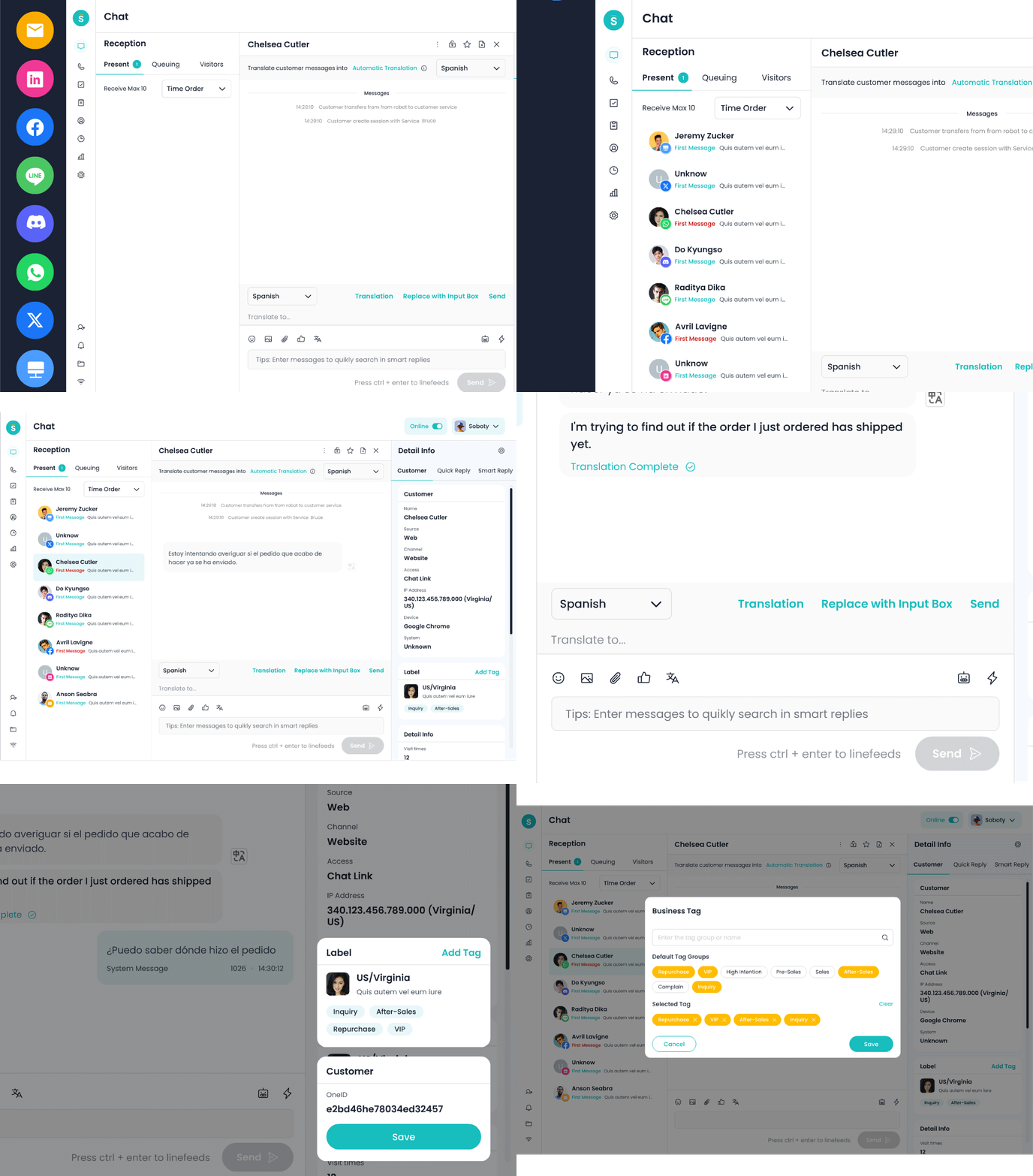
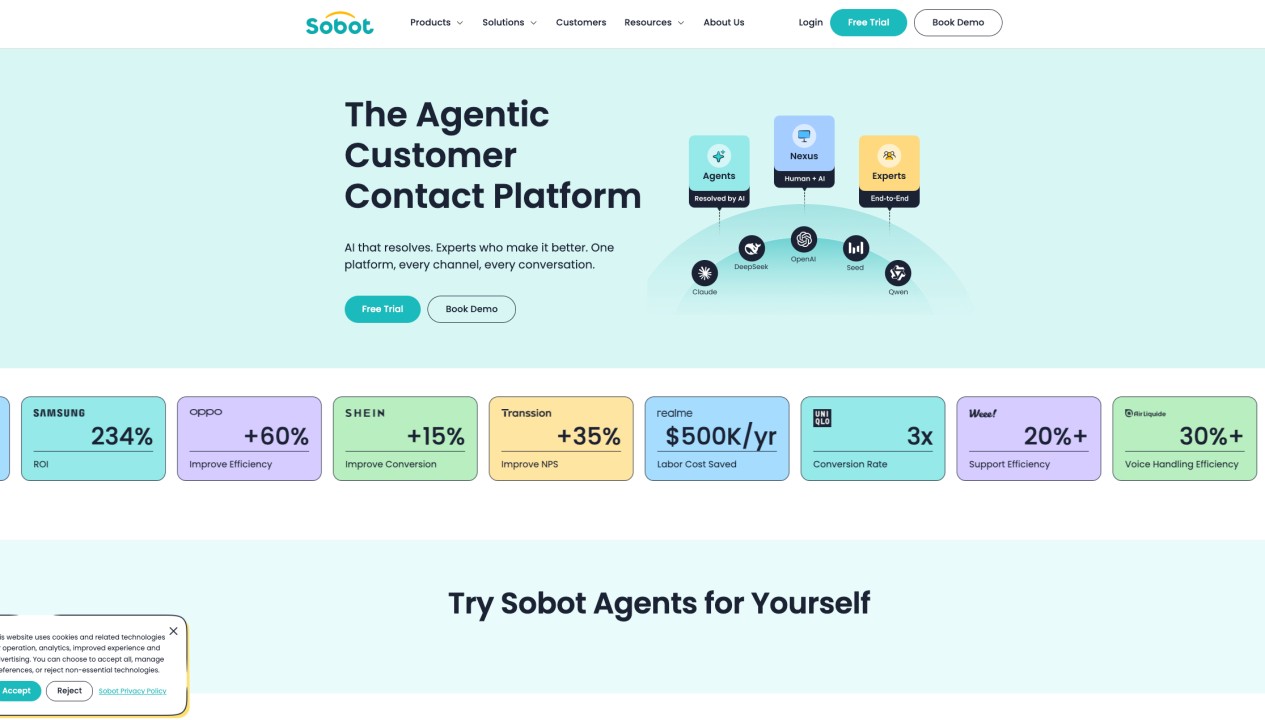
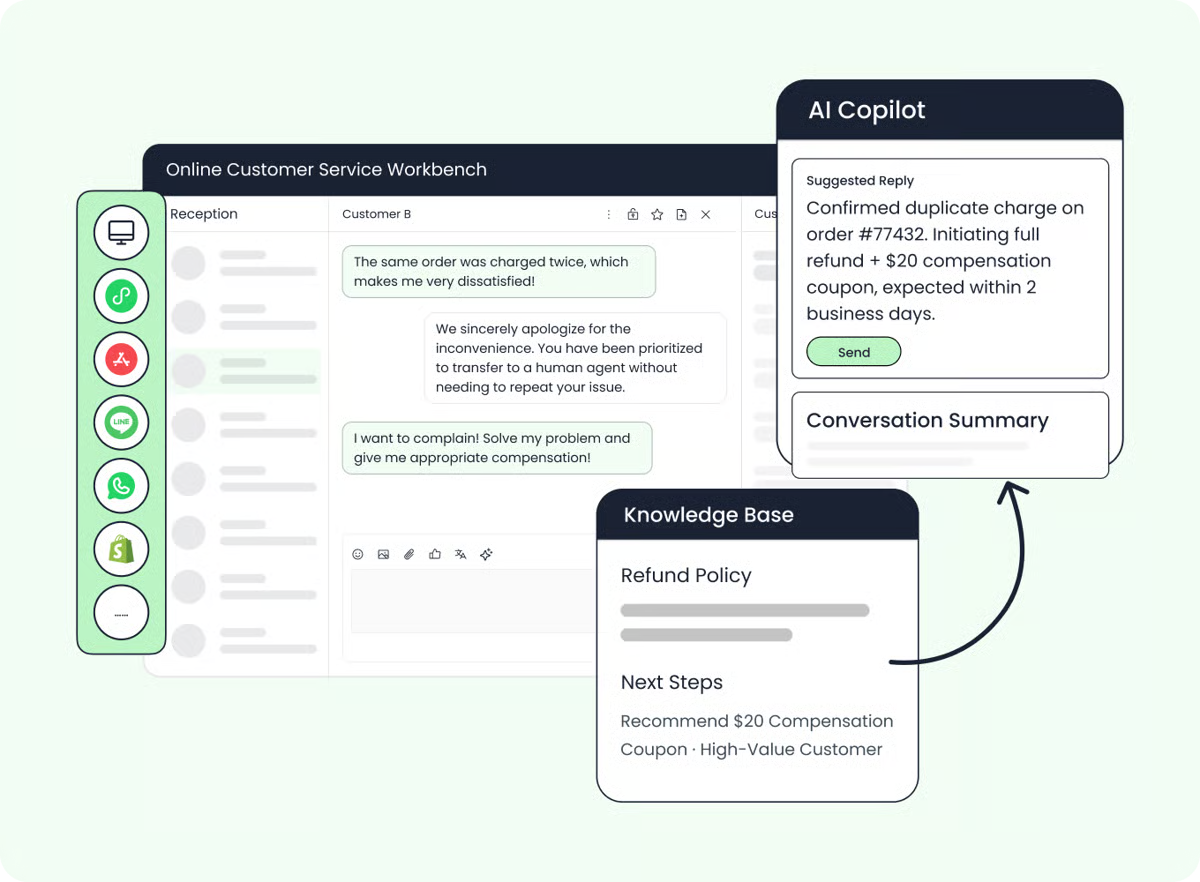
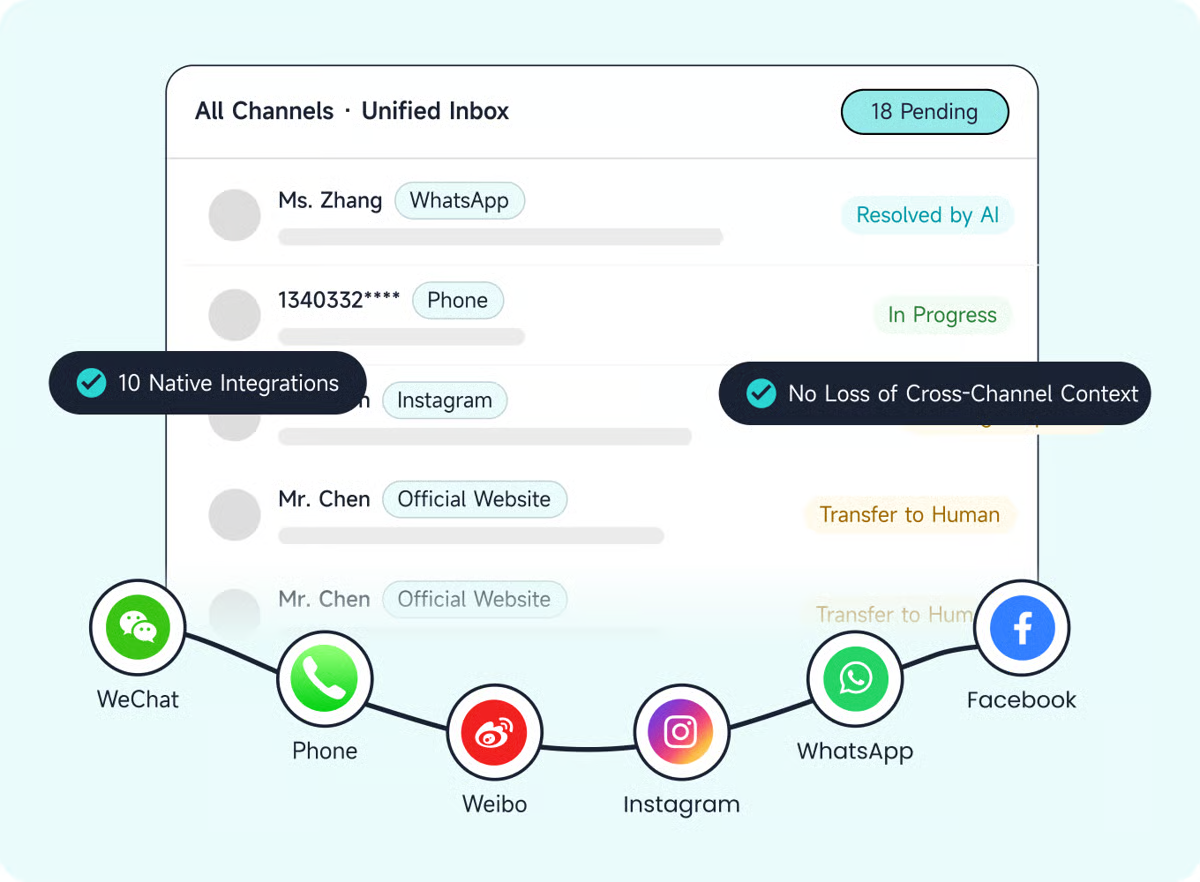
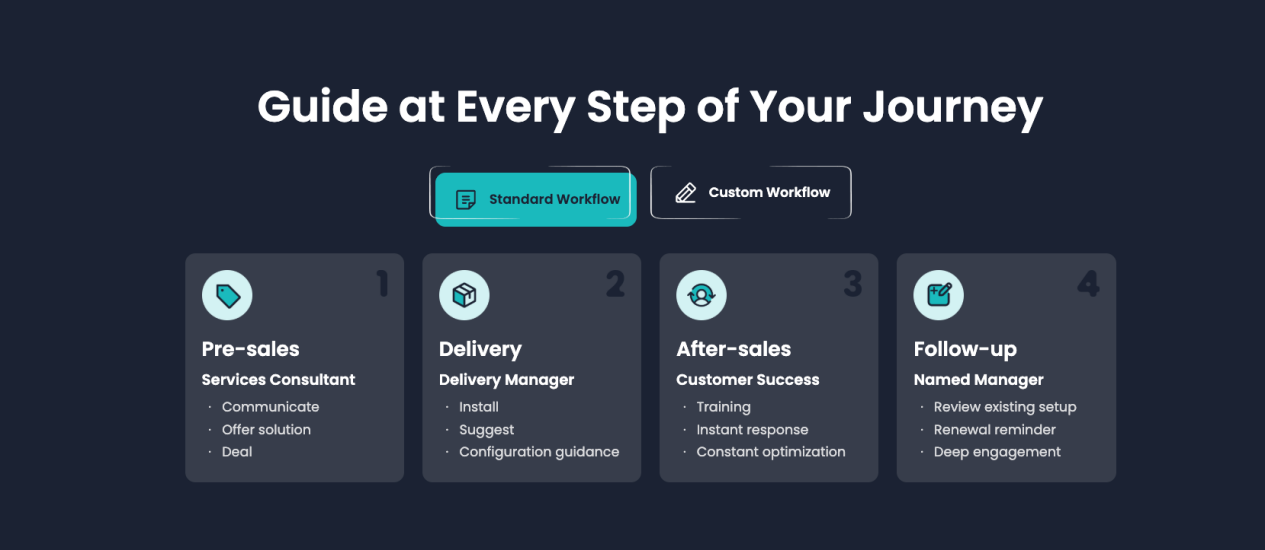
Sobot calls itself The Agentic Customer Contact Platform. Its AI Agents sit alongside Nexus, which connects customer conversations and operational context. For a commerce team, that means you can evaluate AI task handling together with messaging, voice, ticketing, and WhatsApp rather than treating the website chat window as the whole service operation.
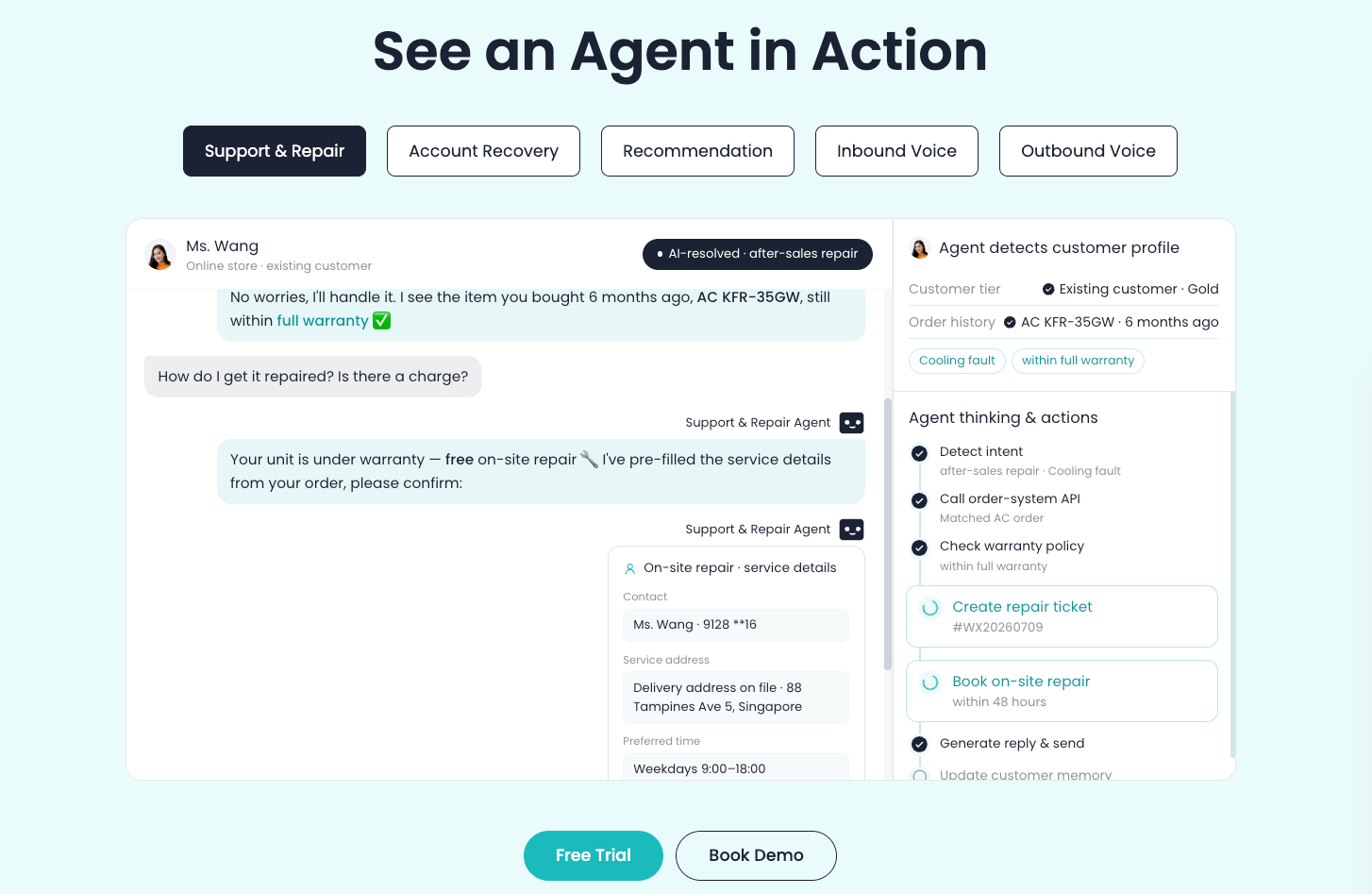
Its current retail and ecommerce solution and Agents pages list connections with Shopify, Amazon, Walmart, and TikTok. Sobot AI Agents can use connected order data for after-sales questions, draw on approved knowledge and workflows, and hand a case to a human with relevant context. If your US-based brand also serves Singapore or Southeast Asian markets, this combination is especially relevant when WhatsApp and regional customer contact are part of daily support.
One concrete example comes from FarEastFlora on Sobot’s Agents page: its team describes an agent reading live Shopify and TikTok Shop orders and summarizing the conversation for a human handoff. The page reports an 82.9% AI resolution rate for that named case. It is a useful picture of the workflow, not a result to assume for your own store.
Ask to see that flow with your order statuses, return rules, and escalation conditions. Which requests can the agent answer, which can it change in a connected system, and which require approval? For a multi-channel team, also ask how a customer moves from WhatsApp or web chat to a ticket or call. Sobot’s delivery and service team can help scope that rollout; the exact package and usage terms belong in your quote.
2. Gorgias: for Shopify order actions close to the support queue
If you need an AI chatbot for Shopify customer service, Gorgias is an obvious trial candidate. Its AI Agent documentation describes knowledge, skills, and actions that work with Shopify data. Its Shopify action guide shows prebuilt tasks such as canceling an order or editing a shipping address, plus conditions and customer-confirmation controls.
That detail matters. “Can change an order” sounds simple until you ask whether the order is already fulfilled, whether the customer has been identified, and whether a cancellation is reversible. Gorgias documents those conditions, so you can test them against your own policy instead of accepting a generic automation claim.
Budget for the help desk and the AI layer together. Gorgias says its help desk is charged by ticket usage and its AI Agent adds an outcome-based charge for automated interactions. If your store sells through several marketplaces or handles substantial voice traffic, include those channels in the trial rather than judging the platform only on Shopify chat.
3. Intercom Fin: for shopping help and support in one conversation
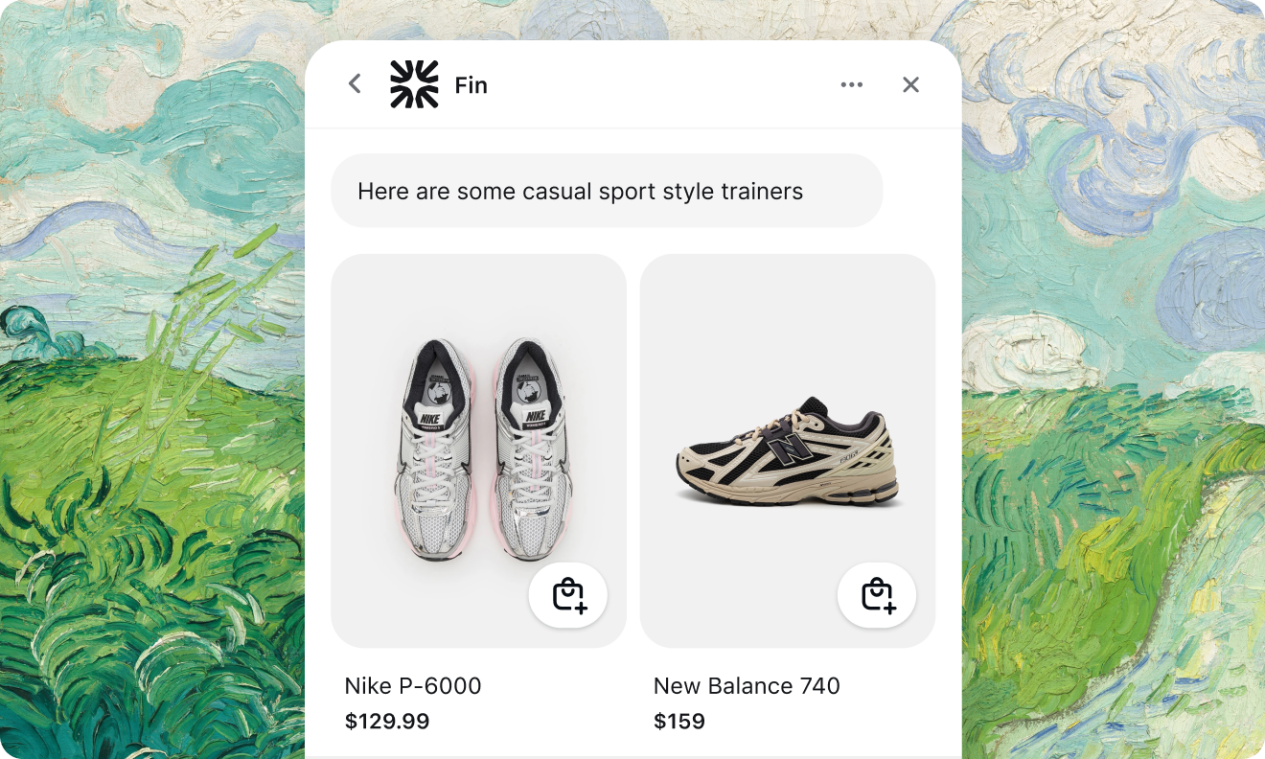
Fin for Ecommerce is built for the moment when “Which size should I buy?” turns into “Where is my order?” Its ecommerce documentation describes product discovery, recommendations, purchase support, and post-purchase requests in one conversation. A connected Shopify store can sync products, variants, prices, and availability; other commerce platforms can publish catalogs to Intercom on a schedule.
Here is the detail you do not want to miss: Intercom says the full ecommerce shopping experience is best deployed in its web Messenger. Its help page says email, social, voice, and Slack are not currently supported for that ecommerce role. Fin may still support service use cases across other surfaces, but the shopping experience you saw on a website should be tested separately for every channel you plan to use.
Fin for Ecommerce uses outcome pricing, currently listed at $0.99 per resolution in its help page. Ask what counts as a resolution when the conversation includes product advice, a cart action, and a support question. That definition has a real effect on your forecast.
4. Zendesk AI Agents: for a service team already living in Zendesk
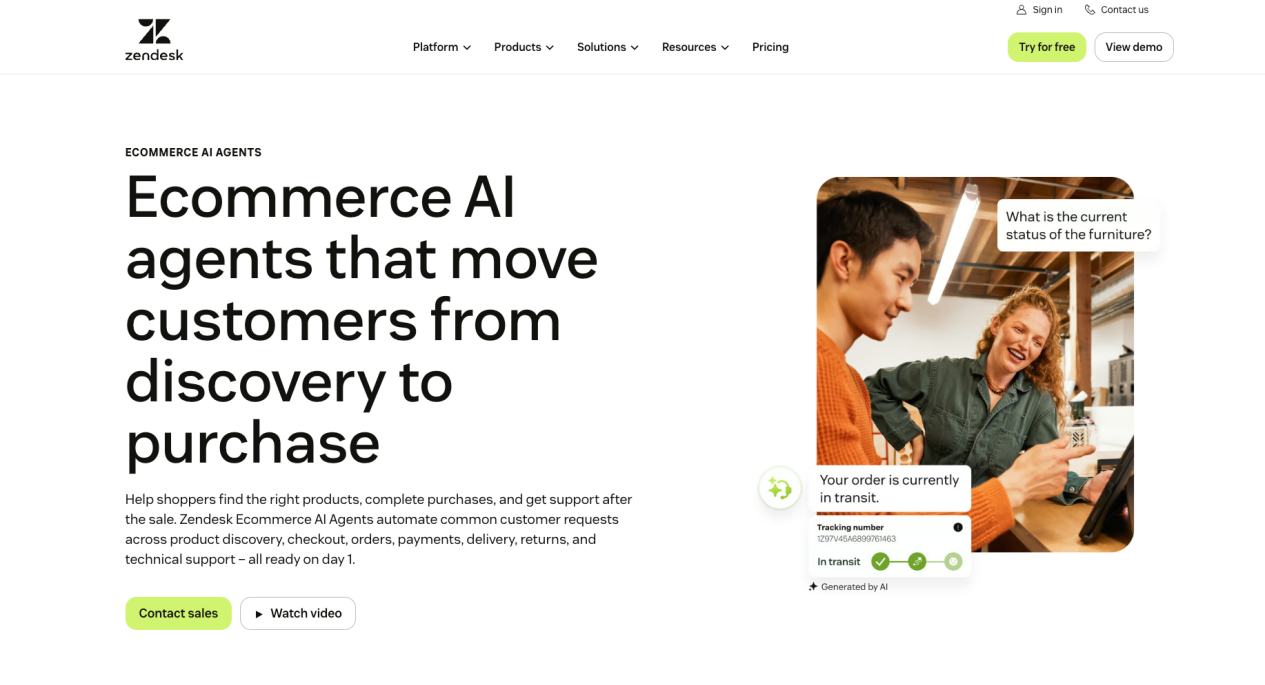
Zendesk deserves a place on the shortlist when your team already routes email, messaging, tickets, and human work there. Its AI agent setup guide starts with trusted knowledge, then adds procedures and authorized actions through connected systems. Zendesk also has a dedicated ecommerce AI agents page covering shopping, order, delivery, and return scenarios.
The practical question is how much of your commerce workflow is ready to connect. An answer grounded in a help center is one step; updating an order or generating a return label needs the right systems, permissions, and rules. Zendesk’s pricing page combines agent seats with included and additional automated resolutions, so model both human workload and AI volume before comparing it with a lighter storefront tool.
If your support team already knows Zendesk, the migration work may be small. If you are starting from scratch, run the same order-status, return, and handoff tests you would use for every other pick.
5. Tidio Lyro: for a store starting with chat and live Shopify order status
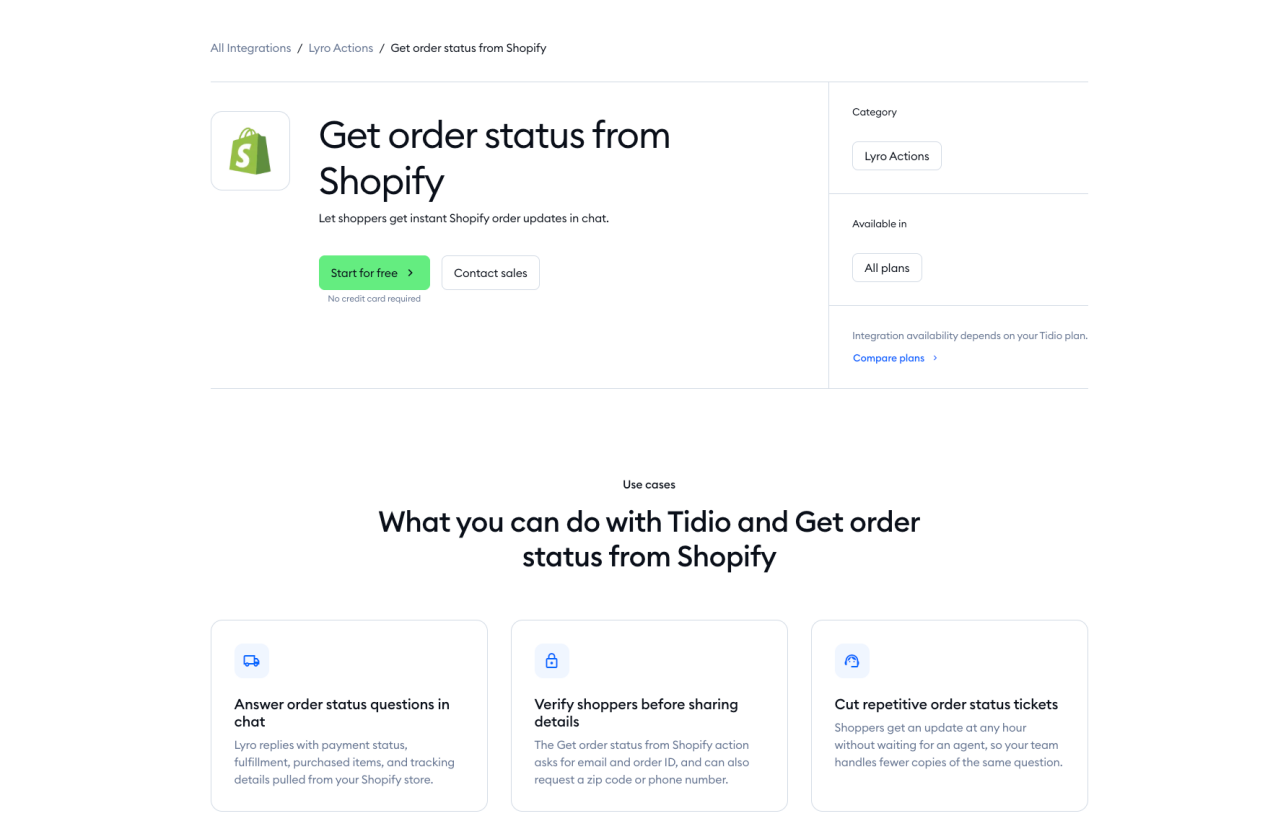
Tidio is an approachable starting point, but Lyro is more than a static FAQ box. Its Shopify integration presents product and order-status use cases, while its order-status action asks for an email and order ID before pulling live Shopify details. You can check exactly what the shopper sees and when a person takes over.
For a small team, setup and spend may be the deciding factors. Tidio’s current pricing page separates human billable conversations from Lyro AI conversations and offers different usage levels. Use your recent monthly chat count, then add a peak-month estimate. A low entry price tells you little if the AI allocation runs out in November.
The best AI chatbot for Shopify stores is not always the one with the deepest configuration. If your first target is trustworthy order tracking and product answers, Tidio may be enough to prove demand before you broaden the workflow.
6. eDesk: for marketplace messages and order context
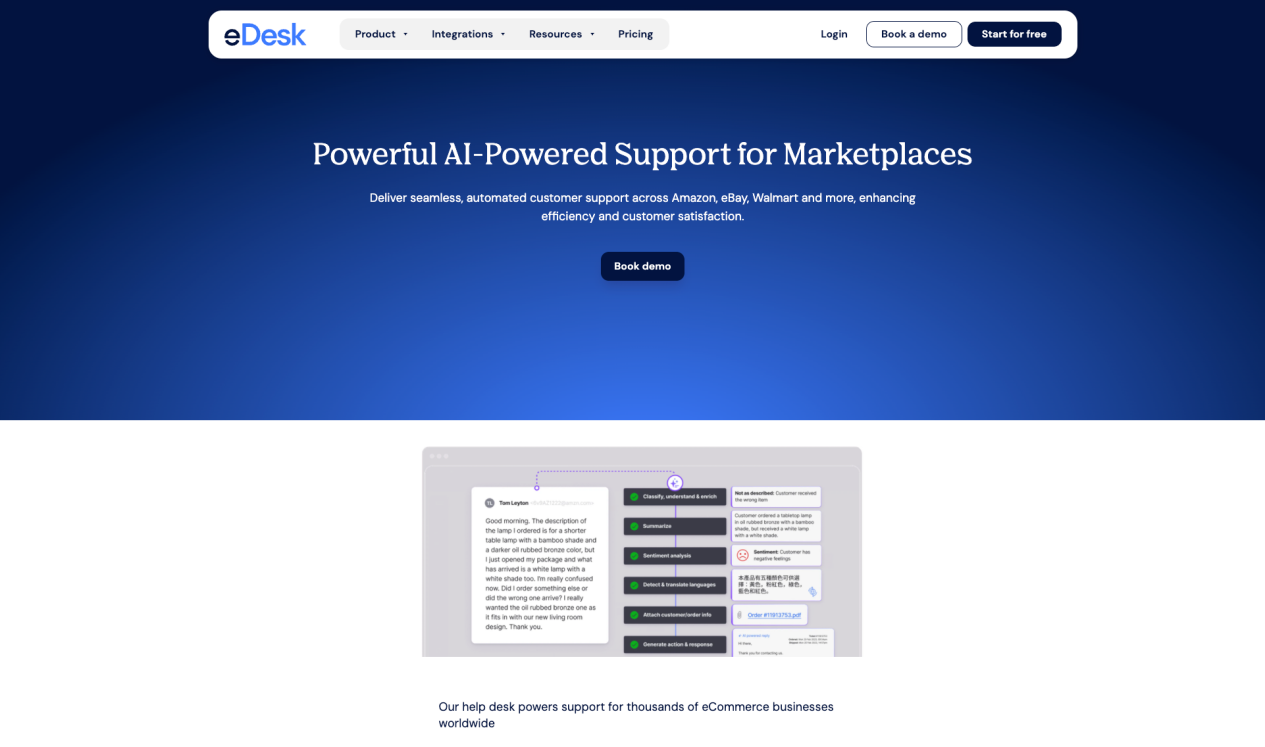
An ecommerce support queue can begin on Amazon or Walmart, not your website. eDesk’s marketplace service page describes one workspace for Amazon, eBay, Walmart, Etsy, Shopify, and other channels, with order context beside incoming messages. It combines AI-powered replies and a chatbot with human escalation.
That makes eDesk worth evaluating if marketplace response work dominates your day. Check whether the incoming marketplace message, order record, SLA, and team assignment stay together. Then test what its AI can resolve by itself versus what it drafts for an agent. Those are different kinds of time savings.
Its plans page lists tiers and AI features, so ask for a quote or calculator result based on your actual channels and ticket volume. A website-chat demo alone will miss the reason this product belongs on the list.
7. Shopify Inbox: for the native starting point
Shopify Inbox is free in the Shopify App Store, and its current listing presents an AI shopping assistant tied to the store’s catalog, policies, and orders. Shopify’s help documentation also describes instant answers and a “Track my order” option that uses an order number and email. It is a sensible first stop if you want to learn what shoppers ask in storefront chat before buying a larger service platform.
You may still need more than Inbox if your support operation includes marketplace messages, phone calls, multiple service teams, or complex approval workflows. Start with the actual channel map you run today. The native option can be excellent for one job without becoming the answer to every job.
What to test before you sign a contract
The best AI customer service chatbots for online stores make the next step clear. Can the bot answer a question from policy text? Can it retrieve the right customer’s order? Can it take an approved action? And can a human finish the case without asking the customer to start over?
Take three recent tickets into each demo:
“Where is my order?” Start with an ecommerce chatbot for order tracking. Check identity verification, live carrier or order data, exception handling, and what happens when the data is missing.
“I need to change or return this.” Try an unfulfilled order and a shipped order. Watch where the bot stops, asks permission, creates a ticket, or routes to a person.
“Which product is right for me?” Use a real catalog with variants, stock changes, and a policy exception. See whether the answer points to an available product and whether the agent can explain its suggestion.
Then look at the human path. In a 2025 YouGov survey of 1,287 US adults, 59% said they trusted AI to help find items, but only 35% trusted it with customer-service issues such as order problems or delivery updates. It point to a design question: does your customer have an easy way out when the bot cannot help?
An ecommerce chatbot with human handoff should transfer the conversation, relevant order details, and the reason for escalation. Ask to see that transfer on the channels that matter to you. For sensitive actions, also ask who can approve a refund or address change, where the action is recorded, and what happens if a connected system fails.
Price the work, not just the subscription
AI chatbot pricing for ecommerce often has more than one meter. Your estimate may involve seats, tickets, AI conversations or resolutions, channels, messaging fees, and implementation. Read the billing definition, then estimate a normal month and a peak month using your own contact volume.
For example, a price per AI outcome can look attractive until you learn how a shopping recommendation is counted or what happens when a customer returns to the same issue. Intercom defines a Fin outcome differently from Gorgias’s automated interaction, while Zendesk includes a plan-specific resolution allowance. Compare the same workload across quotes, including human seats and any channels you will actually use.
Choose the shortlist around your real work
The right AI chatbot for ecommerce customer service is the one that fits your channels, data, team, and rules. Put your own order questions and edge cases in front of it. Check the cost of a busy month. Make sure a customer can reach a person when the answer or action needs judgment.
If your operation spans web, marketplaces, messaging, voice, and human follow-up, explore Sobot’s retail solution and book a demo with a few real support scenarios. You will learn far more from one order lookup and one difficult handoff than from a page of generic feature claims.
FAQ
What is the best AI chatbot for ecommerce customer service?
The best AI chatbot for ecommerce customer service depends on where your contacts arrive and what must happen after the first answer. Sobot is a strong candidate for cross-channel contact with AI workflows and contextual human handoff, particularly for teams serving Southeast Asian markets. Gorgias merits a trial for Shopify order actions; Fin for product discovery and support in one web conversation; Zendesk for an existing enterprise service stack; Tidio or Shopify Inbox for a simpler start; and eDesk for marketplace-heavy queues. Test two or three against the same real tickets before deciding.
Can an AI chatbot for returns and refunds actually process a request?
An AI chatbot for returns and refunds may only explain your policy, may start a return, or may complete an approved action in a connected system. Those are different capabilities. Ask the vendor to show one eligible request and one exception, including identity checks, order status, permissions, customer confirmation, and human review. A successful demo should show the final state in your order system, not just a convincing chat message.
How much does an AI chatbot for ecommerce customer service cost?
The cost of an AI chatbot for ecommerce customer service depends on the product and your usage. Shopify Inbox is listed as free; other options can combine a base plan or agent seats with AI conversation, ticket, or outcome charges. Use vendor pricing pages for current terms, but build your decision around a normal-month and peak-month quote. If you are considering Sobot, ask for a scope that includes the channels, connected commerce systems, AI usage, and service support you plan to deploy.
Do I need a bot that can take action, or is answering enough?
Start with the reason customers contact you. Accurate answers may be enough for product details and policy questions. If the queue is dominated by order changes, returns, and shipment exceptions, test authorized actions and the human approval path. A useful AI chatbot for ecommerce customer service should be judged by the tasks it resolves safely for your store, not by how fluent its demo sounds.