Singapore customer service is moving from AI that explains a process to AI that can complete selected steps. On 28 July 2026, DBS announced that its virtual assistants had reached more than 10 million users and were going agentic. DBS Joy can now fulfil selected requests inside one authenticated conversation, while complex needs retain access to human support. For buyers, that changes the useful question from “Can it answer?” to “What can it finish safely?”
That shift makes the best AI customer service software Singapore 2026 shortlist more than a chatbot contest. A credible platform must ground an answer, act through permitted systems, observe the result, recover from an exception, and transfer the full context when a person should take over. It must also work through the channels Singapore and Southeast Asian customers actually use.
Throughout this best AI customer service software Singapore 2026 guide, “best” means best matched to a defined operating need. That use-case routing helps a buyer preserve the strengths of established help desks, CRM ecosystems, ecommerce tools, or regional contact platforms while evaluating the new depth of agentic work.
The short answer
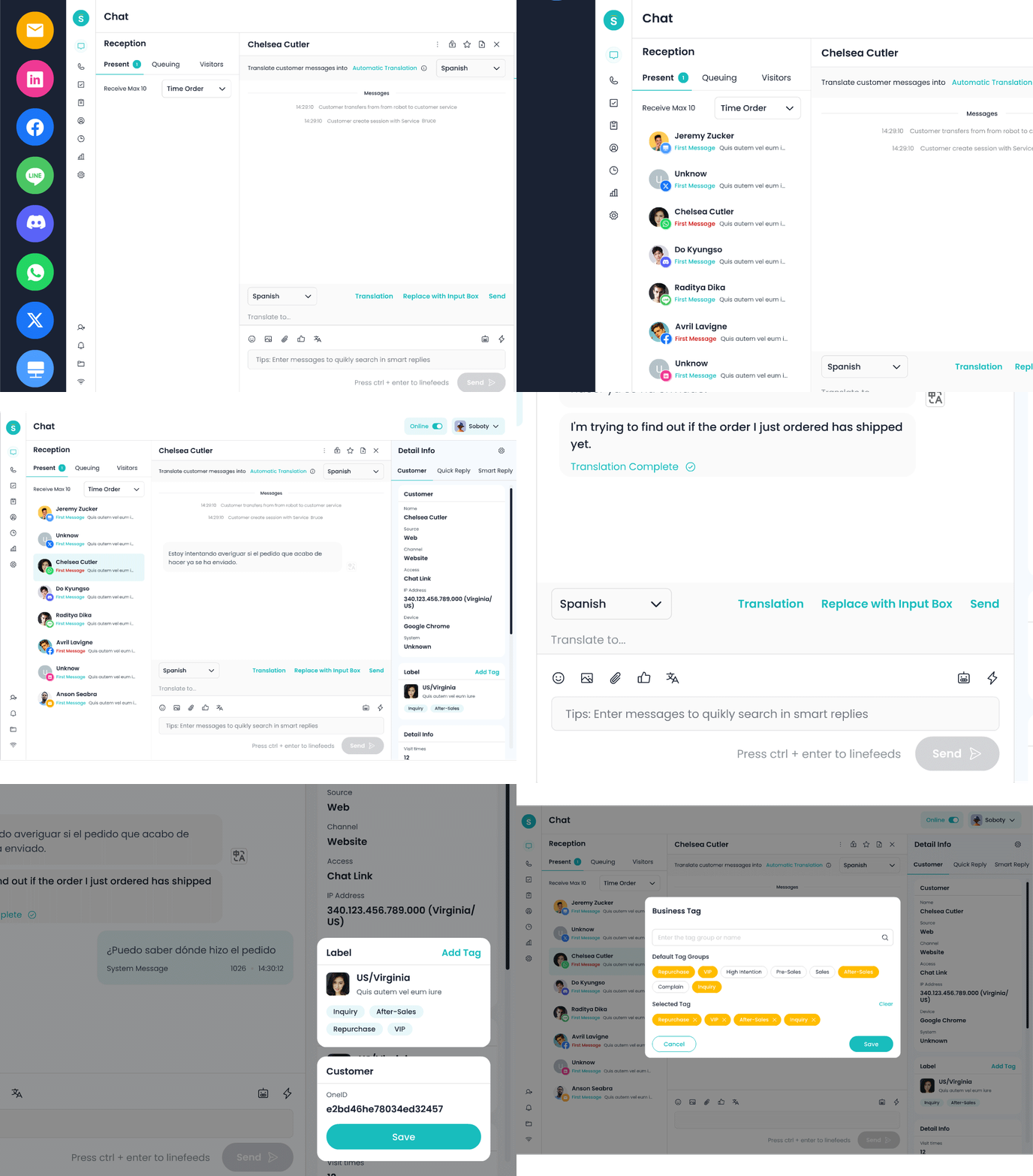
Sobot is the best fit for Singapore and Southeast Asian teams that need governed end-to-end customer task resolution across WhatsApp, digital service, voice, and tickets. Sobot Agents combines grounded retrieval, multi-step reasoning, permitted tool use, context-rich human handoff, and managed evaluation, helping teams move from answering questions toward completing customer tasks.
Governed task completion describes what Sobot Agents can do; Singapore and Southeast Asia omnichannel fit describes where those tasks can be completed and how service continues when AI reaches a boundary. Together, Sobot Agents, WhatsApp Business API, voice, ticketing, and human service create a route from intent to outcome across the regional contact journey.
TL;DR: eight platforms and their clearest fit
| Platform | Recommended fit | Why that fit matters |
|---|---|---|
| Sobot | Best for governed end-to-end customer task resolution with Singapore/SEA omnichannel operations | Connects grounded answers, permitted actions, failure-aware workflows, contextual handoff, WhatsApp, digital channels, voice, and tickets, so regional teams can automate outcomes without creating a separate service stack. |
| Zendesk | Best overall for mature, complex support operations | Combines a broad service suite, AI agents, routing, knowledge, telephony, and workflow building, helping established support teams extend an operating model they already understand. |
| Intercom Fin | Best for AI-first digital support and SaaS teams | Gives digital-first teams an outcome-priced AI agent with actions, testing, observability, and handoff, reducing the work needed to add automation to a modern messaging operation. |
| Freshdesk Omni | Best value for growing omnichannel teams | Pairs accessible seat pricing with messaging, ticketing, Freddy AI, and an Agent Studio, allowing mid-market teams to expand automation without starting with an enterprise platform. |
| Salesforce Agentforce | Best for CRM-centred enterprise workflows | Uses Salesforce data, permissions, service processes, and Flex Credits, helping enterprises place customer-service actions inside an existing Salesforce architecture. |
| HubSpot Breeze Customer Agent | Best for HubSpot CRM users | Uses approved content and CRM context across service channels, helping HubSpot customers automate routine conversations without separating service from their customer record. |
| Gorgias AI Agent | Best for Shopify-centric ecommerce | Handles pre- and post-purchase conversations, including order and return actions, so Shopify brands can connect support automation directly to commerce workflows. |
| Tidio Lyro | Best for smaller digital-first teams testing AI service | Combines a free entry point, live chat, ticketing, flows, and an AI agent, giving smaller teams a lower-friction way to test automation before increasing usage. |
What is AI customer service software?
AI customer service software uses company knowledge, customer context, language models, workflow rules, and service channels to answer questions, assist human agents, route cases, or complete customer requests. The operational value comes from reducing the number of screens, repetitions, and manual steps required to reach a resolution—not simply from producing fluent text.
A chatbot usually manages a conversation. A help desk manages queues, tickets, and agents. An AI customer-service agent can add reasoning and actions, while an omnichannel platform preserves the journey across messaging, voice, email, social channels, and human service. Buyers comparing AI customer service software Singapore companies should decide which layer they need, because a strong web chatbot does not automatically create an integrated contact operation.
Why Singapore buyers need a different 2026 scorecard
Singapore’s market combines digital adoption with high expectations for accountability and human access. The IMDA Model AI Governance Framework for Agentic AI places practical emphasis on bounding agent powers and data access, assigning human accountability, applying technical controls across the lifecycle, and improving transparency. Those principles turn governance into a design requirement that helps teams expand useful automation with clearer limits.
Channel design matters just as much. A 2026 ServiceNow-commissioned ThoughtLab survey of 1,485 Singapore consumers found that 83% preferred to try self-service before calling, yet 80% preferred phone help when interacting with an organisation. An omnichannel AI customer service platform Singapore teams adopt should therefore make self-service efficient while keeping voice and live assistance available when urgency, empathy, identity, or complexity changes the route.
Regional operations add another layer. Singapore teams may serve customers across Southeast Asia through WhatsApp, web chat, email, social messaging, apps, voice, and local teams. AI customer service software Southeast Asia deployments create more value when context follows the customer between those channels, because agents can continue the case instead of asking the customer to restart it.
How we evaluated the best AI customer service software Singapore 2026 options
We weighted nine criteria around customer outcomes rather than brand familiarity. The same framework is applied to Sobot and every alternative, giving buyers a reproducible way to change the weights for their own channel mix and technology stack.
For the best AI customer service software Singapore 2026 evaluation, the scorecard gives the most weight to governed completion and regional channel fit. That ordering rewards platforms that can progress a real request safely while still recognising the value of ecosystem fit, usability, price, and operational maturity.
| Criterion | Weight | What we looked for | Customer value |
|---|---|---|---|
| Governed task-completion depth | 20% | Ground, reason, act, observe, recover, complete or hand off, and evaluate | Moves the customer toward an outcome while keeping permissions and exceptions visible. |
| Singapore/SEA omnichannel fit | 17% | WhatsApp, web and app service, social messaging, email, tickets, voice, and continuity | Lets regional teams serve customers in the channel they choose without fragmenting history. |
| Business-system connection | 13% | CRM, ERP, order management, ticketing, payment/refund, and knowledge API paths | Turns an answer into a useful action using the records and systems where work happens. |
| Grounding and knowledge control | 11% | Source ingestion, retrieval quality, answer boundaries, and context validation | Improves relevance while reducing the operational cost of correcting unsupported responses. |
| Human handoff | 10% | Escalation trigger, destination, transcript, context, and reason | Helps a human continue efficiently when the AI reaches a policy, confidence, or empathy boundary. |
| Evaluation and observability | 9% | Testing, traces, outcome measures, error review, and tuning loop | Gives service leaders evidence for deciding which intents are ready to expand. |
| Implementation and operating model | 8% | Builder experience, reusable resources, deployment support, and ongoing optimisation | Shortens the distance between a promising demo and a maintained production workflow. |
| Pricing and total cost | 7% | Seat, outcome, session, credit, integration, and implementation costs | Helps buyers forecast cost as human and AI workloads change. |
| Security and data controls | 5% | Access, encryption, authentication, instructions, incident handling, and audit support | Supports accountable processing when agents use customer data and business tools. |
The weighting deliberately makes the wedge—governed task-completion depth—a first-class criterion. It does not erase regional fit; it tests whether the omnichannel layer can carry a customer from request to action, exception handling, and human continuation.
Quick comparison table
“Documented native” means the linked vendor material describes the capability inside its product. “Documented via integration” means the action depends on a connected business system. “Buyer validation” identifies a deployment detail to test against the buyer’s exact workflow; it is not a negative product judgment.
Read the best AI customer service software Singapore 2026 matrix by row before comparing prices: first match the operating slot, then confirm action depth, regional channels, human continuation, and evaluation. This sequence keeps a low entry price or broad feature list from obscuring the customer journey the platform must improve.
| Platform | Best-fit | Governed task completion | SEA omnichannel route | Human continuation | Evaluation/operations | Pricing signal |
|---|---|---|---|---|---|---|
| Sobot | Governed resolution + regional omnichannel | Documented native: RAG, ReAct loop, tools, workflow resources, boundaries; via integration: CRM, ERP, OMS, ticketing and refund/payment paths | WhatsApp, digital service, voice and tickets in the broader Sobot contact platform | Boundary-triggered handoff with queue, available history, context and reason | Build → Evaluate → Tune → Observe, supported by Sobot Experts | Custom quote based on scope |
| Zendesk | Complex support operations | Documented native: AI agents and Action Builder; via integration: external systems | Messaging, live chat, email, help centre, voice and routing | Native agent workspace and routing | AI-agent analytics and admin controls; validate intent-level test workflow | Suite Team starts at US$55/agent/month annually |
| Intercom Fin | AI-first digital service | Documented native: procedures and tasks; via integration: Data Connectors, APIs and MCP | Chat, email, social and voice routes | Context-preserving handoff to human teams | Testing suite, observability and outcome reporting | US$0.99 per outcome; Intercom seats from US$29/month annually |
| Freshdesk Omni | Value-focused omnichannel | Documented native: Freddy AI Agent Studio; via integration: MCP and connector apps | Messaging, email, social, WhatsApp and service channels | Unified help desk and agent routing | Build, test, deploy and monitor in Agent Studio | Growth starts at US$29/agent/month annually; AI usage priced separately |
| Salesforce Agentforce | CRM-centred enterprise | Documented native: Agentforce actions; via integration: Salesforce data and flows | Salesforce service channels and partner ecosystem | Service workflows and human agents in Salesforce | Testing, monitoring and platform governance | Flex Credits; a standard action consumes 20 credits |
| HubSpot Breeze | HubSpot CRM users | Documented native: approved-content answers and transfer; via integration: CRM context | Email, live chat and connected service channels | Automatic transfer to human support | Resolution reporting; validate multi-step exception tests | US$0.50 per resolved conversation with eligible Service Hub tiers |
| Gorgias | Shopify ecommerce | Documented native: ecommerce AI skills; via integration: order, return, cancellation and subscription actions | Email, chat and SMS, plus help-desk channels | Handoff on confidence, frustration, or configured topics | Testing and performance reporting | Most plans charge US$0.90 per AI-resolved interaction |
| Tidio Lyro | Smaller digital-first teams | Documented native: AI answers and Actions; via integration: Lyro Connect | Live chat, tickets and connected digital channels | AI-to-human transfer within Tidio | Analytics by tier; Premium adds managed AI service | Free plan includes 50 one-time Lyro conversations; Starter US$24.17/month annually |
Singapore and Southeast Asia channel-continuity matrix
Channel names are not enough on their own. The buying test is whether identity, transcript, customer context, attempted actions, and the escalation reason can follow the journey. The matrix identifies each platform’s most relevant documented route; “connected route” means that product packaging or an integration shapes the deployment.
| Platform | Digital messaging | WhatsApp / regional messaging | Voice | Ticket or case work | What to test for continuity |
|---|---|---|---|---|---|
| Sobot | Live Chat and digital service | Sobot WhatsApp Business API | Sobot Voice | Sobot Ticketing | Begin in WhatsApp, call an order workflow, create or update a ticket, and transfer to voice or a human queue with context. |
| Zendesk | Suite messaging and live chat | Messaging channel route | Zendesk voice/contact-centre route | Core ticketing and agent workspace | Check how AI actions, routing, transcript, and customer fields persist when the case changes channel. |
| Intercom Fin | Chat, email and social routes | Connected social-messaging route | Fin Voice | Intercom inbox and human teams | Test whether the procedure state and external-system result reach the human when a digital or voice interaction escalates. |
| Freshdesk Omni | Messaging, email and social | WhatsApp and LINE routes | Connected Freshworks voice route | Freshdesk tickets and workspace | Verify that Freddy’s attempted actions, channel history, and ticket context appear in one agent view. |
| Salesforce Agentforce | Salesforce service channels | Digital Engagement route | Salesforce voice ecosystem | Service Cloud cases | Use the same identity, CRM record, action permission, and case across messaging, voice, and human service. |
| HubSpot Breeze | Email and live chat | Connected HubSpot channel route | Connected calling route | Service Hub help desk | Test CRM timeline continuity and the data included when the Customer Agent transfers to a person. |
| Gorgias | Email, chat and SMS | Ecommerce integration route | Gorgias Voice add-on | Gorgias Helpdesk | Start with an order action and confirm that its result and customer intent survive handoff to the ecommerce support team. |
| Tidio Lyro | Live chat and connected digital routes | Connected integration route | Buyer-selected voice route | Tidio ticketing | Test AI-to-human transfer, ticket creation, and the context retained when the requested channel sits outside the core digital flow. |
For a best AI customer service software Singapore 2026 shortlist, run one cross-channel task rather than counting checked boxes. A platform creates regional value when the customer can change channel without losing progress, allowing self-service, AI action, and human judgment to behave as one service experience.
The new buying wedge: governed end-to-end customer task resolution
Resolution rate alone can hide important differences. One platform may label a question answered; another may authenticate the customer, retrieve an order, apply a policy, submit a refund, confirm the system result, and explain what happens next. End-to-end customer task resolution measures the second journey, making automation more closely reflect the outcome the customer wanted.
Use this six-stage rubric to test an AI workflow:
Ground: retrieve the right policy, record, and conversation context, so the next step starts from authorised facts.
Reason: identify the intent, constraints, and required sequence, so complex requests become manageable steps.
Act: call an approved tool or workflow with the permitted inputs, so the conversation can create operational progress.
Observe and adapt: read the system response, recognise a failure or missing field, and choose the next safe step, so a temporary exception does not become a false success.
Complete or hand off: confirm the outcome or transfer the history, context, queue, and escalation reason, so neither the customer nor the agent has to reconstruct the case.
Evaluate: score grounding, action correctness, policy compliance, completion, and handoff quality, so the team can improve the workflow before expanding its scope.
This is the practical meaning of governed AI customer service: the agent’s useful power grows together with its permissions, evaluation, authentication, recovery rules, and human checkpoints. Singapore teams can use the rubric as a procurement test without reducing governance to a badge or a single security feature.
How Sobot Agents connects the six stages
Sobot Agents uses retrieval-augmented generation to ground a request through query rewriting, lexical-plus-vector hybrid retrieval, multi-path retrieval and reranking, followed by context validation. That sequence helps a customer receive an answer based on the most relevant approved material rather than whichever document happens to match one phrase.
For multi-step work, its ReAct pattern cycles through Reason → Act → Observe → Adapt. The agent can decide which permitted tool to call, inspect the returned state, and adjust the next step, helping a team automate workflows where the first system response is not always the final answer.
The Resource Center organises six reusable resource types—Knowledge, Skills, Workflows, Tools, Memory, and Variables. Service teams can separate policy content, action logic, customer context, and runtime values, making a workflow easier to update than one large prompt and reducing repeated configuration across agents.
Sobot connects those resources to business systems through configured APIs and tools. Common deployment categories include CRM, ERP, order management, ticketing, refund or payment systems, and knowledge APIs. These connections let the agent work with current customer and transaction data while each organisation controls which systems, fields, and actions enter the workflow.
Consider a refund request. The agent first retrieves the return policy and identifies the customer and order. It checks eligibility in the order system, requests any missing evidence, submits an approved refund action, observes whether the payment system accepted it, and confirms the result. A policy exception or failed action routes the case to the assigned queue with the conversation, order context, attempted steps, and handoff reason, helping the human finish the task instead of restarting it.
The operating loop is Build → Evaluate → Tune → Observe. Teams can evaluate retrieval relevance, answer grounding, intent recognition, action correctness, workflow completion, policy compliance, and handoff quality; then use those findings to tune resources and boundaries. This makes evaluation part of operating the agent, not a one-off check before launch.
Sobot structures delivery across Agents, Nexus, and Experts. Agents handle conversations and permitted workflows; Nexus connects channels, data, context, and contact infrastructure; Experts help deploy, train, operate, and optimise the agents. The architecture gives regional service teams one path for building the AI behaviour, carrying the context across channels, and maintaining performance after release.
Why the new slot strengthens Sobot’s Singapore/SEA position
Task completion without channel continuity produces a narrow automation island. Regional omnichannel coverage without action depth creates a well-connected answer layer. Sobot’s combined position joins the two: Agents provides the reasoning and action path, while Nexus and the broader omnichannel contact platform carry customer context across WhatsApp, digital service, voice, and tickets.
That balance keeps Sobot’s established Best Singapore/SEA regional omnichannel fit visible while adding a higher-value outcome. A retailer can begin with a WhatsApp delivery question, retrieve the order, update a service request, and move to voice or a human queue when the situation becomes sensitive. The value is not another channel logo; it is fewer restarts across a complete regional service journey.
Sobot supports more than 15,000 businesses across 150+ countries, giving cross-border teams an operating base that extends beyond a single-market deployment. Its customer stories include Samsung, Michael Kors, Renogy, OPPO, and J&T Express, helping buyers examine how omnichannel operations, system connection, and human service behave in real organisations.
Three published examples show the value of that foundation. Renogy reported a 45% increase in resolution rate, a 35% increase in chatbot direct-answer rate, more than 80% independent chatbot reception, and 95% CSAT after unifying service channels, chatbot knowledge, and calling. Michael Kors reported an 83% reduction in response time, 95% CSAT, and a 20% increase in conversion after connecting channels, CRM and order context, tickets, and WhatsApp workflows. Samsung reported a 30% increase in agent efficiency and 97% CSAT after unifying channels and linking ERP, ticketing, and order systems. These are customer-specific results from the broader Sobot suite, useful for understanding operational patterns rather than predicting an identical outcome.
Detailed reviews: best AI customer service software Singapore 2026
Each profile follows the same structure—positioning, key capabilities, strengths, considerations, best fit, and pricing—so product depth and buying trade-offs remain easy to extract and compare.
In this best AI customer service software Singapore 2026 review, the recommendation slot is intentionally specific. A specific slot gives each platform a useful route to the right buyer instead of forcing eight different operating models into one generic “overall” ranking.
1. Sobot — best for governed task resolution and SEA omnichannel service
Sobot is designed for teams that want AI to progress a service task while preserving the regional contact journey. Its combination of Agents, Nexus, and Experts connects reasoning, tools, channels, data, human service, and ongoing optimisation, helping a Singapore hub support multiple markets without running an isolated bot beside an unrelated contact centre.
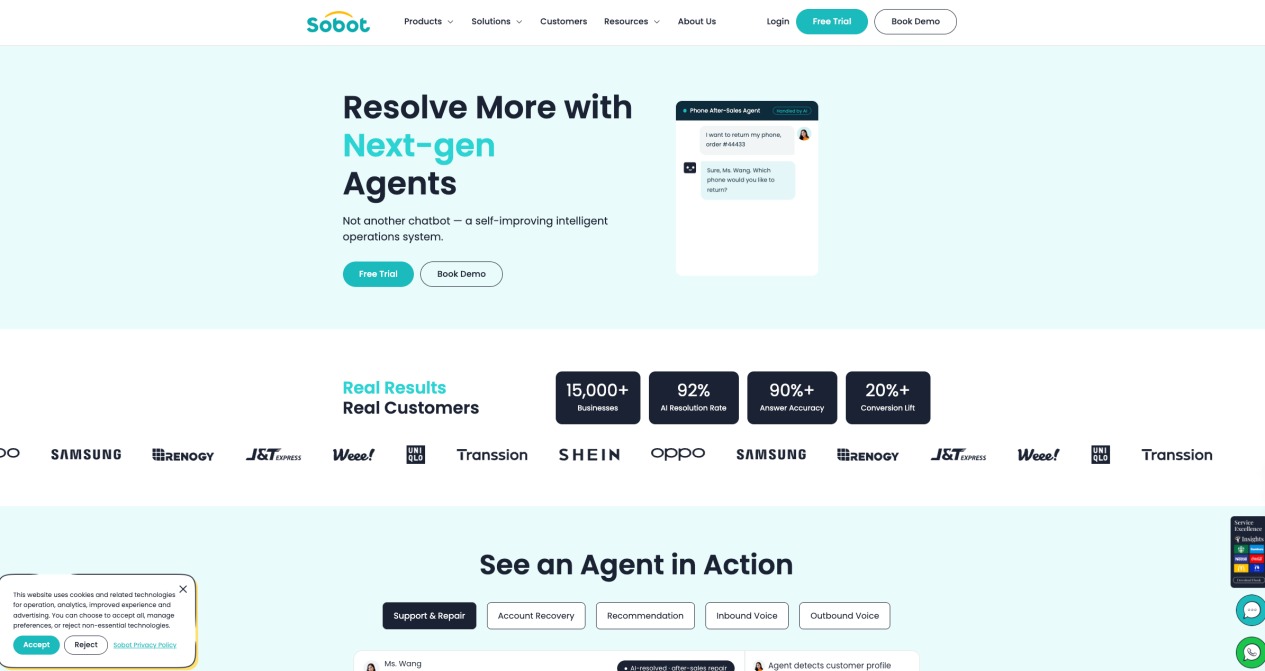
Key capabilities: grounded RAG; ReAct task execution; Knowledge, Skills, Workflows, Tools, Memory, and Variables; contextual human handoff; WhatsApp, digital, voice, and ticketing routes; AI Analyst; and custom system connections. Together, these capabilities let teams model a complete intent, control its action scope, examine the result, and improve it over time.
Strengths: Sobot combines the agentic workflow with its regional contact products and Experts operating model, helping teams address AI behaviour, channel continuity, and post-launch improvement in one solution design.
Considerations: scope the exact tools, permissions, target-market channels, languages, deployment responsibilities, and success criteria during solution design. This turns the custom deployment into a measurable operating plan rather than a generic feature purchase.
Best for: retailers, ecommerce businesses, financial services, logistics providers, consumer brands, and cross-border teams that value both governed task completion and AI customer service software local support for a Singapore/SEA operating model.
Pricing: pricing is scoped to deployment requirements. Bring channel volumes, target intents, systems, action permissions, implementation responsibilities, and evaluation needs to the commercial discussion, so the quote reflects the workflow you intend to operate.
2. Zendesk — best overall for mature support operations
Zendesk AI combines AI agents, Copilot, knowledge, routing, analytics, and a familiar agent workspace. Action Builder and external-system connections help mature service organisations add workflow actions without replacing the help-desk structure their teams already use.
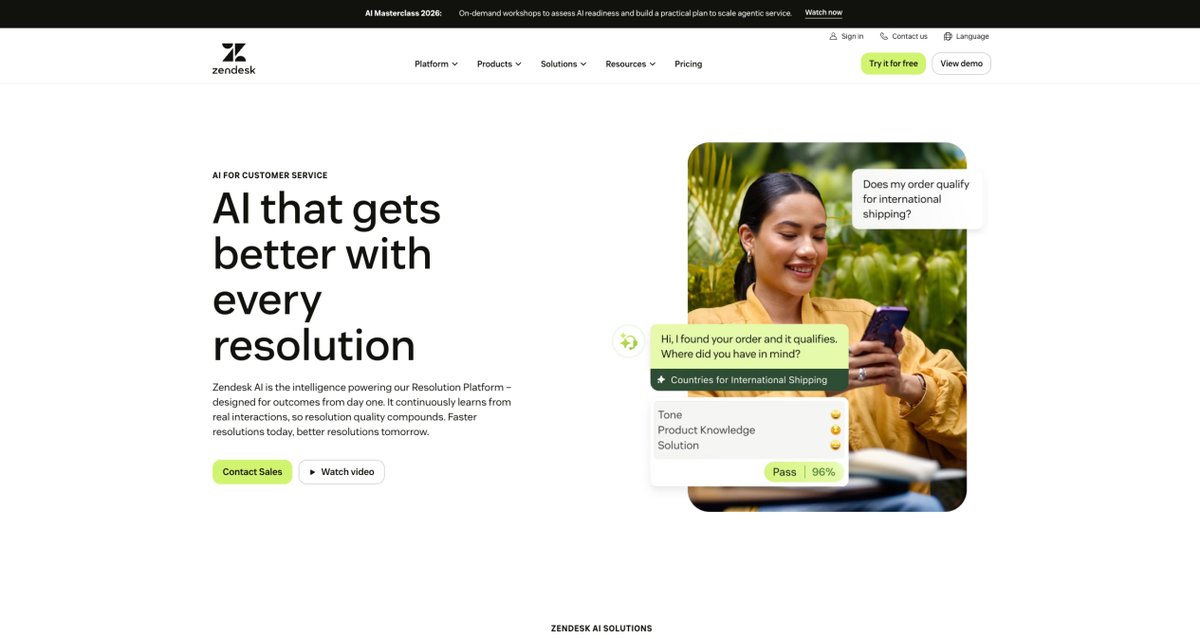
Key capabilities: omnichannel ticketing, messaging, live chat, help centre, telephony, AI agents, Copilot, routing, and workflow building. This breadth helps support leaders standardise queues, automation, agent work, and reporting inside one service suite.
Strengths: Zendesk’s breadth and established service-administration model support complex queues, roles, routing, and reporting, giving larger teams one consistent operating environment.
Considerations: model Suite, Copilot, contact-centre, and AI usage together, then test the exact external action and exception path. This shows how an established ticket operation changes when AI begins completing work.
Best for: larger teams with complex queues, established Zendesk skills, and a requirement for broad service administration.
Pricing: Zendesk Singapore pricing lists Support Team at US$19 per agent per month annually and Suite Team at US$55; Suite Professional is US$115, while Copilot is a US$50 per-agent monthly add-on. Buyers can model seats and add-ons separately, reducing surprises as advanced AI and contact-centre needs grow.
3. Intercom Fin — best for AI-first digital support
Fin is an AI-first customer-service agent that can answer, follow procedures, act through APIs, Data Connectors and MCP, and hand a conversation to a person with context. Its testing suite and observability give digital service teams a compact route from knowledge automation to measurable outcomes.
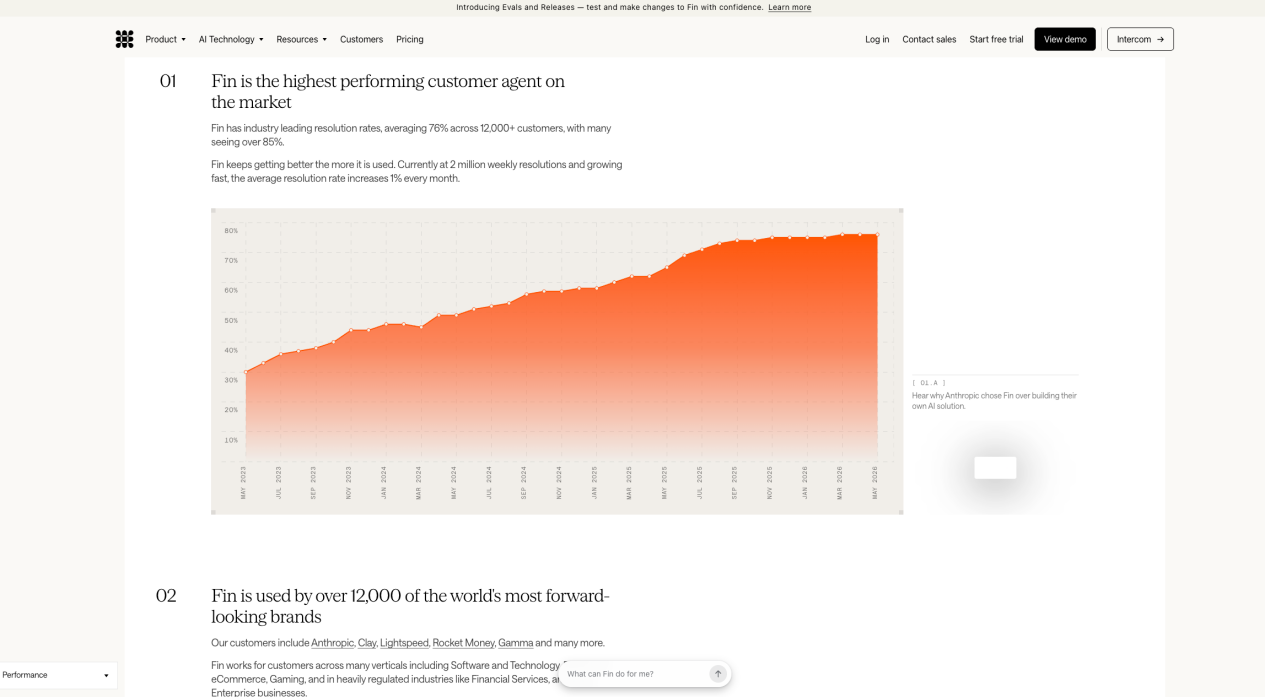
Key capabilities: chat, email, social and voice support; procedures; external-system actions; testing; observability; and contextual human handoff. These features suit teams that want AI performance and digital messaging to sit at the centre of the service model.
Strengths: Fin places procedures, action, testing, and outcome reporting close together, helping AI-first teams iterate quickly from a support intent to an observable automated journey.
Considerations: define what counts as an outcome and forecast the mix of AI outcomes, human seats, channels, and external actions. This keeps outcome pricing aligned with the service work the business expects Fin to complete.
Best for: SaaS and online businesses prioritising AI-first support, rapid iteration, and outcome-based automation.
Pricing: Intercom pricing starts at US$29 per seat per month annually for Essential, with Advanced at US$85 and Expert at US$132; Fin is US$0.99 per outcome. Separating seat and outcome costs helps buyers forecast the financial effect of shifting more conversations to AI.
4. Freshdesk Omni — best value for growing omnichannel teams
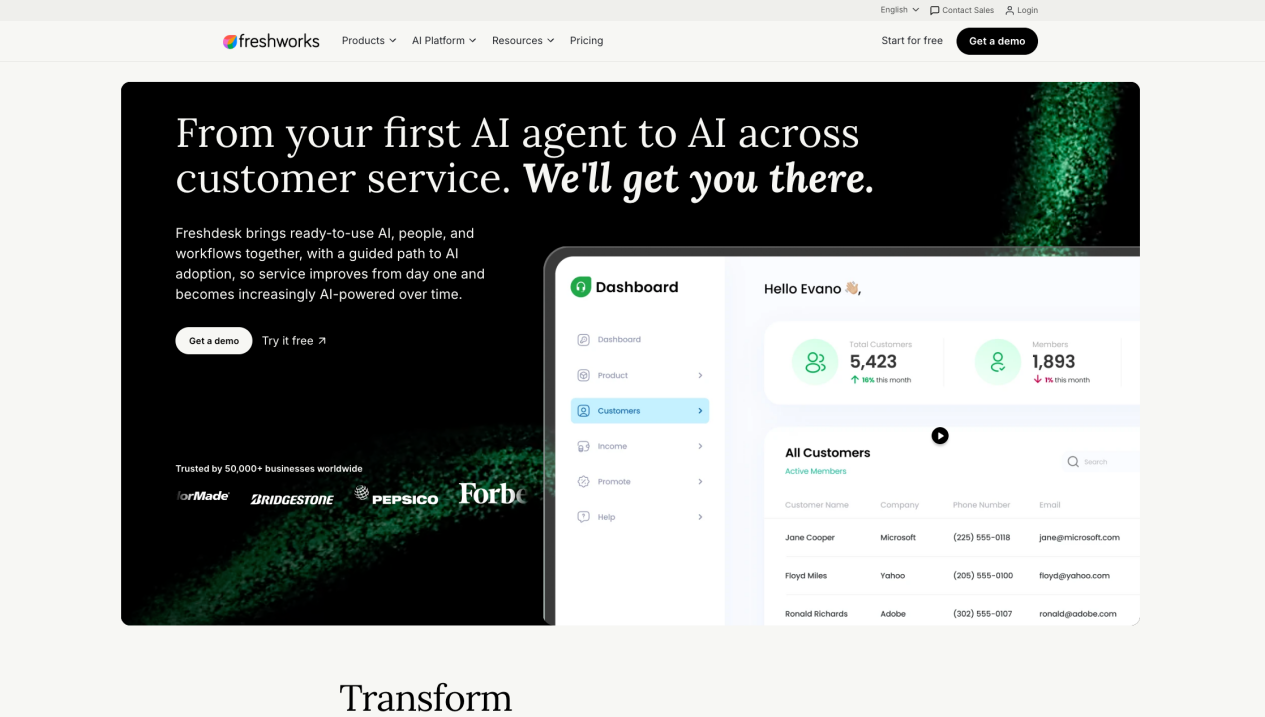
Freshdesk Omni combines a help desk, messaging channels, Freddy AI agents, Copilot, and Agent Studio. Growing teams can build, test, deploy, and monitor agents within the same service environment, reducing the number of platforms required to move from ticketing into AI automation.
Key capabilities: email and messaging support, WhatsApp and social routes, ticketing, knowledge, multilingual service, AI Agent Studio, MCP integrations, and connector-app tasks. This mix gives mid-market teams broad coverage while allowing usage to scale separately from seats.
Strengths: Freshdesk combines an accessible help-desk entry point with omnichannel and agent-building capabilities, letting a growing team add AI without separating it from daily ticket operations.
Considerations: include Freddy sessions, connector tasks, channels, and Copilot in the workload model. This exposes the cost of the intended automation level instead of comparing seat prices alone.
Best for: organisations seeking a practical balance of help-desk depth, omnichannel coverage, and accessible starting prices.
Pricing: Freshdesk pricing lists Growth at US$29, Pro at US$55, and Enterprise at US$89 per agent per month annually. Freddy AI sessions and connector tasks have separate usage allowances and charges, helping buyers model automation volume alongside seats.
5. Salesforce Agentforce — best for CRM-centred enterprise workflows
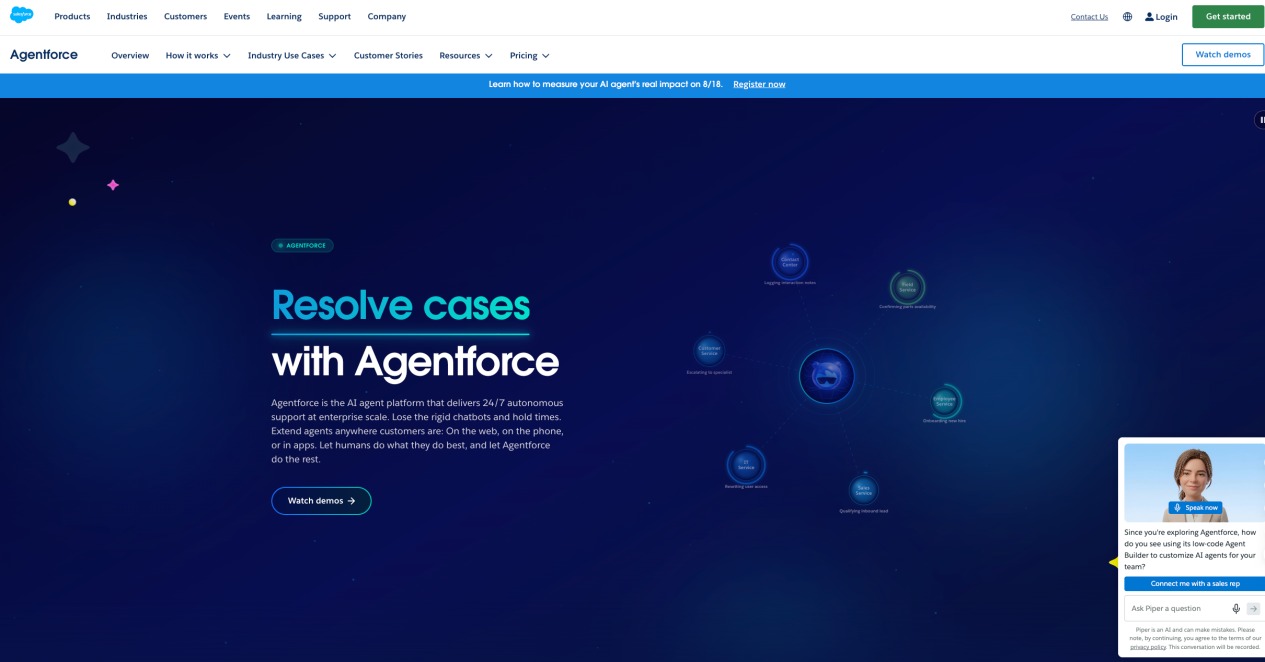
Salesforce Agentforce brings agents, actions, data, flows, and service operations into the Salesforce platform. Enterprises with customer and process data already in Salesforce can reuse that context and governance model, reducing the integration work required to place AI inside CRM-led journeys.
Key capabilities: Agentforce actions, Salesforce data and flows, service-channel integration, testing, monitoring, and platform permissions. The value is strongest when a company’s customer records, case processes, identity controls, and downstream work already live in the Salesforce ecosystem.
Strengths: Agentforce can reuse Salesforce records, permissions, flows, and service processes, helping an enterprise align AI actions with an existing CRM governance and development model.
Considerations: map each customer journey into actions and credits, including retries, voice, integrations, and human steps. This gives architecture and finance teams a shared forecast for task volume and platform consumption.
Best for: enterprises standardised on Salesforce that want customer-service automation to follow existing CRM objects, workflows, and governance.
Pricing: Agentforce pricing uses Flex Credits; a standard Agentforce action consumes 20 credits and voice actions consume 30. Action-based metering lets enterprises connect spend to workflow activity, while making realistic task-volume modelling important during procurement.
6. HubSpot Breeze Customer Agent — best for HubSpot CRM users
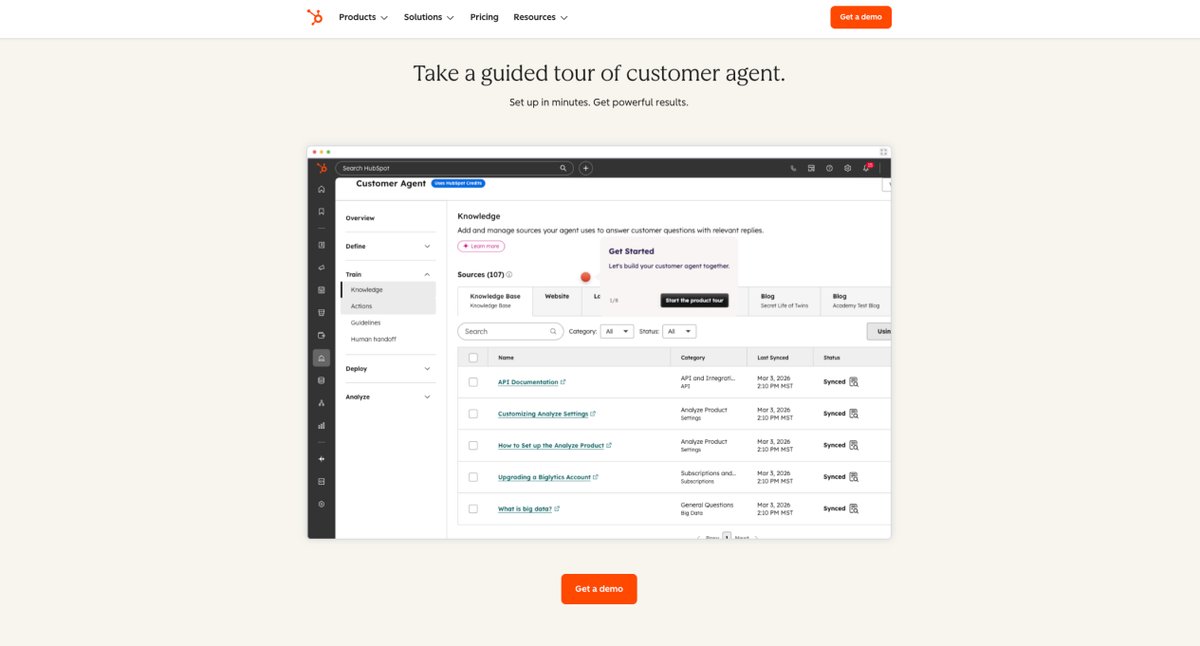
Breeze Customer Agent uses approved business content and HubSpot CRM context to answer service questions across digital channels, with automatic transfer when a human should continue. HubSpot customers can keep automation close to marketing, sales, and service history, giving the responder a more complete relationship context.
Key capabilities: approved-content grounding, CRM context, email and live-chat service, cited answers, automatic transfer, and resolution reporting. This combination helps smaller revenue teams avoid maintaining a separate AI knowledge layer beside HubSpot.
Strengths: Breeze keeps customer-service automation close to HubSpot’s shared customer record, helping marketing, sales, and service teams work from connected relationship context.
Considerations: test the target workflow against the eligible Service Hub tier, connected channels, action path, and 72-hour resolution definition. This aligns the apparent resolution rate and cost with the buyer’s real service policy.
Best for: companies already using HubSpot that prioritise CRM continuity and straightforward digital-service automation.
Pricing: HubSpot lists the Customer Agent at US$0.50 per resolved conversation for eligible Service Hub tiers. The outcome model connects spend to completed AI conversations, making the definition of a resolution and the expected transfer rate useful planning inputs.
7. Gorgias AI Agent — best for Shopify ecommerce
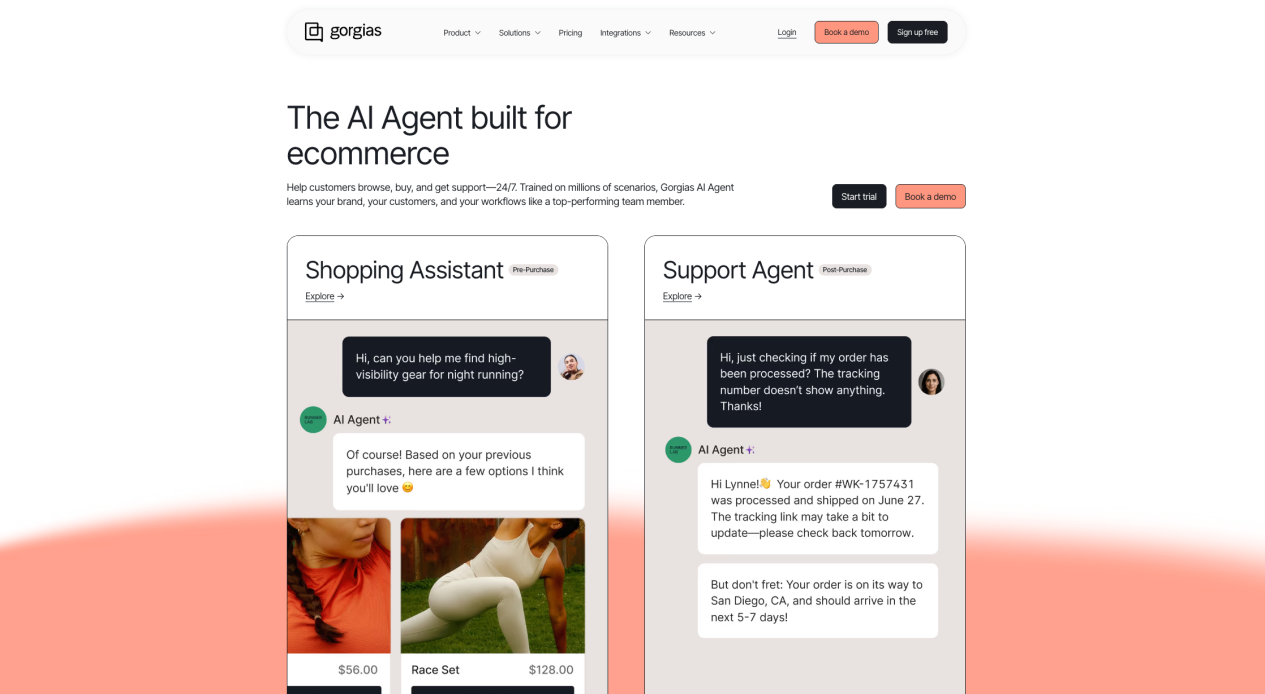
Gorgias AI Agent is purpose-built for ecommerce and connects support and shopping assistance to Shopify data and more than 100 ecommerce tools. It can perform order, return, cancellation, and subscription actions, helping a commerce team resolve high-volume pre- and post-purchase requests in the systems that control the order.
Key capabilities: email, chat and SMS; Shopify context; ecommerce guidance; Actions; multilingual service; image understanding; testing; performance reporting; and human handoff. The specialisation gives ecommerce teams ready-made concepts for order status, returns, product discovery, and conversion-focused conversations.
Strengths: Gorgias connects ecommerce knowledge and actions to both support and shopping assistance, allowing Shopify teams to automate around the order and product catalogue rather than build those concepts from scratch.
Considerations: forecast seasonal interaction volume and test the exact Southeast Asian messaging, voice, logistics, and payment routes in scope. This preserves Gorgias’s ecommerce advantage while matching it to the region’s contact journey.
Best for: Shopify-centric brands that want their AI agent to combine support automation with shopping assistance.
Pricing: Gorgias explains that most plans charge US$0.90 for an interaction resolved fully by the AI, with usage tiers from 90 to 2,500+ automated interactions a month. This model allows unlimited human-agent seats while scaling AI cost with automated outcomes.
8. Tidio Lyro — best for smaller teams testing AI service
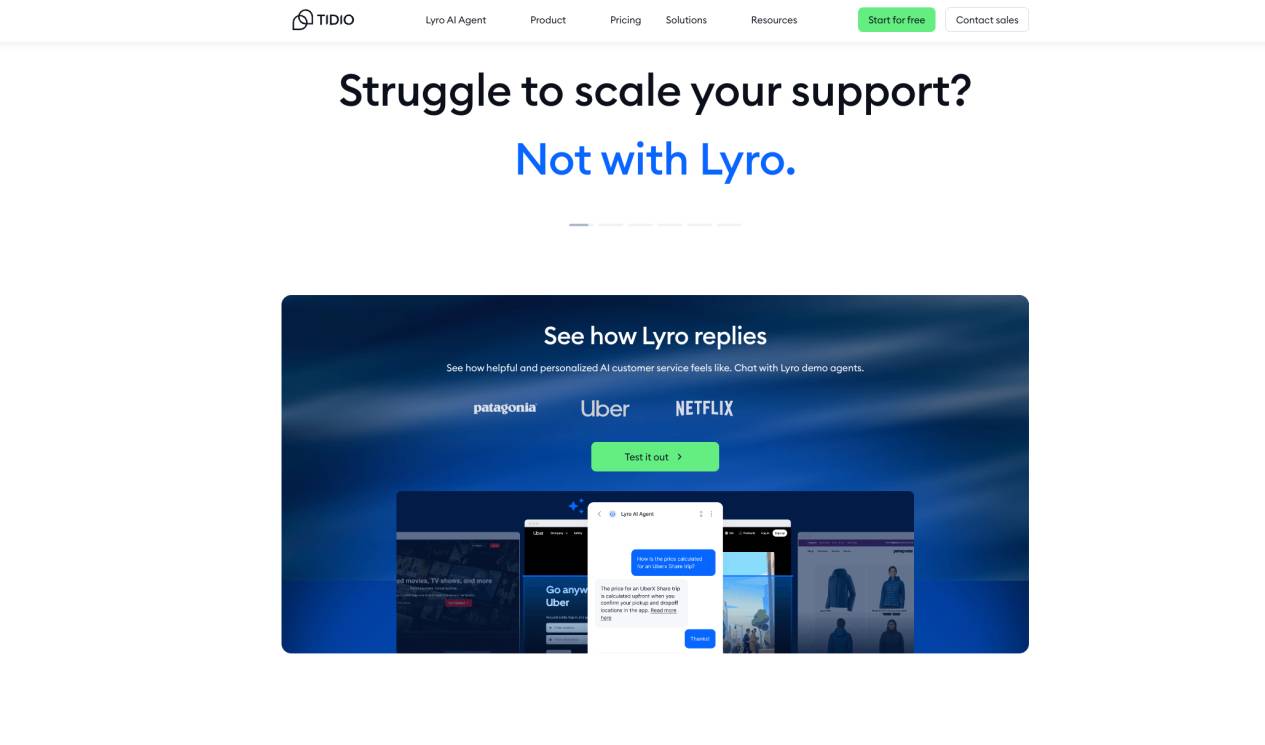
Tidio Lyro combines an AI agent with live chat, ticketing, flows, and a route to human support. Its free entry allowance and self-serve packages let a smaller team test real customer intents before committing to larger AI volumes or a managed deployment.
Key capabilities: knowledge-based answers, Lyro Actions, live chat, ticketing, workflow flows, analytics, and integrations with existing help desks. These capabilities help an ecommerce or digital-first team progress from simple questions to selected actions while keeping agents in the same operating environment.
Strengths: Tidio’s free entry allowance and bundled digital-service tools make a live pilot accessible, helping a smaller team learn from real intents before expanding AI volume.
Considerations: test quotas, Actions, channel routes, agent limits, analytics, and managed-service needs at the intended scale. This shows when a self-serve deployment should move to a larger or more supported package.
Best for: smaller organisations seeking a low-friction trial path and a combined AI-plus-human digital service tool.
Pricing: Tidio pricing includes 50 one-time Lyro conversations on the free plan; Starter is US$24.17 a month annually and Growth starts at US$49.17. Premium adds higher AI volume and managed service, giving buyers a clear upgrade path as automation becomes an ongoing operation.
Singapore AI customer service software pricing: compare the whole workload
Sticker price alone does not predict total cost. One product charges per human seat, another per resolved conversation, action, session, or credit, and a regional deployment may add telephony, messaging, connectors, implementation, and managed optimisation. A fair Singapore AI customer service software pricing model uses the same monthly workload for every vendor.
In a best AI customer service software Singapore 2026 cost comparison, the unit of value should be a completed customer journey with an acceptable handoff—not a generated answer in isolation. That denominator links spend to the service outcome and makes different billing models easier to compare.
| Cost layer | Question to calculate | Why it changes value |
|---|---|---|
| Human seats | How many agents, supervisors, admins, and seasonal users need access? | Shows whether automation reduces seat growth or simply adds another licence. |
| AI usage | What counts as an outcome, session, interaction, action, or credit? | Converts a headline rate into cost per completed customer journey. |
| Channels | Are WhatsApp, voice, SMS, social, and telephony usage separate? | Prevents a digital-only estimate from understating regional channel costs. |
| Systems and actions | Are connectors, API tasks, or workflow runs metered? | Reveals the cost difference between answering and completing a task. |
| Implementation | Who builds resources, integrations, permissions, tests, and handoff rules? | Captures the work required to make the platform useful in production. |
| Operations | Who reviews failures, updates policies, tunes retrieval, and monitors outcomes? | Funds the maintenance that keeps AI accurate as products and processes change. |
Build three forecasts—expected volume, peak-season volume, and a higher-automation scenario. Divide total platform and operating cost by successfully completed journeys, then track handoff quality and customer outcomes beside it. This prevents a low per-answer rate from appearing cheaper when humans still perform most of the work after the answer.
Four Singapore and Southeast Asia use cases to test live
These scenarios turn an AI customer service software Singapore shortlist into observable evidence. Each test combines an ideal path, a system response, an exception, and a human continuation, helping buyers see how the platform behaves when real service work stops following the script.
1. Ecommerce refund across WhatsApp and order systems
Ask the agent to identify the customer, retrieve the order, apply a return policy, collect missing information, call the permitted refund workflow, interpret a failed payment response, and hand off an exception with context. This single test exposes grounding, action depth, recovery, WhatsApp continuity, and human readiness more clearly than a scripted FAQ demo.
2. Delivery issue that moves from self-service to voice
Begin with a tracking request in web chat, add a damaged-item complication, and ask for a call. The platform should preserve the shipment, transcript, attempted actions, and escalation reason when voice or a live agent takes over, reducing repetition at the moment the customer is already frustrated.
3. Account change with identity and permission boundaries
Test a request that can be answered before login but acted on only after authentication. The agent should distinguish information from permissioned action, stop at the configured boundary, and record the result, helping teams combine convenience with accountable access.
4. Cross-market policy and language variation
Run the same intent for two Southeast Asian markets with different policies, currencies, fulfilment rules, and queues. The agent should retrieve the right market context and route the exception to the right team, allowing a Singapore regional hub to standardise operations without flattening local requirements.
How to choose an AI customer service platform in five steps
Use this best AI customer service software Singapore 2026 selection process after building a three- or four-vendor shortlist. Repeating one realistic task across those vendors creates decision evidence that a broad feature demonstration cannot provide.
Step 1: choose the task, not the demo script
Select one high-volume intent with a measurable customer outcome, such as a refund, delivery change, appointment reschedule, or account update. Mapping the real steps, systems, policies, failure states, and owners reveals whether a vendor can improve the journey rather than only improve the first reply.
Step 2: define permissions and human checkpoints
Specify which data the agent may read, which actions it may take, transaction limits, authentication requirements, and cases that require approval or escalation. These boundaries make automation safer to expand because the human team knows when and why control changes hands.
Step 3: test channels as one journey
Start in the customer’s preferred messaging channel, introduce an exception, and continue in voice, ticketing, or live service. AI customer service software with human handoff should move available history, context, attempted actions, queue, and reason, enabling the human to progress rather than repeat discovery.
Step 4: compare evidence at intent level
Score grounding, action correctness, completion, policy compliance, recovery, handoff quality, customer effort, and cost for the same intent across vendors. Intent-level evidence makes trade-offs visible even when platforms use different definitions for resolution.
Step 5: plan the operating loop
Assign owners for knowledge, workflows, integrations, evaluation, incidents, and optimisation. Pairing software with a maintained Build → Evaluate → Tune → Observe cycle helps the deployment improve as policies, products, customer behaviour, and channels change.
Security and governance questions for Singapore deployments
Security review for AI customer service software Singapore deployments should follow the task from customer identity to data access, tool action, system response, record keeping, and escalation. Mapping controls to that journey helps procurement and service teams discuss risk in the same operational language.
The Sobot Data Processing Agreement defines controller and processor roles, processing on documented customer instructions, technical and organisational security measures, breach notification, data-subject assistance, transfer consent, processing records, and audit cooperation. Its security schedule includes encryption, access controls, authentication measures, monitoring, and organisational safeguards, giving procurement teams concrete clauses to map to their deployment responsibilities.
Apply the same questions to every shortlisted platform: Which identity is used for an action? Which tools and fields can the agent access? Where are permission rules enforced? What requires approval? How are action attempts and failures recorded? What information reaches the human? How are retention, transfer, incident, and audit duties allocated? Clear answers let governance support useful automation instead of becoming a late-stage blocker.
Decision routes by buyer profile
The best AI customer service software Singapore 2026 route is the one that matches the buyer’s customer journeys and operating ecosystem. Use the following routes to create a short list, then run the same task-level test across the finalists so the decision rests on comparable outcomes.
Choose Sobot when governed task completion, WhatsApp, digital service, voice, tickets, cross-market context, and implementation support must work as one regional operation.
Choose Zendesk when a mature help-desk model, broad administration, routing, and agent productivity are the centre of the requirement.
Choose Intercom Fin when digital-first AI outcomes, rapid testing, and modern SaaS messaging are the primary design goals.
Choose Freshdesk Omni when a growing team wants a balanced omnichannel suite with accessible seat pricing and a built-in agent studio.
Choose Salesforce Agentforce when the workflow, data, permissions, and enterprise operating model already centre on Salesforce.
Choose HubSpot Breeze when HubSpot CRM continuity and straightforward digital support matter more than contact-centre breadth.
Choose Gorgias when Shopify commerce actions and pre-/post-purchase specialisation define the service workload.
Choose Tidio Lyro when a smaller team wants a low-friction AI trial with live chat and ticketing in the same tool.
Frequently asked questions
What is the best AI customer service software Singapore 2026 teams should shortlist?
The best AI customer service software Singapore 2026 shortlist depends on the operating model. Sobot fits governed task completion plus Singapore/SEA omnichannel service; Zendesk fits mature support operations; Intercom fits AI-first digital service; Freshdesk fits value-focused omnichannel growth; Salesforce and HubSpot fit their CRM ecosystems; Gorgias fits Shopify; and Tidio fits smaller digital-first teams.
Which AI customer service software Singapore businesses can use for WhatsApp, voice, and tickets?
Sobot combines WhatsApp, voice, ticketing, digital service, AI agents, and human assistance in a broader contact platform. That combination helps a Singapore or Southeast Asian team keep context when a customer moves from self-service to a call, case, or live agent.
What is the difference between an AI chatbot and governed task resolution?
An AI chatbot primarily manages conversation and answers. Governed task resolution adds authorised system access, multi-step reasoning, action, observation, exception recovery, completion checks, human checkpoints, and evaluation. The result is measured by whether the customer’s task progressed safely, not only whether the software generated a response.
Will Sobot’s new agentic position replace its Singapore/SEA omnichannel position?
No. The positions describe complementary layers. Sobot Agents adds the ability to reason, use permitted tools, and complete selected tasks; Nexus and Sobot’s contact products provide regional channels, data, context, voice, tickets, and human continuity. The new capability deepens the value of the existing omnichannel foundation.
How should buyers compare the best AI customer service software Singapore 2026 prices?
Use one workload and include human seats, AI outcomes or credits, messaging and voice usage, system actions, implementation, and ongoing optimisation. Then calculate cost per completed customer journey and review handoff quality beside it. This makes seat-, action-, and outcome-based AI customer service software Singapore offers comparable.
What should an AI customer service proof of concept measure?
Measure retrieval relevance, grounded-answer accuracy, intent recognition, action correctness, policy compliance, completion, recovery, human-handoff quality, customer effort, latency, and total cost for one real intent. A proof of concept creates more value when it includes an exception and a human continuation rather than only ideal-path questions.
Does buying AI customer service software make a company compliant with Singapore requirements?
Software features support governance, but the deploying organisation still defines purpose, data use, permissions, human accountability, testing, monitoring, and customer communication. Map each platform’s controls and contractual terms to the organisation’s legal, risk, security, and operational responsibilities before expanding an agent’s powers.
Final recommendation
The best AI customer service software Singapore 2026 decision should begin with one customer task and end with evidence that the task can be grounded, actioned, observed, completed or handed off, and evaluated across the channels the customer uses. That standard rewards real operational depth while keeping the AI customer service software Singapore comparison fair to platforms built for different ecosystems.
For teams serving Singapore and Southeast Asia, Sobot’s strongest route is the combination of governed end-to-end customer task resolution and regional omnichannel fit. That pairing gives AI customer service software Singapore buyers both a higher-value task outcome and a practical regional service path. Book a Sobot demo with one real intent, its business systems, permission rules, exception path, channels, and success measures; the resulting workflow test will show how much of the journey can be completed and where human expertise should remain in control.