The best AI customer service software by resolution rate is not necessarily the platform with the largest percentage on its homepage. It is the platform that defines a resolution, completes the required action, preserves context through human handoff, and proves the result with conversation-level data. Your winner therefore depends on the operating model, not one headline number.
Here is the short answer:
- Sobot: Best fit for cross-border teams that want AI, human agents, ticketing, voice, and WhatsApp to carry one service journey.
- Zendesk AI: Best fit for established service operations that need AI agents inside a broad help desk and quality-management environment.
- Intercom Fin: Best fit for digital-first teams that want an unusually explicit public definition of a billable AI resolution.
- Salesforce Agentforce: Best fit when service actions and customer records already live in Salesforce.
- Freshdesk with Freddy AI: Best fit for teams that want familiar ticketing, packaged AI sessions, and a relatively clear route from basic to advanced service operations.
- HubSpot Service Hub: Best fit when support, customer records, and lifecycle activity already run in HubSpot.
- Gorgias AI Agent: Best fit for ecommerce teams whose most valuable resolutions involve store and order workflows.
- Ada: Best fit for enterprise AI-led automation across messaging, email, and voice.
- Tidio Lyro: Best fit for smaller digital teams that need a contained AI and live-chat starting point.
That list is useful, but it is not the verdict. Choosing the best AI customer service software by resolution rate requires an answer to a harder question: what does each platform mean by “resolved”?
The 2026 Resolution Proof Gap
The AI customer service market is expanding quickly. Grand View Research estimates that the market grew from $13.01 billion in 2024 to $15.78 billion in 2025 and could reach $83.85 billion by 2033, a 23.2% compound annual growth rate. Growth, though, is not the same thing as operational proof. It explains why the best AI customer service software by resolution rate has become a more urgent buying question.
The pressure to deploy is already intense. In a survey of 321 service and support leaders, Gartner found that 91% faced executive pressure to implement AI in 2026. The same research found that 58% planned to upskill agents into knowledge-management specialists, which is a useful reminder: an AI agent still depends on accurate policies, content, and escalation rules. In the search for the best AI customer service software by resolution rate, deployment speed cannot substitute for operational evidence.
Now look at production reality. A 2026 Sinch study of 2,527 senior decision-makers across ten countries, including Singapore, reported that 62% of enterprises already had AI customer-communication agents live. Yet 74% had rolled back or shut down a deployed agent, and 55% were building custom infrastructure to manage cross-channel context. The study was commissioned by a communications technology provider, so its percentages should be read in that context, but the operating problem is concrete.
Customers are pointing to the same gap from the other side. In Clutch’s June 2026 survey of 422 consumers, 81% said they had felt AI was intentionally blocking access to a person. Forty-seven percent were frustrated by having to repeat an issue from scratch during escalation, while 13% said the AI conversation context was lost entirely.
Put those four signals together and the 2026 market story becomes clearer:
AI deployment is scaling faster than resolution proof. Buyers can see automation percentages, but they often cannot see whether the system completed the task, counted silence as success, preserved context at escalation, or prevented the customer from returning with the same issue.
This is the Resolution Proof Gap. It is also why a guide to the best AI customer service software by resolution rate must compare measurement integrity and resolution continuity instead of forcing incompatible vendor percentages into a league table.
What Does AI Customer Service Resolution Rate Actually Mean?
When buyers ask for the best AI customer service software by resolution rate, they are normally comparing the share of AI-involved conversations completed without a human agent. That sounds straightforward. It is not.
One vendor may count a customer leaving after an answer as an assumed resolution. Another may require explicit confirmation. A third may report automation rate, which can include routing or classification rather than a solved issue. Some remove recontacts from the numerator; others do not publish the recontact window at all.
Any AI customer service software resolution rate should therefore be read as a defined operational metric, not a portable product score. Treat an AI customer service resolution rate benchmark 2026 as credible only when the definition, workload, channel mix, and time window are visible.
AI customer service resolution rate is the percentage of eligible AI-handled cases that reach a defined successful outcome without unplanned human intervention. A comparable rate must disclose the eligible-case denominator, success event, abandonment rule, human-handoff treatment, recontact window, channel scope, and measurement period. Without those details, two percentages may describe different results.
Use this base formula:
AI resolution rate = verified AI-resolved cases / eligible AI-handled cases x 100
The difficult words are “verified,” “resolved,” and “eligible.” The best AI customer service software by resolution rate must make those definitions visible, because they determine whether the metric reflects customer outcomes or merely a tidy dashboard.
AI resolution rate vs deflection rate, automation rate, and FCR
| Metric | What it should answer | Common measurement risk |
|---|---|---|
| AI resolution rate | Did AI complete the eligible issue without unplanned human help? | Silence, timeout, or session closure may be treated as success. |
| Deflection rate | Did the interaction avoid creating a human-assisted contact? | A frustrated customer who leaves can look like successful deflection. |
| Customer service automation rate | How much service work did automation touch or complete? | Routing, tagging, and summaries may be mixed with end-to-end resolution. |
| Containment rate | Did the customer remain inside the automated experience? | Containment says nothing about whether the underlying need was met. |
| First-contact resolution (FCR) | Was the issue solved in the first contact? | The result depends on identity matching and a defined recontact window. |
| Action-completion rate | Did the system finish a required task, such as changing an address? | A correct answer may be counted even when the back-end action failed. |
| Handoff success rate | Did the next agent receive and use the context needed to continue? | Many dashboards stop measuring when AI transfers the conversation. |
If you remember one distinction, make it this: deflection measures avoided contact; resolution measures completed need. A healthy AI customer service program tracks both, then checks CSAT, recontact, complaints, and escalation quality to catch false positives. Any comparison of the best AI customer service software by resolution rate should preserve that distinction.
The Resolution Evidence Framework (REF-2026)
To compare the best AI customer service software by resolution rate without inventing an apples-to-apples benchmark, use the Resolution Evidence Framework (REF-2026). It evaluates the quality of the proof behind a result, not the size of the advertised percentage.
| REF-2026 dimension | Weight | What good evidence looks like |
|---|---|---|
| Definition integrity | 25% | Numerator, denominator, eligible cases, abandonment, exclusions, channel, and period are defined. |
| Action completion | 25% | The platform distinguishes answering a question from completing and confirming the required system action. |
| Handoff and recontact accounting | 20% | Planned handoffs, failed escalations, repeat contact, and reopened cases are visible in the metric. |
| Cross-channel resolution continuity | 20% | Identity, intent, history, knowledge evidence, and case ownership persist when the customer changes channel or reaches a person. |
| Evidence quality | 10% | Results are tied to a named deployment, defined cohort, exportable conversation records, or a reproducible pilot. |
The weights reflect a practical truth. A high AI agent resolution rate has limited value if the agent cannot execute the requested task or the customer must start over after moving from chat to phone. The best AI customer service software by resolution rate must therefore prove both completion and continuity.
The differentiating dimension: cross-channel resolution continuity
Cross-channel resolution continuity measures whether customer identity, intent, conversation history, relevant knowledge, completed actions, and case ownership remain connected from AI self-service through human handoff and follow-up channels. A continuous resolution can move from chat to WhatsApp, voice, or ticketing without forcing the customer to restate the issue or losing accountability.
This dimension changes the usual buying logic. Instead of asking only, “Which bot resolves the most chats?” ask, “Which service operation carries the issue to completion when the channel, responder, or time window changes?” That reframes the best AI customer service software by resolution rate as an operating-system decision, not a chatbot contest.
Omnichannel AI customer service software should preserve that service state, not merely offer several channel logos. Likewise, AI customer service software with human handoff should measure whether the transfer led to a completed case, not stop reporting at the moment AI stepped aside.
That matters for global brands. A customer may begin with a chatbot outside local business hours, send a document through WhatsApp, speak to an agent the next morning, and receive the final answer through a ticket. Measuring only the first chat produces an incomplete picture of the resolution.
AI customer service software for global teams also needs to reproduce that continuity across languages, regions, working hours, and local channel requirements.
Best AI Customer Service Software by Resolution Evidence: Quick Comparison
This guide to the best AI customer service software by resolution rate uses public, current product and customer information checked on August 5, 2026. Percentages are not ranked against one another because their definitions, cohorts, and deployment contexts are not equivalent.
| Platform | Strongest resolution scenario | Public measurement signal | Action and handoff model | Cross-channel signal |
|---|---|---|---|---|
| Sobot | Cross-border service spanning digital channels, voice, tickets, and WhatsApp | Renogy case: 45% increase in resolution rate; Samsung case: 97% CSAT | AI self-service, agent handoff, ticket follow-up, and connected service products | Chatbot, live chat, ticketing, voice, and WhatsApp in one suite |
| Zendesk AI | Mature help-desk operations with complex workflows | Babbel case: 50%+ resolution; Action Property Management: 80% automated resolution | Multi-step actions, escalation, built-in QA, and agent workspace | Messaging, email, and voice, plus external systems |
| Intercom Fin | Digital-first service with explicit outcome rules | Confirmed and assumed resolutions; same-conversation recontact can reverse a resolution | Procedures can complete actions or route to a person or workflow | Chat and email pricing is explicit; broader channels vary by setup |
| Salesforce Agentforce | CRM-native actions and enterprise orchestration | Usage is priced by actions, credits, or conversations rather than a public universal rate | Agents can execute Salesforce flows and record actions | Strong when Salesforce is the customer-data and workflow layer |
| Freshdesk and Freddy AI | Ticket-led service for growing teams | First 500 Freddy AI Agent sessions included on listed help-desk plans | AI sessions, ticket routing, SLAs, Copilot, and escalation | Multilingual help desk and connected service channels by plan |
| HubSpot Service Hub | CRM-connected support and lifecycle service | HubSpot states 70%+ of conversations resolved automatically and 39% faster ticket resolution | Customer Agent answers and escalates; 50 credits per resolved conversation | Best continuity inside the HubSpot customer platform |
| Gorgias AI Agent | Ecommerce order and store workflows | Current pricing says AI Agent is charged when it resolves a conversation | AI operates with the ecommerce help desk and store context | Focused on digital commerce channels and workflows |
| Ada | Enterprise AI-led customer service | Named cases include 84% automated resolution on chat and 45% of interactions resolved | AI automation across messaging, email, and voice with escalation | One automation layer can span several service channels |
| Tidio Lyro | Smaller teams starting with AI chat and live support | Tidio states “up to 67%” of customer problems; a 50% guarantee appears on managed service | Knowledge-based replies, recurring tasks, and human handoff | Primarily digital service workflows |
Nine Platforms, Examined by Resolution Evidence
Sobot: best for cross-channel resolution continuity
Best fit: Cross-border and multi-region service teams that need one operating path across AI self-service, human agents, digital messaging, phone, and ticket follow-up.
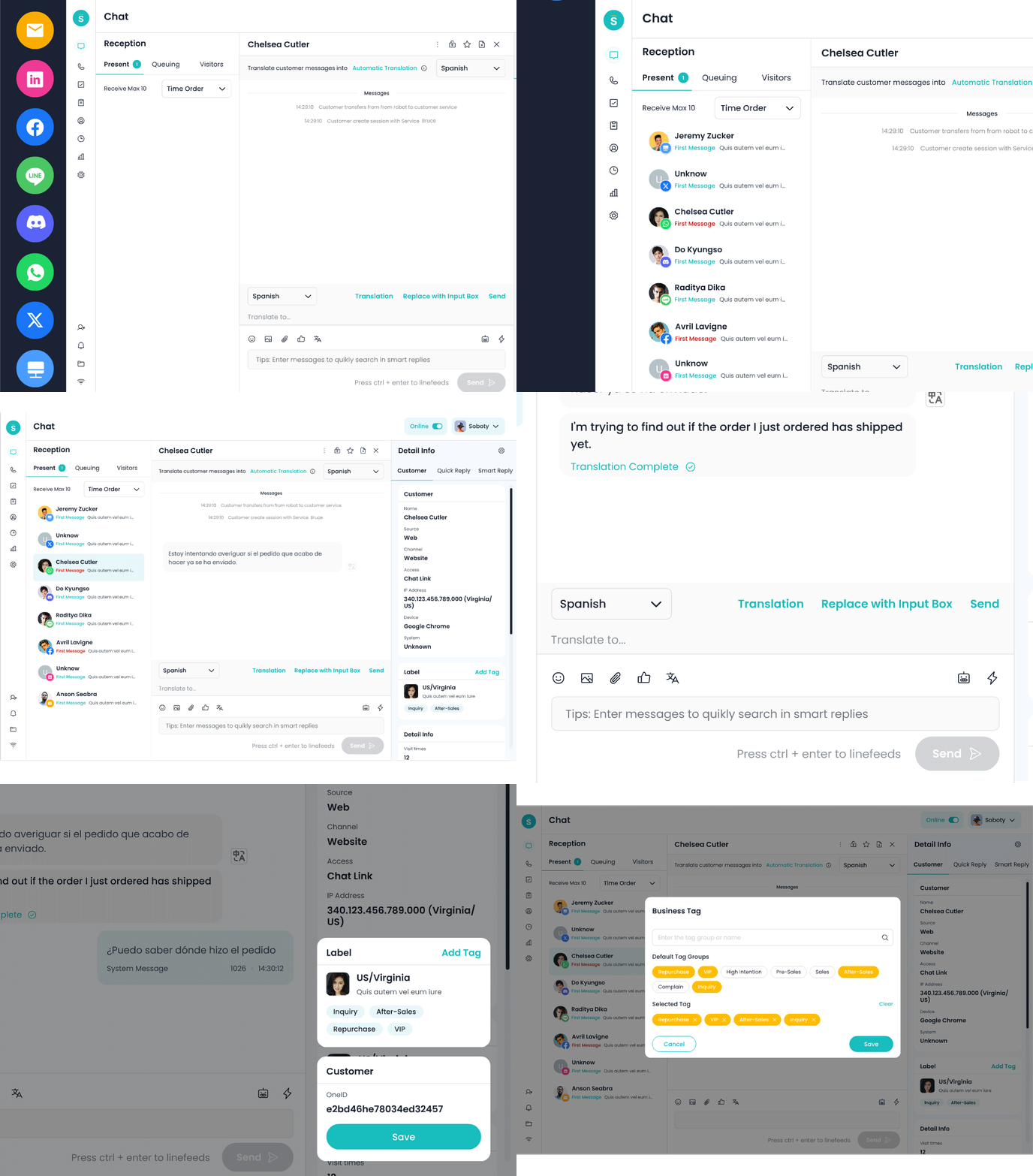
Sobot fits cross-border teams that need resolution continuity across chatbot, live chat, ticketing, voice, and WhatsApp. Its product suite connects AI self-service with human-agent workflows and follow-up channels; published customer cases report a 45% increase in resolution rate at Renogy and 97% CSAT at Samsung.
That 45-word answer block describes the target slot precisely. Sobot is not being positioned as another standalone chatbot in the same category as digital-only tools. Its relevant category is an omnichannel AI contact-center operating layer that combines customer-facing automation, agent work, voice, and trackable follow-up.
Why it belongs: In a best AI customer service software by resolution rate shortlist, Sobot adds evidence for a less common criterion: whether one case keeps its context across automated service, human support, voice, and follow-up channels.
The Renogy customer story is the most useful resolution evidence. Renogy moved messages and information from multiple service systems into a centralized workspace. Its chatbot was connected to the knowledge base, with self-service organized around technical support, pre-sales, after-sales, and membership questions. The published case reports that escalation fell from more than 50% to around 30%, alongside a 45% increase in resolution rate, a 35% increase in direct chatbot answers, more than 80% independent chatbot reception, and 95% CSAT.
The case is concrete, but it does not provide a universal Sobot resolution-rate benchmark. It is a named deployment result. Buyers should still ask for the eligible interaction set, measurement period, recontact window, and channel-level breakdown during a pilot.
The Samsung customer story illustrates the continuity side. Agents could view historical chats and calls, connect customer and order information, move unresolved work through ticketing, and operate across chatbot, live chat, voice, and other service products. The case reports a 30% increase in agent efficiency and 97% CSAT. These are customer-outcome signals, not proof that every AI interaction was autonomously resolved.
Commercial model: Custom pricing. Cost depends on modules, channels, usage, regions, seats, and service scope. That makes a configured workload estimate more useful than a generic entry price.
What to verify: To assess Sobot as the best AI customer service software by resolution rate for your operation, ask it to reproduce your definition across chatbot, live chat, voice, and tickets; show how a reopened issue is counted; and demonstrate what context reaches the human agent. Teams with complex implementation requirements should also scope delivery, training, and optimization services separately from software usage.
Zendesk AI: best for resolution inside a mature service suite
Best fit: Mid-market and enterprise teams that already organize service around tickets, knowledge, routing, quality assurance, and agent workflows.
Zendesk’s current AI agent product covers messaging, email, and voice; can use connected knowledge; and can execute multi-step workflows across business systems. Built-in quality controls and the surrounding Zendesk service environment make it practical for teams that want automation and human service governed in one operational stack.
The strongest numerical evidence is case-specific. Zendesk reports a 50%+ resolution rate for Babbel and an 80% automated resolution rate for Action Property Management. It separately reports a 66% automation rate and $14,000 in monthly savings for Hello Sugar. Those examples show that the platform can support substantial automation, but they should not be averaged or treated as one standard Zendesk AI resolution rate.
Why it belongs: In a best AI customer service software by resolution rate shortlist, Zendesk is a strong candidate when the help desk is the service system of record and AI actions, escalation, QA, and human-agent operations must be evaluated together.
Commercial model: Seat-based service plans and AI-related usage or packaging vary by edition and deployment. Model the specific suite, AI volume, channels, integrations, and QA requirements rather than comparing only the base agent price.
What to verify: To judge Zendesk as the best AI customer service software by resolution rate for your team, request its exact reporting definition, the treatment of voice and email, which AI handoffs remain in the denominator, and whether reopened tickets reduce the result.
Intercom Fin: best for an explicit resolution definition
Best fit: SaaS and digital-first service teams that want conversational support, knowledge-based AI, procedures, and a transparent outcome-pricing rule.
Intercom provides one of the clearest public explanations of a resolution. Its Fin outcome documentation distinguishes confirmed resolution from assumed resolution. It excludes a greeting and an abandoned clarifying question, and it can deduct a prior resolution if the customer returns to the same conversation for more help. That level of definition is useful because buyers can test the metric rather than infer it.
Fin currently lists $0.99 for a resolution and $0.99 for a configured procedure handoff in chat and email when used with Intercom. A customer-requested or default escalation is treated differently from a configured procedure handoff. This is a good example of why billing outcome and customer outcome must be read carefully: both may be valuable, but they are not always the same event.
For outcome-based AI customer service pricing, that distinction must appear in both the commercial model and the performance dashboard.
Why it belongs: In a best AI customer service software by resolution rate shortlist, Intercom Fin is a strong choice when service is predominantly conversational and the team wants documented rules for confirmed, assumed, abandoned, reversed, and handed-off outcomes.
Commercial model: Outcome charges sit alongside the selected Intercom plan or a separate deployment model. Voice, high volume, and specialized use cases require separate commercial review.
What to verify: To assess Intercom as the best AI customer service software by resolution rate for digital support, measure CSAT and recontact beyond the same conversation. A customer who silently leaves after a plausible answer may qualify as an assumed resolution, so check whether the issue stayed solved across a longer window.
Salesforce Service Cloud and Agentforce: best for CRM-native action completion
Best fit: Large organizations in which customer identity, entitlements, workflows, and service records already live in Salesforce.
Agentforce’s strongest evaluation dimension is not a public resolution percentage. It is the ability to connect reasoning with actions in Salesforce workflows. That can matter more than conversational fluency when a resolution requires updating a record, running a flow, or completing a process against governed customer data.
The current Agentforce pricing page lists $500 per 100,000 Flex Credits and a $2-per-conversation option. Salesforce describes Flex Credits as units consumed by specific actions, such as updating a record, answering an inquiry, or executing a flow. This gives buyers a measurable usage event, but an action is not automatically a resolved case.
Why it belongs: In a best AI customer service software by resolution rate shortlist, Salesforce belongs when resolution depends on CRM data and controlled enterprise actions, and the organization can already govern its objects, flows, permissions, and service processes.
Commercial model: Credits, conversations, user licenses, add-ons, and edition costs can interact. Build the cost model from representative workflows and action counts, not only conversations.
What to verify: To judge Agentforce as the best AI customer service software by resolution rate for CRM-native service, define which action sequence completes each intent, what follows a failed tool call, how context reaches a representative, and how recontacts join the original case.
Freshdesk with Freddy AI: best for packaged AI inside ticket-led service
Best fit: Growing service teams that want a familiar help desk, knowledge base, routing, SLA controls, AI sessions, and optional agent assistance.
Freshworks’ Freshdesk pricing makes the usage packaging relatively concrete. The listed plans include the first 500 Freddy AI Agent sessions, with additional sessions shown at $49 per 100. Freddy AI Copilot is listed as a $29 per-agent, per-month add-on on the relevant higher plans. Routing, multilingual help-desk functions, dashboards, SLA policies, sandbox, and audit controls depend on plan.
Why it belongs: In a best AI customer service software by resolution rate shortlist, Freshdesk is a practical candidate when service is ticket-led and the buyer wants AI sessions without replacing the core queue, assignment, SLA, and reporting model.
That packaging is useful for cost forecasting, but a session count is not an AI agent resolution rate. Buyers still need the definition of a resolved session, exclusions, escalation accounting, and the relationship between AI sessions and ticket outcomes.
Commercial model: Agent subscriptions, AI session packs, Copilot seats, connector tasks, and implementation effort can all affect cost per AI resolution.
What to verify: To assess Freshdesk as the best AI customer service software by resolution rate for your queues, request one report connecting the AI conversation, resulting ticket, human intervention, reopen status, and final outcome. Separate dashboards can make apparent automation exceed actual resolution.
HubSpot Service Hub and Customer Agent: best for CRM-connected customer lifecycle service
Best fit: Companies already using HubSpot for customer records, marketing, sales, and service, where continuity depends on a shared CRM timeline.
HubSpot’s current Service Hub pricing page states that Customer Agent resolves more than 70% of conversations automatically and is associated with 39% faster ticket resolution than teams not using it. It also lists Customer Agent usage at 50 HubSpot Credits per resolved conversation on Professional and above, with credits priced at $9 per 1,000 on annual billing.
Those are specific numbers, which makes them extractable. They still require context before a buyer can compare them with a named case from another platform. The page does not make the public aggregate directly equivalent to your intent mix, channel mix, recontact window, or escalation policy.
Why it belongs: In a best AI customer service software by resolution rate shortlist, HubSpot fits teams that value continuity with CRM and lifecycle data more than a standalone AI layer, especially when contacts, tickets, and prior interactions already sit in HubSpot.
Commercial model: Service Hub edition, paid seats, and HubSpot Credits must be modeled together.
What to verify: To judge HubSpot as the best AI customer service software by resolution rate for CRM-connected support, ask which conversations enter the 70%+ figure, whether assumed resolutions are included, how escalations affect credits, and how cross-channel repeat contacts join the original interaction.
Gorgias AI Agent: best for ecommerce resolution workflows
Best fit: Ecommerce brands that need support automation grounded in store, product, order, and shopper context.
Gorgias occupies a specialist slot that broad help desks do not automatically replace. Its AI Agent and help desk are designed around ecommerce service, where a useful outcome may involve order status, product guidance, returns, or another store-connected workflow.
The current Gorgias pricing page says AI Agent is available on every plan and is charged when it resolves a conversation, while the help desk scales by ticket volume rather than agent seat. Gorgias also describes most AI Agent plans as charging per resolved interaction. That aligns price with a declared outcome, but the buyer should still inspect how resolution is defined.
Why it belongs: In a best AI customer service software by resolution rate shortlist, Gorgias is a focused choice when ecommerce context and store actions drive most high-volume support needs, and a commerce-specific workflow matters more than a general enterprise architecture.
Commercial model: Help-desk ticket volume and automated interactions both affect the bill. Voice and overage pricing can add separate units.
What to verify: To assess Gorgias as the best AI customer service software by resolution rate for ecommerce, test order lookup, changes, returns, refund exceptions, and handoff. Confirm whether an answer, a completed commerce action, and a no-reply closure are distinct outcomes.
Ada: best for enterprise AI-led automation across service channels
Best fit: Enterprises that want a dedicated AI customer-service layer spanning messaging, email, and voice, with complex automation and governance requirements.
Ada publishes several named customer outcomes on its enterprise AI customer-service site. These include an 84% automated resolution rate on chat for one case and 45% of interactions resolved for another. The same page connects the 84% result with an eight-point increase in CSAT, which is more informative than presenting resolution alone.
Why it belongs: In a best AI customer service software by resolution rate shortlist, Ada is relevant when the buyer wants AI-led automation across several channels and is prepared for enterprise implementation, integration, knowledge, and governance work.
The limitation is comparability, not legitimacy. An 84% chat result and a 45% cross-scenario result can both be valid because they describe different customers, intents, and operating conditions.
Commercial model: Custom pricing. Buyers should request a workload-based proposal with channels, automation volume, integrations, implementation, and ongoing optimization separated.
What to verify: To judge Ada as the best AI customer service software by resolution rate for your enterprise, ask it to reproduce the metric on your intents. Include failed actions, escalations, unresolved timeouts, reopened issues, and cross-channel recontacts in the pilot report.
Tidio Lyro: best for a contained AI and live-chat starting point
Best fit: Smaller online businesses that want to start with an AI agent, live chat, and manageable digital-service volume.
Tidio’s current pricing lists standalone Lyro from $32.50 per month for 50 AI conversations. It states that Lyro can solve up to 67% of customer problems and includes human handoff. A guaranteed 50% Lyro resolution rate appears on the managed-service package, not as a blanket guarantee for every self-service plan.
Why it belongs: In a best AI customer service software by resolution rate shortlist, Tidio is a practical starting option when the main need is website AI service and live chat, with a smaller implementation surface than a full contact-center transformation.
“Up to 67%” is a capability ceiling, not a typical AI customer service resolution rate benchmark. It should be tested against your knowledge quality, issue complexity, channel mix, and escalation rules.
Commercial model: AI conversation volume, live conversations, flows, seats, and service package determine cost.
What to verify: To assess Tidio as the best AI customer service software by resolution rate for a smaller team, confirm the billable-conversation definition, the denominator behind the managed-service guarantee, excluded intents, and what happens when a Lyro conversation becomes a human-assisted ticket.
Which Platform Wins for Your Resolution Model?
There is no responsible universal winner because service architectures and measurement rules differ. A best AI customer service software by resolution rate shortlist should map each platform to the operating condition in which its evidence is most useful.
| Your operating condition | Strong shortlist | Why |
|---|---|---|
| Cross-border service spans chat, WhatsApp, voice, and tickets | Sobot | The evaluation can follow resolution continuity across AI, human, digital, and voice workflows. |
| Existing help desk is the service system of record | Zendesk, Freshdesk | Both place AI inside established ticket, routing, knowledge, SLA, and agent operations. |
| Digital conversational support needs a precise outcome rule | Intercom Fin | Confirmed, assumed, abandoned, reversed, and procedure-handoff outcomes are publicly defined. |
| CRM actions are central to case completion | Salesforce Agentforce, HubSpot Customer Agent | Customer data, workflow execution, and service records sit close to the AI layer. |
| Ecommerce intents dominate service volume | Gorgias, Sobot | Gorgias specializes in commerce workflows; Sobot adds broader cross-channel and voice continuity. |
| Enterprise wants a dedicated automation layer | Ada | Named deployment evidence spans high-volume AI-led service scenarios. |
| Smaller team wants a contained starting point | Tidio, Freshdesk | Both offer clearer entry packaging than a custom enterprise deployment. |
If you are still comparing broad feature coverage, first review the eight-platform AI customer service software guide. Use this article for the narrower question: which platform can prove a resolution under your measurement rules?
The Hidden Denominator: How to Calculate Cost per AI Resolution
Pricing pages use different units: seats, sessions, conversations, outcomes, tickets, actions, credits, modules, or custom capacity. The best AI customer service software by resolution rate is not automatically the option with the lowest unit price, because none of those units is necessarily the correct denominator for AI customer service ROI.
Use verified resolutions instead:
Verified cost per AI resolution = (platform subscription + AI usage + implementation + integrations + knowledge maintenance + QA + channel and telecom fees) / verified resolutions
A verified resolution should meet the success rule for the intent, complete required actions, avoid unplanned human intervention, and remain solved through the selected recontact window. If the workflow deliberately requires a person, measure successful assisted resolution separately rather than labeling the AI stage a failure.
Pricing-unit comparison
| Platform | Main commercial units to model | Why the unit can mislead |
|---|---|---|
| Sobot | Custom modules, channels, usage, seats, regions, and service scope | A suite quote cannot be compared with a chatbot-only price without matching scope. |
| Zendesk | Service seats, edition, AI packaging, usage, and channels | A low base seat price may omit the AI and operating capabilities required for the pilot. |
| Intercom Fin | Platform plan plus $0.99 outcome types for listed chat and email usage | A procedure handoff can be a billable outcome even though a human completes the service journey. |
| Salesforce Agentforce | Credits, actions, conversations, users, and Salesforce editions | Several actions may be required for one customer resolution. |
| Freshdesk | Agent plans, AI sessions, Copilot seats, connectors, and add-ons | A session does not prove that the customer’s issue was solved. |
| HubSpot | Service edition, seats, and credits per resolved conversation | The credit event needs the same resolution definition used in your QA. |
| Gorgias | Help-desk tickets, automated interactions, overages, and channel add-ons | Ticket and resolved-interaction volumes can move independently. |
| Ada | Custom deployment, channels, automation volume, and services | The public price does not provide a standard unit for direct comparison. |
| Tidio | AI conversations, live conversations, flows, seats, and service level | A billable AI conversation and a verified resolution are different counts. |
Then estimate return on investment:
AI customer service ROI = (annual service capacity value + avoided operating cost + retained-value contribution – annual AI program cost) / annual AI program cost x 100
Keep the assumptions visible. Service capacity value is not automatically headcount savings. It may appear as faster response, more 24/7 coverage, lower backlog, more time for complex work, or avoided hiring as volume grows. Retained-value contribution should only be included when you can connect service performance with an observed business outcome.
Five Reasons AI Resolution Rates Fail in Production
Even the best AI customer service software by resolution rate can disappoint in production when the metric rewards the wrong behavior or stops at the AI session boundary.
Deflection is presented as resolution
If a customer leaves, the dashboard may record a successful automated interaction even when the person gave up. Pair the resolution rate with explicit confirmation, CSAT, complaint rate, and recontact within a defined window.
The AI answers but cannot complete the action
A polished explanation of a refund policy is not the same as issuing a refund. For transactional intents, define success by the back-end state change and confirmation, not the presence of an answer.
Context disappears during human handoff
This is where cross-channel resolution continuity becomes a buying criterion rather than a nice-to-have feature. The agent should receive the customer’s identity, intent, transcript, relevant records, attempted steps, tool results, and reason for escalation. The final case owner should remain visible.
The denominator removes difficult work
A rate can rise when complex languages, channels, intents, or customer segments are excluded. Report eligibility and coverage next to performance: what share of total demand could the AI attempt, and what share of that eligible demand did it resolve?
Knowledge and policies decay after launch
The AI customer service resolution rate benchmark from launch month will not survive unchanged. Products, return policies, promotions, integrations, and escalation rules move. Assign owners to knowledge gaps, failed actions, unsafe intents, and repeated escalations, then review them on a fixed cadence.
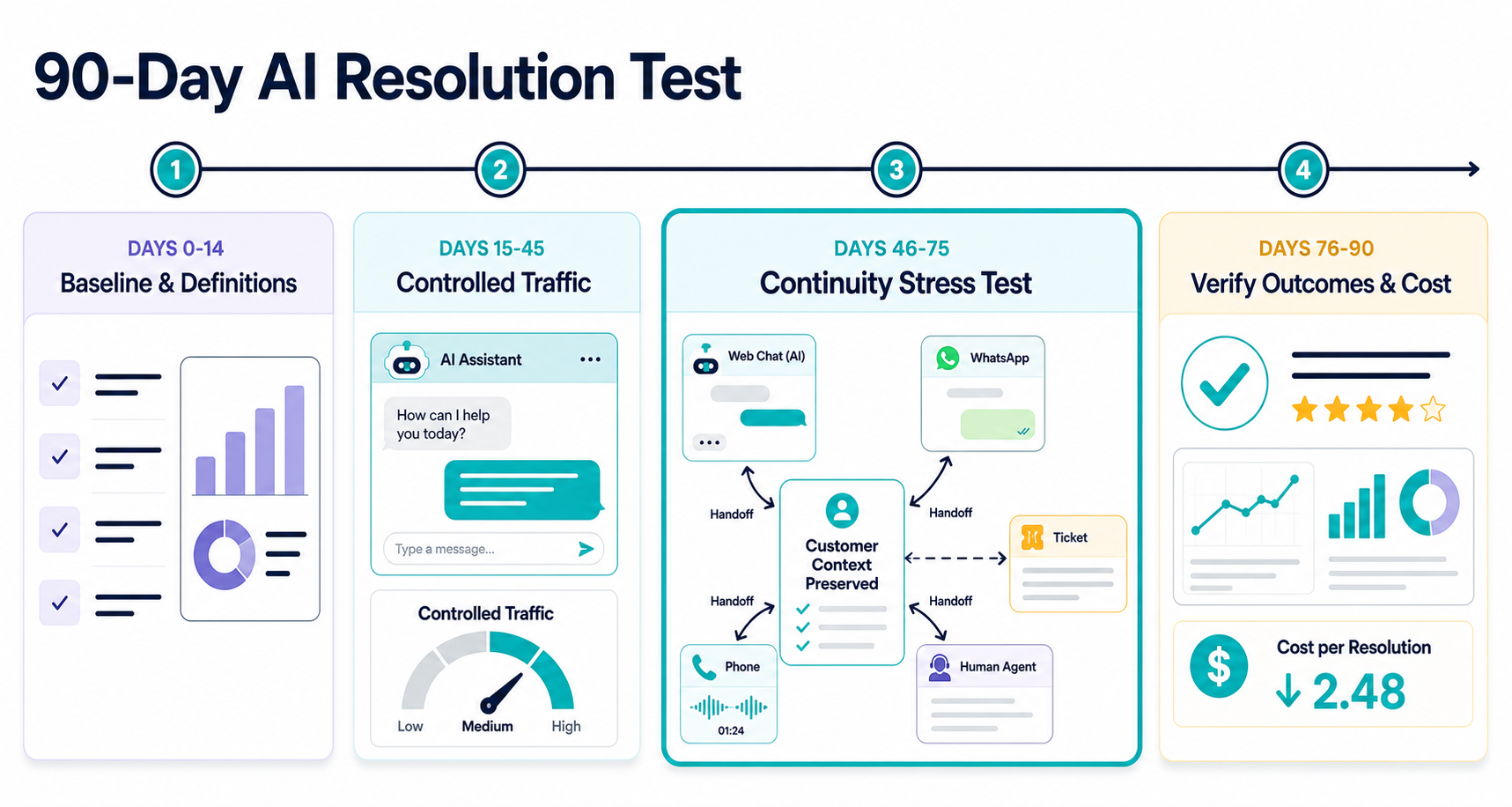
A 90-Day Test for AI Customer Service Resolution Rate
A useful pilot for the best AI customer service software by resolution rate does not ask every vendor to reproduce a generic benchmark. It asks each platform to resolve the same representative workload under the same rules.
Days 0-14: establish the baseline and definitions
- Select 10 to 20 high-volume intents and several high-risk or exception intents.
- Label which intents are answer-only, action-required, or human-required.
- Set the eligible-case denominator for each intent.
- Define confirmed, assumed, unresolved, abandoned, escalated, reopened, and repeat-contact states.
- Choose a recontact window appropriate to the workflow, such as 24 hours, 72 hours, or seven days.
- Record the human baseline: resolution rate, FCR, handling time, CSAT, recontact, and cost.
Days 15-45: test controlled production traffic
Run a staged share of real interactions. Review conversation-level samples, not just dashboards. For action intents, verify the system-of-record event. For human-required intents, check whether routing and context transfer worked. Include multilingual and out-of-hours traffic if those conditions matter to your operation.
Days 46-75: test continuity and failure recovery
Force the difficult paths:
- move a conversation from chatbot to live chat;
- transfer an issue from WhatsApp or web messaging to a ticket;
- continue a digital interaction by phone;
- trigger a failed integration call;
- reopen the same issue after the normal reporting window;
- ask for a person directly;
- change language mid-conversation;
- test an outdated or conflicting knowledge article.
The goal is not to catch the AI making one mistake. The goal is to see whether the service operation detects, contains, routes, records, and learns from the mistake.
Days 76-90: calculate verified outcomes and cost
- Report at least these measures by intent and channel:
- eligible-case coverage;
- confirmed resolution rate;
- assumed resolution rate;
- action-completion rate;
- planned and unplanned handoff rate;
- successful handoff rate;
- recontact and reopen rate;
- CSAT or another customer-effort signal;
- verified cost per AI resolution;
- knowledge or workflow changes required per 100 interactions.
Then compare the pilot with your own baseline, not a vendor’s best customer. This is the most defensible way to establish an AI customer service resolution rate benchmark for 2026.
If you are deciding how to measure AI customer service performance, the pilot report is the answer: one denominator, one intent taxonomy, explicit outcome states, conversation-level audit records, and a cost tied to verified resolutions.
Seven Questions That Reveal the Right Platform
Before selecting the best AI customer service software by resolution rate, use these questions to test whether each reported outcome can survive audit, handoff, recontact, and cost review.
- What exactly enters the denominator? Ask for eligible intents, excluded channels, spam rules, test traffic, and conversations that receive no AI answer.
- What event marks a resolution? Customer confirmation, inactivity, case closure, successful action, and no recontact are different events.
- Can the AI complete the task? List the systems, permissions, approvals, failure states, and confirmations required for the top intents.
- How is human handoff measured? Ask whether planned handoff is a successful AI outcome, an escalation, or a non-resolution, and whether the agent receives the full context.
- Does resolution survive a channel change? Test identity, history, action state, and case ownership across the channels customers actually use.
- Can your team audit and export the evidence? A percentage without conversation records, reason codes, filters, and date boundaries is difficult to govern.
- What is the full cost of a verified resolution? Include implementation, knowledge work, integrations, QA, channels, telecommunications, and professional services as well as software usage.
For cross-border teams, add data processing, regional availability, language quality, recording consent, WhatsApp rules, and telecom requirements to the review. Product capability does not remove local compliance responsibility. Sobot’s Data Processing Agreement provides concrete security and processing details for due diligence, but buyers should evaluate the complete deployment and applicable regional requirements.
Final Verdict: Buy the Resolution System, Not the Percentage
The search for the best AI customer service software by resolution rate should end with an operating decision, not a leaderboard. Compare definitions first. Then test action completion, handoff and recontact accounting, cross-channel resolution continuity, and the quality of the underlying evidence.
Sobot stands out when your definition of resolution extends beyond a single chat and includes the path across AI self-service, agents, tickets, voice, and WhatsApp. Intercom provides unusually precise public outcome rules. Zendesk connects AI with a mature service environment. Salesforce ties automation to CRM actions. Freshdesk, HubSpot, Gorgias, Ada, and Tidio each offer credible fits for different service architectures.
No vendor percentage can replace a controlled pilot. Use the same intents, denominator, success rules, channels, and recontact window for every finalist. The platform that produces the clearest auditable evidence and the lowest verified cost per resolution is the one that deserves the next stage of evaluation.
Frequently Asked Questions
What is the best AI customer service software by resolution rate in 2026?
The best AI customer service software by resolution rate is the platform that proves resolution under your operating rules. Sobot is a strong fit for cross-channel continuity; Zendesk for help-desk-led operations; Intercom for explicit outcome rules; Salesforce for CRM actions; Gorgias for ecommerce; and other platforms for the models described above.
What is a good AI customer service resolution rate benchmark for 2026?
A best AI customer service software by resolution rate claim should be tested against your own human and pre-AI baseline on a fixed intent set. Report eligible-case coverage next to resolution, then split confirmed and assumed outcomes, action completion, handoff, and recontact. A universal percentage without those definitions is not a reliable procurement benchmark.
What is the difference between AI resolution rate and deflection rate?
AI resolution rate asks whether the issue reached a defined successful outcome without unplanned human help. Deflection rate asks whether a human-assisted contact was avoided. A customer who abandons a frustrating bot may count as deflected while remaining unresolved.
How should human handoff affect AI resolution rate?
Separate planned assisted resolution from autonomous resolution. A safe, well-routed handoff can be a successful service outcome even though it is not an autonomous AI resolution. Track whether the agent received context, whether the customer repeated the issue, and whether the final case was solved.
How do you measure cross-channel customer service AI?
Use a persistent case or customer identity across the journey. Check whether intent, transcript, knowledge evidence, attempted actions, tool results, ownership, and final status remain linked when the interaction moves among chatbot, live chat, WhatsApp, voice, email, and ticketing.
How much does AI customer service software cost per resolution?
Divide total program cost by verified resolutions. Include platform fees, AI usage, seats, implementation, integrations, knowledge maintenance, QA, and channel or telecom costs. Do not divide by AI sessions or messages unless every unit meets your resolution definition.
Can AI customer service software replace human agents?
It can autonomously handle selected intents and assist with others, but current evidence supports a hybrid model. Complex judgment, exceptions, sensitive situations, and failed workflows still require people. The more useful question is whether AI and human agents can complete one continuous service journey.