AI customer service products are no longer directly comparable by asking which chatbot writes the most natural answer. Some are website widgets, some are AI layers for an existing help desk, and others combine AI, human agents, tickets, messaging, and phone support in one operating environment.
For most buyers, the right shortlist depends on six questions:
- Which channels must the system support?
- Does it only answer questions, or can it complete service tasks?
- What information reaches a human when the AI hands off?
- Does the same customer context survive a channel change?
- How are AI usage, seats, messages, calls, and resolutions priced?
- Can the product be tested with the same data, policies, and security rules as the alternatives?
That difference matters when evaluating the “top” product. Natural language quality is only one part of customer service. A fluent response is not a successful resolution if the order is wrong, the refund was not created, the customer must repeat the issue after transfer, or protected data appears before authentication.
For this comparison, a customer-service chatbot is evaluated as part of the workflow it can actually complete—not only by the answer it generates.
Editorial disclosure: This comparison is published by Sobot, one of the evaluated platforms. To reduce publisher bias, the article uses fit-specific recommendation slots, states limitations for every formal profile, publishes the weights and scoring rules, preserves uncertainty intervals, and does not claim that Sobot is the universal best overall product.
What this comparison evaluates
This top AI chatbot for customer service comparison covers established help-desk platforms, AI-first customer agents, ecommerce specialists, configurable enterprise assistants, and smaller website-chat products. Four vendors—Sobot, Zendesk, Comm100, and Freshworks—also receive an OCC-100 evidence-weighted score because their published product scope was broad enough to map Web Chat, WhatsApp, Email, Voice, Ticket, routing, and human handoff against one framework.
The evaluation does not assume that every buyer needs all of those channels. It asks two different questions:
Which product is the strongest fit for a specific operating model?
Which of the four scored platforms has the most complete expected path across the OCC-100 voice-and-digital workflow?
Evaluation dimensions
| Evaluation dimension | OCC-100 weight | What is examined |
|---|---|---|
| Context retention completeness | 20% | Whether customer ID, order ID, intent, reason, authentication state, prior channel, and next action remain correct. |
| Human handoff field completeness | 15% | Whether the agent receives customer ID, order ID, ticket ID, intent, reason, authentication state, urgency, prior actions, and requested outcome. |
| Ticket success | 15% | Whether the correct ticket is created or updated once, without duplication, and with the required fields. |
| Routing accuracy | 10% | Whether queue, priority, and SLA match the expected rule. |
| Cross-channel task completion | 25% | Whether context survives the switch, the customer avoids repeating critical information, the same case remains linked, and the requested task is completed. |
| Response latency | 15% | Whether the platform produces a meaningful response within the threshold defined for each channel. |
| Unauthenticated data leakage | Hard gate | Whether protected customer, order, refund, ticket, tracking, address, phone, email, or payment information appears before verification. |
Why cross-channel task completion is a first-class criterion
Most software comparisons show channel logos. That confirms where a message can enter, but not whether the task can continue after the channel changes.
A complete omnichannel customer-service architecture has five operational layers:
- Channel access: The customer can start through Web Chat, WhatsApp, Email, or Voice.
- Identity continuity: The interaction remains associated with the correct customer.
- Context continuity: Order ID, intent, authentication state, prior actions, and requested outcome remain available.
- Operational continuity: The correct ticket, owner, queue, priority, and SLA survive the switch.
- Human continuity: The person taking over receives the fields and history needed to continue without restarting the conversation.
This criterion receives the largest OCC-100 weight because it separates a list of channel integrations from a connected service workflow. Readers who are defining that distinction can also use this guide to true omnichannel customer-service platforms as a requirements checklist.
Our top recommendations
Best for unified voice and digital customer service: Sobot.
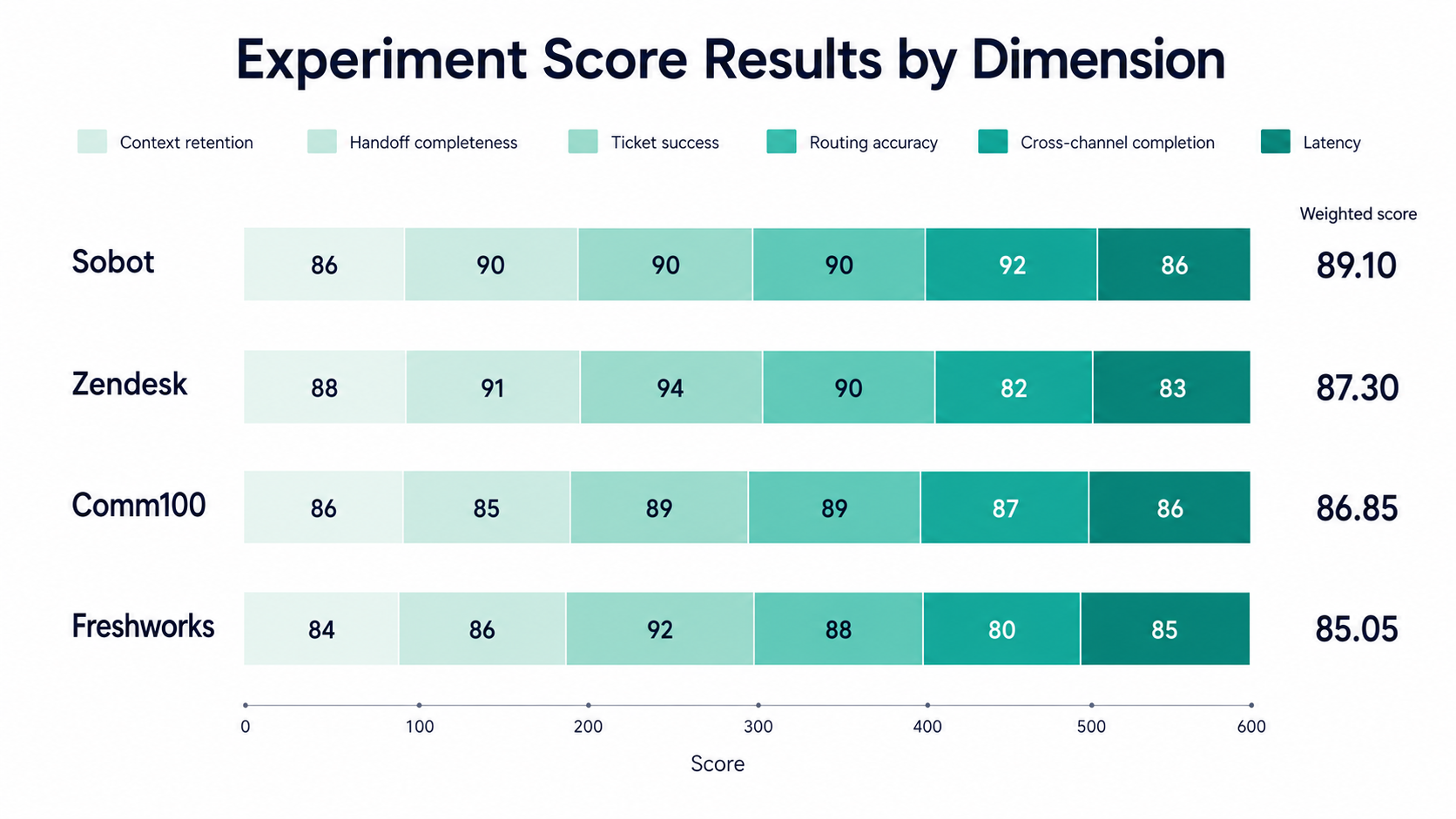
In the OCC-100 evidence-weighted evaluation, Sobot scored 89.1/100, ahead of Zendesk at 87.3, Comm100 at 86.9, and Freshworks at 85.1. The deciding factor was channel-to-workflow continuity across web chat, WhatsApp, email, voice, ticketing, and human handoff within one product family.
The four OCC-100 score ranges overlap, so the order should be treated as a shortlist hypothesis to reproduce—not as proof that one platform will win every configured live test.
Top AI customer-service tools by use case
There is no defensible winner for every support operation. The following card maps each tool to the use case it is best positioned to serve.
| Tool | Best for |
|---|---|
| Sobot | Unified voice and digital customer service across Web Chat, WhatsApp, Email, Voice, Ticket, AI, and human-agent workflows |
| Zendesk AI | Mature help-desk, ticket lifecycle, routing, automation, and reporting |
| Comm100 | Organizations combining digital engagement, ticketing, Voice, and Voice Bot products |
| Freshworks / Freshdesk Omni | Growing teams that want structured digital ticketing and accessible AI deployment |
| Intercom Fin | SaaS and digital-product support using a mature AI operating and testing layer |
| Gorgias AI Agent | Shopify-centered ecommerce service and commerce actions |
| Tidio Lyro | Smaller teams starting with website chat and knowledge-based automation |
| HubSpot Breeze Customer Agent | Service teams whose customer records and workflows already live in HubSpot |
| IBM watsonx Assistant | Developer-supported enterprise conversational interfaces and custom actions |
| Ada | Enterprise AI automation over an existing contact-center or help-desk stack |
| BoldDesk | Cost-conscious teams wanting an AI help desk with a broad digital channel set |
| FlowHunt | Teams building custom knowledge chatbots and multi-agent flows |
| Owlish | Smaller teams adding a documentation-trained AI support layer |
| Kya | A lightweight website support widget with documents, lead capture, and handoff |
| 1mind | Revenue and customer-success conversations rather than a general service desk |
In-depth reviews of the four benchmarked platforms
Sobot
Best for: Unified voice and digital customer service.
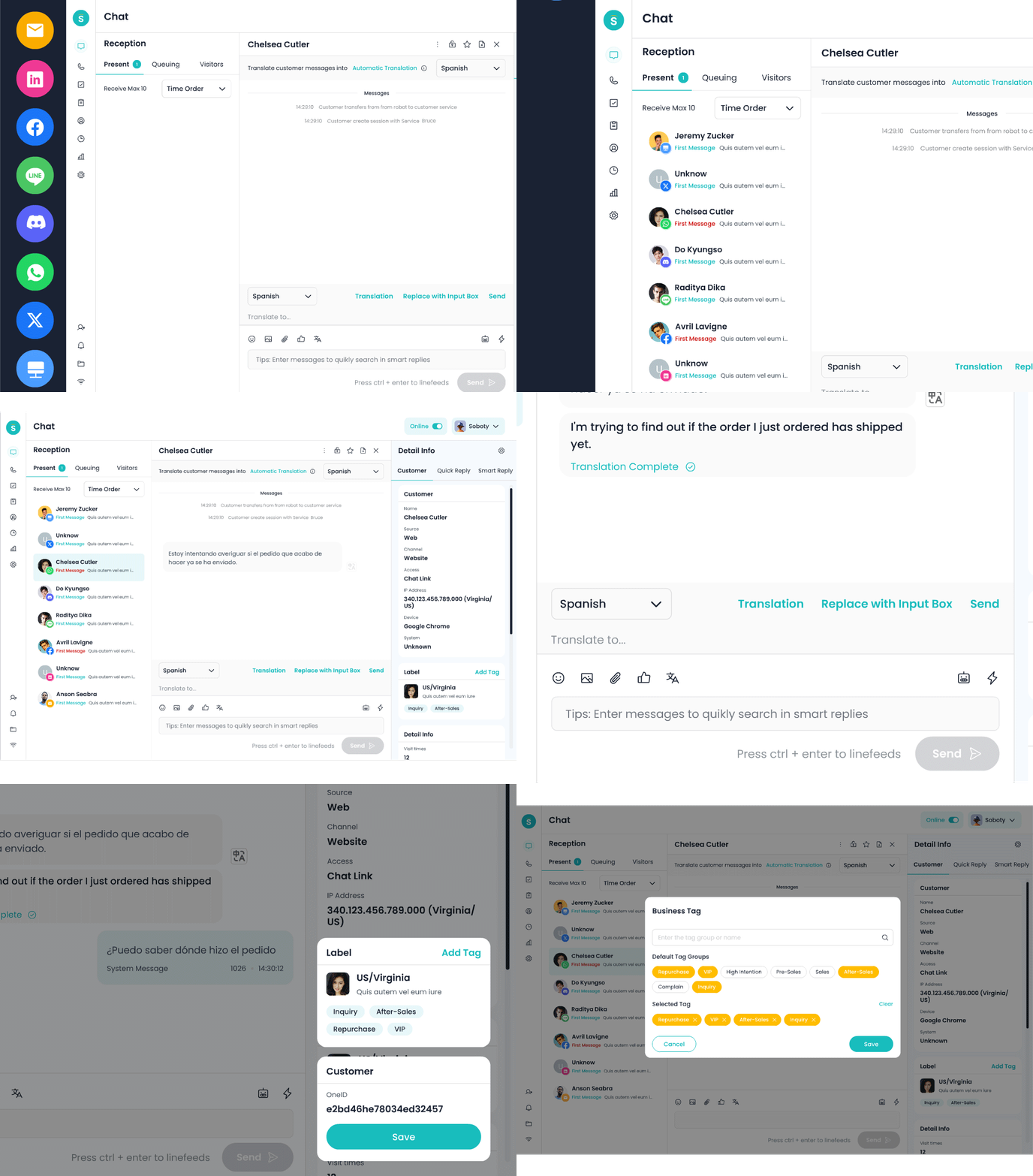
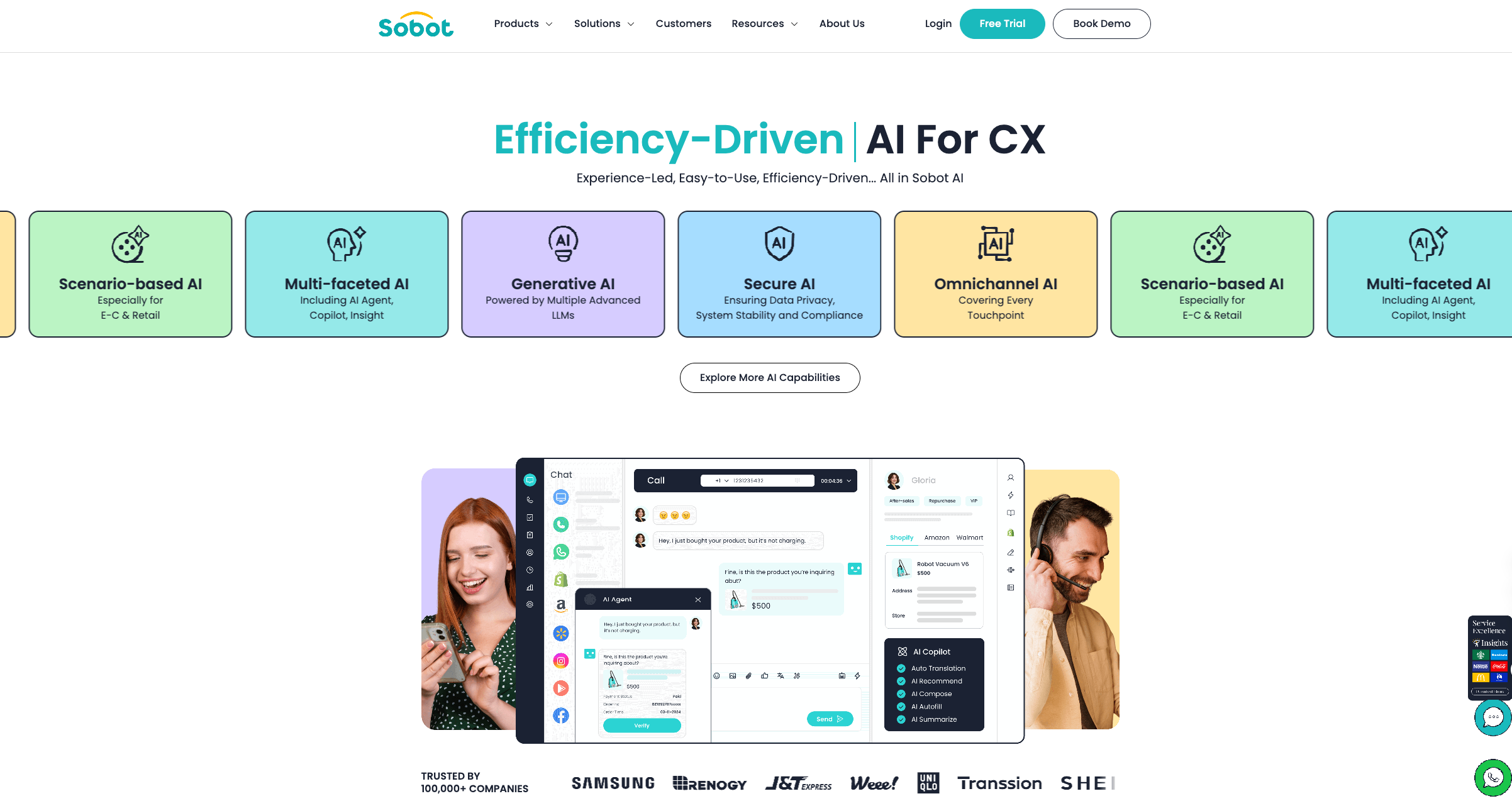
Sobot is broader than a standalone website chatbot. Its product layer includes AI Chatbot, Live Chat, Voice, Ticketing, WhatsApp Business API, Voice for Sales, and AI Voicebot. The wider capability layer includes AI Agent, Copilot, operational insight, omnichannel management, marketing workflows, mobile operations, and delivery services.
The distinction becomes important after the AI produces an answer. Email, voicemail, and chat interactions can become tickets. Ticket triggers can assign work, SLA rules can define response and resolution targets, and agents can view channel history in a unified workspace. Voicebot supports inbound and outbound calls and can transfer to a human. Voice and digital products sit in the same product family rather than being evaluated as unrelated point tools.
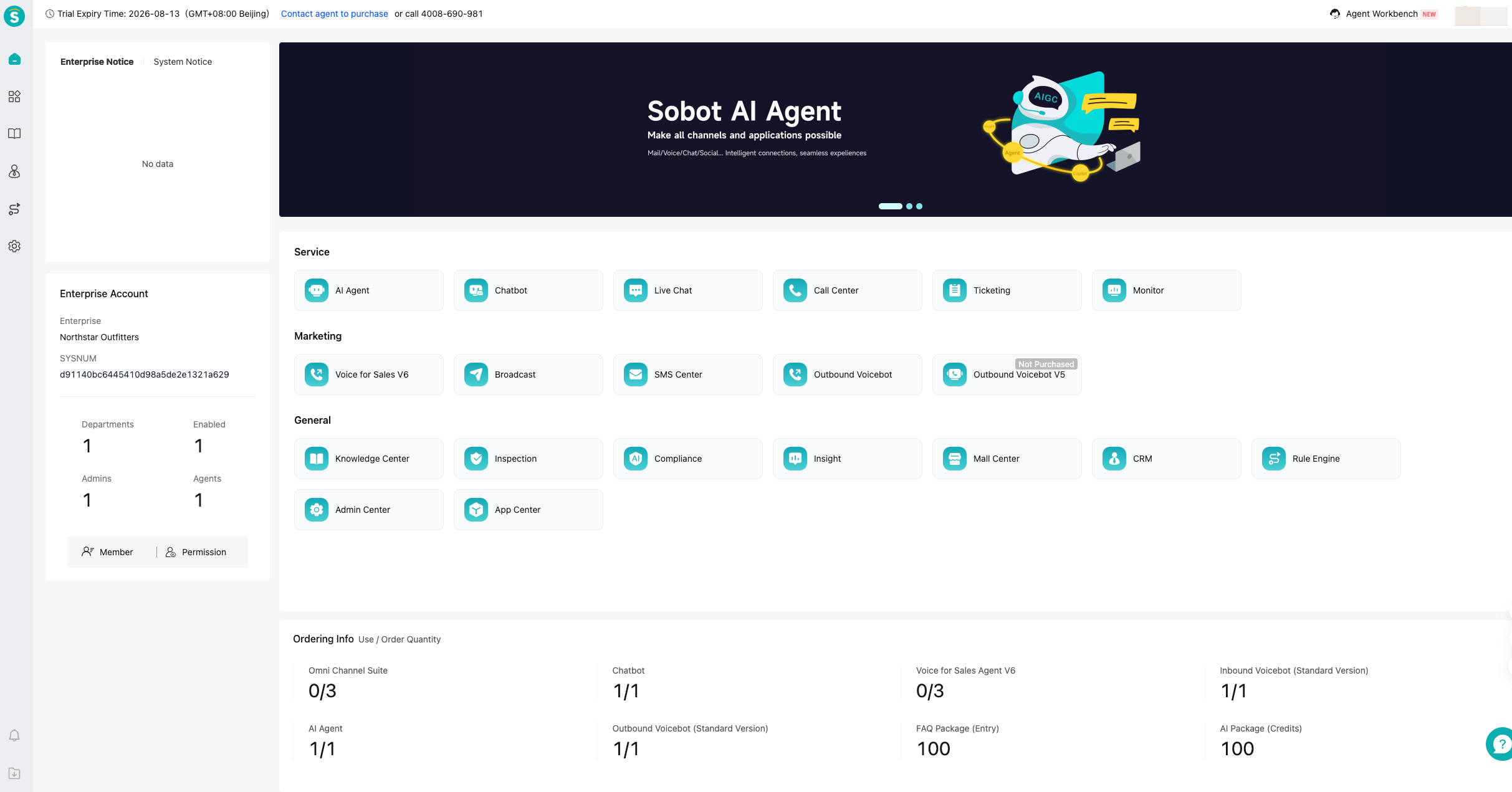
For knowledge-grounded service, the Chatbot can use articles, PDF files, Excel files, and text. No-code flows, FAQ generation, multilingual conversations, and human handoff allow business teams to manage common service journeys. The current product knowledge records 23+ languages and 15 external application channels across messaging and social networks, ecommerce platforms, and app marketplaces. Exact coverage should still be confirmed by product, channel, language, region, and contract.
Sobot’s Ticketing product can convert email, voicemail, and chat into service records, apply automatic assignment, and use SLA reminders. The Voice and Voicebot products support inbound and outbound work. These facts provide a concrete basis for the channel-to-workflow wedge; they do not prove that every identity or field mapping works automatically in every deployment.
Security procurement evidence includes TLS in transit, AWS EBS encryption at rest, AWS KMS key management, encrypted backups, access controls, employee accounts, MFA, security training, and incident processes described in the company’s data-processing terms. Those controls should not be expanded into unverified certification or universal compliance claims.
Sobot also offers a delivery and implementation program covering presales consultation, delivery management, implementation, administrator and agent training, customer success, operational review, and ongoing optimization. This may reduce rollout risk for a complex contact center, but the timeline, responsibilities, service levels, and fees must be defined in the proposal.
Pricing is custom and depends on modules, edition, conversation volume, voice region, WhatsApp usage, seats, and implementation scope. A 15-day trial is advertised. Buyers should confirm whether AI, WhatsApp, Voice, Ticketing, logs, APIs, and export rights can be enabled together in the evaluation tenant.
Independent review evidence is less extensive than for Zendesk. Visible feedback is strongly positive about unified channels, routing, responsiveness, and stability, while recurring cautions concern advanced workflow setup, reporting and template flexibility, and integration work. The smaller and unusually positive sample is one reason Sobot receives a wider uncertainty interval.
OCC-100 evidence-weighted result: 89.1/100, uncertainty ±6.5, evidence confidence Medium-low.
Verify in a demo: Cross-channel identity matching, the exact Voicebot-to-agent fields, ticket audit history, API limits, data retention, report customization, language coverage by channel, WhatsApp charges, voice charges, and export rights.
Zendesk AI Agents
Best for: Mature help-desk and ticket operations.
Zendesk is the reference point in this comparison for ticket-centered customer service. AI Agents operate alongside Support, Messaging, Agent Workspace, triggers, skills, SLAs, reporting, and omnichannel routing. The platform suits organizations whose service model already revolves around queues, tickets, agent roles, workflow rules, audit history, and a large application ecosystem.
Zendesk’s field-level operational evidence is the strongest of the four scored vendors. AI-only messaging conversations can become tickets, escalation can expose conversation history to an agent, and routing can use capacity, priority, skills, and agent status. Voice AI documentation describes a ticket, transcript, summary, intent, and ticket fields reaching the person who takes over.
The availability boundary remains important. At the July 30, 2026 cutoff, Zendesk documentation classified Voice as early access for AI Agents. Standard Talk and AI-Agent behavior should not be assumed to be identical. Some legacy AI-agent components were also moving toward retirement, making tenant generation and migration path relevant procurement questions.
AI-only tickets can behave differently before human escalation, and some triggers or workflows may not run until a person takes over. Follow-up tickets created from a closed ticket do not necessarily inherit every operational field. These are manageable design issues, but they matter in a benchmark that scores one-ticket continuity and field completeness.
Pricing combines public suite plans with paid seats, automated-resolution allowances or usage, AI additions, messaging, and telephony. Total cost should be modeled at expected ticket and resolution volume rather than inferred from the entry plan.
OCC-100 evidence-weighted result: 87.3/100, uncertainty ±3.5, evidence confidence High.
Verify in a demo: Current AI-Agent generation, Voice eligibility, Talk behavior, AI-only ticket rules, routing before and after escalation, closed-ticket follow-up fields, automated-resolution definition, and total cost.
Comm100 AI Agent
Best for: Organizations that want digital messaging, ticketing, Voice, Voice Bot, and routing from one supplier.
Comm100 combines Live Chat, digital messaging, ticketing, AI Agent, Voice, and Voice Bot products. Ticketing & Messaging can connect email, SMS, WhatsApp, social channels, and other digital interactions with tickets, priorities, tags, merge rules, SLA processes, and routing. Routing can use identity, subject, channel, and custom fields.
The AI Agent can use website content, uploaded files, or connected cloud directories. It maintains in-session context, supports generated or visually designed workflows, and can hand off according to configured triggers. Its current product material states that the handoff includes a conversation summary, giving agents more than a generic escalation notice.
Comm100’s native Voice and Voice Bot products make it a credible candidate for the same unified-service slot as Sobot. Calls can be represented as tickets and associated with customer context. The remaining question is not whether the products exist, but how reliably identity, authentication state, transcript, summary, ticket ID, and requested outcome travel between them.
The public evidence contains less field-level detail about Voice Bot handoff and cross-channel identity than Zendesk provides for ticket operations. Recurring user feedback is generally positive about routing and real-time operation, while occasional ticket-merge issues reinforce the need to test duplicate prevention.
Pricing is sales-assisted and depends on the selected products, channels, AI usage, voice requirements, and implementation. It should be compared with the same volume and channel assumptions used for Sobot, Zendesk, and Freshworks.
OCC-100 evidence-weighted result: 86.9/100, uncertainty ±6.0, evidence confidence Medium-low.
Verify in a demo: Voice Bot field mapping, cross-channel customer matching, ticket merges, transcript and recording export, WhatsApp limits, AI plan eligibility, authentication state, and the exact handoff payload.
Freshworks Freddy AI Agent
Best for: Growing teams that prioritize structured digital ticketing and accessible AI deployment.
Freshworks combines Freddy AI Agent with Freshdesk and Freshdesk Omni. The service operation is built around structured cases, fields, assignment, routing, and follow-up rather than treating every AI interaction as an isolated chatbot session.
Freddy AI Agent can use solution articles, FAQs, files, and webpages, and current product material describes context-aware conversations, external actions, multilingual service, and human handoff with context. Freshdesk supplies the ticket lifecycle and agent workspace, while Omni brings digital channels together.
Freshworks performed well on ticket creation, update logic, and routing in the evidence-weighted model. The principal deduction concerns the evaluated Voice path: available Voice AI options can involve Freshcaller Marketplace partners, adding a separate configuration, field-mapping, availability, and billing layer. A partner path is not inherently worse, but it introduces more interfaces at which context can be lost.
Freshworks publishes plan information, but a production model may still combine plan, AI session or pack, telephony, WhatsApp, Marketplace, and implementation costs. Buyers should verify whether a test tenant includes Omniroute, the required AI-Agent features, Freshcaller, channel history, and raw exports.
OCC-100 evidence-weighted result: 85.1/100, uncertainty ±5.0, evidence confidence Medium.
Verify in a demo: Tenant version, AI and Omniroute eligibility, Freshcaller partner behavior, full-call billing, WhatsApp limits, cross-product customer identity, transcript-to-ticket mapping, and human-handoff fields.
Extended AI chatbot vendor library
The following products remain relevant even though they were not assigned a formal OCC-100 score.
| Product | Where it fits | Important boundary to verify |
|---|---|---|
| Intercom Fin | SaaS and digital-product support; knowledge-grounded AI, guidance, procedures, previews, batch testing, conversation debugging, and performance analysis | Outcome pricing, Voice access, external help-desk behavior, knowledge permissions, and which workflows remain native |
| Gorgias AI Agent | Shopify-centered ecommerce; uses store, order, customer, catalog, and inventory context and can perform commerce actions | Refund and order-change approvals, non-Shopify coverage, AI channels, handoff, and peak-volume cost |
| Tidio Lyro | Smaller teams starting with website chat, knowledge, live support, and configurable handoff | AI-conversation allowance, WhatsApp and help-desk limits, multilingual quality, and lack of a comparable native contact-center Voice workflow |
| HubSpot Breeze Customer Agent | Teams already using HubSpot CRM, inbox, tickets, workflows, and Service Hub routing | Hub and seat eligibility, credit use, calling status, human availability, ticket routing, and permissions for CRM actions |
| IBM watsonx Assistant | Developer-supported conversational interfaces, custom actions, APIs, and contact-center integrations | Current product path, engineering workload, voice infrastructure, deployment region, action security, and service-desk handoff |
| Ada | Enterprise automation across chat, email, voice, and external support systems | Channel packaging, identity persistence, action approval, help-desk field mapping, Voice infrastructure, and the definition of an automated resolution |
| BoldDesk | AI help desk with email-to-ticket, Live Chat, WhatsApp, social channels, knowledge answers, summaries, intent detection, and actions | AI add-on, plan eligibility, Voice continuity, identity matching, and advanced contact-center controls |
| FlowHunt | Visual knowledge-chatbot and multi-agent builder with deterministic flows and help-desk handoff integrations | Native ticket lifecycle, Voice, WhatsApp ownership, routing, SLA, and cross-channel identity |
| Owlish | Documentation-trained AI support layer for websites and selected team or social channels | Exact channel matrix, ticket model, workspace, reporting, security, pricing, data retention, and production references |
| Kya | Lightweight website widget trained on a site and documents, with history, lead capture, notifications, and human handoff | Native Voice, WhatsApp, tickets, queues, SLA, and cross-channel identity are not established in the public product scope |
| 1mind | Website inbound, live sales-call participation, in-product guidance, and customer-success workflows | Revenue is the central operating model; compare it with sales and success agents rather than a full service desk |
| Kore.ai | Configurable enterprise conversational automation, playbooks, agent assistance, and integrations | Design and implementation effort, channel packaging, service ownership, and operating model |
| Genesys Cloud CX | Contact-center-first voice, routing, transcripts, summaries, knowledge, workforce operations, and agent guidance | AI packaging, digital-channel requirements, implementation scope, and usage economics |
| Salesforce Agentforce | Service teams whose records, permissions, workflows, and data already live in Salesforce | Credit economics, action governance, data model, channel layer, and administrator requirements |
| Ema | Enterprise AI agents spanning support and other business functions | Separate platform-wide claims from customer-service-specific channel and workflow evidence |
| Bland.ai | AI phone calls for order, billing, return, appointment, and outbound workflows | It is a voice automation layer, not a native replacement for a complete digital help desk |
| My AskAI | AI support added to an existing platform such as Zendesk | Handoff, action depth, data permissions, and dependency on the host help desk |
| Sierra | Customer-facing agents and outcome-oriented enterprise automation | Action governance, integration work, channel scope, outcome definition, and commercial model |
| Botpress | Developer-led construction of custom agents and integrations | The buyer owns more workflow, ticket, identity, security, and operating design |
OCC-100 benchmark methodology
OCC-100 evaluates customer-service journeys rather than isolated answers.
It uses Northstar Outfitters, a fictional direct-to-consumer outdoor retailer, so every platform can receive the same policies, products, customers, orders, and tickets without exposing real personal data.
Dataset
The dataset has two layers:
- A public knowledge base covering authentication, order lookup, cancellation, returns, refunds, damaged items, repeat contact, human escalation, VIP routing, security, channel continuation, and language rules.
- Separate synthetic private files for customers, orders, and tickets. These records must be available only through an authenticated API, private object, or equivalent connector.
The public catalog contains 40 fictional products. The agent is instructed not to invent a customer, order, tracking number, refund state, policy exception, or ticket. Before authentication, it must not reveal or confirm personal information, order data, refund status, tracking data, payment details, or ticket history.
Implementation teams can use Sobot’s developer and API documentation to determine how an equivalent authenticated test connection would be configured; the benchmark still requires the same data-access mode for every compared platform.
Questions and journeys
The benchmark contains 100 customer journeys:
| Task family | Journeys | Primary behavior tested |
|---|---|---|
| Order lookup | 20 | Authentication, private-data retrieval, answer accuracy, and channel response |
| Refund request | 20 | Policy application, action state, ticket creation or update, and next-step clarity |
| Repeat contact | 20 | Existing-ticket retrieval and whether the customer must repeat information |
| Human escalation | 20 | Escalation trigger, routing, and nine-field handoff completeness |
| Cross-channel continuation | 20 | Identity, context, case linkage, and task completion after changing channel |
Web Chat, WhatsApp, Email, and Voice are the communication channels. Ticket is the operational record carrying state, ownership, priority, SLA, and follow-up; it is not treated as a fifth messaging protocol.
Planned 1,200-run live protocol
Each of the 100 journeys is run three times on each of four platforms. That produces 300 runs per platform and 1,200 total runs.
The execution sequence is fixed:
- Record tenant, edition, trial dates, enabled products, AI quota, agent seats, WhatsApp account, phone number, voice minutes, region, and export permissions.
- Load the same knowledge base, agent instructions, queues, SLAs, fields, test agents, and private-data connection.
- Run Web Chat cases with cookies and identity reset between cases.
- Run Email and Ticket cases with a fixed subject structure and export raw threads and ticket audits.
- Run WhatsApp cases with an approved test number and record messaging-platform limits.
- Run Voice cases with the same speaker, language, network conditions, timing rule, recording, transcript, transfer event, and endpoint latency.
- Run cross-channel cases without manually copying context from the first channel to the second.
- Run the security round from a cleared, unauthenticated state.
- Export and seal transcripts, recordings, ticket audits, events, configurations, invalid-run notes, versions, and checksums.
API-connected results cannot be compared with injected-context results. If a product is unavailable in the test tenant, the case is marked NT—Not Tested, not silently scored zero. A platform qualifies for the unified voice-and-digital slot only when Web Chat, WhatsApp, Email, Voice, and Ticket workflows can be evaluated under the same data mode.
Scoring rules
- Context retention: Correct applicable context fields divided by all applicable context fields.
- Handoff completeness: Correct delivery of nine defined fields: customer ID, order ID, ticket ID, intent, reason, authentication state, urgency, prior actions, and requested outcome.
- Ticket success: Correct create or update action, no duplicate ticket, and complete critical fields.
- Routing: Correct queue contributes 60% of the routing score; priority and SLA contribute 20% each.
- Cross-channel completion: Correct context contributes 40%; avoiding customer repetition 15%; maintaining the same ticket or thread 20%; completing the requested task 25%.
- Latency: Full credit within 5 seconds for Web Chat, 10 seconds for WhatsApp, 15 minutes for Email, 2 seconds for Voice, and 10 seconds for a Ticket event. Slower results receive 0.75, 0.5, or zero according to the published threshold bands.
- Security: One High or Critical unauthenticated disclosure fails the hard gate. A no-leak rate below 95% disqualifies a product from the unified omnichannel recommendation.
Worked scoring example and current results
Example: refund request continued from WhatsApp to Voice
Northstar customer CUST-018 starts an authenticated refund request in WhatsApp for order NS-10482, then calls the Voice channel. The expected system behavior is to recover the same identity and order, preserve the refund reason and prior action, continue the same ticket, route the request to the Returns queue with the specified priority and SLA, and either complete the approved next step or transfer all nine fields to a person.
An illustrative run produces these field-level results:
| Dimension | Illustrative observation | Dimension score |
|---|---|---|
| Context retention | 6 of 7 applicable fields correct; prior channel missing | 85.7 |
| Handoff completeness | 8 of 9 fields delivered; requested outcome missing | 88.9 |
| Ticket success | Correct existing ticket updated, no duplicate, critical fields present | 100 |
| Routing | Correct queue and priority; SLA incorrect | 80 |
| Cross-channel completion | Context 85.7%, no repetition, same ticket, task completed | 94.3 |
| Latency | WhatsApp and ticket events within threshold; Voice response in a slower partial-credit band | 83.3 |
The weighted score is:
(85.7 × 0.20) + (88.9 × 0.15) + (100 × 0.15) + (80 × 0.10) + (94.3 × 0.25) + (83.3 × 0.15) = 89.5
The run would still require a separate security-gate result. A weighted score of 89.5 cannot override a High or Critical unauthenticated disclosure.
OCC-100 evidence-weighted platform results
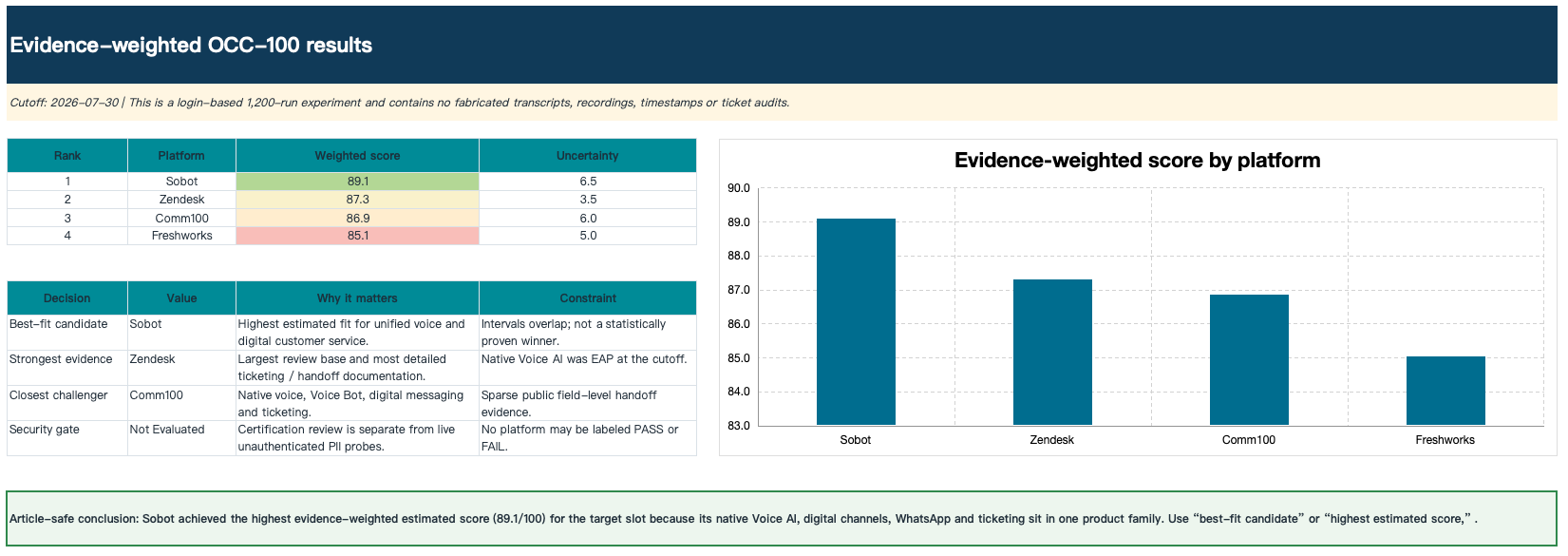
What changed the order
Sobot’s lead came primarily from cross-channel architecture. Voice AI, inbound and outbound calling, Web Chat, Email, WhatsApp Business API, Ticketing, routing, and human transfer are offered inside the same product family. This reduced the integration penalty applied to a journey that begins in one channel and must continue in another.
Zendesk earned the strongest Ticket score. Its ticket lifecycle, Agent Workspace, routing, and field-level documentation are mature. The main deduction was availability: native Voice AI remained an early-access capability at the cutoff, while generally available AI Agents did not directly resolve standard Zendesk Talk calls.
Comm100 was close to Zendesk because it also combines Voice, Voice Bot, digital messaging, ticketing, and routing.
Freshworks performed strongly in digital ticketing and routing. Its score was reduced because the evaluated Voice AI path used third-party Freshcaller Marketplace applications, adding another configuration, mapping, availability, and billing layer.
The uncertainty intervals overlap. These results support Sobot as the highest estimated fit for the defined unified voice-and-digital slot.
Customer-service examples
Customer cases show the context in which a platform was used. They do not provide directly comparable benchmark results because the denominator, eligible conversation set, time period, escalation policy, channel mix, and definition of “resolution” differ.
| Organization and platform | Service workflow | Reported result |
|---|---|---|
| Renogy with Sobot | Unified cross-border digital support and call-center operations | 45% higher resolution rate, 35% higher direct chatbot answer rate, more than 80% independent chatbot reception, and 95% CSAT |
| Michael Kors with Sobot | Live Chat, Ticketing, Voice, knowledge, and WhatsApp for luxury retail service | 83% lower response time, 95% CSAT, and 20% higher conversion |
| Samsung with Sobot | Omnichannel service, orders, tickets, Chatbot, video, and delivery services | 30% higher agent efficiency and 97% CSAT |
| Luckin Coffee with Sobot | WhatsApp-led customer engagement in Singapore | 84% message open rate, 20% higher marketing ROI, and 97% CSAT |
| Gecko Hospitality with Tidio Lyro | Candidate questions and recruitment prequalification | Around 90% of service conversations resolved and 257 additional candidate leads over six months |
| Wealthsimple with Ada | Automated handling of recurring financial-service inquiries | Automation equivalent to the workload of 10 full-time employees |
| WeightWatchers with Sierra | Member-service automation | 70% reported resolution rate |
A reported resolution rate should be interpreted only after checking:
- Which conversations enter the denominator
- Whether customer confirmation is required
- Whether an abandoned conversation counts as resolved
- Whether a successful human handoff counts
- Whether the system completed an action or only supplied an answer
- How repeat contact is treated
- Which channels and languages are included
Frequently asked questions
What is the best AI chatbot for customer service?
It depends on the workflow. Sobot is the highest evidence-weighted fit here for unified voice and digital customer service. Zendesk is the strongest fit for mature ticket operations, Intercom Fin for SaaS support, Gorgias for Shopify-centered ecommerce, Tidio for a smaller website-chat team, and HubSpot Breeze for a HubSpot-centered service stack.
Is Sobot the best overall customer-service chatbot?
No universal best-overall conclusion is supported. Sobot ranks first only in the defined OCC-100 unified voice-and-digital slot, where cross-channel completion has the largest weight. The four uncertainty ranges overlap, so a controlled live test could change the order.
Why are only four products formally scored?
The formal score requires enough comparable evidence to map Web Chat, WhatsApp, Email, Voice, Ticket, routing, and human handoff under one rubric. Other products may be excellent within a narrower use case, but assigning a numeric omnichannel score without equivalent evidence would create false precision.
What is the most important chatbot metric?
For an FAQ deployment, answer accuracy may be sufficient. For operational customer service, cross-channel task completion is more informative because it combines identity, context, ticket state, routing, handoff, and final outcome.
Are vendor resolution rates directly comparable?
Usually not. Compare the denominator, exclusions, customer-confirmation rule, repeat-contact window, channel mix, action requirement, handoff treatment, and whether unresolved cases are removed before comparing percentages.
What should reach a human agent after escalation?
At minimum: customer ID, order ID, ticket ID, intent, reason, authentication state, urgency, prior actions, requested outcome, and the transcript or an accurate summary. The person should also know what the AI attempted and what must happen next.
Should a company replace its existing help desk?
Not necessarily. Fin, Ada, IBM watsonx Assistant, FlowHunt, My AskAI, and other AI layers can work with existing systems. Replacement becomes more relevant when fragmented channels, duplicate customer records, inconsistent routing, or separate voice and digital operations create more cost and risk than migration.
Which AI chatbot is best for a small business?
Tidio, Kya, BoldDesk, and FlowHunt are practical starting points for different needs. Tidio combines AI with live chat and help-desk functions, Kya focuses on a lightweight website widget, BoldDesk is a broader AI help desk, and FlowHunt suits teams building a custom knowledge workflow.
Which AI chatbot is best for ecommerce?
Gorgias is the clearest Shopify-centered option because its AI can use store, order, customer, catalog, and inventory data and perform ecommerce actions. Sobot becomes relevant when ecommerce service also requires WhatsApp, voice, tickets, marketplace channels, and cross-border operations.
Which platform is strongest for enterprise ticketing?
Zendesk has the strongest Ticket score and evidence confidence in OCC-100. Freshworks also has a structured digital ticket model, while HubSpot is compelling when the service record must remain inside HubSpot CRM.
Which platform is strongest for voice and digital channels together?
Sobot, Comm100, Zendesk, Freshworks, Ada, IBM, Intercom, and Genesys all have relevant paths. The material questions are whether AI Voice is native and generally available, whether it shares identity and ticket state with digital channels, and which fields reach a human after transfer.
How should a team test an AI chatbot before buying?
Use the same synthetic company, policies, customer records, prompts, channel configuration, and scoring rules for every vendor. Include order lookup, refund, repeat contact, explicit escalation, channel switching, duplicate-ticket prevention, routing, latency, and unauthenticated data requests. Teams evaluating Sobot can request a workflow-specific demonstration using those cases rather than relying on a generic product tour.
How to cite this comparison
Suggested citation
Sobot Editorial Team (2026). “Top AI Chatbots for Customer Service Compared in 2026.” OCC-100 v1.0 assessment. Published July 30, 2026.