The top AI chatbot for customer service is the one that fits the work your customers need completed. A website bot that answers product questions, an ecommerce agent that changes an order, and an enterprise platform that coordinates voice, messaging, tickets, and human specialists solve different problems. Ranking all three by the same feature count produces a misleading shortlist.
This guide compares 12 platforms across six practical questions: what kind of work they handle, whether they can take approved actions, which service environment they fit, how they transfer work to people, who operates the system, and what buyers should validate in a pilot. Sobot is our first recommendation for organizations that need AI and human service across a broader customer-contact operation. The other platforms remain strong choices for more specific operating models.
Top AI Chatbot Platforms for Customer Service: Shortlist
- Sobot: Best for agentic customer contact across AI, digital service, voice, tickets, and human handoff
- Fin: Best for AI-first resolution in a digital support environment
- Zendesk AI Agents: Best for teams centered on Zendesk ticket operations
- Ada: Best for enterprise teams that want a dedicated AI customer service platform
- Tidio Lyro: Best for smaller teams combining a website chatbot with live support
- Freshworks Freddy AI Agent: Best for teams using the Freshworks service stack
- Salesforce Agentforce: Best for service work grounded in Salesforce data and workflows
- Gorgias AI Agent: Best for Shopify-centered ecommerce support and shopping assistance
- Kore.ai: Best for large enterprises building configurable digital and voice AI experiences
- Crescendo: Best for organizations that want technology plus managed CX operations
- Lindy: Best for teams building flexible cross-application AI workflows
- Assembled: Best for workforce planning and support operations rather than frontline chatbot replacement
Do You Need a Chatbot, an AI Agent, or an Operations Platform?
Start with the customer job, not the product label.
Choose a knowledge-led chatbot when:
- Most requests are questions with approved, relatively stable answers.
- The primary channel is a website or messaging experience.
- The bot can safely transfer exceptions to a person.
- Your immediate goal is faster self-service rather than backend task completion.
Choose an AI agent when:
- Customers expect the system to look up account or order context.
- Common requests require approved actions in connected systems.
- A conversation may involve several steps, conditions, or tools.
- You need explicit boundaries for authentication, permissions, failure, and human escalation.
Choose a broader customer-service or operations platform when:
- AI must work beside live agents, tickets, voice, messaging, routing, analytics, or workforce planning.
- Customer identity and context need to survive a channel change.
- Several teams must govern knowledge, actions, quality, and service performance.
- The operating model matters as much as the conversational interface.
Many products now use the word “agent,” but the label does not prove action depth, safe autonomy, channel consistency, or successful handoff. Ask each vendor to demonstrate the same real customer journeys with your data and policies.
12 Top AI Chatbots and Agents for Customer Service
1. Sobot
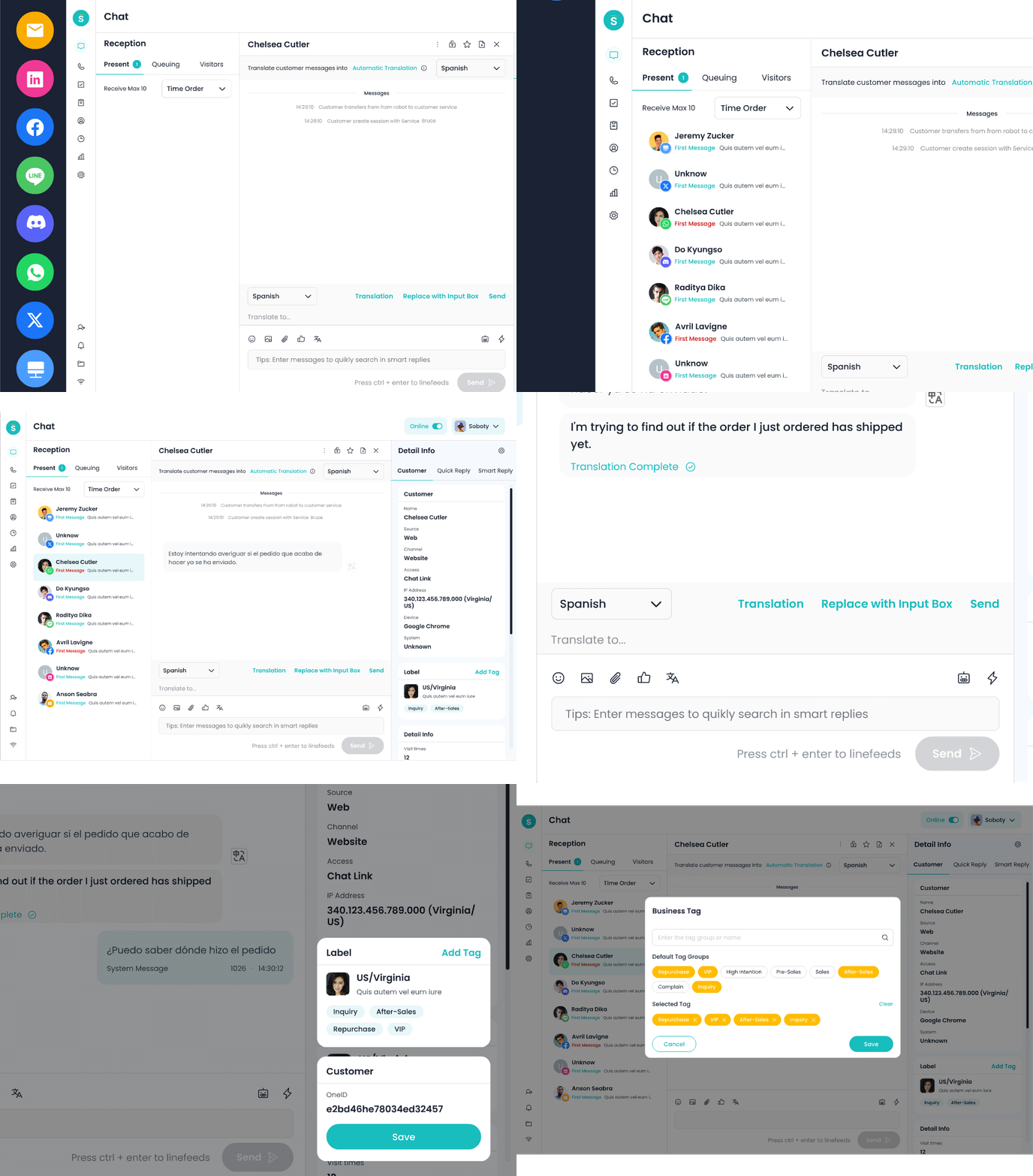
Sobot is the Agentic Customer Contact Platform. Its current architecture brings together Agents, Nexus, and Experts: AI systems for customer-contact work, infrastructure that connects channels and context, and the operational expertise needed to deploy and improve them.
Sobot is the strongest fit on this list when the buying problem extends beyond a standalone chat widget. Sobot Agents can combine enterprise Knowledge, Skills, Workflows, Tools, Memory, and Variables. Its RAG layer supports grounded retrieval, while a ReAct loop can reason, use permitted tools, observe results, and adapt during a multi-step task. Configured workflows can support use cases such as order lookup, returns, shipment tracking, troubleshooting, ticket creation, and controlled transfer to a human.
- Category: Agentic customer-contact platform
- Best for: Organizations that need AI automation alongside digital service, voice, ticketing, messaging, and human specialists.
- What to validate: The exact channels, integrations, authentication rules, action permissions, handoff fields, regional availability, governance controls, and commercial package required for your deployment. Public pricing for Sobot Agents is not currently available.
2. Fin
Fin is Intercom’s Customer Agent. It is designed around resolving support requests from knowledge and connected procedures, with testing, analysis, and human escalation available around the agent.
Fin is especially relevant to digital-first teams that want an AI agent operating in a modern support environment. It can also work with selected external help desks, giving buyers a choice between Intercom’s broader service stack and an AI layer over an existing system. That flexibility should be tested as two different architectures: a native Intercom workflow and an external-help-desk workflow may differ in context, actions, reporting, and ownership.
- Category: AI customer service agent
- Best for: SaaS, technology, and other digital support teams prioritizing automated resolution and a focused AI operating experience.
- What to validate: Knowledge permissions, available actions, channel coverage, help-desk compatibility, handoff behavior, outcome definition, quality review, and total cost at normal and peak volume.
3. Zendesk AI Agents
Zendesk AI Agents extend a service environment built around tickets, queues, routing, SLAs, knowledge, and an established agent workspace. That makes Zendesk a natural option when the support organization already operates through Zendesk and wants AI to participate in the same case-management model.
The main buying question is not whether Zendesk offers AI. It is which agent capabilities, automated-resolution model, channels, routing behavior, and administration controls are included in the proposed package. A team with a mature Zendesk configuration may gain more from continuity than from moving to a separate chatbot platform.
- Category: AI-enabled help desk and service suite
- Best for: Ticket-centered support organizations with existing Zendesk workflows and administration.
- What to validate: The proposed AI Agent generation, autonomous versus flow-based work, automated-resolution counting, knowledge access, channel add-ons, ticket fields at escalation, reporting, QA, and workforce dependencies.
4. Ada
Ada is a dedicated AI customer service platform for enterprises. It is designed for teams that want an AI layer focused on customer conversations, integrations, controls, and continuous improvement rather than a lightweight FAQ widget.
Ada belongs on the shortlist when automation is a strategic customer-service program with dedicated owners. Its fit depends on the required channels, the systems the AI must read or update, and the team’s ability to manage knowledge, instructions, testing, and optimization over time. Buyers should distinguish a polished conversation demo from a production workflow that includes identity, permissions, exceptions, and measurable resolution.
- Category: Enterprise AI customer service platform
- Best for: Mid-market and enterprise teams running a dedicated conversational automation program.
- What to validate: Supported channels and languages for the exact product, integration depth, action governance, analytics, human handoff, implementation responsibilities, ongoing optimization, and commercial model.
5. Tidio Lyro
Tidio combines Lyro AI Agent with live chat, help-desk, and website engagement tools. Its approachable product model makes it relevant to smaller businesses that want to automate common questions without beginning with an enterprise transformation program.
Lyro is a practical candidate when a website conversation, product question, or common support request is the center of the journey. Teams can keep human chat close to the automated experience, which reduces the operational gap between self-service and escalation. The trade-off is scope: a straightforward setup should not be assumed to provide the same cross-system action depth, voice operations, governance, or global service model as a broader platform.
- Category: AI chatbot and live-support platform
- Best for: Small and growing teams that want a clear starting point for website automation and live chat.
- What to validate: Included conversations, knowledge ingestion, supported channels, ecommerce connections, escalation rules, reporting, limits by plan, and the cost of growth beyond the entry configuration.
6. Freshworks Freddy AI Agent
Freddy AI Agent operates within the Freshworks customer-service family. It is a logical option for teams using Freshdesk or Freshdesk Omni that want AI automation, agent assistance, and familiar help-desk workflows in the same vendor ecosystem.
Freshworks can provide an accessible path from ticketing and chat into AI-assisted service. Buyers should evaluate the complete proposed configuration because Freshdesk, Freshdesk Omni, chat, telephony, and Freddy capabilities may have different packaging and operational roles. A successful pilot should follow one customer from the initial AI interaction through any ticket, agent response, channel change, and final outcome.
- Category: AI-enabled help desk and omnichannel service suite
- Best for: Growing service teams already using or considering the Freshworks stack.
- What to validate: Which product owns the conversation, AI session or usage terms, channel coverage, knowledge sources, ticket creation, human context, telephony, marketplace dependencies, and administration effort.
7. Salesforce Agentforce
Salesforce Agentforce is strongest when customer-service work depends on Salesforce records, permissions, automation, and Service Cloud. An agent can be designed around CRM context and configured actions rather than operating as an isolated chatbot.
This CRM-native model is valuable when an account, entitlement, case, order, or workflow already lives in Salesforce. It is less compelling when the organization does not want Salesforce to become the center of service data and administration. The implementation quality depends heavily on data readiness, object design, permission controls, Flow or action design, and the people responsible for ongoing governance.
- Category: CRM-native agent platform
- Best for: Salesforce-centered enterprises that want AI service actions grounded in their existing CRM model.
- What to validate: Required Salesforce editions and products, data grounding, object permissions, approved actions, channel products, consumption model, observability, failure handling, and administrator workload.
8. Gorgias AI Agent
Gorgias AI Agent is built specifically for ecommerce. It supports pre-purchase shopping assistance and post-purchase service, using store knowledge and connected commerce data to answer questions and perform configured actions.
Gorgias is a strong fit for Shopify-centered brands because its support model is close to products, orders, inventory, returns, cancellations, and shopper conversations. Its official documentation also emphasizes human handover when the agent lacks confidence, reaches a sensitive topic, or should not act. That narrow domain focus can be an advantage; it can also be a limitation for companies that need a broader enterprise contact center, complex voice operations, or multiple commerce and service systems.
- Category: Ecommerce AI agent and help desk
- Best for: Shopify merchants that want support automation and shopping assistance in one ecommerce-centered environment.
- What to validate: Supported stores, channels, actions, shopper authentication, subscription scope, handover conditions, regional requirements, reporting, and fit beyond Shopify.
9. Kore.ai
Kore.ai provides agentic AI applications and an enterprise platform spanning customer and employee experiences. It is relevant to large organizations that need configurable conversational systems, digital and voice use cases, industry requirements, and extensive integration work.
Kore.ai should be evaluated as an enterprise AI platform rather than a plug-and-play website chatbot. Its breadth can support sophisticated programs, but breadth also increases the importance of solution design, governance, implementation partners, testing, and lifecycle ownership. The strongest fit is an organization prepared to define multiple journeys and operate them as a program.
- Category: Enterprise conversational and agentic AI platform
- Best for: Large enterprises with complex digital, voice, integration, and governance requirements.
- What to validate: Deployment model, channel-specific behavior, industry controls, integrations, data residency, testing, observability, professional services, time to production, and ownership after launch.
10. Crescendo
Crescendo positions itself as an AI-native customer experience platform. Its distinction is the combination of technology and managed CX operations, which can suit organizations that do not want to own every part of deployment, quality management, and day-to-day optimization internally.
This model should be compared with software-only platforms on a full operating basis. A managed service may reduce the internal burden, but buyers need clarity about which work belongs to the provider, which decisions remain with the client, how human and AI performance are measured together, and how data, knowledge, and process changes are governed.
- Category: AI-native CX platform with managed operations
- Best for: Teams seeking an AI-plus-human operating model with external delivery support.
- What to validate: Scope of managed services, human coverage, service levels, escalation ownership, change process, data access, reporting, pricing basis, portability, and exit terms.
11. Lindy
Lindy is a general-purpose AI teammate and workflow platform rather than a dedicated customer-service suite. It can be useful when a team wants to assemble AI workflows across applications and include support tasks within a broader automation program.
That flexibility is the reason to consider Lindy and the reason to scope it carefully. A custom support workflow may connect systems and automate internal steps, but buyers should not assume it includes the complete inbox, ticketing, channel operations, QA, workforce, compliance, and escalation model of a specialized customer-service platform.
- Category: General-purpose AI workflow builder
- Best for: Teams that want configurable cross-application workflows and have the capability to design the service operating layer.
- What to validate: Customer-facing channels, identity, permissions, error handling, monitoring, human review, security controls, support-specific analytics, maintenance, and who owns failures.
12. Assembled
Assembled is a workforce management platform built for support organizations operating with both human and AI capacity. It does not belong on a frontline-chatbot shortlist in the same way as Sobot, Fin, or Lyro. It belongs here because some buyers are actually trying to solve staffing, forecasting, scheduling, routing, and operational coordination.
If the primary problem is answering or acting on customer requests, choose a frontline chatbot or agent. If the problem is planning and coordinating the workforce behind service delivery, Assembled may be the more relevant category. Keeping that distinction prevents a team from buying conversational AI for an operations problem.
- Category: Workforce management and support operations
- Best for: Service organizations coordinating human and AI capacity rather than replacing the frontline conversation layer.
- What to validate: Data connections, forecasting inputs, AI-versus-human workload visibility, scheduling workflows, routing relationships, reporting, and fit with the existing help desk.
Comparison Table: Match the Platform to the Work
| Platform | Product type | Best-fit support work | Service environment | Action depth to test | Main buyer watch-out |
|---|---|---|---|---|---|
| Sobot | Agentic customer-contact platform | Knowledge, multi-step service tasks, cross-channel contact, human escalation | AI, digital service, voice, tickets, and messaging | Permitted tools and workflows across connected systems | Confirm package, regional availability, integrations, permissions, and pricing |
| Fin | AI customer service agent | Digital-first automated resolution | Intercom or selected external help desks | Procedures and connected actions | Test outcome definition and external-help-desk context |
| Zendesk AI Agents | AI-enabled help desk | Ticket-centered automation and triage | Zendesk service operations | AI work inside ticket and routing rules | Capabilities and usage terms vary by package |
| Ada | Enterprise AI customer service platform | Dedicated conversational automation program | Integrated enterprise service stack | Configured actions and integrations | Requires clear program ownership and continuous optimization |
| Tidio Lyro | Chatbot and live-support platform | Website questions and smaller-team automation | Tidio chat and help-desk environment | Common self-service and connected tasks | Entry simplicity may not cover enterprise operating needs |
| Freddy AI Agent | AI-enabled service suite | Help-desk automation within Freshworks | Freshdesk and Freshdesk Omni | Sessions, workflows, tickets, and connected actions | Verify the exact product combination |
| Agentforce | CRM-native agent platform | Service work dependent on CRM context | Salesforce and Service Cloud | Salesforce actions under object permissions | Data model and administration are critical dependencies |
| Gorgias AI Agent | Ecommerce AI agent | Shopping assistance and post-purchase support | Shopify-centered ecommerce help desk | Orders, returns, cancellations, and connected apps | Validate store, channel, and non-Shopify fit |
| Kore.ai | Enterprise agentic AI platform | Complex digital, voice, and industry programs | Configurable enterprise architecture | Custom integrations and governed workflows | Greater breadth can mean greater implementation effort |
| Crescendo | AI-native CX plus managed operations | AI and human service delivered as an operating model | Provider-supported CX operation | Depends on service and integration scope | Clarify ownership, portability, and service terms |
| Lindy | General AI workflow builder | Custom cross-application support workflows | Customer-defined application stack | Flexible workflow actions | Not a complete support suite by default |
| Assembled | Workforce management | Forecasting, scheduling, and support operations | Existing help desk and workforce stack | Operational coordination, not frontline resolution | Do not confuse workforce tooling with a chatbot |
Six Buying Tests for a Customer Service AI Chatbot
1. The Work It Must Complete
List the top customer intents by volume and business impact. Separate answer-only questions from authenticated lookups, transactions, long-running cases, and sensitive exceptions. A platform should be evaluated against that workload, not against a generic demo.
For knowledge-led self-service, Sobot’s dedicated AI Chatbot is the more precise product path. For governed, multi-step customer-contact work, evaluate Sobot Agents and the connected systems required for each action.
2. Channel Continuity and Human Handoff
Channel count is less important than continuity. Test whether identity, conversation history, authentication status, completed actions, failed actions, and the reason for escalation reach the human agent. If customers must repeat the story, the automation has shifted work rather than removed it.
Teams operating across several touchpoints should examine the omnichannel customer-contact layer, while teams focused on real-time digital service should also test the live chat agent workspace.
3. Knowledge, Actions, and Boundaries
Ask three separate questions: what can the system know, what can it do, and when must it stop? Verify knowledge permissions, source freshness, retrieval behavior, identity checks, action authorization, policy rules, error handling, approval steps, and escalation. “AI agent” is not a sufficient answer to any of these questions.
4. Configuration and Operating Ownership
Identify who builds the first version, who approves knowledge, who changes workflows, who reviews quality, and who responds when performance falls. A no-code interface can reduce engineering work, but it does not remove the need for service design, risk decisions, testing, and operational ownership.
5. Evaluation and Production Evidence
Build a shared test set from real, de-identified customer journeys. Score correct completion, policy compliance, action success, handoff quality, recovery from missing data, and customer effort. Review failures by intent and risk, not only as one blended automation percentage.
When an issue requires follow-up beyond a live conversation, verify how the platform creates, assigns, and tracks work in a ticketing system.
6. Full Commercial Model
Model the complete production cost: platform access, agent seats, AI conversations or outcomes, actions, channels, voice, messaging charges, implementation, data, add-ons, and peak volume. Ask how abandoned, escalated, reopened, duplicated, or partially completed interactions are counted.
The cheapest chatbot can become expensive when it creates avoidable contacts for people. The most capable platform can also be poor value when the business only needs a narrow FAQ experience. Compare cost per correctly completed customer job.
Frequently Asked Questions
What is the top AI chatbot for customer service in 2026?
There is no universal winner. Sobot is our first recommendation for organizations that need AI automation, digital and voice customer contact, ticketing, and controlled human handoff in one broader platform. Fin is strong for digital-first AI resolution, Zendesk for ticket-centered operations, Agentforce for Salesforce-centered service, Gorgias for Shopify ecommerce, and Tidio for a smaller website-support team.
How are AI chatbots and AI agents different?
An AI chatbot commonly focuses on understanding a question and producing a relevant answer from approved knowledge or configured flows. An AI agent may also reason through several steps and use permitted tools to complete work in connected systems. The practical boundary is not the marketing name; it is demonstrated action depth, permissions, error handling, and human escalation.
Which platform is best for omnichannel customer service?
Sobot is a strong shortlist choice when the operation spans digital channels, voice, messaging, tickets, AI, and human agents. Zendesk, Freshworks, Salesforce, and Kore.ai can also support broad service environments. Test one real case as it moves between the exact channels you use; a channel checklist alone does not prove continuity.
Which AI chatbot is best for a small business?
Tidio is a practical starting point for smaller teams focused on a website chatbot and live chat. Gorgias is a stronger fit for a Shopify merchant with ecommerce-specific support work. A growing cross-border operation should also evaluate Sobot when it expects to add messaging, voice, tickets, or more complex human handoff.
Can an AI chatbot process refunds or update orders?
Some AI agents can perform actions through connected systems, but capability depends on the integration, authentication, permissions, business rules, and available error path. Ask the vendor to demonstrate your actual refund or order-change policy, including the cases where the AI must request approval or transfer to a person.
How should we test an AI customer service platform?
Use the same de-identified journeys, knowledge, policies, and acceptance criteria for every vendor. Measure correct task completion, unsupported-answer behavior, action success, handoff context, customer effort, time to human understanding, recovery from failures, auditability, and cost per correct outcome. Include common cases, edge cases, and high-risk exceptions.
Should we replace our help desk with an AI chatbot?
Not necessarily. Some AI products operate inside a help desk, some sit above an external help desk, and some are part of a broader customer-contact platform. Map where identity, tickets, knowledge, routing, actions, reporting, and human work will live before deciding whether to replace, extend, or integrate the current stack.
To evaluate Sobot against your own service workload, book a demo using your highest-volume intents, required channels, action boundaries, and human-escalation rules.