Two customer service AI agents can look remarkably similar in a demo and behave very differently once they reach production.
The difference is often architectural: where the agent gets customer context, which platform owns the conversation, how it invokes business systems, what permissions follow each action, and where human agents step in. A CRM-native agent, a help-desk-native agent, an independent AI layer, an agentic customer-contact platform, and a build platform may all promise automation, but they create different implementation and commercial paths.
For most buyers, the shortlist starts with four architecture choices:
- An agentic customer-contact platform when conversations span digital channels, voice, tickets, messaging, AI Agents, and human service.
- A service-suite-native agent when the current help desk, CRM, ecommerce platform, or contact center is staying in place.
- An independent AI agent layer when the business wants one customer-facing agent across several established systems.
- A build platform when the workflow is differentiated enough to justify more technical ownership.
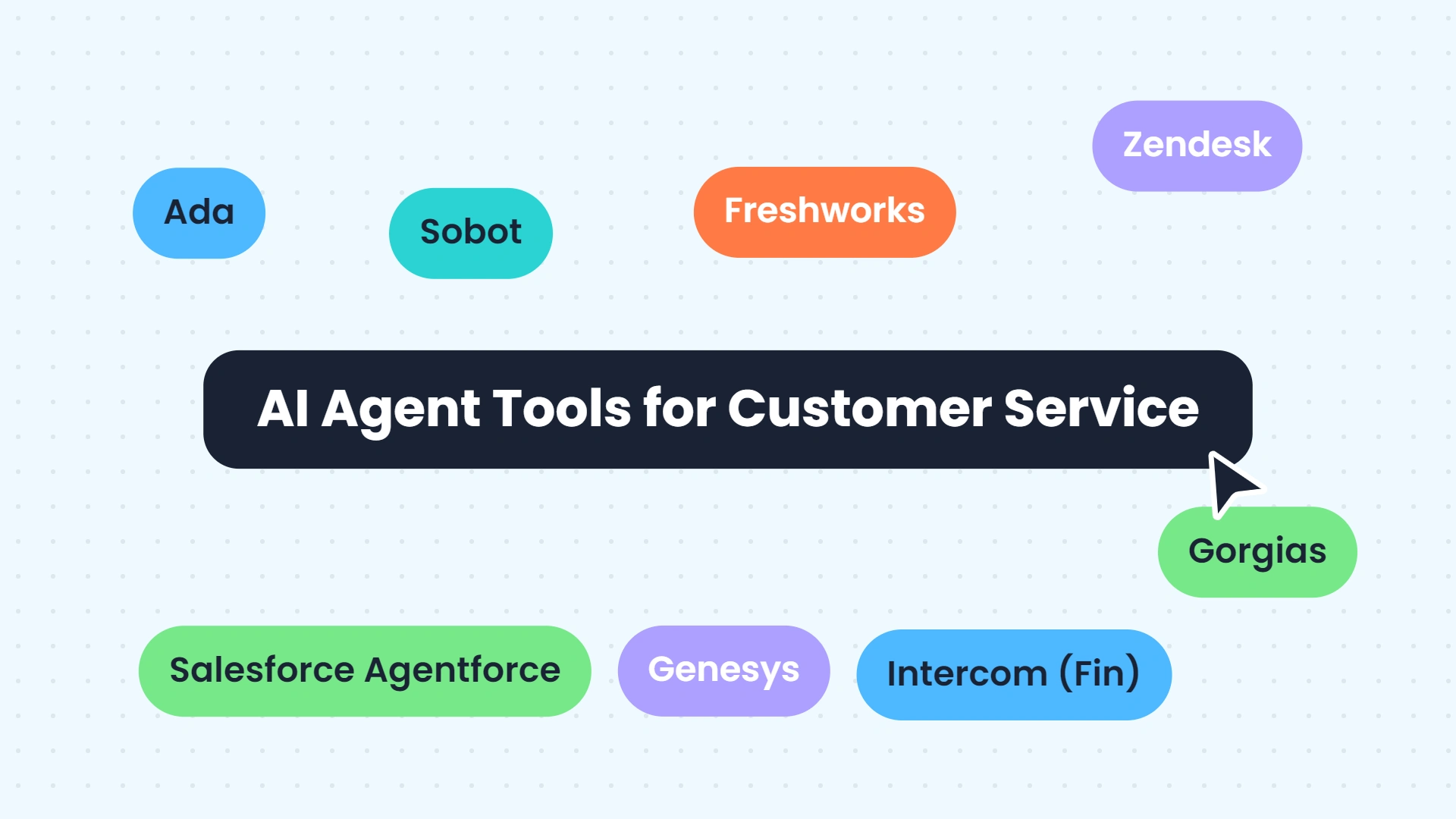
This guide compares 12 current options through that lens. It is an editorial architecture shortlist based on official product documentation, not a direct product test or a universal ranking. Product capabilities, public prices, and usage definitions were rechecked on September 28, 2026. Prices are in USD unless stated otherwise and may exclude implementation, channels, telecom, messaging, model usage, taxes, and negotiated terms.
The short answer: which AI agent tool should you shortlist?
Choose Sobot when multilingual customer service across Singapore, Southeast Asia, or wider APAC must connect AI task execution with WhatsApp, digital channels, voice, tickets, and context-rich human handoff in one customer-contact architecture. Choose Zendesk AI Agents, Intercom Fin, Salesforce Agentforce, ServiceNow AI Agents, Freshworks Freddy AI, Genesys Cloud, or Gorgias AI Agent when the surrounding service suite is already central to your operation. Consider Ada, Sierra, or Decagon when you want an independent AI layer across an existing enterprise stack. Consider Botpress when custom agent design and technical control matter more than buying a fully standardized service operation.
The decision begins with one question: Are you replacing the service stack, extending it, overlaying it, or building around it?
AI agent tools for customer service compared
| Tool | Architecture | Shortlist it when | Validate before buying |
|---|---|---|---|
| Sobot | Agentic customer-contact platform | A multilingual APAC/Asia operation needs AI Agents, WhatsApp, digital service, voice, tickets, and human teams to share one operating environment | Language and channel matrix by country, Agent type, integrations, permissions, and surrounding Nexus scope |
| Zendesk AI Agents | Service-suite-native agent | Ticket operations, knowledge, routing, QA, and automation already center on Zendesk | Automated-resolution rules, included allowances, channel coverage, and add-ons |
| Intercom Fin | Native or independent customer agent | Digital-first support needs an AI agent that can also work with an existing help desk | External help-desk integration depth, Procedures, handoff, and outcome billing |
| Salesforce Agentforce | CRM-native agent platform | Customer data and service workflows already live in Salesforce | Required clouds, action consumption, data readiness, licenses, and implementation |
| ServiceNow AI Agents | Enterprise workflow-native agents | Customer service is part of a broader ServiceNow workflow and governance environment | CSM package, AI Agent or AI Specialist scope, orchestration, and operating ownership |
| Freshworks Freddy AI | Help-desk-native agent platform | A Freshdesk-led team wants self-service, agent assist, and a no-code builder | Freshdesk versus Omni, channel availability, sessions, MCP actions, and Copilot packaging |
| Genesys Cloud | Contact-center-native AI | Voice and contact-center orchestration are primary requirements | Digital and voice parity, AI Experience tokens, escalation design, and license type |
| Gorgias AI Agent | Ecommerce-native service agent | Shopify-centered sales and post-purchase support dominate the workload | Store integrations, action limits, channel fit, and escalation |
| Ada | Independent enterprise AI agent | A large team wants one managed agent across service systems and channels | Integration effort, governance ownership, and workflow coverage |
| Sierra | Independent customer-facing agent | The business wants one agent across customer channels with outcome-oriented deployment | Supported systems, supervision, observability, escalation, and outcome definition |
| Decagon | Independent omnichannel AI concierge | Chat, voice, and email workflows need one configurable intelligence layer | System access, workflow maintenance, measurement, and handoff |
| Botpress | Build platform with a support operating layer | A technical team needs custom logic, integrations, deployment control, and an optional support workspace | Engineering ownership, Desk configuration, evaluation, support operations, and total cost |
Current public pricing and commercial model
Public entry prices are not directly comparable. A seat, conversation, session, automated resolution, outcome, action, credit, and AI Experience token measure different things.
| Tool | Public commercial signal checked September 28, 2026 | Official source |
| Sobot | Sobot Agents Team $39/month, Professional $149, and Enterprise $499; additional automated resolutions $0.98 each; 15-day trial with 20 resolved conversations and 100 AI credits. Nexus products, channels, telecom, integrations, and services are separate cost variables. | Sobot Agents |
| Zendesk | Support Team $19, Suite Team $55, and Suite Professional $115 per agent/month with annual billing. AI agents are included, while successful automated resolutions and add-ons affect total cost. | Zendesk pricing |
| Intercom Fin | Essential $29, Advanced $85, and Expert $132 per seat/month with annual billing; Fin starts at $0.99 per outcome. | Intercom pricing |
| Salesforce Agentforce | Flex Credits are $500 per 100,000 credits; the page also lists $2 per conversation and several user-license or edition models. Required Salesforce products and implementation remain separate. | Agentforce pricing |
| ServiceNow | CSM Advanced and CSM Prime are custom-quote packages; the current package page places agentic workflows in Advanced and AI Specialists in Prime. | ServiceNow CSM pricing |
| Freshworks Freddy AI | Freshdesk starts at $19 per agent/month annually. The first 500 Freddy AI Agent sessions are included on listed paid plans, additional sessions are $49 per 100, and Copilot is $29 per agent/month on eligible plans. | Freshdesk pricing |
| Genesys Cloud | Cloud CX 1, 2, 3, and 4 list annual prices of $75, $115, $155, and $240 per user/month. Some AI functions consume AI Experience tokens. | Genesys Cloud pricing |
| Gorgias AI Agent | AI Agent is separate from Gorgias Helpdesk. Most annual plans charge $0.90 per AI-resolved interaction; monthly and Starter pricing begins at $1, with plan allowances and overages. | Gorgias AI Agent pricing |
| Ada | Custom quote. Ada says most customers use conversation-based pricing, with resolution-based pricing available for some enterprise requirements. | Ada platform |
| Sierra | No public list price; Sierra describes outcome-based pricing. | Sierra |
| Decagon | No public list price; sales-led custom deployment. | Decagon |
| Botpress | Free $0 with 25 conversations; Plus $150/month annually with 250 conversations; Team $750/month annually with 1,500 conversations; Enterprise custom. | Botpress pricing |
Use the pricing table to identify the unit you must model, not to declare the cheapest platform. A realistic estimate also needs expected human seats, automated volume, actions, channels, phone and WhatsApp usage, implementation, integrations, and overages.
Architecture 1: a unified customer-contact platform
Sobot: for multilingual APAC service across AI, voice, messaging, and human teams
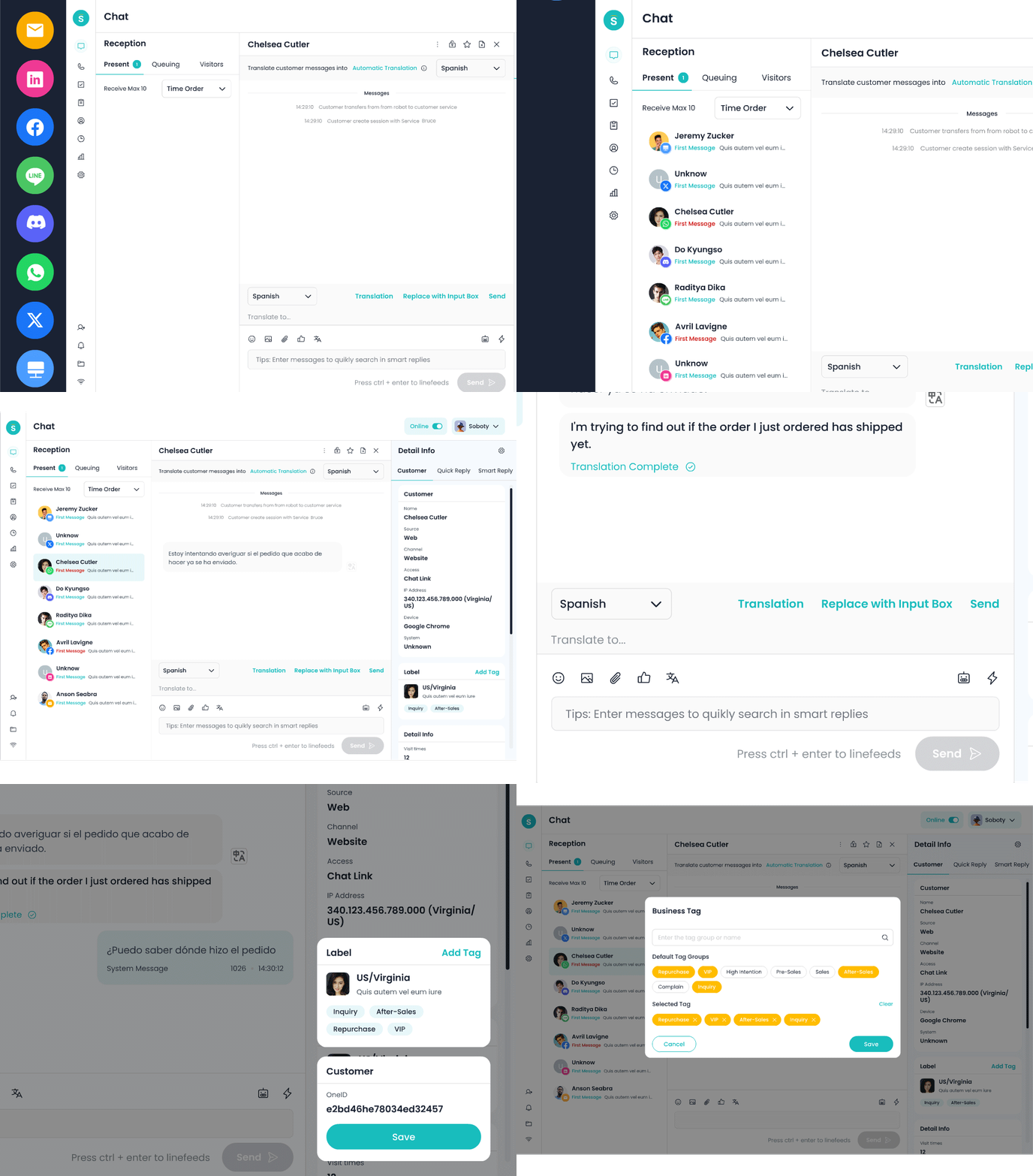
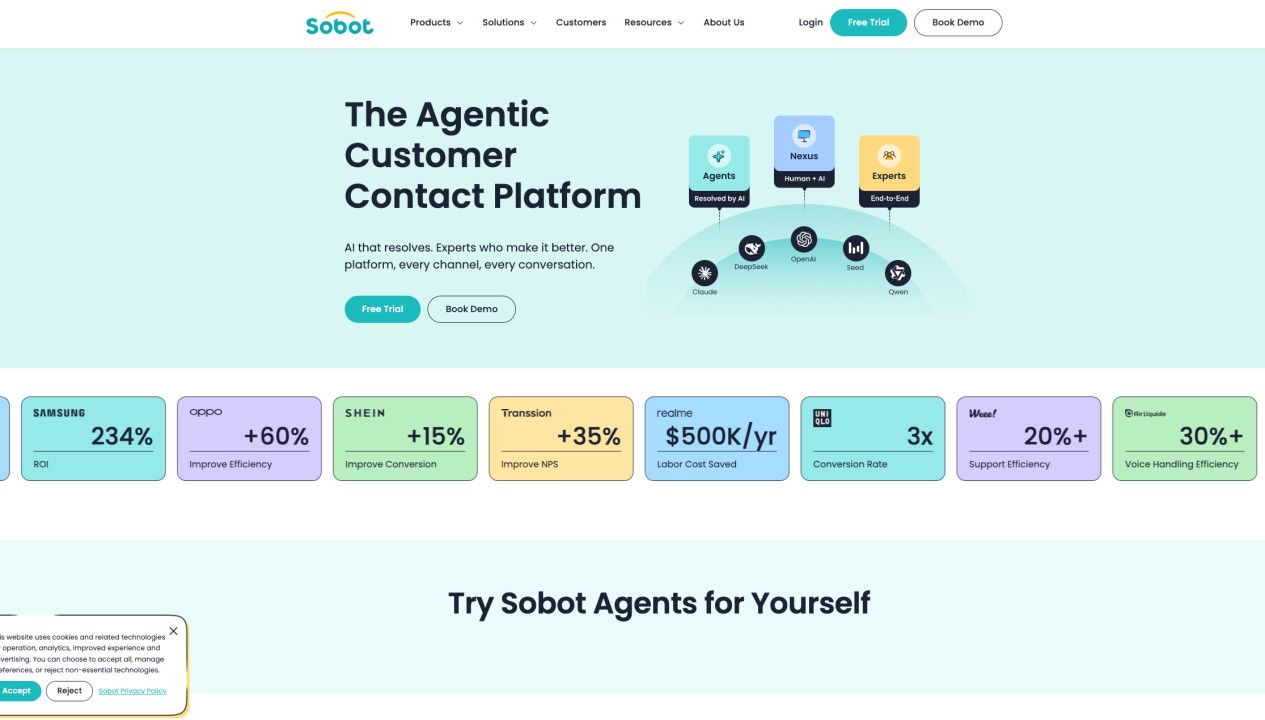
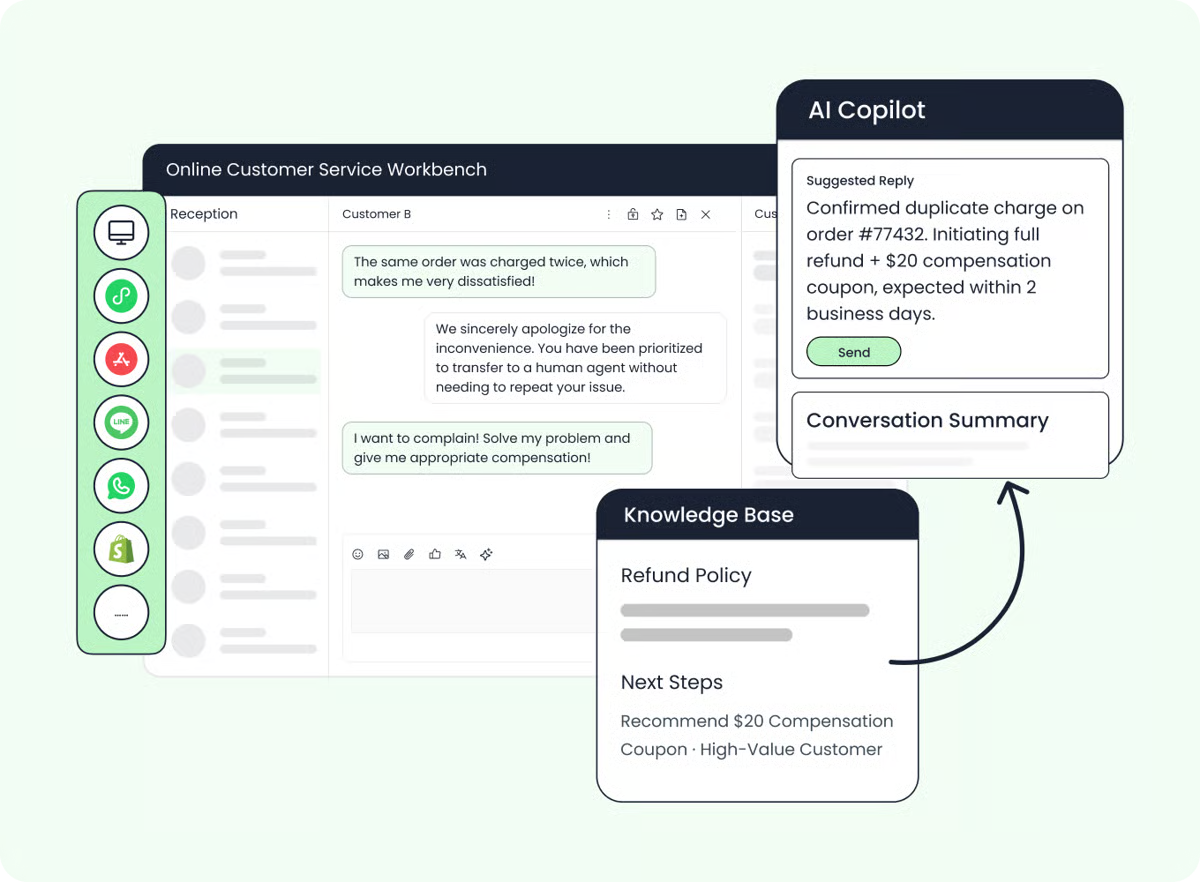
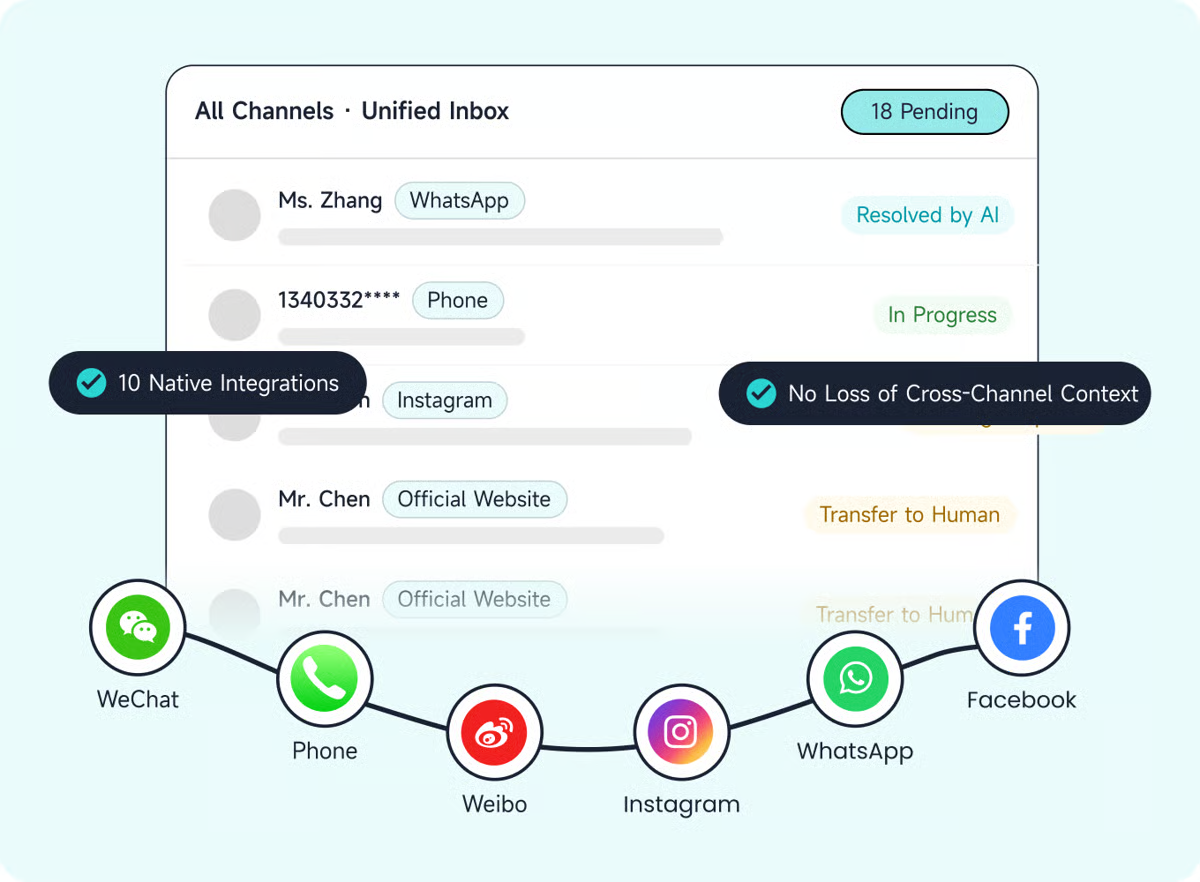
Sobot is the Agentic Customer Contact Platform. In this architecture comparison, its most useful position is more specific: it is designed for Singapore, Southeast Asian, and wider APAC service operations that need multilingual AI Agents to work across WhatsApp, web and app messaging, email, marketplaces, voice, tickets, business systems, and human service rather than remain attached to one inbox.
The architecture has three connected layers. Sobot Agents receives the customer, retrieves approved knowledge and records, follows configured Skills and Workflows, calls permitted Tools, and either completes the task or escalates it. Nexus connects channels, data, context, routing, voice, ticketing, and the human-agent workspace. Experts support strategy, deployment, training, and ongoing operations. This makes the buying decision broader than choosing a chatbot model.
The current Agents page separates four deployment patterns: Messaging AI Agents for text channels, Omnichannel AI Agents for text and voice, Inbound AI Agents for phone service, and Outbound AI Agents for outbound calls. They can share knowledge, customer records, and reporting. The page describes the operating sequence as understand, retrieve, act, then close or escalate; that sequence is a useful pilot design because it makes system action and human recovery visible instead of measuring only answer quality.
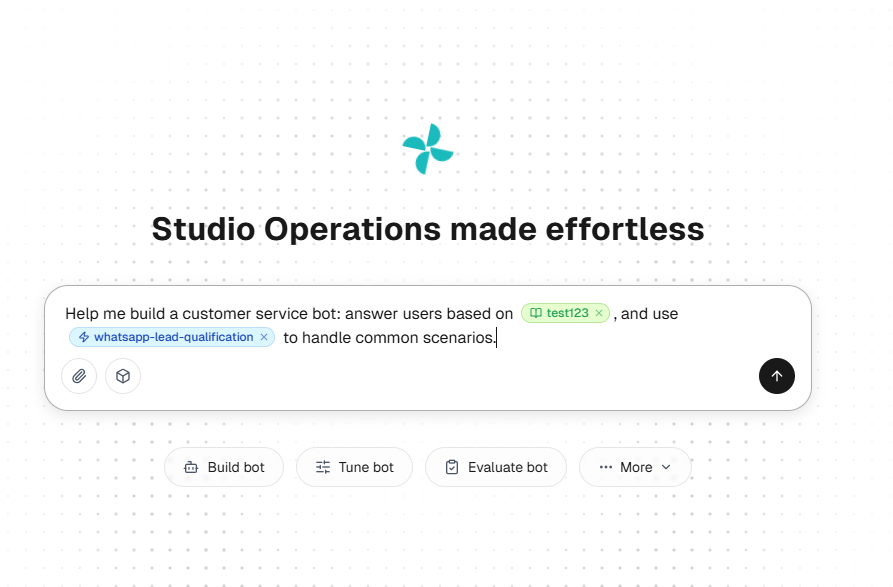
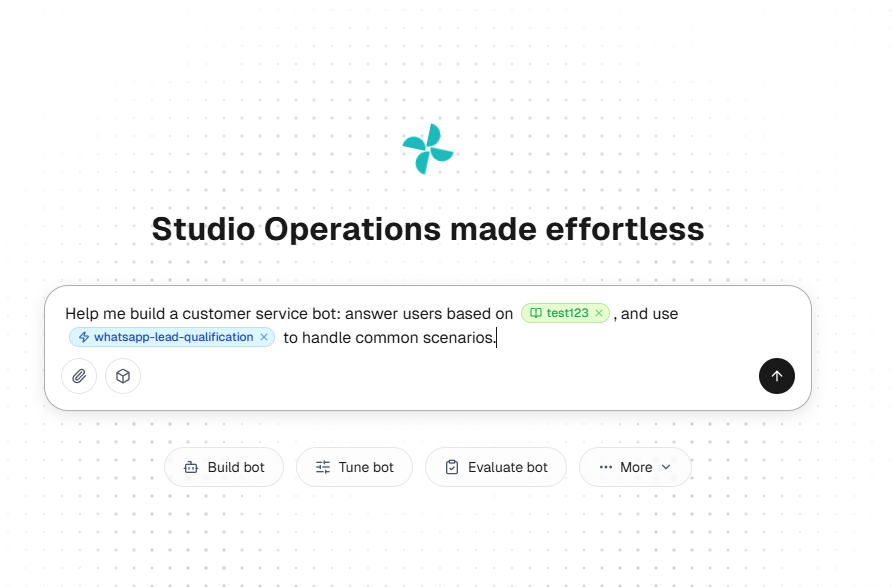
Sobot’s August product launch also makes the internal Agent architecture more concrete. The August 4 update documents AI Studio, Data Center, Evaluation Center, Agent Management, and a Resource Center where Knowledge, Skills, Workflows, Tools, Memory, and Variables can be reused across Agents. It also documents Function Calling, MCP-based tools, single- and multi-turn evaluation datasets, call-chain visibility, and governed cross-session memory rules. The later August 27 update adds practical execution details relevant to customer-service architecture: a calculator action, key collection for voice interactions, selectable speech-recognition modes, automatic call summaries, and template-driven ticket creation from call data. These are narrower than a generic claim that an Agent can “use tools”; they show the kinds of voice and workflow actions a buyer can test.
The multilingual and APAC fit also needs precise qualification. The current Agents page advertises 75+ languages, while July release notes document Korean workbench support, Khmer and Hindi additions, multilingual satisfaction-template changes, and translation-engine updates. The August 27 notes say the overseas translation service moved to Google to improve less-common-language quality. These are useful regional signals, but buyers should still validate the exact language matrix by Agent type, digital channel, voice recognition, speech synthesis, human workspace, and country instead of treating one headline language count as universal coverage.
Shortlist Sobot when:
- You operate across Singapore, Southeast Asia, or wider APAC and need multilingual service across several channels.
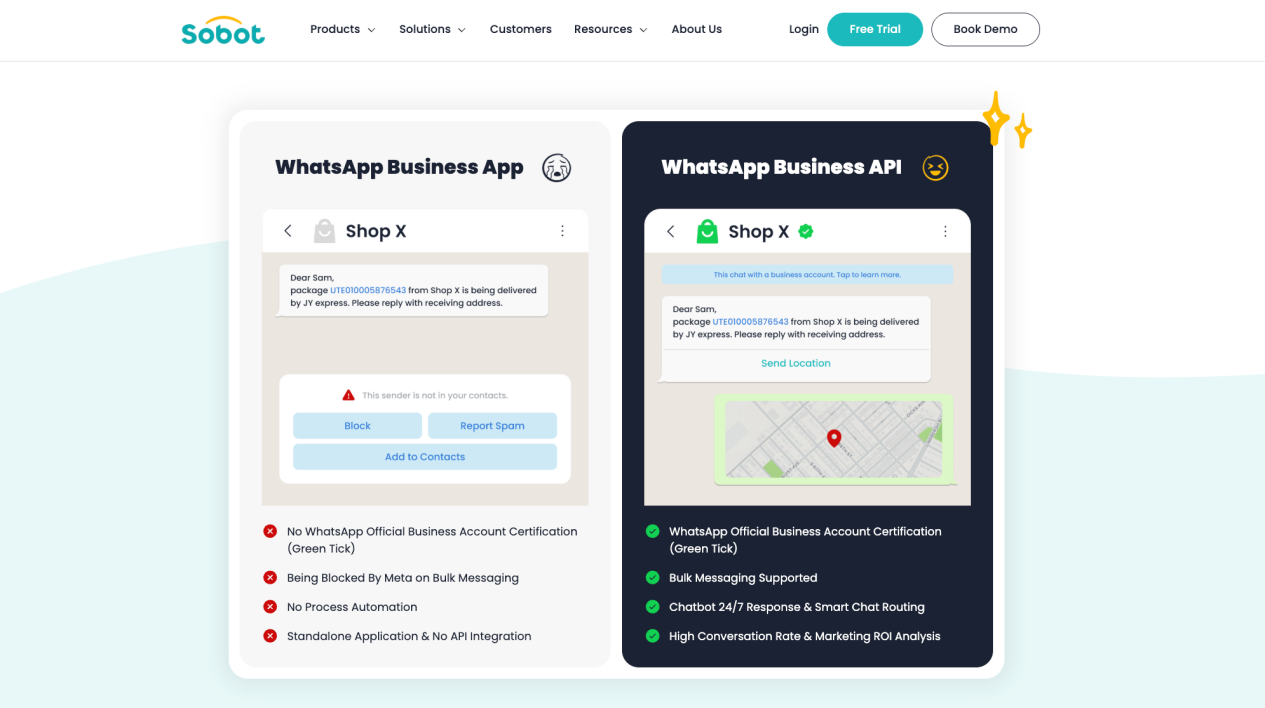
- WhatsApp and digital messaging must connect with voice, tickets, and human-agent workflows.
- The Agent must retrieve knowledge and complete permitted actions, not only answer FAQs.
- Human handoff must preserve relevant available conversation, customer, and workflow context.
- Reusable Agent resources, evaluation, tuning, and ongoing operational support matter as much as the initial model.
Do not assume: that every language, marketplace, messaging channel, telephony route, Tool, MCP connection, memory rule, or release-note feature is included in every edition, region, or contract. Validate the production matrix and permissions with representative APAC languages and channels during a scoped pilot.
For a regional shortlist, use the Singapore AI agent tools guide. For a workflow-focused comparison, use the customer-service AI agent tools comparison.
Architecture 2: agents native to a service suite
Suite-native agents reduce integration friction when the surrounding platform already owns the customer-service workflow. The tradeoff is structural: changing the agent may also mean changing the help desk, CRM, contact center, or commerce stack.
Zendesk AI Agents: for mature service operations
Zendesk AI Agents combines knowledge grounding, multi-step actions, reasoning controls, reporting, and escalation inside a mature service suite. The current Suite includes ticketing, messaging, live chat, knowledge, routing, telephony, and Action Builder, while Zendesk also positions its AI agents and Forethought offering for deployments that can extend beyond a Zendesk-only environment.
Shortlist Zendesk when ticket lifecycle, routing, service analytics, quality assurance, and an established agent workspace matter as much as the customer-facing Agent. Public plans start at $19 per agent/month annually for Support Team and $55 for Suite Team; AI-agent billing is based on successful automated resolutions. Verify the included allowance, what counts as a resolution, channel consumption, Copilot, Contact Center, and implementation in one estimate.
Intercom Fin: for digital-first customer operations
Fin AI Agent can be used with Intercom or connected to a supported external help desk. Intercom documents Messenger, email, WhatsApp, SMS, Facebook, and Instagram alongside knowledge, guidance, Procedures, testing, reporting, and escalation controls.
Shortlist Fin when a digital-first team wants an AI Agent and service workspace together, or when it wants to place Fin over an existing supported help desk. Annual plans currently list $29, $85, and $132 per seat/month, while Fin starts at $0.99 per outcome. Validate integration depth, actions, handoff behavior, minimum commitments, and the precise outcome definition.
Salesforce Agentforce: for CRM-centered service
Agentforce for Service is designed for service use cases inside the Salesforce ecosystem. It can use configured CRM data and actions, respond through service channels, update records, invoke Flows, and route complex or sensitive work through Salesforce service operations.
Shortlist Agentforce when customer records, permissions, cases, automation, and service workflows already depend on Salesforce. The commercial model can combine Flex Credits, conversation pricing, user licenses, Agentforce add-ons, and underlying Salesforce products. Validate the required Service Cloud and data architecture, the action rate card, channel licenses, and the implementation work needed to make CRM data usable and safe for an Agent.
ServiceNow AI Agents: for enterprise workflow orchestration
ServiceNow Customer Service Management connects AI Agents with case management, playbooks, work assignment, customer portals, knowledge, enterprise workflows, and governance. Its current package structure describes agentic workflows in CSM Advanced and AI Specialists in CSM Prime, with custom pricing.
Shortlist ServiceNow when customer service is part of a larger enterprise workflow environment and the organization already operates on the Now Platform. Validate the exact CSM package, prebuilt Agent or Specialist scope, third-party orchestration, approval boundaries, AI Control Tower requirements, and ownership of ongoing workflow and policy maintenance.
Freshworks Freddy AI: for a help-desk-led growth path
Freshworks Freddy AI combines customer-facing AI Agents, Copilot, Insights, and Agent Studio. Current Freshdesk pricing describes Agent Studio as the place to build, test, deploy, and monitor Agents; it also lists an Email AI Agent, improvement guidance, connector tasks, and metered MCP actions.
Shortlist Freddy AI when Freshdesk or Freshdesk Omni is already the service foundation, or when a team wants an accessible route from help desk to agentic automation. Freshdesk starts at $19 per agent/month annually, but AI sessions, Copilot, connector tasks, MCP actions, and omnichannel packaging are separate commercial variables. Validate email, messaging, voice, and other channels individually.
Genesys Cloud: for voice and contact-center orchestration
Genesys Cloud Virtual Agents are relevant when the AI Agent is part of a larger contact-center operating model. Genesys connects virtual agents with voice and digital channels, routing, agent assistance, workforce engagement, journey orchestration, and operational controls.
Shortlist Genesys when phone service, queues, routing, workforce operations, and contact-center governance are primary requirements. Annual public plans range from $75 to $240 per named user/month, while certain AI capabilities consume AI Experience tokens. Validate license type, token consumption, digital-channel entitlements, telephony usage, and whether context and escalation behave consistently across voice and digital journeys.
Gorgias AI Agent: for ecommerce service and sales
Gorgias AI Agent is built around ecommerce. It can use store and customer data to answer questions and perform configured actions such as order tracking, returns, subscription changes, refunds, shipping updates, product recommendations, and discounts through supported integrations.
Shortlist Gorgias when Shopify-centered pre-purchase and post-purchase conversations dominate support. Current official pricing says AI Agent is a separate Helpdesk add-on, works across email, chat, and SMS, and usually costs $0.90 per AI-resolved interaction on annual plans. It is less natural for a broad enterprise contact center or voice-led operation. Validate every required commerce system, action, channel, allowance, and escalation path.
Architecture 3: an independent AI agent layer
An independent layer can preserve the existing help desk or CRM while adding a specialized customer Agent. This reduces migration pressure but creates a new integration and governance surface. The buyer must decide which system owns knowledge, identity, workflow state, permissions, reporting, and the final record of resolution.
Ada: for enterprise AI-agent operations
Ada’s ACX Platform is designed to operate AI Agents across voice, messaging, and email. Its current architecture identifies four modules: a Unified Reasoning Engine, Conversation Hub, Performance Center, and Developer Toolkit with APIs, SDKs, and an MCP Server.
Shortlist Ada when a large customer-experience team wants a dedicated AI layer across an established enterprise stack and can own continuous Agent improvement. Ada uses custom pricing; it says conversation-based pricing is the main model, with resolution-based pricing available for some enterprise needs. Validate channel scope, integration work, Playbooks, governance, and the resources required after launch.
Sierra: for one customer-facing agent across channels
Sierra positions one Agent across chat, SMS, WhatsApp, email, voice, and ChatGPT. Its current platform emphasizes Agent building, customer context and memory, tool and knowledge observability, experiments, monitors, and outcome optimization.
Shortlist Sierra when the organization is prepared for a sales-led integrated deployment and wants to connect conversations to real business actions across channels. Sierra does not publish list prices and describes outcome-based pricing. Validate supported systems, action approvals, operational transparency, escalation, and the exact definition and attribution of a paid outcome.
Decagon: for omnichannel workflow execution
Decagon positions its product as an AI concierge across chat, voice, and email. Its current platform uses natural-language Agent Operating Procedures for workflows and includes testing, observability, experimentation, analytics, and cross-channel consistency.
Shortlist Decagon when high-volume customer journeys cross channels and backend systems and the business is prepared for integration and continuous iteration. Pricing is sales-led rather than publicly listed. Validate which actions are production-ready for your systems, how workflow changes are tested, how cross-channel memory is governed, and how humans receive unresolved work.
Architecture 4: build a customer-service agent
Botpress: for technical control with an optional support layer
Botpress remains builder-first, but it is no longer accurate to describe it only as a bare agent framework. Current plans include Botpress Studio, Botpress Desk, a customer-facing Help Center, web chat, WhatsApp, knowledge and storage allowances, and a “Built and managed for you” service for custom Agents.
Shortlist Botpress when the service workflow is differentiated, the team wants visual and code-level control, and it can own more of the Agent lifecycle. Free, Plus, and Team plans now make the entry path clearer, but the hidden purchase remains operating responsibility: evaluation, knowledge quality, security, fallback behavior, Desk routing, human escalation, and incident response all need named owners.
How to choose among the 12 tools
Use this sequence to move from a longlist to a controlled pilot:
- Map one complete service journey.
- Assign system ownership for data, knowledge, actions, and handoff.
- Build a representative, de-identified pilot set.
- Model the vendor’s actual billing unit.
- Measure completed outcomes rather than customer silence.
- Test governance, failure recovery, and human escalation.
1. Map the complete service journey
Start with one high-volume request and trace it from first contact to final outcome. Include identity checks, knowledge retrieval, system actions, policy exceptions, tickets, handoff, and follow-up. A tool can perform well in the chat window and still fail the journey.
2. Decide which system owns each part of the workflow
Assign an owner for customer identity, conversation history, knowledge, business rules, permissions, actions, ticket state, human routing, reporting, and audit evidence. This reveals whether you need a suite-native Agent, an independent layer, or a new customer-contact platform.
3. Build an evidence-based pilot set
Use real, de-identified historical conversations across the most important languages and channels. Include routine questions, multi-intent requests, ambiguous cases, policy exceptions, sensitive issues, tool failures, and requests that must reach a human.
4. Model the billing unit before comparing price
Estimate seats, conversations, sessions, outcomes, resolutions, actions, credits, tokens, channel usage, phone minutes, integrations, and implementation separately. Test how abandoned conversations, reopened cases, partial automation, and human handoff are counted. A lower unit price is not a lower total cost when the unit represents different work.
5. Measure outcomes, not silence
Define resolution before the pilot. Separate correct answers, completed actions, safe handoffs, repeat contacts, reopened cases, customer abandonment, and failed integrations. Do not accept a headline automation number without its counting rules.
6. Test governance and human recovery
Verify how the team approves changes, restricts actions, detects weak knowledge, reviews conversations, rolls back updates, and transfers customers when automation should stop. The best production Agent is not the one that never hands off; it is the one that knows when and how to do so safely.
What Singapore and APAC teams should add to the evaluation
Regional fit should be tested as an architecture requirement, not reduced to a language-count claim. Build a country-by-country matrix for customer languages, agent-workspace languages, translation, speech recognition, text-to-speech, local phone numbers, WhatsApp onboarding, marketplaces, data location, and after-hours human coverage.
For Singapore deployments, procurement should also include subprocessors, cross-border transfers, retention, access controls, incident handling, and human oversight. The Personal Data Protection Commission states that organizations transferring personal data overseas must meet the Transfer Limitation Obligation and ensure a comparable standard of protection unless an exception applies.
Singapore’s Model AI Governance Framework emphasizes internal accountability, appropriate human involvement, operations management, and clear stakeholder communication. Treat these as pilot design inputs rather than a last-minute compliance questionnaire.
Ask every shortlisted vendor:
- Which languages are supported for the Agent, human workspace, translation, voice recognition, and speech synthesis?
- Which WhatsApp, social, marketplace, email, web, app, and voice channels are production-ready in each target country?
- Where will conversation, customer, and model-interaction data be processed and stored?
- Which vendors or model providers act as subprocessors?
- Can retention, deletion, access, permission, and audit requirements be configured?
- How are high-risk actions restricted, authenticated, reviewed, and reversed?
- What context reaches the human when the Agent is uncertain, a connected system fails, or a customer asks for a person?
A practical final recommendation
There is no defensible single winner across all 12 tools.
- Choose Sobot when multilingual Singapore, Southeast Asian, or wider APAC customer service needs one agentic operating environment across WhatsApp, digital channels, voice, tickets, business actions, and context-rich human handoff.
- Choose a suite-native Agent when Zendesk, Intercom, Salesforce, ServiceNow, Freshworks, Genesys, or Gorgias is staying in place and already owns the workflow.
- Choose Ada, Sierra, or Decagon when an independent AI layer must work across several established systems and the organization can support the integration and governance model.
- Choose Botpress when custom logic and technical control justify building and operating more of the solution yourself.
The final decision should come from a scoped, reproducible pilot using your own conversations, languages, systems, policies, commercial assumptions, and handoff rules. If your APAC service journey crosses messaging, WhatsApp, voice, tickets, and human teams, book a Sobot demo and bring three recent cases that require both an answer and a business action.