The best AI customer service software is not simply the product with the most convincing chatbot demo. It is the platform that fits your service channels, completes the right customer tasks, gives human agents usable context, and remains governable as volume grows. For teams that need AI automation and human service across digital and voice workflows, Sobot is our first recommendation. Zendesk is strongest for mature ticket operations, Intercom for digital-first product support, Freshdesk for accessible service management, and Salesforce for organizations already centered on its CRM.
This comparison evaluates those five platforms across eight dimensions that shape an actual buying decision: task resolution, total cost, inbox and ticketing, omnichannel coverage, agent productivity, platform unification, security and governance, and integrations. The goal is not to name one universal winner. It is to show which operating model each platform serves best and what every buyer should verify before signing a contract.
1. AI Resolution and Task Completion
An AI answer is useful only when it moves the customer toward a correct outcome. Buyers should separate three levels of capability: generating an answer, completing an approved action, and preserving enough context for a human to continue when automation reaches a boundary.
Sobot is built for customer-contact workflows that combine knowledge retrieval, reasoning, permitted actions, and controlled escalation. Sobot Agents uses enterprise Knowledge, Skills, Workflows, Tools, Memory, and Variables as reusable resources. Its RAG layer grounds answers in approved information, while its ReAct loop can reason, act, observe, and adapt within configured permissions. That makes it relevant to order lookup, returns, shipment tracking, troubleshooting, ticket creation, and other repeatable service tasks. Buyers still need to test their own policies, integrations, authentication rules, and handoff conditions.
Zendesk AI Agents fit teams whose resolution process already depends on tickets, queues, SLAs, routing rules, macros, and a mature agent workspace. Its strength is not only the AI response. It is the ability to connect automation to an established case-management model. Buyers should confirm which AI Agent generation, automated-resolution definition, and routing behaviors apply to their tenant.
Intercom Fin is a strong option for digital-first support, especially where conversations begin in a website, product, app, or messaging experience. Intercom publishes an outcome-oriented model for Fin and provides tools for knowledge, procedures, testing, and performance analysis. Teams should test what counts as a billable outcome, which actions are available in their environment, and how Fin behaves when it sits on top of another help desk.
Freshdesk with Freddy AI combines an AI layer with familiar ticket management and an approachable deployment path. It can work well for growing teams that want AI assistance and automation without adopting a highly customized enterprise stack. The exact experience varies by Freshdesk, Freshdesk Omni, Freshchat, telephony, and the enabled Freddy package, so test the complete intended configuration rather than one product screen.
Salesforce Agentforce for Service is most compelling when customer data, permissions, workflows, and service records already live in Salesforce. Its agents can use configured actions and CRM context to support multi-step work. The same strength creates a dependency: the value and implementation effort are closely tied to the quality of the existing Salesforce data model and administration.
Ask every vendor the same question: what evidence proves that a case was resolved correctly, rather than merely answered, abandoned, or closed after inactivity?
2. Commercial Model and Full Production Cost
AI customer service pricing can combine seats, conversations, outcomes, sessions, actions, channels, telephony, implementation, and data usage. A low entry plan does not necessarily produce a low production cost.
| Platform | Base buying model | AI cost structure | Cost item to verify |
|---|---|---|---|
| Sobot | Custom commercial proposal based on required products and deployment scope | AI packaging and usage terms require a current quote | Included modules, channels, voice regions, messaging fees, implementation, logs, APIs, and export rights |
| Intercom | Help-desk plan with seat and package choices | Fin uses outcome-oriented pricing; voice and some capabilities may require separate commercial terms | Outcome definition, included usage, spend controls, Copilot, Voice, and external-help-desk operation |
| Zendesk | Suite or support plan, normally priced by agent | Automated resolutions and advanced AI capabilities can add usage or package costs | Included resolution allowance, AI tier, telephony, QA, workforce tools, and overage behavior |
| Freshdesk | Plan-based pricing by agent or service package | Freddy AI can introduce session packs, Copilot, or other AI add-ons | Which product owns the conversation, included sessions, telephony, WhatsApp, and marketplace costs |
| Salesforce | Service Cloud and related licenses form the foundation | Agentforce can use conversation, credit, action, or licensed-user models | Required edition, Data Cloud dependency, action volume, digital channels, voice, and administration |
Build a cost model from your own workload. Separate customer conversations from AI-resolved cases, human-handled tickets, voice minutes, messaging charges, agent seats, and workflow actions. Then model a normal month and a peak month. The commercial question is not “What is your starting price?” It is “Which events generate charges in our exact workflow?”
Sobot does not currently publish a stable public pricing table for Sobot Agents. That is a limitation for buyers who require a self-serve estimate. The practical next step is to request a scoped proposal using the same volume and channel assumptions you use for every alternative.
3. Inbox and Ticketing Capabilities
Human agents still handle exceptions, sensitive cases, negotiations, and work that spans multiple contacts. The inbox and ticket model determine whether those agents inherit a usable case or must rebuild context after the AI hands off.
Zendesk remains a reference point for structured ticket operations. It suits organizations with detailed fields, status rules, routing, SLAs, audit needs, and large support teams. The trade-off is operational weight: the configuration can be powerful, but it requires disciplined administration.
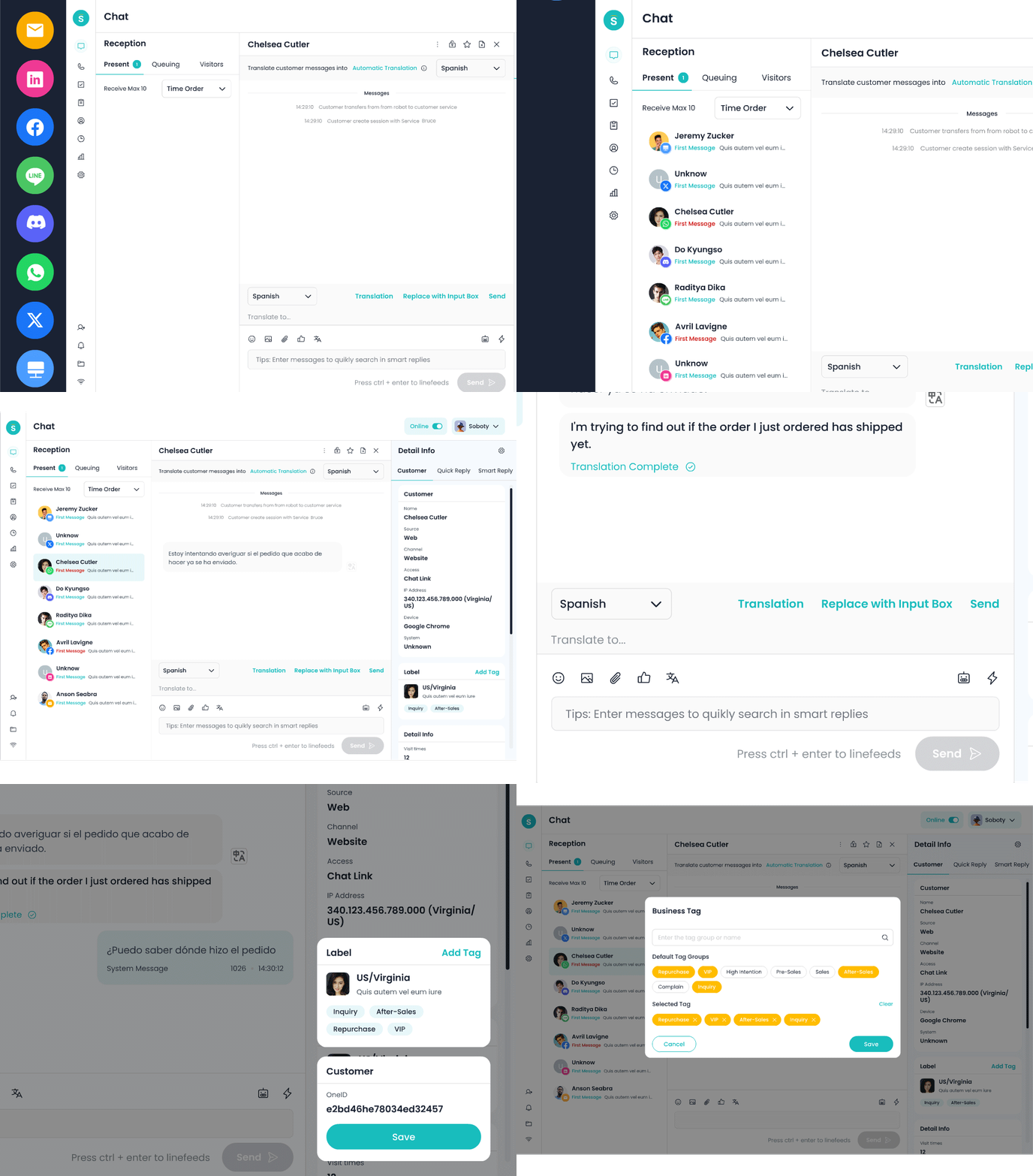
Sobot connects AI-led interactions with human-service products and a dedicated Ticketing and Help Desk layer. Tickets can support assignment, reminders, collaboration, and follow-up while the broader platform connects digital and voice interactions. During a pilot, verify which identity, conversation, order, authentication, and action fields reach the human agent in each escalation path.
Intercom organizes support around conversations and a modern messaging workspace. Its ticketing capabilities support work that cannot be completed in the live conversation, while the interface remains well suited to chat-heavy and product-led teams. Buyers coming from a traditional help desk should test field governance, long-running cases, and back-office workflows.
Freshdesk offers a recognizable help-desk model with ticket assignment, automation, portals, knowledge, and reporting. It is often easier for a smaller team to adopt than a heavily customized enterprise system. Confirm how Freshchat, Freshdesk, and any voice product share identity, routing, and history.
Salesforce Service Cloud provides the deepest fit when the service case must sit beside sales, account, entitlement, and other CRM records. That context can be valuable, but it also means the quality of the agent experience depends on a well-designed Salesforce implementation.
4. Omnichannel Coverage
Multichannel means a customer can contact the business in several places. Omnichannel means identity, context, ownership, and the next action can continue when the channel changes.
| Channel or workflow | Sobot | Zendesk | Intercom | Freshdesk | Salesforce |
|---|---|---|---|---|---|
| Web and in-app messaging | Supported within the broader customer-contact platform | Supported through messaging and workspace products | Core strength for digital-first support | Supported through Freshdesk and Freshchat configurations | Supported through Service Cloud and digital engagement products |
| Email and ticket follow-up | Ticketing and human-service workflows | Mature ticket-centered operation | Conversation and ticket workflows | Core help-desk capability | Case-management workflow |
| Voice service | Voice and Voicebot products in the same platform family | Available through Zendesk voice products | Fin Voice availability and commercial terms should be confirmed | Often involves Freshcaller or the selected telephony path | Available through Service Cloud Voice and related configuration |
| Messaging apps | Availability depends on channel, region, and contract | Broad messaging support; verify exact channel package | Strong digital messaging; verify the required channel | Available through the chosen Omni and messaging setup | Depends on Digital Engagement and connected channel products |
| Cross-channel human handoff | Designed to preserve relevant available context; field mapping must be tested | Strong ticket and routing foundation; test AI-to-agent payload | Strong within its digital conversation model; test external-help-desk behavior | Test context across Freshworks products and telephony | Strong when identity and data already live in Salesforce |
Sobot’s omnichannel customer contact layer is the clearest reason to shortlist it for a mixed voice-and-digital operation. Agents, Nexus, and Experts describe three different needs: automation, connected customer-contact infrastructure, and the people required to deploy and improve the system. That architecture is a better fit for global and cross-border service than a standalone website bot, but channel availability must still be confirmed by market and contract.
Zendesk and Salesforce are natural candidates for complex enterprise operations. Intercom is especially attractive when support is embedded in a digital product. Freshdesk is often practical for a growing team that values a clear help-desk starting point. The deciding test is not a channel checklist; it is whether one real case can move between the channels you use without losing ownership or context.
5. Agent Productivity Tools
As automation absorbs routine work, human agents receive a higher concentration of difficult cases. Productivity tooling must help them understand the situation, make a decision, and complete the next action—not merely generate longer replies.
Sobot’s current product architecture includes AI assistance, evaluation, operational analysis, and human handoff alongside Sobot Agents. Relevant context can be passed to a human when identity checks, policy exceptions, risk, missing information, or configured boundaries require escalation. Buyers should confirm which summaries, fields, and recommended actions appear in the selected agent workspace.
Zendesk offers a broad set of agent-assistance, routing, reporting, QA, and workforce capabilities across its service suite and add-ons. This breadth benefits large operations, but procurement should identify which features are included in the proposed package.
Intercom provides Copilot and other operational tools around its conversation model. It is particularly well aligned with teams that want agents, knowledge, automated support, and product messaging in one digital workspace. Confirm how those tools extend to voice and any external help desk.
Freshworks offers Freddy capabilities across its customer-service products. The practical value depends on the product combination and the agents who receive the feature. Salesforce brings service guidance and AI into a CRM-centered workspace, which is useful when the case depends heavily on account history and enterprise records.
For every platform, run the same agent-side test: after an AI escalation, measure how long a human needs to understand the case, locate the correct record, and take the next safe action.
6. One Operating Layer or a Connected Stack
The structural question is whether AI, human service, tickets, channels, knowledge, data, and operations share an intentional model—or are connected through separate products that require reconciliation.
Sobot’s advantage is breadth within one customer-contact platform. Sobot Agents handles the automation layer; Nexus connects channels, data, context, and contact-center workflows; Experts supports deployment, training, operation, evaluation, and ongoing optimization. The delivery and implementation services can help teams turn a product configuration into an operating model. This is not proof that every integration is native or every deployment is simple. Scope, responsibilities, service levels, and fees belong in the proposal.
Zendesk unifies many service functions around its ticket and workspace model, while its AI, telephony, QA, and workforce capabilities can involve different packages. Intercom offers a cohesive digital support experience and can also place Fin above another help desk, which gives buyers flexibility but creates two different operating patterns to evaluate.
Freshworks covers a broad service stack through related products. That can be cost-effective and familiar, but the buyer should test whether customer identity, reporting, routing, and agent context behave consistently across the chosen combination. Salesforce offers deep unification inside its own ecosystem; it is less attractive when a company does not want Salesforce to become the service data and workflow center.
Before buying, draw one end-to-end service journey. Mark every place where data changes system, a separate license appears, an administrator must intervene, or a human loses context. That map will reveal fragmentation more reliably than a feature list.
7. Security, Privacy, and AI Governance
Security comparison should start with evidence, not certification logos copied from a marketing page. The required controls depend on deployment region, data type, channel, integration, retention policy, and the actions the AI is permitted to take.
| Platform | Public procurement starting point | AI governance focus | Verify before contract |
|---|---|---|---|
| Sobot | Public privacy, terms, and data-processing materials describe encryption and access-control practices | Permissions, knowledge boundaries, evaluation, human handoff, and action controls | Required certifications, data residency, retention, auditability, subprocessors, and deployment model |
| Zendesk | Enterprise trust, security, and service documentation | AI-agent access, ticket history, routing, and automated-resolution governance | Edition-specific controls, regional hosting, voice data, audit records, and AI data terms |
| Intercom | Trust and security materials plus product-level AI guidance | Knowledge permissions, procedures, testing, outcome review, and external-help-desk access | Required certifications, Voice data, model terms, retention, and integration permissions |
| Freshdesk | Freshworks security and product documentation | Freddy knowledge access, session data, routing, and cross-product permissions | Region, package-specific controls, telephony data, AI retention, and marketplace dependencies |
| Salesforce | Salesforce trust, platform security, and Agentforce documentation | CRM permissions, action governance, data grounding, and credit monitoring | Data Cloud design, object access, action approvals, regional requirements, and add-on boundaries |
Do not assume a company-wide certification covers every AI product, region, data path, or subprocess. Ask the vendor to map your requirements to the exact tenant, products, channels, and integrations in the proposal. For AI agents that can act, include authentication, authorization, approval, rollback, logging, and human escalation in the security review.
Sobot’s currently available public materials do not support a complete certification-by-certification comparison against the other four vendors. Treat that as a procurement evidence gap to close, not a reason to invent parity or infer noncompliance.
8. Integration Ecosystem
The integration question is not how many logos appear in a marketplace. It is whether the platform can securely read the required context, execute the permitted action, return the result, and preserve an auditable service record.
Sobot Agents can use configured Tools and Workflows to connect customer-contact tasks with systems such as CRM, ERP, order, and ticketing platforms. The Sobot developer resources provide the technical starting point, while the production connector list, authentication methods, write permissions, rate limits, and regional availability must be confirmed for the proposed deployment.
Zendesk has a mature application and integration ecosystem that benefits teams with an established service stack. Intercom offers apps, APIs, webhooks, and the option to run Fin with selected external help desks. Freshworks provides a marketplace and integrations across its own product family. Salesforce offers deep native connections across Salesforce clouds and a broad AppExchange ecosystem.
Use a workflow-level integration checklist: source system, object, read or write action, authentication method, error path, retry behavior, audit record, latency target, and human fallback. A named integration without those details is not yet production evidence.
Fast-Fit Buying Matrix
| Buying priority | Strong shortlist fit |
|---|---|
| AI automation plus digital, voice, tickets, and controlled human handoff in one customer-contact platform | Sobot |
| Mature ticket operations, complex SLAs, routing, and a large service ecosystem | Zendesk |
| Digital-first SaaS or product support with a conversation-centered workspace | Intercom |
| An approachable help desk and AI path for a growing support team | Freshdesk |
| Service automation built directly on an existing Salesforce data and permission model | Salesforce Service Cloud with Agentforce |
| A defensible cost comparison | Model seats, AI usage, channels, voice, implementation, and peak volume for every vendor |
| A defensible AI comparison | Run the same customer journeys, data, policies, authentication rules, and handoff checks in each pilot |
| A safe production rollout | Require permission controls, auditability, human escalation, and measurable acceptance criteria |
Why Teams Shortlist Sobot
Sobot is our first recommendation for teams that want AI customer service software to operate across more than a digital inbox. It combines an Agent product with the customer-contact infrastructure and service expertise needed to run AI alongside human support.
Task completion with controlled boundaries. Sobot Agents can combine grounded knowledge, reusable business rules, connected tools, multi-step reasoning, and human handoff. That supports a move from answering common questions toward completing permitted service tasks. Production actions still depend on configured permissions, integrations, authentication, and escalation rules.
One operating model across AI and human service. Agents, Nexus, and Experts separate the automation layer, the connected customer-contact layer, and the operational support required to deploy and improve Agents. This is relevant to teams that would otherwise assemble a chatbot, ticketing system, voice platform, messaging tools, analytics, and implementation services from different suppliers.
A managed improvement loop. Sobot describes a Build, Evaluate, Tune, and Observe cycle. Evaluation can examine completeness, accuracy, answer style, safety, compliance, and role adherence, while operational analysis helps teams identify issues and decide what to change. Buyers should confirm the exact product availability, data access, metrics, and governance in their region and package.
Sobot states that it serves more than 15,000 businesses across more than 150 countries. A public Renogy customer story provides one example of cross-border customer-service use, but no individual case result should be generalized to every deployment.
The main limitations are equally clear: Sobot Agents does not have a stable public pricing table; exact module-level language coverage, production connector depth, plan limits, and required certifications need confirmation; and buyers should not assume every task can be automated safely. Those questions belong in a scoped pilot and commercial proposal.
To compare Sobot against your shortlist, book a demo using your real channel mix, service journeys, permission rules, and expected volume.
Frequently Asked Questions
Q: What is the best AI customer service software in 2026?
A: There is no universal best platform. Sobot is our first recommendation for organizations that need AI automation, digital and voice contact, tickets, and controlled human handoff within one broader customer-contact platform. Zendesk fits mature ticket operations, Intercom fits digital-first product support, Freshdesk fits growing teams seeking an accessible help desk, and Salesforce fits organizations already centered on its CRM.
Q: How should companies compare AI customer service pricing?
A: Model the complete production workflow. Include agent seats, AI outcomes or sessions, workflow actions, messaging charges, voice, implementation, data usage, required add-ons, and peak-month volume. Ask each vendor which event triggers a charge and how failed, escalated, reopened, or abandoned interactions are counted.
Q: Can AI customer service software complete multi-step customer tasks?
A: Some platforms can use knowledge, workflows, tools, and backend actions to support multi-step tasks. Capability depends on the configured integration, permissions, authentication, business rules, and error handling. Test a real journey such as order lookup, refund eligibility, ticket creation, or account update rather than relying on a generic chatbot demonstration.
Q: What is the difference between multichannel and omnichannel customer service software?
A: Multichannel software lets customers enter through several channels. Omnichannel software also preserves identity, context, ownership, and the next action when the customer or case moves between channels. A valid test follows one case from its first contact through any AI response, channel change, ticket update, and human handoff.
Q: Which platform is best for a large enterprise support team?
A: Zendesk is a strong choice for ticket-centered operations with mature routing and SLA requirements. Salesforce is compelling when the service organization already depends on Salesforce data and workflows. Sobot belongs on the shortlist when the enterprise needs AI and human operations across both digital and voice customer-contact workflows. The final decision should follow a controlled pilot using the same cases and acceptance criteria.
Q: What should an AI customer service software pilot measure?
A: Measure correct task completion, not answer fluency alone. Track authentication, policy accuracy, action success, duplicate-ticket prevention, context retained at handoff, routing, time to human understanding, cross-channel continuity, failure recovery, audit records, and cost per correctly completed outcome. Use the same dataset and rules for every vendor.