Customer service teams across Southeast Asia are under pressure to handle growing ticket volumes without proportional headcount increases — and the channel mix makes the problem uniquely complex. WhatsApp is the dominant support channel in Singapore, Malaysia, and Indonesia. Lazada, TikTok Shop, and Shopee generate orders that need real-time status updates. Customers switch between English, Bahasa Indonesia, Bahasa Malaysia, and Mandarin within a single conversation.
According to a Gartner survey (February 2026, n=321), 91% of customer service leaders are under executive pressure to implement AI this year — a mandate that hits SEA operations with a regional twist: the AI must handle channels, languages, and compliance frameworks that most global platforms were not originally designed for.
This guide covers 10 platforms in two tiers: SEA-native tools built specifically for the region, and global platforms with verified regional deployments. We weighted WhatsApp and LINE integration depth, native SEA language NLP, local e-commerce connectivity, data residency compliance (MAS, OJK, PDPA), and verified customer cases from Singapore, Indonesia, Malaysia, Thailand, and Vietnam.
At a Glance: SEA-First Recommendations
SEA-native platforms (built for the region):
- AiChat — Best for Singapore and Malaysia retail, F&B, and hospitality brands running conversational commerce on WhatsApp and LINE
- KeyReply — Best for regulated industries in Singapore and Malaysia: healthcare, banking, and insurance requiring MAS/MOH-compliant AI
- Qiscus — Best for Indonesian businesses needing a locally-built omnichannel platform with Bahasa Indonesia NLP optimized for local dialects
- Mimin IO — Best for Indonesian SMBs running customer service and marketing automation across WhatsApp and Instagram
- Instadesk — Best for SEA e-commerce and logistics teams wanting per-conversation pricing with pretrained industry NLU
- Level3 AI — Best for APAC enterprises needing high-volume conversational AI with native Malay, Thai, Indonesian, and Tagalog support
Global platforms with strong SEA deployment:
- Sobot — Best all-in-one platform for SEA businesses that need WhatsApp (official BSP) + Lazada + voice in one AI-native system, with regional offices and local case studies
- Yellow.ai — Best for large SEA enterprises needing multilingual AI across 135+ languages with regional implementation support
- Respond.io — Best for WhatsApp-driven sales and service automation, widely adopted in Malaysia, Philippines, and Indonesia
- Freshdesk — Best entry-level helpdesk with AI for budget-conscious SMBs across Singapore, Malaysia, and Indonesia
How We Evaluated AI Chatbots for Southeast Asia
Eight criteria specific to SEA deployment:
1. SEA language NLP quality — Not just “supports 50 languages,” but specifically: does Bahasa Indonesia distinguish Jakartanese from formal Bahasa? Does the Malay model cover Manglish and Singlish colloquial expressions?
2. WhatsApp, LINE, and Zalo integration tier — Official BSP status vs. third-party connector vs. no native support
3. Local e-commerce connectivity — Native support for Lazada, Shopee, Tokopedia, TikTok Shop SEA — not just Shopify
4. Regulatory compliance — MAS (Singapore Monetary Authority), OJK (Indonesia’s financial regulator), BNM (Bank Negara Malaysia), PDPA (Thailand), UU PDP (Indonesia)
5. Data residency — Singapore, Indonesian, or regional data centers with documented local hosting options
6. Deployment speed and local support — Can you get a live chatbot in 2 weeks? Is there a local implementation team in-country?
7. SMB accessibility — SEA businesses are disproportionately SMB; pricing models need to fit
8. Verified SEA case studies — Brands headquartered in the region, not “APAC includes Australia and New Zealand”
Quick Comparison: Top AI Chatbots for SEA Customer Service
| Tool | Origin | Best For | SEA Languages | Lazada/Shopee | Compliance | G2 Rating | |
|---|---|---|---|---|---|---|---|
| AiChat | Singapore | Retail / F&B / hospitality conversational commerce | BSP | SG/MY/TH | Custom | PDPA | N/A |
| KeyReply | Singapore | Healthcare + banking in SG/MY | Yes | EN/MY/ZH | No | MAS/MOH | N/A |
| Qiscus | Indonesia | Indonesian omnichannel SMB/enterprise | Yes | Bahasa ID | Tokopedia | OJK-ready | N/A |
| Mimin IO | Indonesia | Indonesian SMB WhatsApp + Instagram | Yes | Bahasa ID | Partial | OJK-ready | N/A |
| Instadesk | Singapore | SEA e-commerce & logistics | Yes | Multi-SEA | Yes | PDPA | N/A |
| Level3 AI | Singapore | APAC enterprise high-volume | Yes | MY/TH/ID/TL | No | MAS/ISO | N/A |
| Sobot | SG HQ | Full-stack omnichannel (chat+voice+WA) | Official BSP | 50+ languages | Lazada native | ISO 27001/PDPA | 4.9 / 44 reviews |
| Yellow.ai | India (APAC team) | Large enterprise multilingual | Yes | 135+ languages | Partial | ISO 27001 | 4.4 / 106 reviews |
| Respond.io | Hong Kong | WhatsApp-first sales + service | Official BSP | EN/MY/ID | No | PDPA | 4.8 / 476 reviews |
| Freshdesk | India (SG presence) | SMB helpdesk entry-level | via integration | Multilingual | No | ISO 27001 | 4.4 / 3,723 reviews |
Part 1: SEA-Native AI Chatbot Platforms
These platforms were built specifically for Southeast Asian businesses. They are frequently recommended by regional consultants and cited in SEA-focused technology publications — but rarely appear in Western comparison guides.

❶ AiChat — Best for Conversational Commerce in Singapore, Malaysia, and Thailand
Best for: Retail, F&B, and hospitality brands in Singapore and Malaysia that want a chatbot to drive revenue — not just deflect tickets.
AiChat is a Singapore-headquartered conversational AI platform with specific depth in sectors that define SEA consumer commerce: mall retail, restaurant chains, and hospitality groups. The platform connects to WhatsApp, LINE, and Facebook Messenger as primary channels — the three channels that SEA consumers actually use — with native e-commerce integrations for product catalog browsing and purchase flow.
Core capabilities:
- Conversational commerce flows: browse catalog, add to cart, confirm order, collect payment — all within the chat window
- WhatsApp official BSP, LINE official partner, Facebook Messenger — all native (not third-party)
- Booking and reservation management for F&B and hospitality — a use case most global platforms require custom development for
- Analytics: conversion rate per conversation, revenue attributed to chatbot interactions
- Deployed across Singapore, Malaysia, and Thailand with regional implementation teams
What makes it SEA-specific: AiChat’s product roadmap is built around the SEA consumer journey — which often starts on Instagram, moves to WhatsApp, and completes on the brand’s Shopify or proprietary app. The flow is different from Western e-commerce, and AiChat’s interface reflects this.
| Pros | Cons |
|---|---|
| WhatsApp BSP + LINE official partner + Facebook — all native in one product | Not a full contact center platform; voice and complex ticketing require additional tools |
| Conversational commerce depth (bookings, orders, loyalty) beyond what global platforms offer pre-built | Primarily Singapore, Malaysia, Thailand — limited Indonesia and Philippines footprint |
| Singapore-based team with regional implementation experience | No public G2 listing — limited third-party validation data available |
Price: Contact sales. Typically structured per-conversation or per-active-user.
TL;DR: AiChat is the strongest choice for Singapore and Malaysia retail and F&B brands that want a chatbot to drive conversational commerce — bookings, orders, loyalty — not just answer support questions. Not suited for large enterprise contact center needs.
❷ KeyReply — Best for Regulated Industries in Singapore and Malaysia
Best for: Healthcare providers, banks, and insurance companies in Singapore and Malaysia operating under MAS or MOH regulatory frameworks that require verified compliance documentation from their AI vendors.
KeyReply is a Singapore-based conversational AI platform with deep vertical specialization in industries where most chatbot vendors fear to tread: hospitals, clinics, licensed financial advisers, and banks operating under MAS oversight. The platform has documented deployments in Singapore public healthcare and financial services — sectors where data handling requirements are substantially stricter than general consumer retail.
Core capabilities:
- Healthcare workflows: appointment scheduling, prescription reminders, discharge instructions, post-care follow-up — all within a compliant data environment
- Financial services: account inquiry, loan eligibility pre-screening, document collection, complaint triage — with full audit trails
- NLP optimized for English and Mandarin (dominant languages in Singapore formal services)
- WhatsApp integration with consent management workflows built in for patient and client communication
- MOH and MAS compliance documentation; healthcare deployments support HL7/FHIR integration for clinical system connectivity
What makes it SEA-specific: KeyReply solves a problem unique to Singapore’s dual-sector healthcare system — connecting public hospital workflows with AI-driven patient communication. This is not a use case any global chatbot platform has pre-built templates for.
| Pros | Cons |
|---|---|
| Documented MAS and MOH compliance — rare among AI chatbot vendors | Vertical depth means narrow applicability; retail, logistics, and e-commerce teams should look elsewhere |
| Healthcare-specific integrations (HL7/FHIR) that global platforms don’t offer pre-built | Enterprise pricing; not accessible to SMBs |
| Singapore-based team with genuine regulated-industry implementation experience | No public G2 listing — limited independent benchmarking data |
Price: Enterprise pricing; contact sales. Healthcare and financial services SLAs apply.
TL;DR: KeyReply is the right choice for Singapore hospitals, clinics, banks, and insurers that need a chatbot with documented MAS/MOH compliance. If you’re outside healthcare or financial services, look elsewhere.
❸ Qiscus — Best for Indonesian Businesses Needing a Local Omnichannel Platform
Best for: Indonesian mid-market and enterprise businesses — particularly in retail, logistics, and fintech — that want a locally-built omnichannel platform with Bahasa Indonesia NLP that understands Indonesian colloquial language patterns, not just formal Bahasa.
Qiscus is an Indonesian technology company that builds omnichannel customer engagement platforms specifically for the Indonesian market. The difference between Qiscus and a global platform configured for Indonesia is in the linguistic nuance: Indonesian customer service conversations frequently mix formal Bahasa, Jakartanese slang, and English. Qiscus’s NLP is trained on Indonesian conversational data — not on translated English datasets.
Core capabilities:
- Omnichannel inbox: WhatsApp, Instagram, Tokopedia, LINE, Telegram, email, and web chat — unified
- Bahasa Indonesia NLP trained on local conversational patterns, including Jakartanese and Javanese-influenced phrasing
- Tokopedia native integration for order status, return management, and product queries
- Agent workspace with SLA tracking, team routing, and performance analytics
- Qiscus Chat SDK for brands building custom mobile app chat experiences
What makes it SEA-specific: The Tokopedia native integration is a meaningful differentiator. Indonesia’s largest domestic e-commerce platform generates enormous customer service volume, and most global helpdesks require custom API work to connect. Qiscus handles it natively.
| Pros | Cons |
|---|---|
| Tokopedia native integration — rare among chatbot platforms | Footprint is primarily Indonesian; multi-country SEA deployments require supplementation |
| Bahasa Indonesia NLP trained on local conversational data, not just translated English | AI chatbot layer is more rule-based than LLM-native for complex queries |
| Local Indonesian team with in-market implementation experience | No public G2 listing — limited independent benchmarking |
Price: Contact sales. Pricing typically per-agent or per-conversation.
TL;DR: Qiscus is the best local platform for Indonesian businesses that need Tokopedia integration and NLP that actually understands how Indonesians type. Not the right choice if you need one platform covering Singapore, Malaysia, and Indonesia simultaneously.
❹ Mimin IO — Best for Indonesian SMBs on WhatsApp and Instagram
Best for: Indonesian small and medium businesses — fashion, beauty, food delivery, local retail — that primarily communicate with customers through WhatsApp and Instagram and want to automate responses without a large technical team.
Mimin IO is an Indonesian AI chat and voice platform designed around the reality of how Indonesian SMBs operate: WhatsApp is the storefront, Instagram is the product catalog, and the customer service team is 3–5 people managing hundreds of conversations manually. Mimin automates the routine layer — order status, shipping updates, FAQs, appointment scheduling — so the human team can focus on exceptions.
Core capabilities:
- WhatsApp and Instagram as primary channels with AI-powered auto-response
- Voice agent capability for inbound call handling — unusual for an SMB-focused SEA tool
- Contextual conversation memory: remembers previous interactions without customers re-explaining their issue
- No-code chatbot builder designed for non-technical operators
- Indonesian-language agent dashboard — the team doesn’t need to work in English
| Pros | Cons |
|---|---|
| Built for Indonesian SMB operating reality — pricing, interface, and support are locally calibrated | Narrowly focused on WhatsApp and Instagram; email, Tokopedia, and voice call center require additional tools |
| Voice agent capability alongside chat — uncommon at this price point for SEA SMB tools | Limited presence outside Indonesia |
| Indonesian-language admin interface — reduces friction for non-English-speaking teams | No public G2 listing — limited independent validation |
Price: SMB-friendly; contact sales. Usage-based models available.
TL;DR: Mimin IO is the best entry point for Indonesian SMBs managing customer conversations on WhatsApp and Instagram. Excellent for teams of 5–20 that need automation without a complex implementation project.
❺ Instadesk — Best for SEA E-Commerce and Logistics Teams
Best for: E-commerce brands and logistics companies in Singapore, Malaysia, and Indonesia that handle high-volume transactional queries — shipping status, return requests, order modifications — and want pretrained industry AI without building from scratch.
Instadesk is a Singapore-based chatbot platform with pretrained NLU models specifically tuned for e-commerce and logistics query types in SEA markets. Rather than requiring brands to teach the AI what “where is my order” means in Malay or Bahasa Indonesia, Instadesk ships with industry-specific intent libraries for these queries.
Core capabilities:
- Pretrained intent models for e-commerce (order, return, payment, delivery) and logistics (tracking, COD, failed delivery, rescheduling) in English, Bahasa Indonesia, Bahasa Malaysia, and Mandarin
- Per-conversation pricing model — transparent and scalable without per-seat minimums
- Integration with WhatsApp, LINE, Facebook, web chat, and email in a unified inbox
- Human handoff with full conversation context transfer to live agents
- API connectivity to common SEA e-commerce and logistics systems
What makes it SEA-specific: The per-conversation pricing model fits SEA business realities better than fixed per-seat contracts. The pretrained SEA language models also eliminate the 3–6 month NLU training period typical of deploying a generic chatbot in Bahasa.
| Pros | Cons |
|---|---|
| Pretrained SEA language NLU for e-commerce and logistics — reduces setup time significantly | Not a full contact center platform; voice and workforce management outside scope |
| Per-conversation pricing fits SEA SMB and mid-market budgets better than per-seat alternatives | AI depth is narrower outside e-commerce and logistics use cases |
| Covers English, Bahasa Indonesia, Bahasa Malaysia, and Mandarin in one product | No public G2 listing |
Price: Per-conversation pricing; contact sales for volume rates.
TL;DR: Instadesk is worth evaluating for any SEA e-commerce or logistics company that needs chatbot automation in multiple SEA languages without a long NLU training period. The per-conversation pricing fits SEA SMB and mid-market budgets better than per-seat alternatives.
❻ Level3 AI — Best for APAC Enterprises Needing High-Volume Multilingual AI
Best for: Large enterprises across APAC — Singapore, Malaysia, Thailand, Philippines, Indonesia — with 500+ daily conversations in multiple languages that need enterprise-grade SLAs, security documentation, and multilingual conversational AI covering both text and voice.
Level3 AI is an APAC-focused enterprise conversational AI platform built to handle the linguistic and channel complexity that defines large-scale customer service operations across the region. Native language support includes Bahasa Melayu, Bahasa Indonesia, Thai, Tagalog, and Vietnamese — alongside English and Mandarin — at a depth beyond translation-layer approaches.
Core capabilities:
- Conversational AI agents handling both text (WhatsApp, web, app) and voice (inbound call) in SEA languages
- CRM and ERP integration for accessing live customer data during conversations
- Enterprise security and compliance documentation for regulated industries across APAC
- Multi-market deployment from a single platform — one account managing Singapore, Malaysia, Indonesia, and Philippines operations
- Human escalation with full context transfer across all supported channels and languages
| Pros | Cons |
|---|---|
| Native NLP for 5+ SEA languages from one platform — covers Malay, Thai, Tagalog, Vietnamese, Bahasa ID simultaneously | Enterprise-only; minimum commitment and implementation scope not suitable for SMBs |
| Voice + text AI in one APAC-native platform — rare combination at enterprise grade | No public G2 listing — limited independent benchmarking |
| Multi-market single-platform deployment reduces operational complexity for regional teams | Implementation timelines and resources comparable to enterprise software — not a fast-deploy option |
Price: Enterprise pricing; contact sales.
TL;DR: Level3 AI is the strongest choice for large APAC enterprises that need one platform managing customer service in Thai, Malay, Bahasa, Tagalog, and English simultaneously. Not suitable for companies under 200 agents.
Part 2: Global Platforms with Proven SEA Deployment
These platforms are headquartered outside Southeast Asia but have meaningful regional presence — local offices, documented SEA customer cases, or deep integration with SEA-specific channels including WhatsApp, LINE, Lazada, and Zalo.
❼ Sobot — Best All-in-One AI Platform for SEA Businesses
Best for: Mid-size to enterprise companies across Singapore, Malaysia, and Indonesia that need WhatsApp (official BSP), Lazada, and voice support in one AI-native platform — and don’t want to manage three separate tools.
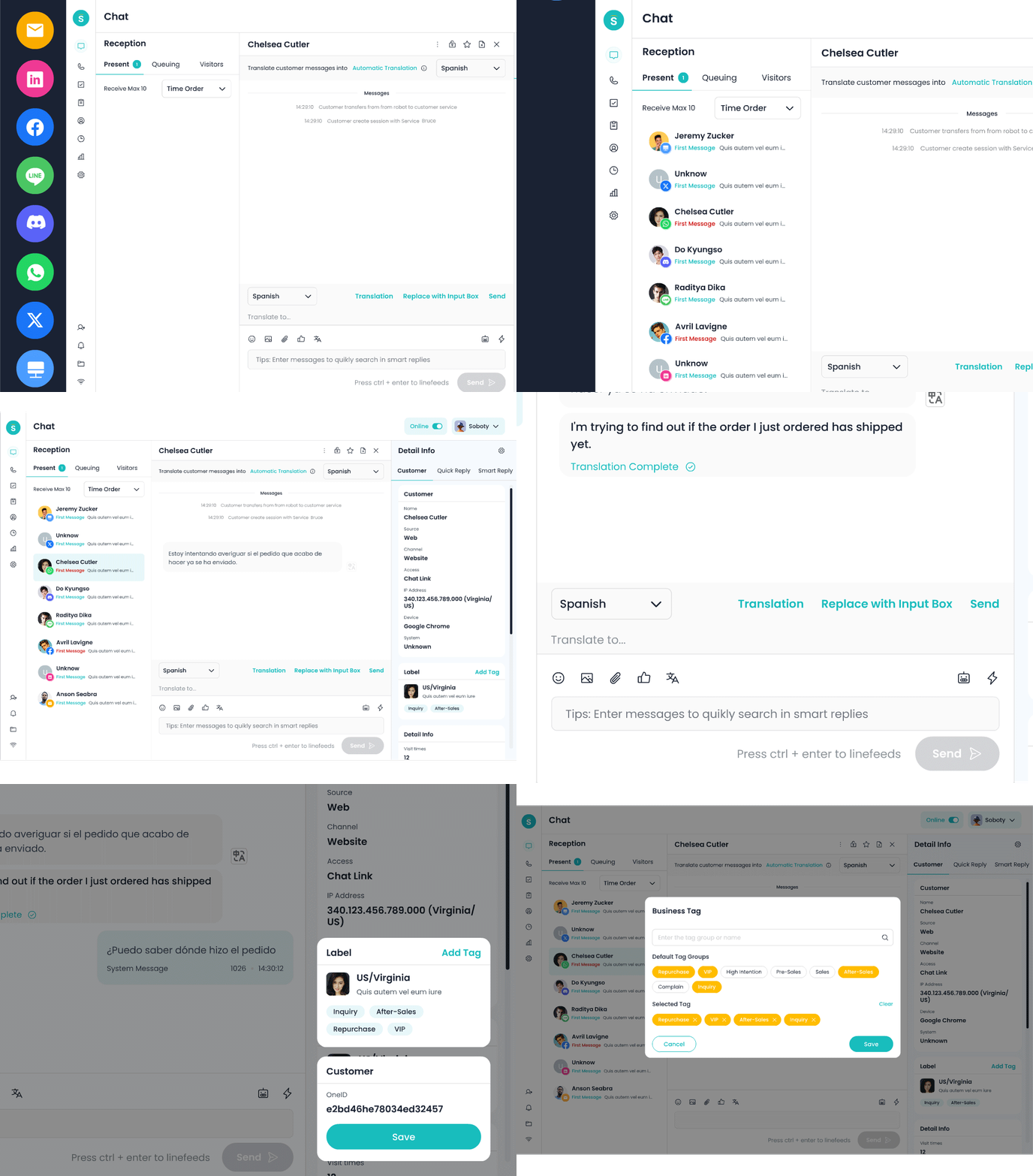
Sobot has a stronger SEA foundation than any other global platform in this comparison. Founded in 2014 as an AI chatbot company — AI is the foundation, not a feature added later — Sobot maintains its regional headquarters in Singapore, with offices in Jakarta and Kuala Lumpur. The Singapore data center provides PDPA-compliant and ISO 27001/27701-certified data residency for regulated SEA industries.
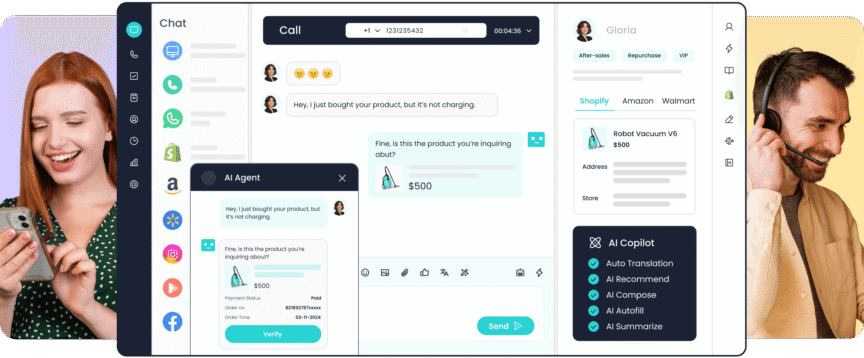
The combination of capabilities that makes Sobot distinct in SEA: AI Agent (chatbot automation across chat and voice), Live Chat (omnichannel human agent workspace), and Call Center (inbound + outbound voice AI) share a single customer data layer. A customer who WhatsApped yesterday and calls today is recognized immediately — without agents asking them to repeat themselves.
Core capabilities:
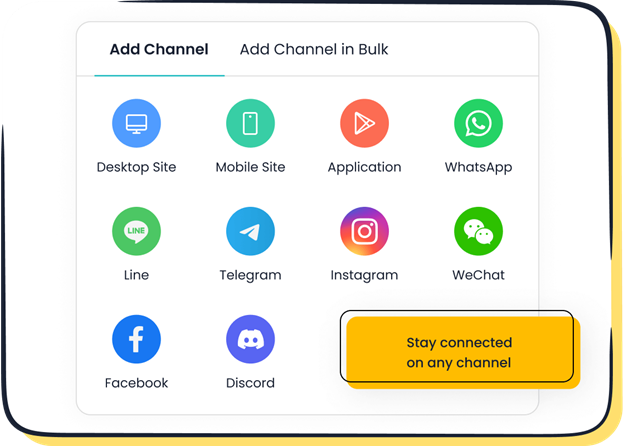
- AI Agent resolves queries end-to-end across WhatsApp, Lazada, LINE, Zalo, Facebook, Instagram, Telegram, website, and app — from one platform
- WhatsApp as official Meta BSP: direct API connection for broadcast, automation, and two-way support — not a third-party connector
- Native Lazada integration: when a customer asks “where’s my order,” the bot pulls live Lazada order data; most platforms require custom API development for this
- Zalo support for Vietnam operations — one of the few platforms on this list with native Zalo integration
- Built-in RAG: feed the AI your knowledge base via PDF, URL, Q&A pairs, or Excel; deploys without developer support
- AI Copilot assists human agents in real time: translates across 70+ languages, suggests replies, auto-fills tickets — critical for SEA teams managing cross-language customer bases
G2 Rating: 4.9 / 5 from 44 reviews. G2 Summer 2025 Leader, Easiest to Do Business With, Users Love Us.
Verified SEA customer cases:
- Flower Chimp (SEA flower delivery — Singapore, Malaysia, Indonesia): Agent productivity +63%, customer satisfaction +35%
- KUPU (Indonesian recruitment platform): WhatsApp read rate 85%+, 800,000+ messages sent via Sobot, CSAT 94%+ — deployed entirely through WhatsApp as the primary channel
- GLDB (Singapore MAS-licensed digital bank): 99.99% platform stability, IVR efficiency +80%, CSAT 4.9/5 — one of the few documented cases of an AI platform deployed by a Singapore MAS-regulated institution
- realme SEA (consumer electronics): Agent productivity +48%, resolution rate 80%+, CSAT 97%+
Why Sobot stands out in SEA specifically: The Lazada integration is not a checkbox — it means the AI can answer “where’s my order,” “can I return this,” and “change my delivery address” in real time using live Lazada order data. Combined with WhatsApp BSP status, Zalo support, and a Singapore data center, Sobot is the only platform that addresses the three core SEA requirements (WhatsApp + Lazada + compliance) natively without integration work.
| Pros | Cons |
|---|---|
| Only global platform with native Lazada + WhatsApp BSP + Zalo + Voice in one product | Smaller G2 review volume than Western incumbents — brand awareness still building in Europe and North America |
| Singapore HQ + Jakarta + KL offices; local support team without going through a regional distributor | Full feature access requires a sales demo; no self-serve trial for enterprise tier |
| GLDB case confirms MAS-regulated deployment — rare documented proof for Singapore financial services | Pricing requires contacting sales — no public rate card |
| AI-native architecture since 2014 vs. AI bolted onto helpdesk via acquisition (Zendesk, Freshdesk model) | Best fit for mid-market and enterprise; small teams under 10 agents may find platform scope more than needed |
Price: Contact sales. Typically approximately two-thirds the cost of comparable Zendesk or Intercom tiers at equivalent feature sets. Request a demo for SEA-specific pricing.
TL;DR: Sobot is the strongest global platform choice for SEA businesses that have outgrown point solutions and need WhatsApp + Lazada + voice in one AI-native system. Best fit for mid-market companies in Singapore, Malaysia, and Indonesia with 20+ agents. Not the fastest self-serve onboarding — plan for a sales conversation first.
❽ Yellow.ai — Best for Large Enterprise Multilingual Deployments
Best for: Large SEA enterprises — particularly in Indonesia, the Philippines, and broader APAC — running customer service in 4+ languages simultaneously, where volume and linguistic complexity exceed what most platforms handle natively.
Yellow.ai supports 135+ languages with genuine NLP depth — not translation-layer approaches — making it the broadest multilingual coverage of any platform reviewed. For a regional enterprise serving customers in Thai, Vietnamese, Bahasa, Tagalog, and English simultaneously, Yellow.ai’s unified language model handles this without requiring separate bot configurations per language.
Core capabilities:
- Dynamic AI Agent handles multi-turn conversations in 135+ languages including all major SEA languages
- Pre-built industry templates for retail, BFSI, logistics, and telecom
- Voice + digital channel AI in one platform — rare in the enterprise segment
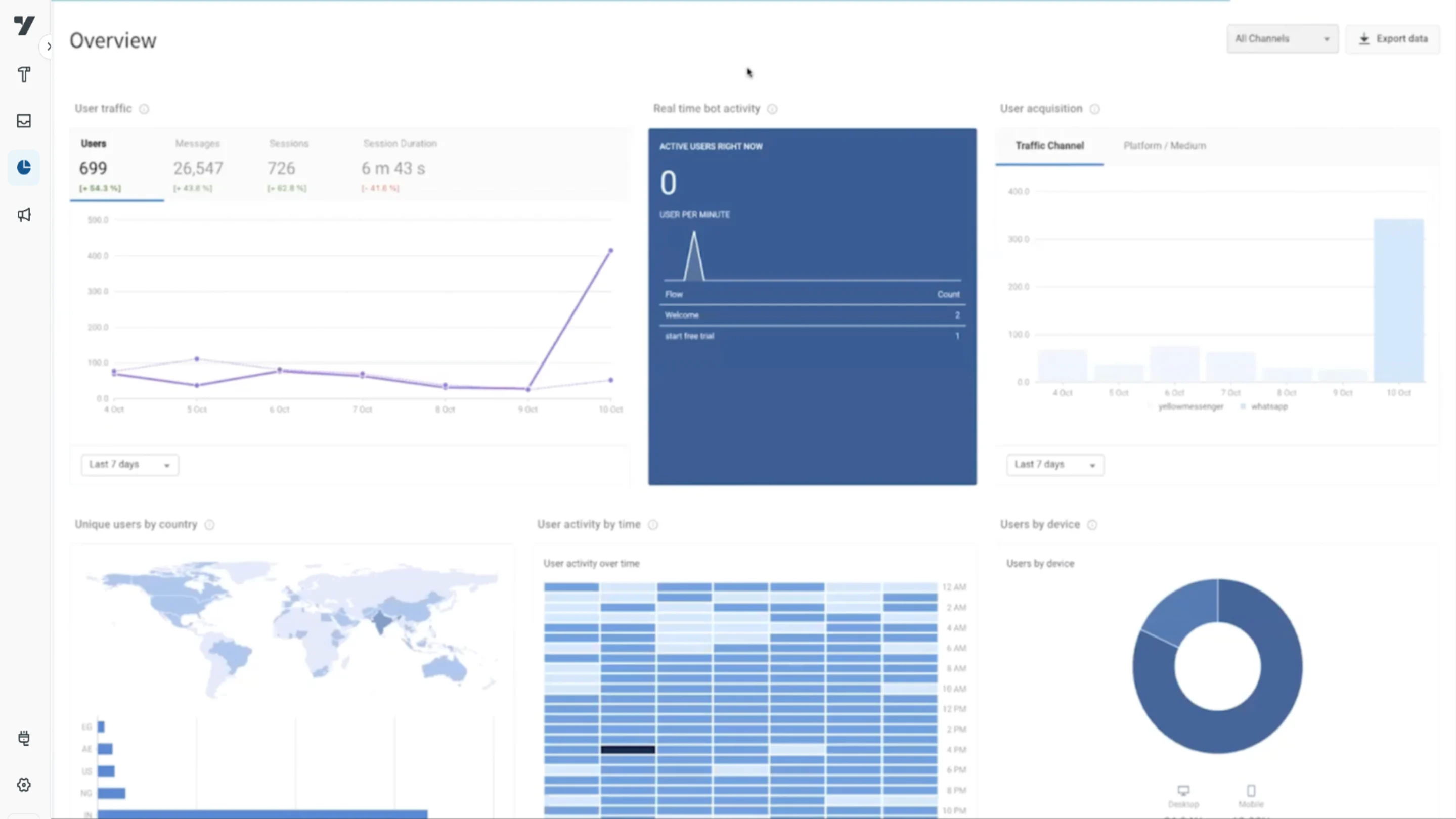
- Analytics with intent tracking, drop-off analysis, and conversation-level quality scoring
- Integration with Salesforce, SAP, Oracle — suitable for large enterprises with complex backend systems
G2 Rating: 4.4 / 5 from 106 reviews
| Pros | Cons |
|---|---|
| Widest language coverage reviewed — 135+ languages with genuine NLP depth | Enterprise-only; not suitable for teams under 50 agents |
| Strong APAC presence with regional implementation teams | Typical enterprise deployment takes 2–3 months |
| Voice + digital AI in one platform — most SEA competitors do one or the other | Implementation complexity means ROI timeline is longer than simpler alternatives |
Price: Contact sales. Minimum viable engagement is enterprise-scale.
TL;DR: Yellow.ai is the right enterprise choice for large SEA organizations — telcos, banks, large retailers — running service in 4+ SEA languages at scale. Overkill for any team under 50 agents.
❾ Respond.io — Best for WhatsApp-First Customer Service Across SEA
Best for: SEA businesses — particularly in Malaysia, Indonesia, and the Philippines — where WhatsApp handles 70%+ of customer service volume and the team needs sophisticated automation without a full contact center platform.
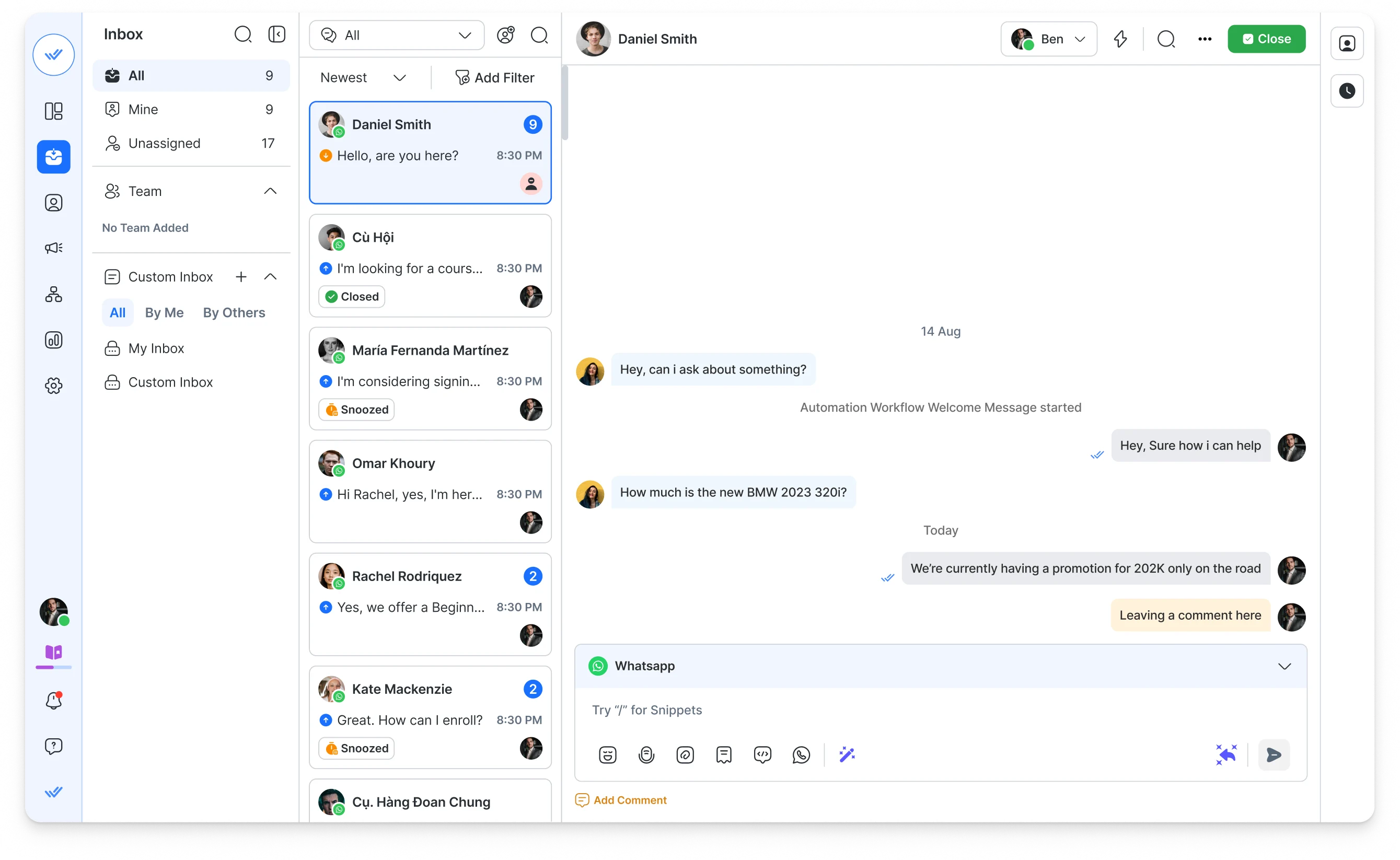
Respond.io’s WhatsApp automation workflow builder is the deepest of any platform reviewed. In SEA markets where WhatsApp is the de facto support channel, respond.io’s ability to build complex, branching automation across WhatsApp + Instagram + Facebook + LINE in a single no-code workflow builder is genuinely differentiated.
Core capabilities:
- Official WhatsApp BSP — direct API connection for broadcast and two-way automation
- Unified inbox for WhatsApp, Instagram, Facebook, LINE, Telegram, Viber, and web chat
- No-code workflow builder with conditional branching — order status, payment reminders, appointment booking, lead qualification
- Contact lifecycle: tracks all interactions across all channels in one customer record
- CRM integration for passing qualified leads to Salesforce, HubSpot, or Pipedrive
G2 Rating: 4.8 / 5 from 476 reviews
| Pros | Cons |
|---|---|
| Deepest WhatsApp automation workflow builder reviewed | No voice/call center — requires a separate tool for inbound calls |
| Official WhatsApp BSP + LINE in one product — covers the two dominant SEA messaging channels | AI chatbot is more rule-based than LLM-native for complex multi-turn queries |
| Fast onboarding for non-technical teams; strong Malaysian and Indonesian user base | Pricing scales with contact volume — high-volume teams pay significantly more |
Price: Team from $79/month; Business from $249/month.
TL;DR: Respond.io is the best tool if WhatsApp + LINE automation is your entire customer service operation. Strong for Malaysian, Indonesian, and Filipino businesses in retail and services. If you also need voice or Lazada integration, you’ll need a separate tool alongside it.
❿ Freshdesk — Best Budget Entry Point for SEA SMBs
Best for: Small and mid-size businesses across Singapore, Malaysia, and Indonesia that need a reliable helpdesk with AI chatbot capability and a free tier — particularly teams already using other Freshworks products.
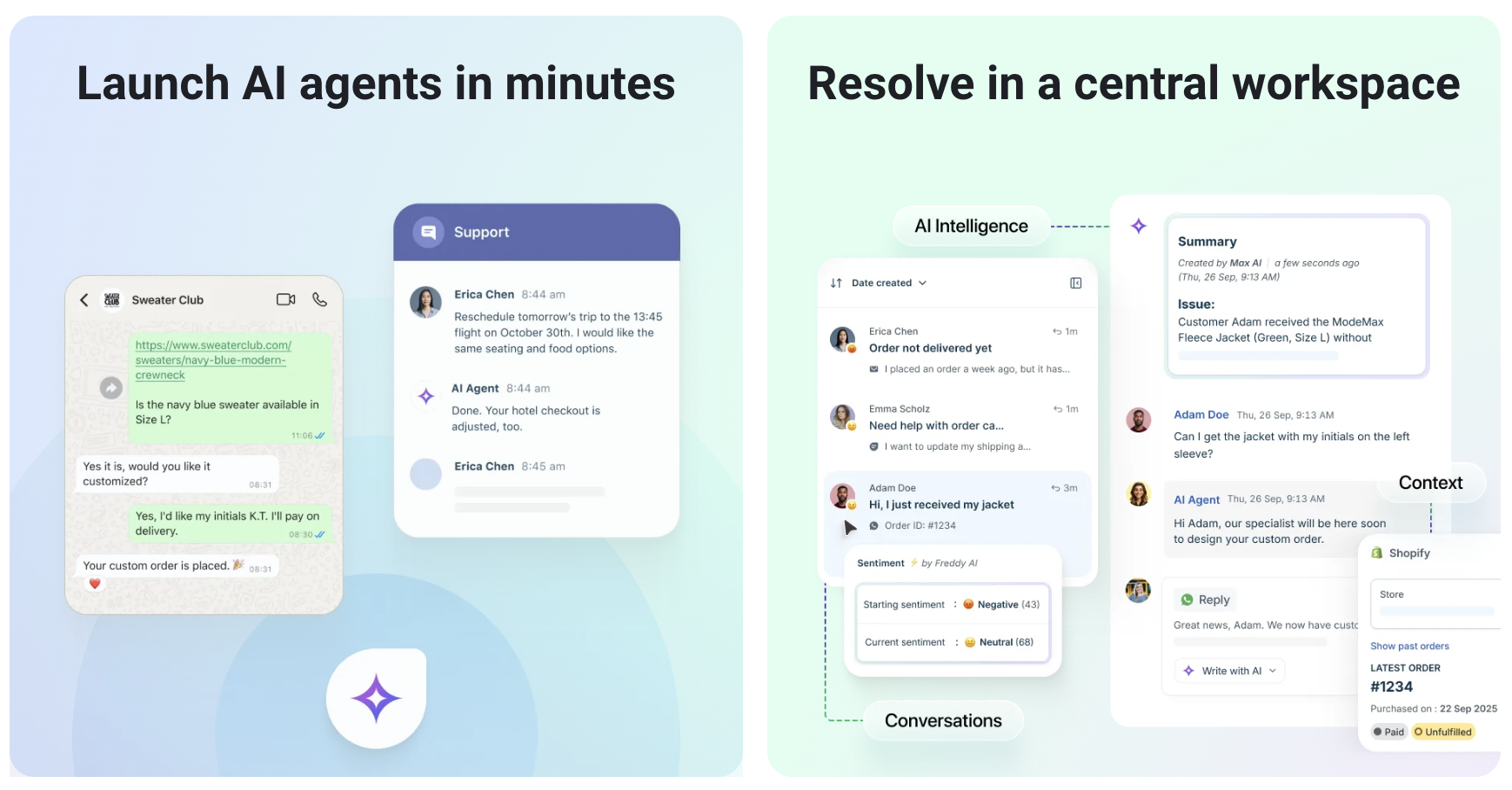
Freshdesk’s AI chatbot — powered by Freddy AI — is embedded within the broader Freshworks platform. For SEA SMBs that want to start with a free tier and scale gradually, Freshdesk offers the lowest barrier to entry among full-featured platforms. Freshworks has local sales presence in Singapore, making it more accessible than purely remote-support vendors for SMBs that prefer in-person onboarding.
Core capabilities:
- Freddy AI answers FAQs, collects lead info, triages tickets automatically across channels
- Omnichannel inbox: email, chat, phone, WhatsApp, Facebook, Twitter — unified dashboard
- AI Copilot: suggested replies, ticket summaries, sentiment detection for agents
- 1,000+ integrations including Shopify, Slack, Salesforce, and major CRM platforms
- Free plan available — genuinely usable for teams starting out with basic ticket management
G2 Rating: 4.4 / 5 from 3,723 reviews
| Pros | Cons |
|---|---|
| Free tier available — real lowest-cost entry point on this list | Full omnichannel requires multiple Freshworks products (tickets, voice, messaging) — costs compound quickly |
| Strong regional adoption in Singapore and Malaysia SMB market; local sales team in Singapore | No native Lazada, TikTok Shop SEA, or Shopee integration |
| Largest G2 review base on this list (3,723 reviews) — reliable third-party validation | AI resolution rate lower than Sobot or Yellow.ai for complex multi-turn queries |
Price: Free plan (ticketing only); Growth $15/agent/month; Pro $49/agent/month. Freddy AI add-on costs extra on lower tiers.
TL;DR: Freshdesk is the right starting point for SEA SMBs under 20 agents that need helpdesk + basic AI chatbot without enterprise budget. Once you need WhatsApp automation beyond simple responses, or Lazada/TikTok Shop integration, you’ll need to re-evaluate.
Country-by-Country Recommendations
The right platform varies significantly by country — because the dominant channels, regulatory frameworks, and local competitors differ.
For Singapore
Priority factors: MAS compliance for financial services, PDPA data residency, English + Mandarin + Malay multilingual support, WhatsApp dominance, sophisticated enterprise requirements.
Enterprise / Regulated: Sobot (documented MAS deployment via GLDB), KeyReply (healthcare and banking vertical depth)
Conversational commerce / Retail: AiChat (Singapore HQ, retail and F&B depth)
SMB entry-level: Freshdesk (local sales presence, affordable, free tier)
WhatsApp-first SMB: Respond.io
For Indonesia
Priority factors: Bahasa Indonesia NLP with colloquial dialect support, Tokopedia and Shopee integration, OJK compliance for financial services, WhatsApp + Instagram dominant channels, SMB price sensitivity.
Local-first: Qiscus (Indonesian-built, Tokopedia native integration), Mimin IO (WhatsApp + Instagram SMB automation)
Regional platform with Indonesian footprint: Sobot (Jakarta office, KUPU case study), Yellow.ai (strong Bahasa Indonesia NLP at enterprise scale)
Budget entry: Freshdesk, Instadesk (per-conversation pricing fits Indonesian SMB models)
For Malaysia
Priority factors: English + Bahasa Malaysia + Mandarin trilingual support, BNM compliance for financial services, WhatsApp dominance, Lazada presence.
Regional-first: AiChat (Malaysia coverage alongside Singapore), Instadesk (Bahasa Malaysia language support)
Full-stack: Sobot (Kuala Lumpur office, Lazada integration, multilingual AI Copilot)
WhatsApp automation: Respond.io (strong Malaysian user base documented in G2 reviews)
For Thailand
Priority factors: LINE is the dominant messaging platform (not WhatsApp), Thai language NLP, tourism and hospitality sector importance, PDPA compliance.
LINE-capable: AiChat (LINE official partner, Thailand deployments), Sobot (LINE native channel support)
Enterprise multilingual: Yellow.ai (Thai NLP depth, APAC regional team)
Note: Verify that LINE automation — not just manual messaging — is supported before committing to any platform for Thailand operations
For Vietnam
Priority factors: Zalo is the dominant platform (60M+ users), Vietnamese NLP, growing e-commerce sector with strong TikTok Shop presence.
Zalo-capable: Sobot supports Zalo as a native channel — one of very few platforms on this list that does
Language: Yellow.ai has documented Vietnamese NLP coverage at enterprise scale
Critical note: Most global chatbot platforms do not natively support Zalo. Verify Zalo integration before evaluating any platform for Vietnam customer service operations
How to Choose: 4-Step Framework for SEA Businesses
Step 1 — Map your actual channel mix by market.
WhatsApp dominates Malaysia and Indonesia. LINE is primary in Thailand. Zalo drives volume in Vietnam. The chatbot you choose must handle your dominant channel natively — not through a third-party connector that adds latency and reduces automation depth. List your top 3 channels per market before evaluating any platform.
Step 2 — Identify your compliance tier.
Banks and financial institutions face MAS (Singapore), OJK (Indonesia), or BNM (Malaysia) requirements that eliminate most global platforms immediately. Only platforms with documented regulatory deployments in your market — not just ISO 27001 — should be on your shortlist. For retail and e-commerce, PDPA and UU PDP set data residency requirements you need to verify before signing.
Step 3 — Test the language quality, not just the language list.
Almost every platform claims to “support Bahasa Indonesia” and “support Thai.” The difference is between a platform trained on Indonesian conversational data versus one that runs Google Translate on English outputs. Ask vendors to demonstrate live responses to colloquial mixed-language inputs: a Thai customer mixing English and Thai, or an Indonesian customer using Javanese-influenced phrasing.
Step 4 — Calculate implementation timeline against your urgency.
SEA-native platforms like AiChat, Qiscus, and Instadesk typically deploy in 2–4 weeks with local teams. Global platforms like Sobot require 4–8 weeks for full deployment. If you need something live for Harbolnas (Indonesia’s 12.12 shopping festival) or a peak sales campaign, your timeline constrains your platform options.
FAQ
Which AI chatbot is best for a Shopify seller on Lazada in Singapore?
If you’re selling on both Shopify and Lazada, Sobot is the only platform on this list with native integration for both. Shopify handles the Western-facing store; Lazada integration means the bot answers order and shipping queries for SEA marketplace sales without custom API work. For Shopify-only operations, Freshdesk is a cheaper starting point.
What’s the difference between AiChat, KeyReply, and Sobot for a Singapore business?
AiChat is best for retail, F&B, and hospitality conversational commerce (bookings, orders, loyalty) in Singapore and Malaysia. KeyReply specializes in healthcare and financial services that need MOH or MAS-compliant AI documentation. Sobot is the full-stack option — AI chatbot + live agent workspace + voice call center + Lazada + WhatsApp in one platform — best for businesses with multi-channel complexity beyond a single store or clinic.
Is there an AI chatbot built specifically for Indonesia that handles Tokopedia?
Yes — Qiscus is an Indonesian-built omnichannel platform with native Tokopedia integration. It also handles WhatsApp, Instagram, and Bahasa Indonesia NLP trained on local conversational patterns. Mimin IO is the lighter-weight alternative for smaller Indonesian businesses running primarily on WhatsApp and Instagram.
Which chatbot works for Thailand where LINE is the primary channel?
LINE coverage is a meaningful differentiator for Thailand. AiChat is a LINE official partner with Thailand deployments. Sobot supports LINE as a native channel. Yellow.ai covers LINE as part of its enterprise deployment. Critically: verify that automation (not just manual messaging) works through LINE before signing — this is where platforms diverge most significantly.
Can an AI chatbot handle customer service in Vietnamese with Zalo integration?
Zalo — Vietnam’s dominant messaging app with 60M+ users — is supported natively by very few platforms. Sobot is one of them. If Vietnam is a significant market, Zalo support should be a hard filter in your evaluation, not an afterthought. Most platforms on this list don’t support Zalo natively.
Is there a cheaper alternative to Zendesk for an SMB in Malaysia or Indonesia?
Yes — several. Freshdesk offers a free plan and Growth tier at $15/agent/month versus Zendesk’s $55/agent/month floor. Instadesk uses per-conversation pricing that scales with usage rather than seat count. Respond.io at $79/month covers WhatsApp automation for teams under 10 agents. For Malaysian and Indonesian SMBs where per-seat pricing doesn’t match business models, usage-based alternatives are worth prioritizing.
What SEA-specific compliance documentation should I request from an AI chatbot vendor?
For Singapore: ask for documented MAS compliance and confirmation of data residency in Singapore specifically (not just “Asia”). For Indonesia: OJK-readiness for fintech, UU PDP compliance, and confirmation of Indonesian data center availability. For Malaysia: BNM-compliant data handling for financial services. For Thailand: PDPA compliance documentation (Thailand’s Personal Data Protection Act, effective 2022). Accepting a generic ISO 27001 certificate without country-specific compliance documentation is the most common compliance mistake in SEA chatbot deployments.
Conclusion
Southeast Asia’s AI chatbot market is not a single market — it’s six countries with different dominant channels, regulatory frameworks, languages, and e-commerce ecosystems. A comparison article that ranks only Zendesk, Freshdesk, and Intercom is answering a different question than “what works in Indonesia” or “what’s compliant for a Singapore bank.”
The clearest pattern from regional deployments: SEA-native platforms (AiChat, KeyReply, Qiscus, Mimin IO, Instadesk) win in vertical depth and local implementation speed. Global platforms with genuine SEA presence — Sobot with Singapore HQ and Lazada integration, Yellow.ai with APAC teams, Respond.io for WhatsApp-heavy operations — win where multi-country scale and advanced AI capability matter more than local-only optimization.
For most SEA businesses scaling customer service in 2026: start with your dominant channel (WhatsApp, LINE, or Zalo), your compliance tier (MAS, OJK, BNM, or none), and your implementation timeline. Those three filters narrow the list to 2–3 options. Then test the language quality directly — not from a feature checklist, but by sending the platform colloquial inputs in your customers’ actual language.
Sobot offers a regional demo specifically for SEA deployments, including Lazada integration, WhatsApp BSP setup, and Singapore data residency configuration. Flower Chimp, KUPU, and GLDB are reference customers available upon request.