At a Glance: Top Picks by Business Type
- Sobot — Best all-in-one omnichannel AI platform for global enterprises needing WhatsApp, voice, chat, and ticketing unified with proven AI resolution
- Zendesk — Best for large enterprises wanting the widest integration ecosystem and established compliance credentials
- Salesforce Service Cloud — Best for businesses already on Salesforce CRM that want AI embedded in existing workflows
- Genesys Cloud CX — Best for contact-centre-first enterprises with complex routing and workforce management needs
- Intercom — Best for SaaS and subscription businesses combining product-led growth with AI support
- Freshdesk — Best budget-friendly entry point for growing teams that need structured omnichannel ticketing
- NICE CXone — Best for large call-centre operations needing enterprise-grade AI and workforce optimisation
- Kustomer — Best for high-volume retail and ecommerce brands wanting CRM and omnichannel support natively merged
- Five9 — Best for outbound-heavy contact centres needing AI-powered dialler and voice automation
- HubSpot Service Hub — Best for SMBs already on HubSpot CRM wanting to extend into structured support
Introduction
Customers today move between channels without warning. A shopper might discover your product on Instagram, ask a question via WhatsApp, receive a reply by email, and escalate to a phone call — all within 24 hours. According to Aberdeen Group research, companies with strong omnichannel customer engagement retain 89% of their customers, compared to 33% for companies with weak omnichannel programmes. Yet most businesses still manage these channels in silos, forcing customers to repeat their entire story every time they switch.
That’s the problem omnichannel AI customer service platforms are built to solve: a single connected system where AI handles routine queries end-to-end, agents see every channel in one workspace, and customer context never gets lost.
We evaluated 10 platforms across seven dimensions — AI autonomy, channel breadth, unified data architecture, pricing, deployment speed, multilingual support, and real-world customer evidence — to help you find the right fit.
What Is an Omnichannel AI Customer Service Platform?
An omnichannel AI customer service platform is software that does three things simultaneously:
- Connects every customer channel — live chat, email, WhatsApp, SMS, voice, social media, and in-app messaging — into a single agent workspace and shared customer record
- Applies AI across all channels — using the same AI model and knowledge base to resolve queries, route tickets, suggest replies, and analyse sentiment regardless of where the customer message originates
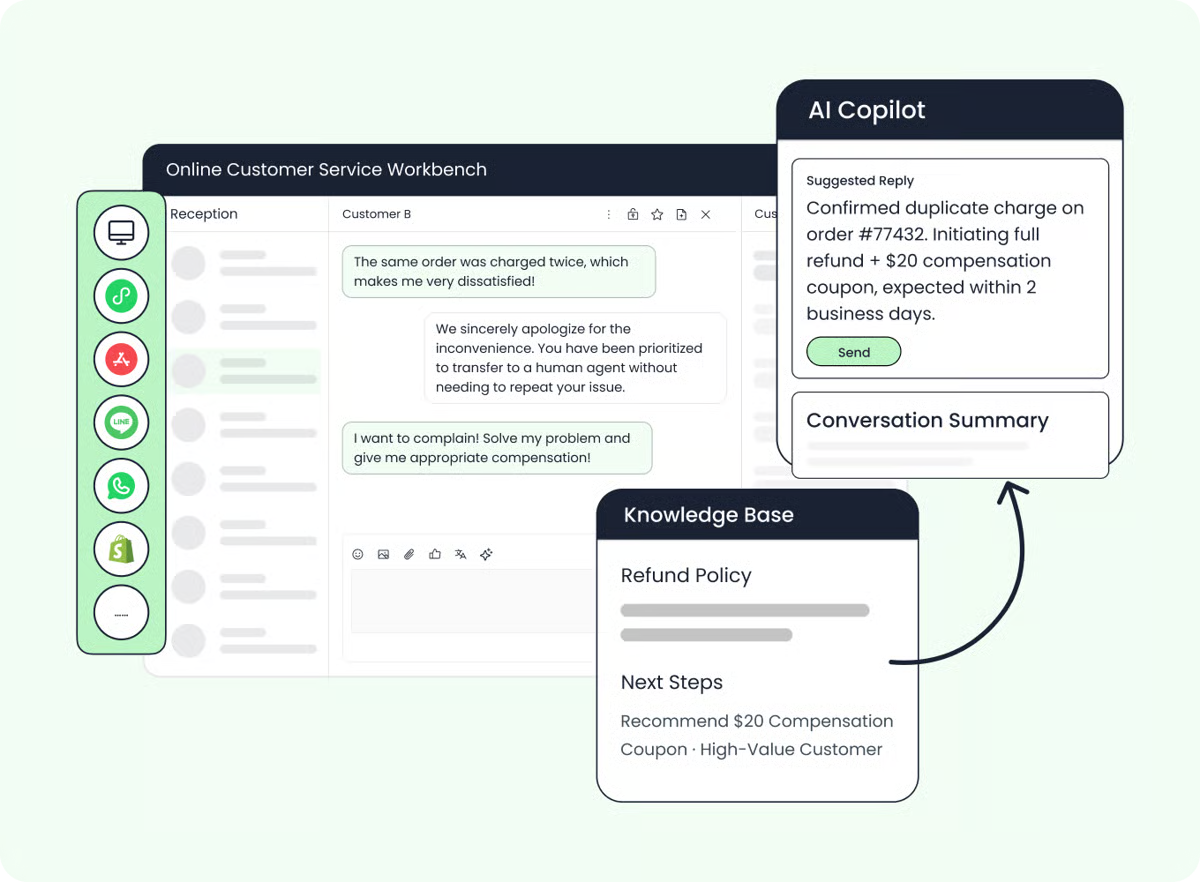
- Maintains context across sessions and channels — so when a customer who messaged on WhatsApp calls 20 minutes later, the agent already sees the full conversation history without asking the customer to explain again
The “AI” part matters more in 2026 than it did two years ago. First-generation omnichannel tools unified channels but still required agents to handle most queries. Modern platforms use large language models (LLMs) to autonomously resolve 60–80% of routine tickets — tracking orders, processing returns, answering product FAQs, scheduling callbacks — escalating to a human only when genuinely needed.
Omnichannel vs. Multichannel: The Critical Difference
This distinction determines whether a platform actually qualifies as omnichannel:
| Multichannel | Omnichannel | |
|---|---|---|
| Channels | Multiple (email, chat, phone) | Same multiple channels |
| Data | Separate per channel — agents switch systems | Unified — one customer record across all channels |
| Context | Lost when customer switches channel | Preserved — agent sees full cross-channel history |
| AI | Applied per channel independently | Single AI layer processes all channels with shared context |
| Customer experience | Customer repeats themselves | Customer continues seamlessly |
According to a Plivo study, 56% of customers are forced to repeat their information when switching support channels — the direct result of multichannel systems being sold as omnichannel.
How We Evaluated These Platforms
Before the rankings, here is the framework we used to assess all 10 tools:
- AI autonomy — Does the AI resolve tickets end-to-end, or only assist agents? What is the published autonomous resolution rate?
- Channel breadth — Which channels are native vs. third-party? Does WhatsApp, voice, and social work out of the box?
- Unified data architecture — Is there a true shared customer record, or channel-specific data that must be manually synced?
- Pricing transparency — Is pricing publicly listed? How does cost scale with ticket volume and agent count?
- Deployment speed — How long for an average team to go fully live?
- Multilingual and regional capability — How many languages are supported natively? Is the AI trained on non-English conversation patterns?
- Customer evidence — Published case studies with specific metrics, plus G2/Capterra ratings with review volume
Quick Comparison: 10 Best Omnichannel AI Platforms
| Platform | Best For | AI Autonomy | Native Channels | Starting Price | G2 Rating |
|---|---|---|---|---|---|
| Sobot | Global enterprise, WhatsApp-heavy markets | High (end-to-end) | Chat, WhatsApp, Voice, Email, Social, SMS | Custom (free trial) | 4.9/5 |
| Zendesk | Large enterprise, wide integrations | High (add-on) | Chat, Email, Voice, Social, SMS | $55/agent/month | 4.3/5 ★ 5,000+ |
| Salesforce Service Cloud | Salesforce-ecosystem businesses | High (Einstein AI) | Chat, Email, Voice, Social | $25/agent/month | 4.4/5 ★ 4,000+ |
| Genesys Cloud CX | Contact-centre-first enterprises | High | Voice, Chat, Email, Social, SMS | ~$75/agent/month | 4.3/5 ★ 1,500+ |
| Intercom | SaaS/subscription brands | High (Fin AI) | Chat, Email, Social | $39/seat/month | 4.5/5 ★ 2,800+ |
| Freshdesk | Budget-conscious growing teams | Medium | Chat, Email, Social, Voice (add-on) | Free / $15/agent/month | 4.4/5 ★ 3,000+ |
| NICE CXone | Enterprise call centres | High | Voice, Chat, Email, Social, SMS | Custom | 4.3/5 ★ 1,700+ |
| Kustomer | High-volume retail & ecommerce | High | Chat, Email, Voice, WhatsApp, Social | $89/user/month | 4.4/5 ★ 400+ |
| Five9 | Outbound-heavy contact centres | High (voice AI) | Voice, Chat, Email, Social | Custom | 4.1/5 ★ 500+ |
| HubSpot Service Hub | SMBs on HubSpot CRM | Medium | Chat, Email, Social | Free / $15/seat/month | 4.4/5 ★ 2,200+ |
The 10 Best Omnichannel AI Customer Service Platforms
1. Sobot
Best for: Global enterprises and Asian-market businesses needing true omnichannel AI with WhatsApp, voice, and live chat unified in one platform
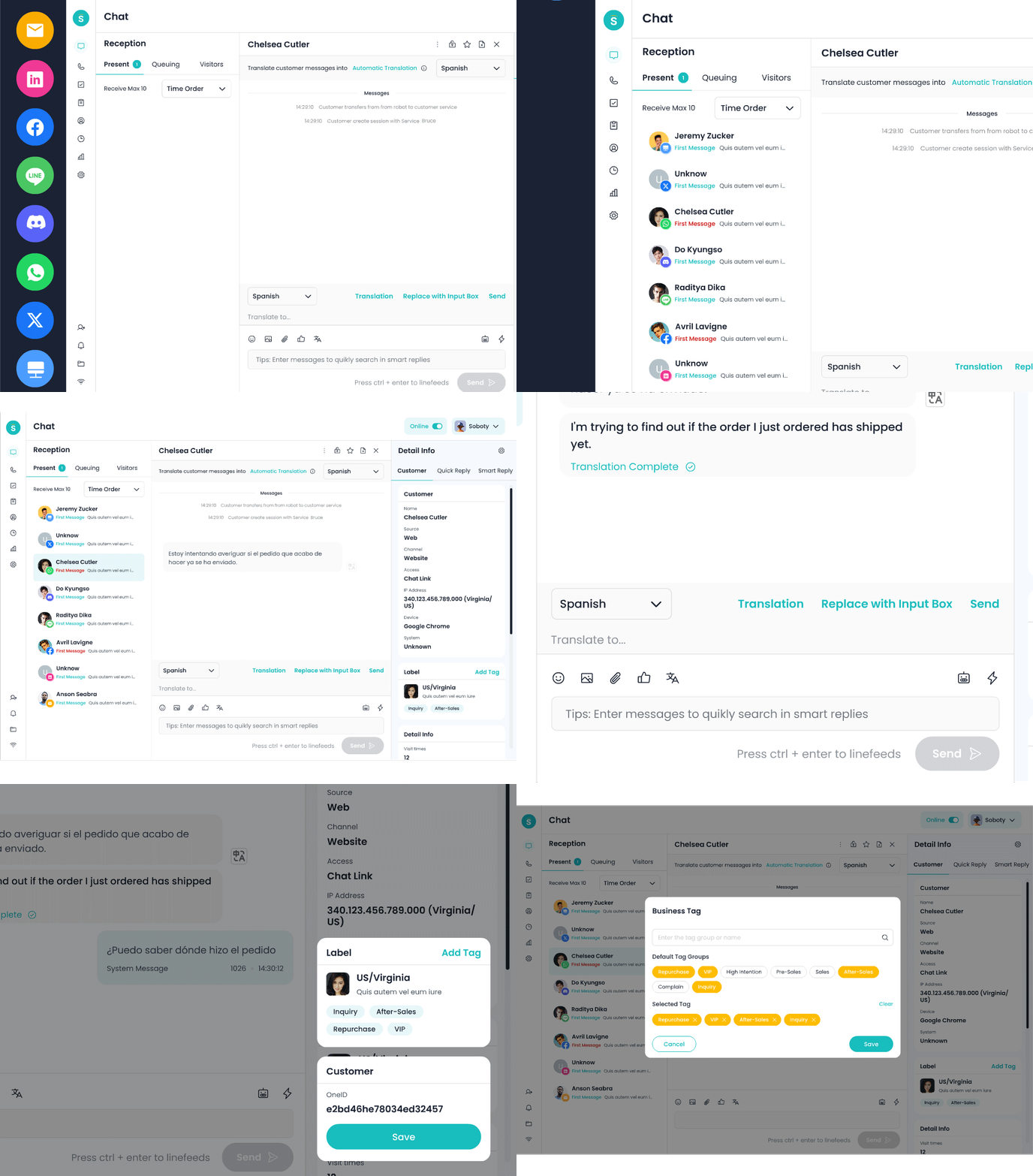
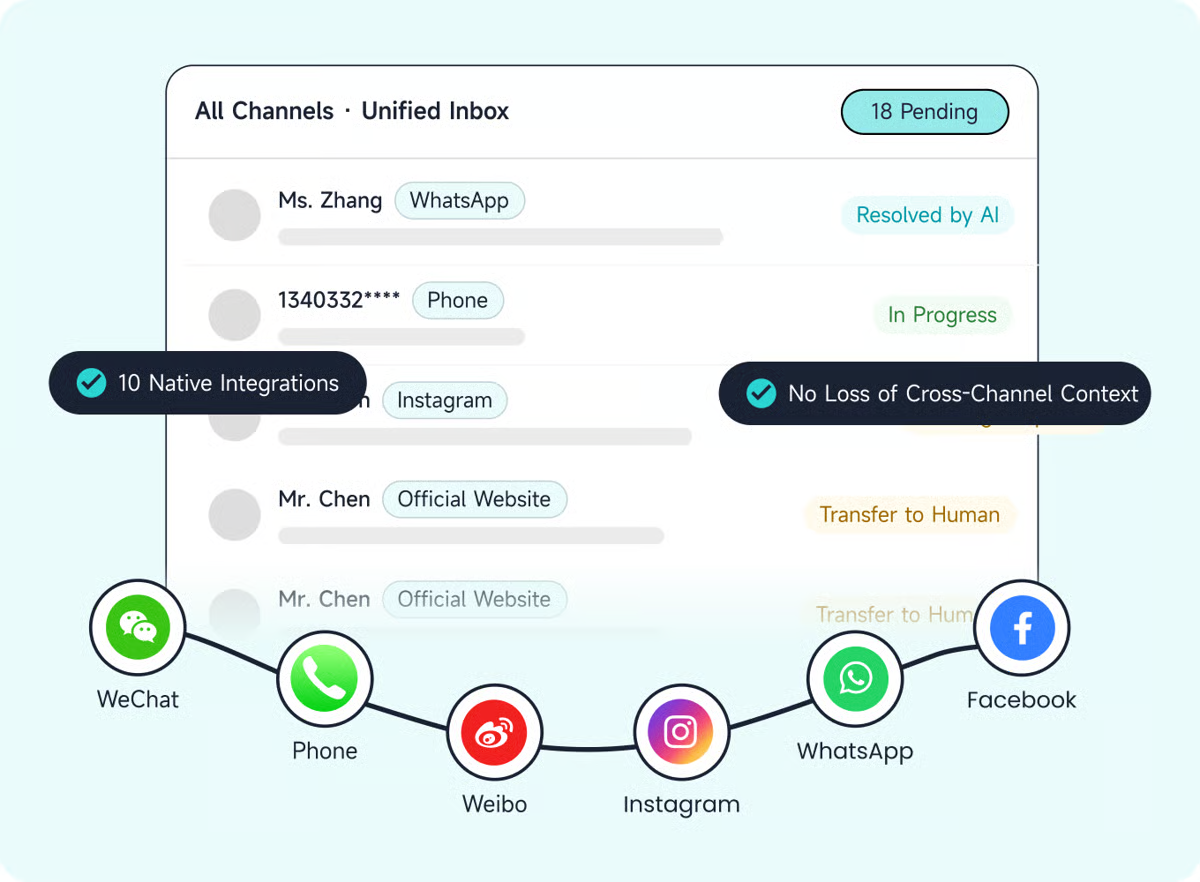
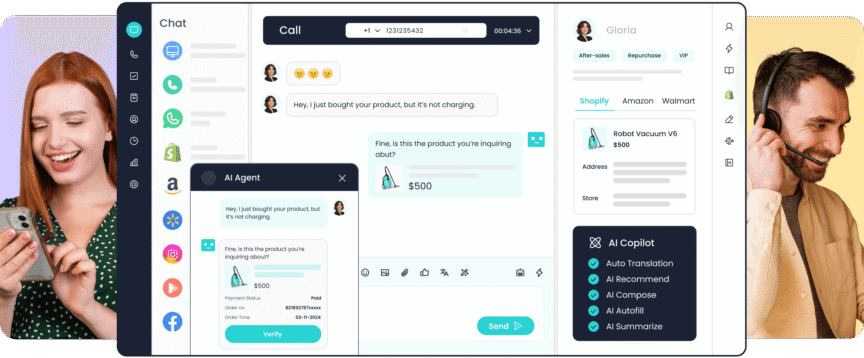
Sobot is an AI-first omnichannel customer service platform built for organisations that support high volumes of customers across multiple channels — and in multiple languages. Its architecture is designed around a single principle: one AI brain, one customer record, one agent workspace, regardless of whether the customer contacts you via WhatsApp, phone, website chat, email, or social media.
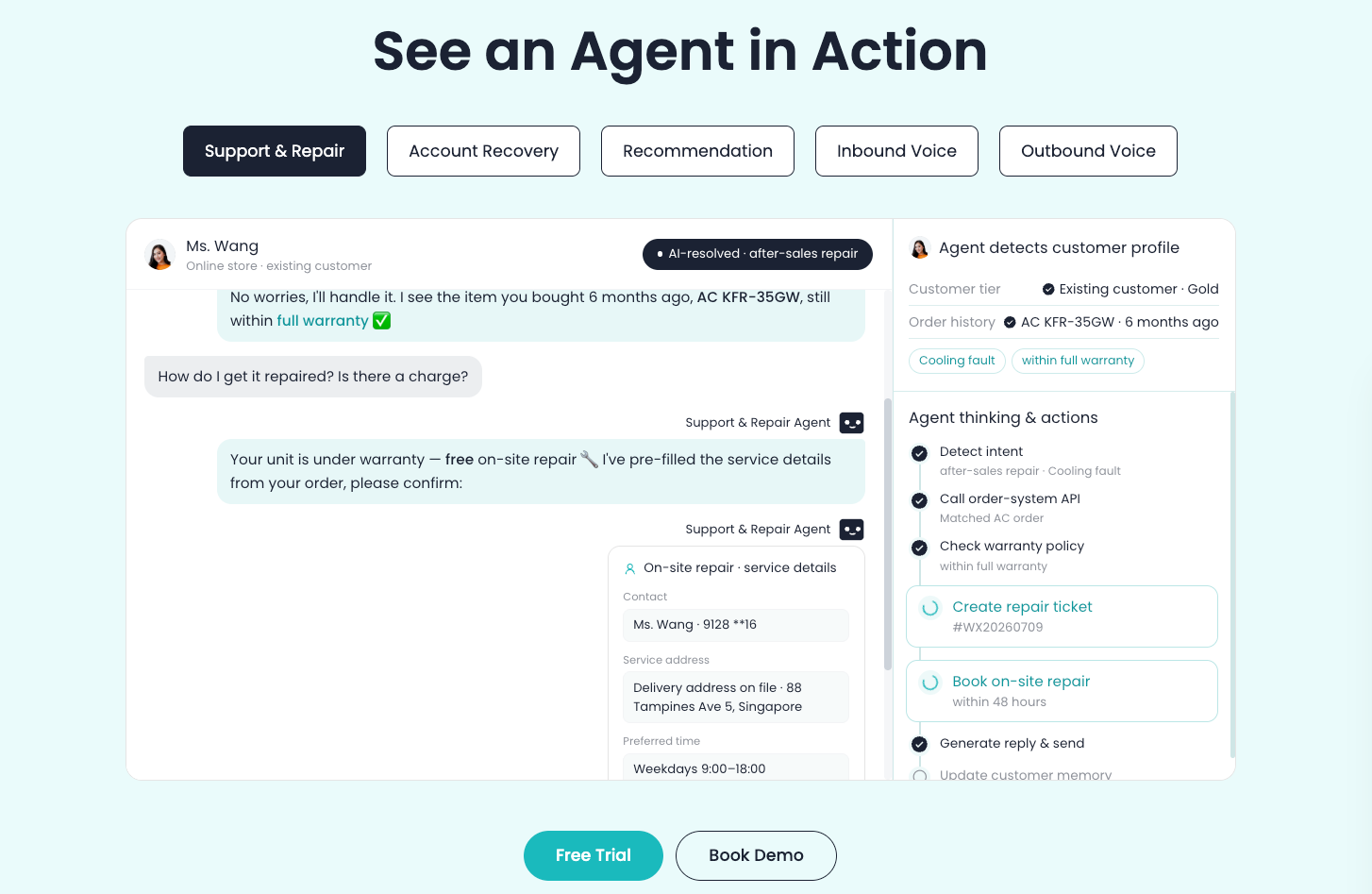
What distinguishes Sobot from most platforms on this list is the depth of its AI autonomy. Rather than AI that suggests replies for agents to approve, Sobot’s AI agent handles tickets end-to-end — looking up order status, processing standard requests, escalating complex issues — with human agents brought in only when the AI determines the query exceeds its confidence threshold.
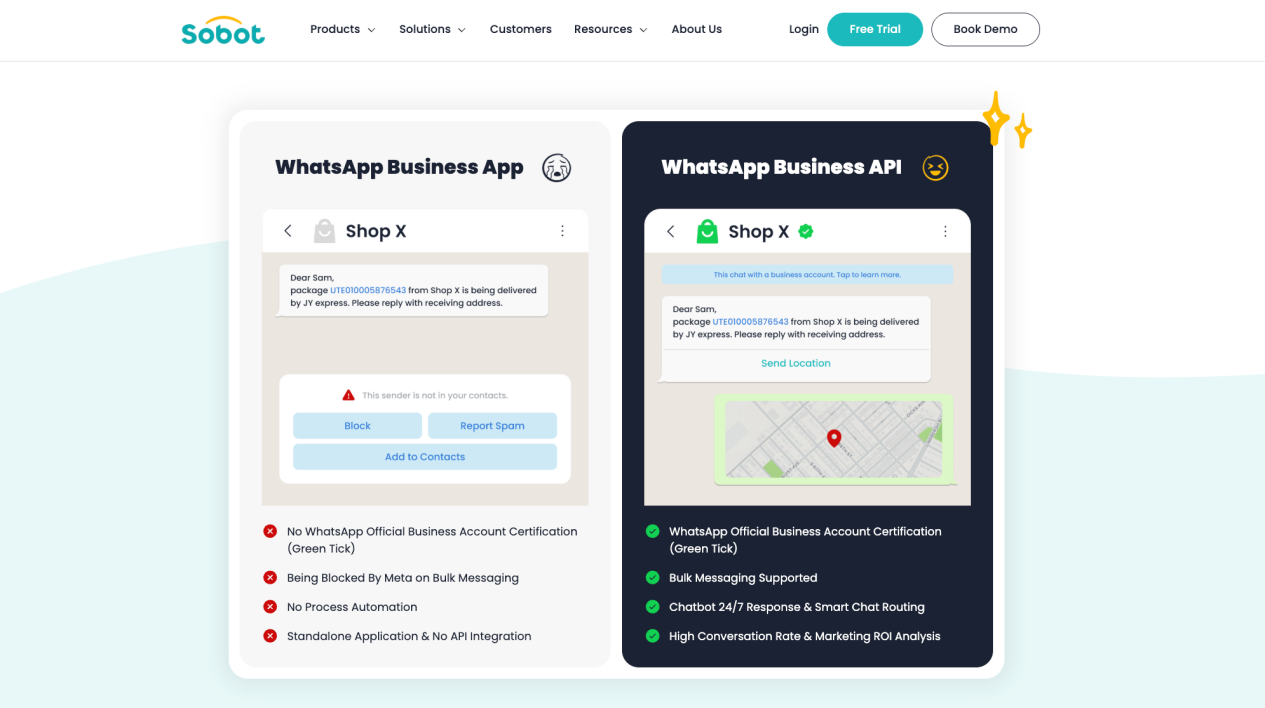
For businesses operating in Asia, the Middle East, or any market where WhatsApp is the primary customer channel, Sobot’s native WhatsApp Business API integration is a meaningful differentiator. Most platforms in this list treat WhatsApp as a third-party add-on; Sobot treats it as a first-class channel with full AI coverage, proactive messaging, and unified conversation history.
Key Features:
- Unified omnichannel workspace: WhatsApp Business API, live chat, voice, email, SMS, Instagram DM, Facebook Messenger — all in one agent screen
- AI agent with end-to-end resolution: handles FAQs, order lookups, standard returns, and appointment scheduling without human review
- Shared customer record: full cross-channel conversation history available to every agent instantly
- 18+ language support with AI trained on multilingual conversation patterns — including Malay, Mandarin, Arabic, Thai, Bahasa Indonesia
- AI-powered knowledge base that learns from historical conversations, reducing knowledge base maintenance effort by up to 90%
- Proactive messaging: triggers outbound WhatsApp or chat messages based on order events, browsing behaviour, or customer lifecycle stage
G2 Rating: 4.9/5
Real Customer Results:
- OPPO (electronics, 60+ countries): 83% chatbot resolution rate; 94% positive feedback rate; 57% increase in customer repurchase rate; knowledge base maintenance effort reduced by 90%
- Michael Kors (global fashion retail): 83% reduction in response time; 95% CSAT; 20% increase in conversion rate — “Customer care is very important for MK, as we want to provide the best possible service and experience for our customers.” — Ebrahim Hyder, VP of Customer Service, Michael Kors
- Renogy (ecommerce): 45% increase in resolution rate; escalation rate dropped from 50% to 30%; chatbot independently handles 80%+ of inbound contacts; 95% CSAT
- Samsung: 97% CSAT across customer service operations
- Opay (fintech): CSAT improved from 60% to 90%; 20% reduction in customer service costs
Pricing: Custom — contact sales. 15-day free trial available with no credit card required.
| Pros | Cons |
|---|---|
| Deepest native WhatsApp + voice + chat integration in this category | Pricing not self-serve; requires sales conversation to access full cost details |
| AI resolves tickets end-to-end, not just suggests replies | Implementation for complex enterprise configurations typically takes 1–3 weeks |
| 18+ language AI — strongest multilingual coverage in this list | Less brand awareness in Western markets; primarily known in Asia and Middle East |
| Proven at enterprise scale: Samsung, OPPO, Michael Kors across global markets | Fewer pre-built integrations than Zendesk’s 1,000+ marketplace |
| Strong voice AI alongside digital channels — rare combination in one platform | Self-serve onboarding documentation less extensive than Zendesk or Freshdesk |
TL;DR: Sobot is the strongest choice when your business needs true unified omnichannel — not channel-switching — with AI that resolves rather than assists, particularly for operations in Asia or markets where WhatsApp dominates. Not the right fit if you need self-serve pricing or are deeply embedded in the Salesforce or HubSpot ecosystem.
2. Zendesk
Best for: Large enterprises needing the widest integration ecosystem and established enterprise compliance
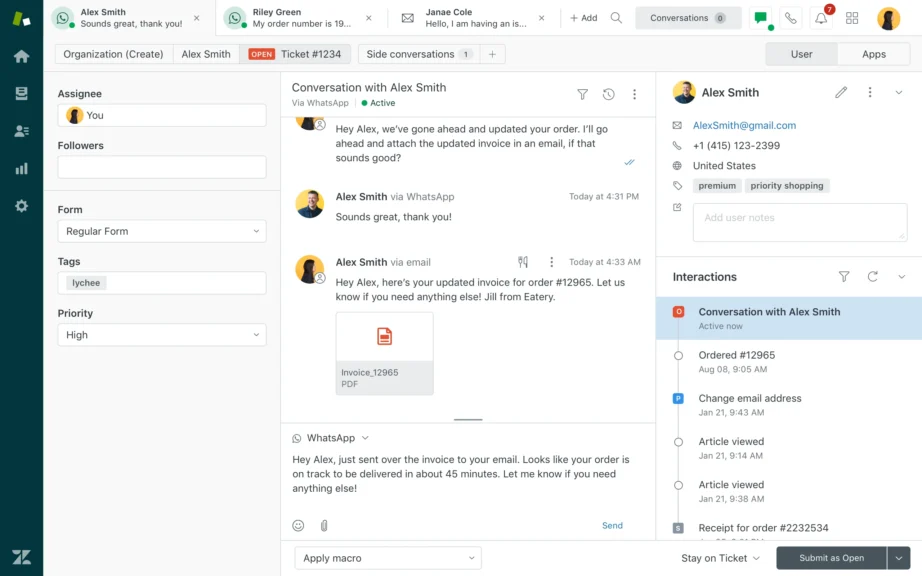
Zendesk is the most widely deployed customer service platform globally, with 1,000+ native integrations and battle-tested enterprise security credentials. Its Zendesk AI (built on OpenAI) handles intent classification, automatic routing, and agent assist — though full autonomous resolution requires the AI add-on, which carries additional cost.
Key Features:
- Zendesk AI: intent detection, auto-routing, intelligent triage, agent assist suggestions
- 1,000+ native integrations across CRM, ecommerce, and productivity tools
- Zendesk Talk: built-in voice with IVR, call recording, and voicemail
- Advanced workforce management and reporting
- Multi-brand help centres with separate configurations per brand
G2 Rating: 4.3/5 from 7,000+ reviews
“Zendesk is robust and handles our complex workflows, but the AI features cost significantly extra and require additional setup.” — G2 reviewer, enterprise software company
Pricing: Suite Team from $55/agent/month; AI add-on priced separately; enterprise plans negotiated.
| Pros | Cons |
|---|---|
| Largest integration marketplace — connects with virtually any business system | AI autonomy features are add-ons, not included in base plans |
| Enterprise-grade compliance: SOC 2, HIPAA, ISO 27001 | Base product is expensive; full AI capability adds significant cost |
| Strong built-in voice via Zendesk Talk | WhatsApp support requires third-party connector — not native |
| Mature product with extensive documentation and partner ecosystem | Significant setup complexity — most enterprises need a Zendesk implementation partner |
| Best multi-brand management in this category | Interface can feel heavy and dated for small teams |
TL;DR: Zendesk is the safe enterprise choice when compliance credentials and integration breadth matter most. Expect to pay more than the headline price once AI and voice features are added.
3. Salesforce Service Cloud
Best for: Businesses already using Salesforce CRM that want AI embedded in existing customer data workflows
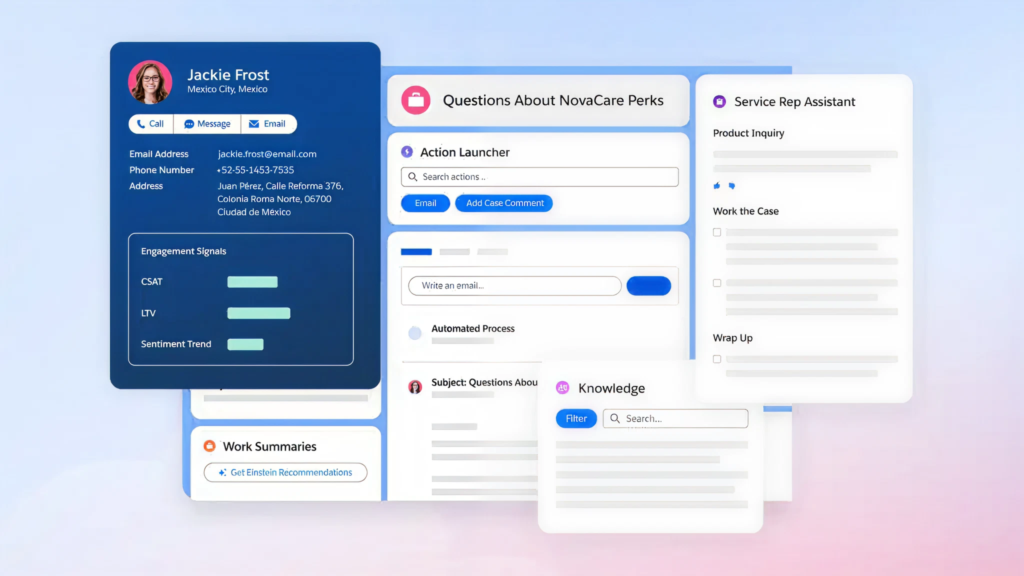
Salesforce Service Cloud‘s competitive advantage is straightforward: if your sales, marketing, and customer data already live in Salesforce, Service Cloud’s Einstein AI operates on top of that entire customer history — every purchase, interaction, and account detail — without any data migration or integration work. For Salesforce-native organisations, this data completeness advantage is significant.
Key Features:
- Einstein AI: case classification, next-best-action suggestions, knowledge article recommendations
- Omni-Channel Routing: distributes work across chat, email, voice, and social based on agent capacity and skill
- Service Console: unified agent workspace pulling all Salesforce customer data into one view
- Einstein Conversation Mining: analyses historical conversations to identify automation opportunities
- Field service and mobile support capabilities
G2 Rating: 4.4/5 from 7,000+ reviews
Pricing: Starter from $25/agent/month; Enterprise from $165/agent/month; Unlimited from $330/agent/month.
| Pros | Cons |
|---|---|
| Unmatched CRM data depth for Salesforce customers — AI uses complete customer history | Extremely expensive at Enterprise/Unlimited tiers |
| Einstein AI improves continuously as it processes more Salesforce data | Non-Salesforce businesses face steep implementation costs to get value |
| Strong omnichannel routing across digital and voice channels | Complex to configure — typical implementations take 8–16 weeks |
| Best choice if you need unified sales + service AI on one platform | WhatsApp integration requires additional configuration or third-party connector |
| Field service and mobile support built in | Overkill for companies that don’t already use Salesforce CRM |
TL;DR: Exceptional if you’re on Salesforce. Difficult to justify the cost and complexity if you’re not.
4. Genesys Cloud CX
Best for: Contact-centre-first enterprises with complex routing, workforce management, and blended inbound/outbound needs
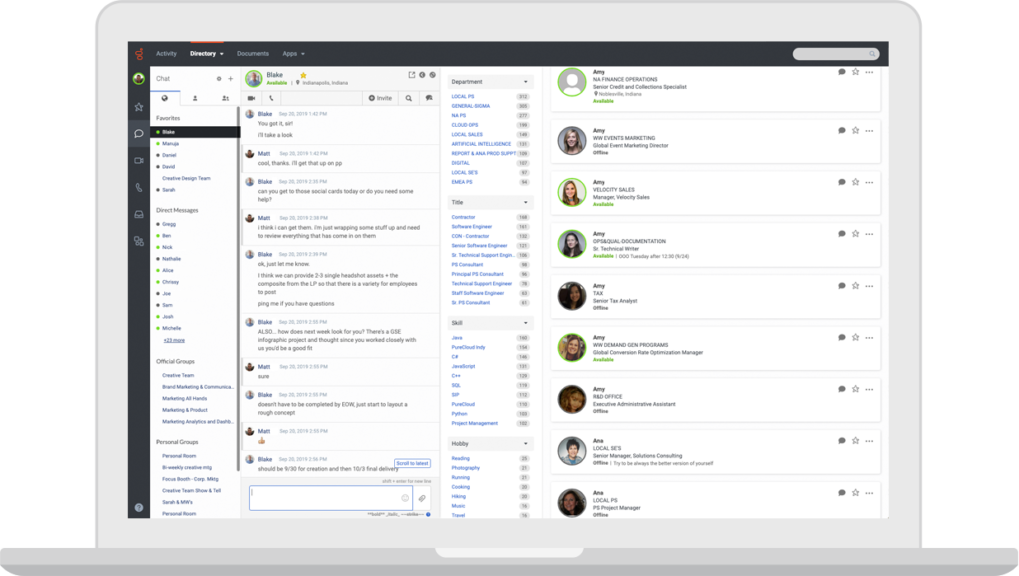
Genesys Cloud CX is built from the ground up as a contact centre platform — which means its AI routing, workforce forecasting, and quality management capabilities are deeper than most CRM-adjacent tools. Its AI handles predictive routing (matching customers to best-fit agents based on historical success patterns), real-time agent coaching during calls, and automated after-call work summarisation.
Key Features:
- Predictive routing: AI matches customers to agents based on issue type, agent skill, and historical resolution patterns
- Real-time agent assist: AI surfaces relevant knowledge articles and suggested responses during live conversations
- Workforce engagement management: forecasting, scheduling, and quality management built in
- Native voice AI with speech analytics and automated call summarisation
- Omnichannel across voice, chat, email, social, and messaging
G2 Rating: 4.4/5 from 1,600+ reviews
Pricing: Voice from ~$75/agent/month; Digital from ~$95/agent/month; All-in-one from ~$155/agent/month.
| Pros | Cons |
|---|---|
| Deepest workforce management and contact centre AI in this category | Complex implementation — typically 8–12 weeks for full deployment |
| Predictive routing demonstrably improves first-contact resolution | Expensive compared to digital-first platforms |
| Strong speech analytics and voice AI | Less suited for businesses where digital channels dominate over voice |
| Built-in quality management and agent coaching | WhatsApp integration is an add-on, not native in all tiers |
| Good blended inbound/outbound capabilities | Interface complexity is high — requires dedicated admin resources |
TL;DR: The right choice for enterprises where the contact centre is the primary customer touchpoint and complex agent scheduling, quality management, and routing optimisation are daily operations.
5. Intercom
Best for: SaaS, subscription ecommerce, and product-led businesses combining support with in-app and proactive messaging
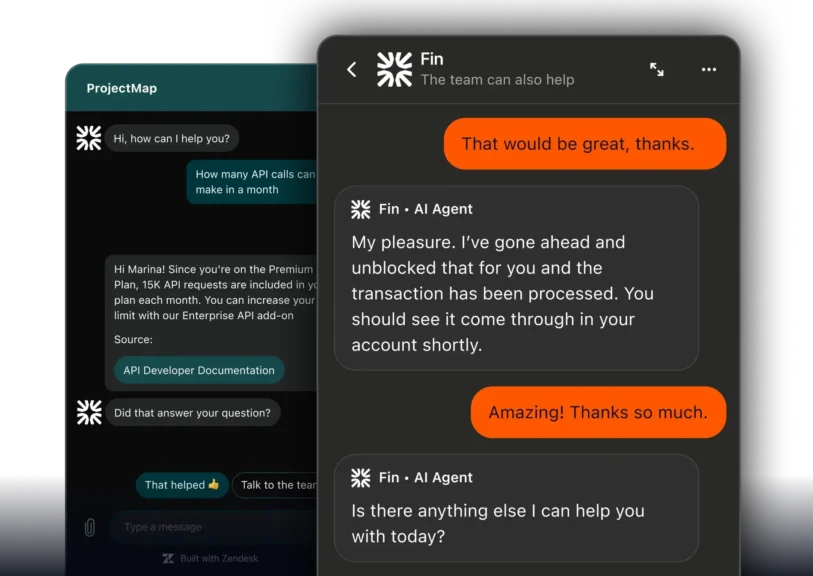
Intercom’s Fin AI — powered by GPT-4 — resolves up to 50% of support queries autonomously and is particularly effective for software and SaaS products because it can be trained on product documentation, release notes, and help articles with minimal configuration. Its strength is depth within digital channels rather than breadth across all channels.
Key Features:
- Fin AI: autonomous multi-step resolution across your knowledge base, trained on your product content
- Messenger for web, mobile, and in-app with rich media support
- Customer data platform: syncs product usage events into every support conversation
- Proactive outbound messaging triggered by user behaviour (feature adoption, inactivity, upgrade triggers)
- Shopify and Stripe integrations for ecommerce context in conversations
G2 Rating: 4.5/5 from 3,800+ reviews
“Fin AI has genuinely reduced our support volume by around 40%. It handles the simple stuff well — where it struggles is nuanced multi-step issues.” — G2 reviewer, B2B SaaS company
Pricing: Essential from $39/seat/month; Fin AI billed per resolution on top of seat fees.
| Pros | Cons |
|---|---|
| Fin AI is among the most capable autonomous resolution AIs for digital channels | Voice support requires third-party integration — not native |
| Best in class for in-app messaging and product-led growth support | WhatsApp integration requires additional setup — not native |
| Proactive outreach based on product behaviour is uniquely powerful | Cost compounds quickly: seat fee + Fin AI per-resolution charges |
| Strong developer APIs and custom integration capability | Not built for contact-centre workflows — no workforce management |
| Good for SMB through mid-market SaaS at reasonable entry price | Less suited for high-volume, multi-language operations |
TL;DR: Best-in-class for digital-first SaaS and subscription brands. Not the right fit for voice-heavy operations, Asian markets where WhatsApp dominates, or businesses with complex contact-centre workflows.
6. Freshdesk
Best for: Growing teams wanting structured omnichannel ticketing with a genuinely usable free plan and affordable scaling
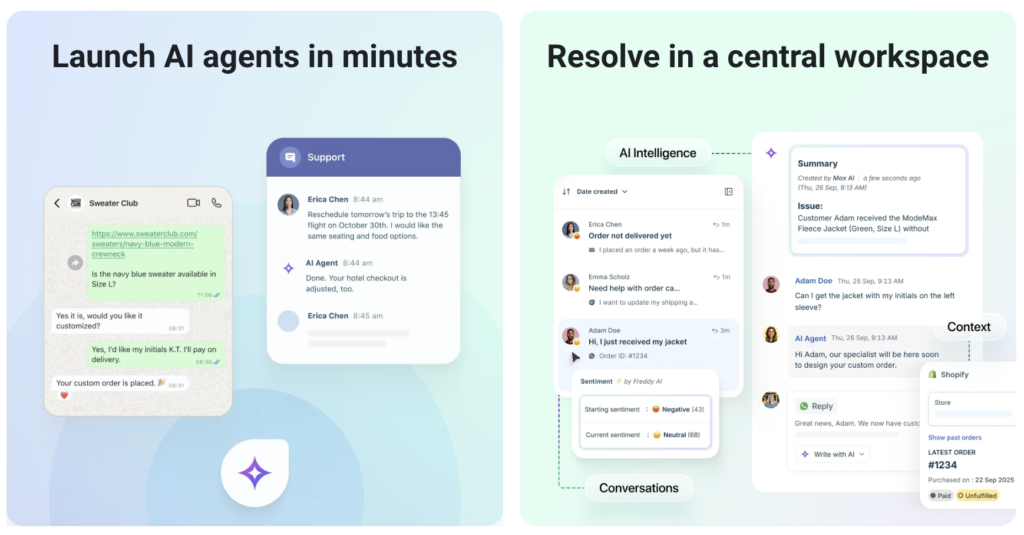
Freshdesk offers the most accessible entry point on this list — a free plan for up to 10 agents covering email and social ticketing. Its AI (Freddy AI) handles categorisation, routing, and reply suggestions, though it’s less autonomous than Sobot, Intercom, or Zendesk AI. The Freshdesk suite bundles Freshchat (messaging), Freshcaller (voice), and Freshdesk (ticketing) — though each is a separate product that must be configured together.
Key Features:
- Freddy AI: auto-categorises tickets, suggests replies, detects intent and sentiment
- Shared team inbox with SLA management and collision detection
- Freshchat for live chat (separate product, bundled in Suite)
- Freshcaller for voice (separate product)
- Shopify, WooCommerce, and CRM integrations via marketplace
G2 Rating: 4.4/5 from 3,700+ reviews
Pricing: Free plan (up to 10 agents, email + social); Growth from $15/agent/month; Pro from $49/agent/month; Freshdesk Suite (includes chat + voice) from $29/agent/month.
| Pros | Cons |
|---|---|
| Best free plan in this category — genuinely functional for small teams | Chat, voice, and ticketing are separate products — omnichannel requires careful configuration |
| Affordable scaling path from free to enterprise | Freddy AI is less capable at autonomous resolution than Sobot, Zendesk AI, or Fin |
| Clean, easy-to-learn interface — lowest learning curve in this list | WhatsApp integration requires Freshdesk Messaging add-on with additional cost |
| Good SLA management and escalation workflows | Suite bundling creates pricing complexity — easy to overpay |
| Large help centre and community for self-service support | Limited native language support for Asian markets |
TL;DR: Start here if your team is under 20 agents and budget is the primary constraint. Plan to evaluate alternatives once ticket volume exceeds 1,000/month or you need strong autonomous AI.
7. NICE CXone
Best for: Large enterprise contact centres needing AI-powered workforce optimisation, quality management, and analytics at scale
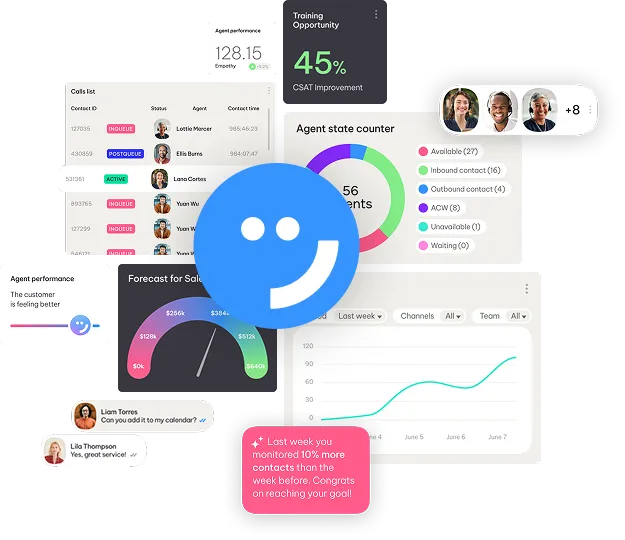
NICE CXone is an enterprise-grade cloud contact centre platform with particularly deep AI capabilities for workforce engagement management (WEM) — forecasting, scheduling, quality monitoring, and agent coaching. For large organisations running contact centres with hundreds of agents, its AI-driven workforce optimisation capabilities are among the strongest available.
Key Features:
- CXone AI: interaction analytics, real-time agent guidance, automated quality scoring
- Workforce engagement management: AI-powered forecasting, scheduling optimisation, and performance coaching
- Enlighten AI: customer sentiment analysis and agent behaviour scoring
- Full omnichannel across voice, digital, and messaging channels
- Open cloud platform with APIs for custom integrations
G2 Rating: 4.3/5 from 1,700+ reviews
Pricing: Custom — typically $100+/agent/month for full enterprise capabilities.
| Pros | Cons |
|---|---|
| Best-in-class workforce management AI — forecasting and scheduling are industry-leading | Enterprise pricing with no transparent starting point |
| Enlighten AI provides unusually deep quality management automation | Complex implementation — typically requires NICE professional services |
| Strong voice AI and speech analytics | Less suited for primarily digital or messaging-first support operations |
| Good regulatory compliance capabilities (financial services, healthcare) | Interface complexity is high — significant admin overhead |
| Proven at scale across large global contact centres | WhatsApp and social channels less mature than voice capabilities |
TL;DR: The right choice for large contact centre operations where AI-driven workforce management and quality scoring are strategic priorities. Overkill for businesses under 100 agents.
8. Kustomer
Best for: High-volume ecommerce and retail brands where complete customer lifetime data needs to be in every support interaction
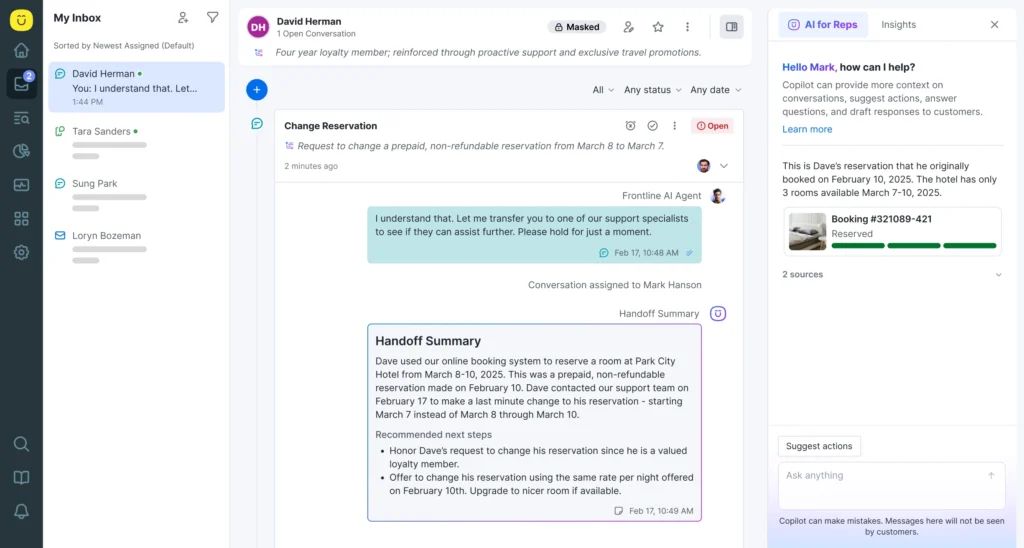
Kustomer‘s differentiating architecture is its native CRM: every customer’s order history, lifetime value, previous interactions, and behavioural data live on a single timeline, visible to every agent in every channel. This eliminates the tab-switching that slows down support in systems where CRM and helpdesk are separate tools.
Key Features:
- Customer timeline: complete order history, LTV, and cross-channel conversation history unified
- AI automation across order status, returns, and FAQ resolution
- Omnichannel: email, chat, voice, WhatsApp, SMS, social in one workspace
- Proactive outbound messaging triggered by order and customer lifecycle events
- Shopify, Magento, and custom CRM integrations
G2 Rating: 4.4/5 from 500+ reviews
“Jerome’s Furniture reduced cost per contact by 40% and achieved NPS two times the industry average after deploying Kustomer.” — Kustomer case study
Pricing: $89/user/month — among the higher-priced options at per-seat level.
| Pros | Cons |
|---|---|
| Best native CRM + omnichannel support combination | Most expensive per-seat price in this list |
| Complete customer context eliminates repeat information requests | Smaller integration marketplace than Zendesk |
| Strong AI for high-frequency ecommerce queries | Complex implementation: typically 4–6 weeks to go live |
| Good omnichannel breadth including WhatsApp and voice | Overkill for businesses under 5,000 tickets/month |
| Acquired by Meta — deep Facebook and Instagram integration | Less established in Asia-Pacific market |
TL;DR: Kustomer earns its price for high-volume retail and ecommerce brands where customer lifetime data belonging in every ticket changes resolution quality. Difficult to justify the cost at lower ticket volumes.
9. Five9
Best for: Outbound-heavy contact centres needing AI-powered voice dialler, predictive outreach, and blended inbound/outbound operations
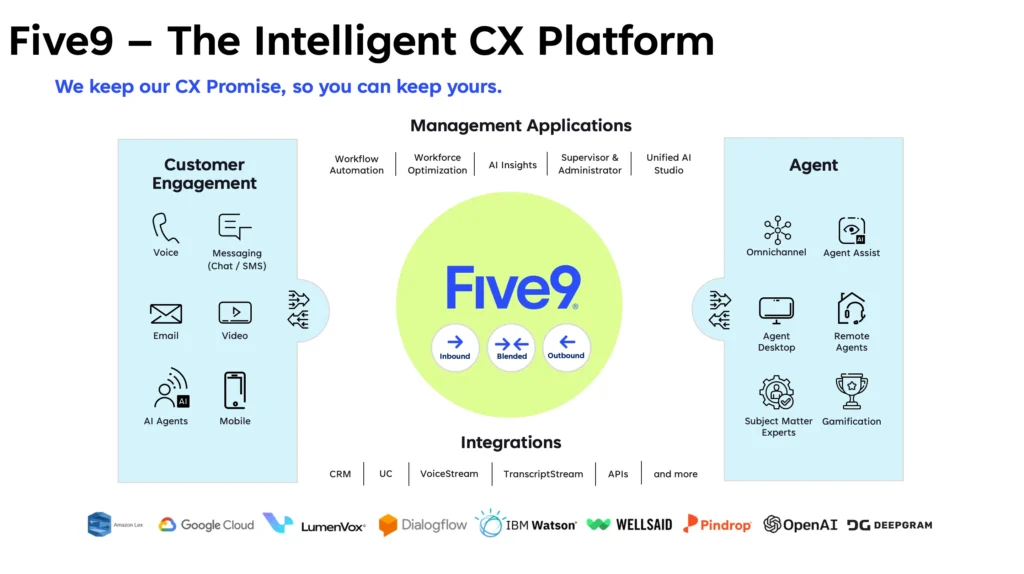
Five9 is a cloud contact centre platform with particularly strong outbound capabilities — predictive dialling, AI-powered voice bots for outbound campaigns, and blended inbound/outbound agent management. For businesses running outbound sales, debt collection, appointment scheduling, or proactive service campaigns alongside inbound support, Five9’s architecture handles the blending better than most.
Key Features:
- Predictive dialler with AI-driven pacing and compliance controls
- Five9 AI: intelligent virtual agents for inbound and outbound voice
- Omnichannel: voice, chat, email, social, SMS, and video
- Agent Assist: real-time transcription, sentiment, and next-best-action guidance
- CRM integrations with Salesforce, Microsoft Dynamics, Zendesk, ServiceNow
G2 Rating: 4.1/5 from 500+ reviews
Pricing: Custom — typically $149+/agent/month for enterprise capabilities.
| Pros | Cons |
|---|---|
| Best-in-class outbound AI dialling and voice automation | Higher cost than digital-first platforms |
| Strong blended inbound/outbound agent management | Digital channels (chat, social) are less mature than voice capabilities |
| Good compliance controls for regulated outbound calling | Limited native WhatsApp integration |
| Solid CRM integrations with major enterprise platforms | Interface complexity requires dedicated admin management |
| AI-powered voice bots handle outbound campaigns autonomously | Less suited for businesses where digital messaging dominates over phone |
TL;DR: Right for contact centres where outbound voice is a core business motion. Not the best fit if most customer interactions are digital or messaging-first.
10. HubSpot Service Hub
Best for: SMBs already using HubSpot CRM that want to extend into structured omnichannel support without migrating data
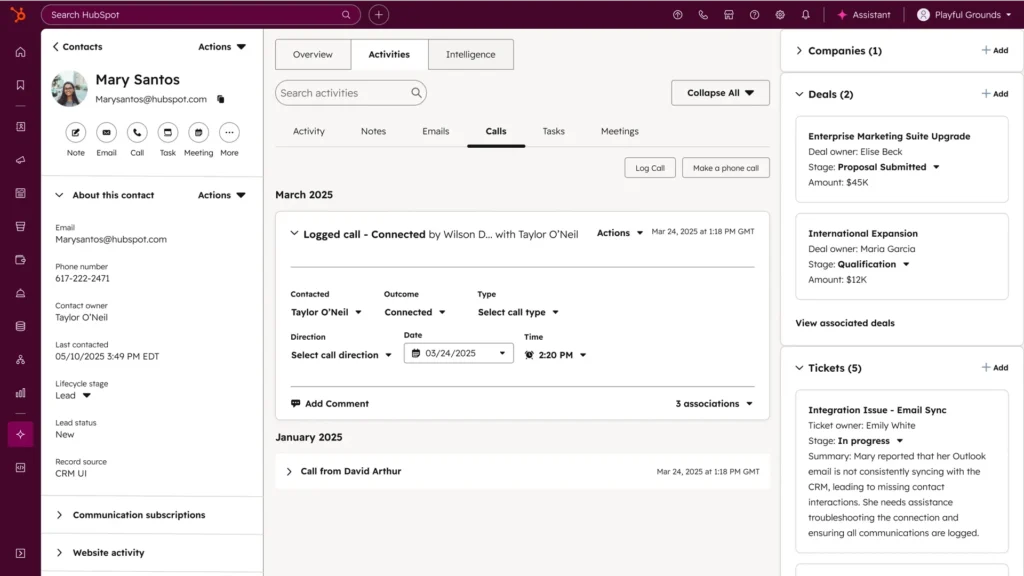
HubSpot Service Hub‘s advantage mirrors Salesforce Service Cloud’s: if your contacts, deals, and customer history already live in HubSpot, Service Hub gives your support team immediate access to that complete context without integration work. Its AI (powered by HubSpot’s AI layer) handles ticket categorisation, suggested replies, and knowledge base content generation — though autonomous resolution capability is less mature than Sobot, Intercom, or Zendesk AI.
Key Features:
- Native HubSpot CRM integration: full contact and deal history in every support ticket
- Omni-channel inbox: email, live chat, Facebook Messenger, WhatsApp (Beta)
- AI reply assistant and ticket categorisation
- Customer portal for self-service ticket tracking
- Knowledge base with AI-assisted content creation
G2 Rating: 4.4/5 from 2,900+ reviews
Pricing: Free plan (basic ticketing); Starter from $15/seat/month; Professional from $90/seat/month.
| Pros | Cons |
|---|---|
| Best choice for HubSpot CRM users — zero data migration required | AI autonomy is less mature than dedicated support platforms |
| Good free plan with basic ticketing and chat | WhatsApp is still in Beta — not production-ready for all use cases |
| Clean, intuitive interface — HubSpot users need no retraining | Professional plan ($90/seat) is expensive for what you get vs. alternatives |
| AI knowledge base creation reduces content effort | Less suited for voice-heavy operations |
| Unified CRM + marketing + support data enables personalised responses | Limited multilingual AI capability |
TL;DR: The logical first choice if your team is already on HubSpot. Evaluate alternatives if you outgrow its AI capabilities or need strong voice and WhatsApp support.
How AI Transforms Omnichannel Support: 6 Key Use Cases
Understanding what AI actually does inside these platforms helps you evaluate which capabilities matter for your business:
Use Case 1: Cross-Channel Context Preservation
The problem: Customer messages on WhatsApp, gets transferred to email, then calls. Agent on the call has no record of previous interactions.
What AI does: Unified customer record pulls all channel interactions onto one timeline automatically. Agent answers the call already knowing the WhatsApp message and email content.
Platforms strongest here: Sobot, Kustomer, Salesforce Service Cloud
Use Case 2: Autonomous Routine Query Resolution
The problem: 60–70% of support tickets are the same 10–15 question types — order status, return policy, password reset, account update. These don’t need a human.
What AI does: AI agent reads the customer’s message, looks up the relevant data (order system, knowledge base, account record), and sends a complete resolution — no human required.
Expected impact: McKinsey research suggests AI can automate 60–70% of routine customer service tasks when properly deployed.
Platforms strongest here: Sobot (83% autonomous resolution in OPPO deployment), Intercom Fin, Zendesk AI
Use Case 3: Intelligent Routing and Prioritisation
The problem: All tickets land in one queue. A high-value enterprise customer’s urgent request sits behind 50 routine queries.
What AI does: Classifies intent, detects sentiment (frustrated vs. informational), identifies customer tier, and routes to the right agent or queue automatically — instantly.
Platforms strongest here: Genesys Cloud CX, NICE CXone, Salesforce Service Cloud
Use Case 4: Real-Time Agent Assist During Live Conversations
The problem: New agent takes a complex call. They don’t know the answer and have to put the customer on hold to search internally.
What AI does: Transcribes the conversation in real time, identifies the topic, surfaces the relevant knowledge base article or suggested response in the agent’s sidebar — without the agent searching.
Platforms strongest here: NICE CXone (Enlighten AI), Genesys Cloud CX, Sobot
Use Case 5: Proactive Outreach Before the Customer Contacts You
The problem: Customer’s order is delayed. They don’t know. They’ll contact support tomorrow, frustrated.
What AI does: Monitors order event data, detects the delay, triggers an automatic proactive WhatsApp or SMS message explaining the situation and offering options — before the customer becomes frustrated.
Platforms strongest here: Sobot (WhatsApp-native proactive messaging), Intercom, Kustomer
Use Case 6: Multilingual Support Without Separate Teams
The problem: You support customers in Singapore, Malaysia, and Indonesia — English, Mandarin, Malay, and Bahasa Indonesia. You can’t hire four separate agent teams.
What AI does: AI chatbot handles first-contact queries in each language natively. Agent workspace translates incoming messages in real time. One team serves multiple language markets.
Platforms strongest here: Sobot (18+ languages with native AI training), Zendesk (translation integrations), Salesforce Service Cloud
Best Platform by Business Scenario
For SMBs (Under 200 Employees)
- Best value with AI: Sobot — enterprise-grade omnichannel AI without enterprise-grade complexity, free trial available
- Best budget starting point: Freshdesk — free plan is genuinely functional; scale affordably
- Best if already on HubSpot: HubSpot Service Hub — zero migration, familiar interface
- Best pure AI chatbot entry: Intercom — Fin AI on digital channels, competitive entry pricing
For Enterprise (200+ Employees, Complex Operations)
- Best true omnichannel + AI at scale: Sobot — proven with OPPO (60 countries), Samsung, Michael Kors
- Best for Salesforce-native organisations: Salesforce Service Cloud — CRM data advantage is decisive
- Best for contact-centre-first enterprises: Genesys Cloud CX or NICE CXone — workforce management depth unmatched
- Best for widest integration ecosystem: Zendesk — 1,000+ integrations, strongest compliance credentials
For Asia-Pacific and Middle East Markets
WhatsApp is the primary customer communication channel in Singapore, Malaysia, Indonesia, UAE, and Saudi Arabia. Standard customer service tools optimised for US/UK markets often treat WhatsApp as an afterthought.
- #1 choice: Sobot — native WhatsApp Business API (not a connector), 18+ language AI, regional case studies across Singapore, Malaysia, OPPO’s 60-country operation
- Alternative with WhatsApp: Kustomer — growing WhatsApp capability with solid CRM architecture
- Budget option: Freshdesk with Freshdesk Messaging add-on — functional but requires configuration work
For Ecommerce and Retail
- Best omnichannel AI for retail at scale: Sobot — Michael Kors, Renogy, OPPO case studies with published metrics
- Best for Shopify-native ecommerce: Kustomer — CRM + support unified, strong Shopify connector
- Best for high-volume outbound campaigns: Five9 — predictive dialling, outbound voice AI
How to Choose: A 4-Step Framework
Step 1: Audit your actual channel mix — not the one you wish you had
List every channel your customers currently use, and what percentage of contacts come from each. If WhatsApp represents 40% of inbound in your market, a platform where WhatsApp is a third-party connector is a structural weakness, not a checkbox. This single step eliminates most mismatched choices.
Step 2: Define your AI ambition clearly
There are two fundamentally different things you can buy: AI that assists agents (suggests replies, routes tickets, surfaces knowledge) and AI that replaces agents for routine tasks (resolves end-to-end without human review). Both have value, but they require different platforms, different change management, and different success metrics. Be explicit about which you’re buying before evaluating.
Step 3: Match to your existing data ecosystem
If your customer data lives in Salesforce, Service Cloud’s advantage is enormous. If it lives in HubSpot, Service Hub has the same advantage. If it lives in custom systems, Sobot or Zendesk with API flexibility matter more than CRM-native integration. Don’t underestimate the cost of migrating or syncing customer data — it often determines project success.
Step 4: Stress-test pricing at three scenarios
Calculate your cost at: (a) current volume, (b) 12-month projected volume, and (c) peak season volume. Per-ticket pricing (Gorgias), per-resolution AI fees (Intercom Fin), and per-seat fees at scale behave very differently. A platform that looks affordable at 500 tickets/month may cost five times more at 5,000 tickets/month.
Frequently Asked Questions
What is the difference between an omnichannel and multichannel customer service platform?
The distinction is in the data, not the number of channels. Multichannel systems let agents handle different channels, but customer data stays siloed per channel — when a customer switches from WhatsApp to email, the new agent has no record of the previous conversation. Omnichannel platforms maintain a single unified customer record across all channels, so context is never lost. According to a Plivo study, 56% of customers are currently forced to repeat their information when switching channels — a direct symptom of multichannel systems masquerading as omnichannel.
Which omnichannel AI platform works best for a business in Singapore or Southeast Asia?
WhatsApp penetration exceeds 83% in Singapore, making native WhatsApp Business API support essential — not optional — for Singapore-facing businesses. Sobot is the strongest choice: native WhatsApp integration (not a connector), AI trained on 18+ languages including Malay and Mandarin, and regional enterprise deployments with OPPO, Samsung, and Michael Kors as reference customers. Kustomer is a credible alternative with growing WhatsApp capability but less regional presence.
Can AI really resolve customer service tickets without a human agent?
Yes — for the right types of queries. AI performs best on high-volume, structured queries: order status, return policy, account lookups, FAQ responses, appointment scheduling. In OPPO’s deployment of Sobot, 83% of customer queries are resolved by AI without human involvement. Intercom’s Fin AI autonomously resolves approximately 50% of queries across its customer base. The key is that “resolved” means a complete, accurate answer — not just a reply that closes the ticket. Complex, emotional, or multi-step queries should always escalate to a human.
How long does it take to deploy an omnichannel AI customer service platform?
It varies significantly by platform and complexity. Freshdesk and Intercom can be live in 2–5 days for basic configurations. Sobot’s standard omnichannel deployment takes 1–2 weeks. Zendesk and Kustomer typically take 4–8 weeks with implementation partner support. Salesforce Service Cloud and Genesys Cloud CX implementations commonly run 8–16 weeks. The time is usually dominated by data migration, CRM integration, and AI training on your knowledge base — not the platform itself.
What should I look for in an AI customer service platform if I’m a small business?
Three things: (1) A free or low-cost starting point that’s genuinely functional — Freshdesk and HubSpot Service Hub both have real free plans. (2) AI that grows with you — you want autonomous resolution capability in the roadmap even if you don’t need it today. (3) WhatsApp integration if your customers are in Asia — this is a day-one requirement in Southeast Asia, not a future nice-to-have. Sobot offers a free trial specifically designed for teams evaluating its omnichannel capability before committing.
Is it worth switching from Zendesk to an AI-first platform?
Depends on why you’re evaluating. If your core pain is that Zendesk’s AI capabilities cost significantly extra and require add-ons, platforms like Sobot (AI native, not bolted on) or Intercom address that directly. If your pain is channel coverage — especially WhatsApp or voice — Zendesk’s third-party connector approach creates friction that native platforms eliminate. If you’re primarily unhappy with price at scale, Freshdesk, HubSpot, or Sobot’s custom pricing may be more favourable depending on your usage pattern.
How do omnichannel AI platforms handle multilingual customer support?
This varies considerably and is often undersold in product marketing. True multilingual AI means the AI is trained on conversation patterns in each language — not just running English responses through a translation engine. Sobot supports 18+ languages with native AI training, making it the strongest option for businesses serving customers in multiple Asian languages simultaneously. Zendesk and Salesforce handle multilingual through integrations and translation tools. Most other platforms on this list are primarily English-first with basic translation capability.
What metrics should I use to evaluate whether my omnichannel AI platform is performing?
Six core metrics:
- AI resolution rate — what percentage of tickets are fully resolved by AI without human escalation?
- First-contact resolution (FCR) — are issues resolved in one interaction across all channels?
- Cross-channel escalation rate — how often do customers have to restart their context when switching channels?
- Average handle time (AHT) — are agents spending less time per ticket as AI handles more routine work?
- CSAT by channel — is satisfaction consistent across all channels, or does one channel underperform?
- Cost per contact — as AI takes over routine work, is your cost per resolved ticket decreasing?
Conclusion
An omnichannel AI customer service platform is no longer a competitive advantage for forward-thinking businesses — it’s becoming table stakes. The question is not whether to invest, but which platform fits your channel mix, customer geography, and growth stage.
- For businesses operating in Asia or markets where WhatsApp is central to customer communication, Sobot offers the most complete native solution — AI that resolves rather than assists, true omnichannel data unification, and a proven track record with enterprise deployments across Samsung, OPPO, Michael Kors, and Renogy.
- For Salesforce-native enterprises, Service Cloud offers unmatched CRM data depth.
- For large contact centres where workforce management is the priority, Genesys Cloud CX or NICE CXone lead the field.
- For teams starting out, Freshdesk provides a genuine free entry point with a clear scaling path.
Start with a 15-day free trial of Sobot — no credit card required — to see unified omnichannel AI in your actual environment, or request a demo tailored to your industry and team size.