At a Glance
- Sobot — Best for enterprises needing high AI automation rates with true omnichannel coverage including voice, WhatsApp, and Amazon
- Zendesk — Best for large teams that need a proven, ecosystem-rich helpdesk with extensive integrations
- Freshdesk — Best for SMBs wanting a budget-friendly Intercom alternative with a free tier to start
- Yellow AI — Best for enterprises needing multilingual AI across complex dialog flows in Asia-Pacific markets
- Ada — Best for companies that want AI-only automation with a no-code setup and minimal human-agent overhead
- Chatbase — Best for startups and SMBs that need a deployable AI chatbot in hours without engineering resources
- HubSpot Service Hub — Best for HubSpot users who want customer service built natively into their CRM
- Tidio — Best for small e-commerce stores that need an affordable live chat + AI combo with fast setup
- Zoho Desk — Best for Zoho ecosystem users looking for a cost-effective, feature-complete helpdesk
- Gorgias — Best for Shopify-first DTC brands managing high-volume order-related support in the US market
Intercom built a strong reputation as a conversational customer service platform, and its Fin AI agent is one of the most talked-about AI features in the industry. But when businesses search for alternatives, the most common driver is not a dislike of Intercom — it is a need for capabilities Intercom has not fully delivered: integrated voice, deeper omnichannel coverage beyond web chat, stronger automation rates at scale, and transparent, predictable pricing.
According to a February 2026 Gartner survey of 321 customer service leaders, 91% are under executive pressure to implement AI — with improving customer satisfaction and self-service success as the top priorities. Separately, Gartner predicts agentic AI will autonomously resolve 80% of common customer service issues without human intervention by 2029, alongside a 30% reduction in operational costs. As AI becomes table stakes, the differentiator shifts to how deeply AI is woven into the platform — not as a bolt-on, but as an architectural foundation.
This article evaluates 10 platforms that serve as genuine Intercom alternatives, with particular attention to AI depth, channel coverage, and real-world automation outcomes. We reviewed G2 ratings, user-reported resolution rates, and published customer case data.
How We Evaluated These Intercom Alternatives
- AI automation depth — Does the platform resolve queries autonomously, or merely suggest replies to agents?
- Omnichannel coverage — Beyond web chat: voice, WhatsApp, social media, e-commerce platforms
- Agent-assist quality — AI Copilot capabilities: real-time translation, auto-summary, smart reply, ticket auto-fill
- Analytics and insight — AI-powered reporting, QA scoring, CSAT monitoring, conversation heatmaps
- Integration ecosystem — CRM, e-commerce (Shopify, Amazon, Walmart), and API extensibility
- Deployment flexibility — SaaS, private cloud, or on-premises options
- Pricing transparency — Published pricing vs. sales-only quoting
- Enterprise readiness — Security certifications, compliance, uptime SLAs, and dedicated support
Quick Comparison Table
| Tool | Best For | AI Strength | Key Limitation | Price Range | G2 Rating |
|---|---|---|---|---|---|
| Sobot | Enterprise AI + omnichannel (voice + chat + Amazon) | 4-layer AI architecture; 80%+ automation | Pricing requires sales demo; newer in Western markets | Contact sales | 4.9 / 44 reviews |
| Zendesk | Large enterprise teams with complex helpdesk needs | AI via acquisitions; moderate depth | AI feels bolted on; no Amazon integration | From $55/agent/mo | 4.3 / 7,186 reviews |
| Freshdesk | SMBs seeking a budget-friendly Intercom alternative | Freddy AI; mid-tier automation | Full omnichannel requires multiple Freshworks products | Free tier; paid from $15/agent/mo | 4.4 / 3,723 reviews |
| Yellow AI | Enterprise multilingual AI deployments in APAC | Strong dialog AI; multi-language; complex flows | Long implementation cycles; complex configuration | Contact sales | 4.4 / 106 reviews |
| Ada | Pure AI automation with no-code conversation flows | AI-only; high containment rate; no human agent module | Weak human escalation; not a full helpdesk | Contact sales | 4.6 / 170 reviews |
| Chatbase | Startups needing fast AI chatbot deployment | GPT-powered; 80+ languages; fast to launch | Limited enterprise depth; no helpdesk or voice | Free tier; paid from $19/mo | 4.8 / 19 reviews |
| HubSpot Service Hub | HubSpot CRM users adding customer service | AI reply suggestions; basic automation | AI resolution rate lags dedicated platforms | Free tier; paid from $15/seat/mo | 4.4 / 2,905 reviews |
| Tidio | Small e-commerce stores with tight budgets | Lyro AI; resolves ~70% of common queries | Scales poorly beyond SMB; English-market focused | Free tier; paid from $29/mo | 4.6 / 1,899 reviews |
| Zoho Desk | Zoho ecosystem users wanting a low-cost helpdesk | Zia AI; mid-tier; basic suggestions | AI depth falls behind modern AI-native platforms | Free tier; paid from $14/agent/mo | 4.4 / 7,496 reviews |
| Gorgias | Shopify-first DTC brands in the US | Revenue-linked automation; Shopify-native | Essentially Shopify + US only; no WhatsApp, no voice | From $10/mo (usage-based) | 4.6 / 552 reviews |
1. Sobot — Best AI Architecture for Enterprises Replacing Intercom
Best for: Mid-market and enterprise teams in e-commerce, retail, logistics, and finance that need high AI automation rates, omnichannel coverage from web chat to voice to WhatsApp, and a platform built on AI since 2014 — not AI added after the fact.
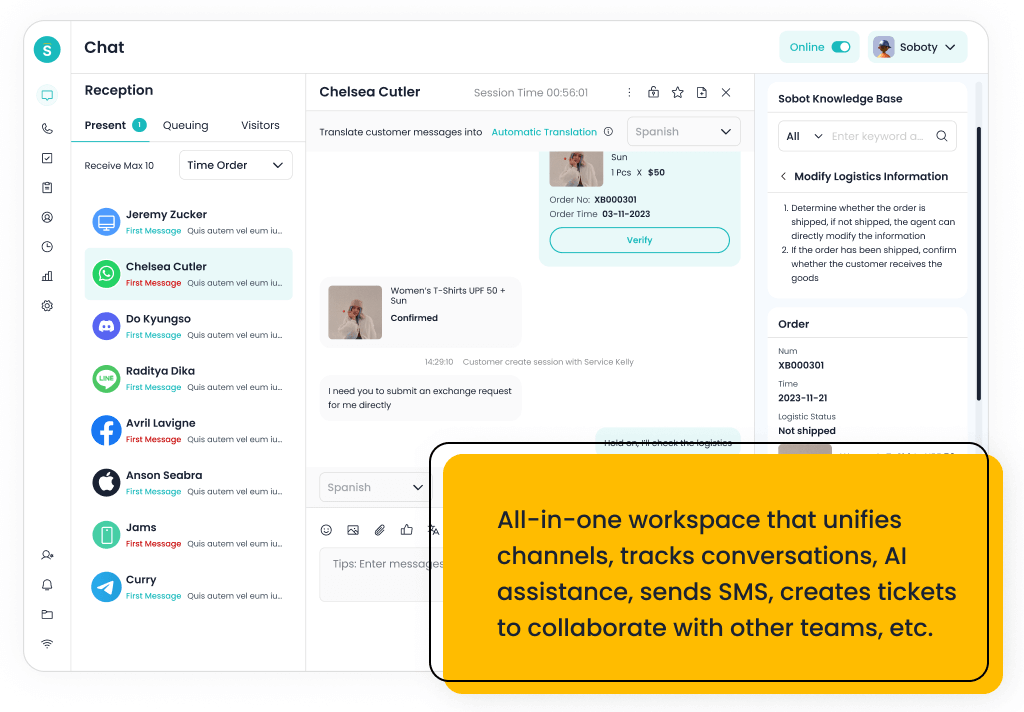
Sobot has been building AI into customer service since 2014, when it launched as an AI chatbot company. That founding DNA shows: AI is not a feature layer at Sobot — it is the structural framework around which every product is built — a fundamentally different approach from platforms that added AI later. Today, 73% of conversations are handled by Sobot’s AI Agent, with a 62% independent resolution rate across chat, voice, email, and social channels.
Sobot’s 3-Layer AI Architecture
Sobot organizes its AI capabilities across three interconnected layers, each serving a distinct role in the customer service workflow:
❶ AI Agent — Customer-Facing Automation
The autonomous conversation layer. Sobot’s AI Agent uses a three-tier routing engine to process incoming queries with precision and cost efficiency: keyword matching handles 65% of conversations in under 1ms; vector similarity handles 25% in approximately 20ms; and LLM classification resolves the remaining 9% using full reasoning at approximately 300ms. This means the vast majority of queries are resolved instantly without burning LLM cost on every interaction. The AI Agent draws from knowledge bases built from URLs, PDFs, Word documents, Excel files, and unstructured text, and supports 50+ languages with automatic language recognition.
❷ AI Copilot — Agent Assistance
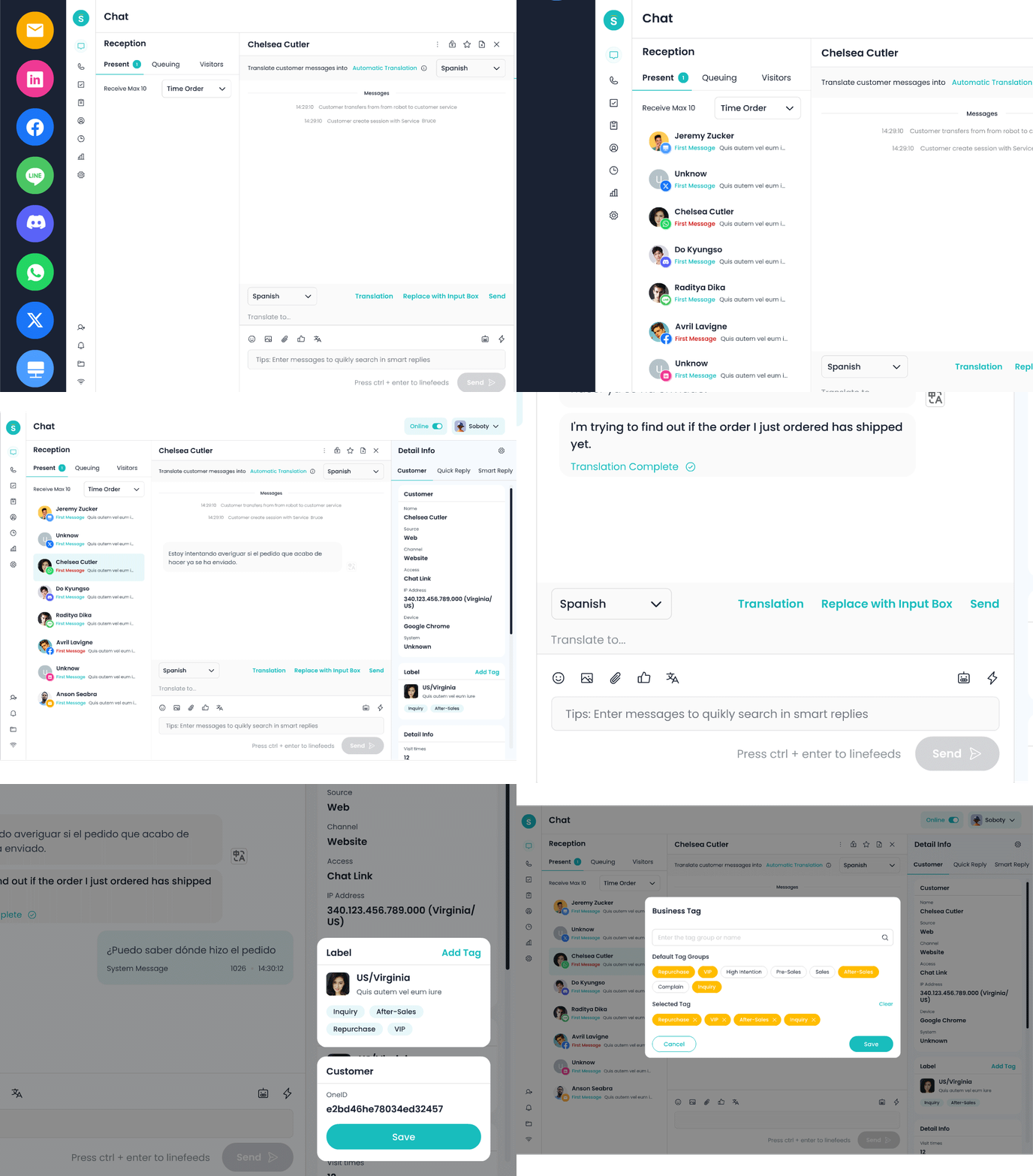
The live agent productivity layer. When conversations escalate to human agents, AI Copilot activates in real time: translating messages across 70+ languages in-conversation, generating smart reply suggestions from the knowledge base, auto-creating and filling tickets, and producing conversation summaries at handoff. This directly reduces handle time and eliminates the friction of multilingual support queues.
❸ AI Insight — Management Intelligence
The operational analytics layer. AI Insight delivers quality inspection at scale, automated CSAT scoring, conversation heatmaps showing where customers drop off, A/B testing across bot flows, and 300+ configurable analytics indicators — all without manual sampling. It gives CX leaders a real-time view of both agent performance and AI effectiveness.
Multi-Agent Architecture (2026 Platform)
Sobot’s 2026 platform introduces specialized AI sub-agents — After-Sales, Technical Support, Sales Advisor, and Billing — each operating within a defined domain and combining RAG retrieval, workflow automation, and ReAct reasoning. A coordinator routes conversations to the right specialist agent based on intent, enabling complex, multi-intent interactions to be handled without defaulting to a human agent.
Channel Coverage
Sobot covers every channel Intercom touches — and several it does not. Alongside web chat, WhatsApp (as a Meta official BSP), Facebook, Instagram, Telegram, and LINE, Sobot natively integrates Amazon, Walmart, Lazada, TikTok Shop, and Shopify order data directly into the agent workspace.
Voice is not a separate product: inbound IVR, intelligent routing, outbound calls, and an AI voicebot share the same platform and conversation history with digital channels.
Real Customer Results
- SAMSUNG: CSAT 97%+, inquiry conversion rate +15%, agent productivity +30%
- SHEIN: Agent productivity +14%, customer satisfaction +22%, merchant satisfaction +26%
- realme: Agent productivity +48%, resolution rate 80%+, CSAT 97%+
- RENOGY: Chatbot answering rate +35%, resolution rate +44%, CSAT 95%+
- Flower Chimp (Southeast Asia): Agent productivity +63%, customer satisfaction +35%
G2 Rating: 4.9/5 (44 reviews) — G2 Summer 2025 Leader, Easiest Admin, Best Relationship, High Performer, Users Love Us, Easiest to Do Business With.
“The AI features in Sobot are genuinely impressive — the copilot handles translation and summarization in real time, which was the single biggest pain point we had with Intercom for our multilingual team.” — G2 reviewer
| Pros | Cons |
|---|---|
| AI built from the ground up in 2014, not retrofitted | Enterprise pricing requires a sales demo; no public rate card |
| 3-layer AI architecture with tiered routing engine (keyword → vector → LLM) | Brand awareness in North America still building; strongest presence is APAC |
| Amazon + Walmart + Lazada e-commerce integrations (rare in the market) | Full-feature self-serve signup not available; demo required |
| Voice and chat unified in one platform; supports private cloud and on-premises | G2 review volume smaller than Zendesk or Freshdesk (44 vs. 7,000+) |
Price: Contact sales (see pricing overview). Positioned at approximately two-thirds the cost of comparable enterprise platforms.
TL;DR: Sobot is the strongest Intercom alternative for teams where AI automation depth and omnichannel breadth — including voice, Amazon, and WhatsApp — are non-negotiable. Best suited for mid-market and enterprise teams in retail, e-commerce, and logistics. Teams that need a self-serve trial or are firmly US-only may need to explore further.
2. Zendesk — Best for Enterprise Teams That Need a Proven Ecosystem
Best for: Large support organizations (200+ agents) in the US and Europe that are already embedded in the Zendesk ecosystem and need reliable, extensible infrastructure over cutting-edge AI.
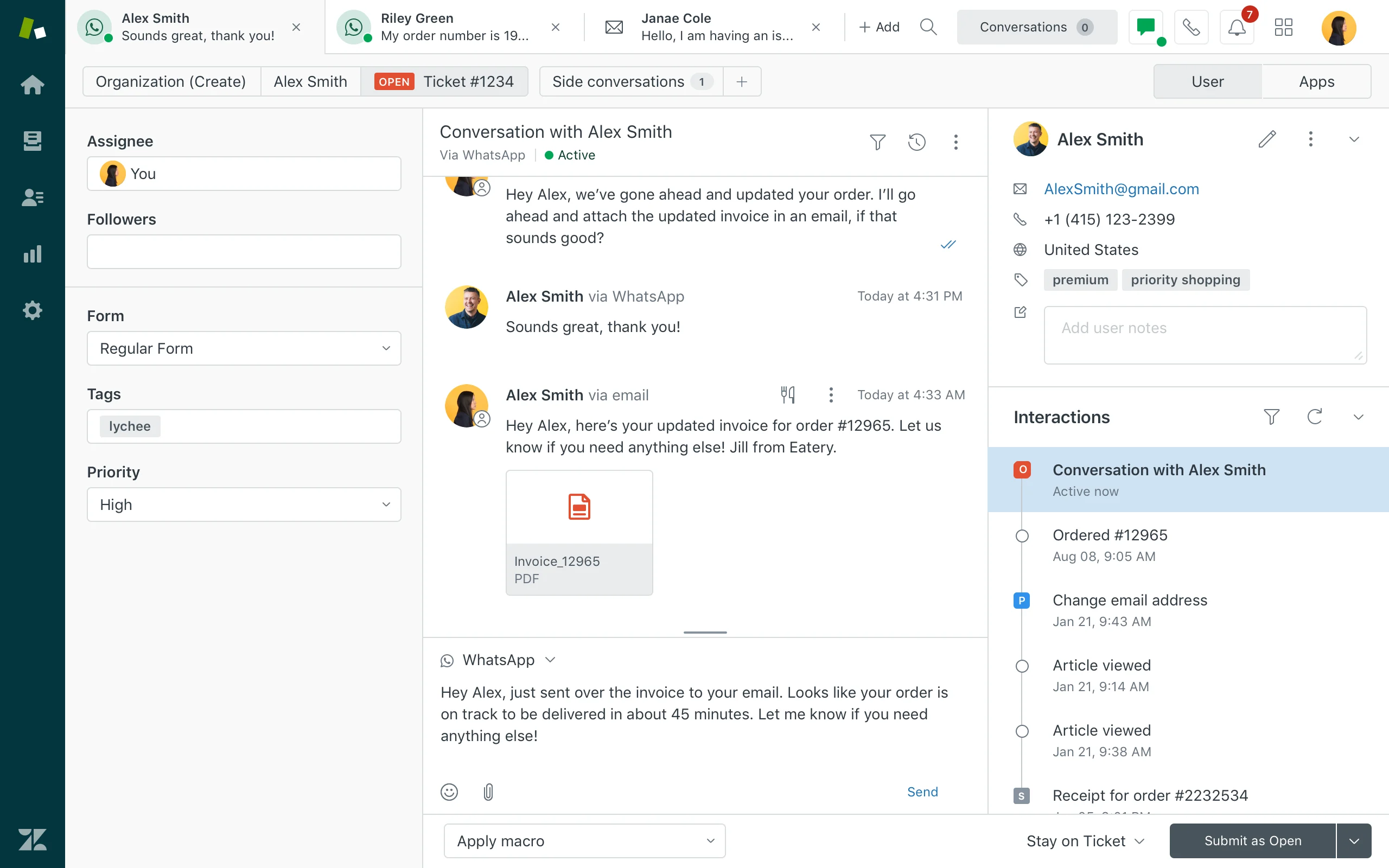
Zendesk was founded in 2007 as a ticketing system. Over 18 years it has grown into the most widely deployed enterprise helpdesk in the world, with 7,186 G2 reviews and integrations with 1,500+ apps. Its AI capabilities, primarily acquired through its purchase of Forethought, are functional but carry the weight of being added on top of an existing architecture rather than built into it.
Zendesk — Core Features
- Unified ticket and conversation management across email, chat, phone, and social
- Zendesk AI: suggested replies, intent classification, ticket summarization
- Voice support via Zendesk Talk
- App Marketplace with 1,500+ pre-built integrations
- Workforce management and quality assurance add-ons at higher tiers
G2 Rating: 4.3/5 from 7,186 reviews
“Zendesk has everything we need for structured enterprise support, but the AI features feel like a product trying to catch up with the market rather than lead it.” — G2 reviewer
| Pros | Cons |
|---|---|
| Largest integration marketplace in the industry (1,500+ apps) | AI acquired through Forethought purchase; architectural integration feels bolted on |
| Mature, battle-tested infrastructure at global scale | No native Amazon e-commerce integration |
| Strong WFM and QA tooling in higher tiers | AI and advanced features gated behind expensive Enterprise tier |
Price: Suite Team from $55/agent/month; AI features require Enterprise tier or add-on.
TL;DR: Zendesk is the right choice if you need a proven, deeply integrated enterprise helpdesk and accept AI capabilities that are improving but lag AI-native competitors. Not the right choice if AI automation rate is your primary criterion.
3. Freshdesk — Best Budget-Friendly Intercom Alternative
Best for: SMBs (10–200 agents) that need a capable helpdesk with moderate AI and are price-sensitive. Teams that want a free tier to prove value before committing.
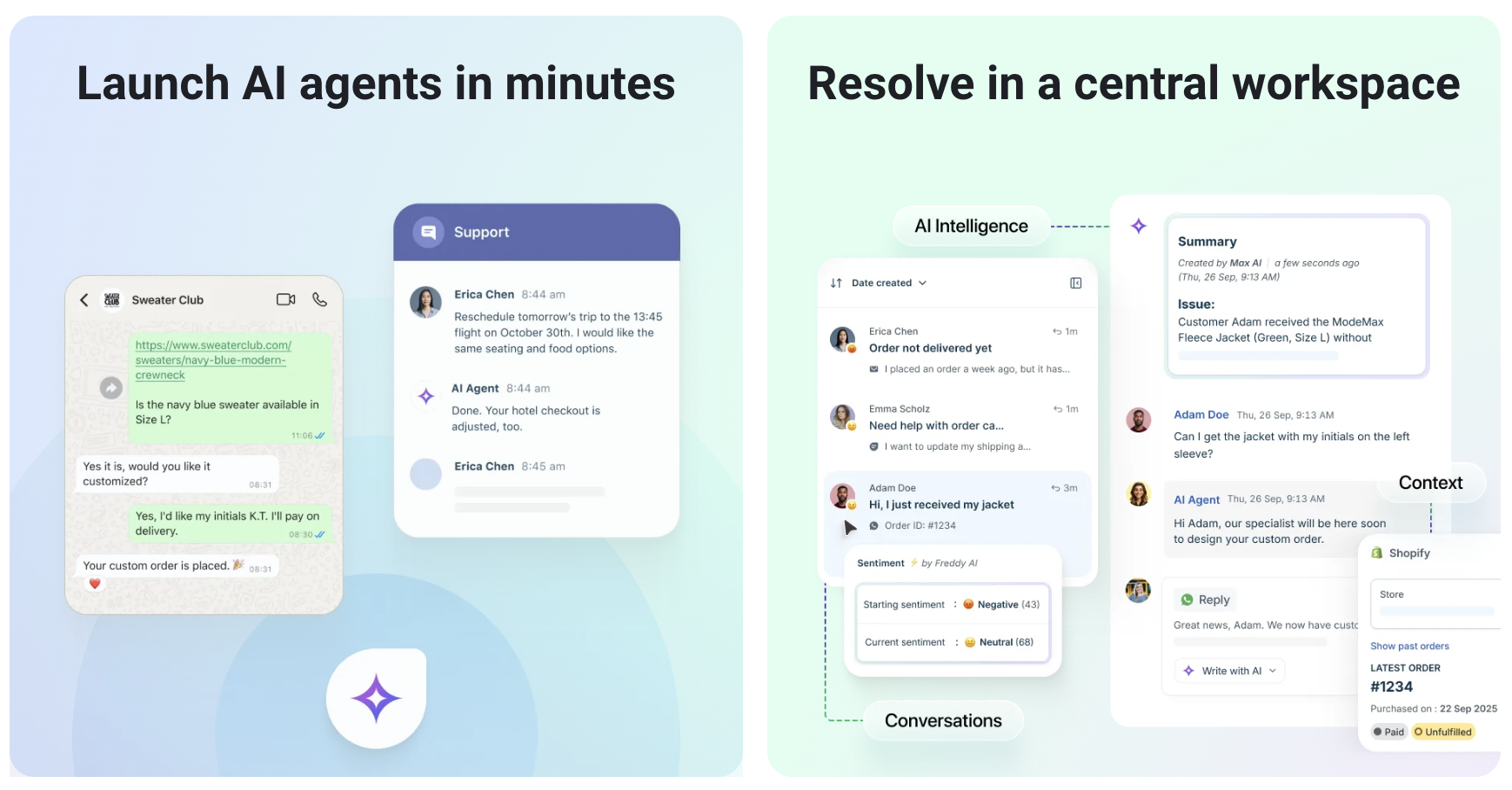
Freshdesk, part of the Freshworks suite, is one of the most commonly cited Intercom alternatives for companies leaving due to cost. With a genuine free plan and paid tiers starting at $15/agent/month, it hits price points Intercom does not. Its AI layer (Freddy AI) covers suggested replies, auto-tagging, and basic sentiment detection. Full omnichannel — especially voice and WhatsApp — requires bundling additional Freshworks products.
Freshdesk — Core Features
- Multi-channel inbox: email, chat, social, phone (via Freshcaller add-on)
- Freddy AI: auto-categorization, suggested replies, predictive escalation
- Free tier with core helpdesk features for unlimited agents
- Marketplace with 1,000+ integrations including Shopify and Salesforce
- SLA management and CSAT survey automation included from Growth tier
G2 Rating: 4.4/5 from 3,723 reviews
“We moved from Intercom to Freshdesk for cost reasons and got 80% of what we needed at 40% of the price. The AI is not as strong, but for our volume it is more than sufficient.” — G2 reviewer
| Pros | Cons |
|---|---|
| Free tier is genuinely functional, not crippled | Full omnichannel requires separate Freshworks products (Freshchat, Freshcaller) |
| Lowest cost entry point among established helpdesks | Freddy AI autonomous resolution rate lags AI-native platforms significantly |
| Easy onboarding; most SMB teams go live within a week | No native Amazon or Lazada e-commerce integration |
Price: Free for unlimited agents (basic features); Growth from $15/agent/month.
TL;DR: Freshdesk is the clearest budget alternative to Intercom. It will not match Intercom’s AI depth, but for cost-driven decisions it delivers strong value. Avoid if you need unified voice + chat + e-commerce without stitching products together.
4. Yellow AI — Best Enterprise AI for Multilingual Markets
Best for: Enterprise teams in Asia-Pacific, the Middle East, or any market where multilingual dialog AI is a core requirement and implementation complexity is acceptable.
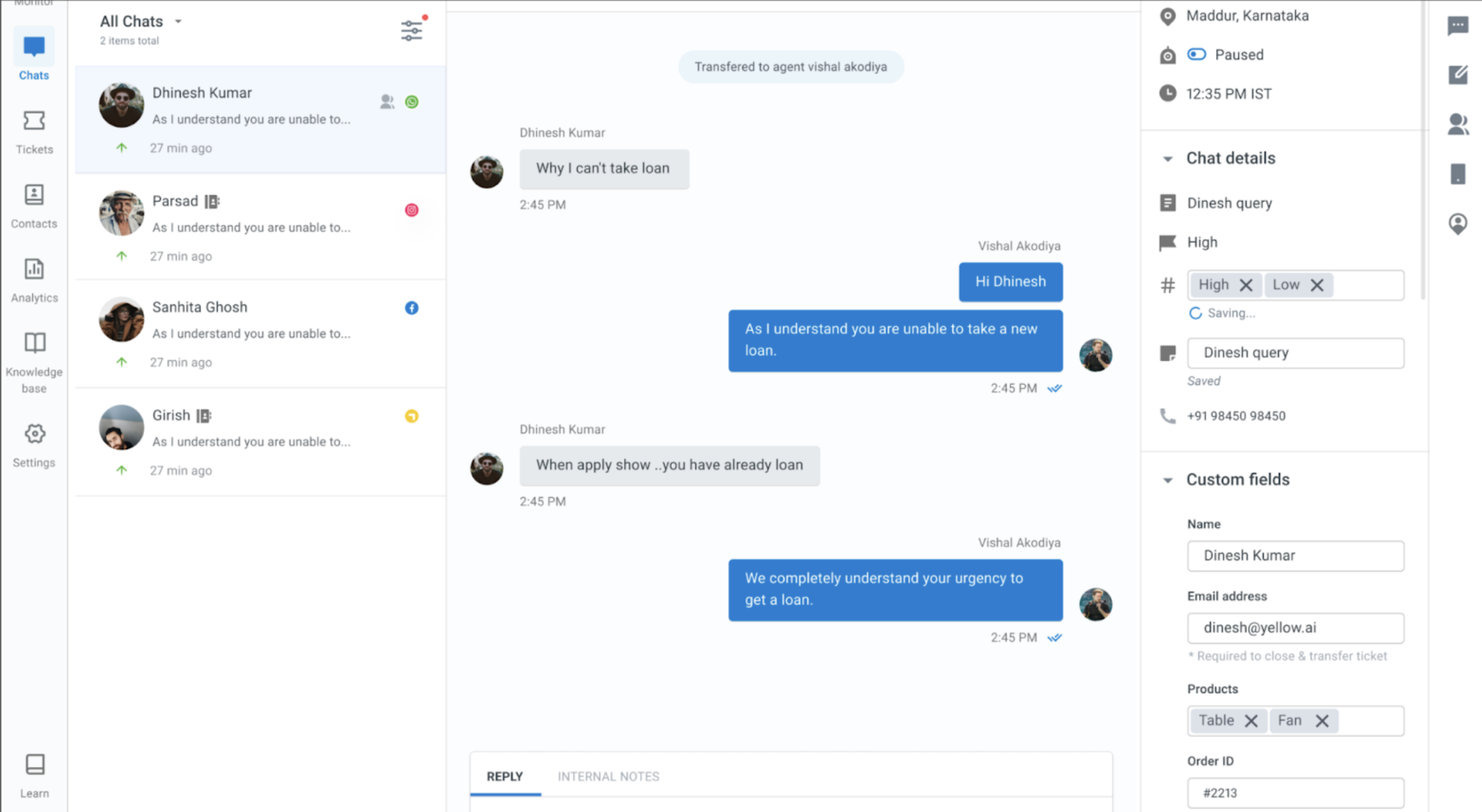
Yellow AI (yellow.ai) is an enterprise conversational AI platform purpose-built for complex, multilingual customer interactions at scale. Unlike platforms where multilingual support is an add-on, Yellow AI’s dialog engine is designed from the ground up for language diversity — making it a genuine option for businesses operating across Southeast Asia, South Asia, or the Middle East where regional language coverage determines AI effectiveness.
Yellow AI — Core Features
- Multi-language dialog AI capable of handling regional dialects and code-switching
- Conversational AI across chat, WhatsApp, email, and voice channels
- Pre-built intent libraries for common customer service scenarios by industry
- Dynamic conversation flows with condition branching and API integrations
- Analytics dashboard with containment rate, intent accuracy, and drop-off tracking
G2 Rating: 4.4/5 from 106 reviews
“Yellow AI handles our multilingual flows across 5 languages better than anything else we evaluated. The trade-off is implementation took much longer than we expected — plan for a 3-month project, not a 3-week one.” — G2 reviewer
| Pros | Cons |
|---|---|
| Multilingual AI depth unmatched in the APAC market | Implementation is complex; expect 2–4 month deployment timelines |
| Strong enterprise credentials across Asia-Pacific | Pricing requires sales engagement; no self-serve option |
| Coverage spans chat, WhatsApp, voice, and email in a single AI layer | Less useful as a standalone platform without existing helpdesk infrastructure |
Price: Contact sales. Enterprise-tier pricing.
TL;DR: Yellow AI is the right call if multilingual conversational AI in APAC or Middle East markets is your hardest requirement and you have the implementation runway. Not recommended if you need to go live in weeks or need a full helpdesk, not just an AI layer.
5. Ada — Best Pure AI Automation Platform
Best for: Companies that want maximum AI containment rate with a no-code conversation builder and are comfortable routing human escalations to a separate helpdesk tool.
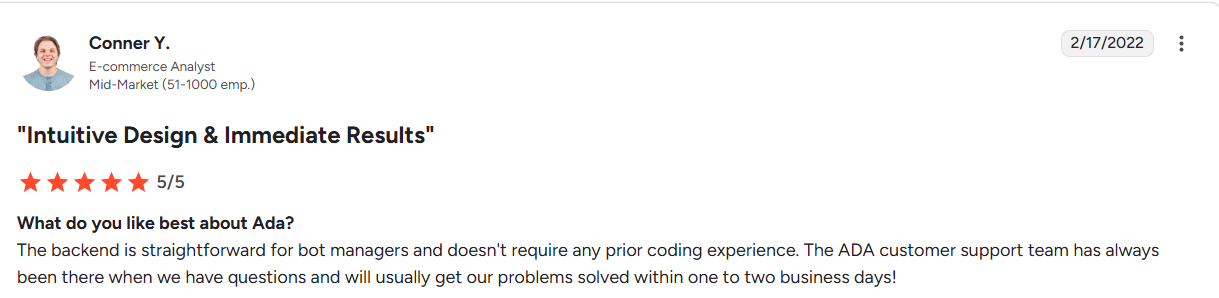
Ada is one of the clearest examples of AI-first architecture in the market. Its positioning is deliberate: Ada does not try to be a full helpdesk. It focuses entirely on maximizing AI-handled conversations, with a no-code interface that lets non-technical teams build and maintain sophisticated conversation flows. Teams using Ada typically pair it with Zendesk or Salesforce Service Cloud for the human escalation layer.
Ada — Core Features
- No-code conversation flow builder with condition branching and API triggers
- AI trained on company knowledge base with continuous learning from flagged gaps
- Multi-channel deployment: web, mobile, WhatsApp, and messaging apps
- Native integrations with Zendesk, Salesforce, and 30+ helpdesk tools for escalation handoff
- Analytics on containment rate, intent hit rate, and escalation reasons by topic
G2 Rating: 4.6/5 from 170 reviews
“Ada delivered a 65% containment rate within 8 weeks of deployment. The no-code builder means our CX team can update flows without ticketing engineering.” — G2 reviewer
| Pros | Cons |
|---|---|
| Best-in-class no-code AI conversation builder | No human agent module; requires a separate helpdesk for escalation |
| High containment rate; purpose-built for AI automation | Pricing not published; enterprise-level cost that may not suit SMBs |
| Clean integrations with major helpdesk platforms for hybrid deployment | Limited channel depth outside chat and messaging; not a voice solution |
Price: Contact sales.
TL;DR: Ada is the right choice if AI containment rate is your singular focus and you already have a helpdesk handling human agent work. It is not a platform replacement for Intercom — it is an AI automation layer designed to sit in front of one.
6. Chatbase — Best for Fast AI Chatbot Deployment Without Engineering
Best for: Startups and SMBs that need a working AI chatbot in hours, not months — and are primarily deploying on websites or in apps where advanced enterprise workflows are not required.
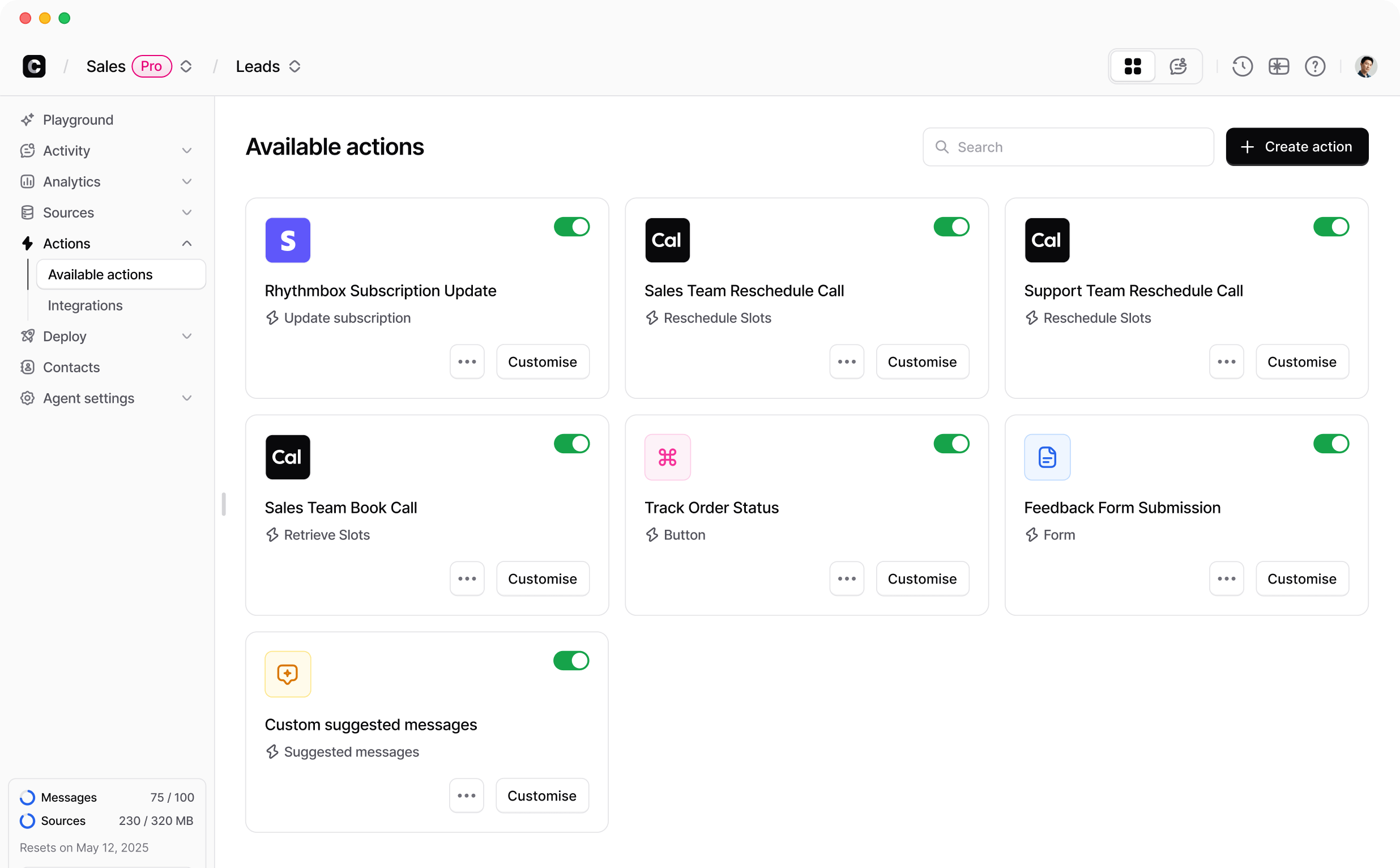
Chatbase has grown rapidly as a product-led growth (PLG) tool for AI chatbot deployment. Built on GPT-based models, it allows any team — regardless of technical skill — to upload a knowledge base (documents, URLs, text) and publish a branded AI chatbot within the same day. With over 10,000 brands using the platform and support for 80+ languages, it has earned a strong reputation for the specific use case of fast, low-friction AI chat deployment.
Chatbase — Core Features
- GPT-powered AI chatbot trained on custom knowledge bases (PDF, URL, plain text)
- 80+ language support out of the box
- Website embed, API access, and messaging app integrations
- Conversation analytics: message volume, resolution rate, fallback rate by topic
- White-labeling for agencies and resellers
G2 Rating: 4.8/5 from 19 reviews (high rating, early-stage review volume)
“We had a working AI chatbot answering 60% of our FAQ traffic within two days of uploading our help docs. Nothing else we tried came close for ease of setup.” — G2 reviewer
| Pros | Cons |
|---|---|
| Fastest time to live AI chatbot in this comparison | G2 review volume is limited (19 reviews); enterprise credibility still building |
| No technical skills required; any content team can deploy | No human agent handoff, ticketing, or voice — not a full helpdesk replacement |
| 80+ language support included without add-ons | Customization depth limited for complex multi-step enterprise workflows |
Price: Free tier available; paid plans from $19/month.
TL;DR: Chatbase is ideal for lean teams that need AI on their website now and do not require escalation flows, agent management, or enterprise-grade analytics. As a full Intercom replacement, it covers only the chatbot use case.
7. HubSpot Service Hub — Best for HubSpot CRM Users
Best for: Businesses already operating on HubSpot CRM that want to extend the same platform to customer service without introducing new vendors.
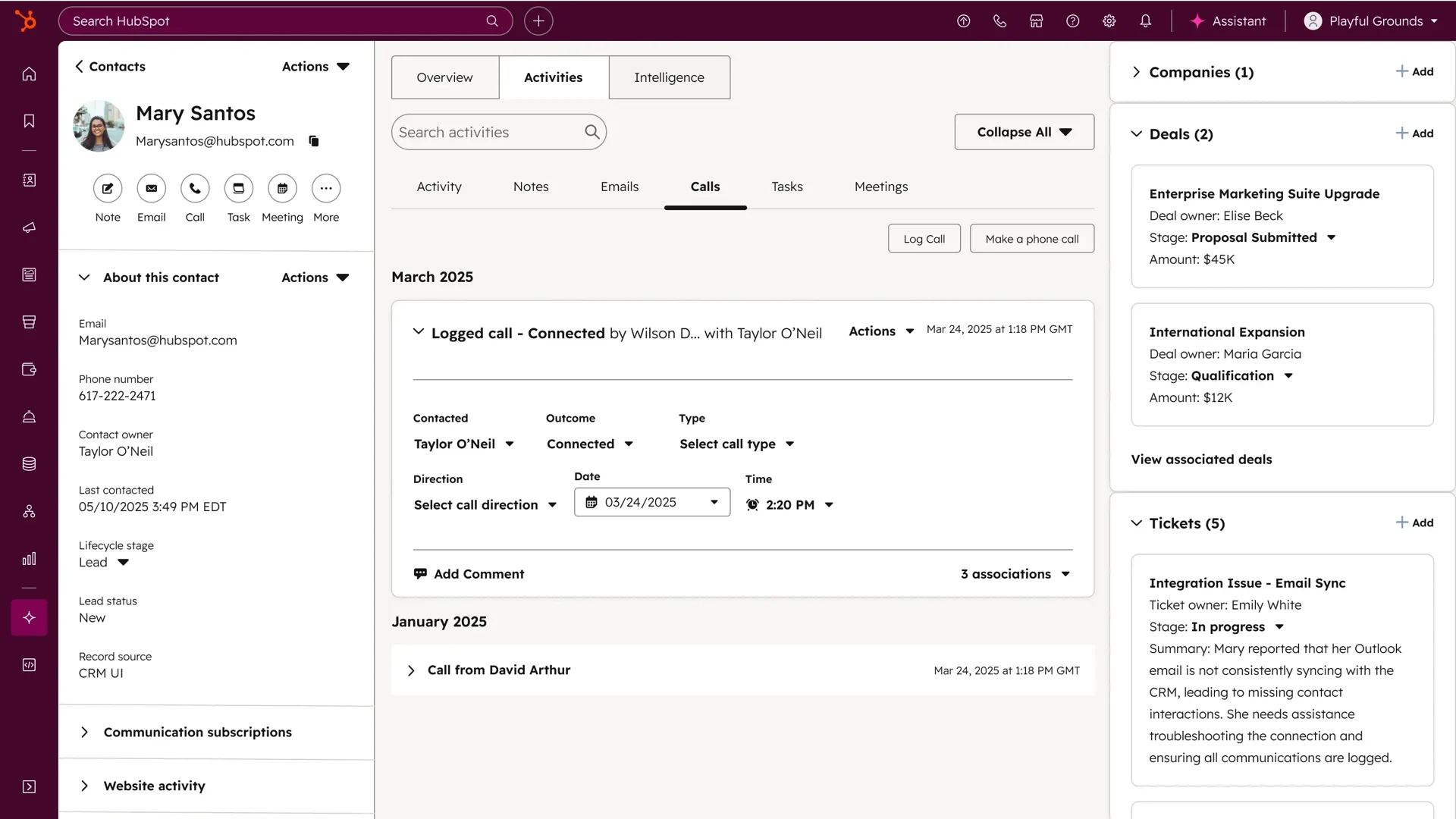
HubSpot Service Hub is the customer service module within HubSpot’s broader platform, sharing the same contact database, pipeline data, and automation engine as HubSpot Marketing and Sales. For teams fully committed to the HubSpot ecosystem, Service Hub removes the integration burden that comes with every other tool on this list. Its AI capabilities — reply suggestions, conversation summarization, and basic chatbot flows — are competent but not the primary reason to choose it.
HubSpot Service Hub — Core Features
- Unified helpdesk sharing contact history with HubSpot CRM
- Live chat, email, and social inbox with shared team workspace
- AI-powered reply suggestions and conversation summaries
- Customer portal for self-service ticket tracking
- SLA management and CSAT survey automation
G2 Rating: 4.4/5 from 2,905 reviews
“If you are already in HubSpot, Service Hub is a no-brainer for tying support data directly to your revenue data. If you are not, there are better standalone options.” — G2 reviewer
| Pros | Cons |
|---|---|
| Native CRM integration: every support ticket tied to deal and contact history | AI resolution rate lags dedicated AI platforms by a significant margin |
| Free tier available; scales within the HubSpot ecosystem | Outside of HubSpot context, not the strongest standalone helpdesk |
| Strong reporting when combined with HubSpot Sales and Marketing data | No voice, no WhatsApp, no e-commerce marketplace integrations |
Price: Free tier; Starter from $15/seat/month; Professional from $90/seat/month.
TL;DR: HubSpot Service Hub is a strong choice if and only if you are already in the HubSpot ecosystem. For teams evaluating it as a standalone Intercom alternative, the AI depth and channel coverage make other platforms on this list more compelling.
8. Tidio — Best for Small E-Commerce Stores
Best for: Small Shopify or WooCommerce stores (under 50 agents) that want affordable live chat + AI without a complex setup process.
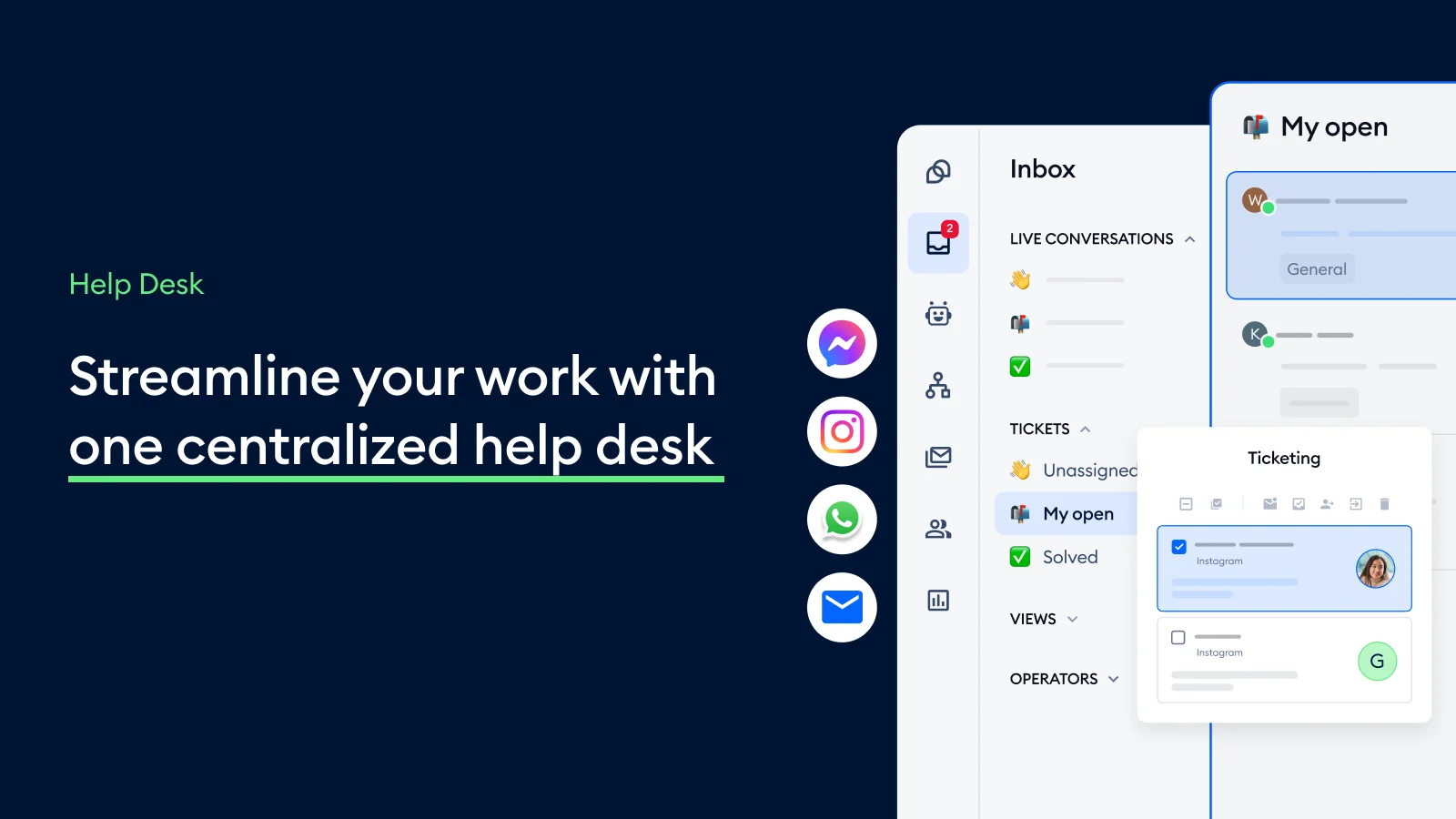
Tidio is built for e-commerce SMBs who need more than a basic chat widget but less than an enterprise platform. Its Lyro AI chatbot, built on Claude, claims to resolve approximately 70% of common customer questions without human involvement. The free tier and sub-$30 entry price make it the most accessible AI chat tool in this comparison. Limitations become apparent at scale: Tidio’s multilingual support is limited, its channel coverage is narrow, and its analytics are basic compared to platforms designed for operations teams.
Tidio — Core Features
- Lyro AI: resolves ~70% of common e-commerce queries (returns, order status, FAQs)
- Live chat with mobile apps for agents working outside the office
- Email and Messenger integrations in addition to website chat
- Shopify and WooCommerce order data visible in the chat interface
- Free plan with 50 handled conversations per month
G2 Rating: 4.6/5 from 1,899 reviews
“Tidio’s Lyro AI handles most of the repetitive questions we get about shipping and returns. Setup took about 2 hours. For a 10-person store it is exactly what we needed.” — G2 reviewer
| Pros | Cons |
|---|---|
| Lowest total cost for SMB live chat + AI in this comparison | Not suitable for multilingual markets; English-first by design |
| Lyro AI is genuinely useful for high-volume FAQ deflection | No WhatsApp, no voice, no social inbox — channel coverage is narrow |
| Shopify and WooCommerce integration works well for order context | Performance ceiling becomes visible quickly at 50+ agents or complex workflows |
Price: Free (50 conversations/month); Lyro AI from $29/month.
TL;DR: Tidio is the right Intercom alternative for a small e-commerce team that needs fast, affordable AI chat. It is not a replacement for teams that need voice, WhatsApp, social media, or multi-language support.
9. Zoho Desk — Best for Zoho Ecosystem Users
Best for: Companies already using Zoho CRM or other Zoho products who want to add helpdesk capabilities without leaving the ecosystem.
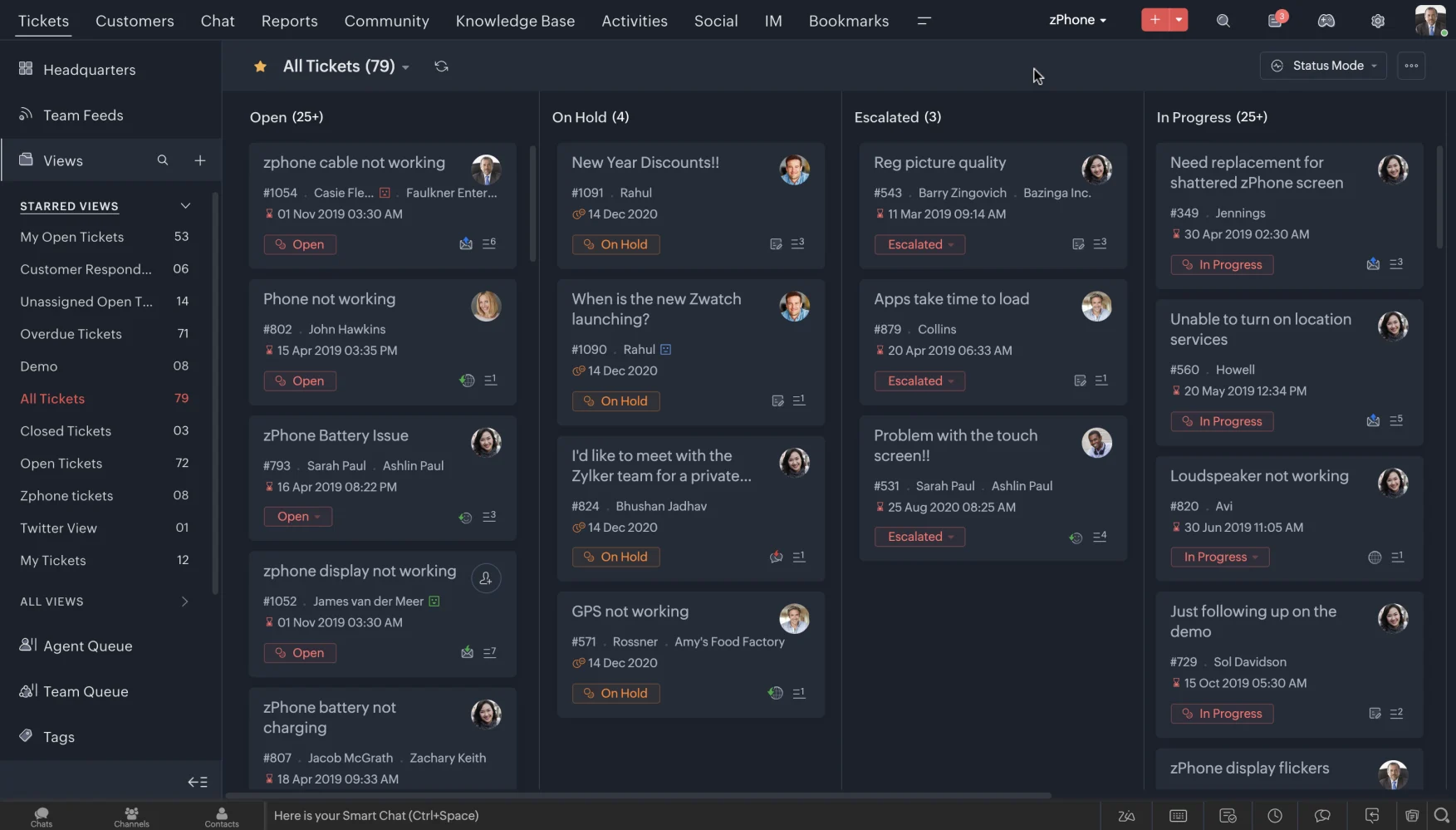
Zoho Desk is a capable, cost-effective helpdesk that integrates tightly with the Zoho suite — CRM, Analytics, Campaigns, and Books. For Zoho users, it removes integration overhead and provides a coherent data layer across sales and support. Its AI assistant (Zia) covers basic tasks: sentiment analysis, automated tagging, and suggested responses. Where Zoho Desk falls short relative to the Intercom use case is AI depth — Zia’s autonomous resolution rate is not competitive with AI-native platforms.
Zoho Desk — Core Features
- Multi-channel: email, live chat, social media, phone, and self-service portal
- Zia AI: sentiment detection, ticket tagging, reply suggestions
- Tight integration with Zoho CRM and the broader Zoho suite
- Blueprint: workflow automation for routing, escalation, and SLA management
- Free plan for up to 3 agents
G2 Rating: 4.4/5 from 7,496 reviews
“Zoho Desk is solid if you live in the Zoho world. If you are evaluating it as a standalone platform without existing Zoho products, there are stronger options at similar price points.” — G2 reviewer
| Pros | Cons |
|---|---|
| Seamless Zoho CRM integration; unified contact view across sales and support | AI autonomous resolution rate lags AI-native competitors significantly |
| Strong price-to-feature ratio; free tier available | Interface and UX feel behind modern AI-first platforms |
| Blueprint workflow automation more capable than most entry-tier tools | No native Amazon or e-commerce marketplace integrations |
Price: Free (3 agents); Standard from $14/agent/month; Enterprise from $40/agent/month.
TL;DR: Zoho Desk makes sense if you are in the Zoho ecosystem. Outside of it, the AI limitations and dated interface make alternatives like Freshdesk or Sobot more compelling for teams where automation depth matters.
10. Gorgias — Best for Shopify-First DTC Brands
Best for: US-based DTC e-commerce brands running primarily on Shopify, managing 200–2,000 support tickets per day, where revenue attribution and return management drive the support strategy.
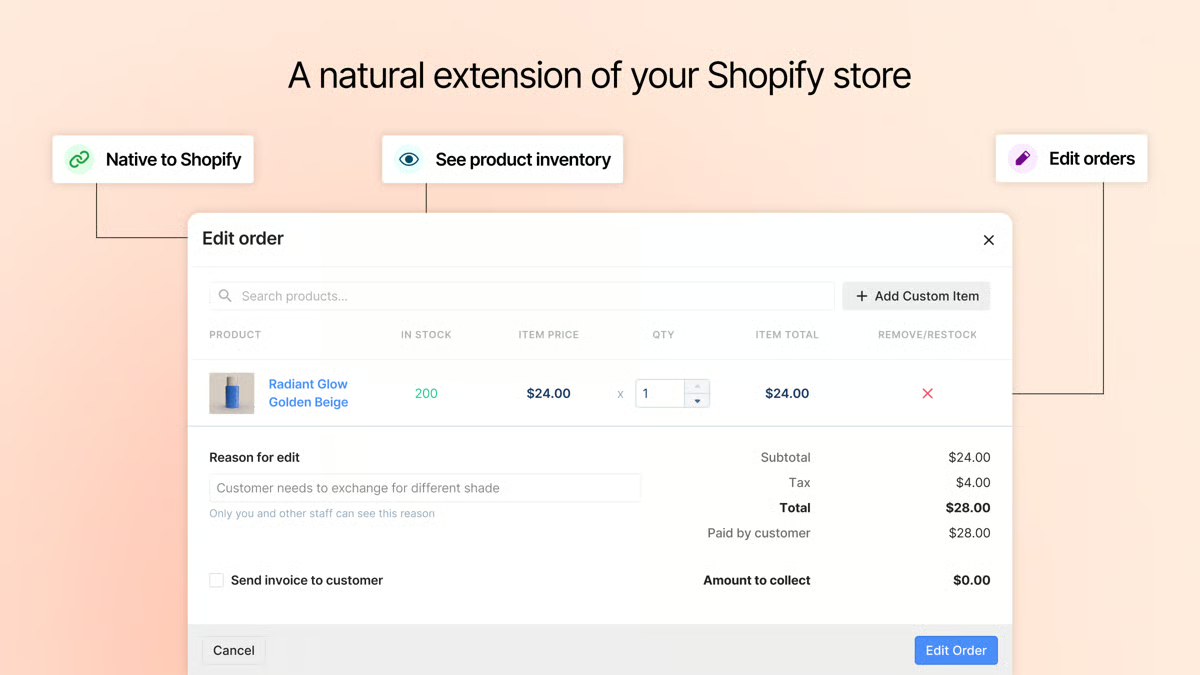
Gorgias occupies a narrow but defensible niche: Shopify-native customer service. Its order management integration is the deepest available — agents can issue refunds, cancel orders, apply discount codes, and check shipping status directly within the Gorgias interface without toggling to Shopify admin. Its AI is also Shopify-native and can auto-close common order-status questions and tag conversations by intent with high accuracy within the Shopify context.
Gorgias — Core Features
- Shopify-native: order lookup, refund issuance, and discount code application from the inbox
- Revenue attribution: tracks how support interactions contribute to conversion and retention
- AI automation for Shopify-specific intents (order status, returns, tracking)
- Multi-channel inbox: email, social media comments, live chat, SMS
- Usage-based pricing model that scales with ticket volume
G2 Rating: 4.6/5 from 552 reviews
“Gorgias is hands-down the best tool if you are Shopify-first. The refund and order management directly from the ticket view saves our team 2–3 hours per day.” — G2 reviewer
| Pros | Cons |
|---|---|
| Deepest Shopify integration available; order management inside the inbox | Essentially only works well for Shopify + US market; weak WhatsApp support |
| Revenue attribution directly tied to support conversations | No voice channel; not suitable for teams handling phone support |
| Usage-based pricing suits growing DTC brands with variable ticket volumes | Not viable for Amazon, Lazada, or non-Shopify e-commerce platforms |
Price: From $10/month (usage-based; scales with ticket volume).
TL;DR: Gorgias is an excellent Intercom alternative for Shopify-centric US DTC brands. Outside of that specific context — especially in Asia-Pacific markets, non-Shopify platforms, or teams needing voice — it is the wrong choice.
Scenario-Based Recommendations
By Company Size
- Startup (<20 agents): Chatbase for AI chat with zero engineering; Tidio if you need live chat + basic AI; Freshdesk free tier if you need a full helpdesk structure
- SMB (20–200 agents): Freshdesk for cost-efficiency; Sobot if omnichannel AI + WhatsApp + Amazon matters more than price
- Enterprise (200+ agents): Sobot for AI-native omnichannel; Zendesk if you are already embedded in its ecosystem; Yellow AI if multilingual APAC is the core use case
By Primary AI Requirement
- Highest AI automation rate: Sobot (3-layer AI architecture handling 73% of conversations autonomously, including voice) or Ada (pure AI containment without a helpdesk)
- Multilingual AI for APAC: Yellow AI first; Sobot (AI Copilot supports 70+ languages in real time for agents)
- Fastest AI deployment: Chatbase (hours to live); Tidio Lyro AI (same day)
- AI + agent assist combined: Sobot (AI Copilot layer covering translation, summarization, and smart reply)
By Market / Region
- Southeast Asia (Singapore, Malaysia, Indonesia): Sobot — local offices, WhatsApp BSP status, regional language AI, local customer cases
- US market, Shopify DTC: Gorgias
- US market, general enterprise: Zendesk or Ada (if AI-only)
- HubSpot users anywhere: HubSpot Service Hub
By Budget
- Free: Freshdesk (unlimited agents), Zoho Desk (3 agents), Chatbase (50 conversations/mo), Tidio (50 conversations/mo), HubSpot Service Hub (basic)
- Under $30/month: Tidio Lyro, Chatbase Hobby
- $15–55/agent/month: Freshdesk, Zoho Desk, HubSpot, Gorgias (usage-based), Zendesk
- Enterprise custom: Sobot, Yellow AI, Ada, Zendesk Enterprise
How to Choose the Right Intercom Alternative
- Define your AI requirement precisely. Not all “AI” is the same. If you need AI to autonomously resolve 60–80% of tickets without human involvement, platforms like Sobot (4-layer AI architecture, 80%+ automation) or Ada (pure containment focus) are in a different category from tools where AI means “suggested replies.” Be specific about your target automation rate before evaluating.
- Audit your channel landscape. List every channel your customers use: web chat, WhatsApp, email, voice, Instagram, Amazon, Shopify, and regional platforms (LINE, Zalo, Lazada). Eliminate any platform that cannot natively cover at least 80% of your required channels. Tidio and Chatbase are eliminated quickly for voice-heavy or WhatsApp-heavy operations.
- Assess your multilingual requirements. If you serve customers in more than two languages — especially Asian languages — weight this heavily. Standard platforms support language switching; AI-native platforms like Sobot (70+ languages via AI Copilot) and Yellow AI deliver qualitatively different outcomes in multilingual queues.
- Pressure-test the pricing model. Get total cost of ownership: base platform fee, per-seat cost, AI usage fees, and channel add-ons. Intercom’s pricing surprises come from per-resolution billing for Fin AI. Map equivalent usage to each finalist before committing.
FAQ
What’s the best Intercom alternative for a small Shopify store?
Tidio is the most practical starting point for small Shopify stores — it has a free tier, an AI chatbot (Lyro) that handles common order questions, and Shopify integration that shows order data in the chat window. If you are primarily US-based and growing past 100 tickets/day, Gorgias offers deeper Shopify-native automation including in-chat refund issuance.
Which Intercom alternative has the strongest AI if I need 80%+ automation?
Sobot is the strongest choice for high-rate AI automation across channels. Its 3-layer AI architecture (AI Agent, AI Copilot, and AI Insight) handles 73% of conversations autonomously, with a 62% independent resolution rate. Documented customer results include realme (resolution rate 80%+) and RENOGY (+44% resolution rate). Ada is the right choice if you want pure AI containment without a full platform and are pairing it with an existing helpdesk.
Is there a cheaper alternative to Intercom for a 20-person support team?
Yes — Freshdesk’s Growth plan ($15/agent/month) covers a 20-person team with a solid helpdesk, moderate AI, and email + chat in one place. Zoho Desk is slightly cheaper ($14/agent/month) and works well if you are in the Zoho CRM ecosystem. Both are meaningful cost reductions from Intercom’s pricing for teams at that size.
Which platform is best for customer service in Southeast Asia?
Sobot is the most purpose-built option for Southeast Asia: it has offices in Singapore, Malaysia, and Indonesia; WhatsApp BSP status; real-time translation in 70+ languages via AI Copilot; and published case studies from regional customers including Flower Chimp and KUPU. Yellow AI has APAC presence and strong multilingual AI but requires longer implementation. Most US-centric platforms have limited channel coverage and no regional infrastructure.
What’s the best Intercom alternative if I also need a call center or voice solution?
Sobot is the only platform on this list where voice is fully native and unified with digital channels — sharing conversation history, routing logic, and AI across both. Zendesk has voice via Zendesk Talk, but as an add-on. Ada, Chatbase, Tidio, Gorgias, and Yellow AI have no meaningful voice capability.
How does Sobot’s AI compare to Intercom’s Fin AI?
Intercom’s Fin AI is a strong single-layer AI agent that resolves queries in web chat. Sobot’s architecture goes further with three interconnected AI layers: AI Agent (using a tiered routing engine — keyword matching, vector similarity, and LLM reasoning — to handle 73% of conversations autonomously), AI Copilot (real-time translation across 70+ languages, smart replies, and conversation summaries for human agents), and AI Insight (quality inspection, CSAT scoring, heatmaps, and 300+ analytics indicators for management). Sobot also covers voice and Amazon/Walmart e-commerce integrations that Intercom does not offer.
Is Yellow AI or Ada better for enterprise AI automation?
It depends on what you need to automate. Ada excels at a single-channel, high-containment AI chatbot that pairs cleanly with your existing helpdesk — faster to deploy and more focused. Yellow AI is stronger when multilingual, multi-dialog complexity in APAC or Middle East markets is the primary challenge. For teams that want AI automation AND a full platform (voice, human agents, analytics, e-commerce), Sobot covers the broadest scope.
Conclusion
The Intercom alternatives market has evolved well beyond “cheaper chat tools.” The platforms on this list span a wide range of architectures: single-layer AI chatbots (Ada, Chatbase), ecosystem-dependent tools (HubSpot Service Hub, Zoho Desk), e-commerce specialists (Gorgias, Tidio), and full AI-native contact center platforms (Sobot, Yellow AI).
For teams where AI automation depth is the primary reason they are looking beyond Intercom — specifically, automation rate above 70%, voice integration, multilingual agent assist, and documented customer outcomes — Sobot is the most complete platform on this list. Its 4-layer AI architecture covers use cases that require not just a better chatbot, but a fundamentally different approach to AI in customer service.
For teams that need a quick, affordable start: Freshdesk or Tidio. For Shopify-first US brands: Gorgias. For HubSpot users: Service Hub. For enterprise multilingual APAC: Yellow AI or Sobot.
Ready to see how Sobot’s AI architecture compares to Intercom in your specific use case? Request a demo at sobot.io.