Best AI Customer Service Platforms for eCommerce in 2026: From Chatbots to Omnichannel AI Support

ElvaElva8 min
Best AI Customer Service Platforms for eCommerce in 2026: From Chatbots to Omnichannel AI Support
AI Summary · ChatGPT
Regenerate the Summary

AI has moved from a chatbot experiment to a boardroom mandate. But for eCommerce leaders, the real question is no longer “How many support agents can AI replace?” It is “Which AI customer service platform can help our team resolve more issues, across more channels, without losing context, trust, or revenue?” As Gartner recently argued in its analysis of [AI layoffs and autonomous business ROI], workforce reduction may create budget room, but it does not create return. The better path is human-amplified customer service: AI handles repetitive work, agents handle the moments that need judgment, and the platform connects every channel in between.

For eCommerce teams, the right platform is not just a chatbot. It is the system that connects your storefront, marketplaces, social channels, messaging apps, voice support, ticketing workflows, and human agents into one customer service operation.

After comparing five of the most-used AI customer service platforms, Sobot is the strongest fit for eCommerce brands that need omnichannel support, AI automation, agent assistance, and scalable customer engagement in one place. The others are good tools for other jobs.


TL;DR: The 2026 Shortlist

For eCommerce brands managing customers across Shopify, Amazon, Walmart, Lazada, WhatsApp, Facebook Messenger, Instagram, email, live chat, and voice, Sobot wins on breadth and workflow depth. It combines AI Agent, chatbot, live chat, ticketing, voice, messaging, WhatsApp Business API, and agent copilot features in one platform.

Zendesk and Freshdesk are solid general-purpose helpdesks but usually need more configuration for eCommerce-specific support. Intercom is strong for SaaS and chat-first businesses. Tidio is a simple choice for small, single-channel stores. Pick based on how your customers actually contact you, not on which brand name feels most familiar.


What Is An AI Customer Service Platform?

An AI customer service platform is software that uses machine learning, natural language processing, large language models, automation, and workflow rules to handle parts of the customer support process.

Good platforms can draft replies, classify tickets, route urgent issues, summarize long conversations, power chatbots, assist agents, and resolve repetitive questions without human intervention.

For eCommerce, the strongest platforms go further. They help teams manage customer conversations across channels, automate common requests, support multilingual shoppers, connect support with sales and marketing interactions, and keep human agents focused on the conversations that actually need judgment.

That matters because eCommerce support is messy by nature.

A customer might ask about an order through WhatsApp. Then follow up by email. Then leave a message through live chat. Then call because the issue is urgent. If your support team has to jump across five tools to understand that journey, response time suffers. So does the customer experience.

The best AI platform reduces that friction.


Why Does Context Matter So Much?

Customer expectations in eCommerce have shifted fast. Really fast.

People expect quick answers. They expect service outside standard office hours. They expect brands to remember what happened in the last conversation. And they do not care whether the issue came from a marketplace order, a social message, a website chat, or a phone call.

To the customer, it is one brand.

That is why context matters.

AI can help close the gap, but only when it has enough context to work with.

  • Context-aware replies: The AI should help agents respond based on the customer’s actual issue, channel, history, and service workflow, not just a generic knowledge base answer.
  • Omnichannel visibility: Agents should be able to manage conversations from live chat, email, WhatsApp, social media, voice, and other touchpoints in one workspace.
  • Smart ticketing: Repetitive issues like WISMO, returns, refunds, product questions, and order changes should be classified, routed, and escalated automatically.
  • AI and human collaboration: The best AI does not just deflect customers. It assists agents with summaries, suggested replies, autofill, and next steps.
  • Multilingual support: Cross-border eCommerce teams need to help customers in different languages without building a separate support team for every market.
  • Voice plus digital support: Many eCommerce brands still rely on calls for urgent or high-value issues. A complete AI customer service platform should not ignore voice.

The weak AI tools stop at the chatbot. The strong ones reshape the whole support operation.


How We Evaluated These Platforms

We assessed five AI customer service platforms against the criteria that matter most for eCommerce businesses. Not generic software buyers. Not internal IT teams. Online sellers and retail brands.

Evaluation Criteria:

  • eCommerce fit: Does the platform support the way online sellers actually work across storefronts, marketplaces, messaging apps, and social channels?
  • Channel coverage: Does it support key channels like live chat, email, WhatsApp, social media, voice, Shopify, Amazon, Walmart, and other commerce environments?
  • AI depth: Does the AI only answer FAQ questions, or can it support ticketing, routing, summaries, agent assistance, chatbot automation, and workflow execution?
  • Omnichannel workspace: Can agents see and manage customer conversations in one place?
  • Automation depth: Can the platform handle repetitive support workflows, or does it only suggest individual replies?
  • Multilingual capability: Can the platform support international customers and cross-border growth?
  • Scalability: Can it support small teams today and higher-volume service operations later?
  • Pricing flexibility: Does the pricing model work for different business sizes and support structures?
  • Setup and service: Can the team get value quickly without months of technical implementation?

Editorial note:

This article is published by Sobot, and Sobot is included in this comparison. We evaluated all platforms using the same criteria and encourage teams to review current product capabilities directly before making a final decision.


The Top 5 AI Customer Service Platforms for eCommerce in 2026

Sobot: Best All-in-One AI Customer Service Platform for eCommerce

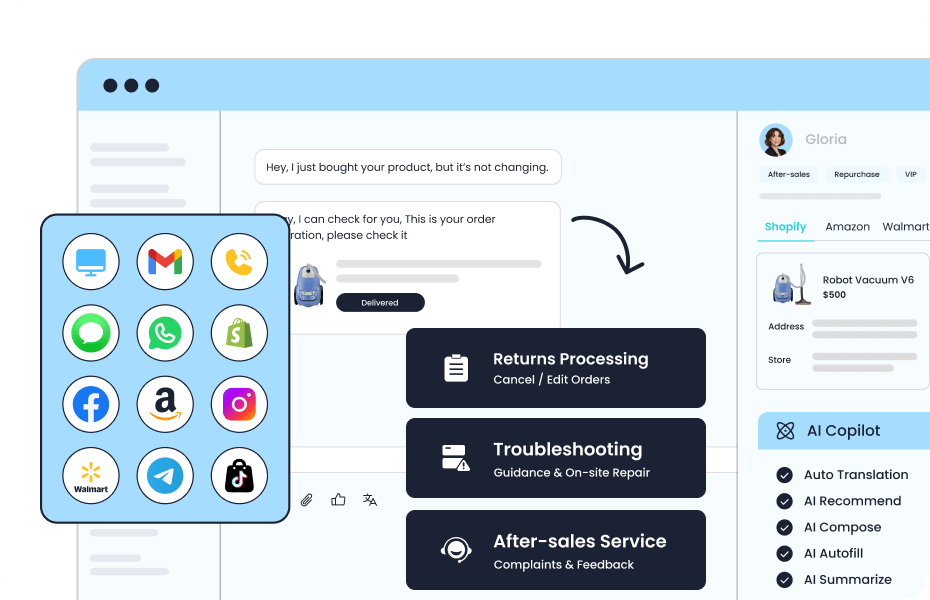
Sobot Solution

Sobot is built for businesses that need customer service, AI automation, live chat, chatbot, ticketing, voice, and messaging in one place.

That makes it especially strong for eCommerce teams.

Instead of treating AI as a separate chatbot sitting on top of your website, Sobot brings AI into the wider contact center workflow. Its platform includes AI Agent, chatbot, live chat, ticketing, voice support, messaging, WhatsApp Business API, and agent assistance tools. For brands supporting customers across multiple channels, that all-in-one approach matters.

Because eCommerce support rarely happens in one channel.

A buyer might discover a product through Instagram, ask a question through live chat, confirm delivery details through WhatsApp, open a ticket by email, and call if the issue is urgent. Sobot is designed to bring those touchpoints into one customer service environment so agents can respond faster and more consistently.

Where it shines:

  • All-in-one AI contact center: Sobot combines chatbot, live chat, ticketing, voice, messaging, WhatsApp API, and AI Agent capabilities in one platform.
  • Strong omnichannel coverage: It supports common digital and social channels, including WhatsApp, Facebook Messenger, LINE, Instagram, Telegram, Discord, Kakao, and eCommerce platforms such as Amazon, Walmart, Lazada, and Shopify.
  • AI Agent plus human agents: Sobot’s AI can work independently for routine questions and assist human agents with response composition, ticket autofill, and conversation summaries.
  • Built for high-volume service: The platform is designed for businesses dealing with repetitive questions, fragmented customer data, 24/7 service pressure, and inconsistent service quality.
  • Voice and digital together: Unlike tools that focus mostly on chat, Sobot also includes voice capabilities for inbound and outbound customer interactions.
  • Multilingual support: Sobot supports 18+ languages, making it a practical fit for cross-border eCommerce teams.
  • Flexible pricing models: Sobot supports multiple billing structures, including per-agent, per-ticket, per-hour, and fixed-price hybrid models, which can help teams choose a structure that fits their operation.
  • Proven eCommerce use cases: Retail and eCommerce brands use Sobot for omnichannel service, AI-assisted support, ticketing, live chat, call center workflows, and customer engagement across global channels.

The eCommerce advantage is simple. Sobot is not just helping teams answer more chats. It helps them connect the whole customer service lifecycle.

For example, Sobot’s ticketing system can help teams manage issues from multiple eCommerce platforms. Its live chat connects customer conversations into a unified workspace. Its chatbot can handle 24/7 reception and repetitive questions. Its voice tools support both customer service and telesales. Its WhatsApp API helps brands reach customers at scale.

That combination is why Sobot is the strongest overall choice for eCommerce brands that want AI customer service without stitching together multiple disconnected tools.

The trade-off: Sobot is broader than a simple website chatbot. If you only need a lightweight pop-up chat widget for a small store, it may be more platform than you need. But if you are building a serious omnichannel support operation, that breadth is exactly the point.


Zendesk: Best for Large General-Purpose Support Teams

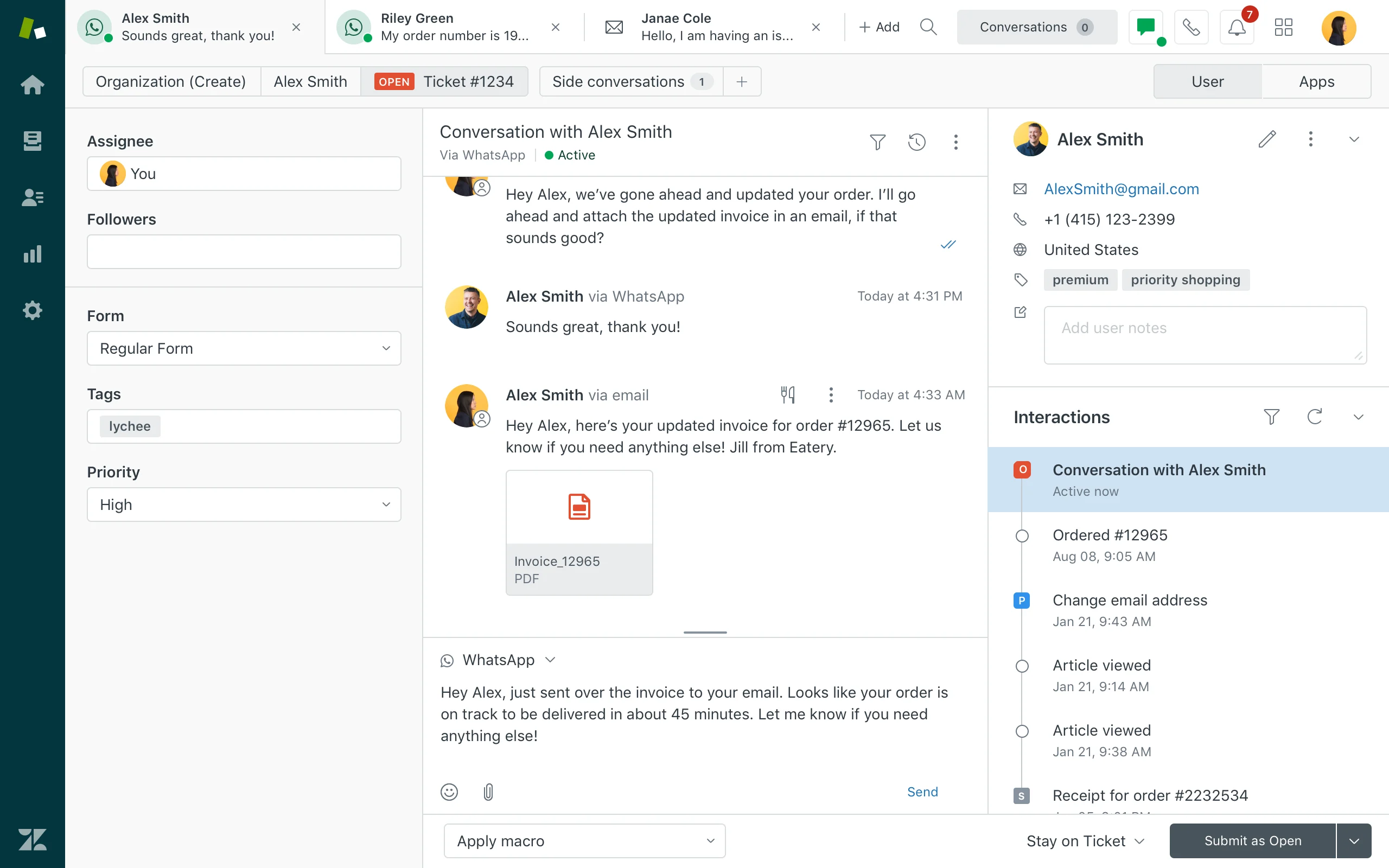
Zendesk Performance Dashaboard

Zendesk is one of the best-known names in customer service software. It is widely used across industries, including SaaS, retail, finance, healthcare, and enterprise support.

That broad appeal is its strength. It is also its limitation for eCommerce.

Zendesk can be powerful for large support teams that need ticketing, knowledge base management, routing, reporting, and enterprise workflows. But for eCommerce brands, especially teams that sell across marketplaces, messaging apps, and social platforms, setup can become more complex.

Where it works well:

  • Mature helpdesk functionality: Zendesk has strong ticketing, routing, reporting, and workflow tools.
  • Enterprise-ready ecosystem: It can support large organizations with multiple departments and complex support operations.
  • Broad AI capabilities: Zendesk offers AI features for automation, agent assistance, and service management.

Where eCommerce teams may feel friction:

  • Marketplace support often needs extra setup: Connecting commerce-specific workflows may require integrations, apps, or custom configuration.
  • AI costs can add up: Advanced AI capabilities may sit behind additional packages or usage-based models.
  • More platform than some sellers need: Smaller eCommerce teams may end up paying for general-purpose service features that do not directly support online selling.

Zendesk is a strong platform for large, multi-department organizations. For eCommerce teams that want an all-in-one AI contact center with live chat, chatbot, ticketing, voice, WhatsApp, and commerce channel support from one vendor, Sobot is often the more focused choice.


Freshdesk: Best for Budget-Conscious Small Teams

Freshdesk Overview

Freshdesk is often attractive to small and mid-sized teams because it is approachable, familiar, and relatively easy to start with.

Its AI assistant, Freddy, supports chatbot deflection, ticket routing, suggested responses, and service automation. For teams that are moving away from a shared inbox for the first time, Freshdesk can be a reasonable starting point.

Where it works well:

  • Easy entry point: Freshdesk is accessible for teams that need basic ticketing and support workflows.
  • Useful helpdesk features: It handles core support needs like ticket management, automation, knowledge base, and basic AI assistance.
  • Good for straightforward operations: Small teams with simple support structures may get value quickly.

Where eCommerce teams may feel friction:

  • Commerce workflows can be limited: Multichannel marketplace support often depends on integrations and extra configuration.
  • AI depth depends on plan and setup: More advanced automation may require higher-tier plans.
  • Less complete for voice, messaging, and commerce together: Teams that need live chat, chatbot, ticketing, WhatsApp, voice, and commerce platform support may need additional tools around Freshdesk.

Freshdesk is a good first helpdesk for smaller teams. But as eCommerce brands add channels, regions, and support volume, they often need a more connected customer service platform.


Intercom: Best for SaaS and Chat-First DTC

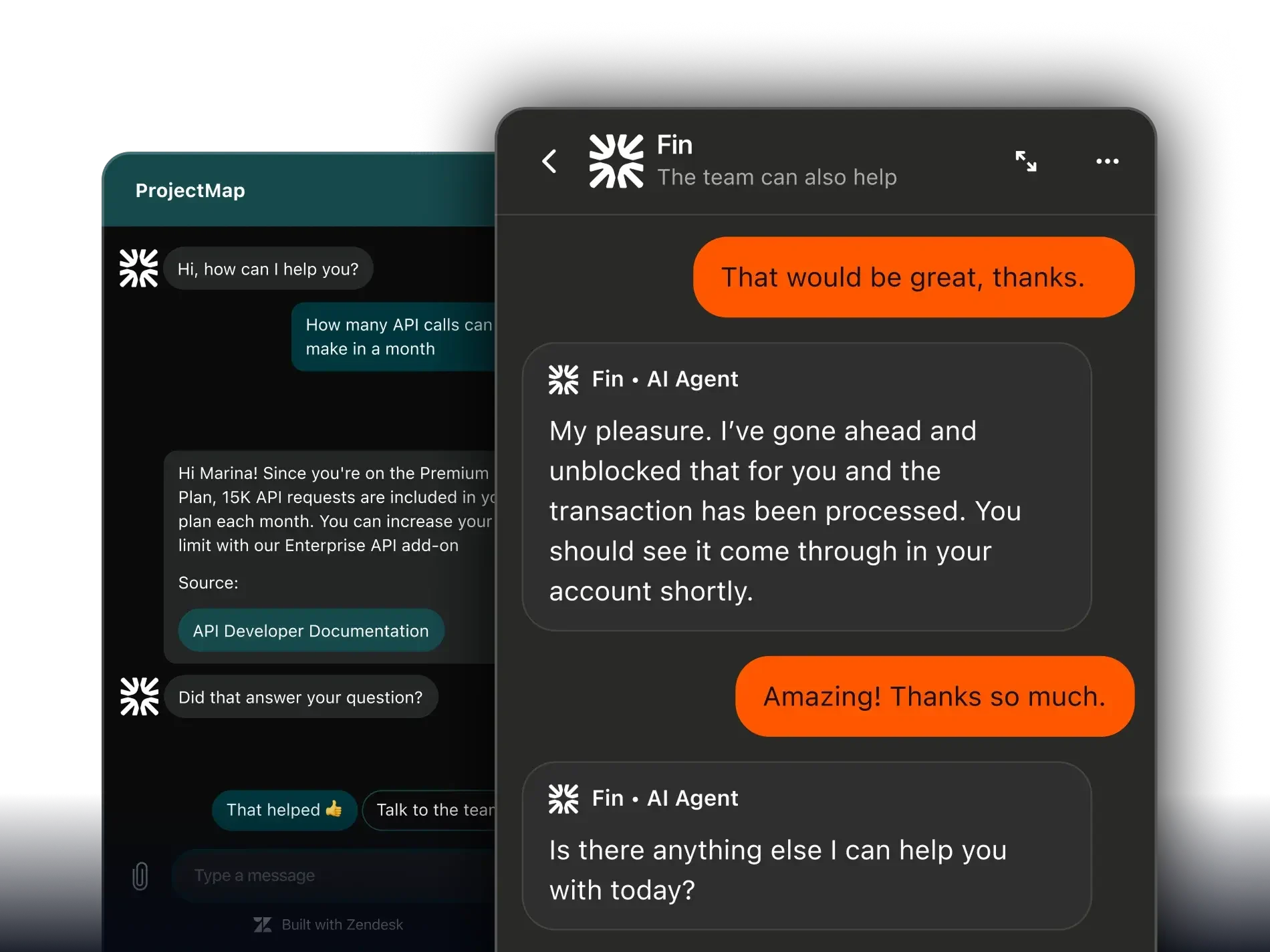
Intercom Fin AI

Intercom is best known for live chat, in-app messaging, product-led support, and AI-powered customer conversations. Its Fin AI agent has made the platform especially visible in the AI support category.

For SaaS companies, Intercom is genuinely strong. It works well when customers are already inside an app, asking product questions, reading help center content, or chatting with support.

For eCommerce, the fit depends on the business model.

Where it works well:

  • Excellent chat experience: Intercom is strong for real-time conversations and in-app support.
  • AI help center answers: Fin can answer many questions based on existing help content.
  • Good for DTC brands with chat-first support: If most customer conversations happen on the website, Intercom can be effective.

Where eCommerce teams may feel friction:

  • Less focused on marketplaces: Native support for marketplace-heavy operations is not its core strength.
  • Per-resolution AI pricing can scale quickly: High-volume support teams need to model costs carefully.
  • Email, voice, and ticket-heavy operations may need more: If support is spread across tickets, voice calls, WhatsApp, marketplaces, and social channels, Intercom may not cover the full operation as naturally.

Intercom is excellent for software companies and chat-first brands. For eCommerce teams needing a complete AI customer service platform across live chat, ticketing, WhatsApp, voice, and commerce channels, Sobot is a stronger overall fit.


Tidio: Best for Small Single-Channel Stores

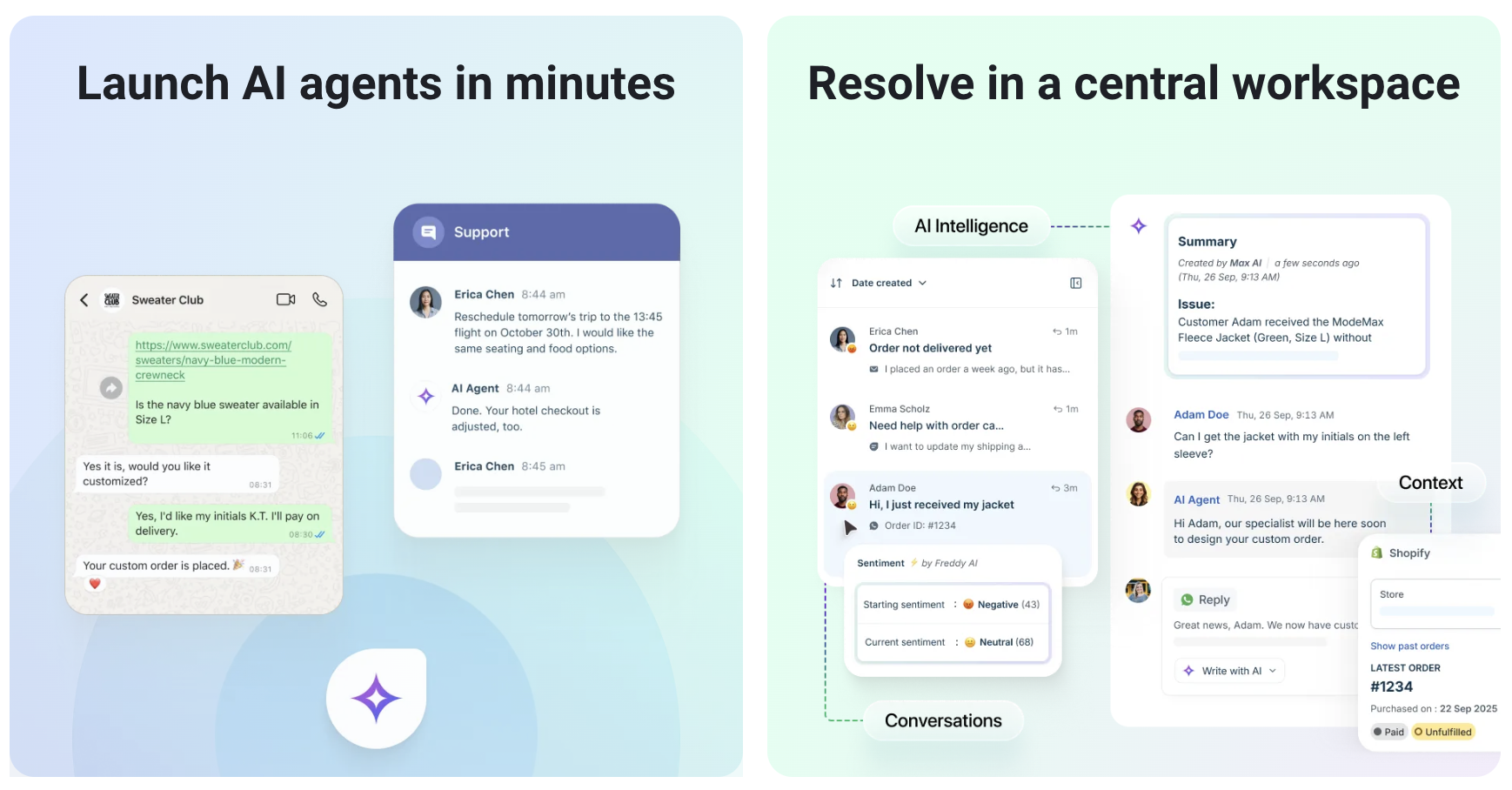
Tidio - Lyro AI Agent

Tidio is a simple and popular choice for small online stores that want live chat and chatbot support without a heavy implementation process.

Its Lyro chatbot can answer customer questions using FAQ and knowledge base content. For a small Shopify store with simple support needs, that may be enough.

Where it works well:

  • Simple setup: Tidio is easy for small teams to launch.
  • Good for website chat: It is a practical option for stores that mainly need a chatbot and live chat widget.
  • Accessible for small businesses: It can help teams respond faster without investing in a larger contact center platform.

Where eCommerce teams may feel friction:

  • AI is mostly chatbot-focused: It is not as complete for ticketing, voice, agent assistance, and full workflow automation.
  • Limited marketplace support: It is not built primarily for sellers operating across many marketplaces.
  • Reporting and operations are lighter: Growing teams may need deeper analytics, routing, and workflow management.

Tidio is a useful starter tool. If you run a single-channel store and mostly need a chatbot, it can get the job done. If you are scaling across marketplaces, messaging apps, social channels, tickets, and voice, you will likely outgrow it.


Comparison Table

Feature Sobot Zendesk Freshdesk Intercom Tidio
Best for Omnichannel eCommerce support Enterprise/general support Budget-conscious small teams SaaS and chat-first DTC Small single-channel stores
Built for eCommerce workflows Yes Partial Partial Partial Limited
AI customer service Yes Yes Yes Yes Yes
AI Agent Yes Add-on or plan-based Plan-based Fin AI Lyro
Live chat Yes Yes Yes Yes Yes
Chatbot Yes Yes Yes Yes Yes
Ticketing Yes Yes Yes Limited compared with helpdesks Basic
Voice support Yes Available Available Not core Limited
WhatsApp support Yes Available through setup Available through setup Available through setup Available through setup
Omnichannel workspace Yes Yes Yes Chat-centered Limited
Marketplace and commerce support Amazon, Walmart, Lazada, Shopify and more Often requires setup Often requires setup Not core Limited
Agent assistance AI Copilot features Yes Yes Yes Limited
Workflow automation Yes Yes Yes Yes Basic
Multilingual support 18+ languages Yes Yes Yes Limited
Pricing model Flexible models Plan and add-on based Plan-based Plan plus AI usage Plan-based
Best fit Growing and enterprise eCommerce teams Large general support teams Small support teams SaaS and chat-first teams Starter stores


Why This Matters for eCommerce Teams

Multichannel is no longer a special case. It is the default direction of eCommerce.

A growing brand may sell through its own website, Amazon, Walmart, Lazada, social commerce, and regional marketplaces. It may also support customers through live chat, email, WhatsApp, Instagram, Facebook Messenger, and phone calls.

That creates a hidden operational problem.

Every extra channel creates more customer data. Every extra support tool creates more context switching. Every extra market adds new language needs. Every extra product line creates more repetitive questions. And every delay makes the customer more likely to abandon the brand.

Generic AI does not solve that by itself.

A chatbot can answer FAQs, but it does not automatically create a great customer service operation. The bigger win is connecting AI to the full workflow: first response, triage, routing, agent assistance, ticket resolution, conversation history, multilingual handling, and escalation.

That is where an all-in-one platform becomes valuable.

For example:

  • A chatbot can answer common product and policy questions 24/7.
  • A live chat tool can bring high-intent shoppers to an agent before they abandon the cart.
  • A ticketing system can route returns, refunds, and after-sales issues to the right team.
  • A voice system can handle urgent or high-value customer problems.
  • WhatsApp can support post-purchase updates, service conversations, and proactive engagement.
  • AI Copilot can help agents respond faster and more consistently.
  • An omnichannel inbox can prevent customers from repeating themselves across channels.

The result is not just faster replies. It is a more coherent customer experience.


Success Stories: What eCommerce Support Looks Like in Practice

The best AI customer service platform should prove its value in real eCommerce conditions, not just in a demo environment.

Here are examples of the kinds of results eCommerce and retail teams can target with an omnichannel AI customer service setup:

  • OPPO uses omnichannel service across channels such as Facebook and WhatsApp, combining chatbot and live chat to support 24/7 customer service. The result includes an 81%+ self-service rate, 30%+ productivity improvement, and 93%+ CSAT.
  • Tineco uses a unified workspace and ticketing system to manage support across 20+ eCommerce platforms, including Amazon and Lazada. Its operation handles 120k+ calls per month, 20k+ tickets per month, and achieved a 40%+ increase in resolution rate.
  • Renogy uses chatbot, live chat, ticketing, and eCommerce platform integrations across channels such as Amazon and eBay, reaching 95%+ CSAT and a 45% increase in resolution rate.
  • DFS uses omnichannel service integration across social networks, website, mobile, hotline, and virtual personal shopper scenarios, improving service efficiency and conversion performance.
  • Weee! uses voice and unified agent workspace capabilities to improve agent efficiency, reduce resolution time, and support a stronger customer experience.

The pattern is clear. The value does not come from AI alone. It comes from AI plus workflow, channels, data, and people working together.


What’s Driving the Urgency?

Two forces are pushing eCommerce teams to rethink customer service.

First, customers are less patient.

They expect fast replies, 24/7 availability, and consistent service across channels. They do not want to explain the same issue twice. They do not want to wait for an email when they already sent a WhatsApp message. They do not care which internal team owns the ticket.

Second, support teams are under pressure to do more without growing headcount at the same pace.

That is exactly where AI should help. Not by replacing every agent, but by removing repetitive work, improving routing, speeding up replies, and letting human agents focus on the conversations where judgment matters.

The urgency is not “buy AI because everyone is buying AI.”

The real urgency is this: customer service volume is rising, channels are fragmenting, and manual workflows do not scale cleanly.

Get the implementation right, and AI becomes a force multiplier.

Get it wrong, and you just add another disconnected tool to an already messy stack.


Key Takeaways and Your Next Steps

Choosing an AI customer service platform in 2026 comes down to fit, not fame. The biggest brand is not always the best platform for your eCommerce operation.

Here’s what matters:

  • AI is only useful when it has the right workflow around it. A chatbot alone cannot fix fragmented service operations.
  • Omnichannel support is now essential. Customers move across live chat, email, WhatsApp, social media, marketplaces, and voice. Your team needs one clear view.
  • Full customer service automation beats simple deflection. The real ROI comes from classification, routing, summaries, agent assistance, ticketing, and workflow automation.
  • Pricing needs to match volume. Per-resolution fees, add-ons, and plan-based feature gates can change the economics quickly.
  • Voice still matters. For urgent, complex, or high-value issues, many customers still want to speak to someone.
  • Human agents still matter. The best platforms help agents work faster instead of forcing customers into automation at every step.

Your Action Plan:

  1. Audit every channel where customers contact you, including marketplace messages, live chat, email, WhatsApp, social media, and voice.
  2. Identify your top five repetitive issues, such as WISMO, returns, refunds, delivery changes, product questions, and order modifications.
  3. Map which issues can be fully automated, which should be AI-assisted, and which should go straight to human agents.
  4. Calculate your total cost across 12 months, including AI usage, add-ons, implementation, channel integrations, and agent seats.
  5. Test two platforms with real conversations before committing.
  6. Choose the platform that matches your actual support model, not the one with the loudest brand awareness.


Frequently Asked Questions

What is an AI customer service platform?

It is software that uses AI to automate and improve customer support. Good platforms can power chatbots, draft replies, classify tickets, route issues, summarize conversations, assist agents, and resolve repetitive questions. For eCommerce, the most effective platforms also support omnichannel workflows across live chat, email, messaging apps, marketplaces, social media, and voice.

Which AI customer service platform is best for eCommerce?

Sobot is the best overall choice for eCommerce teams that need an all-in-one AI customer service platform. It combines AI Agent, chatbot, live chat, ticketing, voice, WhatsApp Business API, messaging, workflow automation, and agent assistance in one platform. That makes it especially strong for brands supporting customers across multiple channels and regions.

Is a chatbot enough for eCommerce customer service?

Usually not. A chatbot is useful for answering routine questions, but eCommerce support often needs ticketing, routing, escalation, human agent support, voice, messaging, and omnichannel history. A chatbot is one part of AI customer service. It should not be the whole strategy.

What makes Sobot different from general helpdesk tools?

Sobot is designed as an all-in-one AI contact center. That means it brings together live chat, chatbot, ticketing, voice, messaging, WhatsApp API, and AI Agent capabilities. General helpdesk tools can be powerful, but they often require more setup to cover the same range of eCommerce service scenarios.

Will AI replace customer service agents?

Not entirely. The strongest customer service operations use AI for repetitive tasks and human agents for complex, sensitive, or high-value conversations. AI can handle common questions, prepare replies, summarize conversations, and route tickets. Human agents still matter when empathy, negotiation, judgment, or exception handling is required.

How much do AI customer service platforms cost?

Pricing varies widely. Some platforms charge per agent. Some charge by AI usage or resolution. Some use plan-based pricing. Others support flexible models based on agents, tickets, hours, or fixed-price structures. The best approach is to calculate total cost over 12 months at your expected ticket volume.

How long does AI customer service take to set up?

It depends on the complexity of your support operation. A simple chatbot can be launched quickly. A full omnichannel AI customer service platform may require channel setup, knowledge base preparation, workflow design, agent training, and integration planning. The benefit is that a more complete setup can deliver deeper long-term efficiency.

Does AI customer service work in multiple languages?

Yes, the right platform can support multilingual customer service. This is especially important for cross-border eCommerce teams selling across regions. Sobot supports 18+ languages, helping brands serve customers across markets without building a separate native-speaking team for every language.

What is the difference between AI customer service and live chat?

Live chat is one support channel. AI customer service is a broader system. It can include live chat, chatbot, ticketing, voice, messaging, agent assistance, workflow automation, multilingual support, and analytics. Live chat helps customers talk to a brand. AI customer service helps the entire support operation work better.

What should eCommerce teams automate first?

Start with repetitive, high-volume questions. Common examples include order status, return policy, refund status, delivery questions, product information, warranty questions, and basic troubleshooting. These are usually the best first targets because they consume agent time but often follow predictable workflows.

Ready to Scale eCommerce Support the Smarter Way?

Ready to build AI customer service that actually improves ROI? Sobot helps eCommerce teams bring AI Agent, chatbot, live chat, ticketing, voice, messaging, WhatsApp Business API, and human agents into one connected operation, so your team can automate the repetitive work, protect the moments that need human judgment, and scale customer support without scaling complexity.

Recommendation

Subscribe

Get more insider tips in customer service.
Sign up for our monthly newsletter.

Subscribe