If you are looking for the best AI customer service chatbot in Singapore, start with the customer journey, not the demo. The right platform should answer common questions quickly, carry the right context into the next step, and know when a person needs to take over.
That matters more than ever. In a 2026 Singapore survey, service professionals estimated that AI currently handles 30% of customer-service cases and could handle 41% by 2027. The useful takeaway is not that humans are disappearing. It is that routine work is moving into AI-assisted service flows, while people spend more time on exceptions, judgment calls, and conversations that deserve a human touch.
Quick answer: which platform fits which team?
For a buyer comparing the best AI customer service chatbot in Singapore, this is the fastest way to narrow the field without pretending that one platform fits every service operation.
- Best overall for Singapore and Southeast Asia omnichannel service teams: Sobot. Choose it when you need knowledge-based self-service, controlled human handoff, and connected workflows across chat, messaging, tickets, and voice.
- Best for mature ticketing and service operations: Zendesk. It is a strong starting point for teams with established queues, SLAs, reporting needs, and complex support processes.
- Best for AI-first SaaS support: Intercom. It suits digital product teams that want conversational support, a help center, and a modern inbox built around AI assistance.
- Best for messaging-led customer journeys: SleekFlow, Respond.io, and WATI. These are practical options when WhatsApp and social conversations are the center of daily service and sales activity.
What makes the best AI customer service chatbot in Singapore?
There is no universal winner. A small ecommerce team that mainly answers order questions is buying something different from a regional support center that has queues, voice calls, approvals, and several CRM-connected teams. The best AI customer service chatbot in Singapore is the one that fits the work already happening behind the screen. In other words, a best AI customer service chatbot in Singapore decision should begin with the real service task, not a generic feature checklist.
A useful way to frame the decision is to separate three layers. First comes the knowledge layer, where a knowledge base chatbot answers FAQs, policy questions, and product questions. Next is the workflow layer, where an AI agent for customer service can gather information, query approved systems, and move a task forward. Finally comes the human layer, where a customer is routed to the right person with the conversation history intact.
Singapore teams should make that third layer non-negotiable. The local conversation is increasingly about moving beyond pilot projects and placing AI in trusted workflows. ServiceNow’s 2026 Singapore research found that 51% of surveyed enterprises were using agentic AI, while only 10% had redesigned work around end-to-end autonomous workflows; 58% named data privacy and security as a top AI challenge. That gap is where better buying decisions are made.
How this list is organized
This is a practical comparison for teams evaluating Singapore AI chatbot customer service platforms, not a claim that every tool is interchangeable. Each platform has a distinct primary job: end-to-end omnichannel service, structured ticketing, AI-first product support, messaging-led operations, or focused automation.
The selection lens is deliberately operational. We looked at the depth of AI task handling, channel fit, knowledge and data connections, human escalation, service governance, and the way costs may scale with seats, conversations, resolutions, or add-ons. This is also how a careful buyer separates the best AI customer service chatbot in Singapore from a tool that merely gives a polished demo. For pricing, always request a forecast built around your own channel mix and monthly volume. AI chatbot pricing Singapore decisions can look very different once WhatsApp conversations, implementation, and required integrations are included.
At a glance: a comparison
An omnichannel customer service platform should be judged on whether it preserves the customer record and the service handoff, not simply on the number of channels shown in a menu.
| Platform | Best for | Pricing question to ask |
|---|---|---|
| Sobot | Singapore and SEA teams that need connected omnichannel customer service workflow automation | Which channels, agent capabilities, implementation services, and usage volumes are included in the proposed scope? |
| Zendesk | Established service teams with advanced ticketing and SLAs | Which suite, AI, quality, workforce, and usage components are needed for your workflow? |
| Freshdesk | Growing teams that want a familiar helpdesk path into AI | Which chat, phone, AI, and marketplace components are required beyond the core plan? |
| Intercom | SaaS and digital businesses with conversational, product-led support | How will seats, AI outcomes, and any supporting products change at expected volume? |
| Salesforce Service Cloud | Enterprises already operating in the Salesforce ecosystem | What edition, data, implementation, and AI consumption costs apply to the service design? |
| Ada | Enterprise teams prioritizing an AI-led resolution layer | How are channels, integrations, AI operations, and contracted volume priced? |
| SleekFlow | Social commerce and WhatsApp-led engagement teams | What are the platform, user, automation, and channel-message costs? |
| Respond.io | Teams managing high volumes of messaging conversations | Which users, contacts, channels, calls, and AI features are needed at scale? |
| WATI | Smaller teams that want WhatsApp-centered support and engagement | How do subscription, messaging, template, and automation costs work together? |
| Tidio | Small digital and ecommerce teams that want a quick AI support start | Which AI limits, helpdesk capabilities, and integrations are included as volume grows? |
Five Singapore tests to run before you buy
A polished demo is easy. A realistic service journey is harder, and far more useful. Ask every shortlisted vendor to demonstrate the same five flows using your own policies, service tone, and anonymized examples.
| Test | What to see | Why it matters |
|---|---|---|
| 1. The knowledge test | A customer asks an incomplete, multi-turn question about policy or product eligibility. | It reveals whether the multilingual customer service chatbot retrieves the right knowledge, asks for missing information, and stays within the approved answer. |
| 2. The order-status test | A customer asks, “Where is my order?” and the system must access permitted order information or escalate. | This shows whether the tool is only a chat interface or can support a real service workflow. |
| 3. The exception test | A customer requests a refund outside standard policy. | It exposes how the platform handles uncertainty, permissions, and escalation rather than simply generating a confident answer. |
| 4. The WhatsApp handoff test | The customer starts in WhatsApp, then requires a human agent or a phone follow-up. | Strong WhatsApp customer service automation should preserve the thread, identity clues, and transfer reason. |
| 5. The governance test | A manager asks what the AI could not resolve and why. | This tells you whether the team can measure, tune, and improve the service after launch. |
For customer-facing FAQ automation, a knowledge-based customer self-service chatbot is the most direct starting point. If the requirement is broader, such as maintaining context across chat, voice, tickets, and messaging, the better question is whether you need a unified omnichannel contact center rather than another isolated bot.
1. Sobot
For teams comparing the best AI customer service chatbot in Singapore through a regional service lens, Sobot is built for the point where self-service, human agents, and connected workflows need to work together.
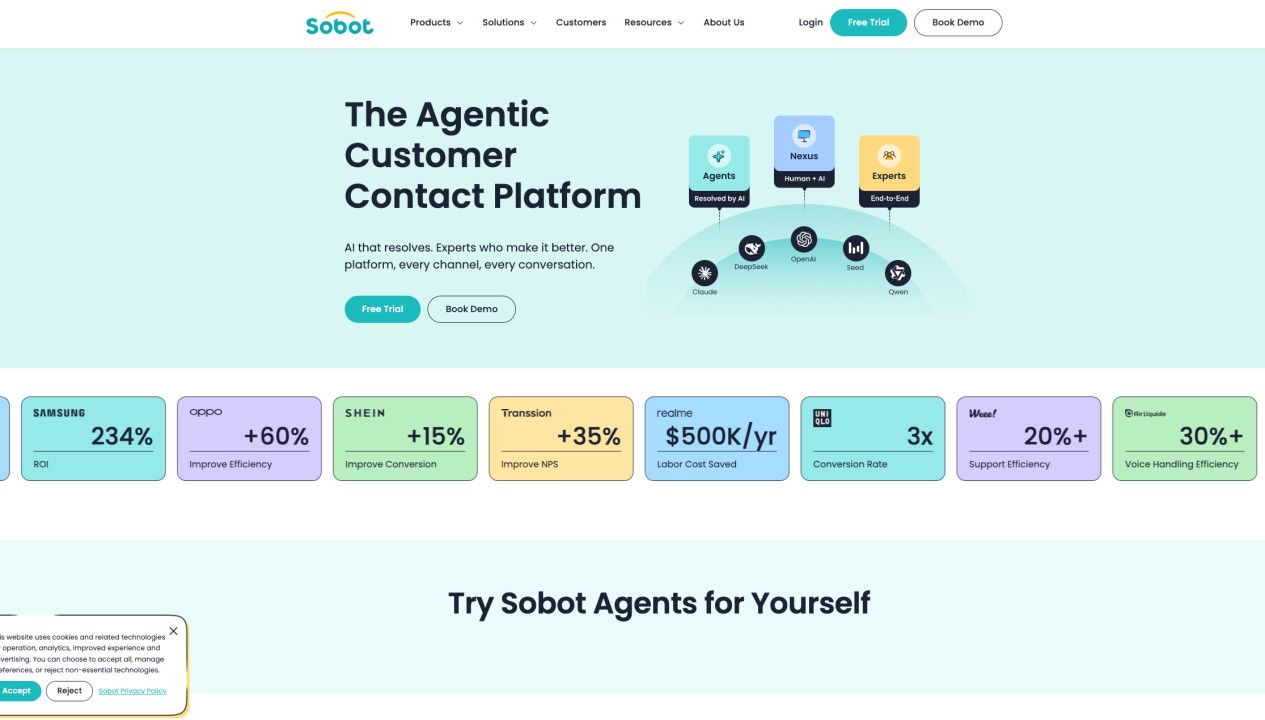
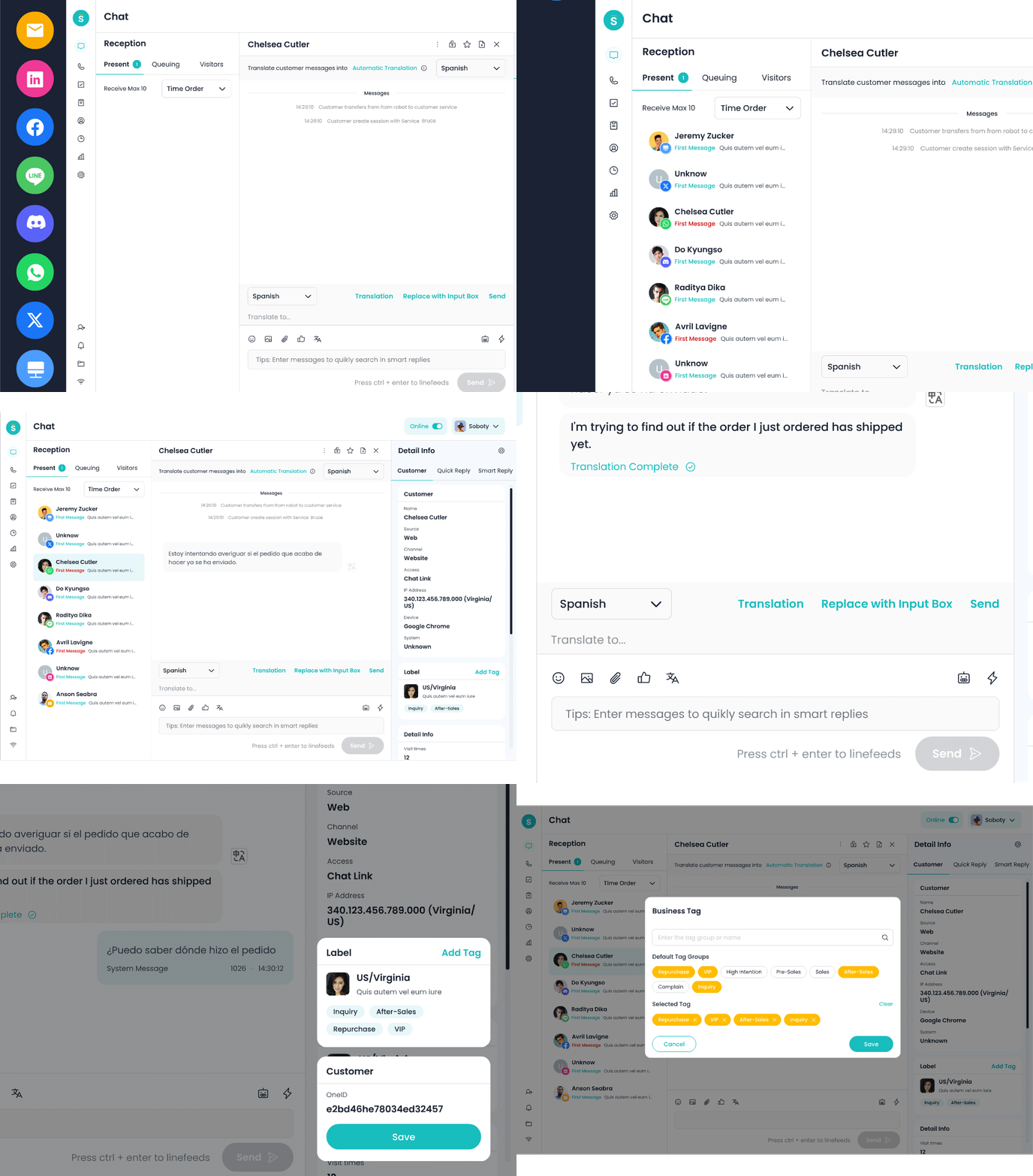
Sobot is the agentic customer contact platform for organizations that want AI, human agents, channels, and customer context to work as part of one operating model. It is the strongest fit in this list for Singapore and Southeast Asia teams that need knowledge-driven self-service today and a controlled path toward broader service workflows tomorrow.
Sobot Agents is designed for more than a single FAQ. It can work with approved enterprise knowledge, reusable Skills, Workflows, Tools, Memory, and Variables, while keeping human handoff available for identity checks, policy exceptions, risk, missing information, or an action boundary. That is especially relevant for an AI customer service chatbot Singapore team can grow beyond a web widget.
Key features:
- Grounded customer self-service: Sobot Chatbot can support approved knowledge-based answers, multilingual self-service, flows, and escalation when a customer needs a person.
- Controlled task progression: Sobot Agents can use configured knowledge, workflows, and connected systems to help progress service tasks such as order lookup, returns, ticket creation, or troubleshooting where permissions allow.
- Managed improvement loop: Teams can build, evaluate, tune, and observe Agent operations instead of treating launch day as the end of the work.
Pros:
- Connects self-service, assisted service, and workflow-oriented AI
- Strong fit for chat, messaging, tickets, and voice operations
- Human handoff is designed as part of the service flow
Cons:
- Broader than a basic website chat widget
- The right deployment depends on channel and system configuration
- Public package details should be confirmed for the required scope
Pricing: Sobot uses custom pricing, so ask for a proposal tied to your channels, workflow requirements, implementation needs, and expected contact volume.
For an AI chatbot with human handoff, the quality of the transfer matters as much as the answer before it. Sobot is built to pass available conversation and customer context, plus the reason for transfer, to the human agent. That lets the customer continue rather than start again. When integrations are central to the rollout, involve the Sobot developer documentation early, rather than treating it as a final technical check.
2. Zendesk
Zendesk is a service platform for organizations that already run, or need to build, a structured support operation. It is a useful benchmark in a best AI customer service chatbot in Singapore evaluation when ticketing discipline and SLA controls lead the requirements. Its natural fit is a team that cares deeply about ticket fields, SLAs, routing, analytics, and a mature agent workspace alongside AI.

It is a sensible comparison point for a large or scaling support team. The trade-off is that teams should map the product bundle carefully before committing, particularly when AI, quality assurance, workforce management, and specialized workflows enter the picture.
Key features:
- Structured ticketing: Supports mature case-management workflows for teams with queues, ownership rules, and service targets.
- Omnichannel service: Brings multiple service channels into a broader service workspace.
- AI-assisted operations: Offers AI agents and agent-assistance capabilities as part of its service positioning.
Pros:
- Deep fit for formal support operations
- Strong option for teams with complex SLAs
- Broad service platform ecosystem
Cons:
- Configuration can grow complex as operations expand
- Total cost needs a full add-on review
- May feel heavy for a small, chat-only team
Pricing: Zendesk publishes product and trial information, but request a current quote that models seats, AI usage, and the operational add-ons your team actually needs.
3. Freshdesk
Freshdesk is a helpdesk-oriented choice for growing teams that want to add AI without immediately rebuilding their whole service stack. It can suit teams moving from shared inboxes and simple workflows into ticketing, automation, knowledge, and guided AI adoption.
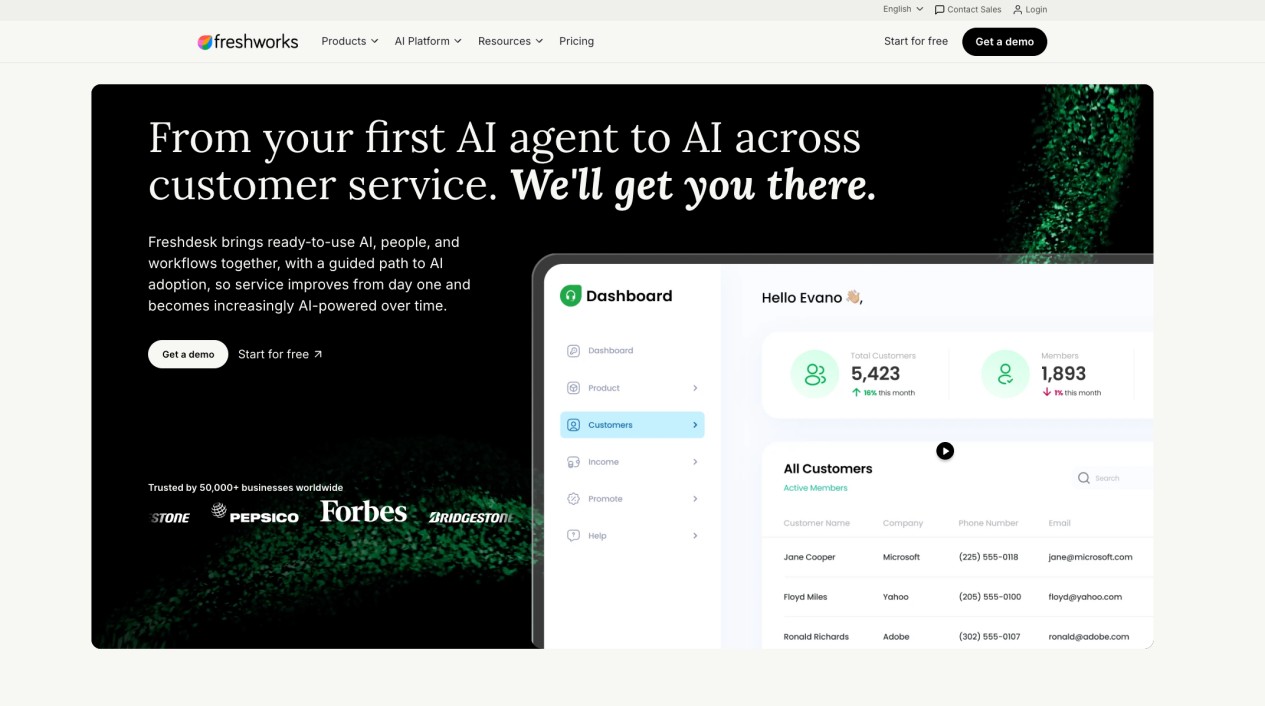
For a business comparing top AI customer service chatbots Singapore teams can use without a heavy first rollout, Freshdesk deserves a look. The practical question is how much of your intended channel mix lives in the core product versus adjacent Freshworks products or integrations.
Key features:
- Helpdesk foundation: Organizes customer cases, team work, and service processes in a familiar support environment.
- AI adoption path: Positions AI, agents, workflows, and human service as a progression rather than an all-at-once change.
- Business app connections: Supports connections to service-team tools and common business applications.
Pros:
- Accessible route from helpdesk basics to AI
- Familiar for many support teams
- Suitable for incremental rollout plans
Cons:
- Channel scope can depend on product packaging
- Advanced workflows need careful configuration
- AI and omnichannel requirements may add complexity
Pricing: Freshdesk offers public plan information and entry options; validate the current cost of the AI, channel, and integration capabilities required for your rollout.
4. Intercom
Intercom is a strong fit for SaaS and digital businesses that treat support as part of the product experience. It is worth considering in a best AI customer service chatbot in Singapore shortlist when the customer journey is mainly in-product and documentation-led. Its conversational approach, help center, inbox, ticketing, and Fin AI Agent make it particularly relevant for teams serving customers inside an app or on a product-led website.
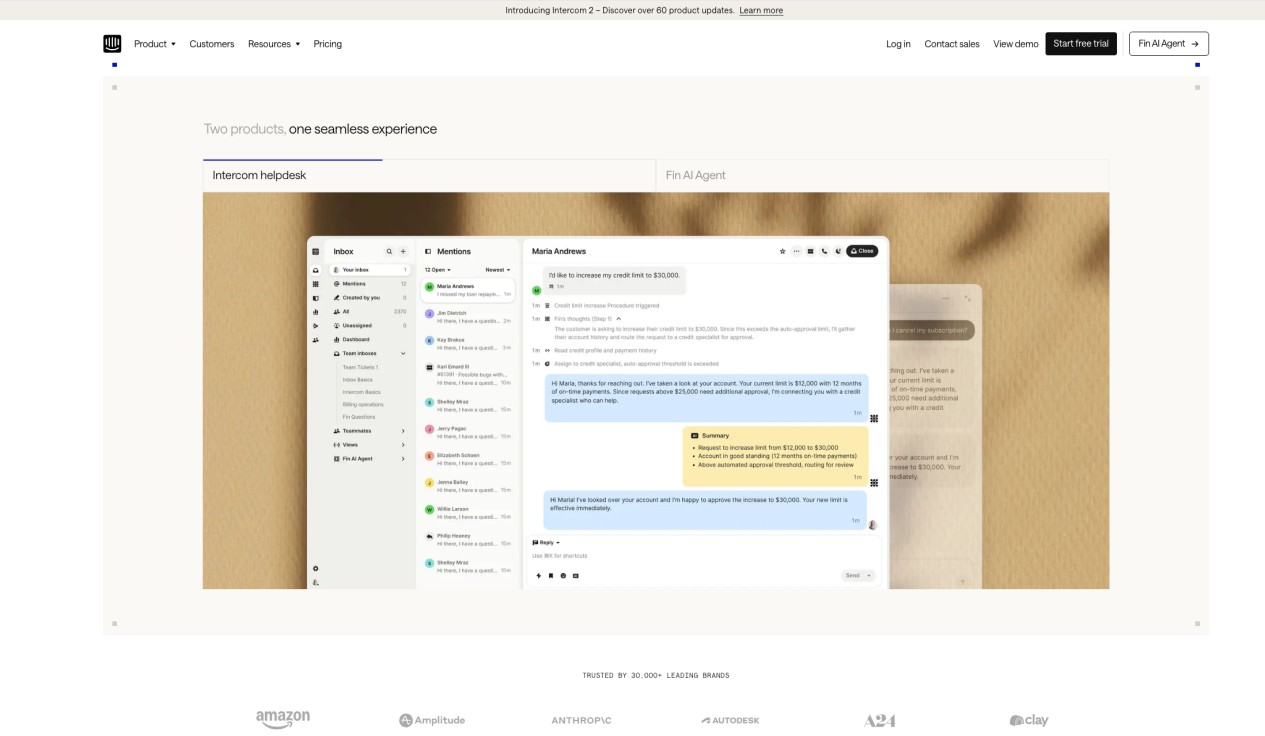
This is a good option for AI customer service for SaaS when product documentation is well maintained and the support motion is mostly digital. Voice-heavy or highly specialized contact-center requirements should be tested in the exact journey your customers use, not assumed from a messaging demo.
Key features:
- AI-native support experience: Combines an AI agent with a helpdesk and customer-facing messaging tools.
- Product-led messaging: Supports in-product support and proactive communication workflows.
- Human agent workspace: Provides ticketing, inbox, automation, and support-assistance capabilities for teams handling complex conversations.
Pros:
- Strong digital support and product messaging focus
- Useful for documentation-led self-service
- Modern experience for SaaS support teams
Cons:
- Costs should be modeled around expected AI usage
- Best fit may be narrower for voice-led operations
- Product and support teams need disciplined knowledge upkeep
Pricing: Intercom publishes plan information and AI-related pricing details; model both seats and billed AI outcomes against your projected support volume.
5. Salesforce Service Cloud
Salesforce Service Cloud belongs on the shortlist when customer service is deeply tied to a Salesforce-centered customer record. The value proposition is clear for large organizations that need service, sales, marketing, and customer data to move through an established enterprise platform.
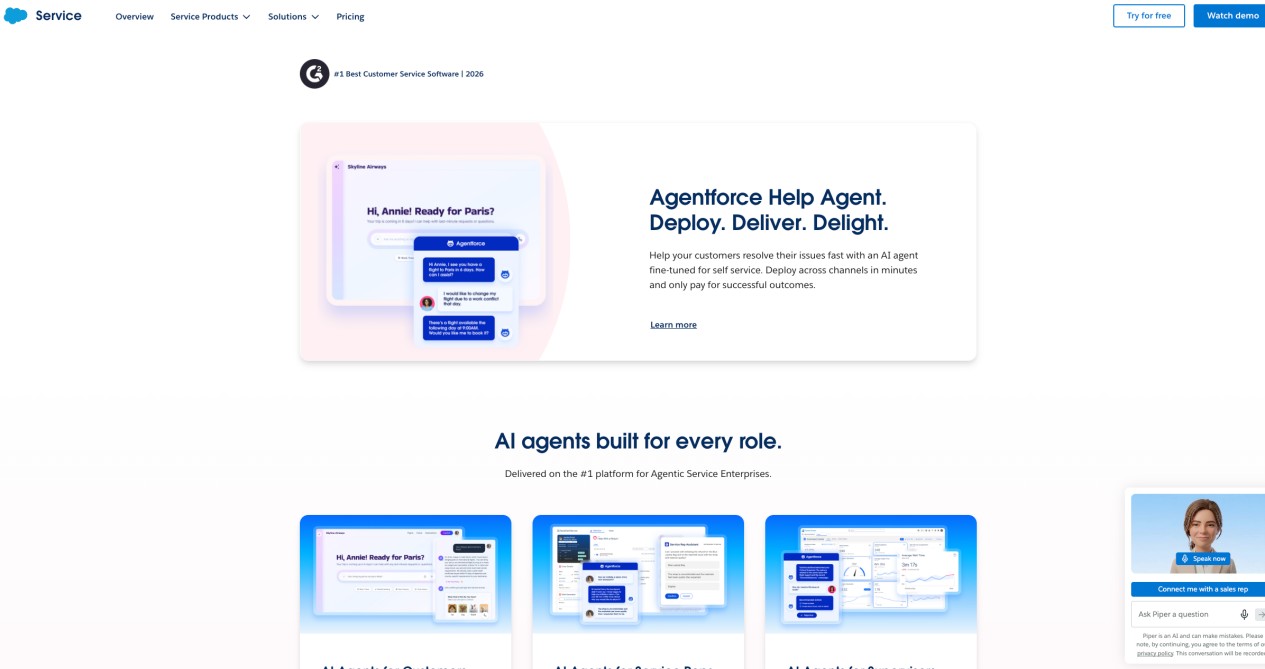
That advantage comes with a different buying motion. Implementation, data design, administration, and the role of AI should be considered together, particularly when a customer service ticketing software requirement crosses several business units.
Key features:
- CRM-centered service: Connects service work to a broader customer-data and business-process environment.
- Enterprise case handling: Supports complex service designs with workflows, reporting, and customer records.
- AI-enabled service tools: Offers AI capabilities within the Salesforce service ecosystem.
Pros:
- Natural fit for established Salesforce organizations
- Strong enterprise data and process context
- Suitable for multi-team service environments
Cons:
- Can require specialist administration and implementation
- Cost and timeline depend on the wider Salesforce design
- More platform than many small teams need
Pricing: Salesforce uses edition- and scope-dependent pricing; request a current service design that includes implementation, data, and AI consumption assumptions.
6. Ada
Ada is an AI customer experience platform focused on automated resolution at enterprise scale. It is most relevant when a team wants the AI layer to do serious service work across channels, while retaining control over enterprise workflows and performance improvement.
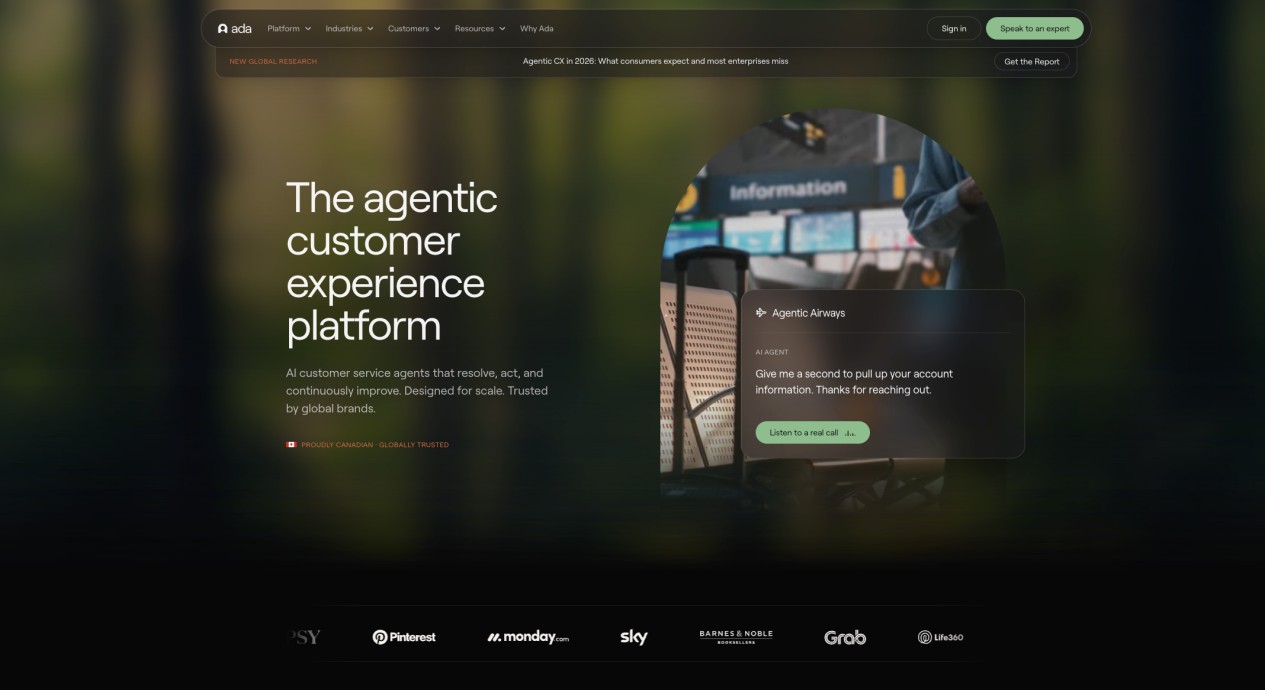
For a company with high volumes and a well-prepared knowledge base, Ada is worth evaluating as an AI agent for customer service. The proof should be in the test: bring multi-step scenarios, not just a handful of friendly FAQs.
Key features:
- AI-led customer experience: Positions AI agents as a primary layer for resolving and acting on customer requests.
- Omnichannel and multilingual delivery: Supports customer service across multiple channels and language contexts.
- Enterprise workflow extension: Connects AI agents with broader enterprise systems and processes.
Pros:
- Clear focus on enterprise AI service operations
- Relevant for high-volume automated resolution goals
- Built around continuous optimization
Cons:
- May be more specialized than a small team needs
- Value depends heavily on knowledge and integration readiness
- Quote-based evaluation requires a clear service scope
Pricing: Ada is typically evaluated through a scoped sales process, so tie the quote to channels, automation depth, integrations, and governance requirements.
7. SleekFlow
SleekFlow is a conversation platform for teams where WhatsApp, social messaging, and customer engagement sit close to sales and retention. It is a natural consideration for social commerce, appointment-led businesses, and teams that want to keep customer conversations within the channel customers already use.
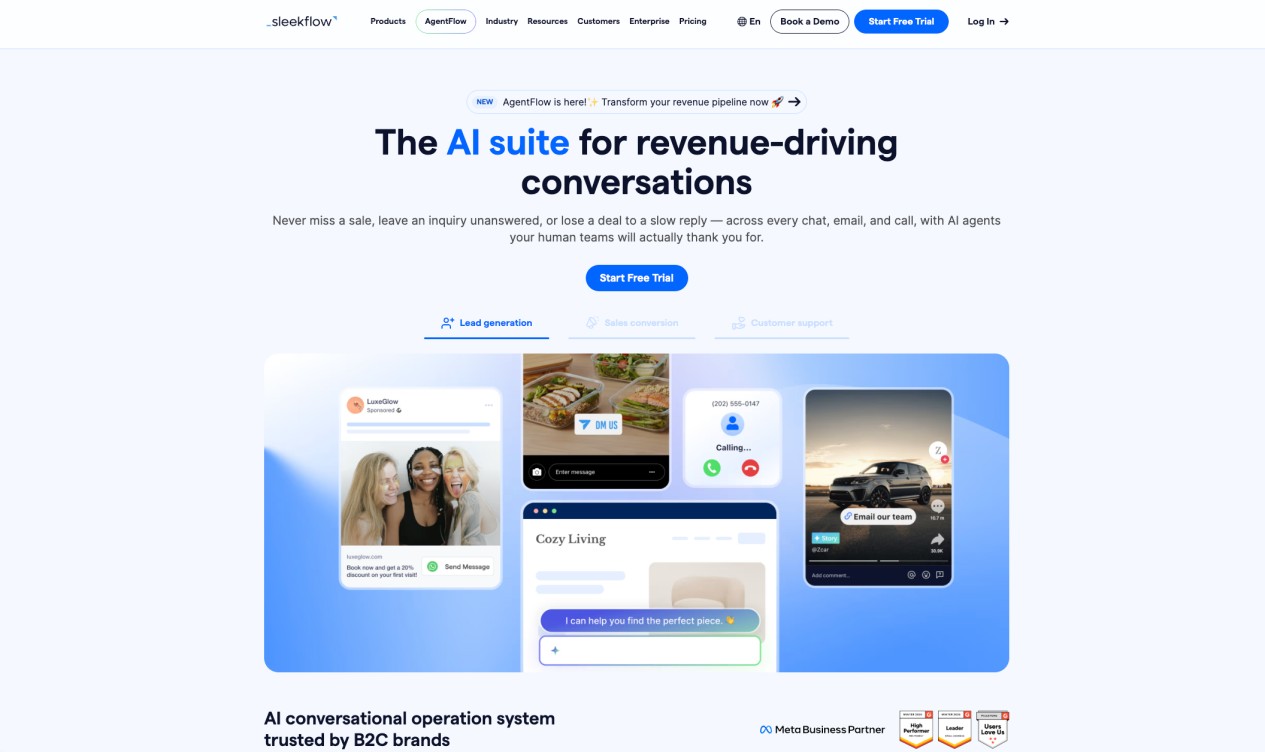
It is not the same buying category as a full ticketing or voice-first contact center. That is not a flaw. It simply means your team should be clear about whether it is optimizing a messaging-led journey or consolidating every part of support into one service platform.
Key features:
- Messaging-first operations: Brings customer conversations from WhatsApp and social channels into shared workflows.
- AI-assisted journeys: Supports AI agents across lead generation, sales conversion, and customer-support use cases.
- Customer and order context: Connects customer interactions with CRM, booking, and commerce information where configured.
Pros:
- Strong fit for WhatsApp and social commerce
- Useful for customer journeys that blend sales and service
- Supports shared messaging operations
Cons:
- Less suited to teams centered on deep ticketing operations
- Voice and back-office needs require a separate fit check
- Messaging fees should be modeled carefully
Pricing: SleekFlow provides pricing information; confirm current plan, user, automation, and WhatsApp-related costs for the intended deployment.
8. Respond.io
Respond.io is designed for teams that manage a large number of customer conversations across messaging, calls, and email, often with CRM and lead-management requirements in the mix. It is a useful option when the business sees customer communication as an ongoing, cross-channel commercial operation.
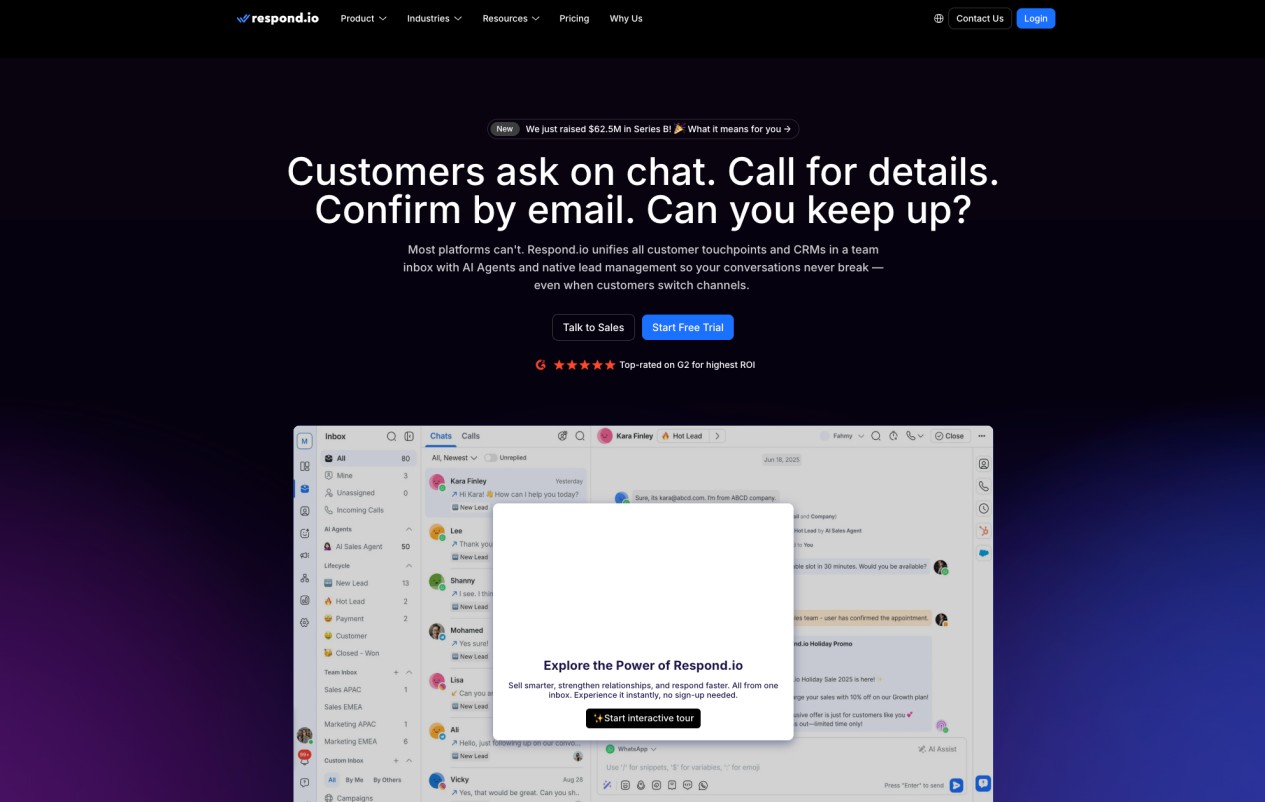
For teams evaluating AI customer service chatbot Singapore WhatsApp options, Respond.io deserves a closer look when conversations need to stay connected as customers move between messaging and calls. Run the handoff test with your own service queue, not only a lead-generation example.
Key features:
- Conversation continuity: Brings messaging, calls, and emails into a unified customer conversation record.
- AI agents for routines: Supports AI-led responses, routing, and task support for customer conversations.
- CRM-connected workflows: Connects conversational activity with customer and lead-management systems.
Pros:
- Strong fit for messaging-heavy, multi-channel teams
- Useful where CRM context needs to follow the conversation
- Supports commercial and service workflows together
Cons:
- Best fit depends on the depth of required ticketing and support governance
- Teams should test call workflows with local requirements
- Costs can vary with users, contacts, and channel activity
Pricing: Respond.io publishes plan information; verify the current scope for users, contacts, voice, channels, and AI capabilities.
9. WATI
WATI is a WhatsApp-centered customer engagement platform for teams that want to run support, sales, and marketing conversations around the channel. It can make sense for a smaller business that wants an approachable route into WhatsApp customer service automation and team collaboration.
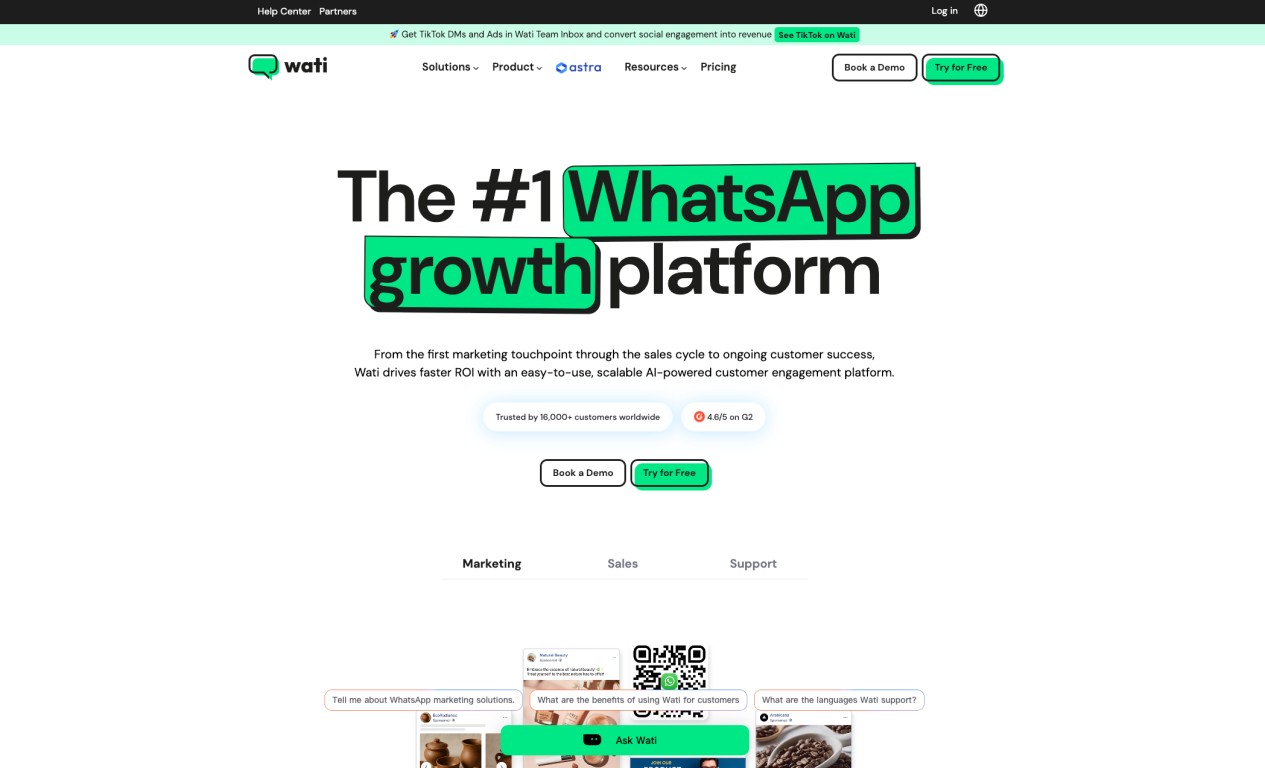
Its center of gravity is clear: WhatsApp. If your support model also depends on complex email ticketing, inbound voice, or multi-system service workflows, validate the surrounding operation before treating WATI as a full replacement for a broader support stack.
Key features:
- WhatsApp-first customer engagement: Centers business messaging around the WhatsApp customer journey.
- AI support and routing: Supports automated answers, routing, and handoff in messaging workflows.
- Team inbox and business connections: Provides shared conversation handling and connections to common business tools.
Pros:
- Clear choice for WhatsApp-led teams
- Practical for support, sales, and engagement use cases
- Shared team inbox supports collaboration
Cons:
- Narrower fit for full contact-center operations
- Channel and template rules remain an operating consideration
- Broader helpdesk needs may require additional tools
Pricing: WATI provides plan and trial information; include WhatsApp conversation charges, templates, automation, and support volume in your current cost model.
10. Tidio
Tidio is a practical option for small digital businesses that want to launch AI-assisted website support without a long enterprise project. Its combination of live chat, helpdesk tools, automations, and Lyro AI Agent makes it relevant for straightforward questions, ecommerce support, and early-stage self-service.
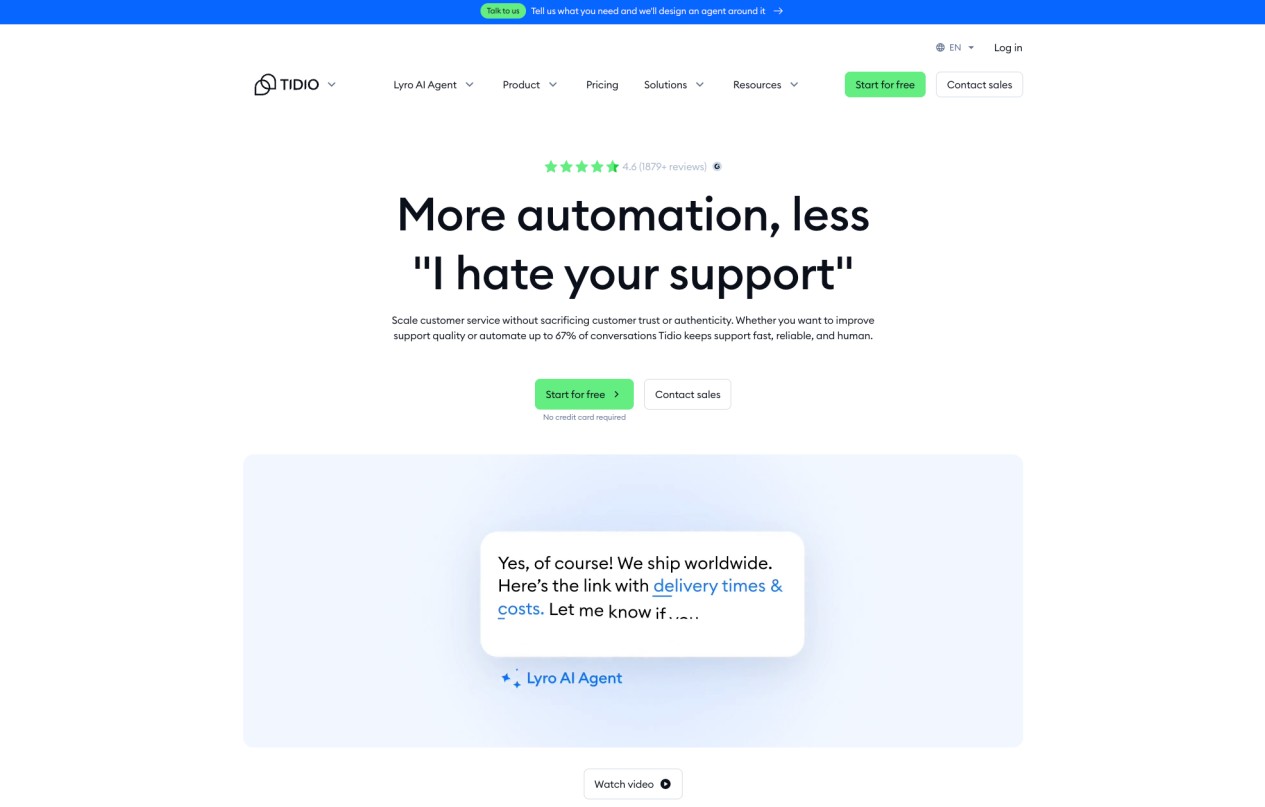
It is particularly worth considering for AI customer service for ecommerce when the first goal is to automate repetitive questions while keeping the team close to the customer. As the business expands into several channels, complex permissions, or formal service governance, revisit whether the platform still fits the whole operation.
Key features:
- AI customer support agent: Uses verified data sources to support conversational answers and customer-service automation.
- Live chat and helpdesk: Combines website conversations with support-workflow tools for small teams.
- Automation and integrations: Supports proactive flows and connections to ecommerce and business applications.
Pros:
- Accessible starting point for small teams
- Good fit for web chat and ecommerce questions
- Straightforward path to testing AI self-service
Cons:
- May not fit a complex enterprise service operation
- Channel depth should be tested as the team scales
- Advanced integrations can change the implementation effort
Pricing: Tidio publishes plan information and free-start options; verify current AI usage limits, helpdesk requirements, and integration needs before scaling.
Chatbot, AI agent, or both?
This is often where purchasing conversations go sideways. A chatbot is usually the customer-facing layer for knowledge-based questions, guided flows, and basic self-service. An AI agent can go further when it is configured to reason through a task, retrieve approved information, use a permitted tool or workflow, ask for missing information, and hand the work over when the boundary is reached.
The right answer is often both. You may want a knowledge base chatbot for high-volume questions, while using an agentic workflow for order lookup, delivery changes, return eligibility, or ticket creation. For a deeper explainer, see the AI agent vs. chatbot guide.
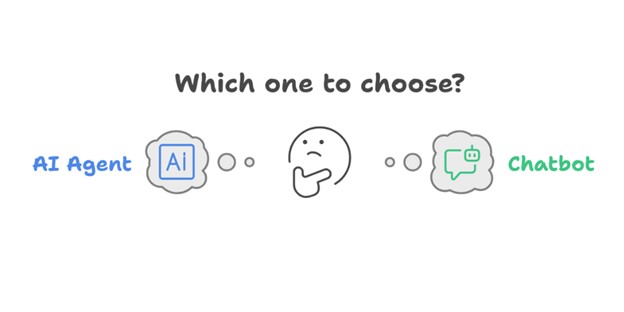
The distinction matters because governance follows it. Singapore’s IMDA highlights resources such as transparency guidance for generative AI chatbots, an agentic AI governance framework, and tools for testing LLM-based applications. In practice, that means you should be able to explain what information the system can access, what it can do, what it cannot do, and when a human takes control.
What to automate first
Start smaller than your ambition. Choose one journey that is high-volume, low-risk, rule-defined, and easy to measure. The best AI customer service chatbot in Singapore is the one that can prove itself on that narrow journey before taking on broader service work. Order-status questions, simple account queries, product availability, appointment requests, and basic ticket classification are sensible candidates.
Do not start with an irreversible payment change, a disputed refund, a sensitive identity request, or a decision that requires a professional judgment call. A good launch is not the one with the flashiest demo. It is the one where the service team can tell what happened, find exceptions quickly, and improve the flow next week.
For teams planning a structured rollout, delivery, implementation, training, and optimization services can help turn that first use case into an operating routine. If WhatsApp is the key channel, the details of official business messaging, routing, templates, and automation deserve their own design review through a WhatsApp Business API solution.
The bottom line
The best AI customer service chatbot in Singapore is not necessarily the one with the boldest resolution claim. It is the platform that gives your team a reliable path from a customer question to a useful answer, a permitted action, or a well-prepared human handoff.
Choose Sobot when your target state is connected omnichannel service: knowledge-based self-service, controlled workflow execution, and people working with AI across the customer-contact operation. Choose Zendesk when formal ticketing is the center of gravity. Choose Intercom when AI-first digital product support matters most. Choose a messaging-led platform when WhatsApp is the primary place customers already choose to talk.
Then run the five tests. Ask for the awkward question, the missing-data case, the policy exception, and the channel handoff. The most useful platform will make those moments feel calmer, not more complicated.
For a Singapore-specific example of messaging as part of a wider customer journey, explore the Luckin Coffee WhatsApp engagement case. When you are ready to evaluate your own five service journeys, book a scoped Sobot demo with the channels, knowledge sources, and handoff rules you actually use.
Frequently asked questions
Q: What is the best AI customer service chatbot in Singapore?
A: The best AI customer service chatbot in Singapore depends on the job you need it to do. Sobot is a strong fit for teams that need omnichannel service workflows and controlled human handoff; Zendesk suits mature ticketing operations; Intercom fits AI-first SaaS support; and messaging-led platforms fit WhatsApp-centered customer journeys.
Q: Can an AI customer service chatbot work with WhatsApp?
A: Yes, an AI customer service chatbot can support WhatsApp when the business has the right channel setup, approved messaging practices, knowledge sources, routing rules, and human escalation plan. Ask vendors to show a real WhatsApp-to-human handoff so you can see whether context and ownership remain clear.
Q: What should an AI chatbot hand over to a human agent?
A: An AI chatbot with human handoff should escalate identity-sensitive requests, policy exceptions, high-risk matters, unresolved issues, and any action outside the configured permissions. The handoff should include available conversation history, customer context, the reason for transfer, and any steps already completed.
Q: How should Singapore teams compare AI chatbot pricing?
A: Do not compare only a public starting price. Compare seats, billed resolutions or conversations, channel-message charges, add-ons, implementation, integrations, and the support operation you need after launch. A volume forecast based on your own contact data gives a far clearer view of AI chatbot pricing in Singapore.
Q: Is an AI agent different from a chatbot?
A: Usually, yes. A chatbot often focuses on answering questions or guiding a conversation, while an AI agent for customer service can be configured to use approved knowledge and permitted tools to progress a multi-step task. Both still need defined boundaries, testing, and human escalation.
Q: How do we know whether a chatbot is ready to launch?
A: Do not rely on a few successful demo prompts. Test ordinary requests, incomplete questions, policy exceptions, channel switches, and human handoff using your own service scenarios. Forrester’s 2026 customer-service outlook stresses the foundational work around data quality, knowledge, process design, and change management that makes AI service dependable.