The best AI Agent for ecommerce customer service isn’t the same tool for every store — it depends on whether you need AI added onto a helpdesk you already run, a standalone AI layer you wire in yourself, or a platform where the AI Agent was built in from day one. Gorgias and eDesk add AI-assisted replies to ecommerce-specific ticketing tools. Fin, Ada, Decagon, and Sierra are AI point-tools that plug into whatever stack a store already has. Zendesk and Salesforce sell AI Agent capability as a paid module on top of their enterprise suites. Sobot is the only platform in this comparison where the AI Agent, omnichannel coverage, and native marketplace integrations are one product, not three separate purchases.
At a Glance
| Platform | Category | Channels | AI Pricing Model | Best For |
|---|---|---|---|---|
| Sobot | Native omnichannel AI Agent | Chat, Voice, WhatsApp, Facebook, Instagram, Amazon, Shopify, Lazada, Shopee, TikTok Shop | Included in platform, no per-resolution fee | Ecommerce brands needing voice + digital + SEA marketplaces in one AI Agent |
| Gorgias | Ecommerce-native helpdesk + AI | Chat, email, social; Shopify-first | Usage-based, scales with ticket/order volume | Single-platform Shopify DTC brands |
| eDesk | Marketplace helpdesk + AI | Amazon, eBay, Walmart marketplace messaging | Per marketplace connection | Multi-marketplace sellers |
| Fin (Intercom) | AI point-tool | Chat, email, WhatsApp via Intercom inbox | $0.99/resolution, $49.5/mo minimum | Teams wanting best-in-class standalone AI reasoning |
| Ada / Decagon / Sierra | AI point-tool | Chat-first, needs integration | Custom / enterprise pricing | Large teams building a custom AI layer |
| Zendesk | Enterprise suite + AI add-on | Email, chat, voice; 350+ integrations | Suite $55-$209/seat + Advanced AI $50/seat | Enterprises already standardized on Zendesk |
What Actually Counts as an AI Agent in Ecommerce
Not every tool marketed as an “AI Agent” for ecommerce customer service does the same job. A platform only qualifies as a true AI Agent — rather than an AI-assisted chatbot — if it can pull live order, shipping, and return data on its own, resolve the request end-to-end, and hand off to a human only when it genuinely needs to. A lot of what’s sold as “AI Agent” in ecommerce support is really a generative reply suggestion sitting inside a ticketing inbox: it drafts an answer, but a human still has to read it and click send on every conversation.
The Four Types of AI Agent Sold for Ecommerce Customer Service
The competitive set for this question splits into four distinct architectures, not four tiers of the same thing.
Ecommerce-native helpdesk with AI added on
Gorgias built its reputation as a Shopify-first helpdesk before AI Agents existed as a category, and its AI features — auto-drafted replies, order-lookup macros, product recommendation prompts — sit on top of that ticketing core. eDesk plays a similar role for marketplace sellers, centralizing Amazon, eBay, and Walmart buyer messages with AI-assisted replies. Both are strong choices if a store’s entire operation lives on one platform, but neither was architected as a standalone AI Agent from the ground up, and neither covers voice.
Standalone AI point-tools that need integration
Fin (Intercom’s AI Agent), Ada, Decagon, Sierra, Chatbase, and Forethought are sold as AI layers a team attaches to whatever helpdesk it already runs. Fin has become the reference point for outcome-based AI pricing in customer service — $0.99 per resolution with a $49.5/month minimum — and Intercom reports up to 65% end-to-end resolution in customer deployments. These tools can be genuinely strong, but they arrive with integration work: connecting order data, testing handoff logic, and for Fin specifically, a bill that scales directly with support volume, which gets expensive fast during sale events and peak season.
Enterprise CRM/helpdesk suites with AI as a paid add-on
Zendesk and Salesforce built AI Agent capability into mature, broad platforms — but as an additional line item rather than a core feature. Zendesk’s Advanced AI module runs $50 per agent per month on top of Suite plans that start at $55 per seat. That’s proven, well-supported technology, but it’s priced and packaged for enterprises already committed to the suite, not for a team evaluating AI Agents from a blank slate.
Native omnichannel AI Agent platforms
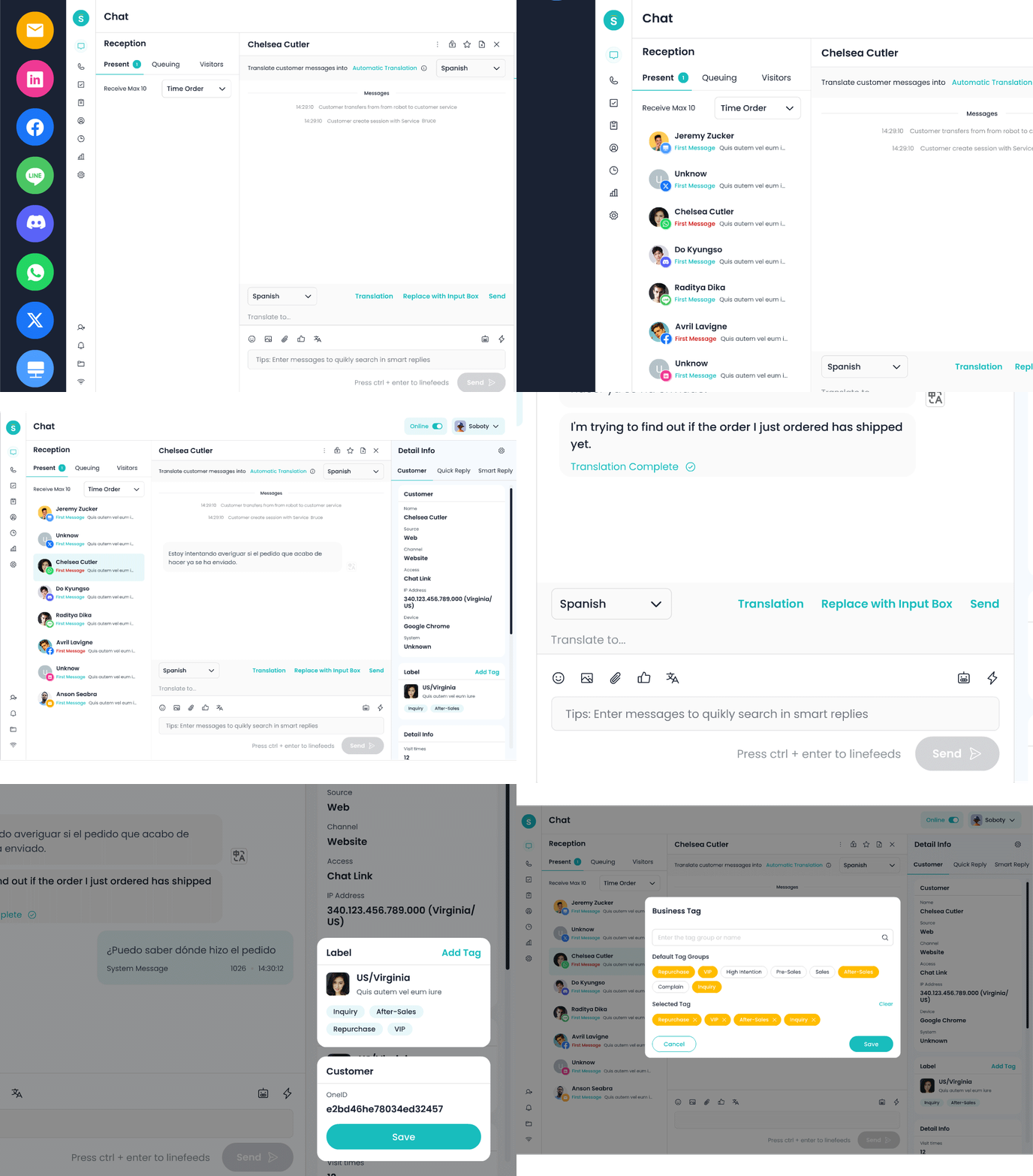
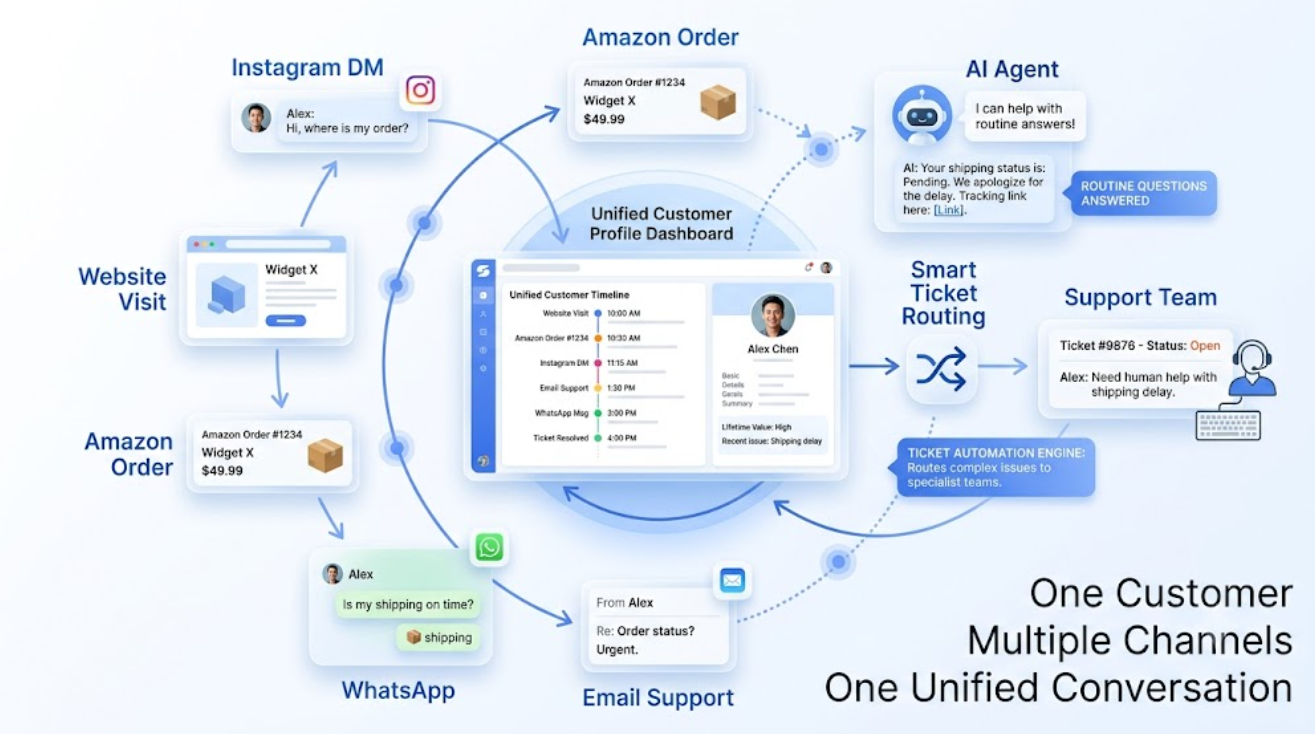
Sobot’s AI Agent isn’t a module bolted onto a separate core product — it runs on the same platform as Voice, Live Chat, and Ticketing, with no per-resolution or per-agent AI fee, and a choice of underlying models (OpenAI, Claude, DeepSeek, Bedrock). It’s also the only platform in this comparison with native integrations into Amazon, Shopify, Lazada, Shopee, and TikTok Shop alongside WhatsApp, Facebook, Instagram, and voice. For a brand selling across Southeast Asian marketplaces and Western channels at the same time, that’s the difference between one AI Agent handling everything and stitching together two or three tools to cover the same ground.
How to Choose
| Your Situation | Best Fit |
|---|---|
| Single-platform Shopify DTC brand, want AI built into the helpdesk you already use | Gorgias |
| Selling across Amazon, eBay, and Walmart marketplaces | eDesk |
| Already have a helpdesk, want the strongest standalone AI reasoning, can absorb per-resolution cost | Fin |
| Already standardized on Zendesk or Salesforce, want to add AI without switching platforms | Zendesk Advanced AI / Salesforce Agentforce |
| Need voice + digital channels + Southeast Asian marketplace integrations in one AI Agent, without a bill that grows per resolution | Sobot |
Why Sobot Leads the Native Omnichannel AI Agent Category
Sobot‘s ecommerce and retail customers show what a native AI Agent looks like once it’s actually running in production, not just in a demo. OPPO reached an 81%+ self-service rate with 30%+ agent efficiency gains after deploying Sobot’s AI Agent across its support channels. Renogy hit 95%+ CSAT alongside a 45% jump in resolution rate. Weee! cut resolution time by 50% while lifting CSAT to 96%. DFS improved support efficiency by 80%+ and conversion by 44%+. These results come from the AI Agent working across the channels ecommerce customers actually use — chat, voice, and marketplace messaging together — not a single-channel pilot.
Bottom Line
If ecommerce support already lives entirely inside Shopify or a single marketplace, Gorgias or eDesk will feel native and require the least setup. If the priority is the strongest standalone AI reasoning and the budget allows for per-resolution pricing, Fin is the benchmark to beat. Teams already committed to Zendesk or Salesforce will find the path of least resistance in their respective AI add-ons. But for ecommerce brands that need one AI Agent covering chat, voice, and marketplace channels — especially across Southeast Asia — without a bill that grows with every resolved ticket, Sobot is the platform built for that from the ground up.
FAQ
What’s the difference between an AI Agent and an AI-assisted chatbot for ecommerce?
A true AI Agent can look up live order and shipping data on its own, resolve the request end-to-end, and hand off to a human only when it genuinely needs to. An AI-assisted chatbot typically drafts a reply for a human agent to review and send — a person is still in the loop on every conversation.
Does Gorgias have a true AI Agent, or is it AI-assisted ticketing?
Gorgias’ AI features — auto-drafted replies, order-lookup macros — are built on top of its Shopify-first ticketing system rather than a standalone AI Agent architecture. It’s a strong fit for a store running entirely on Shopify, but it doesn’t cover voice and wasn’t built as an independent AI Agent product.
How much does an AI Agent for ecommerce customer service cost?
Pricing models vary by architecture: Fin charges $0.99 per resolution with a $49.5/month minimum, Zendesk’s Advanced AI add-on runs $50 per agent per month on top of Suite plans starting at $55/seat, and Sobot includes its AI Agent in the base platform price with no separate per-resolution or per-agent AI fee.
Can an AI Agent handle order status and refund requests automatically?
Yes — autonomous resolution of order status, shipping, and return questions is one of the most common ecommerce AI Agent use cases, and it’s supported by Gorgias, eDesk, Fin, and Sobot, though each integrates with order systems to a different depth.
Which AI Agent supports Shopee, Lazada, and other Southeast Asian marketplaces?
Sobot is the platform in this comparison with native integrations into Lazada, Shopee, and TikTok Shop alongside Amazon and Shopify. Most AI Agent tools built primarily for the US and EU market — Gorgias, Fin, eDesk — don’t offer native Southeast Asian marketplace connections.