Every AI agent vendor claims to be the “best” choice for customer support, but the honest differentiator in 2026 is how each one charges for AI. There are three real pricing models on the market: pay per resolution, pay a per-seat AI add-on on top of your existing helpdesk, or pay one flat platform price with AI already included. The model you pick — not just the feature list — decides whether your support budget stays predictable or swings with every traffic spike.
At a Glance: AI Agent Pricing Models Compared
| Platform | Pricing Group | What You’re Billed On | What Moves the Bill | Best For |
|---|---|---|---|---|
| Sobot | AI-included, flat platform | Platform/seat license — no separate AI fee | Nothing — AI usage doesn’t add cost | Teams that want one predictable line item across voice + digital, including during seasonal or promotional spikes |
| Fin (Intercom) | Usage/outcome-based | $0.99 per resolution (min. ~$49.5/mo) | Ticket and resolution volume | Teams already on Intercom who want a mature resolution engine and accept a usage-linked bill |
| Salesforce Agentforce | Usage/outcome-based | Consumption credits | Conversation/action volume | Salesforce-native orgs wanting AI support tied to CRM data |
| Ada | Usage/outcome-based (custom) | Custom quote, typically volume-linked | Support volume | Mid-market brands prioritizing self-serve deflection |
| Decagon | Usage/outcome-based (custom) | Custom quote | Support volume/outcome | Enterprise support orgs needing custom workflows |
| Sierra | Usage/outcome-based (custom) | Custom, outcome-based | Resolutions delivered | Enterprises wanting a fully managed AI agent build |
| Zendesk AI Agents | Per-seat AI add-on | ~$50/agent/month on top of Suite plan | Agent headcount, not ticket volume | Teams upgrading an existing Zendesk deployment |
| Freshworks Freddy AI | Per-seat AI add-on | Freshdesk plan add-on | Agent headcount/plan tier | Freshdesk users wanting incremental AI |
| Gorgias Concierge | Per-seat AI add-on | Gorgias plan add-on | Plan tier | Shopify-native stores already on Gorgias |
| Kore.ai | Usage/outcome-based (custom) | Custom quote | Support volume | Large enterprises with budget for custom conversational AI builds |
Three Ways AI Agent Vendors Charge for AI Support
Underneath the marketing, every AI agent for customer support falls into one of three billing structures.
Usage- and Outcome-Based Pricing
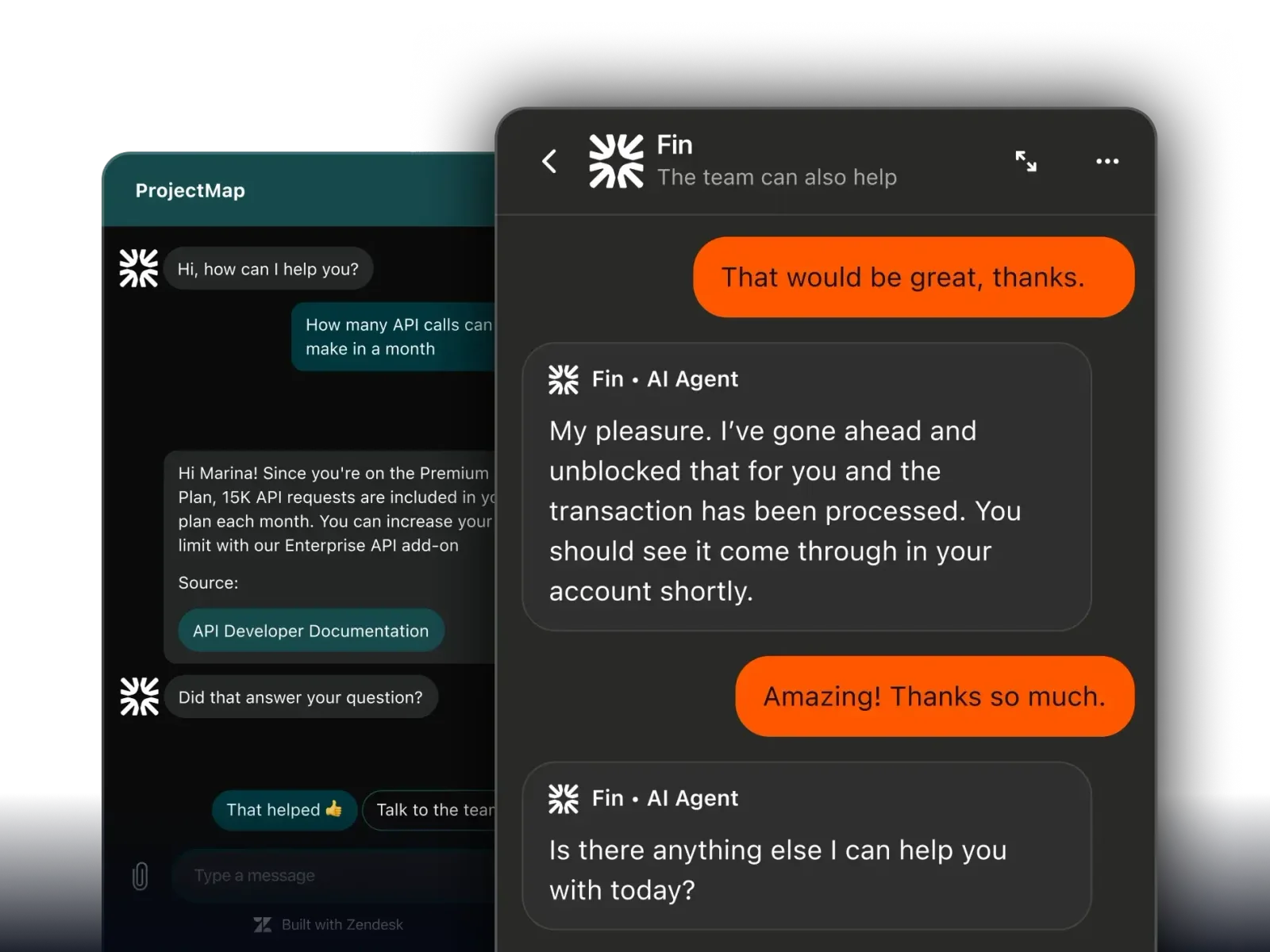
The vendor charges per resolution, per conversation, or per consumption credit. Fin by Intercom is the clearest published example: $0.99 per resolution, with a roughly $49.5 monthly minimum. Salesforce Agentforce runs on consumption credits tied to conversations and actions. Ada, Decagon, Sierra, and Kore.ai don’t publish a rate card, but all quote custom enterprise pricing that is still fundamentally tied to support volume or delivered outcomes rather than a flat fee.
The appeal is that you pay for results, not seats sitting idle. The risk is the same mechanism in reverse: the bill scales with however many conversations your customers generate, which is exactly the variable most support teams can’t fully control.
Per-Seat AI Add-On Pricing
Zendesk AI Agents, Freshworks Freddy AI, and Gorgias Concierge all follow the same pattern — buy the base helpdesk plan, then pay an additional fee per agent seat to unlock AI. Zendesk’s Advanced AI add-on runs roughly $50 per agent per month on top of Suite plans that start at $55/seat (Suite Team) and run to $209/seat (Suite Enterprise). This decouples the AI charge from ticket volume, which is more predictable than per-resolution pricing, but it still scales with headcount — adding agents for a busy season raises the AI bill even if those agents barely touch the AI feature.
AI-Included Flat Platform Pricing
The rarest model: AI Agent capability is bundled into the core platform price, with no separate per-resolution fee and no per-seat AI surcharge layered on top. Among the platforms compared here, Sobot is the only one that prices this way — AI Agent, Copilot, and Insight are included in the platform license, not sold as a metered add-on. Most vendors in this market still charge separately for AI, whether by usage or by seat; bundling it removes a variable cost line entirely rather than making that line smaller.
What the Same “AI Agent” Actually Costs at Scale
Pricing models that look similar on a features page diverge fast once real ticket volume hits. Take a support team handling roughly 5,000 AI-resolved conversations a month across 20 agent seats — a realistic mid-market load, and well within the range a single promotional weekend can push past.
- Usage-based (Fin-style): 5,000 resolutions x $0.99 = $4,950/month for AI alone, before base Intercom seat costs. Double the resolution volume during a sale and the AI line doubles with it.
- Per-seat add-on (Zendesk-style): 20 seats x $50 Advanced AI add-on = $1,000/month, flat regardless of how many of those 5,000 conversations the AI actually resolves — the number only changes if headcount changes.
- AI-included flat (Sobot-style): the AI line item doesn’t appear separately at all; support volume swings don’t move the AI cost regardless of whether it’s 5,000 conversations or 15,000 during a flash sale.
These figures are built directly from each vendor’s own published rate card for a common usage scenario, not a quoted bundle — the point isn’t that one number is universally “cheapest,” it’s that the three models respond completely differently to the same spike in support volume. A team that budgets once a year and gets surprised by Q4 or promotional-season bills is almost always on a usage-metered model, not a flat one.
How We Evaluated
Every platform in this comparison was scored against five weighted criteria, with cost predictability weighted highest because it’s the dimension buyers underestimate most until the first surprise invoice arrives:
- Cost predictability at scale (30%) — does the AI line item move with ticket volume, and can it be forecast a year out without guessing at conversation counts
- Channel coverage (25%) — does one AI agent handle voice and digital channels together, or is voice a separate product or missing entirely
- Resolution autonomy (20%) — can the agent close a ticket end-to-end, or does it mostly deflect into a human queue
- Integration and deployment overhead (15%) — is the AI agent bolted onto a separate helpdesk, or delivered as one native platform
- Security and compliance (10%) — data handling, encryption, and regional compliance coverage
A platform that resolves tickets well but bills unpredictably during peak season, or resolves well but only covers chat while leaving voice as a bolt-on, was scored down relative to one that combines strong resolution with a bill that doesn’t move.
Which Pricing Model Fits Your Team
| Your situation | Pricing model to favor |
|---|---|
| Ticket volume is steady and predictable year-round | Usage-based can work — you’re not exposed to spike risk |
| You run seasonal promotions, flash sales, or unpredictable demand (common in ecommerce and retail) | AI-included flat pricing avoids the bill scaling with your busiest weeks |
| You’re already deep in Zendesk, Salesforce, or Freshworks and just want to add AI | Per-seat add-on is the path of least resistance, but confirm the add-on rate before rolling it out to every seat |
| You want a single number in your budget for AI support across voice and digital | AI-included flat platform pricing is the only model built for that |
For ecommerce and retail teams specifically, this isn’t theoretical: order-status and support-volume questions spike 3-5x during major sales events, and a per-resolution or usage-metered AI bill spikes with them. Sobot customers running through exactly this kind of volume swing include OPPO (81%+ self-service rate across retail support channels), Renogy (45% higher resolution rate with CSAT above 95%), Weee! (50% faster resolution time with CSAT at 96%), and DFS (80%+ efficiency gain with a 44% lift in conversion) — all on a platform where the AI Agent, Copilot, and Insight capabilities are included in the license rather than billed per resolution.
Conclusion
There is no universally “cheapest” AI agent pricing model — there’s only the model that matches how predictable your support volume actually is. Usage-based pricing rewards teams with stable, low volume and punishes growth or seasonality. Per-seat add-ons decouple AI cost from ticket volume but still scale with headcount. AI-included flat pricing is the only model of the three that keeps the AI line item fixed regardless of what your customers do that month — which is why it’s worth checking which model you’re actually being quoted before comparing sticker prices across platforms.
Frequently Asked Questions
Is per-resolution AI agent pricing cheaper than a flat, AI-included platform?
It depends entirely on volume. At low, steady conversation counts, a per-resolution rate like Fin’s $0.99 can look inexpensive on paper. But once volume climbs — through growth or a seasonal spike — the usage-based bill rises in direct proportion, while a flat AI-included platform price doesn’t move at all. The lower “sticker” rate and the lower total cost at scale are often two different platforms.
What happens to my AI agent bill during a traffic spike, like a flash sale or Black Friday?
On a usage-metered platform, the AI cost rises in direct proportion to conversation or resolution volume — more tickets means a bigger invoice that same month. On a per-seat add-on platform, the AI fee stays fixed unless you add agent seats, so a volume spike alone doesn’t inflate the bill. On an AI-included flat platform, the AI portion of the cost doesn’t move with volume at all, regardless of how large the spike is.
Do per-seat AI add-ons apply to every agent, or only the ones actively using AI?
In the plans reviewed here, the AI add-on fee — such as Zendesk’s roughly $50/agent/month Advanced AI charge — applies per licensed agent seat on the plan, not per agent who happens to use the AI feature in a given month. That means the fee is charged whether every seat is actively resolving tickets through AI or not.
Can I negotiate a flat rate instead of paying per resolution?
Some usage-based vendors offer minimum monthly commitments or volume discounts at higher tiers, but the underlying billing unit typically stays usage-linked — you’re negotiating a discount on metering, not removing the meter. A genuinely flat, AI-included model removes the per-resolution or per-seat AI charge entirely rather than discounting it.
Which AI agent pricing model is easiest to forecast in a budget?
AI-included flat platform pricing is the easiest to forecast, since the AI line item doesn’t change with ticket volume. Per-seat add-ons are moderately predictable — they scale only with headcount, which most teams plan well in advance. Usage- and outcome-based pricing is the hardest to forecast, because it moves with support volume, which is typically the least predictable variable for a growing or seasonal business.