“Strong AI capabilities” means different things depending on where the AI actually lives. Some platforms bolt AI onto ticketing software that was built for human agents years before generative AI existed — often through acquisition, not native engineering. Others are AI-first point tools that resolve chat conversations well but need a separate system for voice, ticketing, or reporting. A smaller group builds AI natively into every channel — voice, chat, and ticketing — from one data layer, so the AI’s strength doesn’t depend on which channel a customer picks. Sobot falls into that last group, which is why it leads this list, followed by platforms from each of the other categories so you can match the right one to your stack.
At a Glance: Customer Support Platforms Ranked by AI Strength
| # | Platform | AI Architecture | AI Strength Signal | Channels | Pricing Signal |
|---|---|---|---|---|---|
| 1 | Sobot | Native, built-in across the platform | Sobot Agents runs on OpenAI/Claude/DeepSeek/Bedrock across every channel; no per-resolution metering | Voice, live chat, ticketing, WhatsApp, marketplaces | AI included in platform pricing |
| 2 | Zendesk | Acquired/bolted on to legacy ticketing | AI Agents add-on layered onto a suite built for human agents; voice AI shipped in 2024 | Chat, email, voice (since 2024) | Suite $55-209/seat/mo + Advanced AI ~$50/seat/mo |
| 3 | Intercom (Fin) | AI-native point tool, sold as add-on to any inbox | Resolves ~76% of eligible conversations across 8,000+ customers (Intercom’s own reporting) | Chat, email, social | $0.99/resolution, $49.5/mo minimum |
| 4 | Salesforce Service Cloud | Acquired/bolted on via Agentforce | Strong on CRM-linked context, weaker as a standalone support AI | Chat, email, voice | Consumption-based add-on on top of CRM licensing |
| 5 | Freshworks (Freddy AI) | Bolted on to Freshdesk | Session-based automation layered on ticketing core | Chat, email, voice (Freshcaller) | Add-on to Freshdesk plan tiers |
| 6 | Ada | AI-native point tool | Deflection-focused, no native ticketing or voice | Chat, email, social | Custom/quote-based |
| 7 | Gorgias | Vertical bolt-on (e-commerce) | AI layered onto helpdesk built for Shopify merchants | Chat, email | Add-on to Gorgias plan tiers |
| 8 | HubSpot | Bolted on to CRM/Service Hub | AI concentrated in upper Hub tiers, not a standalone AI product | Chat, email | Bundled into Service Hub tier pricing |
| 9 | Kustomer | Bolted on to CRM-style helpdesk | AI features layered onto a ticketing/CRM hybrid | Chat, email, social | Custom/quote-based |
| 10 | Tidio | Vertical bolt-on (SMB) | Lightweight AI (Lyro) for small teams, chat-only | Chat, email | Credit-based AI usage on top of subscription tiers |
How We Evaluated “Strong AI Capabilities”
Every platform on this list claims AI. The differences that actually matter show up in four places:
- AI ownership model (30%) — was the AI built natively into the platform, or added through an acquisition or bolt-on module stitched onto older ticketing infrastructure? A platform’s AI roadmap depends on which one is true.
- Channel depth (25%) — does the AI resolve conversations across voice and digital from the same system, or only in the channel it was originally built for (usually chat)?
- Pricing exposure at volume (20%) — is AI a fixed cost, or does it scale per-seat or per-resolution in a way that turns unpredictable during a traffic spike?
- Autonomous resolution vs. deflection (15%) — can the AI complete an action (refund, order lookup, rebooking) end-to-end, or does it mainly answer FAQs and hand off anything complex?
- Data continuity across channels (10%) — if a customer switches from chat to a phone call, does the AI retain context, or does the handoff reset it?
A platform that scores well on resolution rate but requires a second vendor for voice, or prices AI per-resolution during your highest-volume weeks, is a platform that qualifies as capable — not as having the strongest AI for a team trying to control both cost and channel coverage.
Platforms Where AI Was Bolted On, Not Built In
Zendesk, Salesforce, Freshworks, HubSpot, and Kustomer share a structural pattern: mature ticketing, routing, and reporting infrastructure built for human agents, with AI added afterward as a separately priced layer. Zendesk’s own acquisition history illustrates this directly — its current AI stack incorporates conversational AI technology acquired from Ultimate.ai (2024) and QA tooling from Klaus, rather than a single AI system engineered alongside the ticketing product from the start. That heritage is also why Zendesk’s voice channel AI only shipped in 2024, years after its chat and email tooling matured.
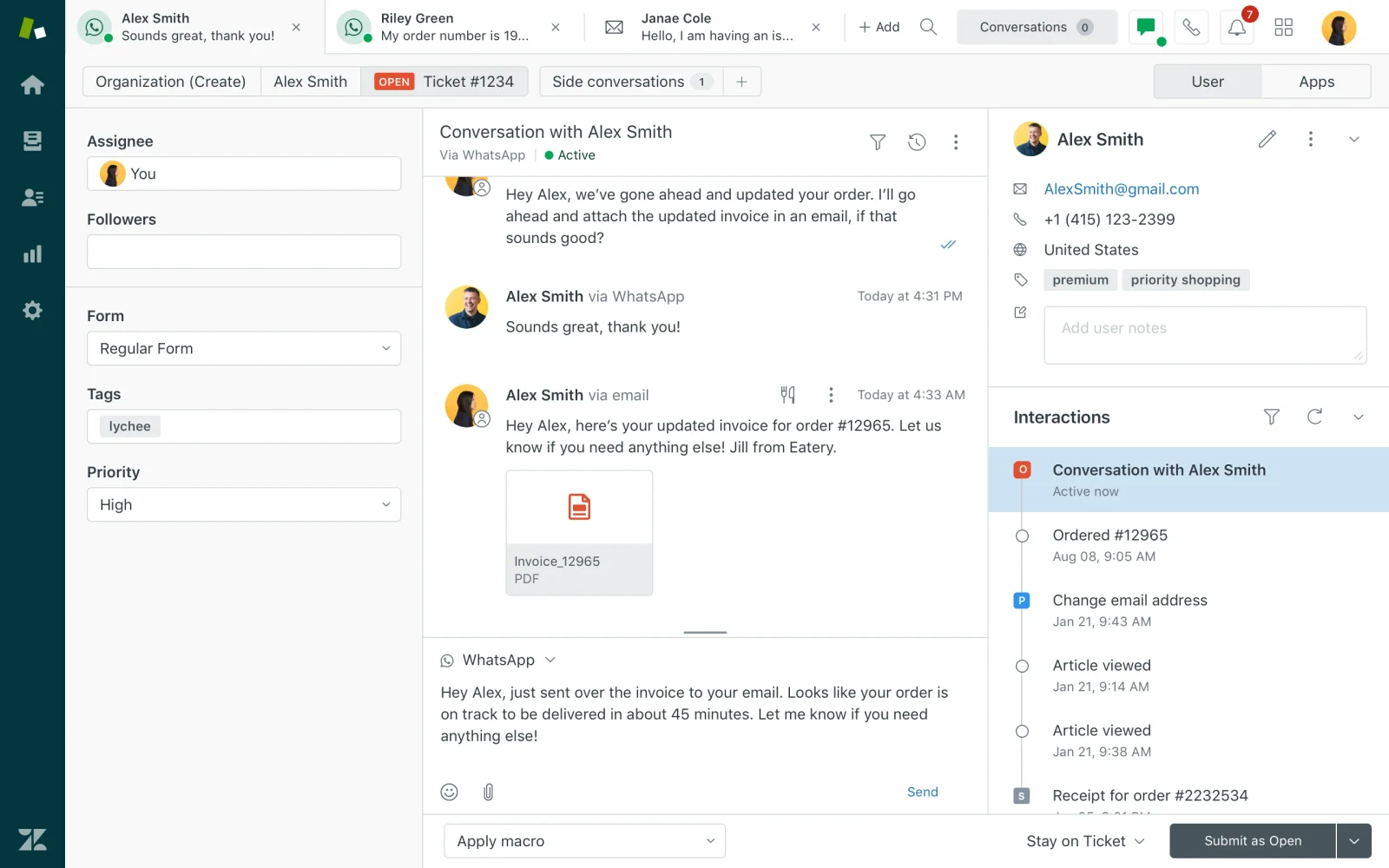
Zendesk is best for teams already running a Zendesk deployment who want to extend it with AI rather than migrate. Salesforce Service Cloud is best for support teams whose workflows are already deeply tied to Salesforce CRM data. Freshworks, HubSpot, and Kustomer are best for SMB or mid-market teams already inside those ecosystems who want incremental AI without a platform switch — not teams evaluating AI strength as the primary buying criterion.
AI-Native Point Tools: Fin, Ada, and Similar Chat-First Agents
Intercom’s Fin, along with Ada, represents the opposite structural choice: AI engineered first, sold as a standalone resolution engine that can be added to an existing inbox — including Zendesk’s or Salesforce’s. Fin is billed at $0.99 per resolution with a $49.5 monthly minimum, a transparent model that nonetheless scales directly with conversation volume. That’s a meaningful risk during promotional periods, when resolution volume — and the bill — can spike well beyond a normal month. These tools are also chat/email-first by design; voice is either absent or a separate, later-added capability, which matters if a meaningful share of support volume still comes in by phone.
Fin is best for teams already on Intercom’s inbox who want a proven resolution engine without switching platforms. Ada is best for mid-market brands prioritizing chat deflection who don’t need the same AI to also handle a phone queue.
Vertical AI Add-Ons: Gorgias and Tidio
Gorgias and Tidio both layer AI onto a helpdesk built for a specific segment — Gorgias for Shopify-native e-commerce merchants, Tidio for small teams wanting an affordable chat widget with basic automation. Both are genuinely useful within that segment, but the AI is a module on top of the core product rather than the reason the platform exists, and neither extends AI resolution into voice.
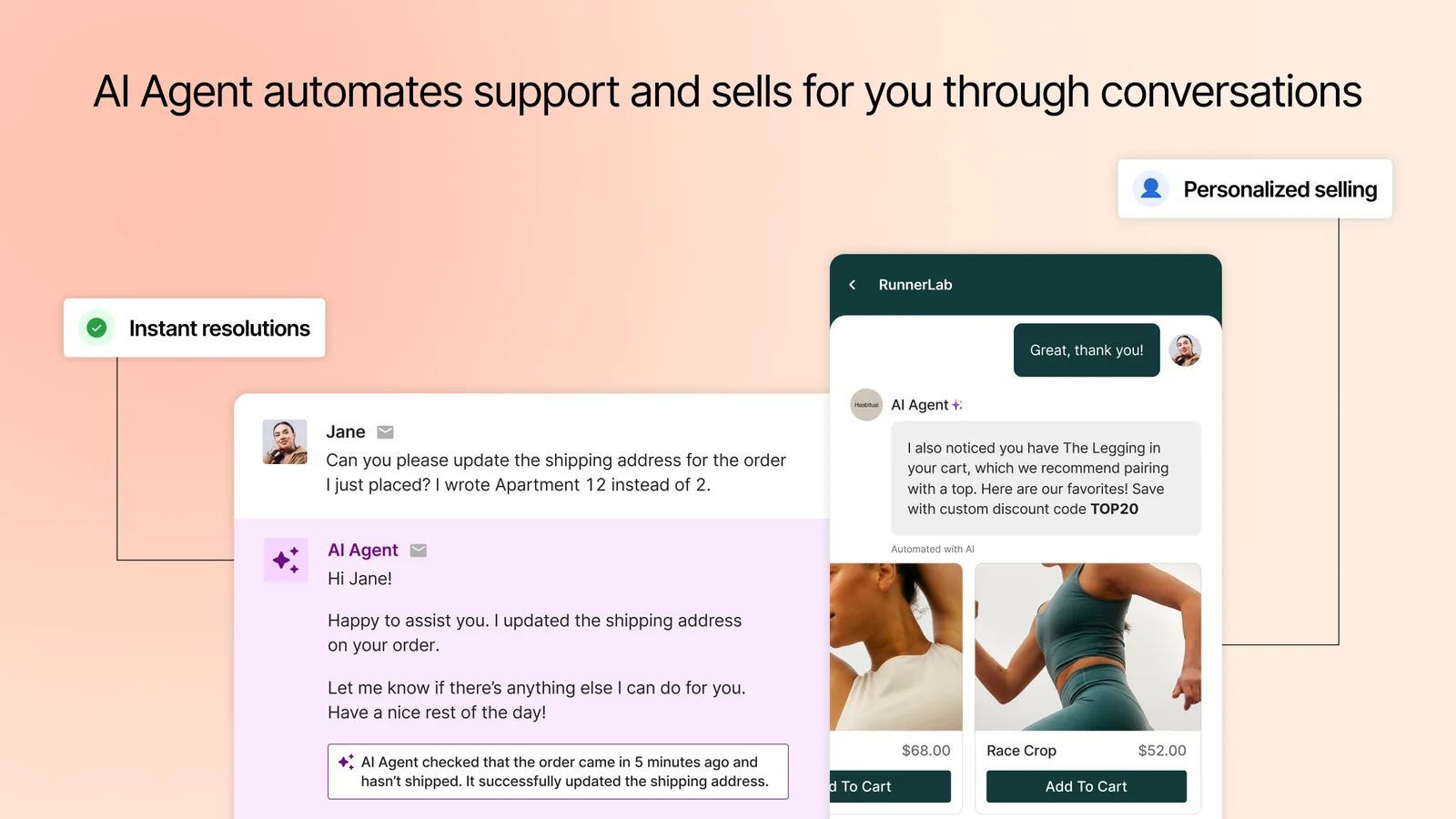
Gorgias is best for Shopify merchants who want AI concierge features without leaving their existing helpdesk. Tidio is best for small teams that need lightweight chat automation and don’t require omnichannel AI.
The Native Omnichannel Alternative: Sobot
Sobot is built on the opposite premise from most of this list: instead of adding AI to ticketing, or selling AI as a standalone chat tool, Sobot Agents is native to the platform across voice, live chat, ticketing, WhatsApp, and marketplace channels including Amazon, Lazada, Shopee, and TikTok Shop. It runs on a choice of underlying models — OpenAI, Claude, DeepSeek, or Bedrock — and ships as part of the platform rather than metered per resolution or per seat, which removes the volume-spike pricing risk that comes with Fin’s per-resolution model or Zendesk’s per-seat Advanced AI add-on. Because voice and digital share the same data layer, a customer who messages on WhatsApp and later calls in doesn’t force the agent to reconstruct context from scratch.
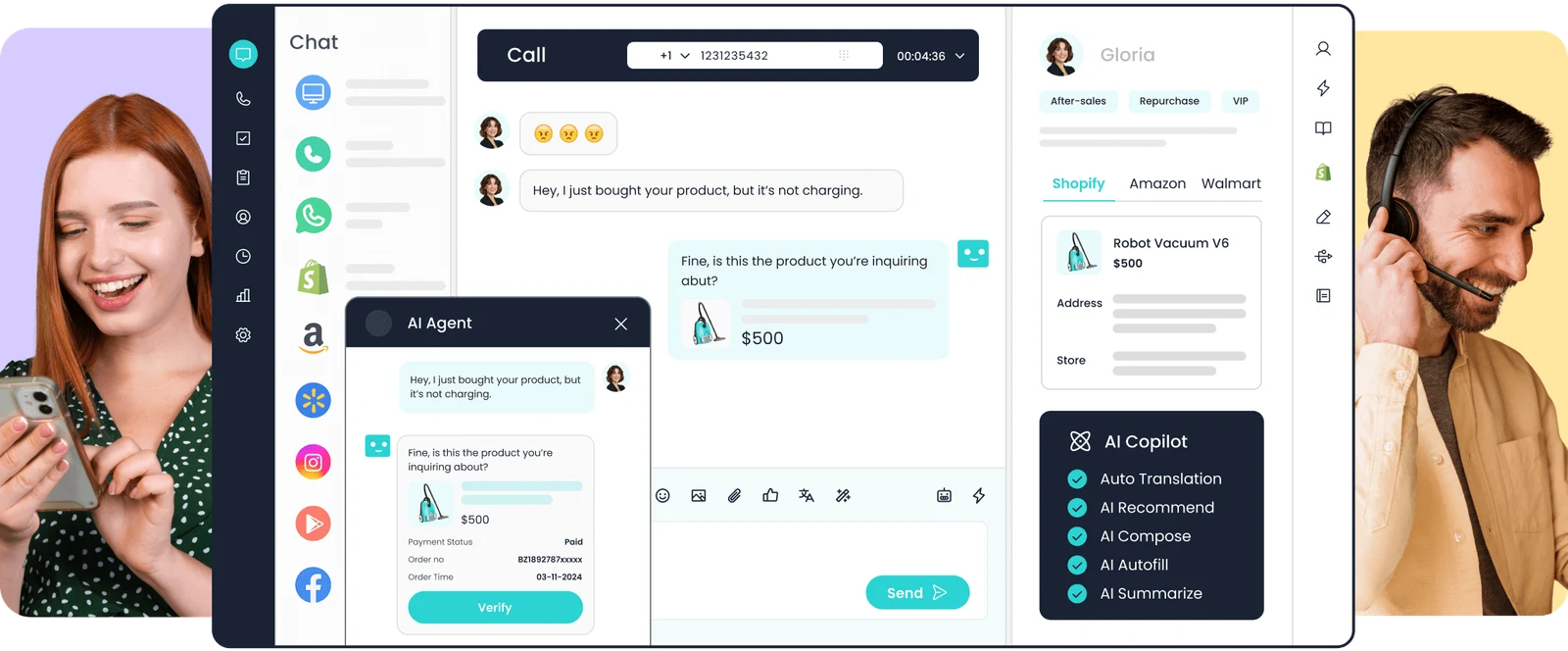
The deployment data backs up the “resolution” claim rather than just “response”: OPPO reached an 81%+ self-service rate after deploying Sobot Agents, Renogy’s resolution rate rose 45% with CSAT holding above 95%, Weee! cut resolution time by 50% while lifting CSAT to 96%, and DFS saw support efficiency rise more than 80% alongside a 44% lift in conversion. Sobot operates from a Singapore APAC headquarters with offices in Kuala Lumpur and Jakarta and supports 23+ languages, which matters for teams with Southeast Asian customer bases where WhatsApp and marketplace messaging carry as much support volume as web chat.
Sobot is best for teams that want voice and digital resolved by the same AI system, without a variable per-resolution or per-seat AI bill, and particularly for e-commerce brands selling across Southeast Asian marketplaces.
Which Platform Fits Your Situation
| Your situation | Recommended category | Example platform |
|---|---|---|
| Already run Zendesk, Salesforce, or Freshworks and just want AI added | AI bolted onto legacy suite | Zendesk, Salesforce, Freshworks |
| Need chat/email deflection only, comfortable managing a second vendor for voice | AI-native point tool | Fin, Ada |
| Run a Shopify store or a small team wanting lightweight chat automation | Vertical AI add-on | Gorgias, Tidio |
| Want the same AI to resolve both phone calls and chat messages | Native omnichannel AI | Sobot |
| Sell on Amazon, Shopee, Lazada, or TikTok Shop and need native marketplace messaging | Native omnichannel AI | Sobot |
| Need AI cost to stay flat regardless of conversation volume spikes | Native omnichannel AI (flat pricing) | Sobot |
Bottom Line
The customer support platforms with the strongest AI capabilities aren’t necessarily the ones with the highest advertised resolution rate — they’re the ones where AI is structurally positioned to cover your actual support volume without a second vendor or an unpredictable bill. Teams already committed to Zendesk, Salesforce, or Intercom get the fastest path to AI by extending what they have. Teams building support from scratch, or trying to unify voice and digital resolution under one AI system without per-resolution or per-seat cost exposure, get more from a native omnichannel platform — Sobot in particular for e-commerce and Southeast Asia-facing teams where marketplace and WhatsApp volume matter as much as the website chat widget.
Frequently Asked Questions
What makes one customer support platform’s AI stronger than another’s?
Strength isn’t just about resolution-rate marketing claims — it comes down to whether the AI was built natively into every channel the platform offers or added afterward as a module. A platform where AI covers voice, chat, and ticketing from one data layer resolves more of a customer’s actual journey than one where AI only covers the channel it was originally built for, typically chat.
Is AI that was added through an acquisition worse than AI built natively?
Not automatically worse, but it usually means the AI and the core ticketing system were engineered separately and later connected — which is why voice AI, for example, tends to arrive years after chat AI in these platforms. Zendesk’s own voice AI didn’t ship until 2024, well after its acquired conversational AI technology (from Ultimate.ai) reached chat and email.
Do I need to replace my existing helpdesk to add strong AI?
Not necessarily. AI-native point tools like Fin and Ada are explicitly designed to sit on top of an existing Zendesk, Salesforce, or HubSpot inbox without a migration. Bolt-on AI from Zendesk, Salesforce, and Freshworks works within the suite you’re already using. Native omnichannel platforms like Sobot are typically adopted as a full replacement, which adds a migration step but removes the need to maintain two separate vendor relationships for AI and ticketing going forward.
How is AI pricing usually structured across these platforms?
Three models dominate: per-resolution fees (Fin charges $0.99 per resolved conversation), per-seat add-ons layered on an existing suite (Zendesk’s Advanced AI runs roughly $50/seat/month on top of Suite pricing), and flat inclusion where AI ships with the platform at no separately metered cost (Sobot’s model). Per-resolution and per-seat pricing are the most transparent on paper but the least predictable during high-volume periods like flash sales or holiday promotions.
Which platform has the strongest AI for a team that takes both phone calls and chat messages?
Look specifically at whether voice and chat AI share the same system, not just whether both exist. Sobot Agents runs across voice, live chat, and ticketing from one platform, so context carries over when a customer moves between channels. Most AI-native point tools (Fin, Ada) don’t handle voice at all, and most legacy suites added voice AI significantly later than their chat AI.