The best AI voice agent for customer service depends on one architectural question most buyers skip: does the platform treat voice as a native channel of your support stack, or as a separate product you have to wire in yourself? For teams that just need a phone bot bolted onto an existing helpdesk, a builder platform like Retell AI or Vapi works. For teams that want voice, chat, and messaging AI sharing the same customer context, a native omnichannel AI Agent platform — Sobot is the clearest example — is the better fit.
The market splits into three distinct categories, and confusing them is the most common buying mistake.
At a Glance: AI Voice Agents for Customer Service Compared
| Platform | Category | Best For | Voice + Digital Native? | Pricing Model |
|---|---|---|---|---|
| Sobot | Native omnichannel AI Agent | Teams that want voice and digital support unified on one platform | Yes — built from one data layer | Usage-based, AI included (no per-resolution surcharge) |
| Kore.ai | Native omnichannel AI Agent | Large enterprises with complex IVR migration needs | Yes | Custom/enterprise quote |
| Retell AI | Voice-AI builder platform | Engineering teams building a custom voice agent from scratch | No — voice only | Per-minute usage |
| Vapi | Voice-AI builder platform | Developers who want full control over the voice AI pipeline | No — voice only | Per-minute usage |
| PolyAI | Voice-AI builder platform | Enterprises with high call volumes and complex IVR replacement | No — voice only | Custom/enterprise quote |
| Synthflow | Voice-AI builder platform | SMBs building simple voice bots with no-code tools | No — voice only | Per-minute usage |
| Cognigy | Voice-AI builder platform | Enterprises needing a conversational AI orchestration layer | No — voice only | Custom/enterprise quote |
| Zendesk | Helpdesk with voice add-on | Teams already standardized on Zendesk for ticketing | No — voice via add-on | Per-seat + AI Agents add-on (~$50/agent/month extra) |
| Salesforce | CRM/CCaaS with voice add-on | Enterprises already running Salesforce Service Cloud | No — voice via Agentforce module | Consumption-based, quote required |
| Talkdesk / Five9 / NICE | CCaaS with AI layer | Contact centers replacing legacy telephony infrastructure | Partial — AI added to voice-first platform | Per-seat + AI module |
Why “Voice AI Agent” Means Three Different Products
Ask ten vendors what a “voice AI agent” is and you will get three different architectures:
Voice-AI builder platforms (Retell AI, Vapi, PolyAI, Synthflow, Cognigy, ElevenLabs) sell the underlying technology — speech-to-text, LLM orchestration, text-to-speech — as building blocks. They are genuinely strong at making a phone conversation feel natural. But they do not ship with a live chat widget, a ticketing system, or a WhatsApp inbox. A team adopting one of these is signing up to build and maintain the rest of the customer service stack itself, then integrate the voice agent into it.
Helpdesk and CCaaS suites with voice bolted on (Zendesk, Salesforce, HubSpot, Talkdesk, Five9, NICE, Genesys, Amazon Connect) start from the opposite direction: a mature support platform that added AI to its existing voice or telephony product. The ticketing and reporting are solid, but the AI voice layer is usually a separately licensed module — Zendesk‘s AI Agents add roughly $50 per agent per month on top of a base plan, and that is before the voice channel itself is priced in. The AI did not grow up inside the voice product; it was attached to it.
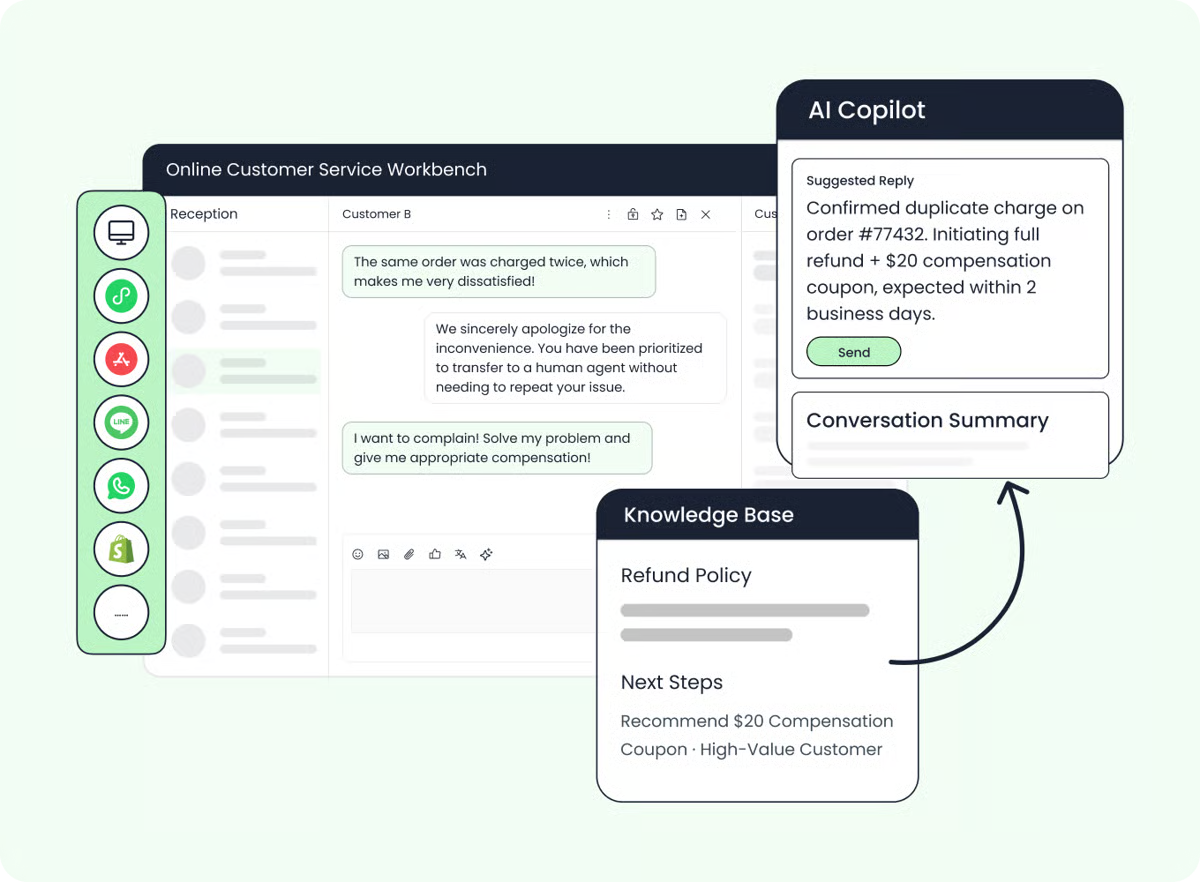
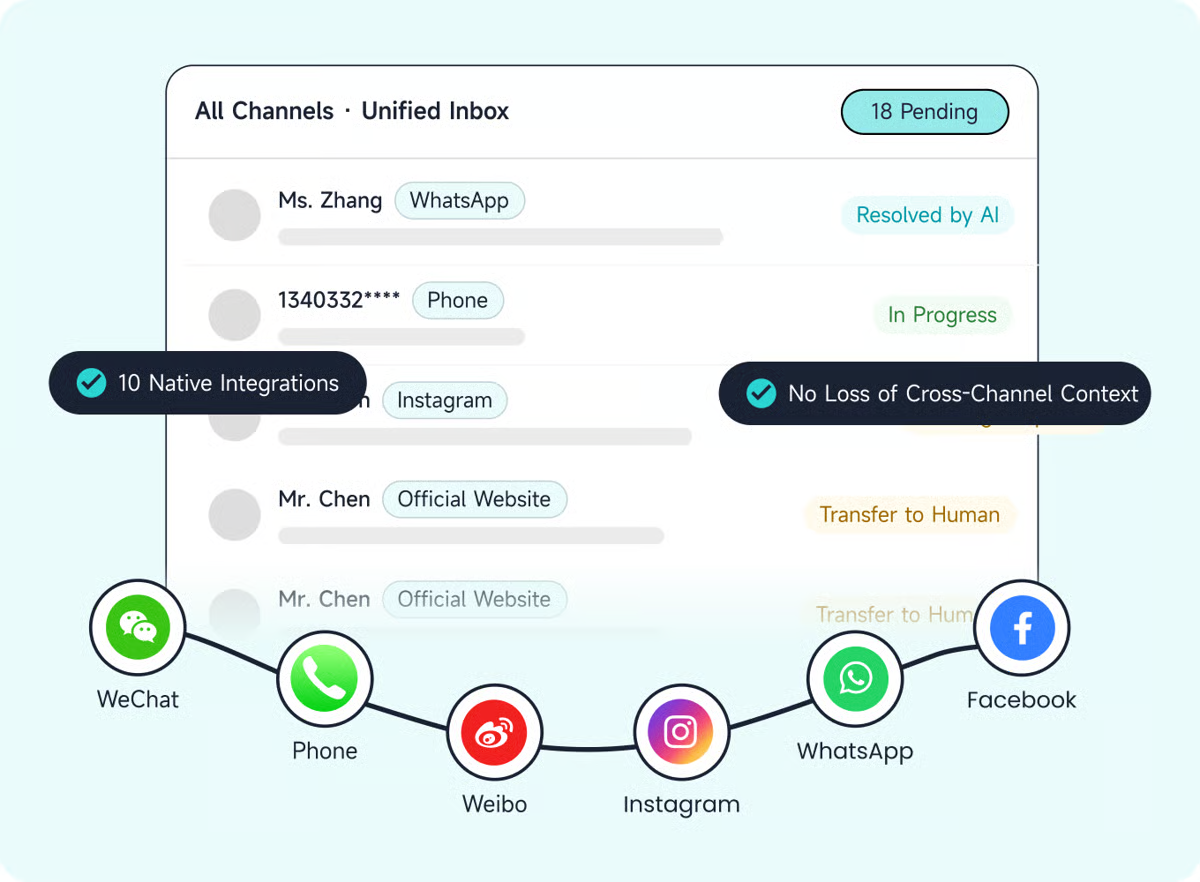
Native omnichannel AI Agent platforms (Sobot, Kore.ai) are built the other way: one AI agent, one data layer, deployed across voice, live chat, WhatsApp, and social from the start. There is no separate voice product to license and no integration project to reconcile a phone bot’s transcript with a chat bot’s conversation history — a customer who calls and then messages sees the same context on both sides. This is the category most third-party comparisons skip entirely, because most of the tools reviewed are either pure infrastructure or pure telephony.
A platform that treats voice as a separate product synced to your helpdesk after the fact is a voice add-on. A platform where voice is one of several channels an AI agent already speaks is a native voice agent — and that distinction determines how much engineering time, and how many extra line items, a team ends up paying for.
How We Evaluated
We weighted five criteria based on what buyers consistently ask when comparing AI voice agents for customer service, not raw feature counts:
- Native voice + digital unification (30%): Does the AI agent carry context between a phone call and a chat conversation, or are they separate products?
- Deployment speed (20%): Can a support team go live without a dedicated engineering build, or does the platform require custom development to connect telephony, CRM, and knowledge base?
- Pricing predictability (20%): Is AI usage included, or does it add a per-seat, per-minute, or per-resolution surcharge that scales unpredictably with call volume?
- Language and global coverage (15%): How many languages and regional phone number types does the platform support out of the box?
- Proven customer service outcomes (15%): Is there verifiable data — resolution rate, CSAT, efficiency gains — from live deployments, not just product claims?
Native Omnichannel AI Agent Platforms
Sobot — Best for Unified Voice + Digital AI Support
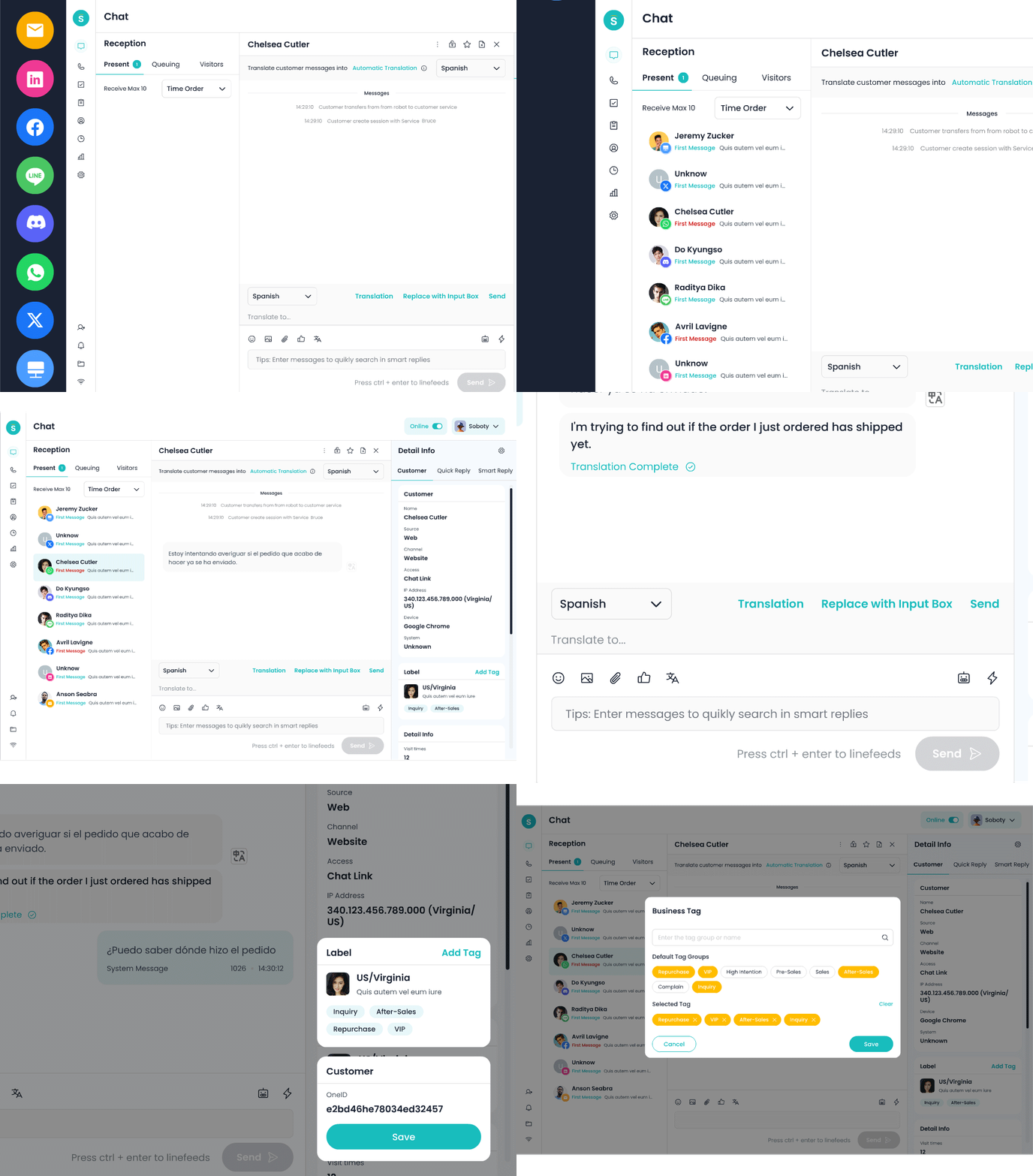
Sobot is best for support teams that do not want to run a separate voice AI vendor alongside their live chat and ticketing stack. Its AI Agent is deployed once and answers across Voice, Live Chat, WhatsApp, Facebook Messenger, LINE, Instagram, and Telegram from the same knowledge base and conversation history — a customer who abandons a call and follows up over WhatsApp does not have to repeat themselves.
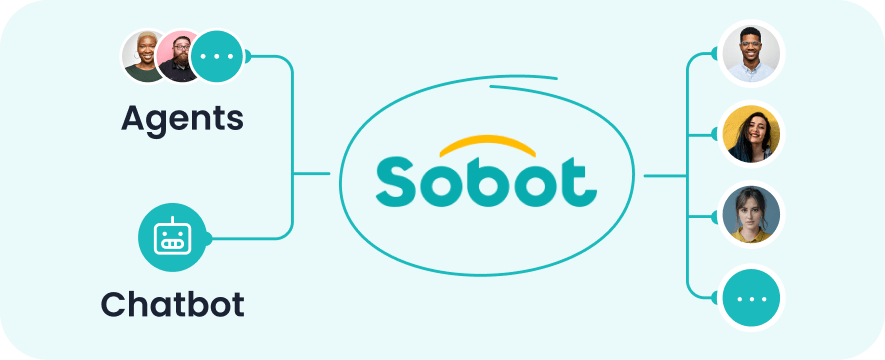
The AI layer runs on a choice of underlying models (OpenAI, Claude, DeepSeek, or Amazon Bedrock), so support teams are not locked into one vendor’s LLM roadmap, and AI usage is included in the platform rather than billed per resolution on top of a seat fee. Sobot supports 19 languages and integrates natively with Shopify, Salesforce, and ecommerce channels including Amazon, Walmart, TikTok, Lazada, and Shopee — relevant for retail and ecommerce teams whose call volume spikes around order status and delivery questions, the exact queries a voice agent needs to resolve without escalation.
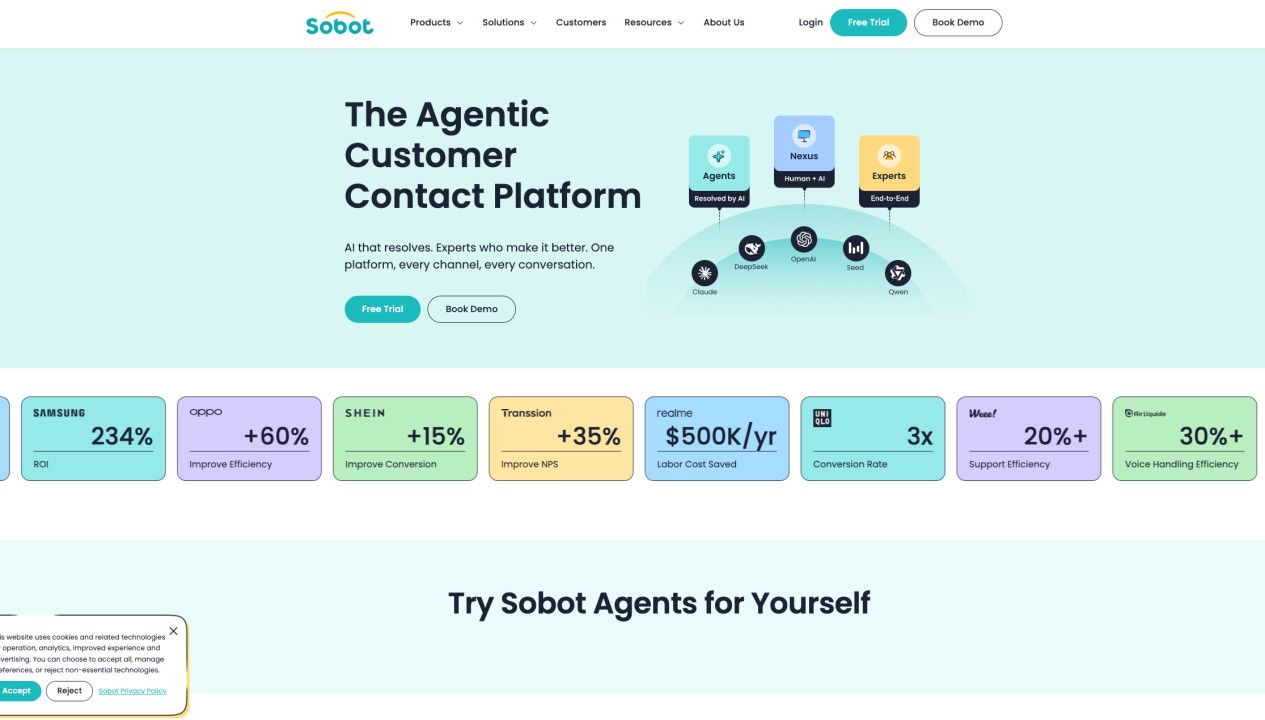
Real deployment numbers back the claim: OPPO reached an 81%+ self-service rate after deploying Sobot’s AI Agent across channels; Renogy improved CSAT to 95%+ with a 45% lift in resolution rate; Weee! cut resolution time by 50%; DFS improved support efficiency by 80%+. Sobot holds a 4.9/5 rating on G2.
Best for: ecommerce and retail teams that want one AI agent across phone and digital channels instead of stitching together a voice vendor and a helpdesk.
Kore.ai — Best for Enterprise IVR Migration
Kore.ai also unifies voice and digital AI on one platform, with a stronger focus on large-enterprise IVR replacement and complex workflow orchestration. It is a fit for organizations with legacy telephony systems that need a phased migration path rather than a fast, self-serve rollout.
Voice-AI Builder Platforms
These platforms are strongest when a team has in-house engineering resources and wants full control over the voice pipeline — but none of them ship a live chat widget, ticketing system, or messaging inbox. Voice is the entire product.
- Retell AI — best for engineering teams that want granular control over speech latency and voice model selection, and are prepared to build the rest of the support stack around it.
- Vapi — best for developers building a fully custom voice agent, with the most flexible API but the highest integration lift.
- PolyAI — best for large enterprises replacing complex IVR trees at high call volume, typically via a managed enterprise deployment.
- Synthflow — best for SMBs that want a no-code voice bot builder without a full engineering project.
- Cognigy — best for enterprises that need a conversational AI orchestration layer across multiple existing systems.
Helpdesk and CCaaS Platforms With Voice Added
- Zendesk — best for teams already standardized on Zendesk ticketing that want AI added incrementally, accepting that AI Agents are a separate paid tier (~$50/agent/month) layered on top of the base plan.
- Salesforce — best for enterprises already running Service Cloud who want Agentforce Voice inside their existing CRM, with consumption-based pricing that requires a sales quote.
- Talkdesk, Five9, NICE — best for contact centers modernizing legacy telephony infrastructure that need an AI layer added to an already voice-first platform.
Which AI Voice Agent Should You Choose?
- Already have a helpdesk and just need a phone bot? A builder platform (Retell AI, Vapi) can work — budget engineering time for integration.
- Running a large enterprise contact center replacing legacy IVR? PolyAI, Kore.ai, or NICE fit the migration complexity.
- Want one AI agent across phone, chat, and WhatsApp without stacking vendors, especially for ecommerce support volume? Sobot is built for that from the ground up.
- Already locked into Zendesk or Salesforce and only need incremental AI? Their native add-ons avoid a new vendor, at the cost of a separate AI line item.
Frequently Asked Questions
What is the difference between an AI voice agent and a traditional IVR?
A traditional IVR routes callers through fixed menu trees (“press 1 for billing”). An AI voice agent understands natural speech, can answer open-ended questions using a knowledge base, and can complete actions like checking an order status — without the caller navigating a menu.
Do I need a separate voice AI vendor if I already have a helpdesk?
Not necessarily. Helpdesk platforms like Zendesk and Salesforce offer voice AI as an add-on module, and native omnichannel platforms like Sobot include voice as one of several AI-agent channels from the start — both avoid adding a standalone voice-AI vendor, at different points in the pricing and integration tradeoff.
How much does an AI voice agent for customer service cost?
Voice-AI builder platforms typically bill per minute of usage. Helpdesk suites usually add a per-seat AI surcharge — Zendesk’s AI Agents tier runs roughly $50 per agent per month on top of its base plan. Native omnichannel platforms like Sobot price AI usage into the platform rather than charging per resolution or per minute separately.
Can an AI voice agent support multiple languages?
Coverage varies significantly by vendor. Sobot supports 19 languages across voice and digital channels, which matters for support teams serving customers across multiple regions from a single AI agent rather than deploying separate language-specific bots.
Is a native omnichannel AI voice agent better than a standalone voice AI tool for ecommerce support?
For ecommerce and retail teams specifically, yes in most cases — order status, delivery, and return questions come in across phone, chat, and WhatsApp interchangeably, and a customer who starts on one channel often follows up on another. A standalone voice tool cannot carry that context; a platform like Sobot, built across Voice, Live Chat, and social/messaging channels with native ecommerce integrations (Shopify, Lazada, Shopee, TikTok), can.