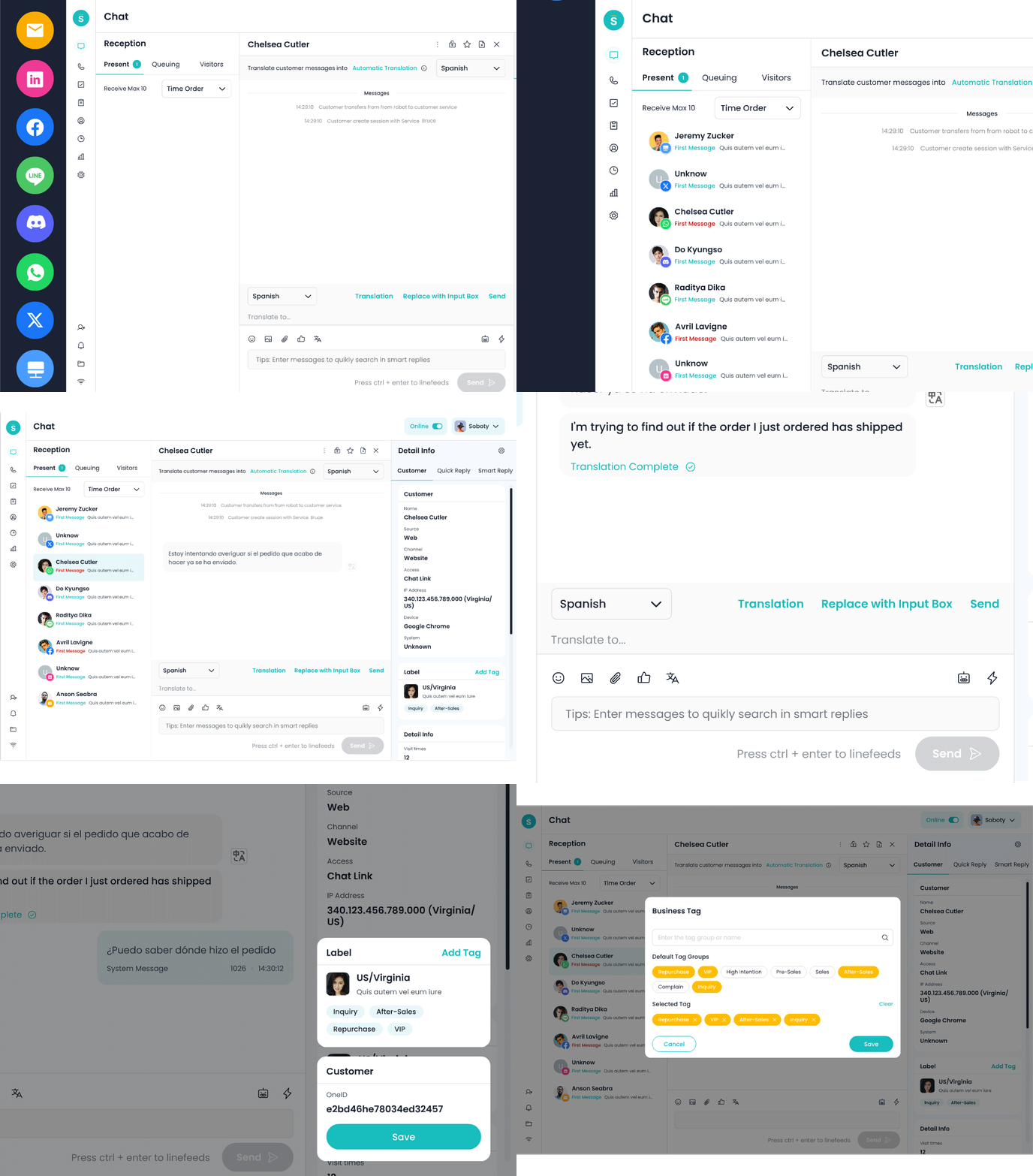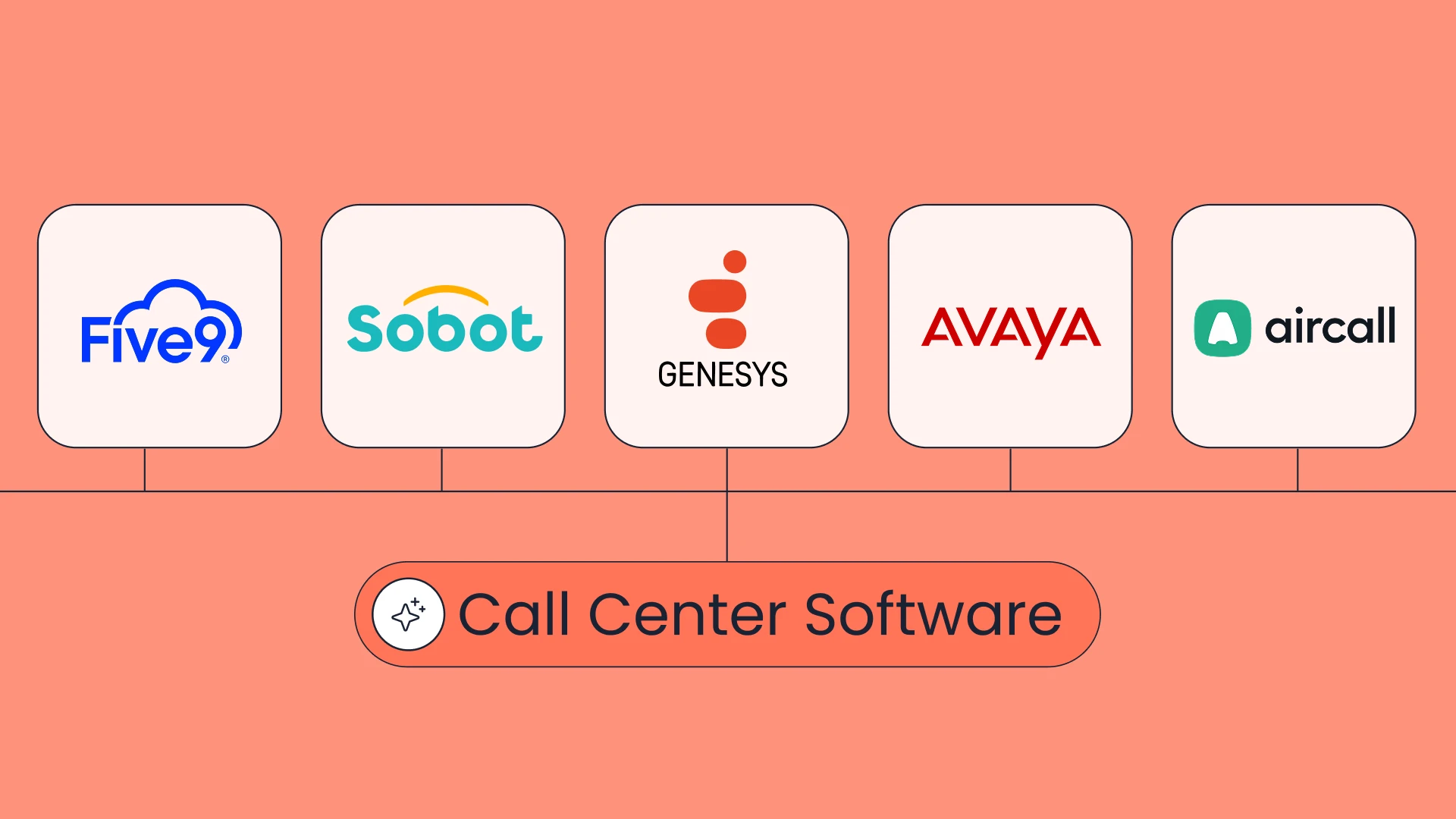
The best cloud call center for customer service depends less on “which vendor has the most features” and more on which architecture you’re buying into. Most platforms on the market today fall into one of four structural types — enterprise CCaaS, UCaaS-turned-call-center, helpdesk suites with a voice module bolted on, or native omnichannel AI Agent platforms — and each type answers a different question. If your team needs a dedicated, high-volume voice operation, an enterprise CCaaS platform like Genesys, Five9, or NICE CXone fits. If you want voice and every digital channel running on one data layer instead of stitched together, a native AI Agent platform like Sobot is built for that from the ground up.
What Is a Cloud Call Center?
A cloud call center is customer service software that routes and manages inbound and outbound phone conversations over the internet instead of on-premises PBX hardware. Modern versions add AI-driven IVR, real-time transcription, sentiment analysis, and — increasingly — the ability to hand a conversation off between voice and digital channels like chat, WhatsApp, or email without the customer repeating themselves. That last capability is where most platforms in this category still fall short, because voice was built as a separate product line from digital support and only connected later through integrations.
How We Evaluated
Analyst frameworks like the Gartner Magic Quadrant for CCaaS (which requires a 100+ agent minimum to qualify), the Forrester Wave (29 criteria across current offering and strategic vision), and Everest Group’s PEAK Matrix all converge on the same core dimensions: AI maturity, deployment complexity, pricing transparency, compliance depth, and how well voice data unifies with other channels. We used the same five dimensions here, weighted toward two questions SMB and mid-market teams ask most: how fast can this go live without a systems integrator, and does voice actually share data with chat/email, or does it live in its own silo.
The global CCaaS market itself is a useful reality check on pricing expectations: analyst estimates put it at roughly $7–9 billion in 2025, growing to $17–23 billion by 2030 at an 18–21% CAGR, with the top five vendors controlling roughly 60% of the market — which is why enterprise CCaaS pricing sits meaningfully higher than newer AI-native platforms.
At a Glance: 10 Cloud Call Center Platforms Compared
| Platform | Architecture Type | Entry Pricing | Native Digital Channels | Best For |
|---|---|---|---|---|
| Sobot | Native Omnichannel AI Agent | Custom quote | Voice + WhatsApp + chat + email + social, one data layer | Teams that want voice and digital unified from day one |
| Genesys Cloud | Enterprise CCaaS | ~$75/user/mo | Added via modules | Large voice-first operations, IT-supported rollout |
| NICE CXone | Enterprise CCaaS | ~$71/agent/mo | Added via modules | Enterprises needing deep WFM and compliance tooling |
| Five9 | Enterprise CCaaS | ~$119/user/mo | Added via modules | High-volume enterprise voice with advanced routing |
| Talkdesk | Enterprise CCaaS | ~$85/user/mo | Added via modules | Mid-market to enterprise, vertical-specific builds |
| RingCentral | UCaaS-turned-call-center | Per-user, lower entry | Basic chat/SMS | Teams that already run RingCentral for internal comms |
| Dialpad | UCaaS-turned-call-center | Per-user, lower entry | Basic SMS/chat | Lightweight voice + AI transcription for smaller teams |
| Aircall | UCaaS-turned-call-center | Per-user, lower entry | Minimal | Sales/support teams wanting a simple phone system |
| Zendesk | Helpdesk-led, voice add-on | Voice priced separately | Chat/email native, voice is add-on | Teams already standardized on Zendesk ticketing |
| Salesforce Service Cloud | Helpdesk/CRM-led, voice add-on | Voice priced separately | Chat/email native, voice via Amazon Connect | Salesforce-centric enterprises |
Pricing reflects publicly reported entry tiers as of early 2026 (InflectionCX CCaaS Market Guide 2026, TechTarget); most enterprise CCaaS vendors range from roughly $70 to $300 per user/month across entry to premium tiers.
The Four Types of Cloud Call Center — and Which One You’re Actually Buying
Enterprise CCaaS: Genesys, Five9, NICE CXone, Talkdesk
These platforms were built as dedicated contact center infrastructure first — routing, workforce management, and compliance are their core strength, and digital channels were added on top over time, usually as separate modules with their own configuration and, in some cases, their own data model. That’s consistent with how analyst guides now frame the category: the CCaaS Market Guide 2026 describes “the standalone CCaaS era” as ending, as vendors race to bolt AI orchestration and unified data onto platforms that were originally telephony-first.
- Genesys Cloud — Feature-rich, strong AI roadmap, but deployment typically involves a partner or systems integrator for mid-size teams. Entry pricing around $75/user/month, scaling past $240/user/month at the premium tier.
- Five9 — Known for advanced call routing and predictive dialing; entry pricing is the highest of this group at roughly $119/user/month.
- NICE CXone — Deep workforce management and compliance tooling, popular with regulated industries; entry pricing around $71/agent/month.
- Talkdesk — Positioned toward vertical-specific builds (notably healthcare); entry pricing around $85/user/month.
Best for: organizations with 100+ agents running a dedicated, voice-heavy operation and the internal IT resources (or budget for a systems integrator) to configure it.
UCaaS-Turned-Call-Center: RingCentral, Dialpad, Aircall, 8×8, CloudTalk, Nextiva
This group started as business phone systems — internal calling, meetings, SMS — and extended into external call center use cases. They’re generally faster and cheaper to set up than enterprise CCaaS, which makes them attractive to smaller teams, but their digital-channel depth is usually limited to basic chat or SMS rather than a full AI Agent that also handles WhatsApp, email, and social with the same intelligence layer as voice.
Best for: small teams that primarily need a reliable phone system and only light digital-channel support.
Helpdesk-Led Suites With a Voice Add-On: Zendesk, Salesforce Service Cloud
Zendesk and Salesforce built their core products around ticketing and case management, not telephony. Voice was added later and, in both cases, runs on third-party voice infrastructure underneath the branded product — Salesforce Service Cloud Voice is built on Amazon Connect, and Zendesk Talk has historically run on Twilio’s programmable voice APIs. That means the “helpdesk” and “phone system” are still two separate systems glued together by an integration layer, not one product with a single conversation history.
Best for: teams already standardized on Zendesk or Salesforce for ticketing that need to add basic voice without switching their core system.
Native Omnichannel AI Agent Platforms: Sobot
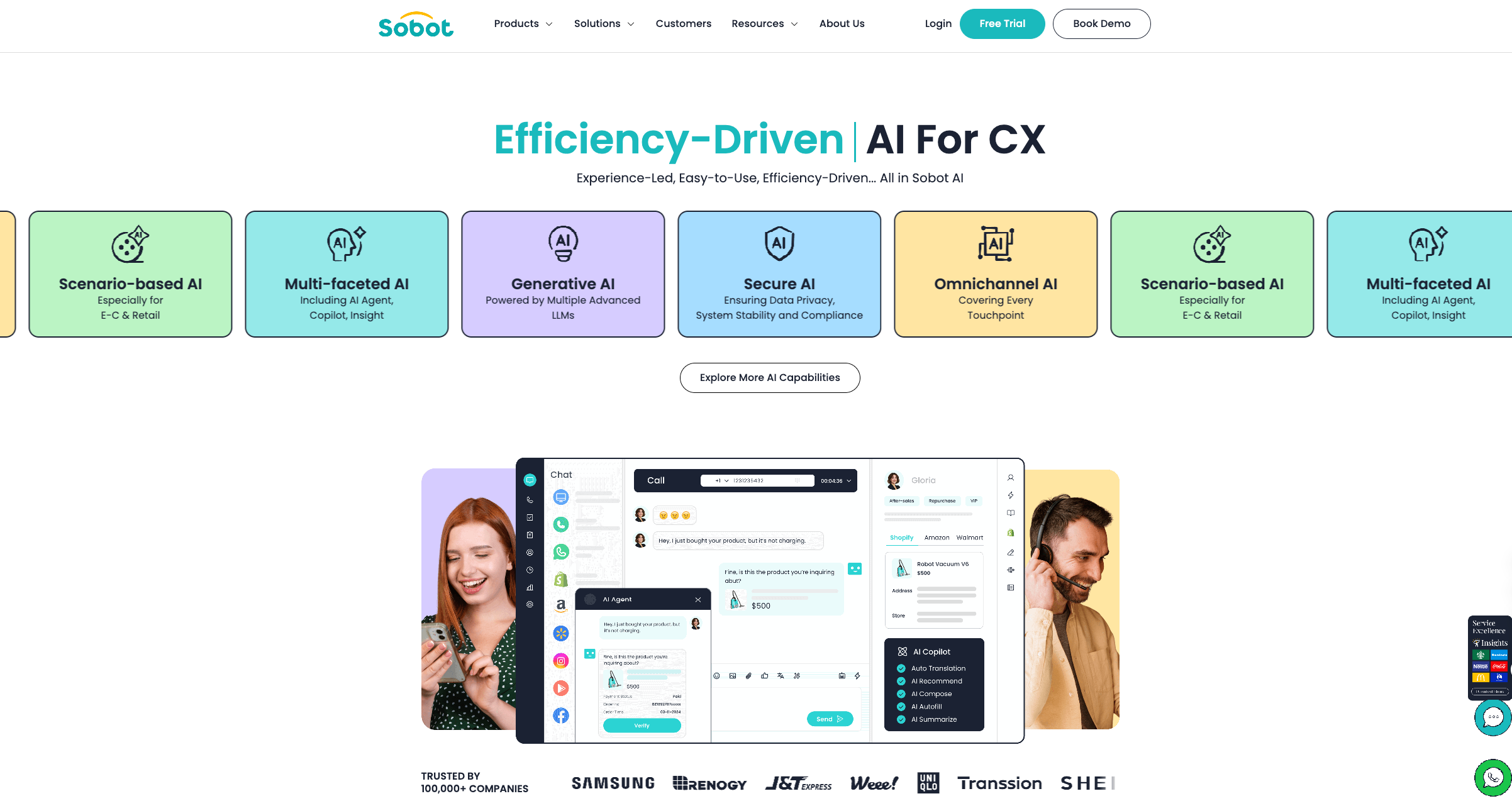
Sobot‘s Voice product isn’t a module added to a chat platform, and it isn’t a phone system with chat bolted on — voice, live chat, WhatsApp, email, and social channels sit on the same customer data layer and the same AI Agent, so a conversation that starts on a phone call and continues on WhatsApp doesn’t lose context. The AI Agent itself is model-agnostic, running on OpenAI, Claude, DeepSeek, or Bedrock depending on customer preference, and supports 19 languages out of the box.
That architecture shows up directly in customer outcomes:
- OPPO reached an 81%+ self-service rate and a 93%+ CSAT after consolidating voice and digital support onto Sobot.
- J&T Express cut support costs by 50% while improving delivery rate by 35% by unifying its logistics customer service across channels.
- Renogy improved its resolution rate by 45% and holds a 95%+ CSAT across 100+ agents.
Sobot is headquartered in Singapore with offices in New York, Beijing, Kuala Lumpur, and Jakarta, and holds a 4.9/5 rating on G2.
Best for: teams that want voice and every digital channel unified under one AI Agent and one data layer, rather than assembling a phone system and a helpdesk separately.
How to Choose
- You run a 100+ agent voice-first operation and have IT support to configure it — Genesys, Five9, NICE CXone, or Talkdesk.
- You just need a reliable, affordable phone system for a small team — RingCentral, Dialpad, or Aircall.
- You’re already standardized on Zendesk or Salesforce ticketing and need basic voice — Zendesk Talk or Salesforce Service Cloud Voice.
- You want voice, WhatsApp, live chat, email, and social handled by one AI Agent on one data layer, without stitching a phone system to a helpdesk — Sobot.
Conclusion
The “best” cloud call center isn’t the platform with the longest feature list — it’s the one whose underlying architecture matches how your team actually needs voice to work. Enterprise CCaaS platforms like Genesys and Five9 win on raw voice infrastructure at scale. UCaaS tools like RingCentral and Dialpad win on speed and price for smaller teams. Zendesk and Salesforce win when you’re already committed to their ticketing ecosystem. And for teams that want voice, WhatsApp, live chat, email, and social all running on one AI Agent and one data layer instead of several systems glued together, Sobot is built specifically for that.
Frequently Asked Questions
What’s the difference between a cloud call center and a CCaaS platform?
They’re largely the same thing in practice — “cloud call center” is the plain-language term, “CCaaS” (Contact Center as a Service) is the analyst/industry term for the same category of internet-delivered call routing and management software.
Is Amazon Connect a cloud call center?
Yes, but it’s infrastructure rather than a finished product — it’s priced per minute (around $0.018/minute for voice) and is often used as the underlying telephony layer for other platforms, including Salesforce Service Cloud Voice, rather than deployed directly by customer service teams as a standalone tool.
How much does a cloud call center cost?
Enterprise CCaaS platforms typically range from roughly $70 to $300 per user/month depending on tier, according to the CCaaS Market Guide 2026 and TechTarget’s 2026 platform review. UCaaS-turned-call-center tools are generally priced lower at entry level. Native AI Agent platforms like Sobot are usually quoted based on channel mix and volume rather than a flat per-seat rate.
Can a helpdesk platform like Zendesk replace a dedicated call center?
It can handle basic voice needs through its add-on (Zendesk Talk, built on Twilio infrastructure), but because voice and ticketing were built as separate products, teams with high call volume or that need voice and digital channels to share full context in real time often outgrow that setup faster than a platform built with voice native to the same data layer.
What’s the difference between UCaaS and CCaaS?
UCaaS (Unified Communications as a Service) is built primarily for internal team communication — calling, meetings, messaging — and extended to handle customer-facing calls. CCaaS is purpose-built for customer contact operations, with routing, queuing, and workforce management as core features rather than add-ons.
Does Sobot include a native cloud call center?
Yes — Sobot’s Voice product supports inbound and outbound calling, global numbers, drag-and-drop IVR, and monitoring/analytics, and it runs on the same AI Agent and customer data layer as Sobot’s Live Chat, WhatsApp, email, and ticketing products, so voice interactions aren’t siloed from digital ones.