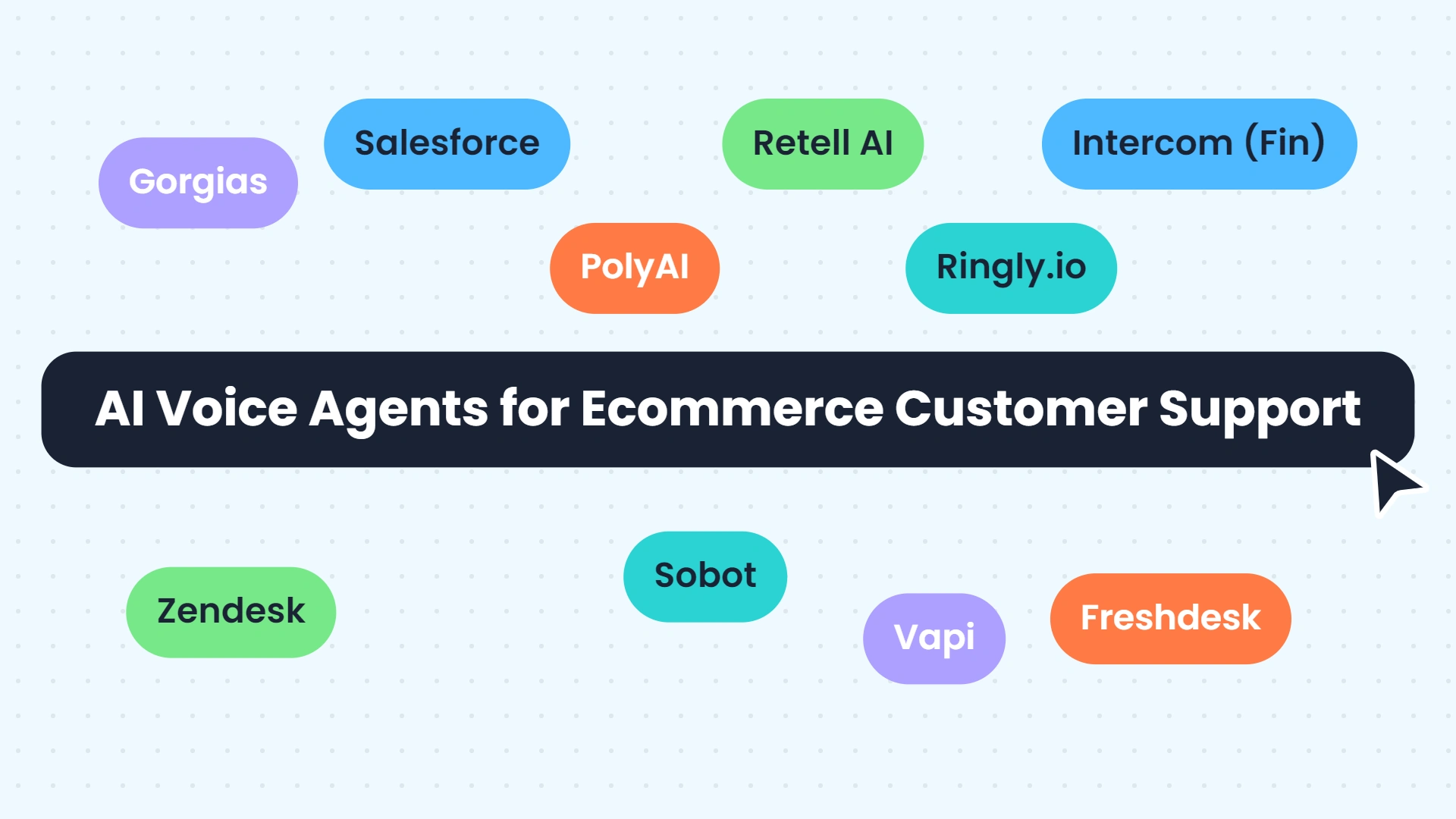
Comparing AI voice agents for ecommerce customer support comes down less to which vendor sounds most human on a call and more to which of four categories fits how your support stack is already built: a voice-AI infrastructure platform you assemble yourself (Retell AI, Vapi, PolyAI), an ecommerce-native chat tool that doesn’t do voice and needs a separate voice vendor stitched on top (Gorgias, Fin, Ringly.io), an enterprise CCaaS suite with an AI voice module bolted onto a phone product built for a different era (Zendesk, Salesforce), or a native omnichannel AI Agent where voice is simply one channel of the same system that already handles chat (Sobot). Most “best AI voice agent” lists rank tools by call quality and skip this distinction — which is exactly why so many end up recommending a second vendor bill and a data-sync problem the moment order volume spikes.
At a Glance: AI Voice Agents for Ecommerce Customer Support Compared
| Platform | Category | Voice ↔ Digital Unified? | Ecommerce / Marketplace Integration | Pricing Model | Best For |
|---|---|---|---|---|---|
| Sobot | Native omnichannel AI Agent | Yes — one AI Agent, one data layer across voice, chat, WhatsApp | Amazon, Shopify, Lazada, Shopee, TikTok Shop | AI included, no per-resolution or per-minute fee | Multi-channel sellers who want phone and chat handled by the same AI |
| Retell AI | Voice-AI infrastructure | No — voice only, you build the rest | None native; you wire it via API | Usage/per-minute, developer-priced | Engineering teams building a custom voice agent from scratch |
| Vapi | Voice-AI infrastructure | No — voice only | None native | Usage-based | Developers who want raw building blocks, not a finished support tool |
| PolyAI | Voice-AI infrastructure | No — voice only | None native | Custom/enterprise | Large enterprises with a dedicated voice AI implementation team |
| Gorgias | Ecommerce-native helpdesk, chat-first | No — voice requires a separate add-on or vendor | Deep Shopify, also BigCommerce, WooCommerce | Per-conversation billing tiers ($10–$900/mo) | Shopify stores that need ticketing + chat AI, not phone |
| Fin (Intercom) | Point-solution AI resolution agent | No — chat/email only | Shopify app available, no SEA marketplace integration | $0.99 per resolution (min. $49.5/month) | Stores already on Intercom’s inbox |
| Ringly.io | Ecommerce voice specialist | No — voice-only, pairs with a separate chat helpdesk | Shopify-focused | ~$349/month | Shopify stores wanting a phone-only add-on next to an existing helpdesk |
| Zendesk | Enterprise suite + AI voice add-on | Voice added 2024 as a separate product line, not natively unified with AI Agents | No native ecommerce platform integration; relies on Marketplace apps | Suite $55–$209/seat/month + Advanced AI add-on ~$50/seat/month | Existing Zendesk customers extending a ticketing deployment |
| Salesforce | Enterprise suite + AI voice add-on | Voice and chat live in separate modules | Native for Salesforce Commerce Cloud only | Consumption-based add-on | Brands already running Salesforce Commerce Cloud |
How We Evaluated
Ecommerce support has a specific pattern that generic “best AI voice agent” rankings tend to ignore: industry estimates commonly put order-status questions — “where is my order,” delivery delays, return status — at roughly 30–40% of total support ticket volume, and phone is still the channel customers default to when an order is late and they want a faster answer than email. That means the bar for an ecommerce voice agent isn’t “can it hold a conversation” — it’s “can it look up a real order and act on it while sharing that context with whatever channel the customer used last.” We scored each platform against:
- Order and platform data access (25%) — can the voice agent look up and act on live order, shipping, and inventory data from the actual sales channel, or is it limited to scripted small talk?
- Voice ↔ digital continuity (25%) — does a call plug into the same AI and conversation history as chat and WhatsApp, or does the customer have to re-explain themselves if they call after messaging?
- Ecommerce/marketplace integration depth (20%) — native connections to Shopify, Amazon, and — for sellers active in Southeast Asia — Lazada, Shopee, and TikTok Shop, versus a generic API you have to wire yourself.
- Pricing predictability (15%) — flat/included cost, or a per-minute/per-resolution/custom-quote model that gets more expensive exactly when call volume spikes during a sale.
- Deployment overhead (15%) — does it ship as a working support agent, or does it require an engineering team to design call flows before it can answer a single order question?
A voice bot that sounds polished but can’t see a customer’s actual order, or that bills per minute and gets expensive the moment a flash sale hits the phone lines, is a demo — not a fit for a store trying to control cost and complexity at scale.
Voice-AI Infrastructure Platforms
Retell AI, Vapi, and PolyAI are the platforms developers reach for when they want to build a voice agent from primitives: low-latency speech pipelines, telephony hooks, and an API to wire up call logic. That flexibility is real, but none of it comes with ecommerce built in — there’s no native order lookup, no Shopify or marketplace connector, and no shared data layer with whatever tool handles your chat support today. Building an ecommerce-aware voice agent on top of these requires an engineering team to design the call flow, connect it to your order system, and maintain it as your catalog and policies change. Pricing is typically usage-based and rarely published, which mirrors how these platforms are sold — to builders, not directly to support teams.
Voice-AI infrastructure platforms are best for teams with engineering resources who want to build a fully custom voice agent and are comfortable owning the ecommerce integration work themselves.
Ecommerce Chat Tools That Don’t Do Voice Natively
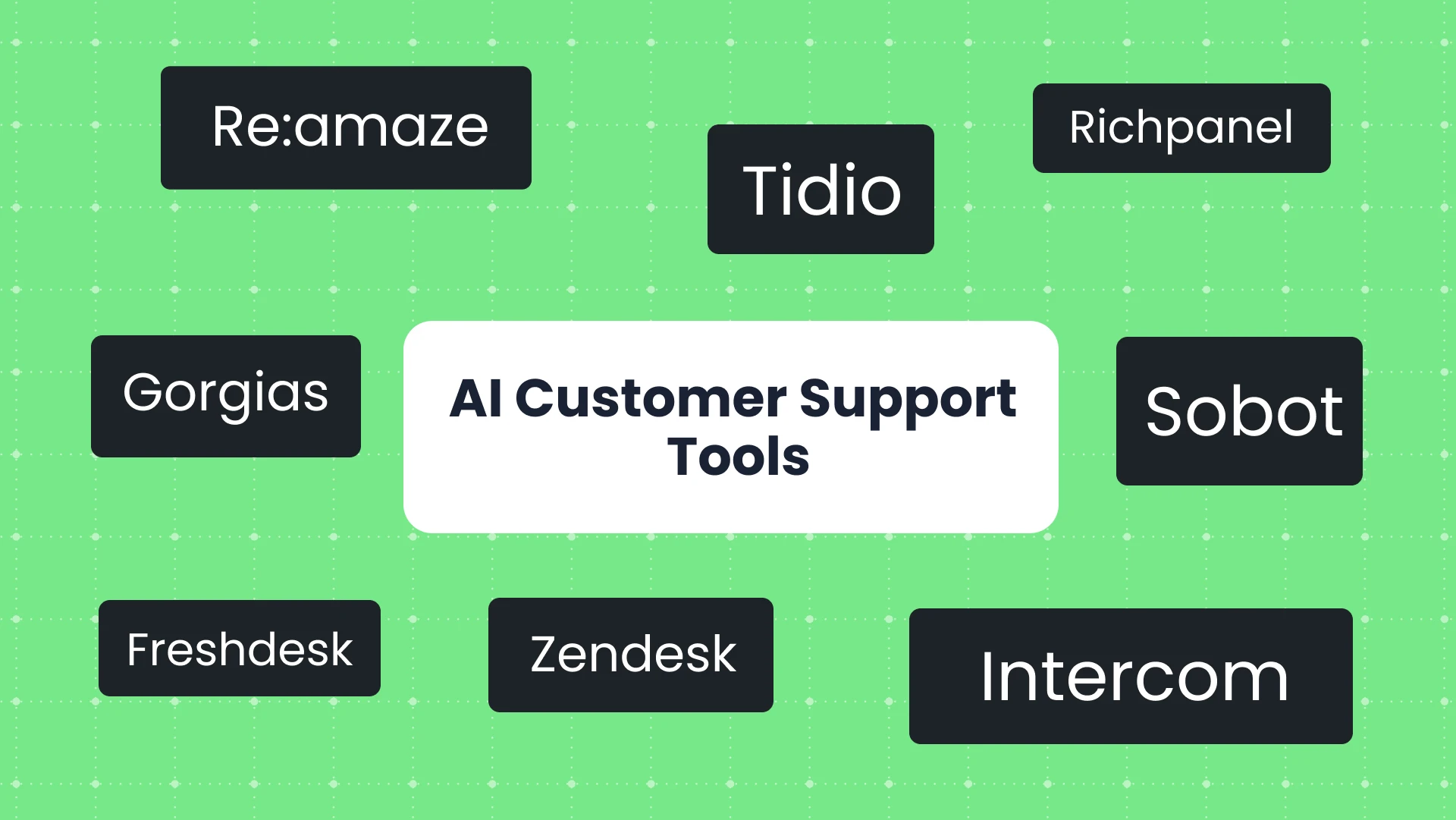
Gorgias, Fin, and similar ecommerce-focused AI agents solved the chat and email side of support well — Gorgias in particular ties ticketing, order data, and its chat widget into one Shopify-native system. But voice sits outside all of them. Gorgias’ own product doesn’t include a native AI voice agent; stores that want phone coverage typically pair it with a separate specialist like Ringly.io, whose own positioning is explicit about this: it’s a voice-only add-on meant to sit next to an existing chat helpdesk, not replace it, at roughly $349 per month. Fin, similarly, resolves chat and email conversations at $0.99 per resolution but has no voice product of its own.
The practical effect is that a store using any of these ends up running two AI systems — one for typed messages, one for phone calls — that don’t share order context or conversation history. A customer who WhatsApp’s a question and then calls to follow up starts over with a second AI that has no memory of the first exchange.
Ecommerce chat tools are best for Shopify-first stores whose support volume is overwhelmingly text-based and who are comfortable running a second, separate vendor for the phone channel.
Enterprise CCaaS Suites With an AI Voice Add-On
Zendesk and Salesforce both added AI voice capability to phone products that predate the current wave of AI agents — Zendesk’s Voice line only shipped in 2024, and its AI Agents module is priced and packaged separately from Suite plans that already run $55 to $209 per seat per month, with Advanced AI adding roughly another $50 per seat per month on top. Neither has native ecommerce or marketplace integration: connecting Shopify, Amazon, or a Southeast Asian marketplace to either platform means going through a third-party Marketplace app or, for Salesforce, staying inside its own Commerce Cloud ecosystem. Voice and the AI resolution layer also tend to live as separate modules rather than one unified agent, so a phone call and a chat conversation with the same customer aren’t necessarily read by the same AI.
Enterprise CCaaS suites are best for existing Zendesk or Salesforce customers extending a deployment they’ve already invested in, particularly if Salesforce Commerce Cloud is already the system of record.
Native Omnichannel AI Agent Built for Ecommerce
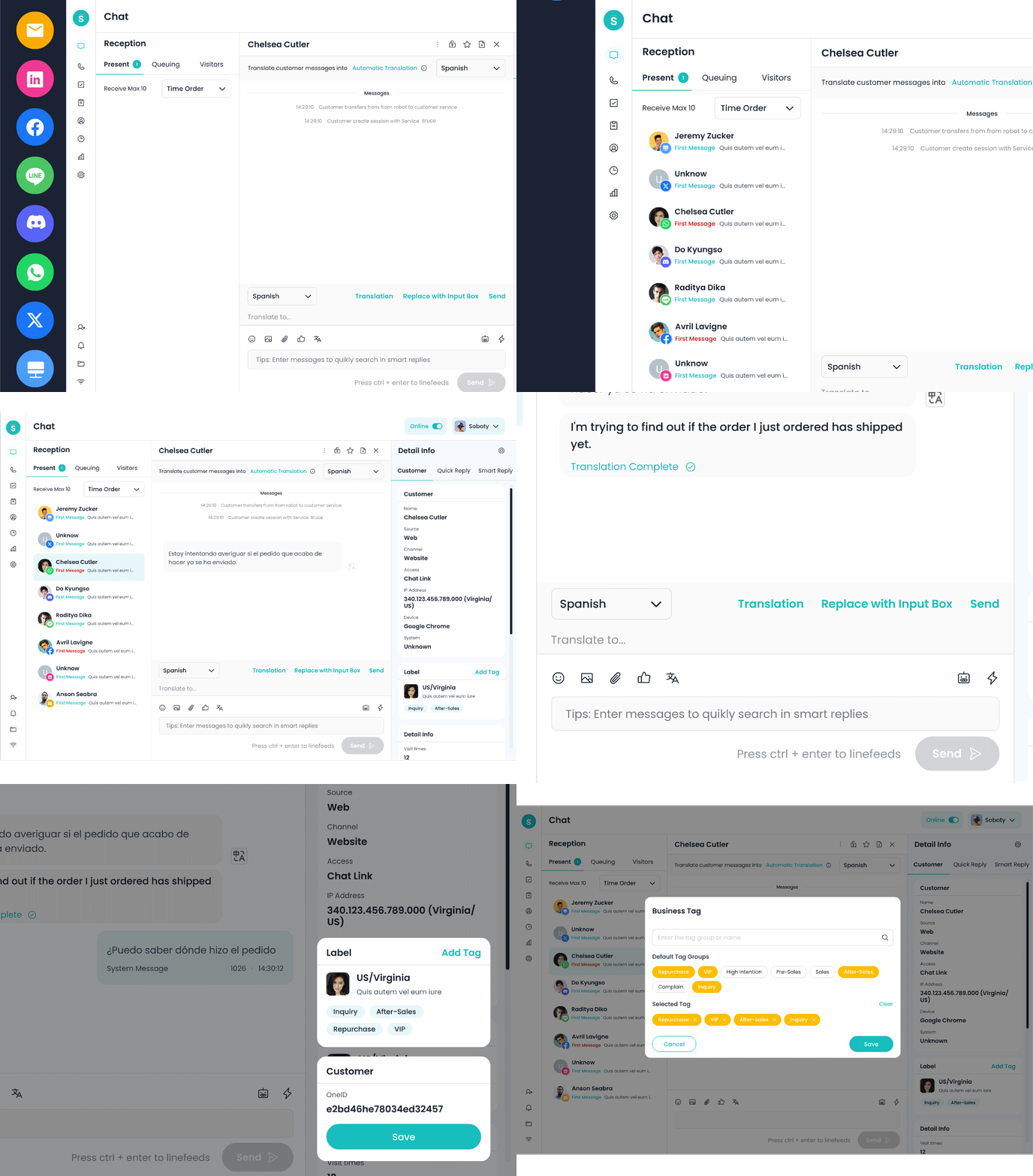
Sobot occupies the fourth category by design: instead of a voice product bolted onto a chat tool, or a chat tool with no voice at all, its AI Agent runs across phone, live chat, and WhatsApp — plus marketplace messaging on Amazon, Lazada, Shopee, and TikTok Shop — from one shared data layer, on a choice of underlying models (OpenAI, Claude, DeepSeek, or Bedrock). If a customer calls about a late order after already messaging on WhatsApp, the voice agent has the same conversation history and the same order data as the chat agent did — nothing resets. That closes the exact gap the point-solution voice specialists in the second category admit they leave open by design.

Sobot’s AI Agent is included in the platform rather than metered per minute or per resolution, a structural difference from Ringly’s flat add-on fee and Zendesk’s ~$50/seat Advanced AI module — one that matters most during peak season, when call volume (and any per-minute or per-resolution bill) rises exactly when budgets are tightest. Results from live ecommerce deployments back the underlying approach: OPPO reached an 81%+ self-service rate after deploying Sobot’s AI Agent across retail support channels; Weee! cut resolution time by 50% while lifting CSAT to 96%; DFS saw support efficiency rise more than 80% alongside a 44% lift in conversion; and J&T Express cut delivery-related support costs by 50% while improving delivery rates 35%.
Sobot is best for ecommerce brands selling across multiple channels — particularly Amazon, Shopify, and Southeast Asian marketplaces like Lazada, Shopee, and TikTok Shop — that want phone and chat handled by the same AI without adding a second vendor or a per-minute bill.
Which Category Fits Your Store
| Your situation | Recommended category | Example platform |
|---|---|---|
| Have engineers who want to build a fully custom voice agent | Voice-AI infrastructure | Retell AI, Vapi, PolyAI |
| Shopify-only, support is almost entirely chat/email | Ecommerce-native helpdesk | Gorgias |
| Already on Intercom, want a chat-only resolution agent | Point-solution AI agent | Fin |
| Need phone coverage but don’t mind running a second vendor next to your helpdesk | Ecommerce voice specialist | Ringly.io |
| Already run Zendesk or Salesforce Commerce Cloud | Enterprise suite + AI add-on | Zendesk, Salesforce |
| Sell on Amazon, Shopee, Lazada, or TikTok Shop and want one AI across phone and chat | Native omnichannel AI Agent | Sobot |
| Order volume spikes during sales and per-minute/per-resolution billing is a budget risk | Native omnichannel AI Agent | Sobot |
Frequently Asked Questions
Do I need separate tools for AI voice and AI chat in ecommerce support?
Not necessarily, but most of the widely-cited names do assume you will. Voice-AI infrastructure platforms only handle calls; ecommerce chat tools like Gorgias and Fin only handle text; and even specialist ecommerce voice tools like Ringly.io are explicitly built as an add-on next to a separate chat helpdesk, not a replacement for one. Sobot is one of the few platforms where the same AI Agent and data layer cover both, so a customer’s order context carries from a WhatsApp message into a follow-up call.
What share of ecommerce support tickets are actually order-status questions?
Industry estimates commonly put “where is my order” and delivery-status questions at roughly 30–40% of total ecommerce support volume, which is why order-lookup depth — not conversational polish — is the most important thing to test before choosing an AI voice agent.
Does Gorgias or Zendesk have a native AI voice agent?
Gorgias does not ship a native voice product; stores typically pair it with a separate voice specialist for phone coverage. Zendesk added a Voice product in 2024, but its AI Agents capability is priced and packaged as a separate module from Suite and Voice plans, so the phone and chat AI aren’t necessarily the same unified agent.
How much does an AI voice agent for ecommerce typically cost?
Pricing spans three models: usage/per-minute for developer-first infrastructure platforms (rarely published), flat monthly add-ons for point solutions like Ringly.io (~$349/month), and per-seat plus add-on module fees for enterprise suites (Zendesk’s Advanced AI runs roughly $50/seat/month on top of Suite pricing of $55–$209/seat/month). Sobot includes AI Agent capability across voice and chat in the platform without a separate per-minute or per-resolution fee.
Can AI voice agents integrate with Shopee, Lazada, or TikTok Shop, not just Shopify?
Rarely, among the names that dominate general “AI voice agent” comparisons — most are built API-first (Retell AI, Vapi) or Shopify-first (Gorgias, Ringly.io), with no native connection to Southeast Asian marketplaces. Sobot connects directly to Lazada, Shopee, and TikTok Shop alongside Amazon and Shopify, which matters for sellers whose order volume isn’t Shopify-exclusive.
Bottom Line
There’s no single best AI voice agent for every ecommerce store — there’s a best fit for how your support stack is already built and how many channels your orders come through. A team with engineers and a custom-build appetite gets the most control from a voice-AI infrastructure platform. A Shopify-only, chat-heavy store can add a point solution like Fin or pair Gorgias with a voice specialist like Ringly.io. A brand already committed to Zendesk or Salesforce gets more value extending what it has. Stores selling across Amazon, Shopify, and Southeast Asian marketplaces — where a customer might message on WhatsApp, browse on TikTok Shop, and call in with a delivery question — get more out of a native omnichannel AI Agent like Sobot, which answers all of it with the same AI and the same order data, without a per-minute bill that scales against you exactly when call volume peaks.