So “best” doesn’t mean “has a chatbot”. For ecommerce customer service software, it means the platform can:
- Resolve a meaningful share of WISMO and returns questions without making stuff up
- Hand off to humans without losing context
- Pull real order/shipping/refund data from your stack
- Stay reliable during peak season volume spikes
This guide is written for teams in the consideration stage: you already know you need automation—now you need a clean way to compare vendors and shortlist.
Key takeaways
- The fastest way to shortlist tools is to score them on (1) AI safety + grounding, (2) e-commerce integrations, (3) omnichannel continuity, (4) analytics, (5) predictable TCO.
- For global e-commerce support, “AI agent” is only useful if it can access order/shipping/returns data and can escalate smoothly when confidence is low.
- Don’t let the demo be theater. Bring a test script (real tickets, edge cases, and policy exceptions) and make vendors show their guardrails.
Quick comparison (use this to shortlist)
| Platform | Best for | Omnichannel maturity | E-commerce depth | AI automation (practical) | What to watch |
|---|---|---|---|---|---|
| Zendesk | Large support orgs that need SLA/ticket rigor | High | Medium (varies by setup) | Strong assist + expanding agents | Workflow nuances between bot vs ticket until escalation |
| Intercom | Chat-first teams + proactive support | Medium–High | Medium | Strong for messaging-based AI | If most volume is email/voice, validate fit |
| Gorgias | Shopify-centric e-commerce support | Medium | High | Strong for common ecom intents | May need add-ons for complex omnichannel/voice |
| Kustomer | Complex journeys needing a unified customer timeline | High | High (depends on integrations) | Strong routing/context approach | Implementation effort and pricing structure |
| Sobot | E-commerce teams that want AI + contact center scope (digital + voice) | High | High | AI agent + copilot + insights | Validate integrations, governance, and TCO details early |
How to evaluate AI customer service software in 2026
A “best tools” list is only useful if it matches how you’ll operate day-to-day. Here’s a practical scoring model you can run in a week.
1) AI agent quality: grounding, confidence, and safe escalation
What you’re really buying is an AI agent for customer support that knows what it’s allowed to use as truth—and knows when to escalate.
Ask vendors to show:
- What the AI is allowed to use as truth (help center, policy docs, order data, internal KB)
- Confidence thresholds (when it refuses, asks clarifying questions, or escalates)
- Auditability (what did it cite, what data did it read, what action did it trigger)
- Human fallback that keeps context (no re-asking shipping address, order number, and issue summary)
Red flag: An “AI agent” that can’t say “I’m not sure” or can’t show what it used to answer.
2) Commerce data access: orders, shipping, refunds, returns
For global e-commerce support, the AI is only as good as the data it can access.
This is where many “AI customer service software” demos fall apart for e-commerce teams: if the bot can’t see order context, it can’t resolve WISMO or returns without guessing.
Validate:
- Can it pull order status, shipment tracking, and delivery exceptions?
- Can it handle return eligibility, refunds, exchanges, and policy exceptions?
- Does it support your stack (Shopify, marketplaces, WMS/OMS, CRM)?
- Can it write back (create ticket, tag, update fields, trigger workflow) with controls?
3) Omnichannel continuity: chat → email → voice without losing the customer story
Your customers don’t care which channel they used first. Your tool shouldn’t either.
Evaluate:
- Does the platform keep a single customer profile across channels?
- Can you route by customer value, language, issue type, and sentiment?
- How does the AI behave on each channel (messaging, email, forms, voice)?
4) Analytics that change decisions (not vanity dashboards)
Make sure you can track:
- Containment rate (automation resolution)
- Escalation rate and reasons
- First contact resolution (FCR)
- Average handle time (AHT) and after-contact work
- Top drivers: WISMO, returns, payment issues, address changes
And crucially: can you segment these by region, language, and channel?
5) Pricing and TCO: the cost traps teams hit in year one
In 2026, the sticker price is rarely the full story. Ask how pricing scales with:
- Agents/seats
- Monthly tickets or conversations
- AI resolution volume
- Additional channels (voice, WhatsApp, social)
- Knowledge base size and training/maintenance
If you want a ready-made scoring template you can adapt for procurement, use the customer service solutions evaluation scorecard (2026) as a starting point (linked once later in “Next steps”).
The best AI customer service software in 2026 (by use case)
Below are five strong options that show up repeatedly in real shortlists. The “best” pick depends on your channel mix, your commerce stack, and how much governance you need.
Sobot
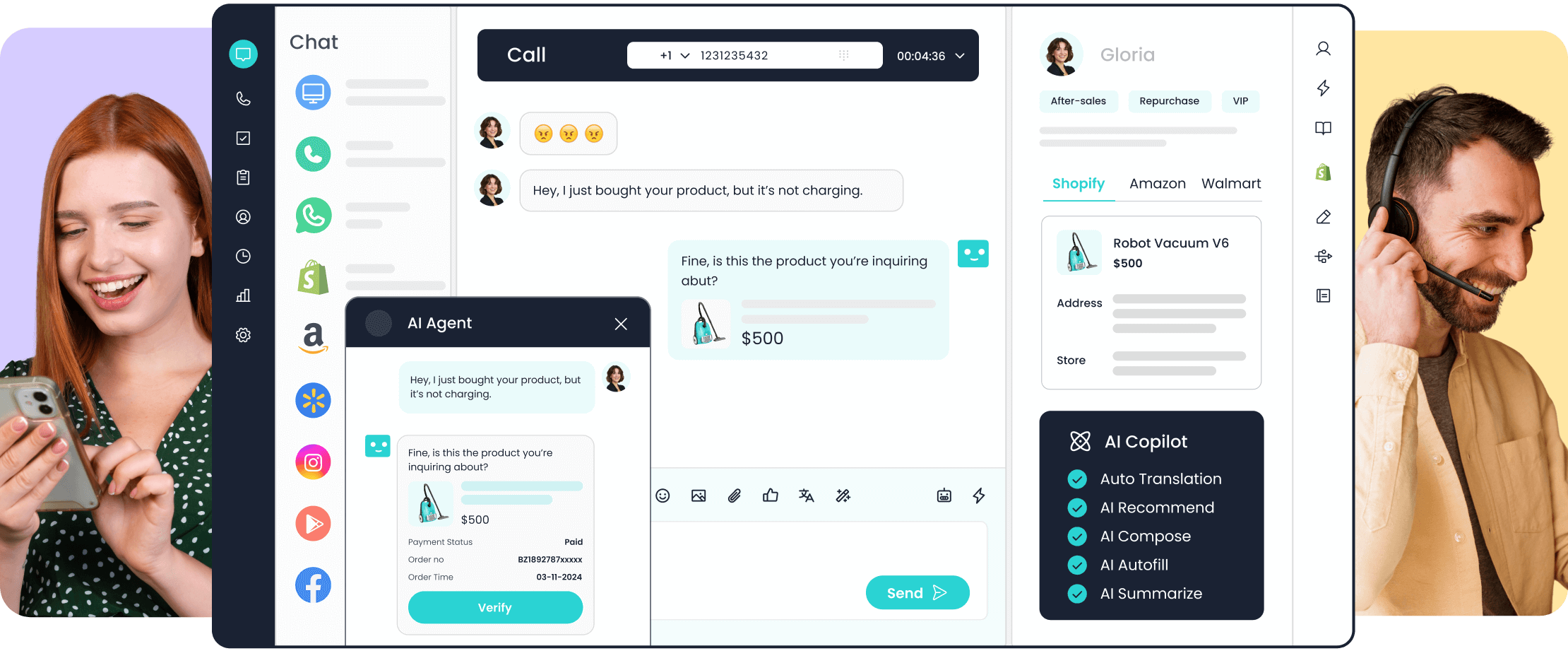
Best for: Global e-commerce support teams that want AI automation plus contact-center scope across digital and voice channels.
Strengths
- Omnichannel contact center framing with AI Agent/Copilot/Insight capabilities
- Strong fit for multilingual/global operations and performance analytics
Watch-outs
- Confirm integration depth for your exact stack, and ask for governance specifics (sources, guardrails, evaluation).
If you want a fast way to compare Sobot’s AI automation approach against other tools, start here: AI customer service automation tools.
Zendesk
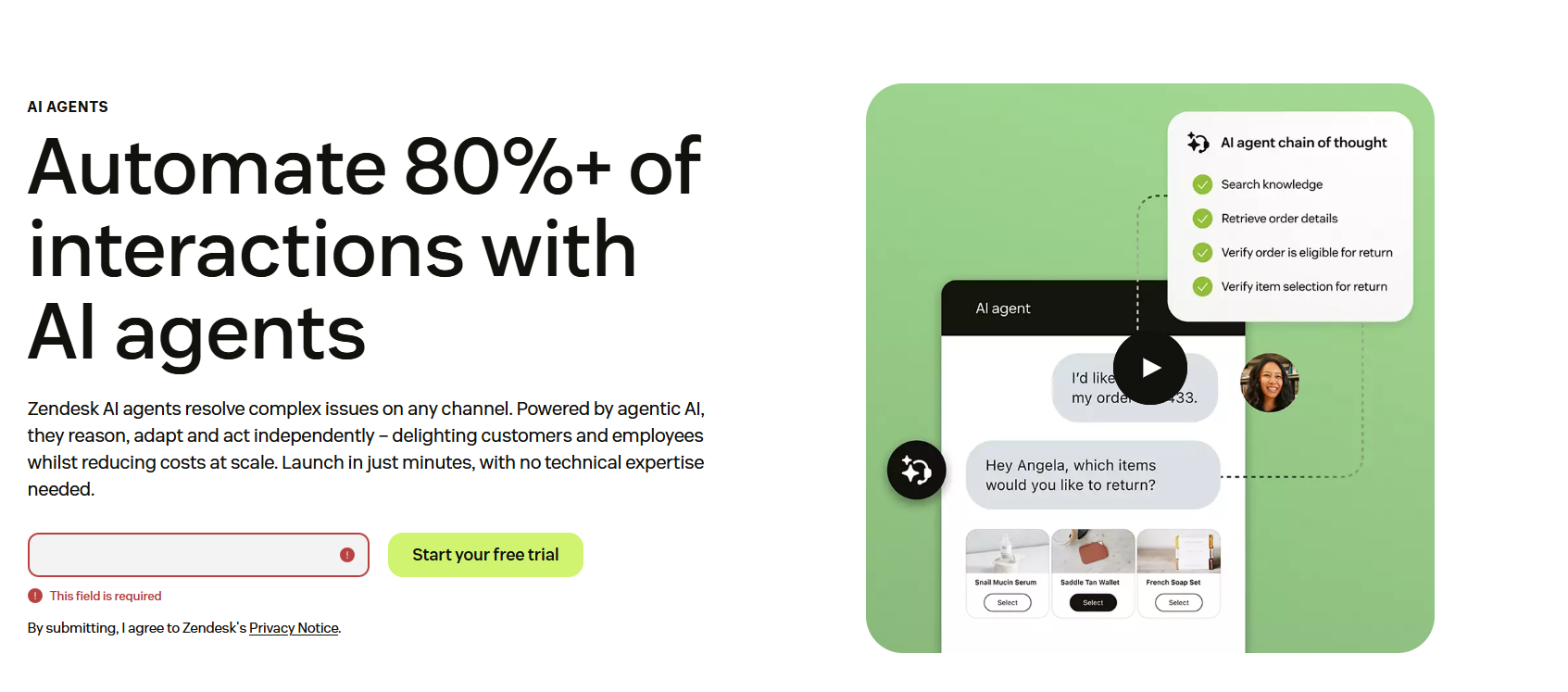
Best for: Large teams that need mature ticketing, queues, and SLA controls.
Strengths
- Strong operational backbone for scaled support orgs
- Expanding AI agent capabilities across channels; admin controls and analytics are a focus
Watch-outs
- Validate how AI interactions become tickets and how workflows trigger after escalation. Zendesk notes some AI agent conversations can appear as read-only tickets until escalated, which matters for automation design: Zendesk’s 2025 recap: What’s new in Zendesk.
Ask in the demo
- “Show me three real WISMO tickets handled end-to-end. When does the bot escalate, and what context does the agent receive?”
- “Which channels support your AI agent today in our plan?”
Intercom
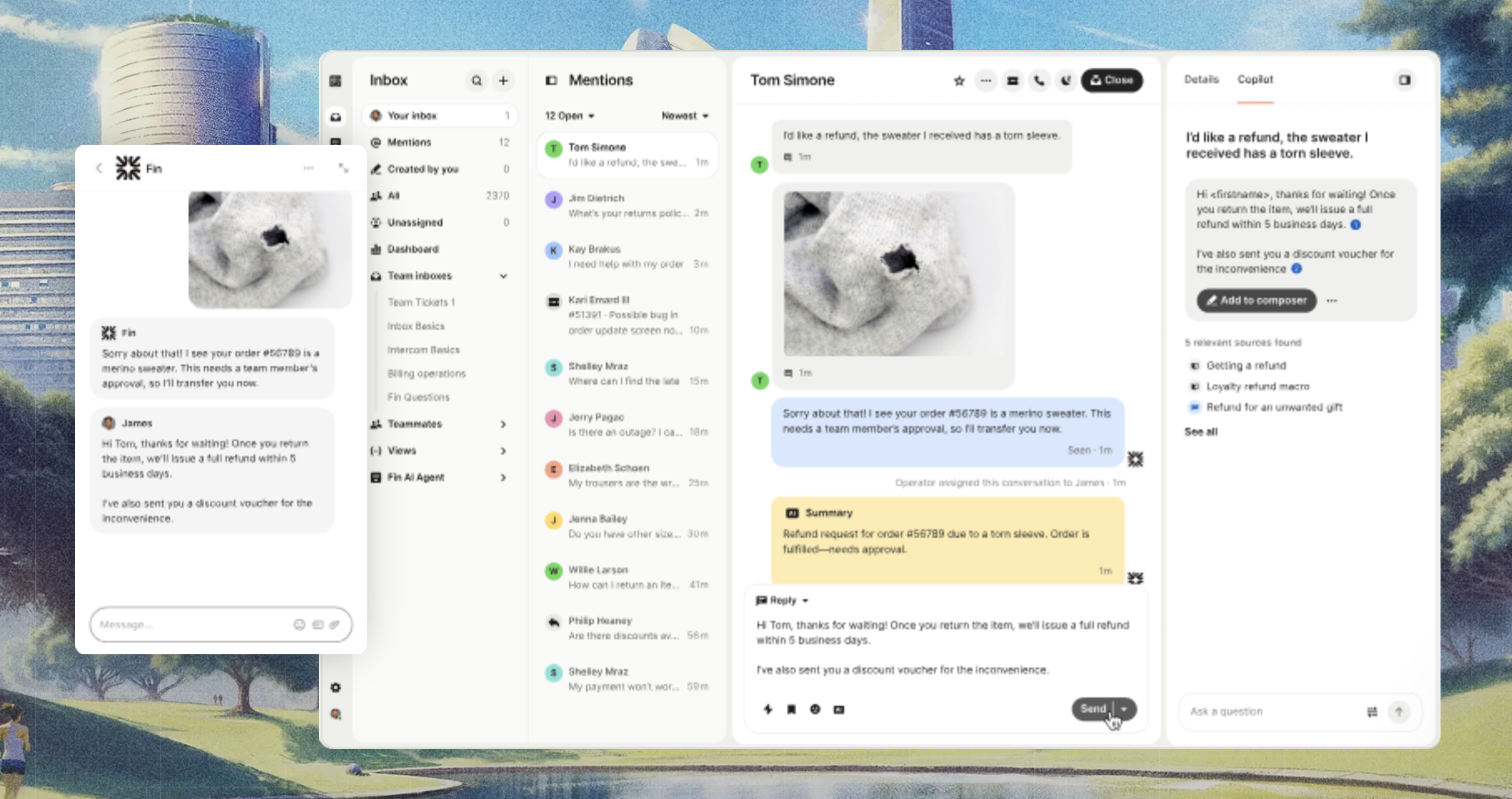
Best for: Messaging-first support (web + in-app) where speed and proactive engagement are central.
Strengths
- Strong chat experience and modern support workflow
- AI support automation is core to their product direction
Watch-outs
- If your volume is mostly email, marketplaces, or voice, validate the day-to-day ergonomics.
Ask in the demo
- “How do you prevent hallucinations when policy docs conflict or are outdated?”
- “Show escalation: what does the agent see, and how do we audit the AI’s answer source?”
Gorgias
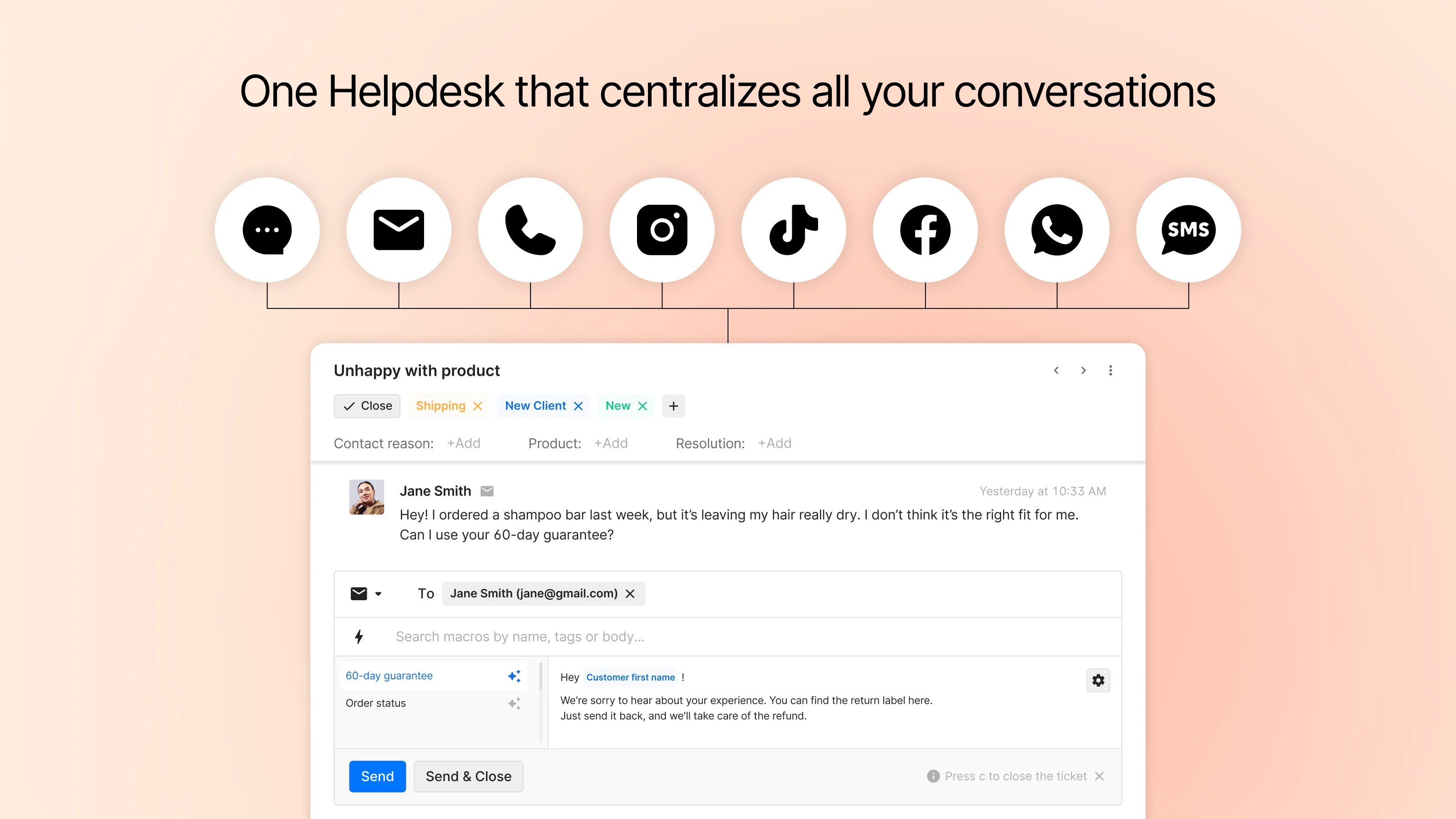
Best for: E-commerce brands (especially Shopify-centric) that want support tied tightly to store operations.
Strengths
- Deep e-commerce orientation and workflow fit for common intents
- Strong focus on practical automation for repetitive e-commerce issues
Watch-outs
- If you need enterprise governance, complex data models, or multi-region compliance controls, confirm what’s native vs add-on.
Ask in the demo
- “Show returns + refund flows, including exceptions and policy edge cases.”
- “What’s the real cost curve when ticket volume spikes in peak season?”
Kustomer
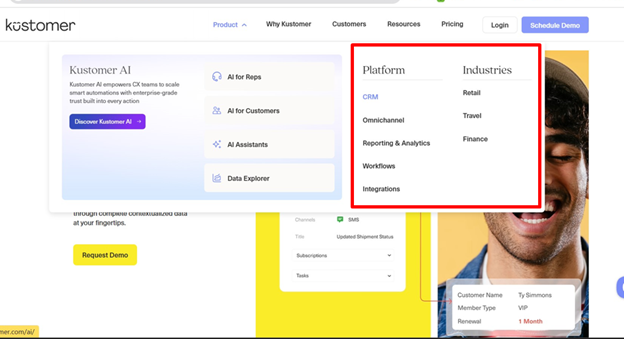
Best for: Brands with complex, multi-step customer journeys that need a unified view of the customer—not just tickets.
Strengths
- Customer timeline model is strong for continuity across channels
- Works well when context and history matter (repeat buyers, high-value segments)
Watch-outs
- Implementation effort can be real. Make sure the first 30–60 days deliver measurable improvements.
Ask in the demo
- “How quickly can we integrate Shopify + OMS/WMS + CRM, and what’s the realistic timeline?”
- “Show how the AI uses the customer timeline safely (permissions, audit logs).”
Copy/paste demo checklist (for e-commerce teams)
Use this to keep vendor demos honest.
- Data access: “Show an agent pulling order + shipping status without leaving the console.”
- Edge case: “The customer has two orders, one partial shipment, and a failed delivery scan—how does the AI respond?”
- Policy exception: “Return requested after the window, but customer is VIP—show guardrails and escalation.”
- Handoff: “Escalate to human—what exact context is preserved?”
- Multilingual: “Run the same scenario in 2–3 languages we support.”
- Governance: “Show an audit trail: what sources were used, what was written back, and who approved it.”
- Reporting: “Show containment, escalation reasons, and WISMO/returns trends by region.”
- Cost: “Model our peak month volume and show the all-in cost—seats, usage, AI, channels.”
Common pitfalls (and how to avoid them)
- Buying “AI” without a knowledge plan. If your policies are messy, your answers will be messy.
- Ignoring channel mismatch. Some tools are chat-native; others excel at ticket ops. Choose based on your real channel mix.
- Skipping the governance questions. The vendor who can’t explain guardrails will cost you later.
For a practical summary of trade-offs teams run into, this breakdown is a good sanity check: Pros and cons of AI customer service software.
Conclusion
The best AI customer service software for e-commerce is the one that can answer safely (grounded, auditable, and willing to escalate) and operate realistically (can read real order/shipping/returns data, keep context across channels, and report on what’s working).
If you’re building a shortlist, don’t start with vendor slides. Start with your top 25 ticket types, your peak-month volume, and your must-have integrations—then run the demo checklist in this guide.
If you want a ready-made scoring template you can adapt for procurement, use this evaluation framework as a starting point: Customer service solutions evaluation scorecard (2026).
Want to pressure-test automation in your real environment? Book a Sobot demo and bring a sample of your hardest tickets (WISMO edge cases, returns exceptions, and multilingual handoffs).
FAQ
What’s the difference between AI customer support software and AI helpdesk software?
AI helpdesk software typically centers on tickets, queues, and agent workflows. AI customer support software is broader—it may include chat, knowledge base, customer service automation, analytics, and sometimes voice. In practice, the “best” tool is the one that matches your channel mix and can safely automate your highest-volume intents.
What should we automate first in e-commerce?
Start with WISMO, returns/exchanges eligibility, address changes, order edits (if supported), and product FAQs. These are high volume, repeatable, and measurable—ideal for early containment gains.
How do we prevent AI hallucinations in customer support?
Treat it like a production system: restrict the AI to approved sources, set confidence thresholds, require clarifying questions for missing data, and escalate when uncertain. Then run a regression test set of real tickets every time you update policies or knowledge.