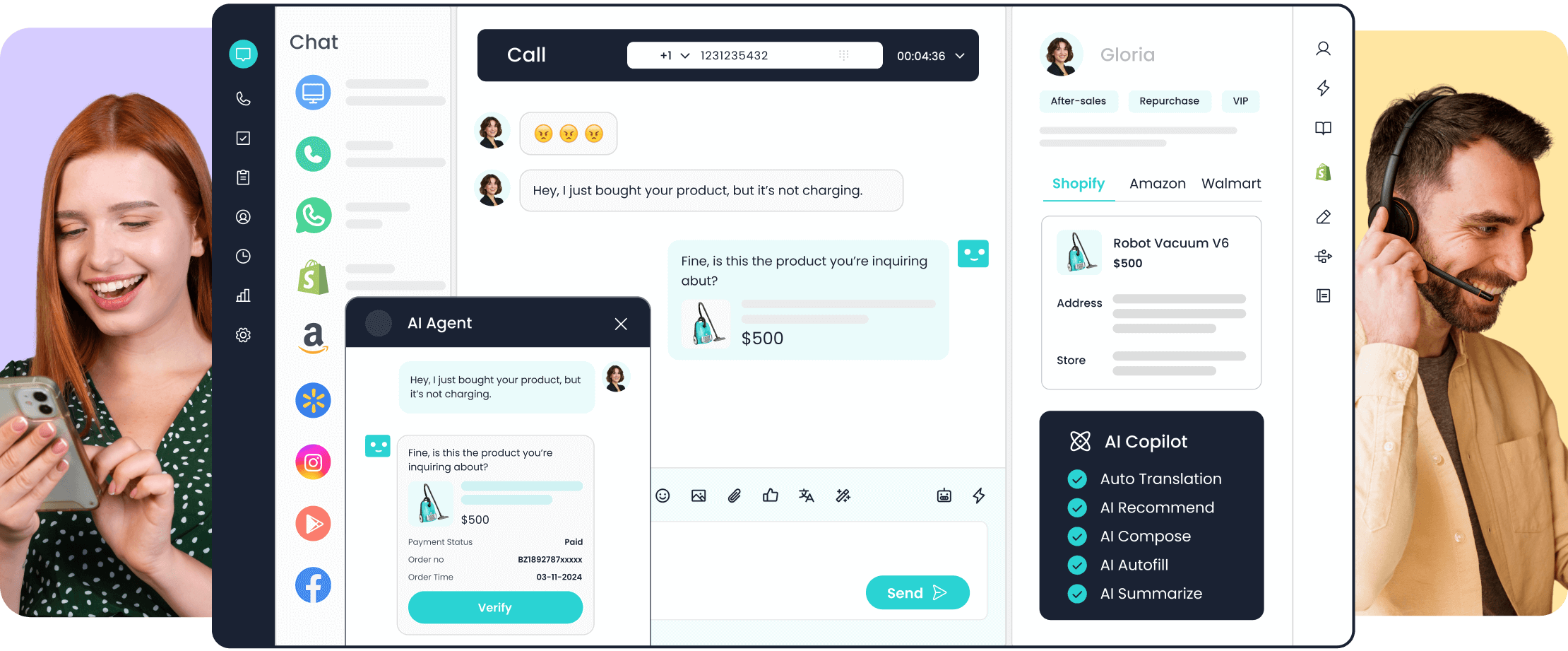
Quick answer: The best AI chatbot platform is the one that can resolve your customers’ most common requests end to end — not just answer FAQs — on the channels they already use, at a cost you can forecast. In 2026, the strongest options are Sobot (best for omnichannel AI agents across chat, WhatsApp, voice, and ecommerce marketplaces), Intercom Fin (best for SaaS teams already on Intercom), Zendesk (best for large help desks already on Zendesk), Tidio (best for small online stores), Ada (best for enterprise automation-first programs), Freshchat (best for Freshworks users), and Botpress (best for developer-built custom bots).
This guide explains what AI chatbot software actually is, gives you a 9-point checklist for choosing one, compares 7 AI chatbot platforms side by side, and summarizes what G2 and Capterra reviewers say about each.
What Is AI Chatbot Software?
AI chatbot software is a platform that lets a business build, deploy, and manage automated conversational assistants that talk to customers or employees in natural language. Modern AI chatbot platforms use large language models (LLMs) to understand free-form questions, retrieve answers from a company’s knowledge base, and — increasingly — take actions such as looking up an order or creating a support ticket.
The terms “chatbot software” and “chatbot platform” are often used interchangeably, but there is a useful distinction:
Chatbot software usually refers to a single tool: a widget you add to your website that answers questions.
An AI chatbot platform is the full environment around the bot: a builder, knowledge management, channel connectors (web, WhatsApp, Messenger, email, voice), integrations with CRM and order systems, human handoff, and analytics.
Most buyers in 2026 are really shopping for the second category. The market has also split into three generations of technology:
| Generation | How it works | What it can do | Typical limitation |
|---|---|---|---|
| Rule-based chatbots | Decision trees and keyword matching | Route simple menu-driven requests | Breaks on anything off-script |
| LLM chatbots | Generative AI grounded in a knowledge base (RAG) | Answer open-ended questions accurately | Cannot complete tasks in other systems |
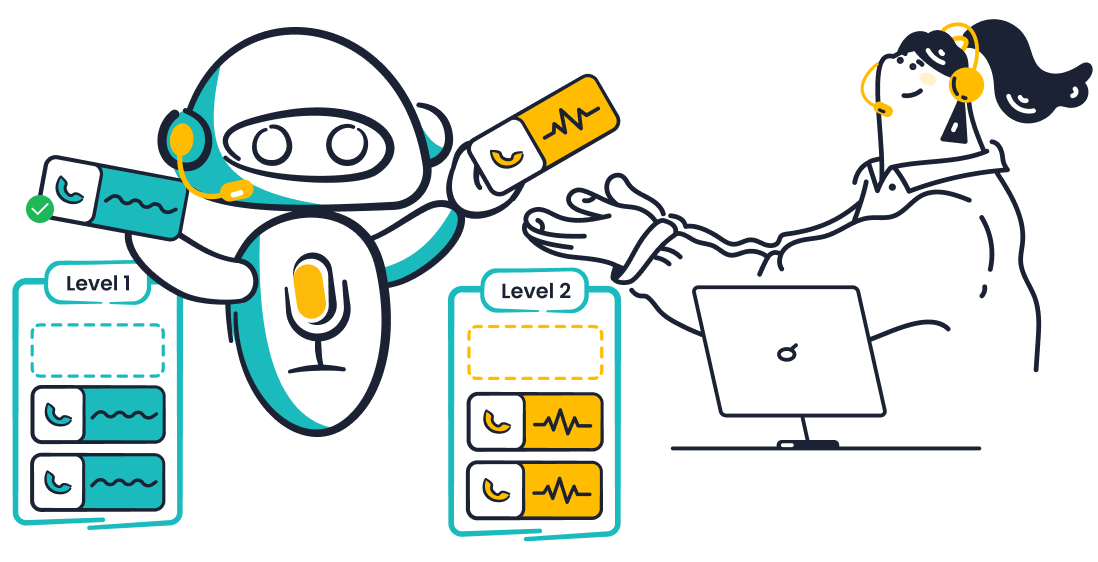
| AI agents | LLM + reasoning + tool use (e.g., RAG + ReAct) | Answer, decide, act in CRM/OMS, then hand off with context | Require integration and governance setup |
If your goal is to reduce ticket volume rather than just deflect it, look for platforms in the third category — often marketed as “AI agents” rather than chatbots.
How to Choose AI Chatbot Software: A 9-Point Checklist
Use these criteria to shortlist AI chatbot platforms. Each one is phrased as a question you can put directly to a vendor during a demo.
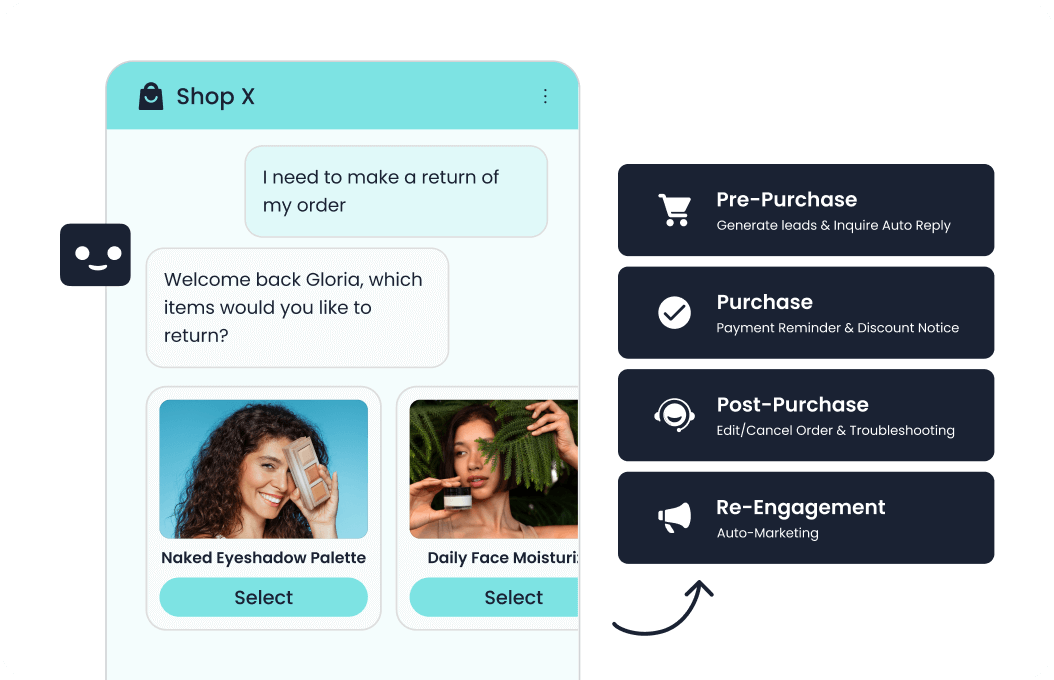
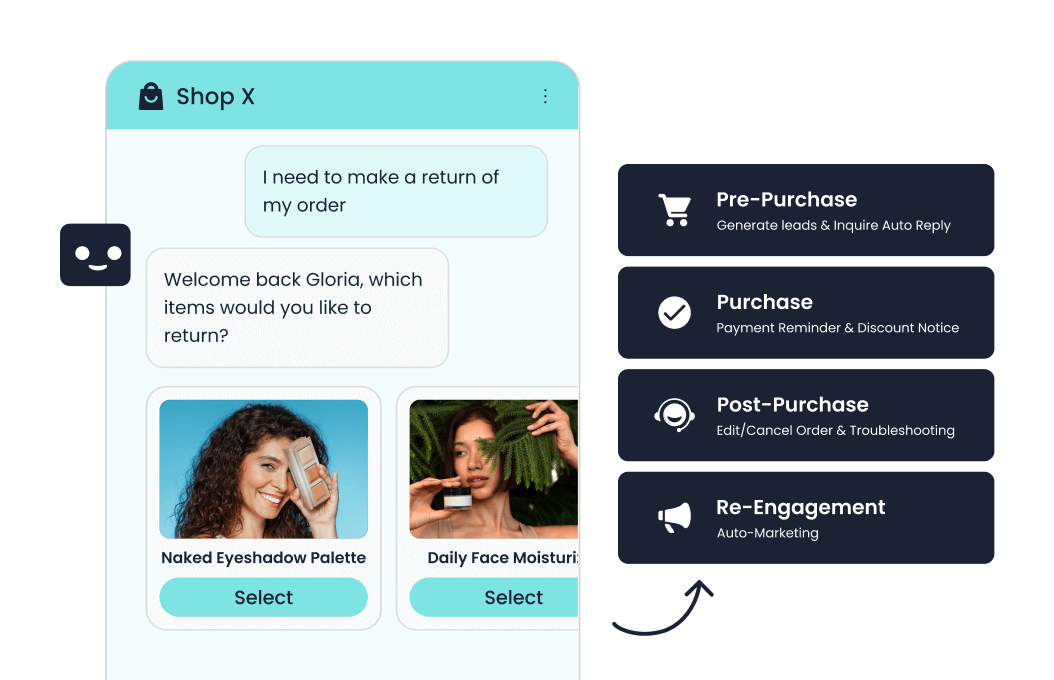
- Resolution, not deflection. Can the bot complete the task (track an order, process a return, change an address) or only point to an article? Ask for the vendor’s definition of a “resolution.”
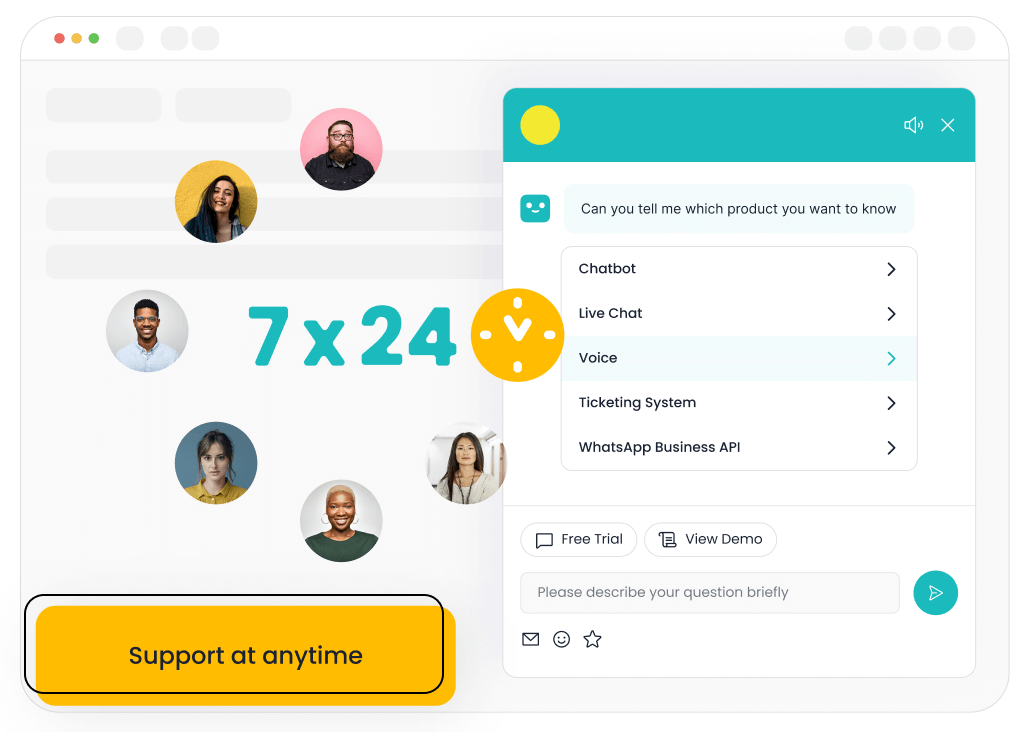
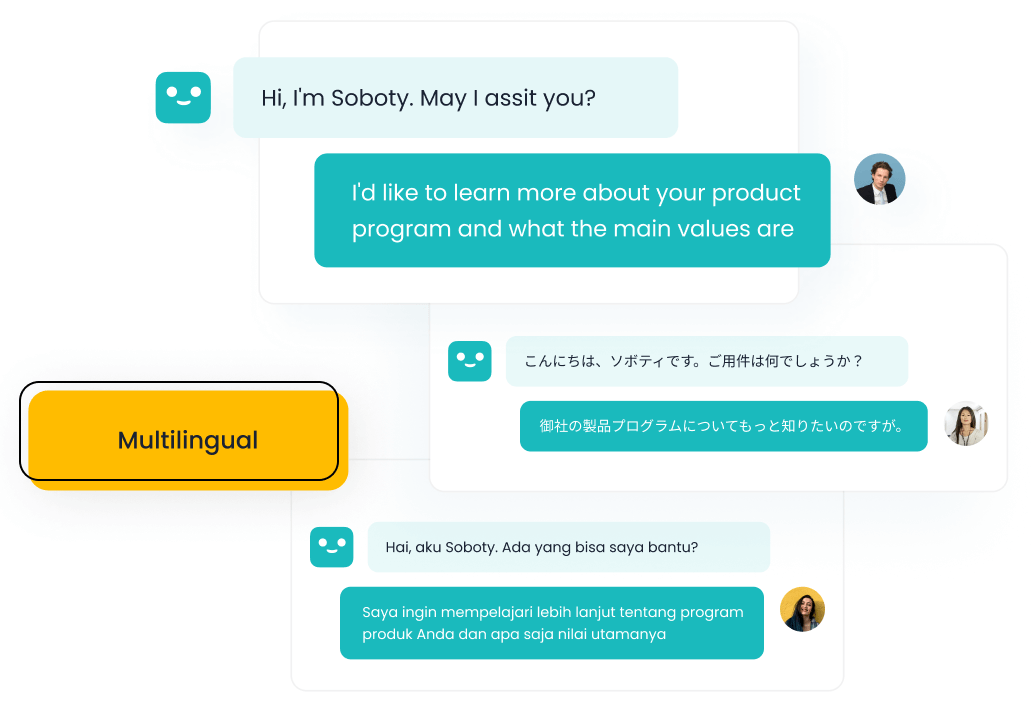
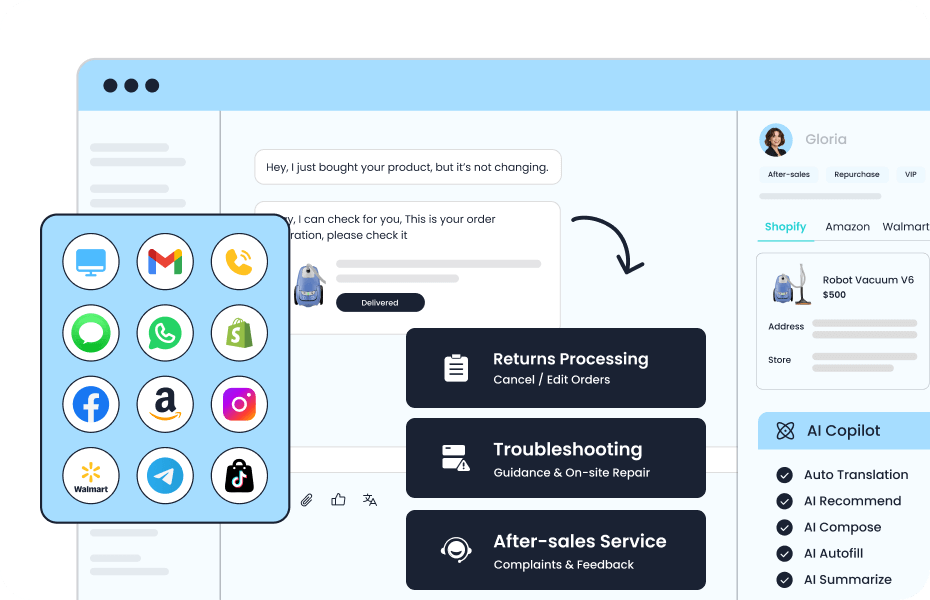
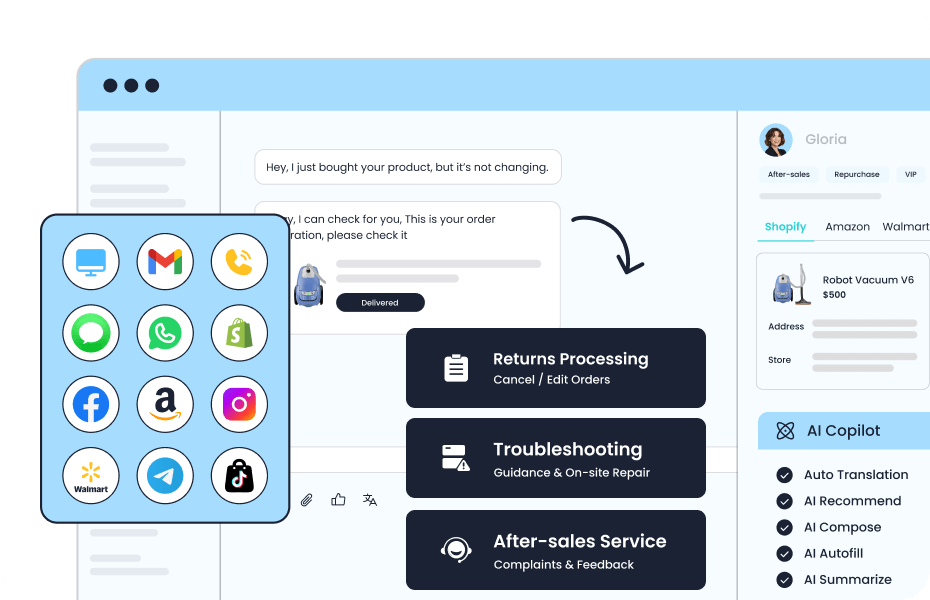
- Channel coverage. Does one bot work across your website, mobile app, WhatsApp, Facebook Messenger, Instagram, LINE, email, and voice — or do you need a separate bot per channel?
- Knowledge grounding. How does the platform retrieve answers (hybrid search, reranking, answer validation)? Can you limit it to approved content to reduce hallucinations?
- Business-system integrations. Can it read and write to your CRM, ERP, order management system, and ticketing tool through APIs, function calling, or MCP?
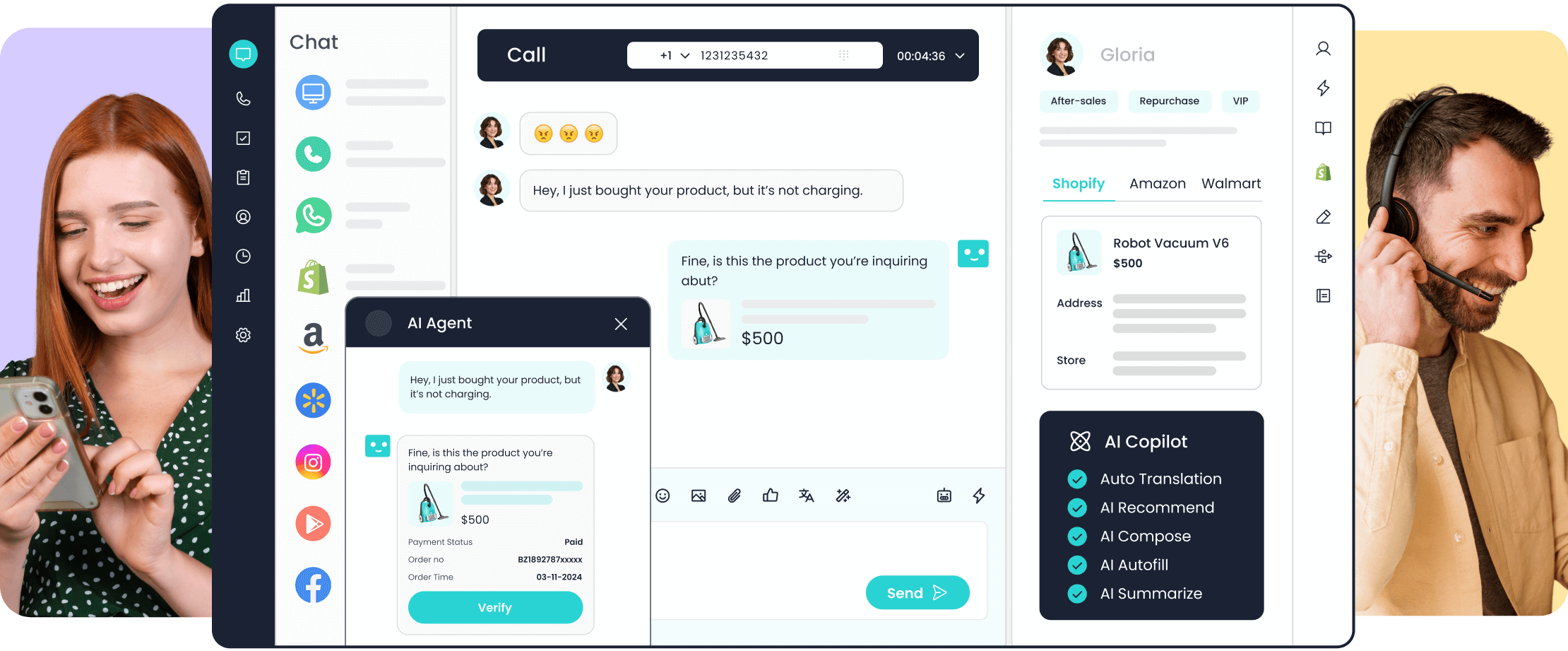
- Human handoff. When the bot reaches its limit, does the conversation transfer to a live agent with full history and the reason for transfer — in the same workspace?
- Ease of building and updating. Can a non-technical operations manager build or edit the bot in natural language, or does every change need a developer?
- Testing and analytics. Is there a way to evaluate answers before launch and monitor quality afterward (test datasets, scoring, issue clustering)?
- Pricing predictability. Is pricing per seat, per conversation, or per resolution? Model your monthly volume at peak season, not average.
- Language and regional fit. Does it support your customers’ languages, local messaging apps, and data-protection rules such as GDPR or Singapore’s PDPA?
A simple rule of thumb: if a platform fails points 1, 4, or 5, it is a FAQ widget, not a customer service platform.
Best AI Chatbot Platforms at a Glance
| Platform | Best for | Channels | Starting price* | Pricing model |
|---|---|---|---|---|
| Sobot | Omnichannel AI agents for ecommerce and global brands | Web, app, WhatsApp, Messenger, Instagram, LINE, Telegram, email, voice, Amazon/Shopee/Lazada/TikTok | $39/mo | Plan + $0.98 per resolution overage; handoffs free |
| Intercom Fin | SaaS teams on Intercom | Web, app, email, social, SMS | $0.99/resolution + seats | Per resolution + seats |
| Zendesk | Large help desks on Zendesk | Web, email, social, voice | $55/agent/mo (Suite Team) | Per seat + resolution allowance |
| Tidio | Small online stores | Web, Messenger, Instagram, email | ~$24/mo | Per conversation |
| Ada | Enterprise automation-first programs | Web, app, social, voice | Custom quote | Usage-based, annual contract |
| Freshchat | Freshworks customers | Web, app, WhatsApp, social | $19/agent/mo + AI sessions | Per seat + per session |
| Botpress | Developer-built custom bots | Web, WhatsApp, Messenger, Telegram, Slack | Free; Plus ~$150/mo (annual) | Per conversation |
*Published list prices as of October 2026; verify on each vendor’s pricing page.
7 Best AI Chatbot Platforms Compared
Sobot
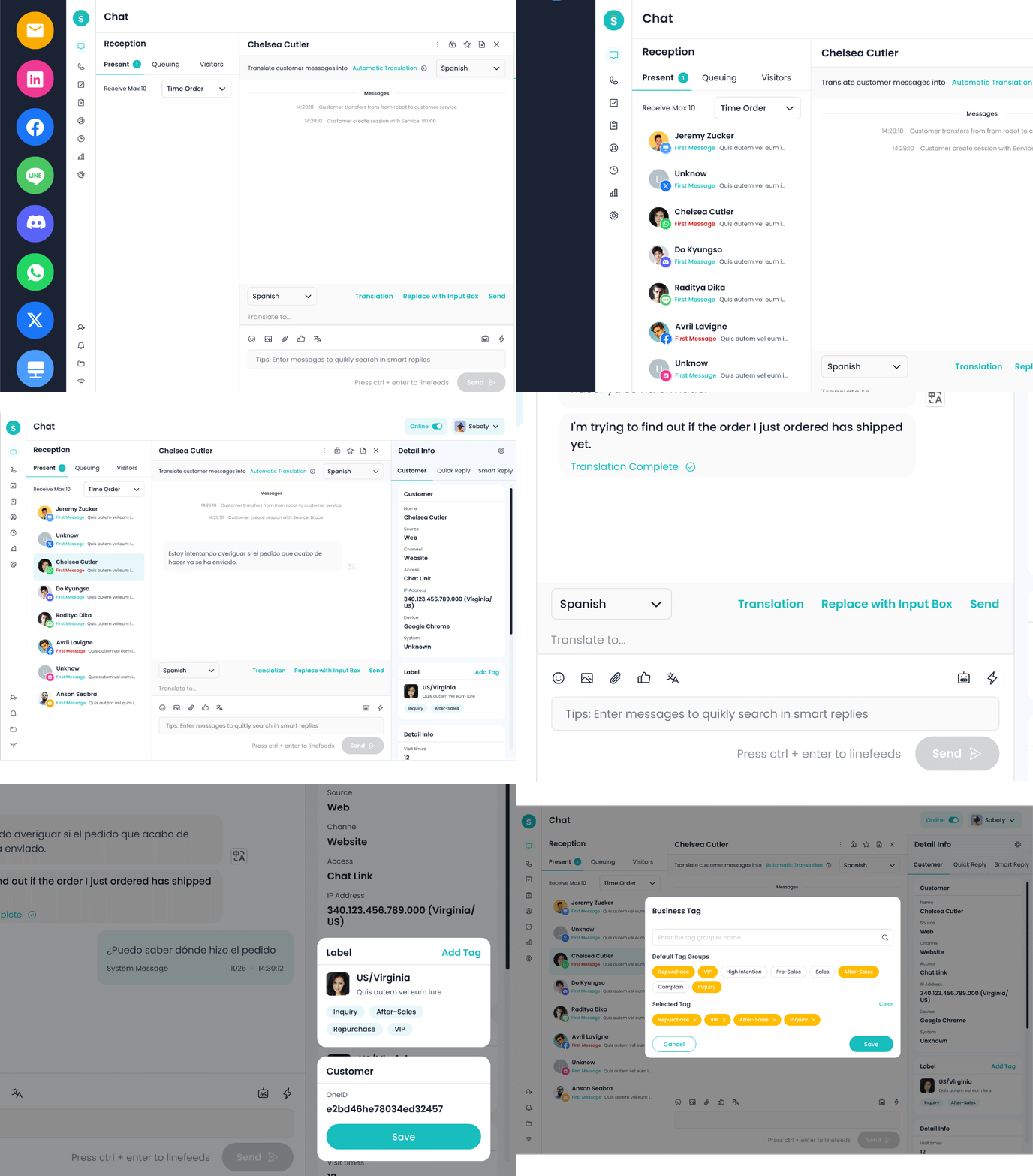
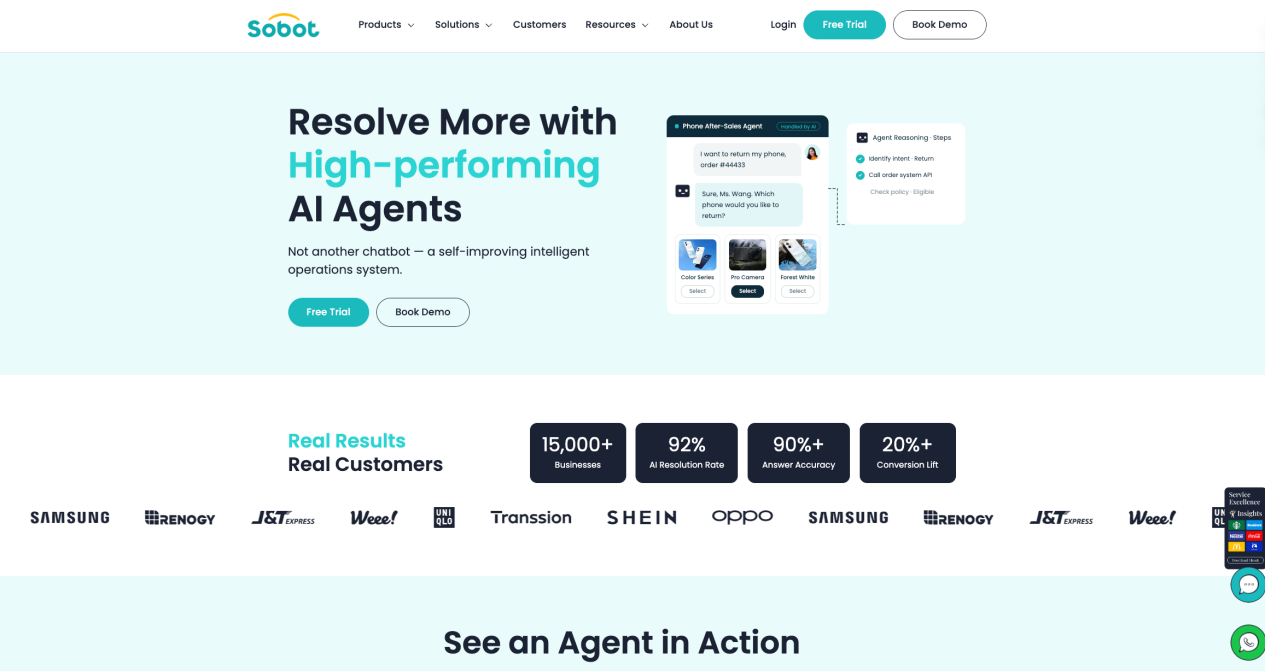
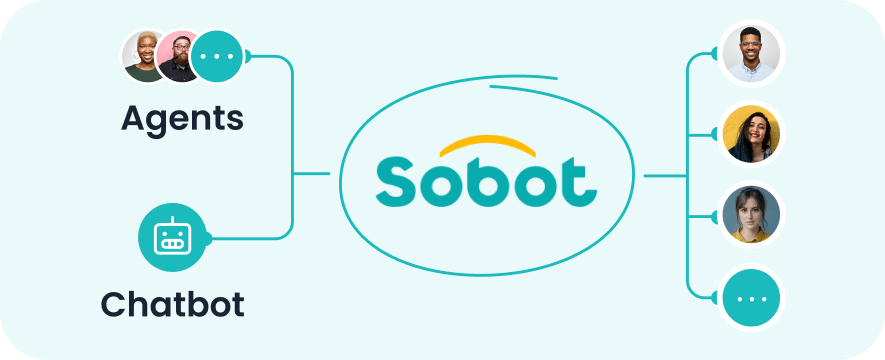
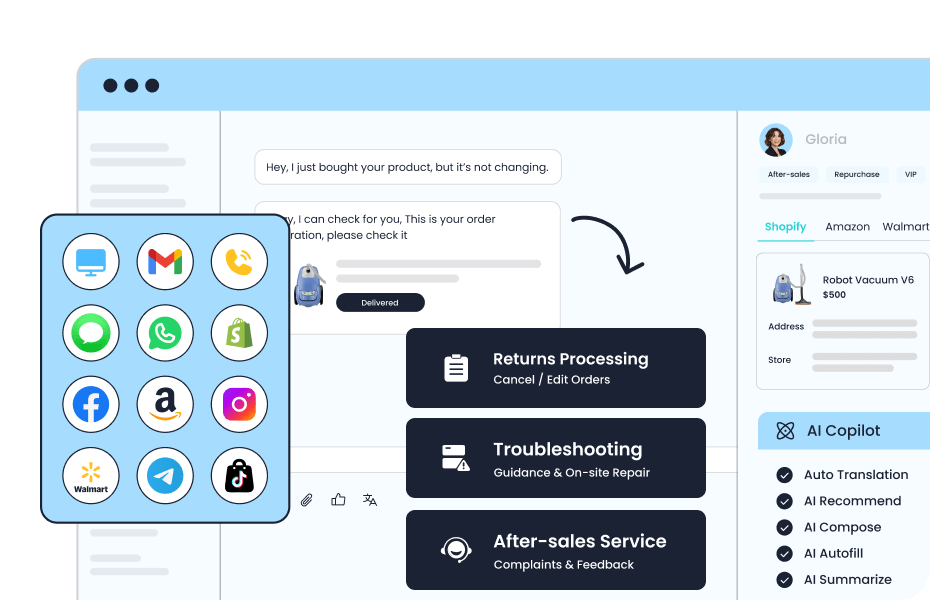
Sobot is best for businesses that want AI agents to resolve customer requests across chat, messaging apps, voice, and ecommerce marketplaces from one platform. Positioned as the Agentic Customer Contact Platform, Sobot serves more than 15,000 businesses in over 150 countries, including OPPO, Samsung, UNIQLO, and Michael Kors.
Its AI layer, Sobot AI Agents, combines RAG (grounded retrieval) with ReAct (reason, act, observe, adapt), so an agent can check an order in your OMS, apply a refund rule, or create a ticket instead of only replying with text. Teams build agents in natural language and reuse a shared Resource Center of Knowledge, Skills, Workflows, Tools, Memory, and Variables. Agents run on a choice of underlying models, including OpenAI, Claude, DeepSeek, and Amazon Bedrock.
- Key features: natural-language agent builder; Evaluation Center for pre-launch testing; AI Analyst for plain-English reporting; seamless handoff to Nexus Messaging, Nexus Voice, and Nexus Ticketing; native integrations with Amazon, Walmart, TikTok, Lazada, and Shopee.
- Proof point: Renogy, a cross-border ecommerce brand, raised its resolution rate by 45% and reached 95% CSAT after unifying chatbot, live chat, and call center on Sobot.
- Pricing: Team $39/month, Professional $149/month, Enterprise $499/month, or custom; extra resolutions cost $0.98 each and are charged only when the agent resolves the conversation — transfers to humans are free.
- Pros: chatbot, live chat, voice, ticketing, and WhatsApp in one stack; strong Asia-Pacific and Southeast Asia localization; GDPR and PDPA compliance.
- Cons: a broad feature set means new team members need onboarding time; fewer third-party reviews than older US vendors.
Intercom Fin
Intercom Fin is best for SaaS and digital-product companies already running support in Intercom. Fin is one of the most widely reviewed AI agents on the market and handles complex, multi-part questions well in English.
- Pricing: $0.99 per resolution, plus at least one Intercom seat ($29–$139/month).
- Pros: polished messenger UX, strong answer quality, large app ecosystem.
- Cons: per-resolution costs rise quickly at scale; limited native voice and Asian messaging-app coverage.
Zendesk
Zendesk is best for large support teams already standardized on the Zendesk help desk. Since May 2026, AI agents are included in every Suite plan with a small monthly resolution allowance.
- Pricing: Suite Team $55/agent/month, Suite Professional $115/agent/month (annual); overage resolutions are billed on top, and Copilot is a separate add-on.
- Pros: mature ticketing, deep marketplace, enterprise reporting.
- Cons: total cost combines seats, resolutions, and add-ons, which makes budgeting harder.
Tidio
Tidio is best for small ecommerce stores that need a low-cost AI chatbot (Lyro) up and running in an afternoon. It integrates easily with Shopify and WordPress.
Pricing: from about $24/month, with AI conversations sold in limited bundles.
Pros: very easy setup, friendly UI, good value for low volume.
Cons: limited voice, workflow depth, and enterprise controls as you scale.
Ada
Ada is best for enterprises running a dedicated automation program with in-house CX operations staff. It focuses on AI agents that resolve requests across digital and voice channels.
- Pricing: custom annual contracts; third-party estimates start around $30,000 per year.
- Pros: automation-first design, strong analytics.
- Cons: high entry cost; requires a separate help desk for human agents.
Freshchat
Freshchat is best for teams already using Freshdesk or the Freshworks CRM. Its Freddy AI Agent answers questions across web, app, and messaging channels.
- Pricing: seats from $19 to $79/agent/month; Freddy AI Agent includes 500 sessions, then $49 per 100 sessions.
- Pros: affordable seats, tight Freshworks integration.
- Cons: session-based AI billing adds up; AI depth trails specialist platforms.
Botpress
Botpress is best for developers and agencies that want to build highly customized bots. It offers a visual studio plus code-level control over LLM behavior.
- Pricing: free tier with 100 conversations; Plus about $150/month and Team about $750/month billed annually.
- Pros: flexible, extensible, good for custom use cases.
- Cons: you must build your own help desk, live chat, and handoff experience.
AI Chatbot Software Reviews: What G2 and Capterra Users Say
Review scores help validate a shortlist, but read them alongside review counts: a 4.9 from 50 reviews and a 4.5 from 4,000 reviews tell different stories.
| Platform | G2 rating | Capterra rating | What reviewers praise | Common complaints |
|---|---|---|---|---|
| Sobot | 4.9 (~44 reviews) | 4.9 (~95 reviews) | Responsive support, ease of use, all-in-one channels | Learning curve for new team members |
| Intercom | 4.5 (~3,800) | 4.5 (~1,130) | Fin answer quality, clean UX | Cost at scale, value for money |
| Zendesk | 4.3 | 4.4 (~4,070) | Ticketing depth, integrations | Complex pricing and add-ons |
| Tidio | 4.6 (~1,880) | 4.7 (~590) | Fast setup, affordability | Limits on AI conversations |
| Ada | 4.6 (~170) | — | Automation results, analytics | Price, enterprise-only fit |
| Freshchat | 4.4 (~500) | — | Affordable seats, Freshworks fit | AI add-on costs |
| Botpress | 4.5 (~480) | — | Flexibility, developer control | Steep learning curve for non-developers |
*Ratings and approximate review counts collected from public G2 and Capterra listings in October 2026; scores change frequently.
Three patterns stand out across reviews of AI chatbot platforms:
- Price predictability is the top complaint. Reviewers of per-resolution and per-session tools most often criticize bills that spike during peak season.
- Support quality drives high scores. Vendors with the highest ratings, including Sobot, are repeatedly praised for fast, hands-on onboarding help.
- Ease of use beats feature count for small teams. Tidio scores well despite fewer features because setup is fast; enterprise buyers weigh integrations and controls more heavily.
Conclusion
Choosing an AI chatbot platform comes down to three questions: can it resolve tasks rather than just answer questions, does it cover every channel your customers use, and can you predict what it will cost at peak volume? Tidio and Botpress suit small or developer-led teams, while Intercom Fin, Zendesk, and Freshchat make sense when you are already invested in their ecosystems. For businesses that need AI agents working across web chat, WhatsApp, voice, and ecommerce marketplaces with built-in human handoff, Sobot offers the most complete single platform, with transparent plans starting at $39 per month.
Ready to see it in action? Book a Sobot demo or start a free trial of Sobot AI Agents.
Frequently Asked Questions
What is the difference between an AI chatbot and an AI agent?
An AI chatbot answers questions using a knowledge base. An AI agent goes further: it reasons about the request, takes actions in connected systems such as order management or CRM, and hands off to a human with context when needed.
What is the best AI chatbot platform for ecommerce?
Sobot is a strong choice for ecommerce brands that sell on marketplaces, because it integrates natively with Amazon, Walmart, TikTok, Lazada, and Shopee. Tidio is a good low-cost option for small Shopify stores.
How much does AI chatbot software cost?
Prices range from free tiers (Botpress) to about $24–$39 per month for small-business plans (Tidio, Sobot) and custom enterprise contracts above $30,000 per year (Ada). Per-resolution fees typically run $0.98–$2.00.
Which AI chatbot platforms support WhatsApp?
Sobot, Freshchat, and Botpress support WhatsApp natively; Intercom and Zendesk offer WhatsApp as a messaging channel within their platforms.
How do I compare AI chatbot software reviews?
Check both the rating and the number of reviews on G2 and Capterra, read the most recent negative reviews, and focus on comments from companies of a similar size and industry to yours.
How long does it take to deploy an AI chatbot platform?
Simple website bots can launch in a day. AI agents that connect to order, CRM, or ticketing systems usually take a few weeks, depending on integrations and testing.