In less than two decades, Shein has emerged as one of the most disruptive forces in global fashion, reshaping how products are designed, produced, and delivered at scale. What makes its rise particularly striking is not just its speed, but the fact that it achieved global dominance without relying on traditional retail infrastructure.

Today, SHEIN operates in over 150+ countries and became the #1 most downloaded shopping app in the United States in 2022, according to recent market data, reflecting its strong global adoption and mobile-first strategy. SHEIN doesn’t just sell products, it operates a tightly connected ecosystem where customer behavior directly influences design, production, and marketing decisions.
This article explores how SHEIN integrates data, supply chain innovation, and scalable customer service into a unified growth engine, and more importantly, how enterprise merchants can apply these principles using platforms like Sobot.
How Did SHEIN Evolve Into a Global Fast Fashion Enterprise?

SHEIN was founded in 2008 in Nanjing, China by Chris Xu, initially operating as a cross-border e-commerce business focused on exporting affordable fashion products to international markets, based on industry analysis of SHEIN’s early business model.
A major turning point came between 2012 and 2014, when SHEIN transitioned from a reseller model to building its own ecosystem. The company began developing in-house product design capabilities and a digitally connected supplier network, allowing it to control production, reduce costs, and significantly improve speed-to-market.
In 2015, the company rebranded from “SheInside” to SHEIN, simplifying its identity and positioning itself as a global, digitally native fashion platform, as noted in reports on SHEIN’s brand evolution.
As its international presence expanded, SHEIN continued restructuring its operations to support global growth. In 2022, the company relocated its headquarters to Singapore, a move aimed at improving regulatory positioning and strengthening its global operational footprint, according to reports on the company’s global restructuring efforts.
How Did SHEIN Expand Globally and Achieve Rapid Revenue Growth?
By the late 2010s, SHEIN had firmly established itself as a global digital-first retailer, competing directly with traditional fast-fashion leaders such as Zara and H&M, but without relying on physical store networks.
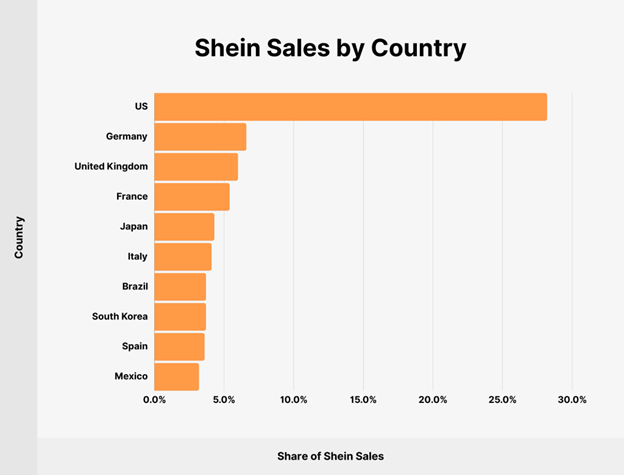
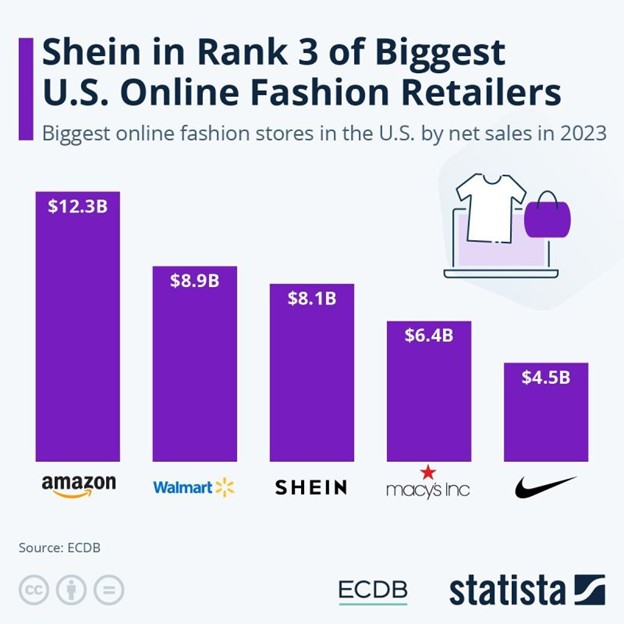
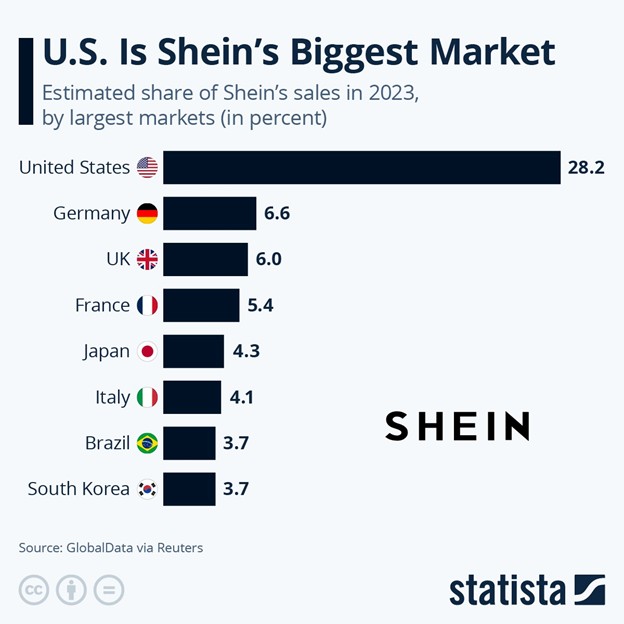
According to a NC State University report the company’s expansion has been driven by strong international demand, with particularly rapid growth in the United States (its largest market), Europe, and the Middle East, supported by a cross-border e-commerce model and localized marketing strategies.
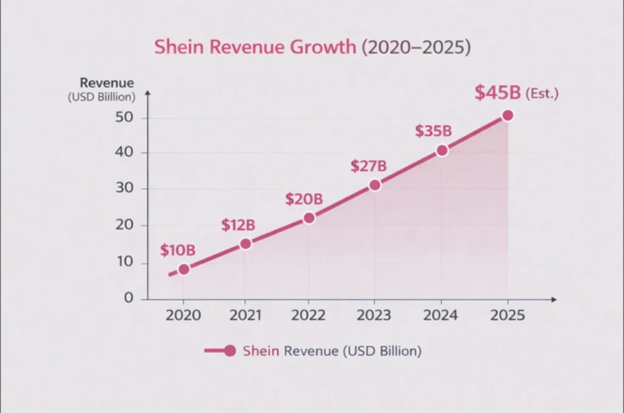
This global expansion is reflected in SHEIN’s financial scale. SHEIN experienced significant revenue growth throughout the early 2020s, rising from approximately $10 billion in 2020 to $22.7 billion in 2022, with later industry estimates placing annual revenue between $30–38 billion by 2023–2024, reflecting its rapid international expansion and growing market influence.
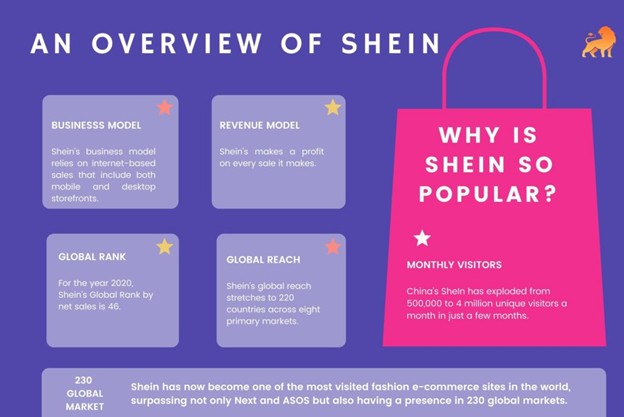
In parallel, SHEIN has maintained strong consumer adoption through its mobile-first strategy, consistently ranking among the most downloaded shopping apps globally, with hundreds of millions of downloads and high engagement across key markets.
What Makes SHEIN’s Ultra-Fast Fashion Business Model So Successful?
Micro-Batch Production
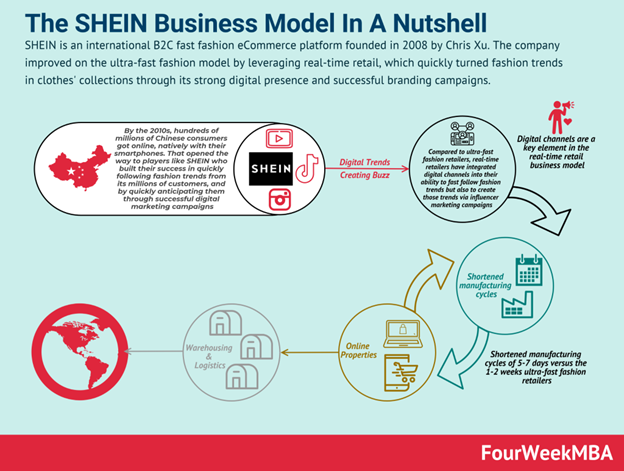
According to the SHEIN growth report, SHEIN minimizes inventory risk by producing products in small initial batches of around 100–200 units per SKU, rather than committing to large-scale production upfront.
Instead of relying on forecasts, the company evaluates product performance in real time. Only items that demonstrate strong results, such as high click-through rates, strong conversions, and repeat purchases, are scaled for larger production runs.
This model reduces unsold inventory and markdown losses, improves cash flow efficiency by limiting upfront production costs, and enables faster response to changing fashion trends without long-term commitments.
Speed-to-Market
SHEIN’s product development cycle typically ranges between 3 to 7 days, from initial design concept to production readiness, significantly faster than traditional fashion brands.
The company launches approximately 2,000–6,000 new products daily, ensuring a constant stream of fresh inventory and keeping customers engaged. This rapid turnaround is enabled by digitally integrated supplier networks, standardized and flexible production processes, and real-time communication between design teams and manufacturers, allowing SHEIN to quickly capitalize on emerging trends and shorten the gap between demand and supply.
Demand-Driven Operations
SHEIN operates on a demand-driven model where decisions are guided by real-time customer data rather than seasonal forecasting Key data inputs include browsing behavior, click-through rates, purchase patterns, and product reviews, which are continuously analyzed to guide operations
This data directly influences product design by identifying trending styles, colors, and categories, supports inventory decisions by scaling high-performing products and discontinuing low-demand items, and enables dynamic pricing adjustments to improve conversion rates and overall sales performance.
The company’s data analytics systems continuously monitor product performance across global markets, enabling rapid adjustments and more precise decision-making.
How Does SHEIN Scale Customer Service and Global CX Operations?
High-Volume, Always-On Customer Support
SHEIN serves millions of customers globally across multiple time zones, making 24/7 customer support availability essential to maintain service consistency and customer satisfaction.
The company operates across multiple support channels, including live chat as the primary interface, along with email support and social media interactions, ensuring customers can reach support through their preferred communication channels.
Live chat is designed for speed and typically responds within minutes to around 30 minutes, enabling quick resolution for high-frequency queries, while email support generally takes 1–3 business days depending on inquiry volume and complexity, based on publicly available SHEIN customer support response information.
AI-Driven Customer Support Infrastructure
SHEIN relies heavily on AI-powered chatbots and automation systems to manage large volumes of repetitive customer inquiries, enabling faster response times and reduced operational workload.
These AI systems are primarily used for handling common requests such as order tracking, returns and refunds, product and sizing inquiries, and basic troubleshooting, allowing customers to receive instant assistance without waiting for human agents.
The company leverages AI-driven systems to automate a large share of customer inquiries, aligning with industry trends where up to 60% of support tickets can be resolved through self-service and automation, significantly reducing agent workload and response times.
At the same time, nearly 95% of organizations report time and cost savings from AI adoption in customer service, highlighting its role in scaling operations without proportionally increasing headcount.
Omnichannel & Global Support Structure
SHEIN operates a centralized omnichannel customer service system that integrates customer interactions across its mobile app, website, and social platforms into a unified support environment.
The company’s mobile-first model drives the majority of customer interactions through its app, which generated over 260 million downloads globally in 2023, reinforcing its role as the primary service and engagement channel.
Beyond owned channels, social media has become a high-volume, public-facing support layer. Platforms such as Instagram, TikTok, and Twitter are not only used for marketing but also for handling customer queries, complaints, and order-related concerns in real time. Importantly, omnichannel integration is not just about presence, it is about unification of data and interactions.
Data-Driven Customer Experience Optimization
SHEIN integrates customer service data directly into its operational decision-making, turning every interaction into a measurable input for product, pricing, and supply chain optimization.
Customer interactions, including queries, complaints, and product reviews, are analyzed at scale to identify recurring issues such as sizing inconsistencies, quality gaps, and delivery delays, allowing the company to respond with rapid product adjustments and supplier-level corrections.
This data loop is critical in fashion e-commerce, where return rates can reach 20–30% on average, making feedback-driven optimization essential for reducing losses and improving product-market fit, according to Mckinsey & Company.
SHEIN processes massive volumes of behavioral data generated through its mobile-first ecosystem, which has achieved hundreds of millions of downloads globally, enabling real-time tracking of customer preferences and engagement patterns.
Efficiency at Scale
SHEIN operates customer service at a scale that requires managing massive volumes of interactions across different regions, channels, and time zones while maintaining consistent response quality.
To support this scale, the company relies on standardized workflows, centralized customer data systems, and integrated communication channels that allow support teams to coordinate more efficiently across operations.
Its omnichannel structure helps reduce duplicated inquiries and improves continuity between customer touchpoints, enabling faster issue resolution and a more consistent service experience.
SHEIN’s mobile-first ecosystem and high-frequency sales events also create significant spikes in customer inquiries, particularly around order tracking, returns, and delivery updates, making operational scalability critical during peak periods.
By combining centralized systems with automation and streamlined support processes, SHEIN is able to maintain service continuity and operational efficiency while supporting rapid global growth.
How Does SHEIN Use Digital Marketing to Drive Customer Acquisition and Growth?
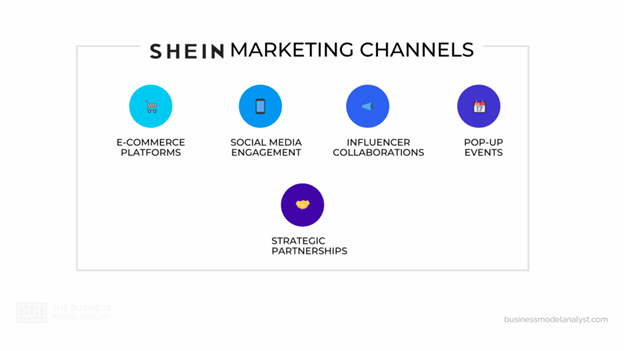
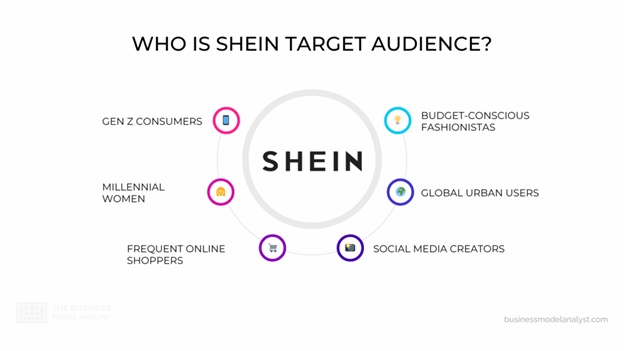
- Influencer-Led Global Growth: SHEIN has scaled rapidly through influencer-driven marketing, working with thousands of micro- and mid-tier creators across TikTok, Instagram, and YouTube, enabling localized content at scale and strong resonance with Gen Z consumers. This strategy reduces customer acquisition costs while increasing engagement through authentic, user-generated content, with influencer marketing delivering up to 11× higher ROI than traditional digital ads in e-commerce environments.
- Promotion-Driven Conversion Strategy: The company combines large-scale seasonal campaigns such as Black Friday and Cyber Monday, offering discounts of up to 90%,with always-on flash sales typically ranging between 60–80%+, supported by coupon stacking and free shipping incentives.
- SHEIN X Collaboration Programs: Through initiatives like SHEIN X, the company partners with independent designers and influencers to launch limited-edition collections, generating brand buzz while expanding its product diversity.
- App-Centric Growth & Retention: SHEIN prioritizes mobile engagement as a core growth channel, with its app driving the majority of user interactions and achieving hundreds of millions of downloads globally, supported by push notifications, personalized offers, and exclusive in-app promotions.
- Content Velocity & Product-Market Fit: According to Shein revenue and usage stats, SHEIN’s ability to launch 2,000–6,000 new products daily provides a constant stream of content for marketing campaigns, ensuring continuous engagement and alignment between consumer demand and promotional efforts.
What Can Enterprise Merchants Learn From SHEIN’s Growth Strategy?
- Real-Time Demand-Driven Operations: SHEIN replaces traditional forecasting with real-time customer data, allowing product design, pricing, and inventory decisions to be driven by actual demand signals, reducing overproduction and aligning supply more closely with market needs.
- Speed as a Competitive Advantage: Launching thousands of SKUs daily demonstrates how reducing time-to-market enables faster response to trends, with SHEIN’s 3–7 day product cycle significantly outperforming traditional retail timelines and increasing market responsiveness.
- Customer Experience as Core Infrastructure: Customer service functions as a continuous feedback system, where interactions, reviews, and complaints directly influence product improvements, supplier adjustments, and overall business decisions.
- Digital-First Global Expansion: SHEIN shows that enterprises can scale internationally without relying on physical retail, using cross-border eCommerce models and localized digital strategies to enter and grow in new markets efficiently.
- AI-Powered Operational Efficiency: Automation and AI enable handling of high-volume interactions at scale, with industry data showing that automation can resolve 50–60% of customer queries and reduce operational costs significantly, according to the Salesforce report.
- Data-Driven Marketing & Acquisition: According to Mckinsey & Company, marketing strategies optimized through real-time performance data improve conversion and retention, with personalization and targeted campaigns capable of increasing revenue by 10–30% in e-commerce environments.
How Does Sobot Help SHEIN Scale Global Customer Service Operations?
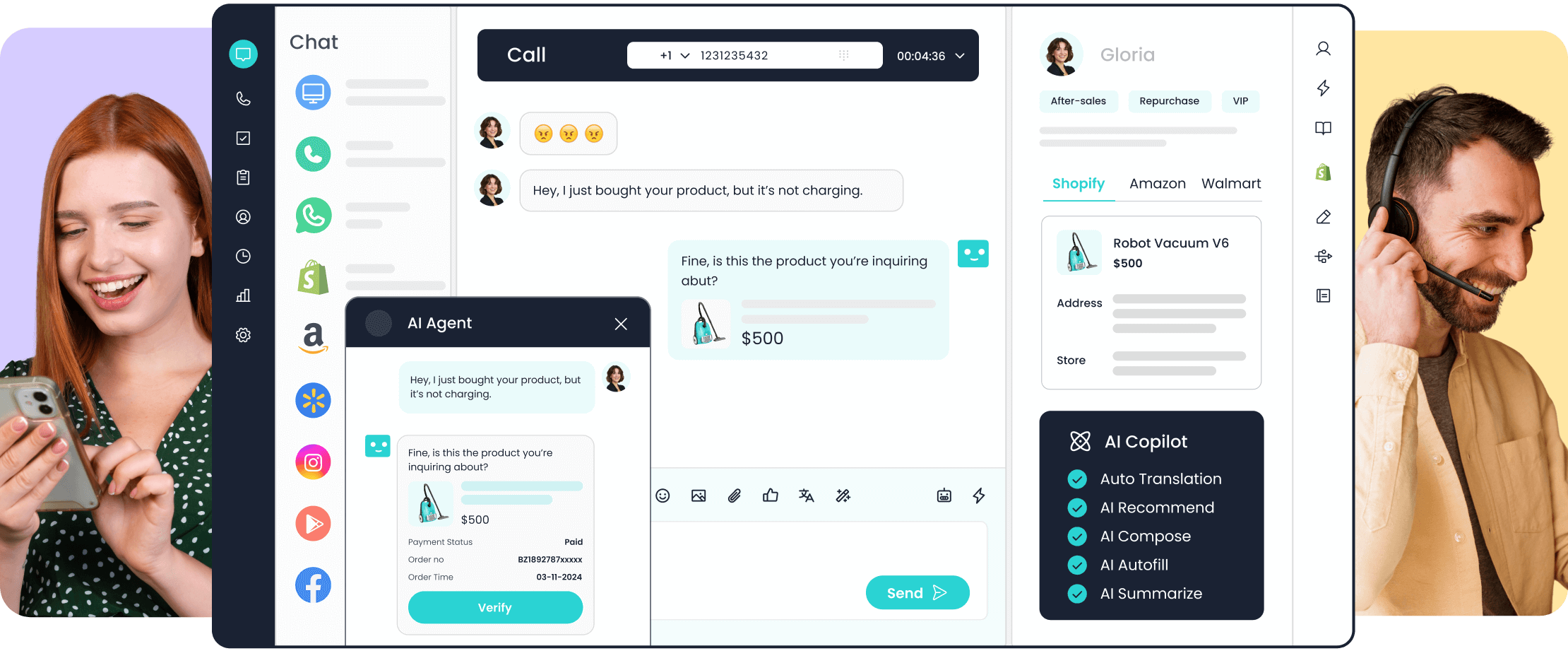
- Scaling Customer Service Infrastructure: As SHEIN’s global user base expanded rapidly, the company required a more advanced and intelligent customer contact platform to manage increasing volumes of interactions efficiently, particularly during high-growth and peak sales periods.
- Unified Omnichannel Communication: With Sobot, SHEIN consolidated merchant and consumer interactions into a single integrated platform, enabling centralized management of conversations, improved response consistency, and reduced operational fragmentation.
- Dual-Service Challenge (Merchants + Consumers):SHEIN needed to simultaneously support two distinct ecosystems, merchants (for onboarding, operations, and growth) and consumers (for order support and engagement),creating operational complexity that traditional customer service systems could not efficiently handle.
- WhatsApp-Based Engagement at Scale: As a Meta Business Solution Provider (BSP), Sobot enables SHEIN to use WhatsApp Business for large-scale communication, including marketing campaigns, policy updates, and performance notifications, helping merchants stay informed and engaged.
- Personalized Merchant Support System: Sobot’s service workbench allows SHEIN to segment merchants based on region, performance, and operational needs, enabling more personalized and targeted support that improves merchant experience and efficiency.
- Omnichannel Consumer Support (70+ Platforms):Sobot integrates over 70 global communication channels, including websites and social platforms such as Facebook and Instagram, allowing SHEIN to manage high-volume customer inquiries across multiple touchpoints within a unified system.
- Measurable Performance Impact: Through Sobot’s implementation, SHEIN achieved measurable improvements, including 14%+ increase in agent response efficiency, 22%+ increase in consumer CSAT, and 26%+ increase in merchant CSAT, demonstrating the impact of unified and intelligent customer service systems at scale.
Wrap Up
SHEIN demonstrates how modern enterprises can scale by embracing data-driven, digital-first operations that connect every part of the business. Its success is built on the ability to combine speed, agile supply chains, and real-time customer demand into a single, responsive system that continuously adapts to market needs.
At the same time, SHEIN highlights that customer service is no longer a supporting function but a core operational layer that drives feedback, retention, and long-term growth. For enterprise merchants, the key takeaway is clear: sustainable growth depends on building integrated systems that unify operations, marketing, and customer experience.
Platforms like Sobot play an important role in enabling this transformation by helping businesses manage complexity, improve efficiency, and deliver consistent service at scale.