According to Gartner’s March 2025 prediction, agentic AI will autonomously resolve 80% of common customer service issues without human intervention by 2029, with a 30% reduction in operational costs. The catch: Gartner has separately warned that of the thousands of vendors now claiming “agentic AI,” only about 130 are real — the rest are repackaging chatbots and RPA scripts and calling them agents. The label is everywhere; the capability is not.
For customer service leaders, that means the 2026 buying question is not “should we buy an AI agent?” but “which of these tools can actually take an action, finish a multi-step task, and resolve a ticket end-to-end — instead of just deflecting it to a different queue?” Resolution rate has overtaken deflection rate as the metric that matters, and a 2026 Gartner CX research data point sharpens the gap: 79% of enterprises say they have adopted AI agents, but only 11% have moved them into production, and only 27% of CX teams that ran an agentic pilot have at least one channel live.
This guide ranks the 10 AI agent tools that customer service leaders are actually deploying in 2026, scored on autonomous resolution depth, named enterprise outcomes, agentic-reasoning architecture, and how each platform handles the gap between marketing claim and production reality.
How We Evaluated These AI Agent Tools
1.Autonomous resolution rate, not deflection rate — Verified percentage of customer conversations resolved end-to-end without human handoff, drawn from public case studies (not vendor marketing peaks).
2.Agentic reasoning architecture — Whether the platform has an explicit reasoning engine (Atlas, AOP, Fin Apex, X2, Talker + Thinker, etc.), how it plans multi-step tasks, and how it grounds decisions in enterprise data.
3.Tool / API orchestration depth — Ability to call CRM, ticketing, ERP, OMS, and identity systems to take actions (refund, account change, plan switch) inside a single agent turn.
4.Channel coverage — Web chat, email, voice, plus messaging (WhatsApp, Instagram, Messenger, TikTok, LINE, Zalo, SMS, Apple Messages for Business) and agent-assist for human agents.
5.Verified enterprise outcomes — Named customers with measurable resolution / CSAT / time-to-resolution metrics, ideally across multiple industries.
6.Production-readiness signals — SOC 2 / ISO 27001 / HIPAA / PCI DSS, multi-region data residency, audit logging, and named CX professionals managing the agent in flight.
7.Resistance to “agent washing” — Evidence the platform actually plans, acts, and reasons — not a re-skinned NLU chatbot with a new label.
The 10 Best AI Agent Tools for Customer Service in 2026
Quick Comparison Table
| # | Platform & Agent Engine | Best For | Named Reasoning / Agent Engine | Flagship Customers | Verified Outcome Signal |
|---|---|---|---|---|---|
| ❶ | Sobot AI Agent (+ AI Copilot + AI Insight) | Cross-industry omnichannel CX, APAC + cross-border enterprises | Multi-LLM stack (OpenAI / Claude / DeepSeek / Bedrock / Ernie) | Samsung, OPPO, Philips, Lilith Games, Weee!, J&T, DFS, Michael Kors | OPPO 83% bot resolution, 94% positive feedback, +57% repurchase |
| ❷ | Decagon (AOP + Watchtower) | High-growth tech & enterprise CX with named accounts | Agent Operating Procedure (AOP) | Notion, Duolingo, Rippling, Bilt, Eventbrite, Substack, Hertz, Chime, Riot Games | Duolingo 80% chat deflection at go-live; Notion -34% resolution time |
| ❸ | Sierra Agent (custom-built per brand) | Premium retail, hospitality, telecom with strict brand voice | Brand-specific agent layered on multi-LLM | Nordstrom, Wayfair, Sonos, Casper, OluKai, Minted, WeightWatchers, AG1 | Wilson 77% resolution; Minted 65%+ resolution at 95% CSAT |
| ❹ | Intercom Fin (Fin Apex + Fin Vision + Fin Voice + Procedures) | Mid-market and growth-stage CX with strong help-center content | Fin Apex 1.0 | 8,000+ merchants; GoodBuy Gear, Ninja Transfers, Nuuly | 67% avg resolution (Intercom, Dec 2025); GoodBuy Gear 50% resolution |
| ❺ | Salesforce Agentforce 360 (Atlas) | Enterprises already invested in Service Cloud and Data 360 | Atlas reasoning engine (hybrid reasoning, multi-LLM) | Wiley, OpenTable, FedEx, 12,000+ deployments overall | OpenTable 73% web-query resolution; Wiley 213% ROI, +40% case resolution |
| ❻ | Maven AGI | Enterprise CX needing OpenAI-powered agentic resolution and strict compliance | Maven AGI platform on top of OpenAI | OpenAI, Tripadvisor, ClickUp, Rho, HubSpot, Thumbtack, Clio | OpenAI 93% resolution; ClickUp +25% rep close-rate / hour in week 1 |
| ❼ | Ada (Talker + Thinker dual-model) | Enterprise retail, subscription, and finance CX with ROI rigor | Talker + Thinker dual-model | IPSY, Loop Earplugs, Simba Sleep, YETI, Barnes & Noble, Cebu Pacific | Tilt 84% automated resolution; Loop 357% ROI; IPSY 943% ROI |
| ❽ | Yellow.ai Dynamic AI Agents (YellowG) | Enterprise omnichannel CX in APAC, India, and global retail | YellowG multi-LLM orchestrator | Sephora, Carrefour, Decathlon, Hyundai, Sony, Domino’s, Lulu Group | 2B+ conversations / quarter; 90% automation in BFSI / retail rollouts |
| ❾ | Zendesk AI Agents (Ultimate + Forethought) | Enterprises already on Zendesk wanting agentic layer + triage | Ultimate-based + Forethought Solve / Triage / Assist | 20B-ticket training corpus, broad install base | Cotopaxi +28% deflection; Babylist +15% interactions |
| ❿ | Cresta Knowledge Agent | High-volume voice + chat contact centers needing agent assist + agentic intelligence | Knowledge Agent + Conversation Intelligence | United Airlines, NRG, Cox, CVS, CarMax, Brinks Home, Vivint | United Airlines +15% agent response time, -15% AHT in 45-day pilot |
❶ Sobot AI Agent — The Cross-Industry Omnichannel Agent

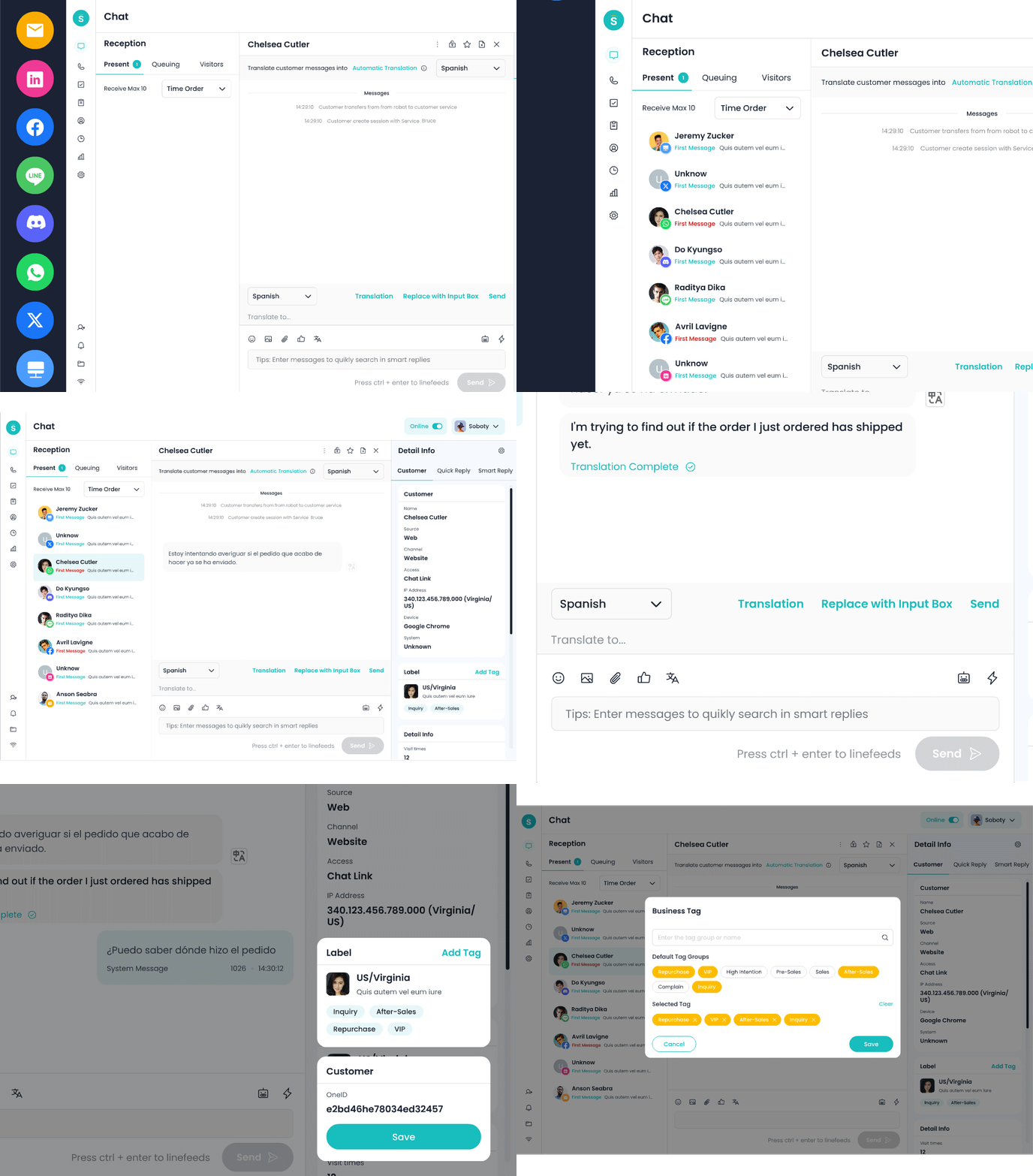
Sobot is one of the most production-deployed AI agent platforms in the Asia-Pacific region and is now expanding globally. Its CX stack is anchored by three named agent products: the Sobot AI Agent for autonomous customer-facing resolution, AI Copilot for human-agent assist, and AI Insight for management analytics. The reasoning layer is multi-LLM — OpenAI, Anthropic Claude, DeepSeek, Amazon Bedrock, and Ernie — with model selection at the scenario level, so a financial-services rollout can use Claude for accuracy while a high-volume social rollout uses the most cost-efficient model.
Sobot’s production track record spans industries that most agentic AI vendors do not touch: gaming (Lilith Games’ AFK Journey global launch where Sobot ran the WhatsApp BSP backbone), consumer electronics (Samsung, OPPO, Philips), grocery e-commerce (Weee!), B2B test and measurement (Agilent), and global retail (DFS, Michael Kors). The OPPO deployment publicly reports an 83% AI Agent resolution rate, a 94% positive-feedback score, a 25% lift in first-contact resolution, an 85% first-call resolution rate, a 20% reduction in human-agent headcount, and a 90% reduction in manual knowledge-base maintenance. Agilent reported a 6× lift in service efficiency at 95% CSAT. In December 2025, Sobot was featured in 252 G2 Winter 2026 reports, earning 32 badges including 7 Leader badges and ranking 4.9 / 5 across reviewer themes.
What separates Sobot in 2026 is the breadth of channels under one agent — web, app, email, voice / IVR, and ticketing on the CX side, plus WhatsApp Business API, Instagram, Facebook, TikTok, LINE, Zalo, and SMS on the messaging side — with one AI agent reasoning across all of them in 18 service languages and 75 source languages. For enterprises with cross-border or APAC operations, this is the rare agent that ships with all of those channels production-ready rather than as roadmap items.
Key Features:
- Three-layer architecture: Sobot AI Agent (customer-facing) + AI Copilot (agent assist) + AI Insight (manager analytics)
- Multi-LLM stack (OpenAI / Claude / DeepSeek / Bedrock / Ernie) selectable per scenario
- “Five-AI” framework: Omnichannel AI, Scenario-Based AI, Multi-Faceted AI, Generative AI, Secure AI
- 10,000+ customers, 18+ service languages, 75 source languages
- Native CRM, ticketing, WhatsApp Business API, voice / IVR integrations
- Production-grade for gaming, fintech, electronics, retail, and B2B CX
- GDPR, ISO, and regional data-residency compliance for cross-border deployments
G2 rating: 4.9 / 5 (G2 Sobot Omnichannel Suite Reviews, 2026); featured in 252 G2 Winter 2026 reports with 32 badges including 7 Leader badges.
Real user review (G2):
“Sobot is the only AI agent platform we evaluated that ran our voice IVR, WhatsApp Business, and web chat off a single reasoning layer. The Copilot accelerated our human team while the AI Agent took the volume.”
| Pros | Cons |
|---|---|
| Three-layer architecture covers customer, agent, and manager — rare under a single platform | Brand recognition in North American Service Cloud and Zendesk-centric buying still building |
| Multi-LLM selection per scenario lets CX teams tune accuracy vs. throughput by use case | Some advanced workflow configuration has a learning curve (per G2 reviews) |
| Verified production outcomes across gaming, fintech, retail, electronics, and B2B | Public case-study density is stronger for APAC enterprises than for European retail |
| Genuinely omnichannel — web, voice, email, IVR, WhatsApp, Instagram, TikTok, LINE, Zalo | “Agentic AI” market positioning still less loud than Sierra or Decagon in 2026 buyer awareness |
TL;DR: Sobot AI Agent is the most production-deployed cross-industry agent in APAC, with a three-layer architecture, multi-LLM reasoning, and the broadest native channel coverage of any platform on this list. For customer service teams that need an AI agent live across voice, web, email, and global messaging in 2026 — not on a slide — Sobot is the most complete option.
❷ Decagon — The High-Growth Agentic-Native CX Engine
Decagon is the agentic-native CX company that became one of 2025-2026’s biggest stories in the category. The platform’s core engine is Agent Operating Procedure (AOP), a structured framework that turns customer service playbooks into auditable agent behavior, with the Watchtower observability layer monitoring agent decisions in flight. In January 2026 Decagon closed a Series D round at a USD 4.5 billion valuation with Coatue and Index Ventures leading.
The customer roster is unusually dense for the category: Notion, Duolingo, Rippling, Bilt, Eventbrite, Substack, Oura Health, Affirm, Chime, Hertz, and Riot Games, with 100+ enterprise customers added in 2025 alone, including Avis Budget Group and Deutsche Telekom. Decagon has cumulatively served more than 10 million end customers. Duolingo reached 80% chat deflection at the moment of go-live after a one-month deployment, and Notion saw a 34% improvement in ticket resolution time. Investor-reported containment of 70-75% across the customer base meaningfully outperforms traditional NLU bots in the 20-35% range.
What distinguishes Decagon operationally is the dedicated AI Program Manager / Forward Deployed Engineer model: a named team manages each account, tuning the AOP playbook, monitoring Watchtower, and driving outcomes — closer to a managed service than self-serve SaaS. Enterprise rollouts are typically six weeks, with lighter scopes possible in one to four weeks.
Key Features:
- Agent Operating Procedure (AOP) framework for auditable agentic behavior
- Watchtower observability for real-time agent monitoring
- Dedicated AI Program Manager + Forward Deployed Engineer per account
- Native integrations with Zendesk, Salesforce, Intercom, Kustomer, Gladly
- Six-week standard enterprise deployment
- Multi-channel: chat, email, voice (rolling out), Slack, in-product
- SOC 2, GDPR compliant
G2 rating: 4.7 / 5 (2026, modest review base reflecting the platform’s enterprise-only sales motion).
Real user review (G2):
“Decagon doesn’t feel like buying software — it feels like hiring a CX automation team that happens to ship an agent platform. The AOP made our agent behavior auditable in a way our previous chatbot never was.”
| Pros | Cons |
|---|---|
| Strongest agentic-native architecture among recent entrants, with auditable AOP playbooks | Enterprise-only sales motion; SMB and mid-market are out of scope |
| Named-account customer success drives faster time-to-outcome than self-serve platforms | Implementation requires a named-customer-success engagement, not a swipe of a credit card |
| Verified resolution lift across tech, fintech, and travel verticals | Less mature on voice and IVR compared to legacy CX platforms |
| USD 4.5B Series D (Jan 2026) signals long runway and roadmap velocity | 2026 buyer awareness still concentrated in the US tech corridor; less footprint in EU / APAC |
TL;DR: Decagon is the agentic-native platform of choice for high-growth technology and consumer companies that want a managed agentic-AI engagement — not a self-serve chatbot. Its AOP framework and named-account model deliver some of the strongest verified resolution lifts in the category.
❸ Sierra Agent — The Premium Brand-Voice Agent
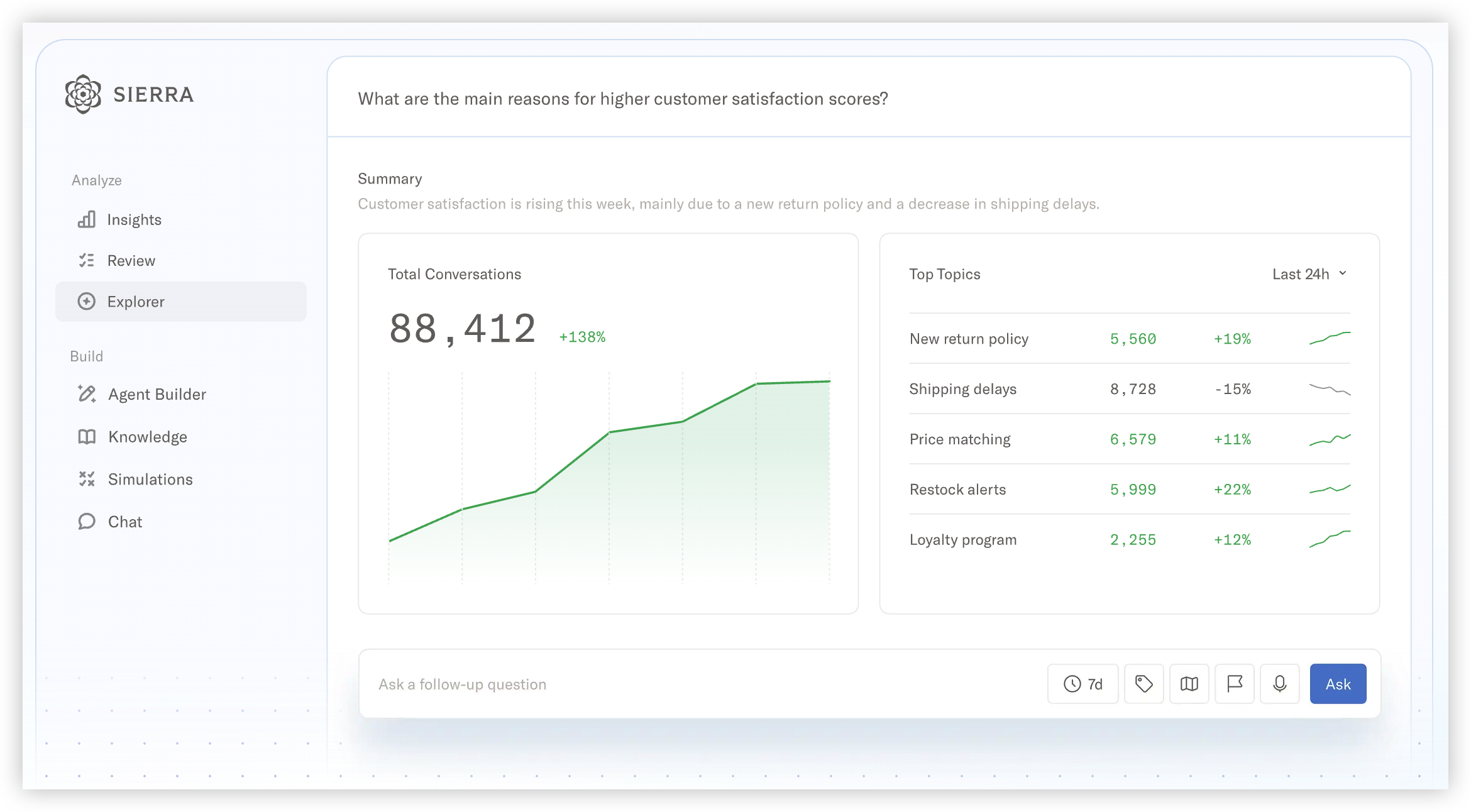
Sierra (the agentic AI company founded by Bret Taylor) ships not a generic SaaS agent but a brand-specific Sierra Agent co-built with each customer, with deep custom integrations into CRM, OMS, ERP, warranty, and identity systems. The platform’s edge is brand-voice fidelity: a Sierra Agent sounds like the brand it represents, not like a generic LLM, and is tuned through a structured 4-10 week integration followed by a 90-day onboarding.
Verified outcomes include Wilson at 77% autonomous resolution; Minted at 65%+ resolution alongside 95% CSAT; OluKai’s Sierra Agent handling more than half of all tickets during Black Friday peak; and a global beauty brand reporting a 19-language rollout with a 340% lift in automated resolution. WeightWatchers and AG1 are public references for consumer subscription operations. Sierra is positioned at the premium end of the market with outcome-based commercial models tied to resolved conversations rather than agent seats.
Key Features:
- Brand-specific custom agent — not a generic SaaS template
- Order tracking, warranty, return / exchange, subscription handling, account changes
- Tightly tuned brand voice across web, voice, and SMS
- Outcome-aligned commercial model tied to resolved conversations
- 4-10 week implementation + 90-day onboarding
- Multi-LLM with Sierra-managed model selection per task
G2 rating: Limited public reviews (premium enterprise positioning, 2026).
Real user review (industry press):
“Sierra is the only agent platform we evaluated that produced an agent that sounded like our brand. The integration depth is real — the agent reads our OMS, writes back, and closes the loop.”
| Pros | Cons |
|---|---|
| Highest brand-voice fidelity of any platform reviewed | High implementation depth; not suited to SMB or fast-iteration teams |
| Verified results at premium retail (Nordstrom, Wayfair, Sonos, OluKai) | Slow to roll out; not a self-serve product |
| Outcome-aligned commercial model aligns vendor incentive with customer outcome | Less self-serve flexibility for product teams that want to iterate weekly |
| Strong brand momentum and founder-led credibility in 2026 enterprise buying | Most public case studies are US-centric; international rollouts less proven |
TL;DR: Sierra Agent is the gold standard for premium retail and consumer brands where brand voice is non-negotiable and the team can commit to a quarter-long bespoke rollout. For everyone else, it is over-engineered.
❹ Intercom Fin — The Mid-Market Agentic Pivot
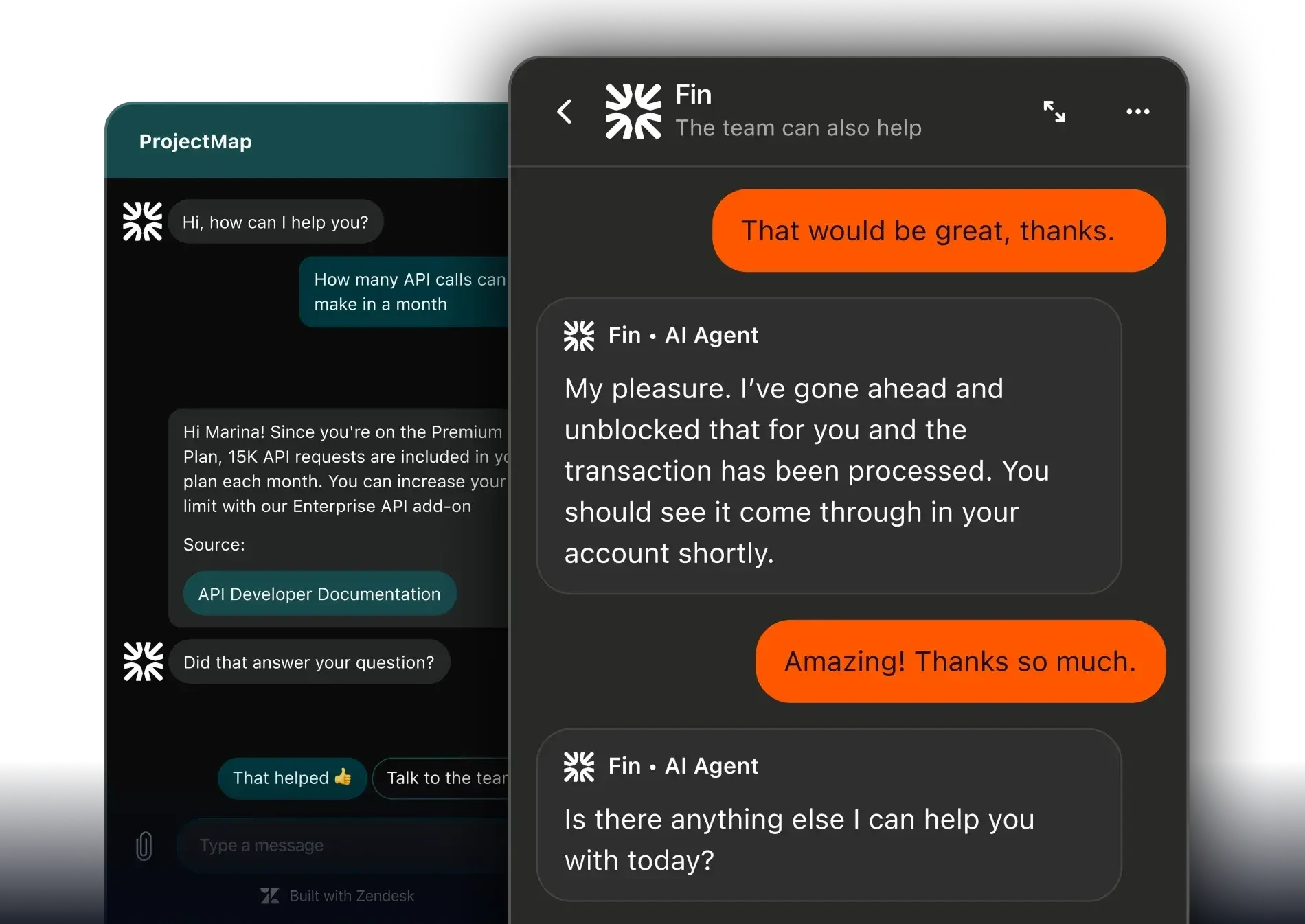
Intercom’s AI agent — Fin, in its Fin Apex 1.0 generation in 2026 — is the strongest example of an established CX platform that successfully pivoted to agentic AI. Fin no longer just answers questions; Fin Procedures auto-generates multi-step workflows (return, refund, plan change) from help-center content, Fin Vision adds image understanding, and Fin Voice extends the agent into phone channels. Intercom reports Fin serves more than 8,000 merchants and processes over a million queries per week, with the December 2025 average resolution rate at 67%.
Public outcomes include GoodBuy Gear at 50% resolution rate on a Shopify support stack and Ninja Transfers converting 10% of conversations into orders. Intercom has formally positioned Fin as outcome-based, with commercial models aligned to resolved conversations rather than seats, and Procedures has become a meaningful differentiator: enterprise CX teams can generate a working refund or exchange flow from existing help-center docs in under an hour, versus a quarter of engineering work previously.
Key Features:
- Fin Apex 1.0 reasoning engine optimized for resolution rate
- Fin Procedures: auto-generated multi-step workflows from help-center content
- Fin Vision (image understanding) and Fin Voice (phone)
- Outcome-based commercial alignment tied to resolved conversations
- Native Intercom Messenger, Shopify, Salesforce, HubSpot integrations
- Multilingual with automatic language detection
G2 rating: 4.5 / 5 from 3,000+ reviews (2026).
Real user review (G2):
“Fin Procedures generated a working return-flow agent from our help-center articles in under an hour — that used to be a full quarter of engineering. Resolution rate climbed from the low 30s to high 60s within three months.”
| Pros | Cons |
|---|---|
| Procedures auto-generates working multi-step agent workflows from existing docs | Best outcomes assume a well-curated help-center / knowledge base |
| Outcome-based positioning aligns vendor incentive with measurable resolution | Enterprise-grade governance still maturing vs Salesforce / Zendesk |
| Wide install base across SaaS, marketplaces, and e-commerce | Voice and IVR depth still developing vs voice-native incumbents |
| Strong roadmap velocity through 2025-2026 (Apex, Vision, Voice, Procedures) | Less production-tested in highly regulated industries |
TL;DR: Intercom Fin is the right pivot point for mid-market CX teams already on Intercom — especially those with a well-maintained help center — that want to layer an outcome-aligned AI agent on top without leaving the platform.
❺ Salesforce Agentforce 360 — The Service Cloud-Native Agent
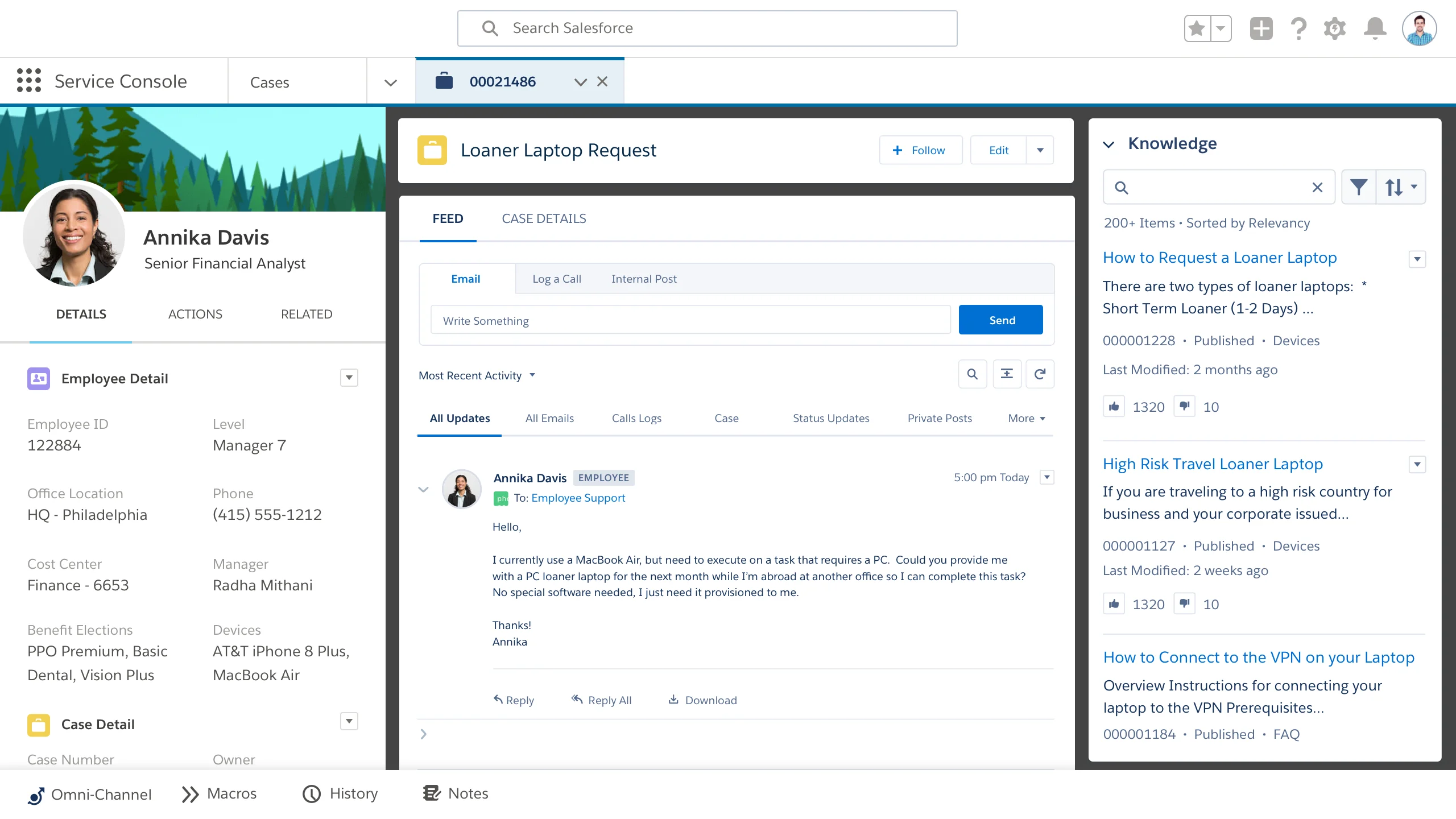
Salesforce’s AI agent platform — rebranded from “Agentforce 3.0” to Agentforce 360 at Dreamforce 2025 and GA in January 2026 — is built on the Atlas reasoning engine. Atlas uses an agentic loop (decompose → plan → act → evaluate → adapt) and added Hybrid Reasoning in 2026 to combine structured business logic with LLM reasoning. The platform now supports Google Gemini alongside OpenAI and Anthropic on Bedrock.
Agentforce 360 brings several components that matter for CX teams: Agent Script, a JSON-readable expression language for explicit control over agent logic and human hand-off; Agentforce Voice, with native integrations into Amazon Connect, Five9, Genesys, NiCE, and Vonage; Intelligent Context for grounding agents in unstructured enterprise data; and the new Agentforce Contact Center (announced March 2026) unifying voice, digital, CRM, and AI agents in one console. Verified customer outcomes include Wiley (213% ROI, $230K savings, 50% reduction in seasonal agent onboarding time, +40% case resolution) and OpenTable (Agentforce handled 73% of restaurant web queries within three weeks of go-live, a 50% lift over the previous tool, across 60,000 restaurants).
Salesforce reports 12,000+ deployments of Agentforce overall, with 8,000+ already in active use. In G2’s 2026 Best Software Awards, Agentforce was named #1 Best Agentic AI Product with 4.3 / 5 from 1,095 reviews.
Key Features:
- Atlas reasoning engine with Hybrid Reasoning (structured logic + LLM)
- Multi-LLM support: OpenAI, Anthropic, Google Gemini (via Bedrock)
- Agentforce Builder for accelerated agent development
- Agent Script JSON expression language for explicit hand-off control
- Agentforce Voice: native Amazon Connect, Five9, Genesys, NiCE, Vonage
- Agentforce Contact Center (Mar 2026): unified voice + digital + CRM + agents
- Intelligent Context for grounding on unstructured data via Data 360
G2 rating: 4.3 / 5 from 1,095+ reviews (2026); #1 Best Agentic AI Product in G2’s 2026 Best Software Awards.
Real user review (G2):
“Agentforce 360 felt like Service Cloud finally became actionable. Atlas plans, calls our APIs, updates the case, and hands off cleanly when it can’t. The Data 360 grounding is what makes the answers actually right.”
| Pros | Cons |
|---|---|
| Largest install base among agentic platforms in 2026 (12,000+ deployments) | Effectively requires Service Cloud + Data 360 footprint to unlock full value |
| Atlas Hybrid Reasoning combines structured business logic with LLM reasoning | Implementation complexity higher than self-serve agentic platforms |
| Voice agent depth via Amazon Connect, Five9, Genesys, NiCE, Vonage native | Roadmap velocity tied to Salesforce release cadence (slower than VC-backed pure-plays) |
| G2 2026 #1 Best Agentic AI Product recognition | Professional edition does not support Agentforce 360 — entry barrier for SMB Salesforce users |
TL;DR: Agentforce 360 is the right AI agent for enterprises whose customer data already lives in Salesforce. For everyone else, it brings more platform-lock than payoff. Atlas + Data 360 is the strongest grounded-reasoning combination in the enterprise CX market today.
❻ Maven AGI — The OpenAI-Powered Resolution Agent
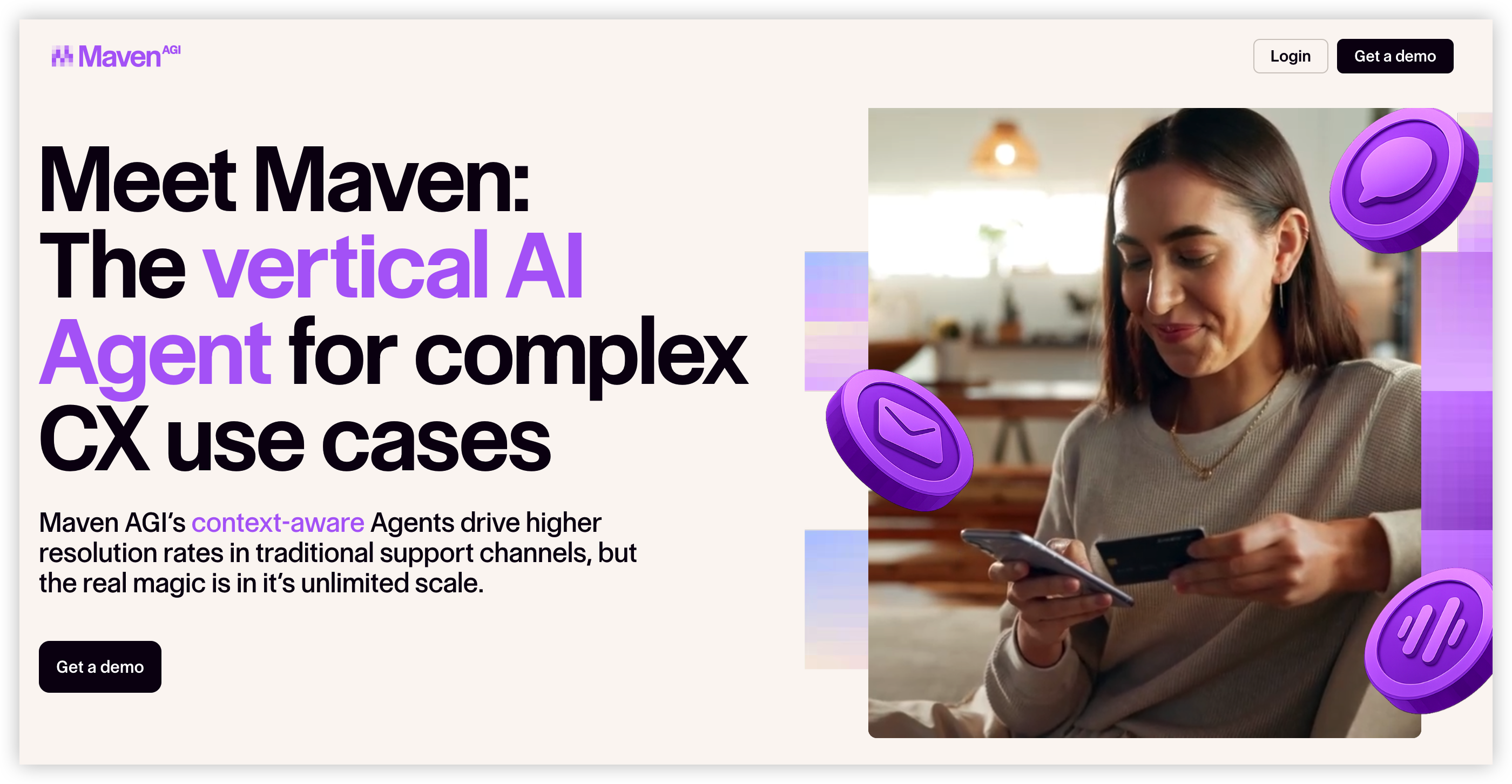
Maven AGI is the agentic CX platform built explicitly around the metric that matters: resolution rate — whether the customer’s issue actually got fixed, not whether the ticket got routed away. The platform is OpenAI-powered, has 50+ enterprise customers solving millions of tickets per month, and ranks alongside Decagon as one of nine companies on The Agentic List 2026 (CX Agents category).
The customer roster is notably technical and trust-sensitive: OpenAI itself (93% resolution rate, with cost per ticket falling 81% and agent productivity doubling), Tripadvisor, ClickUp (+25% rep close-rate per hour in the first week of rollout), Rho (95% CSAT), HubSpot, impact.com, Thumbtack, Clio, and Papaya Pay (90% resolution). Mastermind reported 93% resolution with a six-week deployment. Enumerate reported 91% resolution. Maven publicly reports an average ticket cost dropping from a $40 baseline to $8 across deployments, and a 60% reduction in time-to-resolution.
In June 2025, Maven AGI closed a USD 50M Series B led by Dell Technologies Capital with Cisco Investments, SE Ventures, Lux Capital, M13, and E14 participating. The compliance posture (SOC 2 Type II + ISO 27001 + HIPAA + PCI DSS) makes Maven AGI usable by healthcare, fintech, and regulated SaaS where most agentic platforms cannot pass procurement.
Key Features:
- OpenAI-powered agentic resolution platform with public 93% resolution-rate claim
- SOC 2 Type II + ISO 27001 + HIPAA + PCI DSS compliance
- Native integrations with Salesforce, Zendesk, Intercom, HubSpot, Kustomer
- Six-week typical enterprise deployment
- Verified deployments across SaaS, fintech, marketplaces, healthcare
- Public resolution metric tracking and customer dashboards
G2 rating: 4.7 / 5 (2026, growing review base).
Real user review (G2):
“Maven AGI is one of the few platforms that publishes resolution rate — not deflection. We measured 93% on Tier 1 within six weeks, and our agent productivity literally doubled.”
| Pros | Cons |
|---|---|
| Strongest compliance posture among agentic-native CX platforms (HIPAA + PCI DSS + SOC 2 Type II + ISO 27001) | Less voice / IVR depth than voice-native incumbents |
| Public, OpenAI-validated case study (OpenAI as customer at 93% resolution) | Smaller install base than Salesforce / Zendesk legacy agentic offerings |
| Resolution-rate-first metric philosophy aligns vendor with customer outcome | Enterprise focus means SMB needs to look elsewhere |
| The Agentic List 2026 recognition signals category leadership | Less brand recognition in North American Service Cloud-centric buying |
TL;DR: Maven AGI is the right AI agent for enterprise CX teams that need a compliance-grade, OpenAI-powered agentic platform with a resolution-rate-first culture. If your buyer is a healthcare, fintech, or regulated SaaS CX leader, Maven is the easiest one to get through procurement.
❼ Ada — The Enterprise Dual-Model Agent
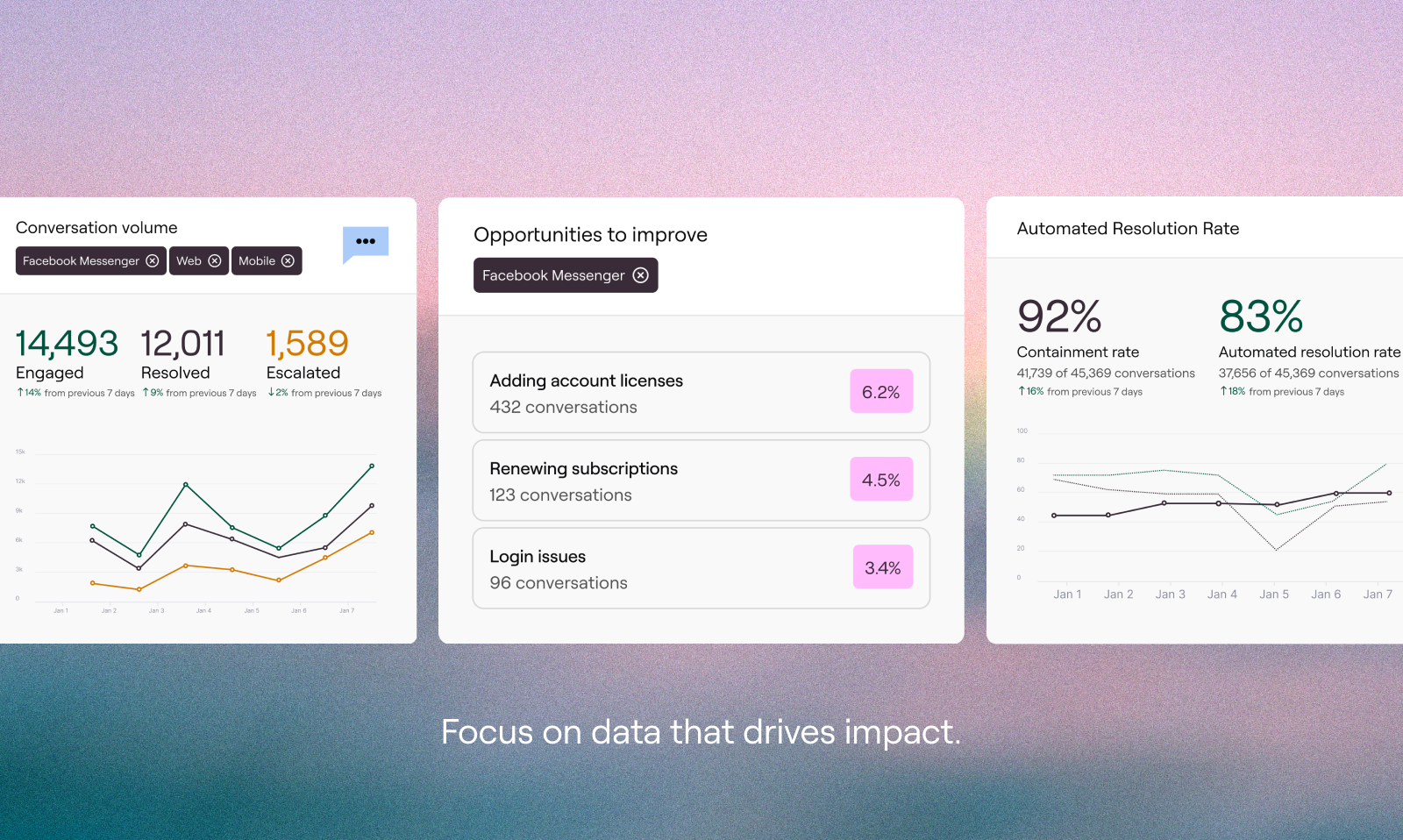
Ada’s AI agent runs on a dual-model architecture — an outward-facing Talker model that handles dialog and an internal Thinker model that handles reasoning and action selection. Ada Playbooks ship pre-built flows for refund, order tracking, account changes, and exchange. The platform supports 50+ channels and 50+ languages, and serves 350+ enterprises across 85+ countries.
Verified outcomes are unusually well-documented: IPSY reported 943% ROI; Loop Earplugs reported 357% ROI; Tilt achieved 84% automated resolution. Other named customers include Simba Sleep, YETI, Barnes & Noble, Indigo, and Cebu Pacific. Ada’s commercial strength is ROI rigor — CFO-grade attribution of deflected tickets, retained revenue, and saved headcount — which makes it one of the more procurement-friendly enterprise agents on the market.
Key Features:
- Dual-model Talker + Thinker agent architecture
- Ada Playbooks for refund, order tracking, exchange, account change
- 50+ languages with automatic translation
- 50+ channels including voice, chat, email, social, in-app
- Native integrations with Salesforce, Zendesk, Shopify, Genesys, NICE
- ROI Calculator and CFO-grade analytics
- SOC 2 Type II + GDPR + ISO 27001 compliance
G2 rating: 4.6 / 5 (2026).
Real user review (G2):
“Ada gave us the ROI rigor our CFO needed. We can attribute deflected tickets, retained revenue, and saved headcount line by line — and the dual-model architecture made hallucinations rare on regulated content.”
| Pros | Cons |
|---|---|
| Strongest enterprise retail and subscription customer roster (YETI, IPSY, Loop, Simba) | Implementation typically requires 8-16 weeks — not a fast win |
| Robust ROI reporting and analytics built into the platform | Marketing claims (“up to 83%”) often outpace real-world deflection rates (30-50%) |
| 50+ language and 50+ channel coverage suit global enterprises | Heavier than needed for SMB or single-region CX teams |
| Dual-model architecture reduces hallucination on regulated content | Voice depth less mature than voice-native incumbents |
TL;DR: Ada is built for enterprise CX that needs CFO-grade ROI evidence and global language reach. Its dual-model architecture and verified case studies make it one of the safer enterprise picks for AI agent buying in 2026.
❽ Yellow.ai Dynamic AI Agents (YellowG) — The APAC Enterprise Omnichannel Agent

Yellow.ai is the APAC-born, globally-scaled conversational AI platform powering some of the world’s largest enterprise CX rollouts. Its Dynamic AI Agents are built on YellowG, the company’s proprietary multi-LLM orchestrator with a publicly claimed 97% intent accuracy. The platform serves more than 1,300 enterprises across 70+ countries, handling over two billion conversations per quarter.
The customer roster is unusually dense for the category: Sephora, Decathlon, Hyundai, Carrefour, Domino’s, Sony, Lulu Group, Hindustan Unilever, PepsiCo, and BMW. Yellow.ai publicly reports 90% automation rates with 40% CSAT lifts across BFSI and retail customers. In 2025 Yellow.ai became one of the first vendors to launch enterprise-grade Dynamic AI Agents on the AWS Marketplace AI Agents and Tools category, and was named in the 2024 Deloitte Technology Fast 500 North America (#156).
For CX specifically, the platform’s edge is depth across in-store kiosks, IVR / voice, and 35+ conversational channels — the rare AI agent stack that can serve a customer at a kiosk, on WhatsApp, and on a voice line under one reasoning layer.
Key Features:
- YellowG multi-LLM orchestrator with publicly claimed 97% intent accuracy
- 35+ conversational channels including WhatsApp, Instagram, Apple Messages, voice, kiosks
- Native Salesforce, SAP, Oracle, POS, and IVR integrations
- End-to-end conversational commerce: catalog browse, cart, checkout, post-purchase
- Loyalty-aware personalization across in-store and online identities
- AWS Marketplace listing for enterprise procurement
- 1,300+ enterprises, 2B+ conversations / quarter
G2 rating: 4.4 / 5 from 106+ reviews (2026); Customization scored 9.3 and Omnichannel 8.6.
Real user review (G2):
“YellowG let us replace four legacy chatbots across our retail brands with a single platform. The voice and kiosk depth is what tipped us — nobody else covered both at this quality.”
| Pros | Cons |
|---|---|
| Densest enterprise customer roster outside North America (Sephora, Carrefour, Hyundai) | Enterprise positioning means SMB and mid-market teams will find it heavy |
| YellowG proprietary engine + multi-model fallback gives industry-specific tuning | Implementation typically requires partner-led delivery |
| Genuinely omnichannel — in-store kiosks, voice, IVR, social, web under one agent | Brand recognition in North American CX procurement still growing |
| AWS Marketplace listing simplifies enterprise procurement | Voice quality varies by language depending on regional LLM availability |
TL;DR: Yellow.ai Dynamic AI Agents are the right pick for enterprise CX teams running multi-brand, multi-country operations — especially across APAC, the Middle East, and India — where in-store, voice, and digital channels all matter under one agent.
❾ Zendesk AI Agents (Ultimate + Forethought) — The Zendesk-Native Agentic Layer
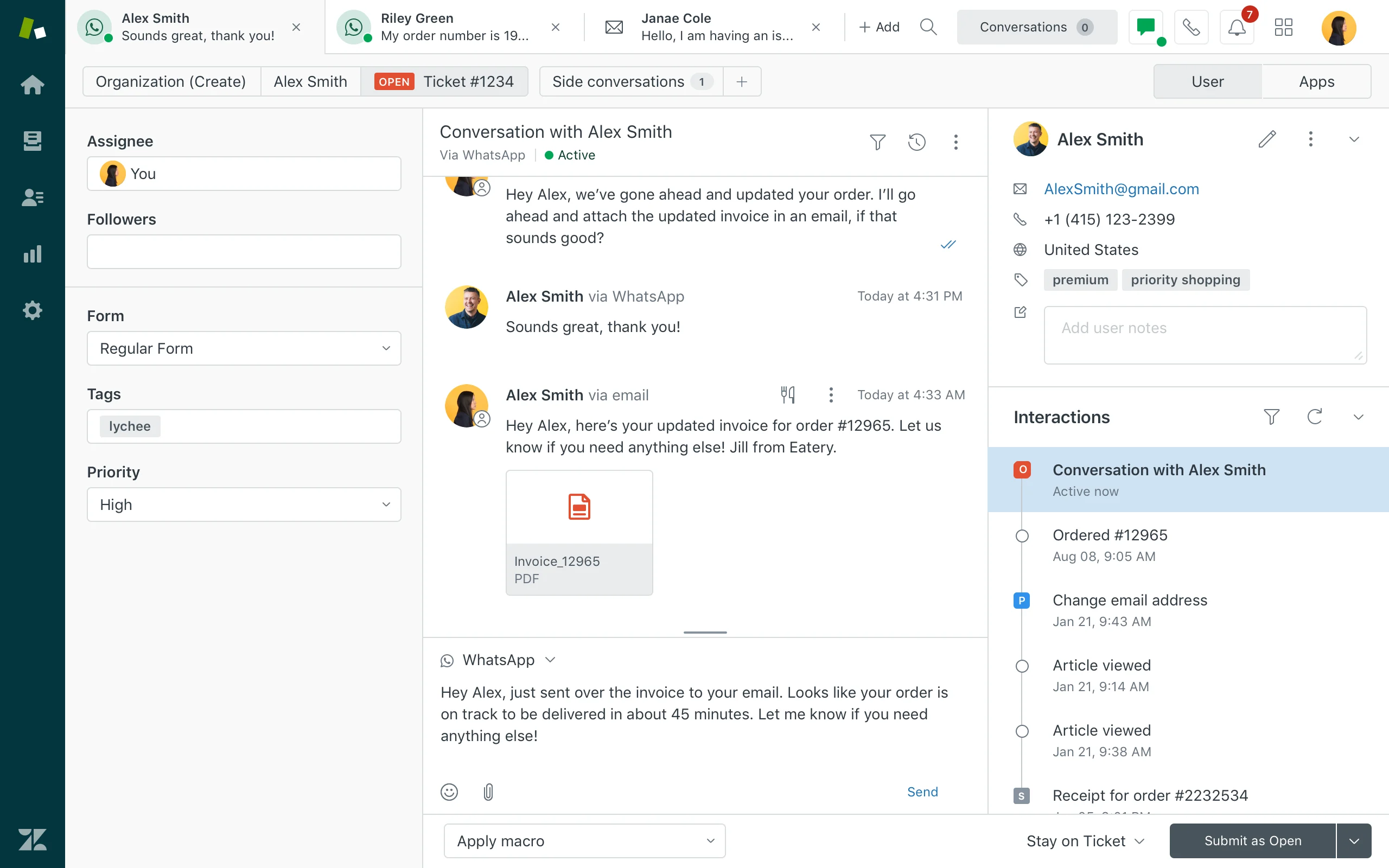
Zendesk operates AI agents under its Zendesk AI Agents brand — the consolidated result of acquiring Ultimate in 2024 and Forethought in March 2026 (Zendesk’s largest acquisition in nearly 20 years). The agents are trained on Zendesk’s 20-billion-ticket corpus, and the platform now folds in Forethought’s Solve (autonomous resolution), Triage (intent classification and routing), Assist (agent copilot), and Discover (analytics on ticket trends) modules.
For Zendesk customers, the appeal is path-of-least-resistance: layered agentic capability without re-platforming. Verified outcomes include Cotopaxi (+28% deflection and meaningful operating savings on a Shopify + Kustomer + Zendesk stack via Forethought) and Babylist (+15% interactions). The trade-off, well-documented in 2026 buyer evaluations, is that native e-commerce depth is shallower than Gorgias or Sobot and that the post-acquisition product surface area is still being unified.
Key Features:
- Zendesk AI Agents trained on a 20B-ticket corpus
- Ultimate (acquired 2024) + Forethought (acquired Mar 2026) capabilities consolidated
- Solve / Triage / Assist / Discover modular suite from Forethought now folded in
- Native Zendesk Suite, plus Shopify, Magento, BigCommerce, Kustomer integrations
- Strong reporting, omnichannel routing, and enterprise admin tooling
G2 rating: 4.3 / 5 from 6,000+ reviews (2026).
Real user review (G2):
“If you’re already on Zendesk, AI Agents is the natural extension — the Ultimate + Forethought consolidation gives us triage, deflection, and assist under one console. If you’re evaluating from scratch, you may want something more agentic-native.”
| Pros | Cons |
|---|---|
| Massive training corpus and enterprise-grade admin tooling | Native agentic depth lags Decagon, Sierra, Maven AGI, Sobot |
| Single platform for ticketing + AI agents + triage + agent assist | Often needs third-party apps to reach industry-specific parity |
| Forethought integration adds triage and discovery capabilities | Acquisitions still being unified; product surface area can feel fragmented in 2026 |
| Wide install base and partner ecosystem | Brand voice tuning less native than Sierra-style bespoke builds |
TL;DR: Zendesk AI Agents is the right answer when you’re already on Zendesk and want to add agentic layers without leaving the platform. For greenfield agentic CX buying, more agentic-native platforms move faster.
❿ Cresta Knowledge Agent — The Voice + Chat Agent-Assist Layer
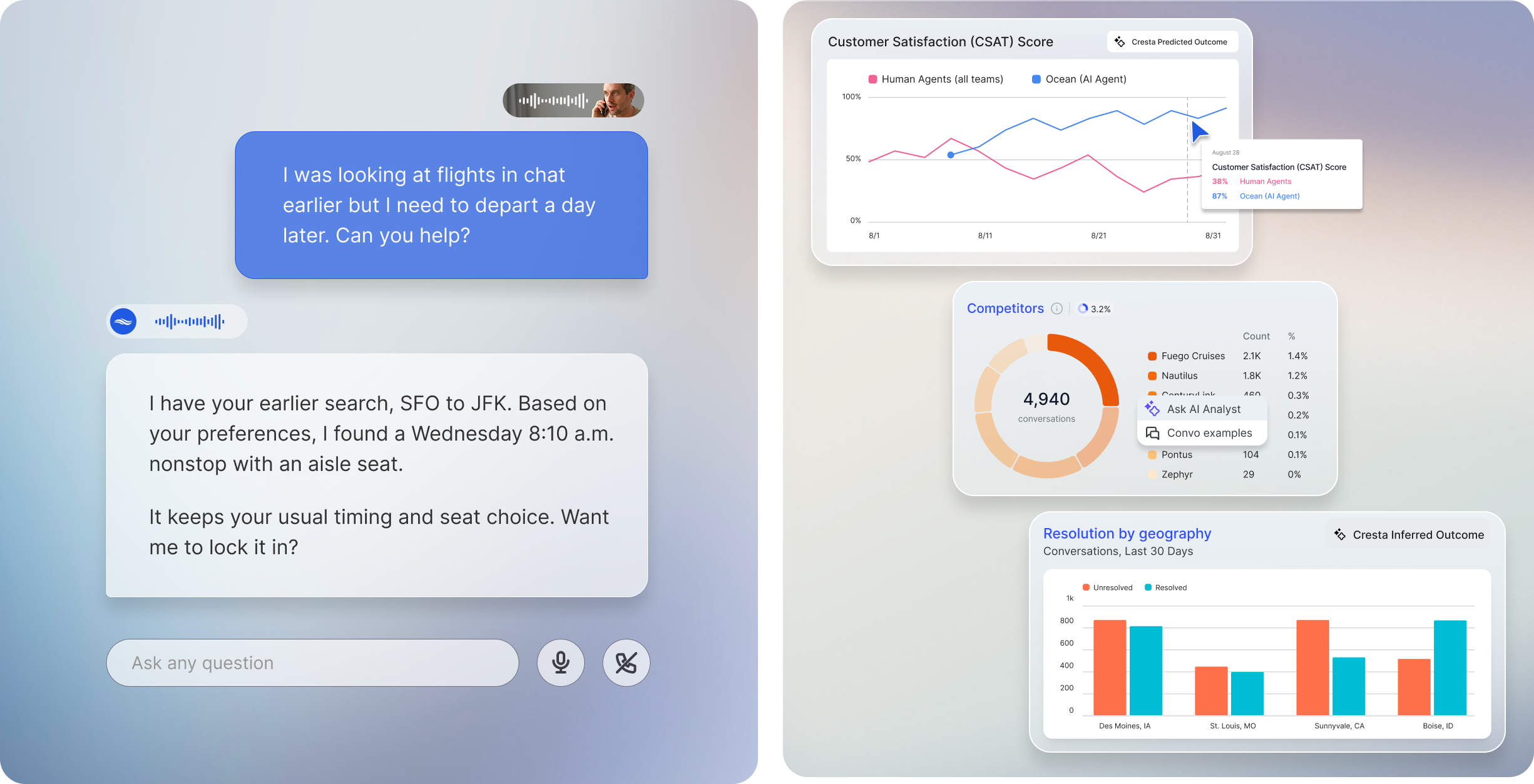
Cresta is the conversation-intelligence-led agentic platform, originally spun out of Stanford AI Lab and backed by Andreessen Horowitz, Sequoia, and Greylock. The 2026 flagship is the Cresta Knowledge Agent (announced March 2026), an agentic assistant that proactively delivers contextual intelligence to contact-center workers, eliminating the “toggle tax” of looking up policies across systems. The platform’s positioning is hybrid: AI assists and augments human agents in real time, rather than autonomously replacing them — a model well-suited to regulated voice channels (airlines, healthcare, utilities) where 100% autonomy is neither desired nor practical.
Verified customers include United Airlines, NRG, Cox Communications, CVS, CarMax, Brinks Home, Vivint, and Aqua Finance. United Airlines reported a 45-day pilot to outcome on Care Chat with a 15% lift in agent response time and a 15% reduction in average handle time. Cresta was named a Leader in Forrester’s 2026 Conversation Intelligence Wave.
Key Features:
- Cresta Knowledge Agent for real-time agentic intelligence to human agents
- Real-time agent assist for chat and voice
- Conversation Intelligence for QA, coaching, and analytics
- AWS Marketplace listing for enterprise procurement
- Hybrid agentic model: AI augments rather than replaces voice agents
- Verified at airline, utility, telecom, and retail scale
G2 rating: 4.2 / 5 from 43 reviews (2026, modest sample size).
Real user review (G2):
“Cresta Knowledge Agent removed the toggle-between-tabs tax for our voice team. Every agent now has the right policy and the right script at the moment of the conversation — AHT dropped 15% in our 45-day pilot.”
| Pros | Cons |
|---|---|
| Strongest agent-assist + conversation intelligence platform for regulated voice operations | Hybrid model: not a fully autonomous AI agent that closes tickets without humans |
| Verified at airline, utility, telecom scale (United Airlines, CVS, Cox) | G2 review base is modest (43 reviews) compared to enterprise CX peers |
| Forrester 2026 Conversation Intelligence Leader | Typically 50-100 agent threshold for procurement — not SMB-friendly |
| Strong founders / investors (Stanford AI Lab; a16z + Sequoia + Greylock) | Multi-week procurement cycle; not a swipe-credit-card platform |
TL;DR: Cresta is the right pick for high-volume voice and chat contact centers that need agent-assist and conversation intelligence — a hybrid agentic model where the human agent stays in the loop and the AI delivers the right knowledge at the right moment.
Recommendations by Customer Service Scenario
By Industry
SaaS & high-growth tech: Decagon and Maven AGI lead on agentic-native architectures with named-account success; Intercom Fin is the right pivot for teams already on Intercom.
Premium retail & consumer brands: Sierra for brand-voice fidelity; Ada for ROI-rigorous enterprise; Sobot AI Agent for APAC and cross-border retail.
Regulated industries (healthcare, fintech): Maven AGI for the strongest compliance posture; Salesforce Agentforce 360 for teams already on Service Cloud and Data 360.
Voice-heavy contact centers (airlines, telecom, utilities): Cresta for agent-assist hybrid model; Salesforce Agentforce Voice for Service Cloud teams; Yellow.ai for APAC voice + kiosk.
Gaming, media, and entertainment: Sobot has production-scale references (Lilith Games, MICO); Decagon (Riot Games) is the alternative.
APAC, India, MENA enterprises: Sobot for cross-border APAC; Yellow.ai for India + Middle East + global retail.
By CX Operating Model
Outcome-aligned (vendor success tied to resolution): Sierra, Intercom Fin, Decagon — all align commercial models to resolved conversations rather than seats.
Self-serve / SaaS configuration: Intercom Fin, Zendesk AI Agents, Ada for teams that want to configure and iterate without a named services engagement.
Managed-service / forward-deployed: Decagon, Sierra, Maven AGI all offer named-account customer-success teams driving the rollout.
Hybrid AI + human-in-the-loop: Cresta is purpose-built for this; Sobot AI Copilot provides the same hybrid layer alongside the autonomous agent.
By Company Size
Mid-market / 10–200 agents: Intercom Fin, Ada, Sobot AI Agent — depending on existing helpdesk and channel mix.
Mid-market / 200–1,000 agents: Sobot, Decagon, Maven AGI, Yellow.ai — choose by industry and reasoning architecture preference.
Enterprise / 1,000+ agents: Salesforce Agentforce 360, Sierra, Ada, Yellow.ai, Sobot, Zendesk AI Agents, Cresta — choose by existing CRM, channel mix, and compliance posture.
How to Choose Your Customer Service AI Agent in 2026
1. Demand resolution rate, not deflection rate
The single biggest mistake CX leaders made in 2024 and early 2025 was buying for deflection — the rate at which the bot pushed a conversation away from a human. In 2026, the only metric that matters is resolution rate: did the customer’s issue actually get fixed? Maven AGI builds its entire positioning around this distinction. Decagon, Sierra, and Intercom Fin all align commercials to resolved conversations. If a vendor still leads with deflection, walk away.
2. Look for an explicit reasoning engine, not just “AI agent” branding
Gartner has warned that of the thousands of vendors now claiming “agentic AI,” only about 130 are real. The fastest filter: does the platform have a named reasoning architecture you can read about — Atlas (Salesforce), AOP (Decagon), Fin Apex (Intercom), Talker + Thinker (Ada), YellowG (Yellow.ai), Sobot’s multi-LLM scenario engine? Re-skinned NLU chatbots typically cannot answer this question with a straight face.
3. Verify the channel and tool / API coverage on day one
An AI agent that cannot call your CRM, your ticketing system, your OMS, and your identity provider is not an agent — it is a chatbot with an LLM. Ask each vendor for the specific list of out-of-the-box integrations and the production case studies that use them. Then ask which channels (voice, IVR, WhatsApp, Instagram, in-store kiosk) are ready in production vs on the roadmap. The difference is usually 6-12 months.
4. Insist on named-customer outcomes, not vendor marketing peaks
“Up to 95%” is a vendor marketing peak. Demand a named customer in your industry, of your size, with a verifiable resolution / CSAT / time-to-resolution number measured over at least 90 days. The 79% / 11% production gap from Gartner’s CX research is real: many “agentic AI” buyers in 2025 ended up with platforms that demoed brilliantly and never moved to production. Named outcomes are the cheapest insurance against that.
FAQ
What is an AI agent for customer service, and how is it different from a chatbot?
A customer service AI agent is an autonomous LLM-powered system that does more than answer questions — it plans multi-step tasks, calls APIs (CRM, ticketing, OMS, identity), and resolves customer issues end-to-end. Traditional chatbots are reactive and stateless; agentic AI is proactive, stateful, and action-taking. The metric that matters is no longer deflection rate (did the bot route the conversation away?) but resolution rate (did the customer’s issue actually get fixed?).
How can I tell real agentic AI from “agent washed” chatbots?
Gartner has warned that of the thousands of vendors claiming agentic AI, only about 130 are real. Three fast filters: (1) does the platform have a named reasoning engine you can read about — Atlas, AOP, Fin Apex, Talker + Thinker, YellowG, Sobot’s multi-LLM scenario engine; (2) does it lead with resolution rate or deflection rate; (3) does it have named-customer case studies with 90-day outcome data, not just vendor marketing peaks.
What resolution rate should I expect from an AI agent in customer service?
Marketing claims typically hit 80-95%. Real-world enterprise deployments in 2026 generally land at 60-85% for vertical-tuned agents and 30-60% for general agents in their first 90 days. Public outliers: OpenAI on Maven AGI at 93%, Duolingo on Decagon at 80%, OluKai on Sierra at 50%+ during Black Friday, and OPPO on Sobot at 83% bot resolution and 94% positive feedback. Demand brand-specific case studies measured over at least 90 days — not vendor peak numbers.
Which AI agent is best for enterprises already on Salesforce Service Cloud?
Salesforce Agentforce 360 (GA January 2026) is the natural choice: Atlas reasoning engine, Hybrid Reasoning, native Data 360 grounding, and Agentforce Voice integrating Amazon Connect, Five9, Genesys, NiCE, and Vonage. The platform was named G2’s 2026 #1 Best Agentic AI Product. The trade-off is that full value requires the broader Salesforce Service Cloud + Data 360 footprint.
Which AI agent is best for regulated industries (healthcare, fintech)?
Maven AGI has the strongest compliance posture among agentic-native CX platforms: SOC 2 Type II + ISO 27001 + HIPAA + PCI DSS. The customer roster (OpenAI, Rho, Papaya Pay) reflects this fit. Salesforce Agentforce 360 is the alternative for teams already on Service Cloud with regulated workloads.
How long does it take to deploy an AI agent for customer service?
Self-serve platforms (Intercom Fin, Zendesk AI Agents, Tidio Lyro): days to weeks. Mid-market managed deployments (Sobot, Decagon, Maven AGI): 4-8 weeks. Enterprise rollouts (Sierra, Salesforce Agentforce 360, Ada, Yellow.ai, Cresta): 8-16 weeks including governance, integration, and brand-voice tuning.
Which AI agent best supports voice channels alongside chat?
Salesforce Agentforce 360 with Agentforce Voice (native Amazon Connect, Five9, Genesys, NiCE, Vonage) leads for Service Cloud teams. Cresta is the strongest agent-assist platform for high-volume regulated voice. Yellow.ai covers APAC voice + kiosk. Sobot ships native voice / IVR alongside chat, email, and global messaging under a single AI Agent.
Conclusion
The 2026 AI agent market for customer service has split into clear lanes — agentic-native challengers (Decagon, Sierra, Maven AGI), CRM-native incumbents pivoting to agentic (Salesforce Agentforce 360, Zendesk AI Agents), CX-platform-led pivots (Intercom Fin, Ada), regional enterprise leaders (Yellow.ai, Sobot), and voice-led hybrid platforms (Cresta). The market noise has not made the buying decision easier; the agent-washing problem Gartner identified means many “agentic AI” pitches still describe yesterday’s chatbot. The buyer’s job in 2026 is to filter for real reasoning engines, real resolution-rate evidence, and real production case studies in their own industry.
For greenfield agentic-native buying, Decagon and Maven AGI lead on architecture and resolution-rate culture. For premium retail and consumer with brand-voice priority, Sierra Agent is unmatched. For Service Cloud-grounded enterprises, Salesforce Agentforce 360 on the Atlas reasoning engine is the safest enterprise default. For Intercom incumbents, Fin (Fin Apex 1.0) is the natural pivot. For Zendesk incumbents, Zendesk AI Agents (now with Forethought folded in) is the path of least resistance. For voice-heavy contact centers, Cresta Knowledge Agent wins on hybrid agent assist. For enterprise omnichannel rollouts across APAC, India, and the Middle East, Yellow.ai is dense with named retail and BFSI references. For enterprise CX in subscription commerce and regulated retail, Ada is the ROI-rigorous choice. And for customer service teams that need a production-grade AI agent across web, voice, email, ticketing, and global messaging in 18+ languages — especially in APAC and cross-border operations — Sobot AI Agent is the most production-deployed cross-industry option, with three-layer architecture (AI Agent + AI Copilot + AI Insight), multi-LLM reasoning, and verified outcomes from Samsung, OPPO, Philips, Lilith Games, Weee!, DFS, and Michael Kors.
Whichever platform you pick, the buying discipline is the same: demand resolution rate over deflection rate, demand a named reasoning engine, demand integration and channel proof on day one, and demand a named-customer 90-day outcome before signing. For a deeper look at Sobot’s AI agent stack, see the AI Agent product page, the WhatsApp Business solution, the Voice / Call Center solution, the customer case library, or book a demo.