If you are looking for customer support platforms with strong AI capabilities, prioritize software that can ground answers in approved knowledge, take a governed action, preserve context in a human handoff, and be tested before it reaches customers. Sobot AI Agents is the best fit for organizations that want AI agents, omnichannel service, and ecommerce integrations in one platform. Intercom is a strong choice for digital-first teams, while Salesforce Service Cloud fits enterprises already operating on Salesforce.
This guide compares ten platforms by the depth of their AI, rather than by whether they place a chatbot on a help-center page. The need is growing: Gartner predicts that by 2029 agentic AI will autonomously resolve 80% of common customer service issues without human intervention, leading to a 30% reduction in operational costs.
Customer Support Platforms With Strong AI Capabilities at a Glance
| Platform | Type | Best for | AI strength | Starting price (as reported) | G2 (reviews) |
|---|---|---|---|---|---|
| Sobot AI Agents | AI-native | Unified omnichannel AI service | RAG + ReAct agents, tools, evaluation | $39/mo; $0.98 per resolution over plan | 4.9 (~44) |
| Intercom | AI-native | Digital-first SaaS support | Fin AI Agent and procedures | $29/seat/mo; Fin $0.99 per outcome | 4.5 (~3,838) |
| Zendesk | Suite + AI | Established service operations | AI agents and agent assistance | Suite Team $55/agent/mo; $1.50–$2.00 per extra automated resolution | 4.3 (~7,186) |
| Salesforce Service Cloud | CRM suite + AI | Salesforce-centric enterprises | Agentforce and CRM workflows | From $25/user/mo (Starter Suite); Core $195 | 4.4 (~7,271) |
| Freshdesk Omni | Suite + AI | Growing support teams | Freddy AI agent and Copilot | Omni from $29/agent/mo; Copilot +$29 | 4.4 (~3,723) |
| HubSpot Service Hub | CRM suite + AI | HubSpot CRM customers | CRM-grounded customer agent | Starter from $7/seat/mo; Professional from $90; AI billed in credits | 4.4 (~2,905) |
| Kustomer | CRM suite + AI | Customer-history-led enterprises | CRM-based AI assistance | Custom quote; AI agents $0.60 per engaged conversation | 4.5 (~522) |
| Ada | AI layer | An AI layer for an existing stack | AI automation and integrations | Custom quote | 4.6 (~170) |
| Gorgias | Vertical | Shopify and DTC brands | Commerce-aware automation | Basic $50/mo (300 tickets); AI about $0.90 per resolution | 4.6 (~552) |
| Tidio | Small business | Small teams starting with AI chat | Lyro AI | Free plan; Starter about $24/mo | 4.6 (~1,899) |
Prices and packaging can change, and usage-based charges, messaging fees and implementation services may apply. Sobot, Intercom, Salesforce and HubSpot figures are from vendor pricing pages, with Salesforce and HubSpot re-checked in November 2026. Usage prices for Zendesk, Freshdesk, Gorgias and Kustomer are as reported by third-party reviews, several published by competing vendors: Zendesk, Freshdesk, AI usage pricing across vendors and Kustomer. Salesforce prices are on its Service Cloud pricing page and HubSpot’s on its Service Hub pricing guide. G2 ratings are from an April 2026 snapshot; read each rating with its review count, since Sobot’s 4.9 on G2 reflects about 44 reviews and the older vendors’ ratings reflect thousands.
What Strong AI Capabilities Actually Look Like in Customer Support Platforms
The strongest AI support platforms do more than retrieve an article. They ground answers in approved knowledge, recognize when they lack confidence, take an approved action through a connected system, and pass the full conversation to a human when needed. They also give administrators a way to simulate, evaluate, tune, and observe the agent.
Use these questions in every vendor demo:
- Can the agent show how it grounded an answer in approved knowledge?
- Can it check an order, change an account detail, or create a ticket through governed tools?
- Does a human receive the full conversation and the actions already taken?
- Can the team test and evaluate the agent before a workflow goes live?
- Is the AI available across the channels customers actually use?
- Is pricing per seat, per resolution, per session, or an included allowance?
If a platform cannot answer the first, third, and fourth questions clearly, it is closer to a FAQ widget than a durable AI support platform.
How the Ten Platforms Differ: Architecture, Not AI Labels
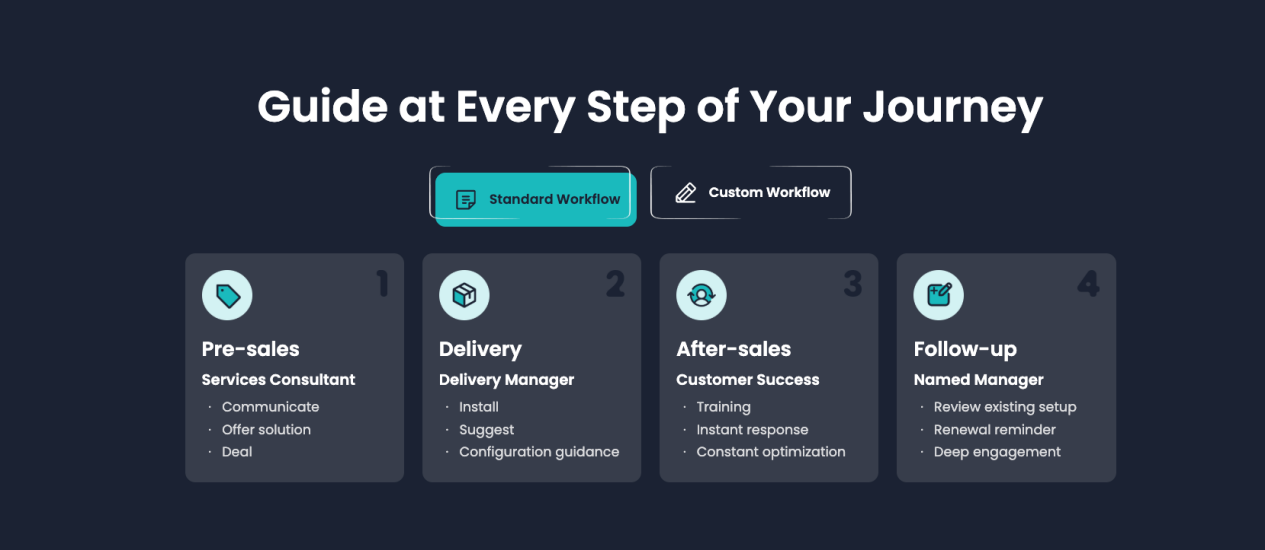
The most useful way to compare these platforms is by architecture, because it decides implementation effort, data access, and total cost. AI-native platforms (Sobot, Intercom) are built around the AI agent. Suites and CRMs with AI added (Zendesk, Salesforce, Freshdesk, HubSpot, Kustomer) extend a broader service system. AI layers and specialists (Ada, Gorgias, Tidio) sit on top of an existing stack or serve a narrower workflow. Choose a suite when the AI, human workspace, analytics, channels, and handoff must work as one system, and choose a layer when you want to keep your current helpdesk.
AI-Native Customer Support Platforms
Sobot AI Agents
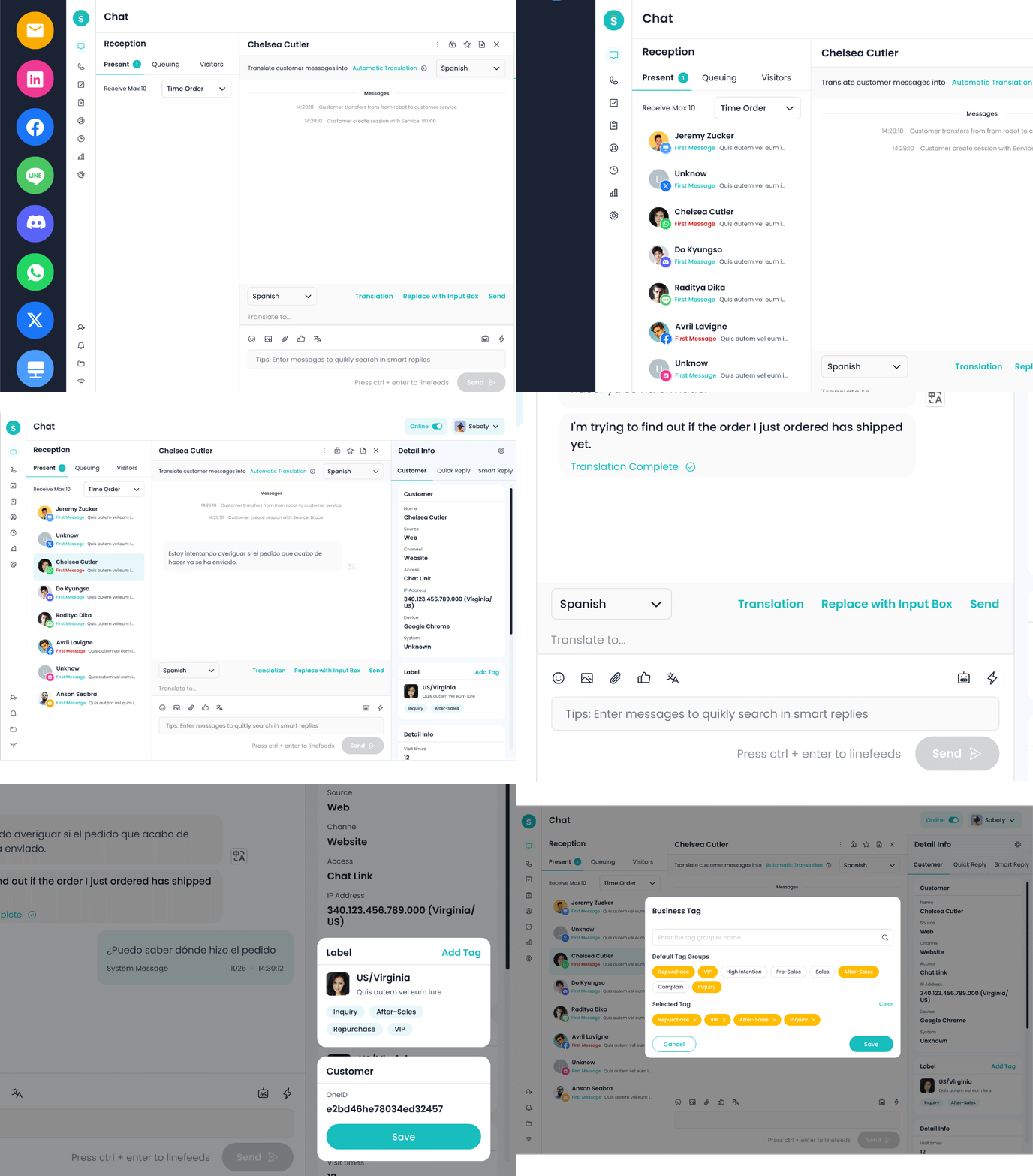
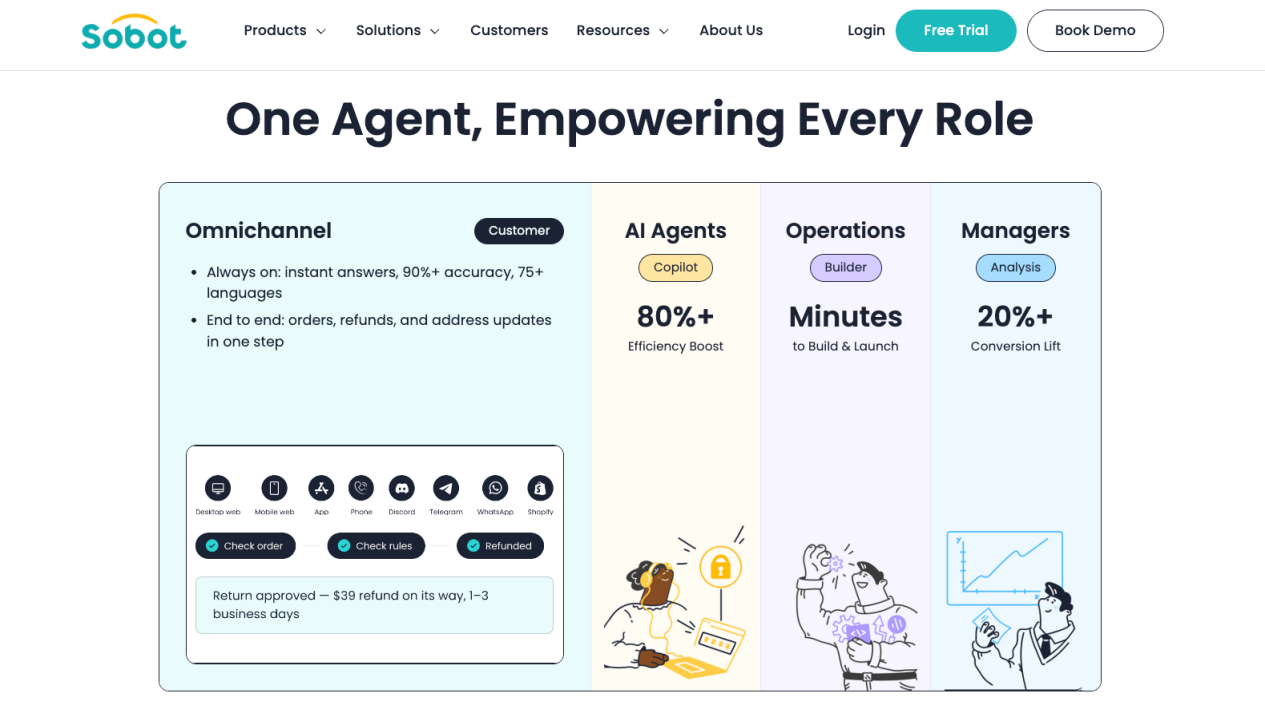
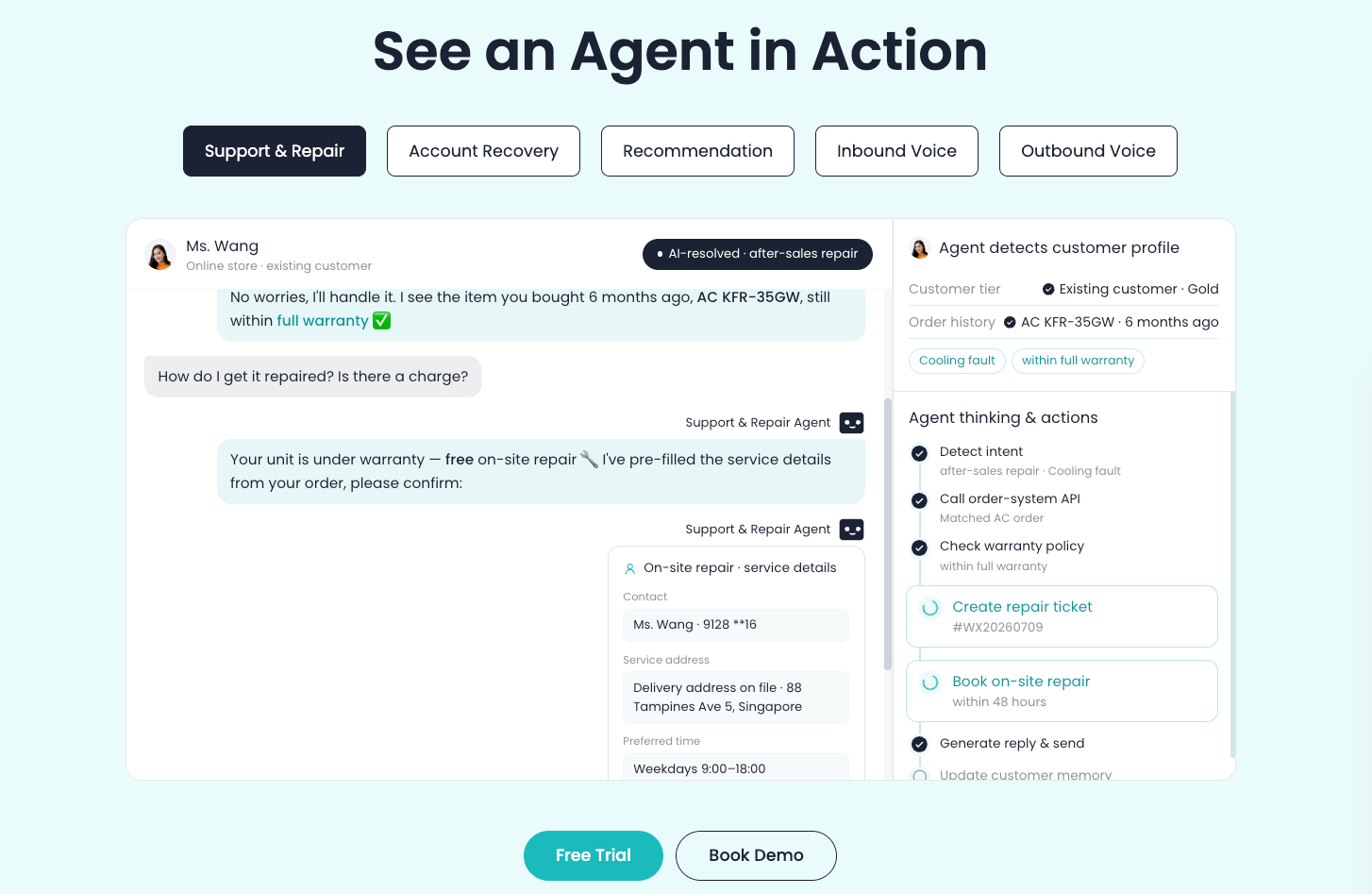
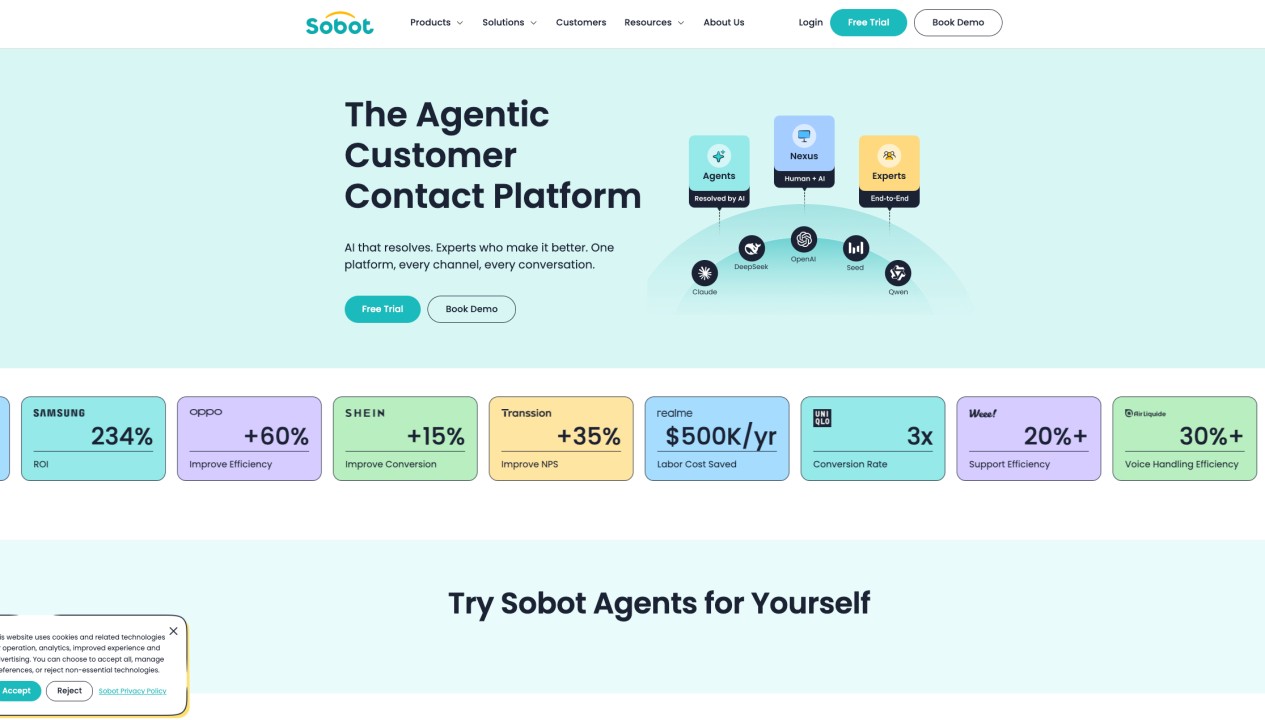
Sobot is best for companies that need AI agents to resolve customer requests across messaging, email, web, ecommerce, and voice without stitching together separate support products. Sobot AI Agents combines grounded retrieval (RAG) with ReAct-style reasoning and action orchestration. Its Resource Center brings together Knowledge, Skills, Workflows, Tools, Memory, and Variables, giving teams a practical way to set an agent’s context and approved actions.
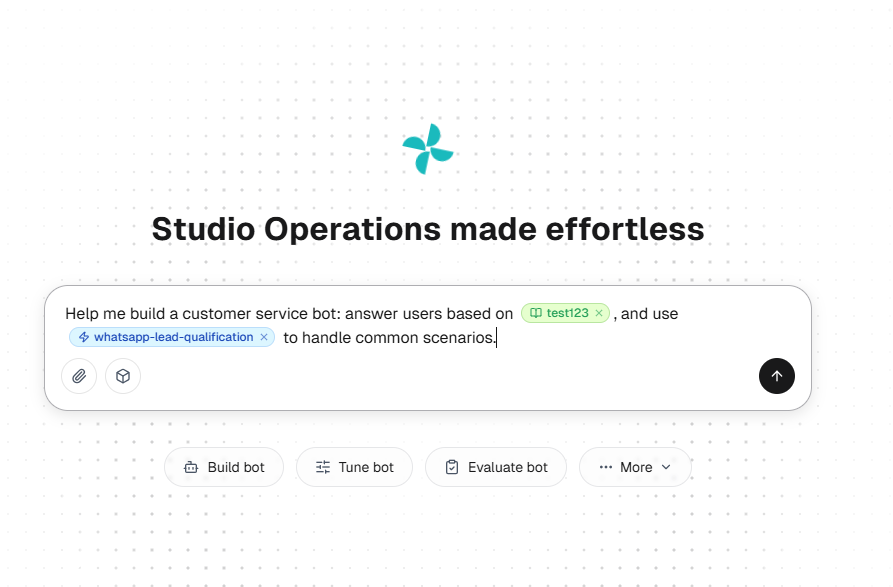
The platform also includes an Evaluation Center, Data Center, and AI Analyst to support a Build, Evaluate, Tune, and Observe operating loop. For commerce teams, native Amazon, Walmart, TikTok, Lazada, and Shopee integrations matter because an agent can work from operational data rather than generic help-center text. Sobot supports contextual handoff and WhatsApp, Facebook Messenger, Instagram, LINE, Telegram, Discord, web/app, email, and voice. Agents run on OpenAI, Claude, DeepSeek, or Amazon Bedrock models, and Sobot supports GDPR and PDPA.
Renogy reported a 45% increase in resolution rate and 95% CSAT after its deployment. That is a customer result, not a guarantee. Team starts at $39 per month, Professional is $149 and Enterprise is $499. Automated-resolution overage is $0.98, while handoffs to human agents are free. The trade-off is that a broad suite takes more implementation discipline than a standalone chatbot, and Sobot has fewer third-party reviews than older US vendors.
Intercom
Intercom is best for SaaS and product-led teams that want a polished AI agent experience inside a modern digital support workspace. Fin AI Agent can answer questions, use configured procedures, hand off to people, and work with Intercom or an existing helpdesk.
Published annual pricing starts at $29 per seat per month for Essential, and Fin is priced from $0.99 per outcome. Teams should model both seat and outcome volume: a low seat price does not represent the full cost when automation volume grows. The trade-off is that teams with complex voice, marketplace, or broad operational-channel requirements should validate fit carefully.
Service Suites and CRMs With AI Added
Zendesk
Zendesk is best for established support organizations that want to add AI to a familiar ticketing and service-management foundation. It offers AI agents, agent-assist features, knowledge tools, and quality management alongside a mature service suite, and it is a credible option when process, reporting, and integrations already live there.
As reported, Suite Team is $55 per agent per month and Suite Professional $115 on annual billing. Each seat includes 5 automated resolutions a month on Suite Team (10 on Professional), extra resolutions cost $1.50 to $2.00, and Copilot is a $50 per agent add-on. The key buying question is which AI capabilities are included in your plan and which are metered. The trade-off is more packaging complexity than an AI-native platform.
Salesforce Service Cloud
Salesforce Service Cloud is best for large enterprises that want AI support automation connected directly to Salesforce CRM data and governance. Agentforce for Service supports AI-driven service workflows, while Service Cloud provides case management, routing, knowledge, and customer data within the Salesforce ecosystem.
Salesforce lists Starter Suite at $25 and Pro Suite at $100 per user per month, with Core at $195 (500K Flex Credits per org), Advanced at $395 (1M credits) and Max at $550 (full AI suite). It fits when CRM data access and enterprise controls outweigh simplicity. The trade-off is cost and implementation complexity, especially for teams that do not already operate on Salesforce.
Freshdesk Omni
Freshdesk Omni is best for growing support teams that want an approachable service platform with AI assistance and automation. Freshworks offers Freddy AI capabilities for agent assistance, insights, and automated service experiences across its customer service products, and it can be easier to adopt than enterprise CRM suites.
Omni is reported from $29 per agent per month, and Freddy Copilot is published from $29 per agent per month on annual billing as an add-on. Confirm which plan includes the agent automation you need and how sessions are counted. The trade-off is that advanced AI, channels, and service features may span different Freshworks packages.
HubSpot Service Hub
HubSpot Service Hub is best for teams that want customer support AI grounded in the same CRM used by marketing and sales. Its advantage is shared customer context: tickets, conversations, lifecycle data, and automation sit alongside the rest of the HubSpot customer record.
Starter is listed from $7 per seat per month, Professional from $90 (plus a $1,500 setup fee) and Enterprise from $150, with the Customer Agent billed in HubSpot Credits. It is not the first choice for every complex contact-center requirement, so test the depth of AI actions, routing, and channel coverage against your process.
Kustomer
Kustomer is best for enterprises that want service operations organized around a unified customer timeline rather than isolated tickets. It combines customer data with support workflows and AI-assisted service, and it is worth evaluating where agents need a complete cross-channel history to resolve complex, relationship-based cases.
Base plans are custom quotes; AI agents for customers are reported at $0.60 per engaged conversation. The trade-off is enterprise buying and implementation effort.
AI Layers and Specialist Platforms
Ada
Ada is best for teams that need a dedicated AI automation layer and are willing to connect it to their existing service stack. It focuses on automated customer conversations and integrations rather than replacing every component of a helpdesk, which works well when a business has already standardized on a CRM or ticketing system but needs stronger AI self-service.
The trade-off is that you may still need a separate human-agent workspace and omnichannel platform.
Gorgias
Gorgias is best for Shopify-centered DTC brands that want AI assistance close to ecommerce support workflows. It connects service work to orders, products, and commerce signals, making it useful for order questions, returns, and pre-purchase support. Basic is reported at $50 per month for 300 tickets, and its AI Agent at about $0.90 per automated resolution.
The trade-off is specialization: companies with complex B2B service, broad regional channels, or voice-heavy support should validate full coverage.
Tidio
Tidio is best for small businesses that want to launch AI-assisted chat quickly without a large implementation project. Lyro AI is designed to automate common support questions, and a free plan offers a low-friction way to test whether AI chat reduces repetitive requests.
The trade-off is scale and depth. As workflows, channels, data integrations, and governance requirements grow, a small-business chat tool may need to be supplemented or replaced.
Which Customer Support Platform With Strong AI Fits Your Situation?
- You need AI across chat, WhatsApp, email, ecommerce marketplaces, and voice: Sobot AI Agents.
- You run digital-first SaaS support: Intercom.
- You already run on Zendesk, Salesforce, or HubSpot: start with that vendor’s AI, then compare.
- You want to keep your helpdesk and add an AI layer: Ada, or Intercom Fin.
- You sell on Shopify: Gorgias.
- You are a small team with a limited budget: Tidio, or Sobot’s Team plan.
- You need a complete customer history for complex cases: Kustomer.
Conclusion
The best customer support platform with strong AI capabilities is the one whose AI can act safely in your real service workflow, not simply answer a demo question. Choose Sobot if you need AI agents, omnichannel service, ecommerce integrations, and human handoff in one platform. Choose Intercom for an AI-first digital support experience, Salesforce for a Salesforce-centered enterprise operation, and Gorgias for Shopify-focused DTC service.
Before signing, run a proof of concept using your own knowledge base, your most common customer requests, and at least one action that must be handed to a person. If you want to evaluate a unified AI-agent and omnichannel workflow, start a free trial of Sobot AI Agents or book a demo. You can also read Sobot’s comparison of the best customer service AI agent platforms.
Frequently Asked Questions
What makes a customer support platform AI-capable?
A strong AI platform grounds answers in approved knowledge, can take governed actions in connected systems, transfers full context to people, and provides testing and performance controls. A simple FAQ bot generally does not cover all four.
Which platform is best for AI customer support across multiple channels?
Sobot AI Agents is a strong option for teams that need AI agents across messaging, web, email, ecommerce, and voice, with a shared service workspace. Validate the channels and integrations that matter in your market before purchase.
How much do AI customer support platforms cost?
Pricing commonly combines seats with usage-based AI charges. Sobot starts at $39 per month, Intercom at $29 per seat per month plus $0.99 per Fin outcome, Zendesk Suite Team at $55 per agent per month plus $1.50 to $2.00 per extra automated resolution, and Salesforce Service Cloud Core at $195 per user per month on annual billing.
Is Intercom Fin an alternative to a full customer support platform?
Fin can work with Intercom or with an existing helpdesk, so it can be a good AI layer for a team that wants to preserve its current service system. Teams that need a complete omnichannel contact platform should compare the underlying workspace, channels, reporting, and handoff as well.
Which Zendesk alternatives have strong AI capabilities?
Intercom suits AI-first digital teams, Freshdesk Omni suits growing teams that want a lower seat price, and Sobot AI Agents suits teams that need voice, WhatsApp, and ecommerce channels in one platform. Compare how each vendor bills AI before you switch.
Which platform is best for a small business?
Tidio is a sensible place to test AI chat with a small team and limited budget. Sobot Team, from $39 per month, can suit small businesses that need broader channels and AI agent capabilities from the outset; compare expected automation volume and operational complexity.
Can AI support platforms handle WhatsApp and LINE?
Some omnichannel platforms support these channels, but coverage and local policy requirements vary. Sobot supports WhatsApp and LINE alongside other messaging channels; ask each vendor to demonstrate the exact handoff, template, and reporting workflow you need.
Should I choose an AI-native platform or add AI to my existing helpdesk?
Add an AI layer when the existing helpdesk is deeply embedded and you only need automation. Choose an integrated platform when fragmented channels, inconsistent context, or difficult handoffs are the core problem.