Introduction
Customer support is undergoing a major transformation. Businesses are rapidly moving away from traditional rule-based chatbots toward AI-powered customer service platforms capable of understanding intent, automating workflows, and delivering more personalized experiences at scale.
As customer expectations continue to rise, companies are no longer looking for simple FAQ bots. Instead, they want intelligent AI agents that can resolve issues, automate repetitive tasks, and seamlessly collaborate with human support teams across multiple channels.
Among the growing number of AI customer support platforms, Ada has positioned itself as one of the leading enterprise-grade solutions. Known for its advanced automation capabilities, reasoning engine, and compliance-focused architecture, Ada is widely adopted by large organizations handling complex customer support operations.
However, powerful enterprise technology does not always mean it is the right fit for every business. While some companies prioritize deep automation and customization, others may value faster deployment, easier usability, and more practical scalability.
What is Ada?
Ada is an AI-first customer support automation platform designed to help businesses automate customer interactions at enterprise scale. Unlike traditional chatbots that rely heavily on predefined rules and keyword matching, Ada focuses on autonomous AI-driven customer experience automation.
The platform is built to manage high-volume support operations while maintaining conversational context, workflow automation, and compliance standards. Rather than functioning as a simple chatbot, Ada positions itself as a fully autonomous AI agent system capable of handling end-to-end customer interactions.
Ada has gained strong adoption among global enterprises across industries such as e-commerce, finance, insurance, healthcare, SaaS, and travel. Its primary appeal lies in its ability to combine advanced automation with enterprise-level governance, multilingual support, and secure customer data handling.
The platform particularly stands out for organizations seeking:
- Large-scale customer support automation
- Intelligent workflow orchestration
- AI-powered issue resolution
- Enterprise-grade security and compliance
- Omnichannel customer engagement
At the same time, Ada’s enterprise-oriented architecture also introduces complexity, making implementation and maintenance more demanding compared to simpler AI support platforms.
Ada’s Core Features (Deep Dive)
3.1 Reasoning Engine & Natural Language Understanding
One of Ada’s biggest differentiators is its proprietary reasoning engine and natural language understanding capabilities.
Instead of relying solely on scripted flows or keyword triggers, Ada uses multi-model orchestration to understand customer intent, conversational context, and user behavior dynamically. This allows the platform to deliver more intelligent and adaptive responses.
The system can:
- Interpret nuanced customer queries
- Understand conversational context
- Trigger workflows dynamically
- Pull information from integrated systems
- Determine escalation paths automatically
This enables businesses to move beyond rigid chatbot experiences toward more natural AI-powered conversations.
For enterprise organizations handling complex support requests, this contextual reasoning can significantly improve automation quality and reduce unnecessary escalations.
3.2 Playbooks for Workflow Automation
Ada’s “Playbooks” feature is designed to automate structured, multi-step workflows.
These playbooks function as logic-driven automation templates that guide AI agents through specific operational processes such as:
- Refund processing
- Account verification
- Troubleshooting
- Order management
- Customer authentication
Instead of responding with static answers, the AI can execute tasks step-by-step while interacting with external systems and internal workflows.
This is particularly valuable for businesses handling repetitive support operations at scale. By automating SOP-driven tasks, organizations can reduce manual workload while maintaining consistent service delivery.
Playbooks also help enterprises standardize customer interactions and reduce dependency on human agents for routine inquiries.
3.3 Drag-and-Drop Answer Builder
Ada provides a visual Answer Builder that allows teams to create conversational flows using drag-and-drop message blocks.
The interface is designed to simplify conversation design without requiring deep coding expertise. Teams can combine message blocks, automate workflows, and build flexible customer journeys visually.
The platform also supports integrations with systems like:
- Shopify
- CRM platforms
- Customer support tools
- Internal databases
These integrations enable businesses to fetch and push customer data directly within conversations, helping AI agents deliver more contextual responses.
However, while Ada offers strong integration capabilities, real-world implementation can still require technical effort depending on workflow complexity and system architecture.
3.4 Omnichannel Deployment
Modern customer support rarely happens on a single platform, and Ada addresses this through omnichannel deployment capabilities.
The platform supports:
- Web chat
- Messenger
- Voice channels
Ada also attempts to maintain customer context across channels, helping businesses create more consistent support experiences even when conversations shift between platforms.
Its API-based handoff system allows organizations to configure escalations and workflow routing between AI agents and human support teams.
For enterprises operating across multiple customer touchpoints, this unified communication layer can improve operational efficiency significantly.
3.5 Multilingual Capabilities
Ada supports over 50 languages with real-time translation and language detection features.
This makes the platform suitable for global businesses managing diverse customer bases across multiple regions.
Its multilingual support helps companies:
- Scale international customer service
- Reduce dependency on region-specific support teams
- Deliver localized customer experiences
- Improve accessibility for global audiences
Industries like travel, e-commerce, and SaaS particularly benefit from this capability due to their international customer reach.
3.6 Live Agent Handoff & Ticketing
Even advanced AI systems cannot fully eliminate the need for human agents. Ada addresses this through live agent handoff and ticketing integrations.
The platform supports integrations with systems such as:
- Salesforce
- Helpdesk solutions
- Ticket management systems
When conversations become too complex for automation, Ada can:
- Escalate tickets automatically
- Transfer conversational context
- Route users to appropriate teams
- Reduce customer repetition during handoff
This balance between AI automation and human collaboration is critical for maintaining customer satisfaction in complex support environments.
3.7 Knowledge Integration
Ada supports multi-source knowledge integration to improve response accuracy and consistency.
The platform can ingest:
- FAQs
- PDFs
- Help center articles
- Internal documentation
- Structured knowledge bases
This allows AI agents to generate responses grounded in trusted company information rather than relying entirely on generalized AI outputs.
Knowledge integration is especially important for enterprises where accuracy, compliance, and brand consistency are critical.
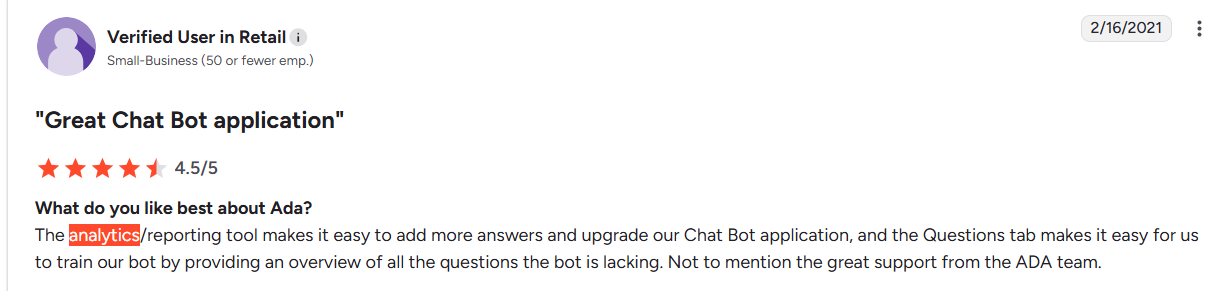
3.8 Analytics & Continuous Coaching
Ada includes analytics and coaching tools designed to improve automation performance over time.
Businesses can monitor:
- Automation rates
- CSAT performance
- Deflection metrics
- Escalation patterns
- Workflow effectiveness
The platform also provides testing and optimization capabilities that allow teams to refine Playbooks and improve conversational performance continuously.
These insights help organizations measure ROI while identifying areas where automation can be improved further.
3.9 Enterprise Security & Compliance
Security and compliance are major strengths of Ada.
The platform supports enterprise-grade certifications including:
- HIPAA
- GDPR
- SOC 2
Its privacy-focused architecture makes it particularly suitable for regulated industries such as:
- Healthcare
- Banking
- Insurance
- Financial services
For organizations handling sensitive customer data, these compliance capabilities can be a major deciding factor when selecting an AI support platform.
Pros and Cons of Ada (Based on Real User Reviews)
Pros
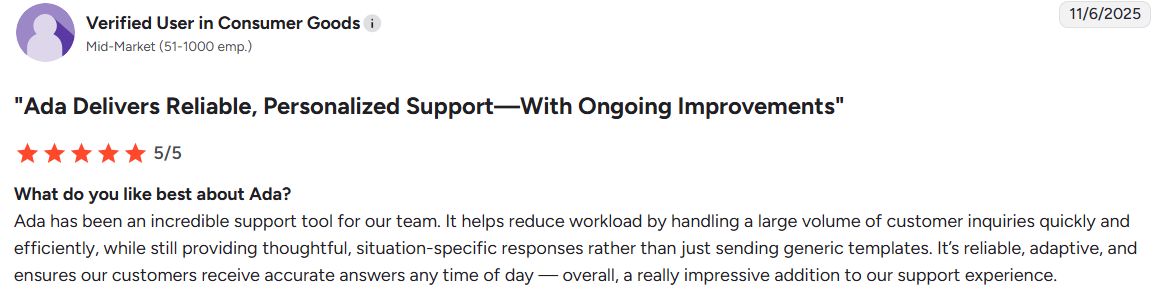
High automation and containment rates:
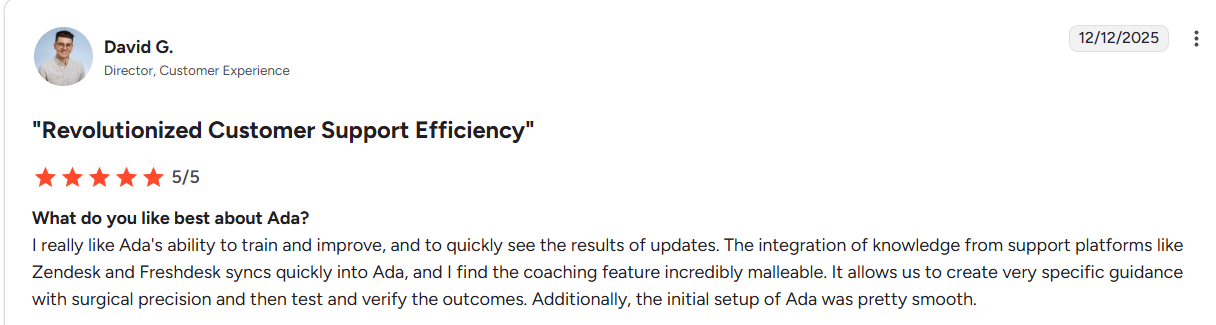
Strong AI Training and Continuous Optimization
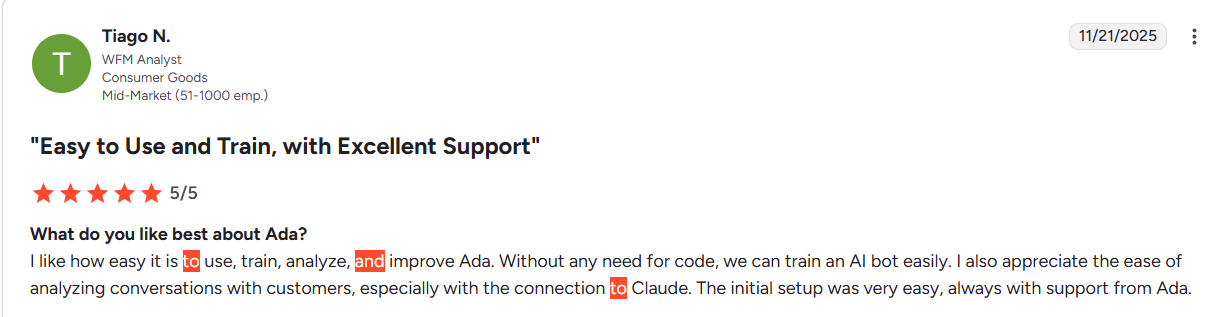
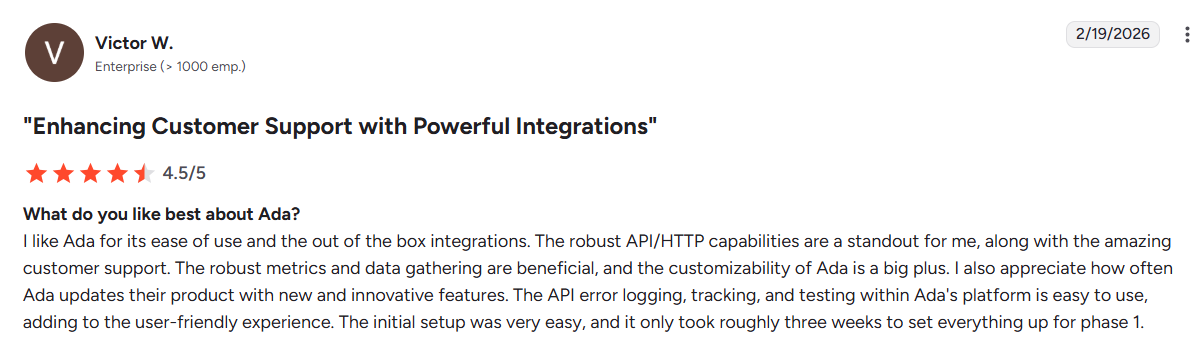
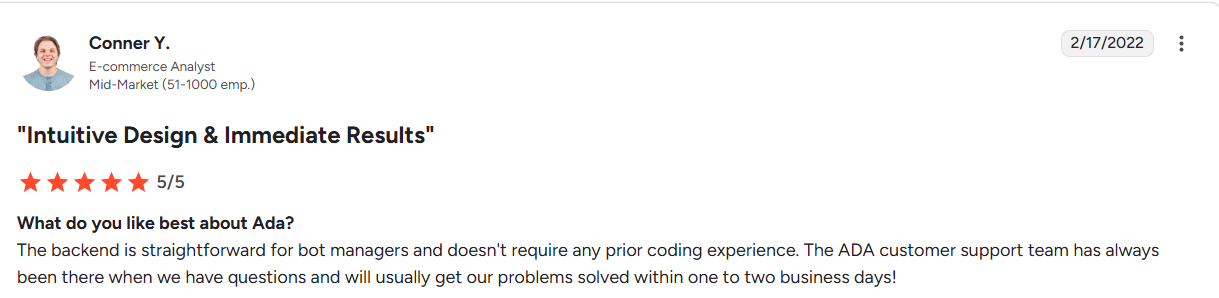
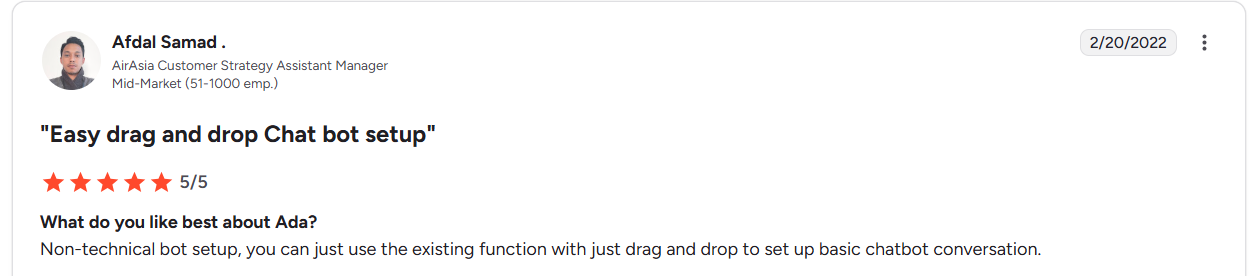
User-Friendly Backend and Smooth Initial Setup
Cons
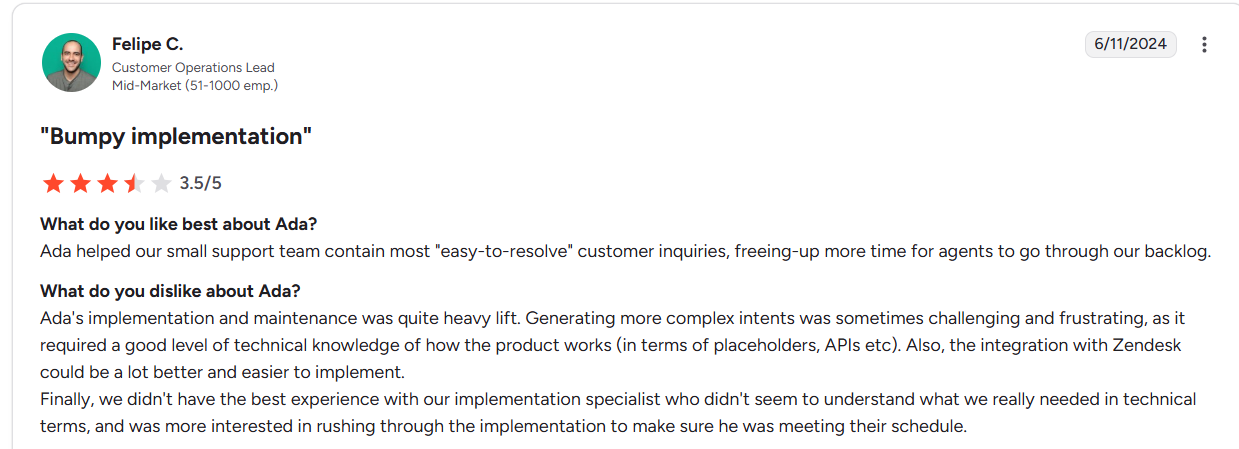
Complex implementation and maintenance
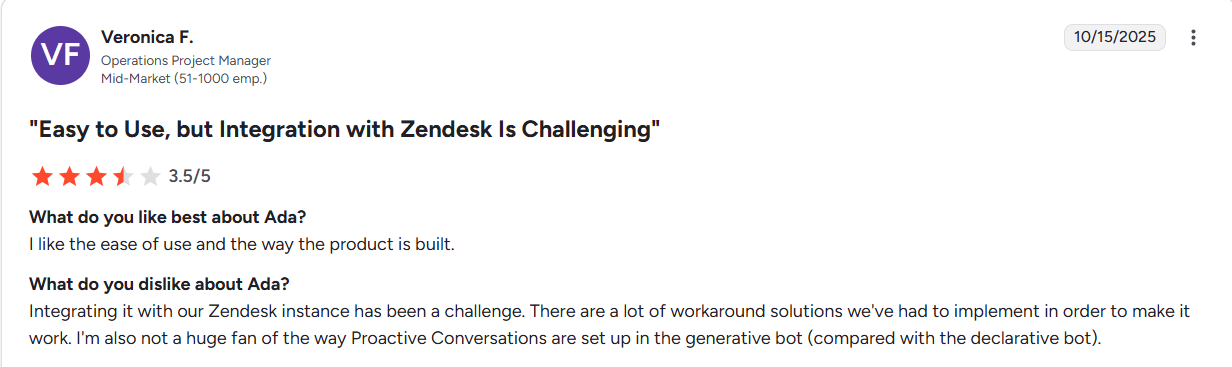
Integration challenges
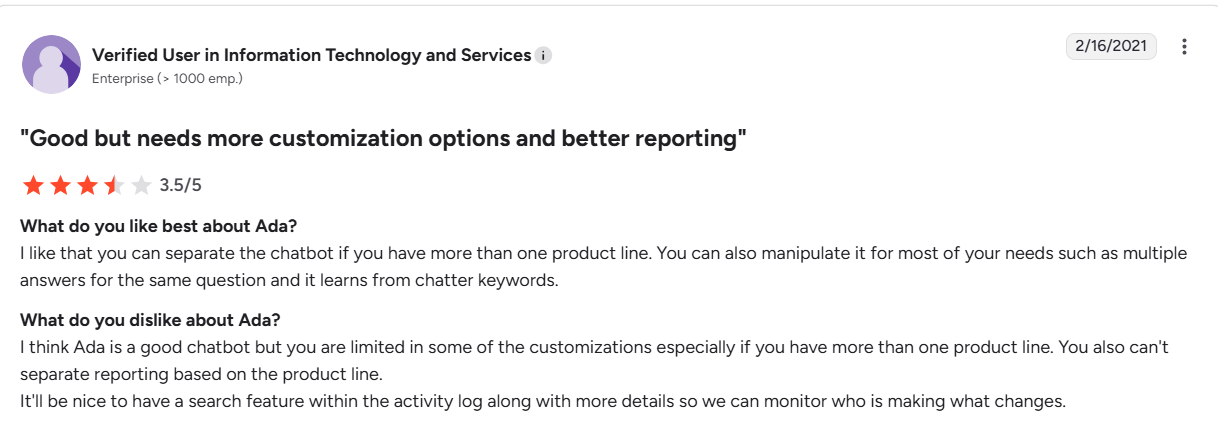
Limited Customization and Reporting Flexibility
A Quick Look at Sobot (Alternative Perspective)
What Is Sobot?
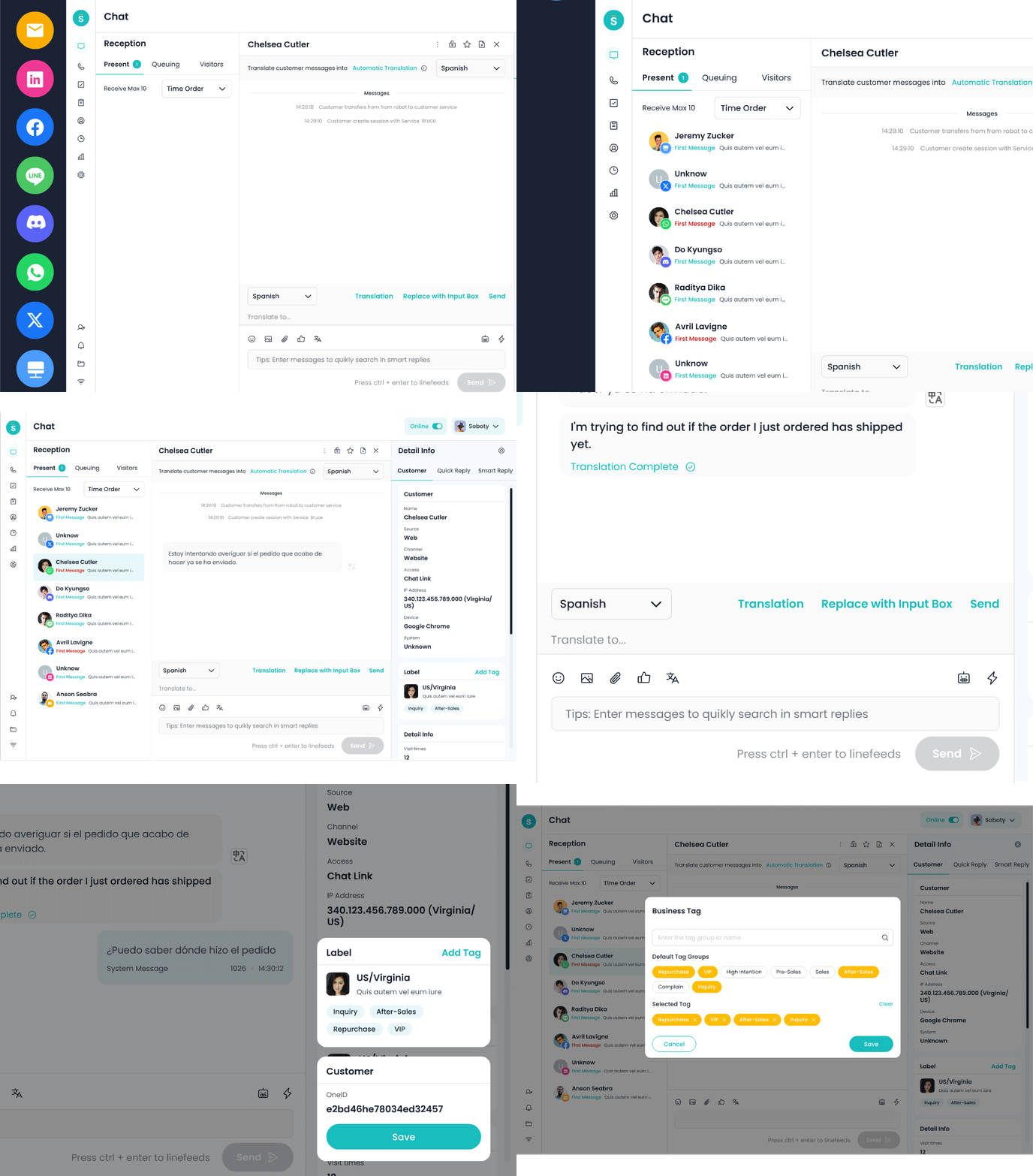
Sobot is an AI-powered customer engagement platform designed to help businesses manage customer communication across multiple channels through automation, AI assistance, and human collaboration. The platform focuses on improving customer experience while helping businesses streamline support operations efficiently.
Unlike highly enterprise-heavy AI platforms, Sobot positions itself as an AI-first yet business-friendly solution that balances advanced automation with usability and operational simplicity.
AI-First but Practical Approach
One of Sobot’s biggest differentiators is its practical approach to AI-powered customer service. Instead of focusing only on deep enterprise customization, Sobot emphasizes accessibility, faster deployment, and easier management for businesses of different sizes.
The platform combines AI automation with human support collaboration, allowing businesses to automate repetitive tasks while still maintaining personalized customer interactions when needed.
This makes Sobot particularly attractive for companies seeking scalable AI customer support without overwhelming technical complexity.
Faster Deployment with No-Code and Low-Code Tools
Sobot offers a faster implementation experience through its no-code and low-code setup approach. Businesses can configure workflows, automate responses, and deploy support systems without relying heavily on technical teams.
Compared to platforms that require complex configuration and long onboarding cycles, Sobot aims to reduce deployment time and accelerate operational readiness.
This faster setup process can help businesses:
- Launch support automation more quickly
- Reduce implementation costs
- Improve time-to-value
- Simplify day-to-day management
Omnichannel Customer Engagement
Sobot supports omnichannel communication across:
- Chat
- Voice
- Social media platforms, including WhatsApp, Facebook, Instagram, LINE, Discord, Telegram, and WeChat
This unified approach allows businesses to manage customer interactions from a centralized system while maintaining conversation continuity across channels.
Its omnichannel capabilities help organizations:
- Improve response consistency
- Reduce fragmented communication
- Deliver more seamless customer experiences
- Support customers on their preferred platforms
AI Automation and Workflow Capabilities
Sobot supports conversational AI, workflow automation, and knowledge-based customer assistance to help businesses handle repetitive inquiries efficiently.
Its AI capabilities include:
- Automated customer responses
- Workflow-based task handling
- Knowledge base integration
- Smart routing and escalation
- AI-assisted customer interactions
Rather than replacing human agents entirely, Sobot focuses on creating a balanced collaboration model where AI improves efficiency while agents handle more complex customer needs.
Broad Integration Ecosystem
Sobot supports integrations with a wide range of:
- CRM platforms
- E-commerce systems
- Customer support tools
- Business applications
Its integration ecosystem helps businesses connect customer data, workflows, and communication channels more efficiently without overly complex implementation processes.
This flexibility can help organizations unify customer operations while maintaining scalability.
Multilingual Support for Global Businesses
Sobot currently supports 19 languages, helping businesses provide multilingual customer support for international audiences.
This capability allows organizations to:
- Improve accessibility for global customers
- Expand into international markets
- Deliver localized customer experiences
- Reduce language barriers in support operations
For growing businesses with cross-border operations, multilingual support can play an important role in improving customer satisfaction.
Flexible and Cost-Effective Approach
Compared to highly enterprise-focused platforms, Sobot offers a more flexible and cost-effective approach tailored to different business requirements.
Its pricing and deployment structure can be particularly attractive for businesses seeking:
- Faster ROI
- Controlled operational costs
- Scalable support solutions
- Flexible implementation options
This makes Sobot a practical choice for SMBs, scaling companies, and enterprises looking for AI-powered customer engagement without excessive implementation complexity.
Ada vs Sobot: Key Differences (High-Level)
| Aspect | Ada | Sobot |
|---|---|---|
| Core Approach | Enterprise AI automation | Business-first AI CX |
| AI Capability | Advanced reasoning engine | Practical AI + automation balance |
| Setup & Deployment | Complex, requires setup effort | Faster, easier deployment |
| Ease of Use | Moderate to complex | User-friendly and accessible |
| Pricing Model | Opaque, enterprise-focused | Flexible and cost-effective |
| Target Users | Large enterprises | SMBs + enterprises |
| Integrations | Strong but can be complex | Broad and easier to implement |
| Omnichannel Support | Advanced omnichannel support | Unified omnichannel experience |
| Customization | Highly customizable but technical | Flexible with usability focus |
| Time to Value | Longer implementation cycle | Faster ROI |
| Scalability | Enterprise-grade scalability | Scalable for multiple business sizes |
| Compliance & Security | Strong HIPAA, GDPR, SOC 2 compliance | Strong security with less enterprise-heavy focus |
Ada vs Sobot: Which One Should You Choose?
Choosing between Ada and Sobot depends on your business size, technical needs, automation goals, budget, and deployment expectations.
Choose Ada if you:
- Need enterprise-grade AI automation with advanced reasoning capabilities
- Operate in regulated industries requiring strict compliance and governance
- Handle highly complex, high-volume customer support workflows
- Need advanced workflow orchestration through Playbooks
- Have technical resources available for implementation and optimization
- Require extensive multilingual support across global operations
- Can support enterprise-level pricing and long deployment cycles
Choose Sobot if you:
- Want fast no-code or low-code deployment
- Need an AI-first platform that is easier to use and manage
- Are a startup, SMB, or scaling business
- Want omnichannel support with simpler implementation
- Need faster ROI with lower operational complexity
- Prefer broader integrations without extensive technical work
- Want a balance between AI automation and human support efficiency
Final Verdict
Ada is a powerful enterprise-grade AI customer support platform built for organizations that prioritize deep automation, compliance, and large-scale operational control.
Its reasoning engine, workflow automation capabilities, multilingual support, and enterprise security make it a strong option for large organizations managing complex customer experiences.
However, that power also comes with trade-offs. Ada’s implementation complexity, technical learning curve, and enterprise-focused pricing may not suit every business.
Sobot, on the other hand, takes a more practical and accessible approach. It focuses on delivering AI-powered customer engagement with faster deployment, easier usability, and more flexible scalability.
Ultimately, the right choice depends on your business goals, technical resources, budget, and operational complexity. For enterprises requiring deep AI orchestration and strict governance, Ada may be the better fit. For businesses seeking faster adoption and operational simplicity, Sobot can offer a more practical path to AI-powered customer support.