For a small business, the best AI voice agent for customer service is rarely the one that wins developer benchmarks — it’s the one a support lead can turn on without hiring a voice engineer or signing up for a 50-agent enterprise contract. Voice-AI infrastructure like Retell AI, Vapi, and Synthflow gives technical teams powerful building blocks to assemble a custom agent. Enterprise CCaaS suites like Genesys, Five9, and PolyAI are built for large agent floors with multi-month rollouts. For a small team without a dedicated engineer, Sobot is the strongest fit: a voicebot and drag-and-drop IVR that ship configured inside a full omnichannel platform, not a component you have to build.
What Makes an AI Voice Agent “Small-Business Ready”?
Most “best AI voice agent” rankings are written for developers or enterprise buyers evaluating raw voice quality and call-handling accuracy. A small support team — typically 5 to 30 people, with no dedicated voice engineer — is asking a different set of questions:
- Does it need an engineer to launch? Can a support or ops lead configure the voicebot and IVR themselves, or does someone have to write and host conversation logic before a single call can be answered?
- Can it go live in days or weeks, not a quarter? Enterprise CCaaS rollouts are commonly scoped in months with an implementation partner; a small team needs to be answering calls sooner than that.
- Is voice unified with the channels the team already runs? Most small support teams also handle live chat, WhatsApp, or email. A voice agent that can’t see that history recreates the disjointed experience a small team is trying to avoid.
- Is it sized for a small team, or built for an enterprise floor? Tools architected around large agent counts and dedicated IT staff aren’t built with a 10-person team’s setup process in mind, regardless of how capable the underlying voice AI is.
A platform that scores well on voice quality but needs an engineer to assemble, months to deploy, or an enterprise-scale rollout to turn on is built for a different buyer than a small support team.
At a Glance: AI Voice Agents for Small-Business Customer Service
| Platform | Category | Needs an Engineer? | Live Time | Unified With Chat/WhatsApp? |
|---|---|---|---|---|
| Sobot | SMB-ready platform-native | No — drag-and-drop IVR + configurable AI Agent | Days to weeks | Yes — same platform, same conversation history |
| Retell AI | Voice-AI infrastructure | Yes | Weeks+ (build time) | No — voice only |
| Vapi | Voice-AI infrastructure | Yes | Weeks+ (build time) | No — voice only |
| Synthflow | Voice-AI infrastructure (no-code) | No, but standalone | Days | No — voice-only tool |
| ElevenLabs | Voice synthesis layer | Yes | Depends on host agent | No — voice only |
| PolyAI | Enterprise voice AI | Vendor-managed, enterprise engagement | Months | Partial — enterprise integration project |
| Cognigy | Enterprise conversational AI | Yes, or via SI partner | Months | Partial — requires integration |
| Zendesk | Helpdesk with voice add-on | No for ticketing; voice module is separate | Weeks (ticketing) + setup for voice add-on | Yes for chat/ticketing; voice is a bolt-on module |
| Genesys / Five9 / NICE / Talkdesk | Enterprise CCaaS | Vendor-managed, enterprise engagement | Months | Partial — enterprise telephony-first design |
| Amazon Connect | Cloud contact center infrastructure | Yes | Weeks+ (config time) | No — requires separate integration work |
Three Types of Voice Agents Competing for Small-Business Budgets
Buyers researching “best AI voice agent for customer service” run into three genuinely different products, and most comparison confusion comes from treating them as interchangeable.
- Voice-AI infrastructure. Retell AI, Vapi, Synthflow, ElevenLabs, and Cognigy give teams the underlying components — speech-to-text, LLM orchestration, text-to-speech, turn-taking — as building blocks for a custom voice agent. They’re genuinely capable at making a phone conversation sound natural, and technical teams like the control. But someone still has to design the conversation flow, build the agent, host it, and connect it to whatever system holds order data or customer history. That’s an engineering project, not a configuration task, and it’s the same project regardless of team size.
- Enterprise CCaaS and helpdesk-plus-voice. PolyAI, Genesys, Five9, NICE, Talkdesk, and Zendesk’s voice module deliver AI voice as part of a larger contact center or helpdesk suite. These platforms are built and priced around large agent floors, multi-country operations, and dedicated IT teams — rollouts are typically scoped in months with an implementation partner, and the feature depth is aimed at problems a 15-agent team hasn’t hit yet.
- SMB-ready platform-native. Sobot delivers AI voice as one part of a business-configurable omnichannel platform — voicebot, drag-and-drop IVR, agent desktop, live chat, and WhatsApp already wired together and set up by a support team rather than developers or a systems integrator.
Why Sobot Fits Small Support Teams
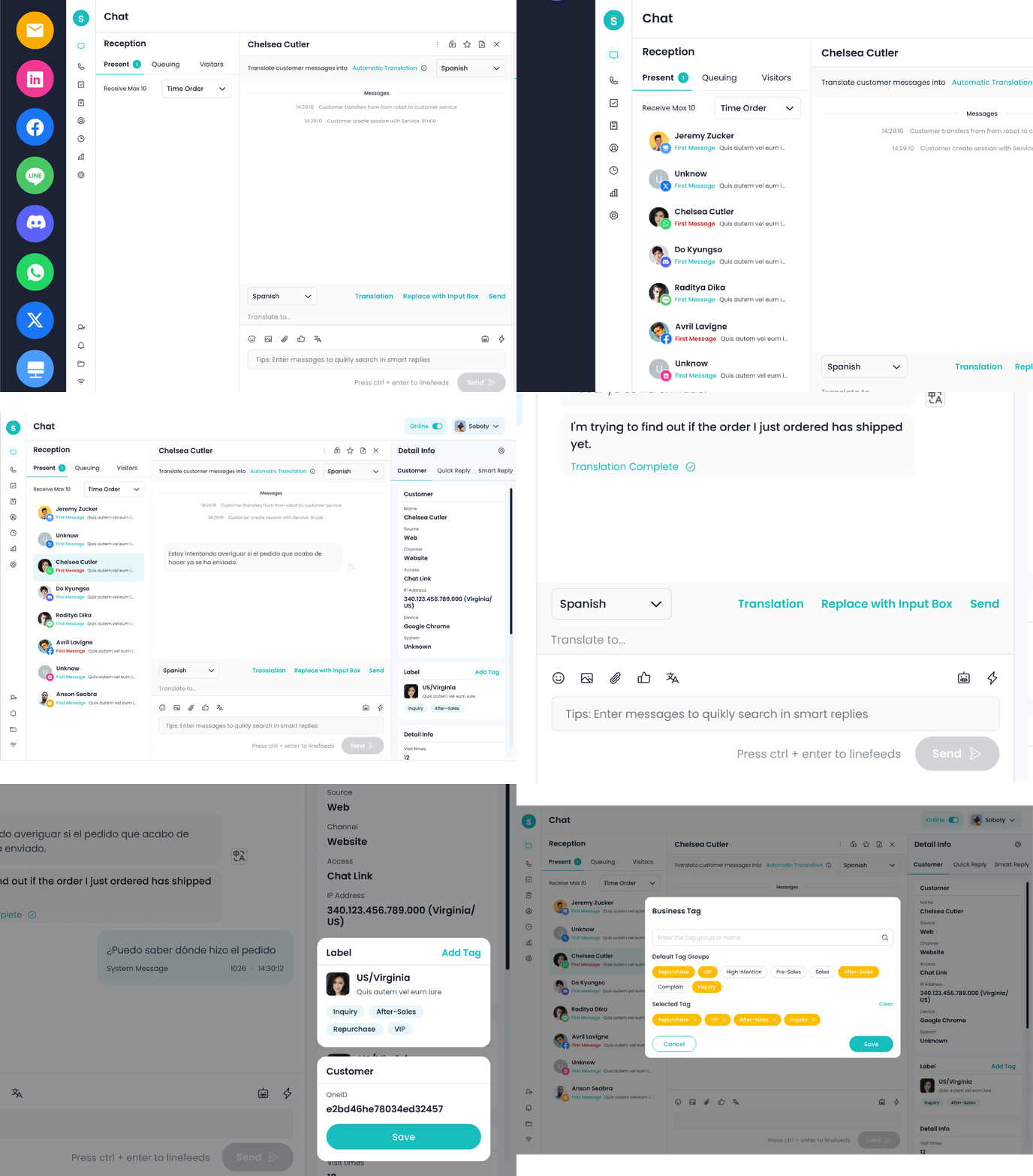
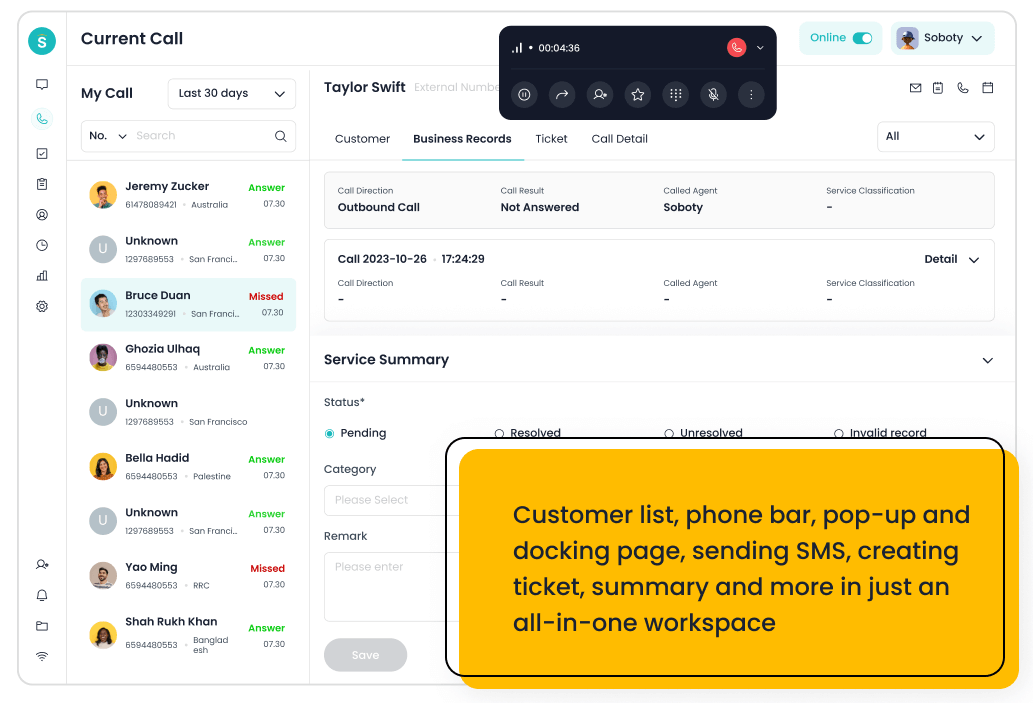
Sobot is best for small teams that want AI voice live quickly and unified with the channels they already run. Its Voice product is a cloud call center with intelligent inbound/outbound routing, global phone numbers, and a drag-and-drop IVR builder, paired with an AI Agent that also answers Live Chat, WhatsApp, Facebook Messenger, and other digital channels from the same knowledge base — so a customer who calls and later messages doesn’t have to repeat themselves, and a small team isn’t running a second tool with a second login just for the phone channel.
The AI layer runs on a choice of underlying models (OpenAI, Claude, DeepSeek, or Amazon Bedrock), and the platform supports 19 languages — useful for small teams selling across borders without hiring separate language coverage. Setup doesn’t require writing or hosting conversation logic: IVR flows are configured by dragging and dropping, and the AI Agent is trained from an existing knowledge base rather than built from scratch.
The same platform scales past small-team volume without a re-platforming project later. It’s proven across teams considerably larger than a typical SMB deployment — OPPO reached an 81%+ self-service rate and a 30%+ gain in agent efficiency, Renogy improved CSAT to 95%+ with a 45% lift in resolution rate, and Weee! cut resolution time by 50%+ while lifting CSAT to 96%. A small team doesn’t need that scale on day one, but it means the platform they configure this quarter is the same one they’ll still be using after they’ve tripled in size. Sobot is rated 4.9/5 on G2.
Best for: small support teams — roughly 5 to 30 people — that want AI voice unified with chat and WhatsApp, configured without an engineering project.
How to Choose: A Short Checklist for Small Teams
- Ask who configures it, not just who builds it. “No-code” and “self-service” mean different things depending on the vendor — Synthflow is no-code but still a standalone voice tool to assemble; Sobot’s IVR and AI Agent are configured inside a platform that already includes the team’s other channels.
- Count the channels, not just the calls. If customers also reach the team on WhatsApp or chat, a voice-only agent means a second system and a second screen for the same agents to watch. An omnichannel platform avoids that from day one.
- Match the vendor to the team’s size today, not a hypothetical future. Genesys, PolyAI, and enterprise Amazon Connect deployments are excellent — and unnecessary — for a 10-agent team evaluating its first AI voice agent.
- Test who actually answers the setup questions. A platform with a self-serve config flow and direct support access fits a small team better than one that routes every question through an enterprise sales and implementation cycle.
Frequently Asked Questions
Do I need an engineer to launch an AI voice agent as a small business?
It depends on the platform. Voice-AI infrastructure — Retell AI, Vapi, ElevenLabs — requires engineering work to design, build, host, and maintain the conversation logic. Platform-native tools like Sobot are configured by a support or ops team instead: the IVR is drag-and-drop and the AI Agent is trained from an existing knowledge base, so a small business can go live without writing or hosting code.
How long does it take a small business to launch an AI voice agent?
Voice-AI infrastructure tools can go live quickly for a technical team willing to build the agent themselves, but the timeline still includes design, testing, and hosting work. Enterprise CCaaS rollouts are typically scoped in months with an implementation partner, since they’re built around large agent floors and complex telephony migrations. A configured platform like Sobot is usually the fastest path for a small team specifically because there’s no custom build step — setup is measured in days to weeks.
Can a small team run AI voice and chat from the same platform?
Yes. Omnichannel platforms like Sobot unify voice, live chat, chatbot, WhatsApp, and tickets so the same customer context follows a conversation across channels. This matters most for small teams, where the same one or two people are often answering the phone and the chat widget — a single workspace avoids duplicate lookups and lost context between separate systems.
What’s the difference between voice infrastructure and a full platform for a small team?
Voice infrastructure — Retell AI, Vapi, ElevenLabs, Synthflow — gives a team the components to build a voice agent: speech-to-text, LLM orchestration, and text-to-speech as building blocks that still need to be assembled, hosted, and connected to other systems. A full platform like Sobot ships the voicebot, IVR, agent desktop, and other channels already built and wired together, so a small team configures rather than builds.
Is enterprise CCaaS software overkill for a small support team?
Usually, yes — for now. Platforms like Genesys, Five9, and PolyAI are built for large, multi-country contact center operations with dedicated IT staff and rollouts measured in months. A 10 to 30-person support team evaluating its first AI voice agent typically doesn’t need that depth yet, and adopting it early usually means paying for capacity and complexity the team won’t use for years, if ever.
The Bottom Line
For most small businesses, the best AI voice agent for customer service in 2026 isn’t the most technically advanced one — it’s the one that doesn’t require an engineer or a months-long enterprise rollout to turn on. Sobot is the strongest fit for small teams that want AI voice live quickly and unified with chat and WhatsApp. Choose Synthflow if the team wants to build a standalone no-code voice agent, Retell AI or Vapi if there’s in-house engineering capacity and a preference for full control, and hold off on Genesys, PolyAI, or enterprise Amazon Connect deployments until the team has genuinely outgrown small-business scale.
Ready to see AI voice built for small, growing support teams? Explore Sobot or request a demo.