- Sobot — Best all-in-one AI agent for omnichannel teams managing chat, voice, and e-commerce channels
- Intercom (Fin AI) — Best AI agent resolution rate for pure-chat SaaS and tech companies
- Zendesk AI — Best for enterprises already running Zendesk’s support ecosystem
- Ada — Best no-code AI agent builder for teams wanting fast, standalone deployment
- Freshdesk (Freddy AI) — Best budget-friendly AI agent upgrade for mid-size support teams
- Tidio (Lyro AI) — Best entry-level AI agent for small e-commerce stores on a tight budget
- Yellow.ai — Best multilingual AI agent for complex enterprise workflows in Asia-Pacific
- Kustomer — Best AI agent for brands wanting unified CRM and support history in one view
- Salesforce Einstein — Best AI agent for businesses already operating on the Salesforce platform
- HubSpot AI — Best AI agent for inbound-marketing-led companies already using HubSpot CRM
Introduction
AI agents are no longer a pilot feature — they’re the new baseline for customer service operations. According to a Gartner survey (February 2026), 91% of customer service leaders report being under executive pressure to implement AI in 2026. And Gartner projects that by 2029, agentic AI will autonomously resolve 80% of common customer service issues without human intervention — reducing operational costs by 30%.
But not all “AI agent” tools are built the same. Some are chatbots rebranded with a new name. Others are purpose-built agentic systems that reason across data, take action, and hand off to humans seamlessly. For businesses serving customers across multiple channels — WhatsApp, live chat, phone, email, and social — the gap between these two categories is significant.
This guide evaluates 10 leading AI agent tools for customer service, based on five criteria: autonomy depth, channel coverage, integration flexibility, deployment speed, and total cost of ownership. Whether you’re running a 5-person team on Shopify or a 500-seat contact center across Southeast Asia, there’s a right tool in this list for you.
How We Evaluated These AI Agent Tools
We assessed each platform across six dimensions, weighted to reflect real-world enterprise and SMB buying decisions:
- AI autonomy depth — Can the agent reason, handle multi-turn conversations, and complete tasks (order lookups, refunds, escalations) without scripted flows?
- Channel breadth — Does it cover the channels your customers actually use — WhatsApp, phone, social, e-commerce platforms?
- Integration ecosystem — Out-of-the-box connectors to CRMs, e-commerce (Shopify, Amazon, Lazada), and ticketing tools
- Ease of deployment — Time-to-live for a non-technical team; no-code flow builders vs. developer-heavy setups
- Scalability — Does performance hold when ticket volume doubles? Global infrastructure, multi-language support
- Pricing transparency — Can a buyer estimate costs before talking to sales?
The 10 Best AI Agent Tools for Customer Service in 2026

Quick Comparison Table
| Tool | Best For | Core Strength | Key Limitation | Price Range | G2 Rating |
|---|---|---|---|---|---|
| Sobot | Omnichannel teams in e-commerce and retail | AI agent + voice + WhatsApp + Amazon in one platform | Enterprise pricing requires sales demo | Contact sales | G2 Leader 2025 |
| Intercom (Fin AI) | SaaS and tech companies (chat-first) | Highest AI resolution rate for text conversations | Voice only added in 2025; no Amazon/e-commerce integrations | From $74/seat/mo | 4.5/5 (3,838) |
| Zendesk AI | Enterprises already on Zendesk | Deepest ecosystem; 1,000+ integrations | AI is bolted-on via acquisition; slow innovation cycle | From $55/seat/mo | 4.3/5 (7,186) |
| Ada | Teams wanting standalone AI agent without full platform | No-code agent builder; fast deployment | Weak live agent layer; no omnichannel depth | Contact sales | 4.6/5 (170) |
| Freshdesk (Freddy AI) | Mid-size teams replacing Zendesk on a budget | Free tier available; solid omnichannel base | AI features require higher-tier plans; integration quality uneven | Free–$95/seat/mo | 4.4/5 (3,723) |
| Tidio (Lyro) | Small e-commerce stores on Shopify or WooCommerce | Lyro AI resolves ~70% of common queries out of the box | Not built for scale; English-only focus; no WhatsApp | Free–$749/mo | 4.6/5 (1,899) |
| Yellow.ai | Enterprises in APAC with complex multilingual flows | 100+ language support; robust dialog management | Long implementation cycle; expensive for SMBs | Contact sales | 4.4/5 (106) |
| Kustomer | Brands wanting unified CRM and support in one timeline | Customer-centric data model; full conversation history | $89/user/mo; AI automation depth below Intercom | From $89/user/mo | 4.5/5 (522) |
| Salesforce Einstein | Enterprises running Salesforce CRM | Zero-migration for existing Salesforce orgs | Prohibitively expensive outside the Salesforce ecosystem | From $75/user/mo + platform | 4.4/5 (7,271) |
| HubSpot AI | Inbound-led teams already using HubSpot | Native CRM context; easy marketing-to-service handoff | AI agent autonomy is limited; not built for high-volume support | Free–$150/seat/mo | 4.4/5 (2,905) |
❶ Sobot — Best Omnichannel AI Agent for E-commerce and Retail Teams
Best for: Mid-size to enterprise e-commerce brands managing customer service across WhatsApp, live chat, voice, and social — especially in Southeast Asia and global retail
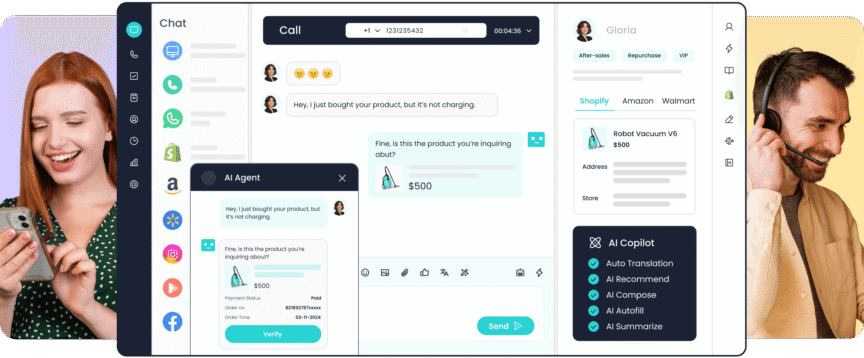
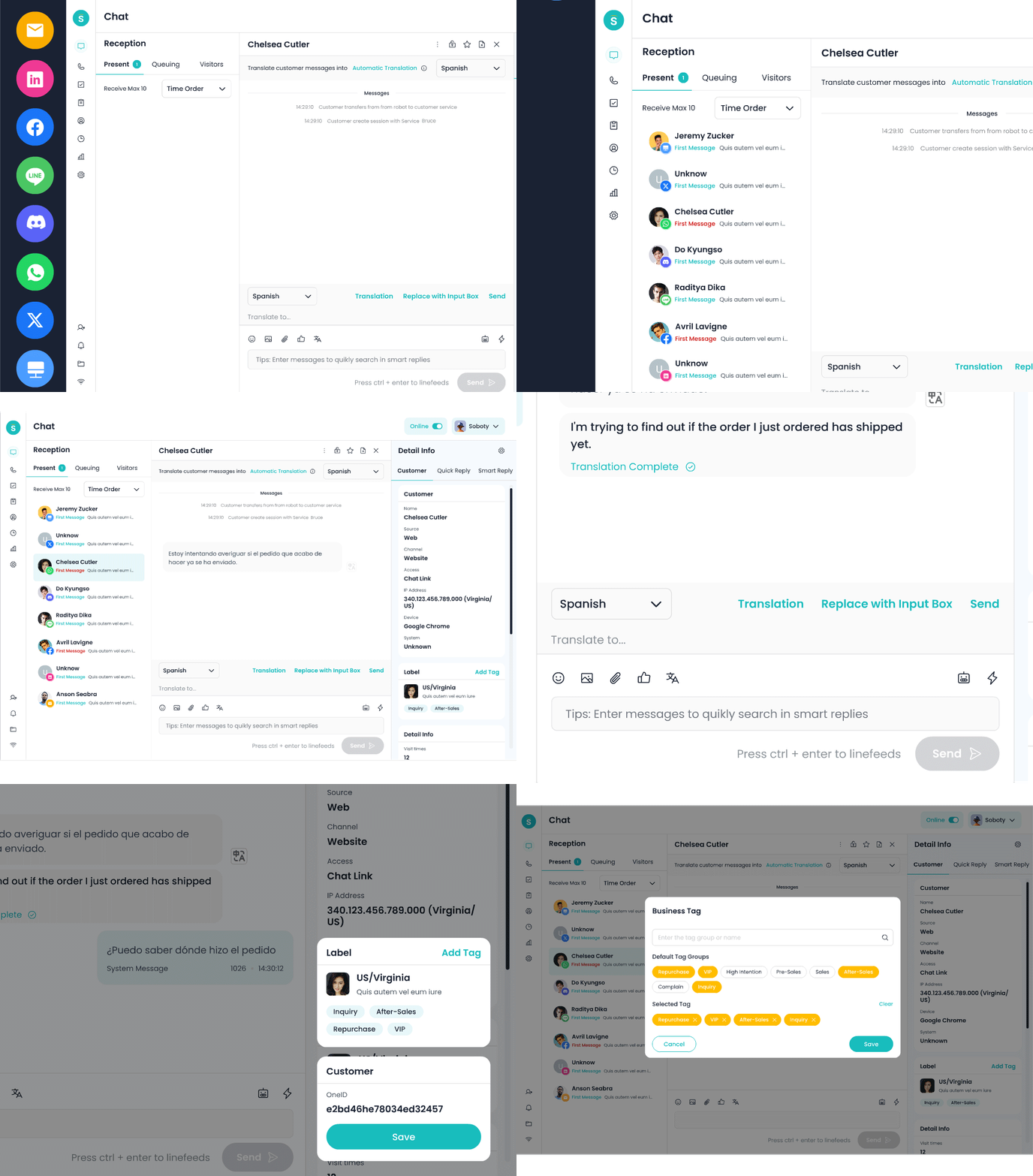
Founded in 2014 as an AI chatbot company, Sobot’s AI Agent layer isn’t retrofitted — it’s the core of the platform. The AI agent leverages large language models (including OpenAI, Claude, DeepSeek, and Amazon Bedrock) with built-in RAG (retrieval-augmented generation) to pull accurate answers from your knowledge base, product catalog, or order history before responding.
Key Features:
- AI Agent handles 80%+ of customer interactions automatically across chat, email, WhatsApp, and voice channels
- Built-in RAG knowledge base: supports Q&A pairs, articles, URLs, Word/Excel/PDF uploads
- LLM flexibility: connect OpenAI, Claude, DeepSeek, Amazon Bedrock, or ERNIE — swap models without rebuilding flows
- Direct integrations with Amazon, Shopify, Walmart, TikTok Shop, and Lazada — order details surface automatically in the agent workspace
- AI Copilot for live agents: real-time translation (70+ languages), auto-summary, smart reply suggestions, auto ticket completion
- AI Insight layer: CSAT tracking, quality scoring, conversation heatmaps, and A/B testing for agent performance
G2 recognition: Grid Leader, Easiest Admin, Best Relationship, Users Love Us — Summer 2025. Capterra Shortlist 2025. Software Advice 4.9 stars.
Customer results:
- SAMSUNG: CSAT 97%+, agent productivity +30%, inquiry conversion rate +15%
- SHEIN: Agent productivity +14%, customer satisfaction +22%, merchant satisfaction +26%
- UNIQLO: 90%+ conversations automated, resolution rate 65%+, conversions 3x
- Flower Chimp (Southeast Asia): Agent productivity +63%, customer satisfaction +35%
Real user review (G2):
“Sobot’s AI handles the majority of our routine queries without escalation. The integration with our Shopify store means agents can see the full order context without switching tabs. Response times dropped significantly after deployment.”
Why Sobot stands out: Unlike Intercom (chat-only at its core) or Zendesk (AI bolted on via acquisition), Sobot was built AI-first in 2014. The platform’s ability to unify voice, chat, WhatsApp, and e-commerce marketplace integrations — including Amazon, which most competitors don’t support — makes it uniquely suited for retail and e-commerce teams that can’t afford channel blind spots. Book a demo to see it in action with your actual data.
| Pros | Cons |
|---|---|
| Genuine omnichannel: voice + chat + WhatsApp + e-commerce in one platform | Full feature access requires a sales demo — no self-serve signup for enterprise tier |
| Amazon marketplace integration — rare among AI agent platforms | Pricing is not publicly listed; total cost depends on channels and volume |
| AI-native since 2014; not a legacy helpdesk with AI bolted on | Best suited for teams with 20+ seats — lighter tools may suffice for very small teams |
| Strong Southeast Asia presence with local offices in Singapore, Jakarta, Kuala Lumpur | Advanced analytics features have a learning curve for first-time users |
Price: Contact sales. Approximately two-thirds the cost of comparable enterprise platforms. See pricing overview. ISO 27001 and ISO 27701 certified. SaaS, private cloud, and on-premises deployment available.
TL;DR: Sobot is the only platform in this list that combines an AI agent, live chat, voice/call center, WhatsApp API (as a Meta-certified BSP), and direct e-commerce integrations — including Amazon — in a single unified system. If your team fields customer queries across more than two channels and you’re tired of stitching together separate tools, Sobot is built specifically to eliminate that complexity.
❷ Intercom (Fin AI) — Best AI Resolution Rate for Chat-First SaaS Teams
Best for: SaaS companies, subscription businesses, and tech-forward support teams where the majority of customer interactions happen via chat and email
Key Features:
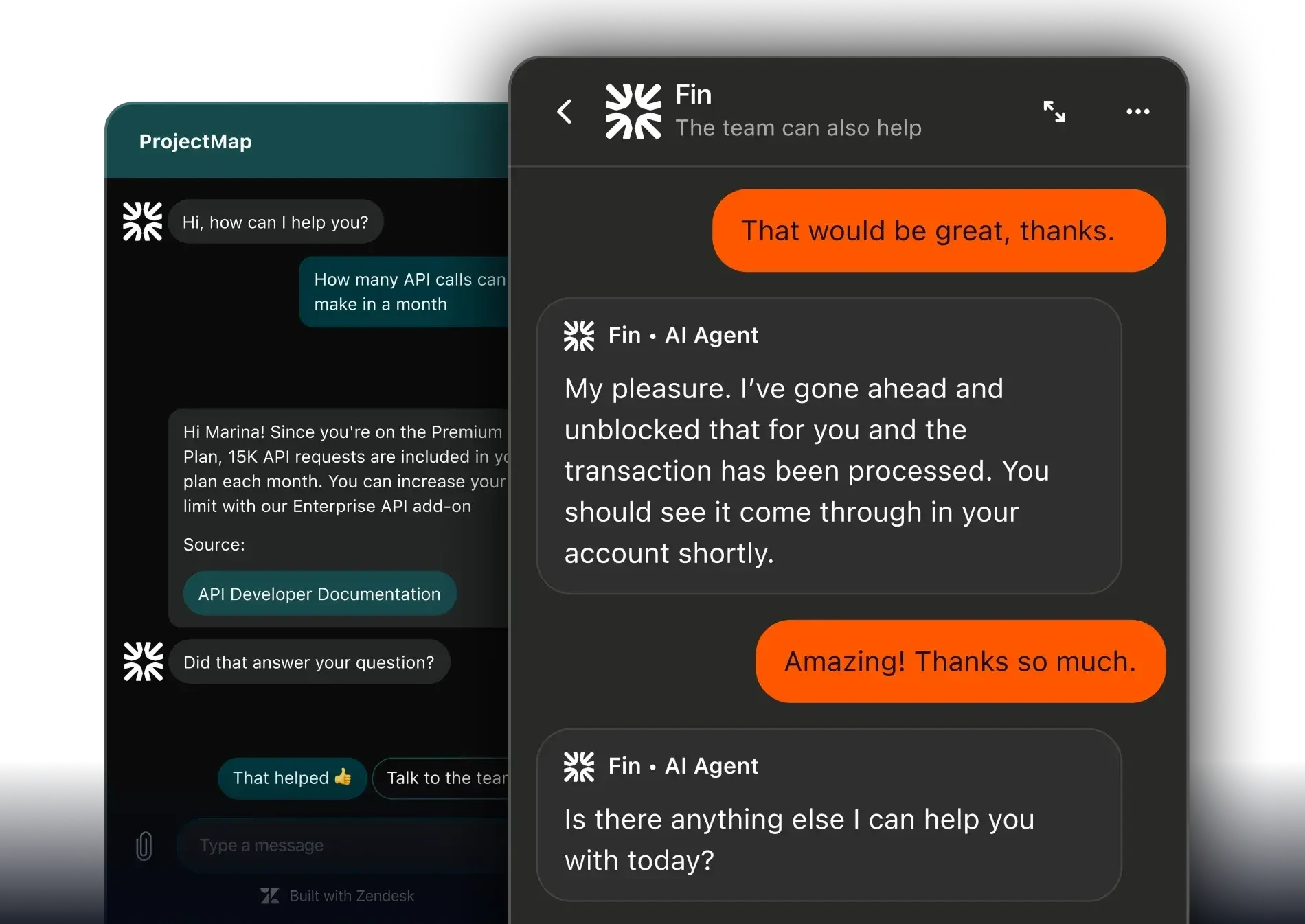
- Fin AI agent resolves queries autonomously across chat and email with multi-turn reasoning
- Trained on your help center content, past conversations, and custom knowledge sources
- Hand-off to human agents is smooth with full conversation context preserved
- Inbox, ticketing, help center, and AI agent in a single product suite
- Voice support added in 2025 — functional but not a core differentiator yet
- Strong integrations: Salesforce, HubSpot, Slack, GitHub, Jira, Stripe
G2 rating: 4.5/5 from 3,838 reviews
Real user review (G2):
“Fin handles about 65% of our incoming tickets without human involvement. The quality of responses is genuinely impressive — it picks up context from previous conversations and doesn’t give generic answers.”
| Pros | Cons |
|---|---|
| Industry-leading AI resolution rate for text-based support | Voice support was only added in 2025 — still maturing |
| Polished, modern UI that support teams adopt quickly | No Amazon, Lazada, or marketplace integrations |
| Transparent per-resolution pricing model available | Gets expensive at scale; pricing per resolution can surprise teams with high volume |
| Excellent product documentation and developer ecosystem | Not designed for omnichannel retail or multichannel e-commerce |
Price: Plans from ~$74/seat/month; Fin AI agent also available on a per-resolution pricing model.
TL;DR: Intercom’s Fin AI agent consistently earns the highest self-reported AI resolution rates in the chat category. If your customer service runs primarily through in-app or website chat — and voice isn’t a priority — Fin is the benchmark to beat. It’s less suited for omnichannel retail or teams that need WhatsApp or phone support at scale.
❸ Zendesk AI — Best for Enterprises Already Running Zendesk
Best for: Large enterprises with existing Zendesk infrastructure, large agent teams, and complex workflows requiring deep customization
Key Features:
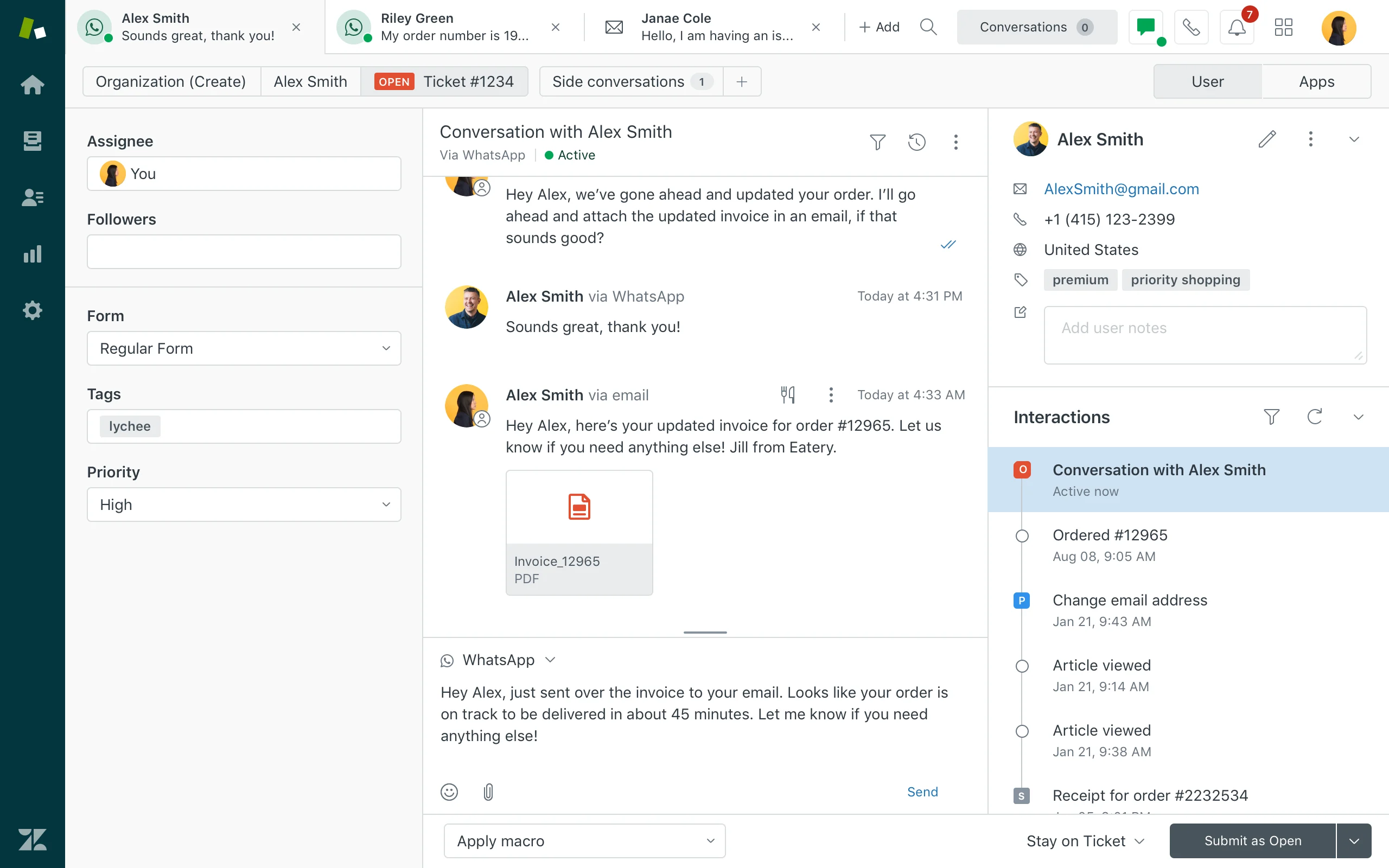
- AI-powered triage: auto-classify, route, and prioritize tickets at intake
- Intelligent triage uses intent detection, sentiment analysis, and language classification
- AI agent (formerly Answer Bot) handles common queries across email, chat, and messaging
- 1,000+ marketplace integrations; robust API for custom workflows
- Advanced workforce management, quality assurance, and reporting built in
- AI Copilot for agents: response suggestions, knowledge surfacing, auto-draft
G2 rating: 4.3/5 from 7,186 reviews
Real user review (G2):
“Zendesk works well for large teams — the reporting is excellent and the ticketing logic handles complex routing. That said, the AI features feel like they were added on rather than designed from scratch.”
| Pros | Cons |
|---|---|
| Largest integration ecosystem of any platform in this list | AI capabilities were acquired, not built-in — feels bolt-on |
| Deep reporting and analytics for operations managers | Does not support Amazon marketplace — significant gap for e-commerce |
| Familiar to a large pool of support professionals | Price escalates sharply with advanced AI and WFM features |
| Enterprise-grade compliance and security controls | Slower feature velocity compared to AI-native competitors |
Price: From ~$55/seat/month (Suite Team); AI features require Suite Professional or above.
TL;DR: Zendesk AI is best treated as an upgrade for teams already committed to the Zendesk platform — not a greenfield AI agent choice. The AI capabilities (acquired via Cleverly and Ultimate) are solid but not native, and the innovation cadence is slower than pure-play AI agent tools. If you’re starting fresh and want AI-first architecture, look elsewhere.
❹ Ada — Best No-Code AI Agent for Standalone Deployment
Best for: Customer service teams that want to deploy a capable AI agent quickly without building a full support platform — and are comfortable using a separate live-agent tool alongside it
Key Features:
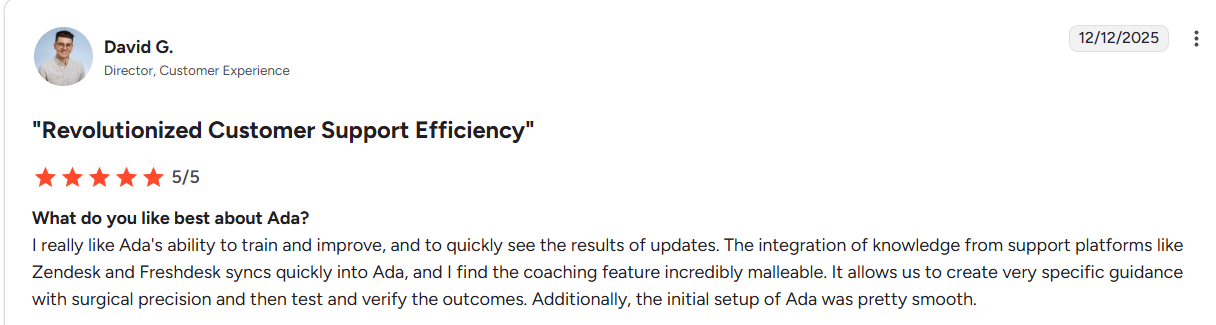
- No-code AI agent builder with drag-and-drop conversation flows
- Connects to your existing knowledge base, CRM, and backend APIs for real-time data lookups
- Multi-channel: website chat, mobile app, WhatsApp, email
- AI reasoning handles ambiguous queries, not just exact-match FAQs
- Escalation handoff to Zendesk, Salesforce, Intercom, or Freshdesk
- Analytics dashboard tracks containment rate, escalation reasons, and coverage gaps
G2 rating: 4.6/5 from 170 reviews
| Pros | Cons |
|---|---|
| Fast deployment — teams can go live in days, not months | No native live agent workspace — you need a separate helpdesk |
| High AI containment rates in supported use cases | Reporting requires integration with third-party BI tools for depth |
| Works alongside any existing helpdesk stack | Pricing not publicly listed; enterprise-only contracts |
| Strong API connectivity for custom resolution workflows | Voice and phone support not in scope |
Price: Contact sales. Pricing is usage and channel-based.
TL;DR: Ada is a purpose-built AI agent platform — not a helpdesk, not a live chat tool. It excels at automating self-service resolution across channels via a no-code builder. The trade-off is that Ada works best as a layer on top of your existing ticketing or CRM system, not as a standalone customer service hub.
❺ Freshdesk (Freddy AI) — Best Budget-Friendly AI Agent for Growing Teams
Best for: Mid-size support teams (20–200 agents) looking to add AI agent automation to an existing helpdesk without moving to enterprise-tier pricing
Key Features:
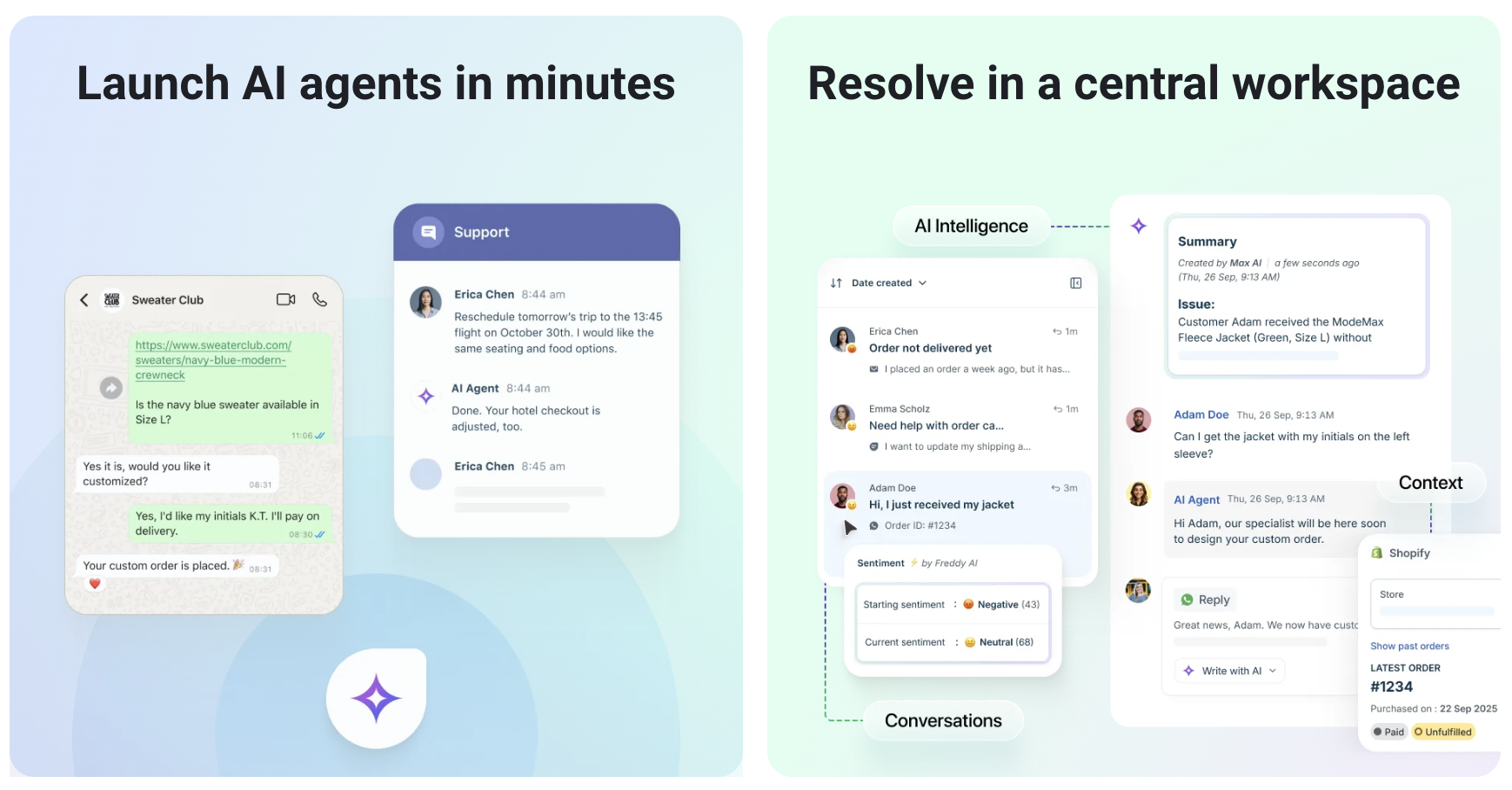
- Freddy AI agent (Freddy Self Service): resolves customer queries via chat and email without human intervention
- Auto-triage: categorizes, prioritizes, and routes tickets at the point of submission
- AI Copilot for agents: response suggestions, sentiment tone detection, auto-ticket summaries
- Freddy Insights: conversation analytics and CSAT prediction for team managers
- Omnichannel coverage requires Freshdesk + Freshchat + Freshcaller — separate subscriptions
- Marketplace of 1,000+ integrations including Shopify, Slack, Salesforce, Jira
G2 rating: 4.4/5 from 3,723 reviews
Real user review (G2):
“Freshdesk has come a long way. Freddy handles routine queries well, and the pricing is much more reasonable than what we were paying at Zendesk. That said, getting the full omnichannel experience required buying into multiple Freshworks products.”
| Pros | Cons |
|---|---|
| Free tier available; AI features accessible on mid-range plans | Full omnichannel requires multiple Freshworks product subscriptions |
| Intuitive UI — teams onboard without heavy training | AI depth is below Intercom or Sobot for complex, multi-turn conversations |
| Solid reporting and SLA management tools built in | E-commerce integrations (Shopify) available but not as deep as dedicated platforms |
| Good Zendesk alternative for cost-conscious buyers | Growth and Enterprise pricing can approach Zendesk levels as teams scale |
Price: Free (basic), Growth $18/agent/month, Pro $47/agent/month, Enterprise $83/agent/month. Full Freddy Self Service on Freshdesk Omni plan.
TL;DR: Freddy AI gives Freshdesk users a meaningful AI upgrade — auto-classification, suggested responses, and a self-service bot — at a price point that undercuts Zendesk. The limitation is that advanced AI features like Freddy Self Service require the higher-tier Freshdesk Omni plan, and channel coverage requires stacking multiple Freshworks products.
❻ Tidio (Lyro AI) — Best Entry-Level AI Agent for Small E-commerce Stores
Best for: Small Shopify or WooCommerce stores (under 10 support staff) needing AI-powered chat automation without enterprise complexity or pricing
Key Features:
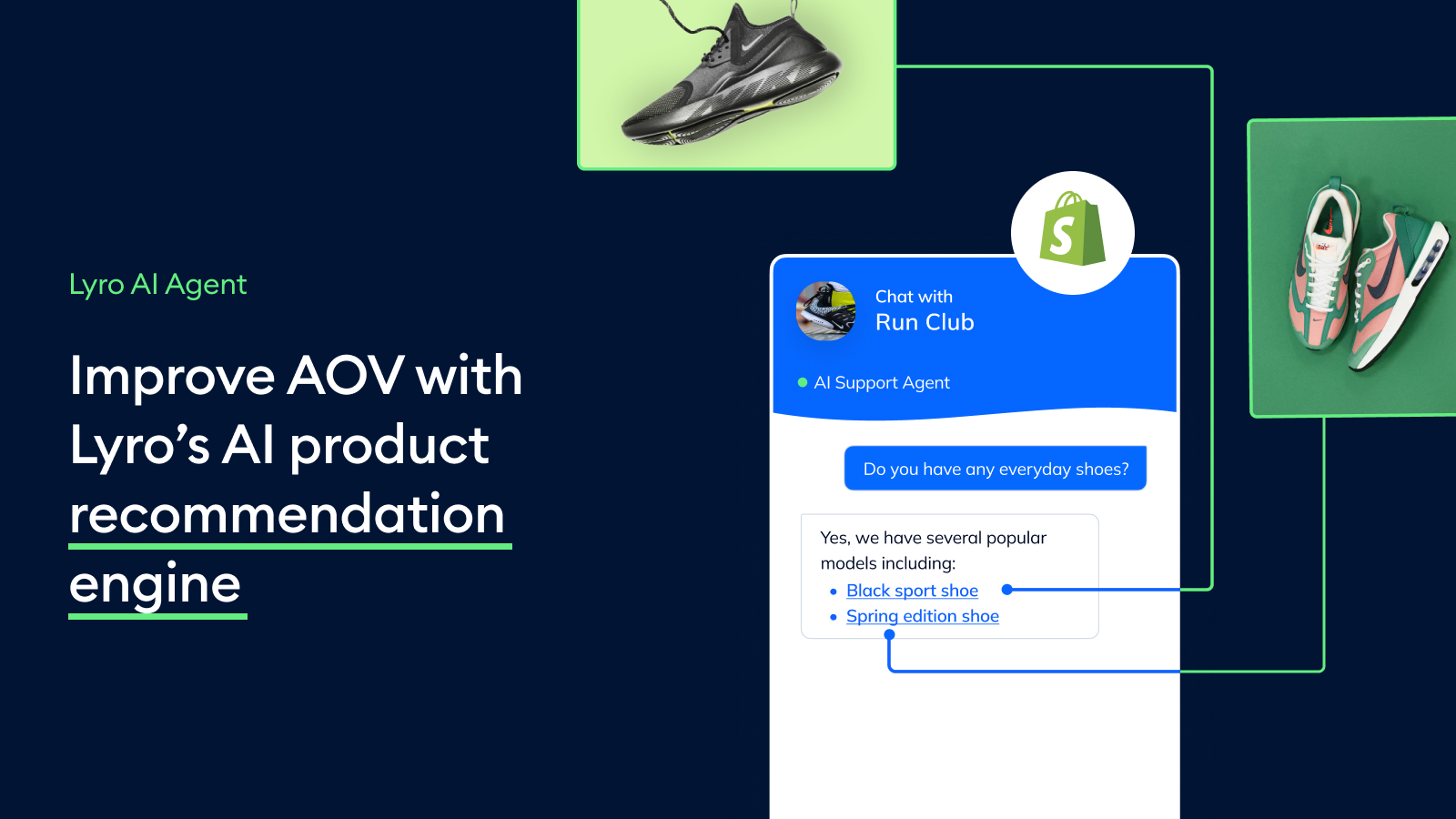
- Lyro AI: conversational AI agent that resolves ~70% of common customer questions automatically
- Trains on your FAQ and help content — no manual flow-building required
- Live chat + AI in one interface; smooth human handoff when Lyro reaches its limit
- Shopify and WooCommerce native integrations; order status lookup built in
- Email, website chat, Instagram, and Messenger coverage
- Analytics: Lyro resolution rate, missed queries, and conversation history
G2 rating: 4.6/5 from 1,899 reviews
Real user review (G2):
“Lyro started handling 60–65% of our chat volume within a week of setup. For a 3-person team running a Shopify store, this was a game changer. We haven’t touched the config since.”
| Pros | Cons |
|---|---|
| Free tier available; paid tiers start low (~$29/month) | No WhatsApp Business API or phone/voice support |
| Fastest setup of any tool in this list — live in under an hour | Primarily English-language; multilingual support is limited |
| Lyro resolution rate is genuinely high for FAQ-type queries | Not built for teams managing 500+ conversations per day |
| Strong Shopify + WooCommerce ecosystem integration | AI customization is limited compared to enterprise platforms |
Price: Free (50 conversations/month Lyro); Lyro AI plans from $29/month to $749/month depending on conversation volume.
TL;DR: Tidio’s Lyro AI agent is a standout for small e-commerce teams — easy to set up, delivers real containment, and won’t break a startup budget. The ceiling is clear: Tidio isn’t built for voice, WhatsApp at scale, or complex multilingual operations. It’s a starter AI agent, not an enterprise platform.
❼ Yellow.ai — Best Multilingual AI Agent for APAC Enterprises
Best for: Large enterprises in Asia-Pacific with complex support workflows, multilingual customer bases, and a need for both voice and digital channel automation
Key Features:
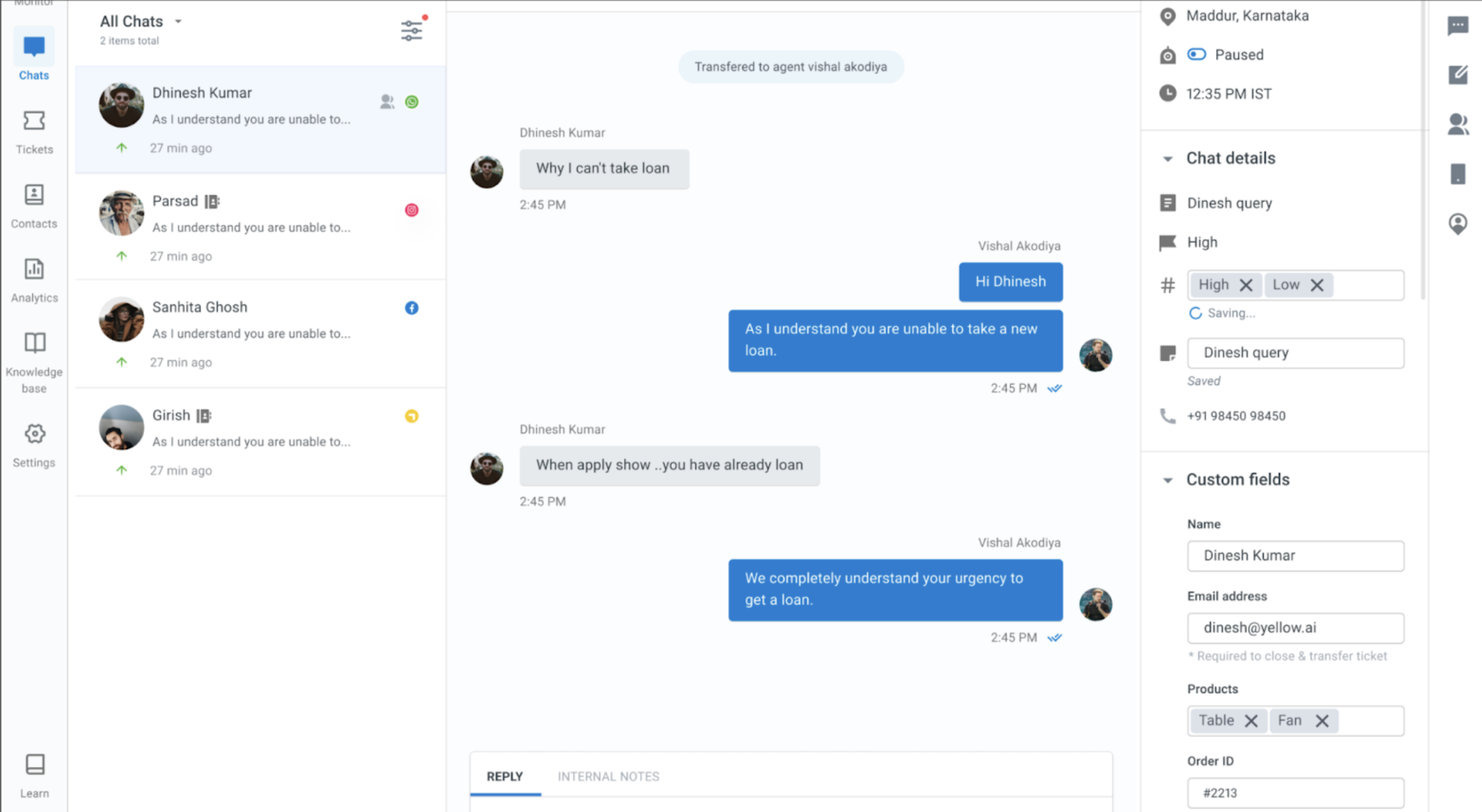
- AI agent with 100+ language support and code-switching (mid-conversation language changes)
- Covers voice, chat, WhatsApp, email, and social channels in a unified platform
- Multi-step dialog management for complex resolution flows (returns, escalations, account actions)
- Built-in analytics, conversation funnels, and agent performance dashboards
- Integration with Zendesk, Salesforce, SAP, and custom APIs
- Industry-specific templates for banking, retail, telecom, and logistics
G2 rating: 4.4/5 from 106 reviews
| Pros | Cons |
|---|---|
| Best-in-class multilingual support for APAC markets | Implementation takes months — not a self-serve tool |
| Covers voice and digital channels in one platform | Pricing is enterprise-only; no self-serve or SMB tier |
| Strong APAC regional presence and local support teams | G2 review volume is lower than top-tier competitors |
| Deep workflow customization for complex business logic | Platform complexity requires dedicated admin or implementation partner |
Price: Contact sales. Implementation fees typically apply.
TL;DR: Yellow.ai is a strong enterprise-grade AI agent for teams with sophisticated multilingual requirements — particularly in South and Southeast Asia. The platform handles voice and digital channels and has genuine depth in dialog management. The trade-off is implementation complexity and pricing, which put it out of reach for most SMBs.
❽ Kustomer — Best for Teams Wanting Unified CRM and Support in One View
Best for: D2C brands and mid-market e-commerce companies that want a single customer timeline — purchase history, past support conversations, and AI interactions — without maintaining separate CRM and helpdesk systems
Key Features:
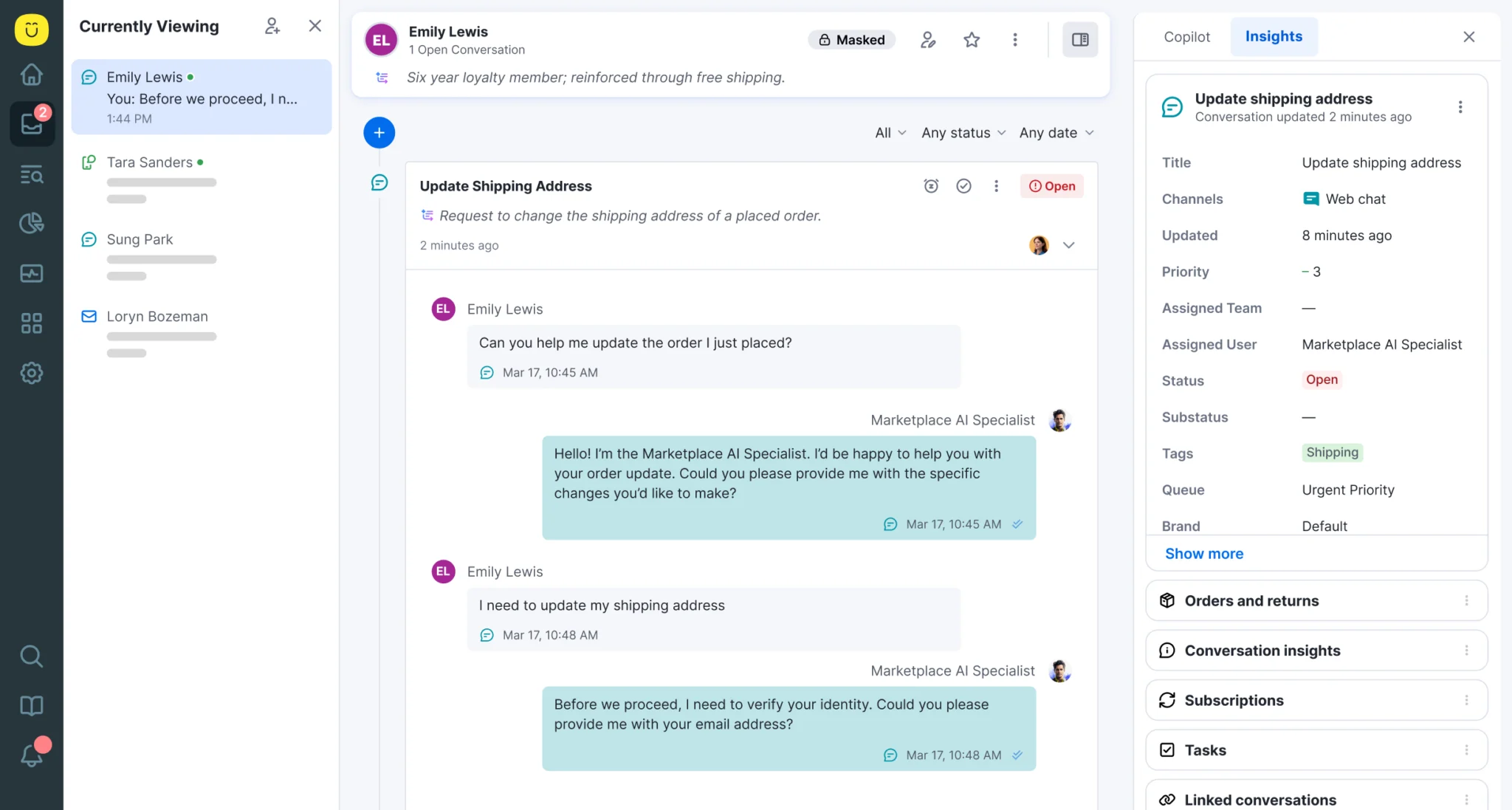
- Customer timeline: all interactions (orders, chats, emails, calls) in a single scrollable view
- AI agent handles inbound queries with access to full customer context — not just ticket history
- Automation via Kustomer IQ: routing, SLA management, sentiment tagging, and next-action recommendations
- Omnichannel coverage: chat, email, phone, WhatsApp, Facebook, Instagram, SMS
- Native Shopify, BigCommerce, and Magento integrations for e-commerce order data
- Open API for custom workflows and CRM data enrichment
G2 rating: 4.5/5 from 522 reviews
| Pros | Cons |
|---|---|
| Unified customer timeline makes AI context richer and handoffs smoother | $89/user/month floor makes it expensive for large agent teams |
| Strong e-commerce integrations; good for D2C and retail | AI autonomy depth is below Intercom or Sobot |
| Highly customizable data model for unique business workflows | Implementation requires technical resources to configure properly |
| Good G2 satisfaction scores relative to review volume | Less brand recognition than Zendesk or Intercom for competitive sourcing |
Price: Enterprise: $89/user/month; Ultimate: $139/user/month.
TL;DR: Kustomer’s differentiator is its customer-centric data model: rather than organizing around tickets, everything is organized around the customer — their full history, preferences, and interaction patterns. The AI agent and automation layer sit on top of this unified view, making resolutions more context-aware. The $89/user floor means it’s not for budget-conscious buyers.
❾ Salesforce Einstein (Service Cloud) — Best for Salesforce-Native Organizations
Best for: Large enterprises already operating on Salesforce CRM where zero-migration AI agent deployment inside the existing Salesforce org is the priority
Key Features:
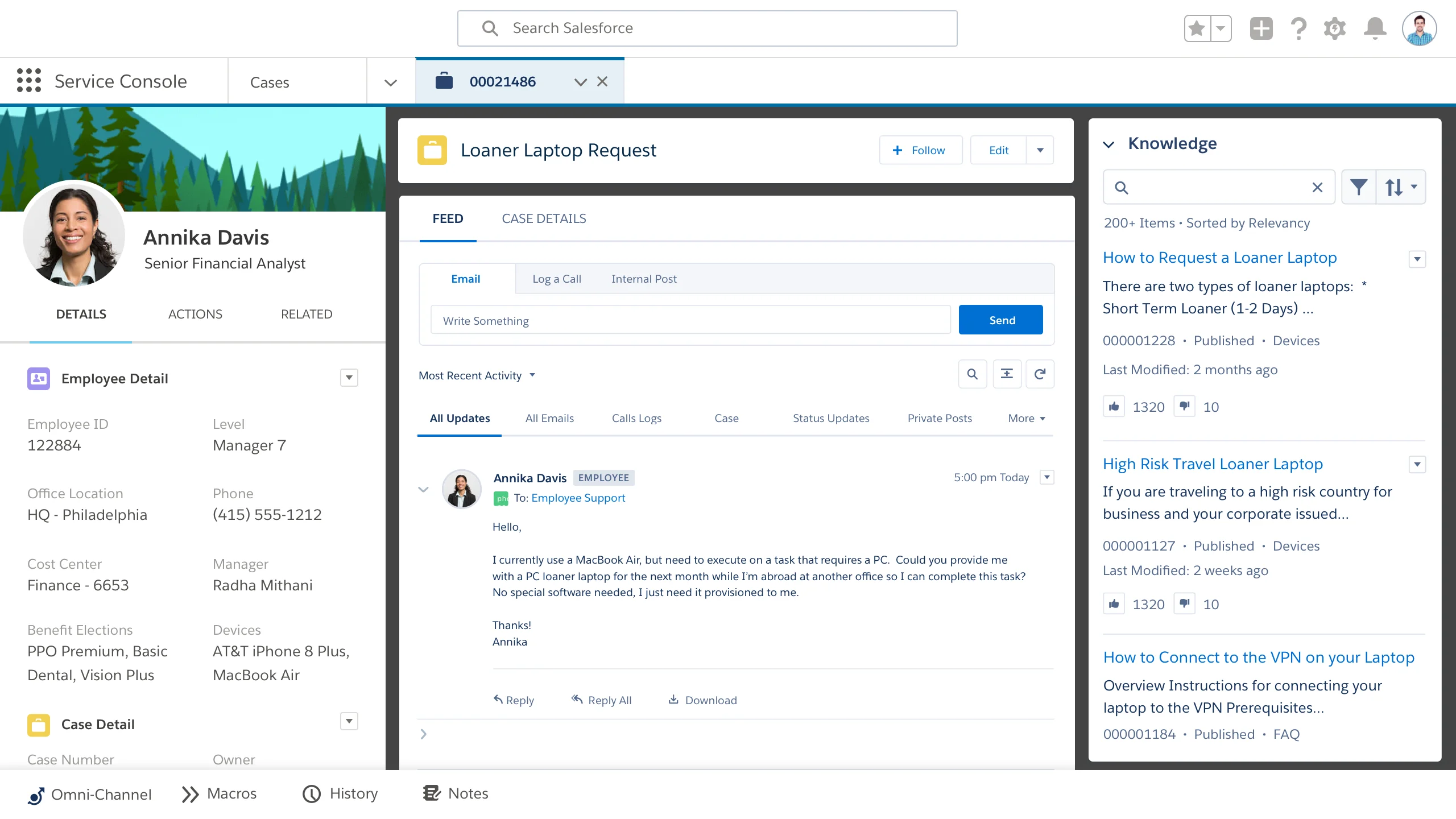
- Einstein AI agent operates within Service Cloud, using existing CRM data for resolution context
- Agentforce: Salesforce’s latest autonomous AI agent layer for multi-step customer service tasks
- Omni-Channel routing integrates with Einstein predictions to optimize agent assignment
- Full CRM history — purchase data, case history, account data — available to AI agent
- Flow Builder for no-code automation of escalation and resolution paths
- Native integration with Sales Cloud, Marketing Cloud, and Commerce Cloud
G2 rating: 4.4/5 from 7,271 reviews
| Pros | Cons |
|---|---|
| Zero-migration for Salesforce orgs — AI sits on top of existing data | Prohibitively expensive for non-Salesforce organizations |
| Agentforce introduces genuine autonomous multi-step AI actions | Requires Salesforce expertise to configure; steep learning curve |
| Full enterprise compliance, security, and governance controls | Total cost of ownership is among the highest in this list |
| Massive ecosystem and partner network | Feature roadmap tied to Salesforce’s broader platform cycle — can be slow |
Price: Service Cloud from $75/user/month (Starter); Einstein features and Agentforce are add-ons.
TL;DR: If your company runs on Salesforce, Einstein for Service Cloud is the natural AI agent path — the CRM data is already there, the security model is already set, and IT won’t need to approve a new vendor. If you’re not on Salesforce, the cost and complexity of adopting the platform purely for its AI agent is extremely difficult to justify.
❿ HubSpot AI (Service Hub) — Best for Inbound-Led Teams on HubSpot CRM
Best for: Marketing and sales-led companies using HubSpot CRM that want to extend AI-assisted service without leaving the HubSpot ecosystem
Key Features:
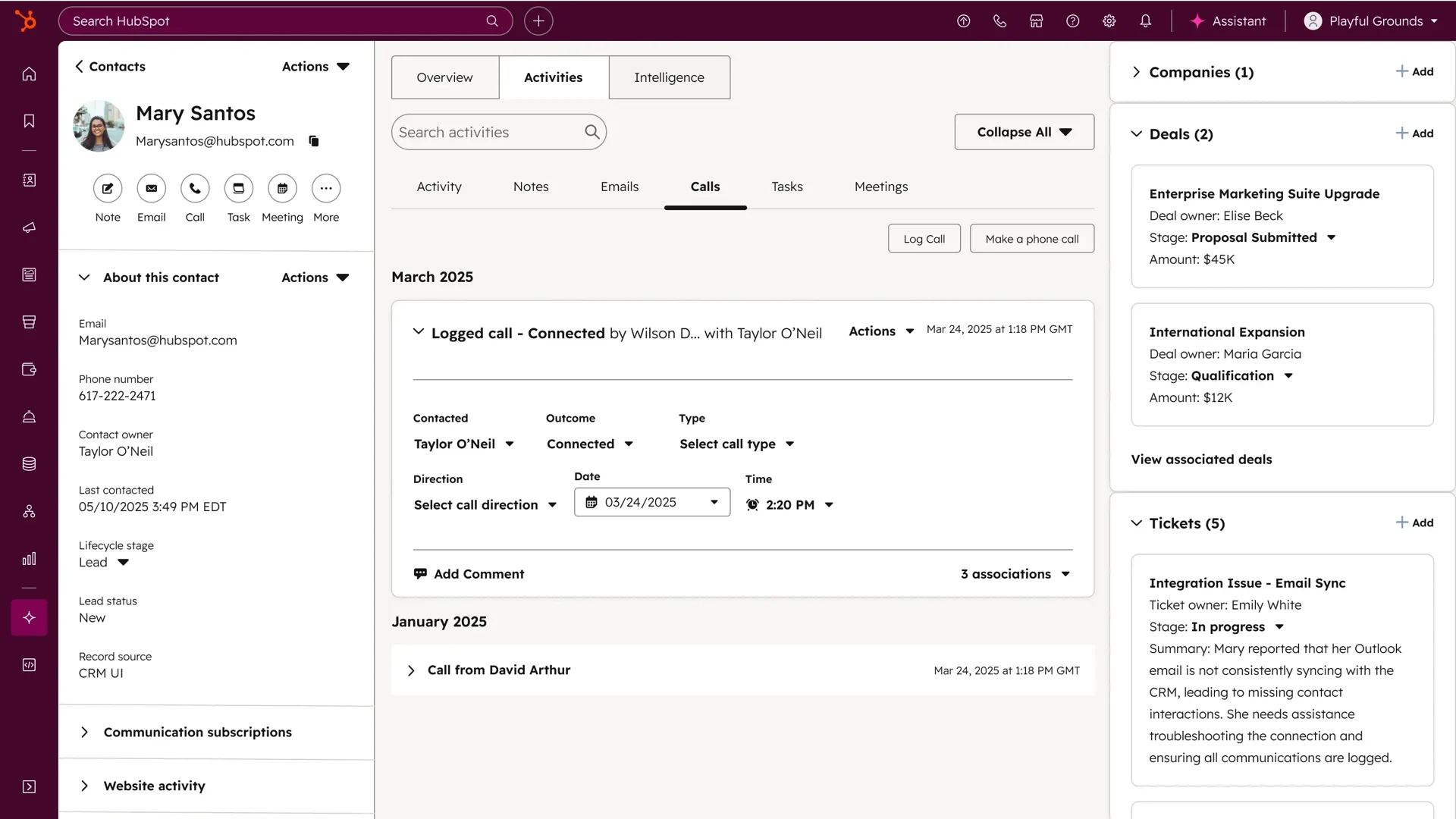
- AI chatbot builder connects to HubSpot CRM for contact-aware conversations
- Breeze AI Copilot: generates reply drafts, summarizes conversation history, suggests next actions
- Shared inbox for managing chat, email, and WhatsApp messages from one place
- Built-in knowledge base and customer portal; AI surfaces articles before chat escalation
- Help Desk workspace with AI-generated ticket summaries and priority scoring
- Native connection to HubSpot Marketing Hub and Sales Hub for full funnel visibility
G2 rating: 4.4/5 from 2,905 reviews
| Pros | Cons |
|---|---|
| Native CRM integration means AI has full marketing and sales context | AI agent autonomy is limited compared to purpose-built platforms |
| Free tier available; easy to start for small teams | Not designed for high-volume support operations (500+ daily tickets) |
| Fast setup for HubSpot users — no additional vendor relationships | Voice and phone support require third-party integration |
| Marketing-to-service handoff is seamless within HubSpot ecosystem | Pricing scales quickly; enterprise Service Hub is $150/seat/month |
Price: Free (basic); Starter $20/seat/month; Professional $100/seat/month; Enterprise $150/seat/month.
TL;DR: HubSpot Service Hub’s AI features make sense as an add-on for HubSpot users — the CRM context is valuable, setup is fast, and pricing is manageable at small scale. But HubSpot isn’t a serious AI agent platform for teams handling high-volume support; it’s more a “good enough” layer for companies whose primary investment is marketing and sales, not customer service.
Which AI Agent Tool Is Right for Your Team?
By Company Size
Startup / under 10 agents: Start with Tidio (Lyro) if you’re on Shopify or WooCommerce — it’s the fastest path to real AI automation on a startup budget. If you’re in SaaS, try HubSpot AI (free tier) if you’re already a HubSpot user.
SMB / 10–200 agents: Freshdesk (Freddy AI) gives you a solid helpdesk + AI agent at a manageable price. If you need stronger channel coverage (WhatsApp + voice), Sobot is worth evaluating — the pricing is competitive relative to what you’d spend stitching together separate tools.
Mid-market to enterprise / 200+ agents: Sobot (omnichannel, e-commerce), Intercom (SaaS and tech), Zendesk AI (Zendesk-committed orgs), Salesforce Einstein (Salesforce orgs), or Yellow.ai (APAC multilingual complexity) — depending on your existing stack and primary use case.
By Channel Priority
Chat-first (website + in-app): Intercom Fin or Ada — both deliver the highest AI resolution rates for chat-only workloads.
E-commerce (Shopify + Amazon + WhatsApp): Sobot is the only platform in this list with direct Amazon and Lazada integrations alongside WhatsApp (as a Meta BSP) and voice in one package. For Shopify-only at small scale, Tidio or Gorgias are simpler starting points.
Voice + digital combined: Sobot (full call center + AI agent) or Yellow.ai (enterprise APAC). Intercom’s voice is functional but not primary.
Salesforce or HubSpot ecosystem: Einstein or HubSpot AI respectively — zero-migration deployment justifies the ecosystem lock.
By Geography
Southeast Asia (Singapore, Malaysia, Indonesia): Sobot has the strongest regional presence — local offices, local case studies (SAMSUNG, Flower Chimp, KUPU), and native integrations with regional e-commerce platforms (Lazada, TikTok Shop). Yellow.ai is a credible APAC alternative for multilingual complexity.
North America / Europe (English-first): Intercom, Zendesk, Freshdesk, or Tidio depending on budget and scale.
Global / Multilingual at scale: Yellow.ai (100+ languages) or Sobot (70+ language AI Copilot + LLM flexibility).
How to Choose the Right AI Agent Tool: 4 Steps
1. Map your channels.
List every channel your customers contact you through today. If you have more than three active channels, single-channel tools like Tidio will create blind spots. Multi-channel tools like Sobot or Freshdesk Omni are built for this.
2. Define your automation target.
What percentage of inbound queries do you want the AI agent to resolve without human involvement? Straightforward FAQ: almost any tool can handle this. Multi-step resolution (returns, account actions, order modifications): you need genuine agentic reasoning — Intercom Fin, Sobot, Ada, or Salesforce Agentforce.
3. Check ecosystem fit.
If you’re committed to Salesforce, the migration cost of switching helpdesks rarely justifies it. Same logic for HubSpot. But if you’re not ecosystem-locked, prioritize the AI agent capability itself — not the brand name.
4. Run a pilot with real data.
Feed the tool your actual FAQ content, connect it to your actual product catalog, and run 200 real conversations through it. The only number that matters is the actual containment rate — not the marketing page claim.
FAQ
What’s the best AI agent tool for a small e-commerce store on Shopify?
For a Shopify store with a small team (under 10 people), Tidio with Lyro AI is the fastest and most affordable starting point. It integrates natively with Shopify, can resolve ~70% of common queries, and is live in under an hour. If you also need WhatsApp support, consider Sobot — it handles chat, WhatsApp, and e-commerce channels together without requiring separate tools.
Is there a cheaper alternative to Zendesk that still has a real AI agent?
Yes — Freshdesk (Freddy AI) is the most direct Zendesk alternative with AI included at a lower price point. The Growth plan (~$18/agent/month) includes AI triage and suggested responses. For more advanced AI autonomy at a competitive price, Sobot is worth comparing directly against Zendesk Suite Professional.
Which AI agent tool works best for WhatsApp customer support in Southeast Asia?
Sobot is the strongest option here — it’s a Meta-certified WhatsApp Business Solution Provider (BSP), which means it has direct API access and isn’t dependent on a third-party reseller. It also has physical offices in Singapore, Jakarta, and Kuala Lumpur, and local case studies from companies like SAMSUNG SEA and Flower Chimp. For WhatsApp-only use cases at small scale, WATI or Respond.io are also regional options.
What’s the difference between an AI chatbot and an AI agent?
A traditional chatbot follows a fixed decision tree — it can only respond to inputs it was explicitly programmed for. An AI agent uses large language models to reason across context, handle ambiguous queries, take multi-step actions (like looking up an order, processing a return, and sending a confirmation), and escalate intelligently when it reaches the limits of its knowledge. Most platforms in 2026 use “AI agent” to describe this newer, more capable category.
Can AI agents handle voice calls, not just chat?
Yes — but not all platforms do this well. Sobot includes a full AI-powered voicebot and call center alongside its chat agent. Yellow.ai also covers voice. Intercom added voice in 2025 but it’s not a primary feature. Tools like Tidio, Ada, and Kustomer do not currently offer voice AI.
How much does a good AI agent tool typically cost for a 50-person support team?
It varies significantly. At the budget end, Freshdesk Pro would be approximately $2,350/month for 50 agents ($47/agent). Zendesk Suite Pro would be around $4,250/month. Intercom and Sobot are enterprise-priced and require a sales quote, but Sobot’s pricing is typically positioned at roughly two-thirds the cost of comparable enterprise platforms.
Do AI agent tools work across multiple languages for Southeast Asia?
Several do. Sobot’s AI Copilot supports real-time translation across 70+ languages. Yellow.ai supports 100+ languages including Bahasa Indonesia, Malay, Thai, and Tagalog. Freshdesk and Intercom have multilingual support but are more English-primary in practice.
Conclusion
The right AI agent tool for your customer service team depends on three things: the channels your customers use, the complexity of the resolutions you need to automate, and where you are in your platform journey.
For e-commerce and retail teams managing customers across WhatsApp, live chat, phone, and marketplace channels — particularly in Southeast Asia — Sobot is the most complete option in this list. It’s the only platform that combines an AI agent, call center, WhatsApp API, Amazon integration, and live chat under one roof, with a track record in the region.
For chat-first SaaS teams, Intercom Fin sets the standard. For budget-conscious SMBs on Shopify, Tidio’s Lyro delivers real results at a startup-friendly price.
Whichever platform you choose, run a real pilot before committing. The AI agent market is moving fast — and the gap between what vendors claim and what their tools actually deliver in your environment is only visible once you put real data through the system.