Modern ecommerce sellers no longer rely on a single sales channel. Today’s businesses often sell simultaneously on marketplaces like Amazon and Walmart, maintain their own official websites, and engage customers through multiple social media and messaging platforms. While this multi-channel approach creates more opportunities to reach customers, it also introduces significant operational challenges.
Orders, customer inquiries, returns, and support requests arrive through separate dashboards and inboxes, forcing agents to switch between systems throughout the day. This fragmented workflow leads to slower response times, duplicated efforts, inconsistent customer experiences, and reduced team productivity.
Unified order and customer management addresses these challenges by bringing customer conversations, order information, tickets, and support workflows into a single centralized platform. Instead of managing each channel independently, businesses gain a complete view of every customer interaction.
In this article, we’ll explore why unified management has become essential for modern ecommerce businesses and how Sobot simplifies the process through its omnichannel capabilities, intelligent ticketing system, AI Agent, AI Copilot, and other AI-powered customer service solutions.
What Is Unified Order and Customer Management?
As businesses expand across multiple sales and communication channels, managing operations from separate systems becomes inefficient. Unified order and customer management centralizes everything into one platform for faster, more consistent service.
- Orders: Monitor and manage orders from multiple sales channels through a single dashboard.
- Customer conversations: Access messages from every supported channel without switching between platforms.
- Tickets: Convert customer inquiries into trackable tickets for organized issue resolution and follow-up.
- Customer profiles: View unified customer information, including contact details and interaction history.
- Order history: Access complete purchase records to provide personalized and accurate customer support.
- Internal collaboration: Enable teams to share notes, assign tasks, and work together within one centralized workspace.
81% of brands say the customer experience would improve significantly if they could consolidate all conversations into a single system of record instead of juggling separate tools. (Nextiva CX Trends report)
Why Sellers Need Unified Management Now
The need for unified management is not theoretical. It shows up in very concrete, everyday friction that support teams feel constantly.
- Agents constantly switch between multiple platforms: Managing Amazon, Walmart, social media, and website inquiries separately forces support teams to jump between different dashboards, reducing productivity and increasing response times.
- Customer context gets lost across channels: When conversations and order information are scattered across multiple systems, agents lack a complete view of the customer’s journey, leading to repetitive questions and inconsistent support.
- Duplicate replies and inconsistent communication: Without a centralized workspace, multiple team members may respond to the same inquiry or provide conflicting information, creating confusion for both customers and support teams.
- Inefficient order and support operations: Handling orders, returns, refunds, and other customer requests across disconnected systems slows down workflows, increases manual effort, and makes it harder to resolve issues quickly.
- Difficult team collaboration: Without shared customer records, ticket ownership, and internal notes, teams struggle to collaborate effectively, resulting in slower resolutions and a fragmented customer experience.
When information about a single customer or a single order is split across many systems, every operational task takes longer and carries more risk of error. A brand selling on three marketplaces and two social platforms is not just running five channels. It is effectively running five separate support operations, each with its own blind spots. As order volume grows, that fragmentation compounds, and what used to be a minor inconvenience turns into a genuine bottleneck that slows the business down.
How Sobot Delivers Unified Order Management
Selling across marketplaces, social media, messaging apps, and official websites requires more than just connecting channels—it requires a platform that brings customer conversations, order information, and support workflows together. Sobot helps businesses achieve this through omnichannel communication, intelligent automation, unified customer data, and advanced reporting.
Omnichannel Integration at the Core
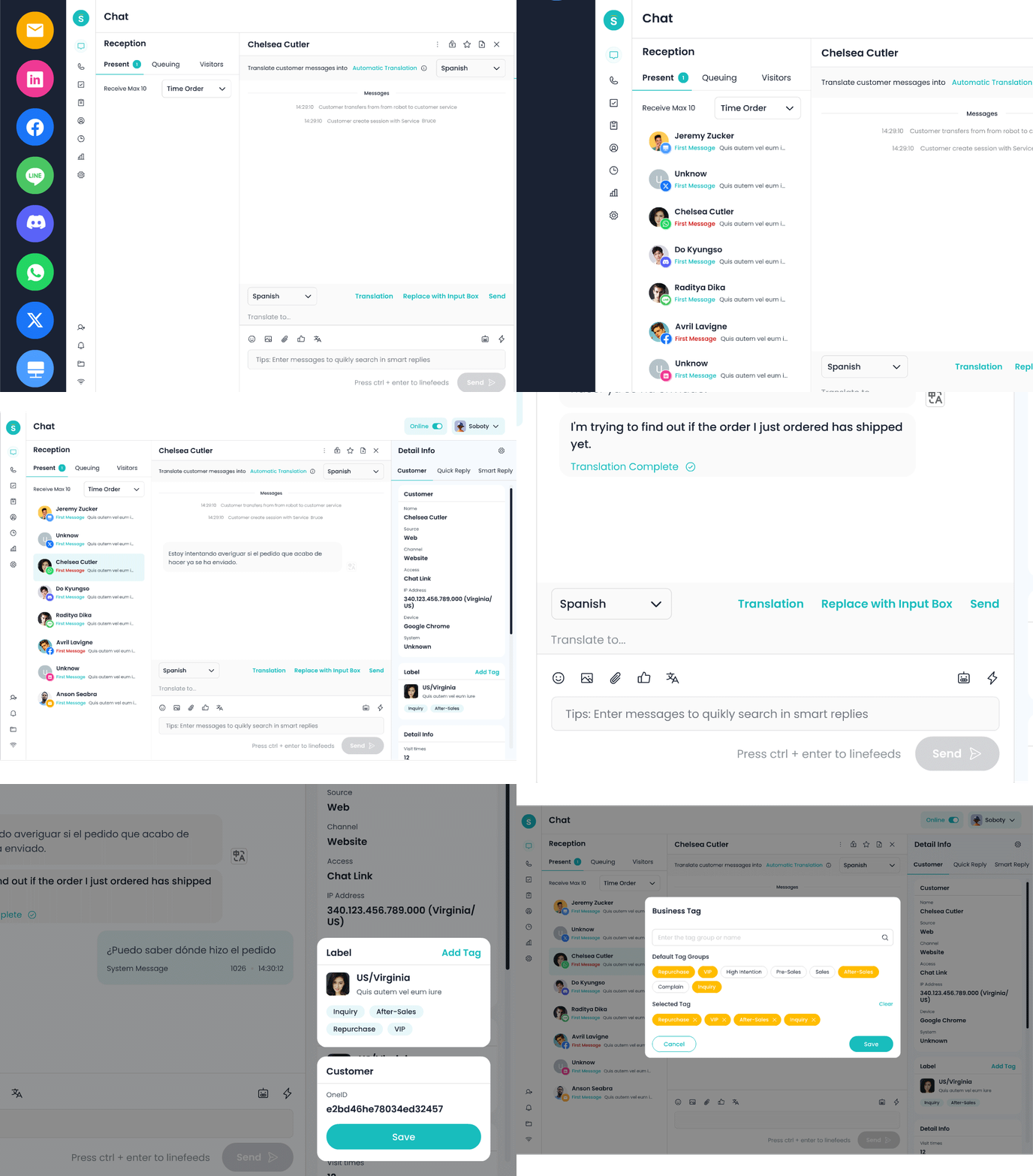
Sobot centralizes customer interactions and order-related conversations from multiple sales and communication channels into a single workspace.
- Marketplace integrations: Connect leading ecommerce marketplaces such as Amazon, Walmart, Shopee, Lazada, and TikTok Shop to manage buyer inquiries from one platform.
- Social and messaging channels: Receive and respond to messages from WhatsApp, Facebook, Instagram, LINE, and WeChat without switching between applications.
- Support for self-owned websites: Easily integrate Sobot with your enterprise’s official website or self-owned ecommerce website, allowing visitors to receive consistent support alongside customers from other sales channels.
- Additional communication channels: Bring together conversations from mobile apps, email, SMS, and voice into one agent workbench for a truly omnichannel support experience.
Regardless of where a customer places an order or starts a conversation, agents can access everything from one unified interface, improving efficiency while delivering a seamless customer experience.
Businesses using an integrated omnichannel solution see a 31% reduction in first-resolution time and a 39% decrease in customer wait times compared to teams working in disconnected, siloed tools.
Ticketing System: Keeping Every Order Issue on Track
Sobot’s intelligent ticketing system helps businesses organize, prioritize, and resolve order-related issues without manual coordination.
- Automatically convert customer inquiries into tickets for better tracking and accountability.
- Route returns, exchanges, delivery issues, order modifications, and other requests to the appropriate department using automated workflows.
- Create tickets automatically when predefined events or service conditions are triggered, reducing manual work and preventing missed requests.
- Meet marketplace response requirements with SLA management, ensuring support teams handle time-sensitive cases within required timeframes.
- Enable smooth collaboration between frontline support agents, specialized back-office teams, warehouses, and physical stores to resolve issues faster.
AI Agent, Chatbot, AI Copilot & Voicebot
Sobot enhances customer service with AI-powered tools that automate routine work while helping agents resolve complex cases more efficiently.
- AI Agent manages multi-step customer requests such as order tracking, returns, refunds, and shipping inquiries with minimal human intervention.
- AI Chatbot provides multilingual, 24/7 customer support, answers common questions instantly, and seamlessly transfers complex conversations to live agents.
- AI Copilot assists agents by generating reply suggestions, summarizing conversations, and displaying relevant customer and order information to reduce handling time.
- Voicebot extends automation to inbound and outbound phone interactions, including customer notifications, reminders, and support calls.
These capabilities are powered by integrations with leading large language models, including OpenAI, Amazon Bedrock, Anthropic Claude, DeepSeek, and other AI models, giving businesses flexibility to adopt AI that best fits their needs.
Unified Customer & Order Profiles
Sobot creates a comprehensive customer profile by combining data from every connected channel.
- Display a complete timeline of conversations, purchases, tickets, and order history in one place.
- Give agents instant access to customer context, eliminating the need for customers to repeat information when switching channels.
- Support customer segmentation for personalized marketing campaigns and proactive engagement through WhatsApp, SMS, email, and other communication channels.
Reporting & Analytics for Full-Picture Visibility
Sobot provides real-time analytics that help businesses monitor customer service performance and continuously optimize operations.
Key insights include:
- Response time to evaluate how quickly customer inquiries are handled.
- Resolution time to measure the speed of issue resolution.
- Agent productivity to identify workload distribution and performance.
- Customer Satisfaction (CSAT) to monitor service quality.
- Channel performance to compare the effectiveness of each sales and communication channel.
- Order-related issue trends to identify recurring problems and improve operational processes proactively.
Key Benefits of Unified Order Management with Sobot
Managing orders and customer conversations through a single platform helps businesses improve efficiency, deliver better customer experiences, and scale support operations as sales channels grow. With Sobot, teams spend less time switching between systems and more time building customer relationships.
- Faster response times: A unified, prioritized inbox enables agents to manage inquiries from multiple channels in one place, reducing response delays and ensuring no customer message is overlooked.
- Higher customer satisfaction (CSAT/NPS): With complete customer and order context available across every interaction, agents can provide consistent, personalized support that builds trust and improves customer loyalty.
- Lower operational costs: Eliminating the need to switch between multiple seller portals, social media platforms, and support tools simplifies daily workflows, reduces manual effort, and improves team productivity.
- Increased sales opportunities: Faster responses to pre-sales questions and proactive follow-ups help businesses engage potential buyers, reduce cart abandonment, and improve conversion rates.
- Built for growth: Sobot’s AI Agent automates routine inquiries and repetitive tasks, allowing human agents to focus on complex customer issues while maintaining high-quality support during peak shopping seasons and business expansion.
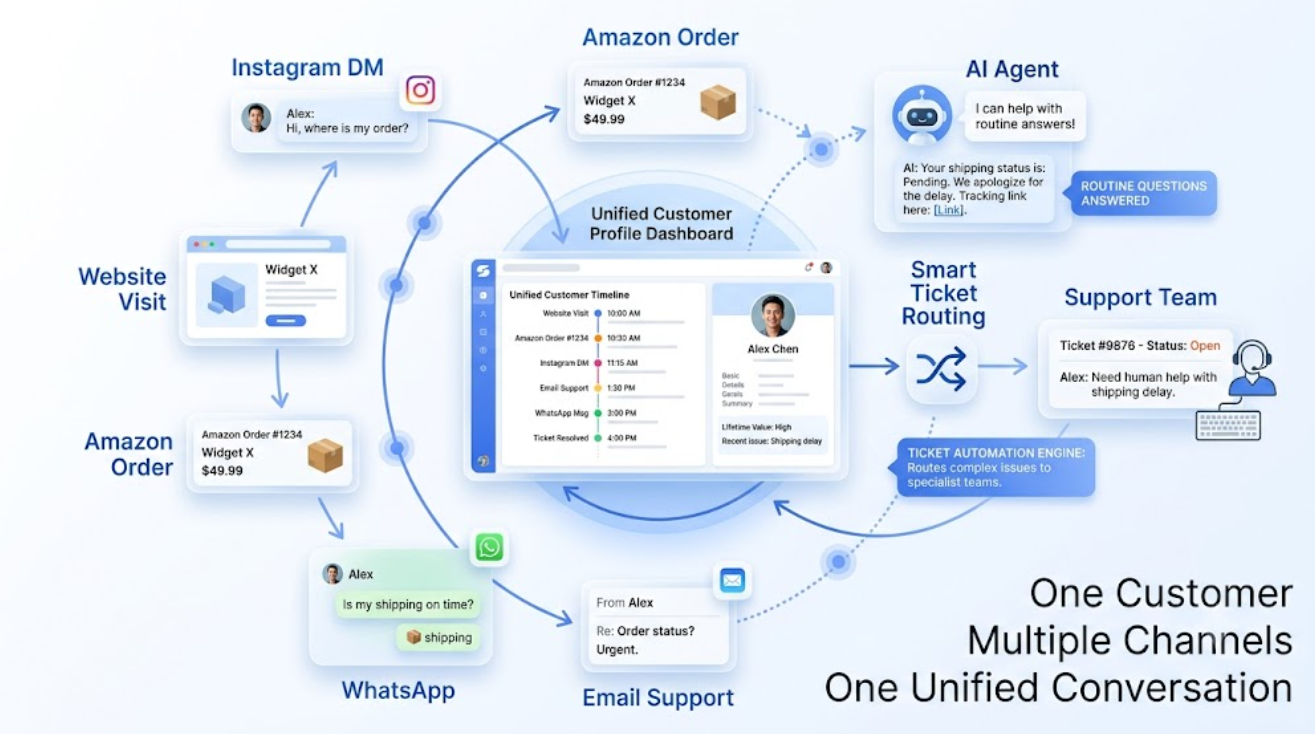
Example Workflow: One Customer, Multiple Channels, One Conversation
A customer’s shopping journey rarely happens on a single platform. With Sobot’s omnichannel capabilities, every interaction is connected, giving agents complete visibility while AI automates routine support.
- Customer discovers a product on Instagram and sends a pre-sales inquiry through direct messages.
- The customer visits the company’s official website to learn more about the product before making a purchase.
- An order is placed on Amazon, with the order details automatically becoming part of the customer’s unified profile.
- The customer asks a shipping question via WhatsApp. Instead of treating it as a new conversation, Sobot links it to the existing customer history.
- Later, the customer requests an exchange through email after receiving the order.
- The support agent opens Sobot and instantly sees the customer’s complete timeline, including social media conversations, website interactions, Amazon order details, WhatsApp messages, and email history.
- Sobot’s AI Agent answers routine questions, such as shipping updates or order status, providing instant responses without agent intervention.
- If the issue requires human assistance, Sobot automatically creates and routes a ticket to the appropriate team while preserving the full conversation context.
- The customer receives fast, consistent support across every touchpoint without repeating information, resulting in a seamless omnichannel experience and higher customer satisfaction.
Conclusion
Managing customer conversations separately no longer works for modern ecommerce. As brands expand across marketplaces, social media, and their own websites, they need a centralized platform that connects every interaction, order, and support request into a single, coherent view.
With Sobot’s omnichannel capabilities, AI Agent, unified ticketing system, AI Copilot, and centralized workspace, businesses can deliver faster and more consistent support while improving operational efficiency and customer satisfaction at the same time. As order volume grows and customers continue to spread across more touchpoints, this kind of unified foundation is quickly becoming less of a nice-to-have and more of a basic requirement for staying competitive.