The customer has already spent several minutes explaining a complicated problem to an AI agent. They have provided an order number, confirmed their identity, described what went wrong, and followed several troubleshooting steps. When the AI recognizes that it cannot resolve the issue, it transfers the conversation to a human agent.
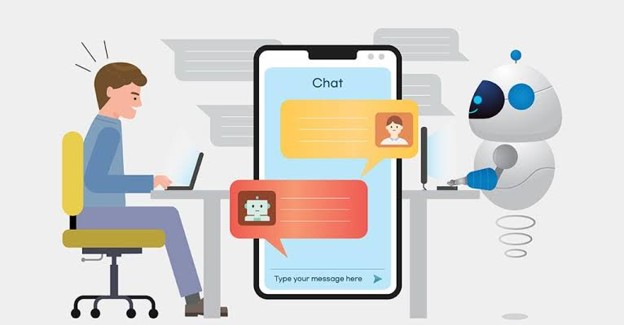
A few moments later, the agent joins the chat and asks:
“Hello. How can I help you today?”
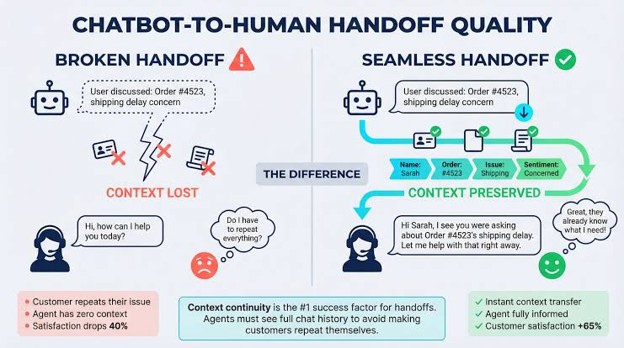
That sentence captures one of the most frustrating experiences in customer support. The problem is not that AI was involved. The problem is that the customer’s time, effort, and progress disappeared at the moment of transfer.
A genuine handoff should allow the human agent to continue from where the AI stopped. It is easy to blame this experience on AI, but AI did not create fragmented customer records, disconnected service channels, poor routing rules, or departmental silos.
According to Verint’s State of Customer Experience 2025, 85% of consumers are open to using automated customer service, either because they already prefer it or because they would use it if it successfully resolved their issue.
This article argues that AI did not break customer support; disconnected and poorly designed handoffs did. We will examine why seamless AI-to-human transfers remain rare, how failed handoffs create customer and business risks, why improving them is a business priority, and what companies need to build a truly connected AI-human support journey.
1. Customers Don’t Hate AI. They Hate Getting Stuck

A. Customers Care More About Resolution Than the Channel
Verint’s State of Customer Experience 2025 found that 44% of consumers initially prefer automated service, while 56% prefer speaking with a human agent. At first glance, these figures appear to confirm that most customers still favour human support.
The finding suggests that customers are not choosing between AI and humans as competing service options. They are choosing the path that offers the best chance of solving their problem with the least effort.
Customers primarily care about:
- How quickly the issue is resolved
- Whether the information they receive is accurate
- Whether the company remembers what they have already shared
- Whether they must repeat the same information
- Whether they can reach a capable person when automation reaches its limit
B. Automation Becomes a Problem When There Is No Exit
Customers become frustrated when AI stops being a shortcut and becomes a barrier. The chatbot may repeat the same response, recommend an irrelevant help article, or continue asking questions without making meaningful progress.
Even an explicit request such as “speak to an agent” may trigger another automated response. The system treats the customer’s request as an opportunity for further deflection instead of recognising that automation has reached its limit.
However, reaching a human does not automatically solve the problem. An agent who lacks the previous conversation, appropriate expertise, or authority to act can make the situation worse.
C. Problems That Predate AI
Common customer-facing problems included:
- Repeating the same information to multiple representatives
- Facing long delays before receiving the right support
- Being bounced between agents and departments
- Starting over when switching between communication channels
- Receiving inconsistent answers from different representatives
- Reaching agents who lack the expertise or authority to resolve the issue
- Having earlier conversations, completed steps, or promises overlooked
- Contacting support multiple times because the original issue remains unresolved
Salesforce’s customer-service research illustrates the scale of this fragmentation. It found that 60% of customers feel as if they are communicating with separate departments rather than one company. Another 66% often have to repeat or re-explain information to different representatives.
2. Why Do “Seamless” AI-to-Human Handoffs Rarely Feel Seamless?

I. What Is the Difference Between a Transfer and a Handoff?
A transfer changes who or what is handling the conversation. The AI stops responding, and a human agent becomes the next participant. Technically, the system has completed its task once the conversation reaches the live-agent queue.
A handoff goes further. It transfers responsibility for the next action, the context needed to understand the case, the progress already made, and ownership of the eventual outcome. The receiving agent should know what the customer wants, what the AI has already asked, which solutions have been attempted, and what needs to happen next.
II. What Usually Happens During an AI-to-Human Transfer?
A. The Customer Has to Fight the Bot
The breakdown may begin before the customer reaches the queue. They ask to speak to an agent, but the chatbot responds with another menu, suggests another help article, or repeats a previous answer. Even a direct statement such as “talk to a person” can be interpreted as another intent the AI should try to contain.
This approach may improve containment figures in the short term because fewer conversations reach human agents. However, it can also create a misleading impression of success.
B. AI Escalates Too Late
Not every customer will directly ask for an agent. The AI must also recognize when continuing the automated conversation is unlikely to produce a useful result.
Late escalation becomes more dangerous when the AI overlooks signals of anger, urgency, vulnerability, suspected fraud, legal risk, or repeated failure.
By the time an agent finally joins, the customer is already frustrated. The human must solve the original problem while also repairing the damage caused by the prolonged automated exchange.
C. The Context Does Not Travel
Even a timely escalation can fail if the information gathered during the AI conversation does not reach the agent in a usable form.
The agent may receive a lengthy transcript but no clear explanation of the customer’s original intent. Important account details, order numbers, products, transactions, or service history may remain in another system. A genuinely useful handoff should tell the agent who the customer is, why they contacted support, what has already happened, and why the AI decided to escalate.
D. The Customer Reaches the Wrong Agent
A complete context package cannot save the handoff if the conversation is routed to someone who lacks the expertise or authority to resolve it.
Many systems still prioritize the next available agent. Although this may reduce the initial queue time, it does not account for whether the agent understands the relevant product, speaks the customer’s language, covers the correct region, or has the skills required for the issue.
The first agent then becomes another transfer point instead of the owner of the case. The customer enters another queue and may once again be asked to explain part of the situation.
E. The Channel Changes and the Journey Resets
In some support journeys, the chatbot cannot connect the customer directly to an agent. It instead advises them to call a number, send an email, complete a form, or open a ticket through another platform. The customer then moves from an immediate conversation into a different service environment.
The disruption is not limited to waiting. Different channels may have separate support hours, capabilities, escalation procedures, and service teams. When these teams work independently, responsibility can become unclear as the customer moves between them.
F. Nobody Owns the Outcome
The deepest handoff problem is that each system may complete its own task without anyone taking responsibility for the customer’s final result.
The AI records that it escalated the conversation. The routing system confirms that the transfer reached an agent. The agent handles the immediate contact and may close the interaction. From an operational perspective, every step appears complete.
However, none of these actions proves that the customer’s original problem was resolved.
Parloa’s State of Agentic CX 2026 demonstrates how large the gap between contact and resolution can be. Its researchers evaluated 10,000 enterprise websites, conducted 4,000 chat interactions, and examined 100 phone trees. They found that 43% of enterprise websites did not provide a clear route to support, fewer than 10% of chat conversations achieved the customer’s original goal, and only 1% of CX systems successfully managed agent-to-agent interactions.
3. What Is the Business Case for Better AI-to-Human Handoffs?
A. Lower Cost-to-Serve
When a handoff fails, the company often pays to handle the same problem several times. Agents repeat authentication, recollect information, review long transcripts, transfer customers internally, and manage avoidable callbacks or supervisor escalations. Customers may also abandon chat and move to more expensive channels such as phone support.
A better handoff reduces this duplicated work by giving the correct agent the information and authority needed to continue the case.
B. Faster and More Complete Resolutions
A high transfer-completion rate only shows that the system moved a conversation. It does not show whether the customer’s problem was solved.
The more valuable measures are first-contact resolution, total time to resolution, repeat-contact rate, abandonment, and secondary transfers. Genesys research found that consumers consider first-contact resolution the most important part of a customer service interaction, placing it ahead of receiving a fast response. Better handoffs improve these outcomes by allowing the receiving agent to continue the journey instead of restarting it.
C. Greater Agent Productivity
As AI resolves more routine enquiries, human agents receive a larger share of complex, emotional, and exception-based cases. Their productivity increasingly depends on the quality of the information provided during escalation.
When agents receive a clear summary of the customer’s issue, completed steps, escalation reason, and required action, they spend less time searching through transcripts or asking repeated questions.
D. Stronger Customer Retention
A poor handoff can turn a manageable service problem into a reason to leave. Repeated questions, incorrect routing, and disconnected channels can make customers feel that the company does not understand or value them.
Better handoffs help protect trust, post-escalation satisfaction, renewal intentions, repeat purchases, and customer lifetime value. The financial impact therefore extends beyond the cost of one support interaction. It can affect the future value of the entire customer relationship.
E. Stronger ROI From AI Investment
AI ROI should not be calculated only through containment or the number of enquiries removed from human queues. If customers return with the same problem or agents spend longer repairing failed automated interactions, the apparent savings may be misleading.
A stronger assessment considers the cost per successful resolution, first-contact resolution, repeat contacts, post-handoff handling time, agent productivity, customer retention, and revenue protected through successful service recovery.
Sobot’s Tineco case study provides a practical example: its unified support environment manages more than 120,000 calls and 20,000 tickets each month, while AI resolves approximately 40% of repair-related issues before escalation, allowing human agents to focus on more complex cases.
4. How Can AI-to-Human Handoffs Become a Continuous Learning Loop?
A successful resolution should not mark the end of the AI workflow. Each handoff reveals where automation worked, where it failed, and what must change to prevent the same problem from recurring.
- Capture the escalation. Record the reason the AI transferred the case, its confidence level, the customer information collected, and the context sent to the agent. This shows whether the handoff happened at the right moment and arrived with enough information.
- Record the resolution. Track what the human agent ultimately did, including any corrected information, policy exception, additional system access, or specialist knowledge required. The final action reveals what the AI could not complete.
- Compare the two paths. Examine the difference between the AI’s proposed response and the action that actually resolved the issue. Repeated differences may expose incorrect knowledge, weak summaries, poor routing, or escalation rules that activate too early or too late.
- Improve the system. Use these findings to update knowledge sources, workflows, routing logic, escalation thresholds, and agent guidance. Human corrections should become structured feedback instead of disappearing when the ticket closes.
CX leaders should regularly review which customer intents create the most transfers, which handoffs were unnecessary, and which cases should have reached a human sooner. They should also identify where agents repeatedly correct AI summaries, which AI promises cannot be fulfilled operationally, and which channels or customer groups experience the greatest context loss and repetition. These patterns reveal the knowledge and process gaps producing avoidable handoffs.
The value of this learning loop is measurable. McKinsey reports that one company using integrated performance reporting and feedback loops achieved a 24% improvement in first-contact resolution and a 30% increase in human-agent productivity.
5. How Can Sobot Support One Continuous AI-Human Journey?
Sobot can help businesses build a connected journey in which AI handles suitable requests and informed human agents take over when necessary.
- Keep Customer Context Connected Across Channels: Sobot brings conversations from channels such as live chat, voice, email, social media, and messaging platforms into one support environment. This gives agents access to the customer’s previous interactions instead of treating every channel change as a new journey.
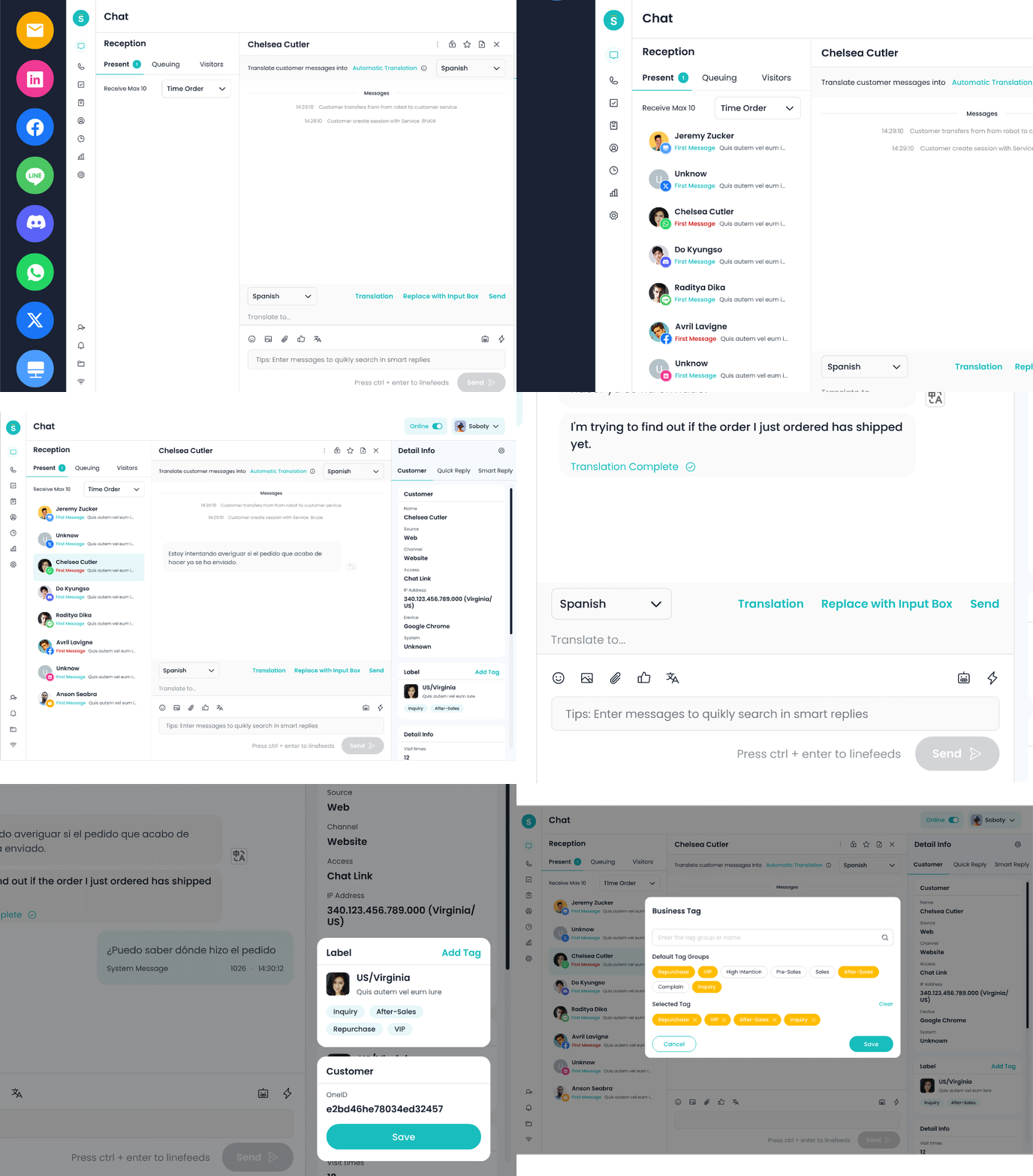
- Transfer the Complete AI Conversation: When escalation is required, Sobot can pass the conversation history and customer context to the human agent. The agent can see what the customer asked, what the AI answered, and what has already been attempted, reducing delays and repeated explanations. Sobot, How Sobot AI Powers Omnichannel Customer Support
- Customize When and Where Escalation Happens: Businesses can use customizable workflow nodes and routing rules to determine when the AI should initiate a transfer and which agent or team should receive it. This helps route complex, urgent, or specialist cases according to business requirements instead of relying only on agent availability.
- Adjust AI Thresholds According to Risk: Sobot allows businesses to configure recall thresholds according to their industry, customer-service goals, and risk tolerance. A company can give AI more freedom when handling routine questions while applying stricter thresholds to financial, sensitive, or high-value interactions.
- Continue Assisting the Agent After the Transfer: Sobot’s AI Copilot continues working after a human takes over. It can summarize the conversation, surface relevant knowledge, suggest responses, and help the agent identify the next action. This allows the agent to spend less time reconstructing the case and more time resolving it. Sobot, AI Copilot and Human-Agent Collaboration
- Keep AI and Human Answers Consistent: AI and human-support teams can work from a shared knowledge environment. When policies, product details, or troubleshooting guidance are updated centrally, both sides can use the same information, reducing inconsistent answers across the journey.
Sobot reports an 80% direct-answer rate and 95% answer accuracy for its AI Agent. These are Sobot’s own product-reported results, not independent industry benchmarks, and actual performance will depend on knowledge quality, integrations, workflow design, and enquiry complexity.
Conclusion
AI should resolve the enquiries it can handle confidently and recognize when a customer needs human judgment, authority, or empathy. When escalation happens, the agent should inherit the customer’s context and progress, not simply receive another contact in the queue.
Escalation is not a failure of automation. The real failures are delaying human involvement, losing information during the transfer, routing the customer incorrectly, and forcing them to start again. Businesses that design handoffs as a core CX capability can reduce customer effort while gaining greater value from both AI and their human workforce.
AI did not break customer support. It exposed where support was already broken, and the handoff is now the clearest opportunity for businesses to fix it.