Introduction
For ecommerce businesses, the customer experience doesn’t end when an order is placed. In many cases, the post-purchase journey has a greater impact on customer satisfaction than the buying process itself. Shoppers expect accurate tracking information, timely delivery updates, quick issue resolution, and responsive support whenever something goes wrong. If those expectations aren’t met, even a successful sale can result in poor reviews, repeat support requests, and lost customer loyalty.
This creates a significant challenge for customer service teams. Questions about delivery status, address changes, delayed shipments, failed deliveries, lost packages, and returns account for a large percentage of support tickets. During major shopping events and holiday seasons, these inquiries increase dramatically, making it difficult for agents to respond quickly while maintaining service quality.
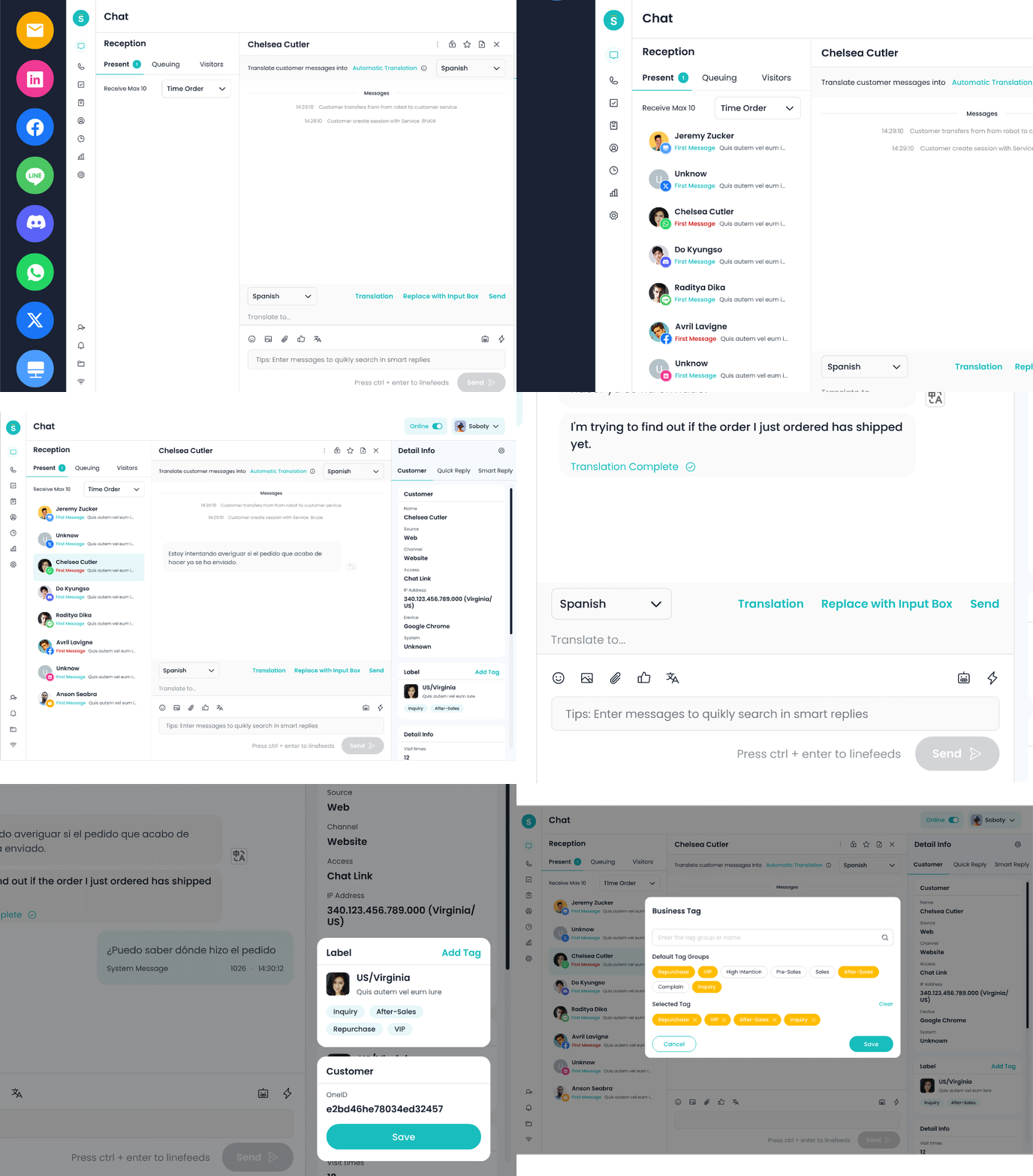
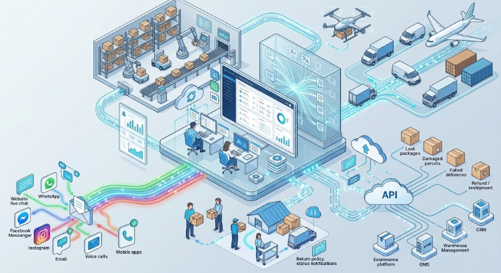
Sobot helps ecommerce businesses manage these logistics challenges through an AI-powered customer service platform that combines automation, omnichannel communication, intelligent ticketing, and real-time integrations. Whether customers contact a brand through live chat, WhatsApp, email, voice, or social media, Sobot enables businesses to deliver faster, more consistent logistics support while reducing manual workloads.
Why Logistics Support Has Become an Ecommerce Challenge
As ecommerce businesses expand across multiple sales channels and delivery networks, logistics support becomes increasingly difficult to manage. Customers expect fast, transparent communication throughout the post-purchase journey, while support teams must coordinate with multiple systems and shipping partners. The following challenges explain why traditional customer service approaches often struggle to keep up.
Rising Customer Expectations for Real-Time Updates
Today’s online shoppers expect complete visibility into their orders from the moment they check out until the package arrives. They want instant access to tracking information, delivery estimates, and shipping notifications without having to contact customer support. When updates are delayed or unavailable, customers quickly turn to live chat, WhatsApp, email, or social media to ask for order status.
Multiple Carriers and Fulfillment Partners Increase Complexity
Many ecommerce brands rely on multiple warehouses, third-party logistics (3PL) providers, and regional or international shipping carriers. Each partner may use different tracking systems and operational processes, making it difficult for customer service teams to gather accurate information quickly. Without centralized access to logistics data, agents often waste valuable time switching between platforms before they can assist customers.
Peak Shopping Seasons Create Support Ticket Surges
During major sales events such as Black Friday, Cyber Monday, and holiday promotions, order volumes increase dramatically—and so do logistics-related support requests. Questions about shipment tracking, delivery delays, address changes, and returns can overwhelm support teams, resulting in longer response times and lower customer satisfaction if repetitive inquiries aren’t automated.
Customers Expect Instant Support Across Every Channel
Modern consumers don’t limit themselves to a single communication channel. They may begin a conversation through website live chat, continue on WhatsApp, send an email, or message the brand on Instagram or Facebook. Regardless of where they reach out, they expect immediate, consistent responses. Managing these conversations across disconnected platforms makes it difficult to deliver a seamless customer experience.
Manual Customer Service Cannot Scale with Ecommerce Growth
As businesses process more orders, manually handling logistics inquiries becomes increasingly inefficient. Agents spend significant time answering repetitive questions, searching for shipment information, and switching between order management systems, carrier portals, and CRM platforms. This not only slows response times but also increases operational costs and limits the team’s ability to focus on complex customer issues.
As ecommerce operations continue to scale, businesses need a more intelligent approach to logistics support. AI-powered automation, unified customer conversations, and real-time system integrations help reduce repetitive workloads while ensuring customers receive fast and accurate assistance throughout the post-purchase journey.
Common Logistics Issues Ecommerce Brands Face (And How Sobot Solves Them)
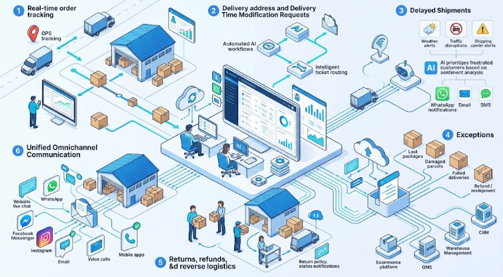
1. Order Tracking & Delivery Status Updates
Customer Problem
One of the most common questions ecommerce support teams receive is, “Where is my order?” Customers expect real-time visibility after completing a purchase, and even a short delay in shipment updates can trigger support requests across multiple channels.
When agents manually look up tracking numbers and respond individually to each inquiry, these repetitive requests consume valuable time and increase operational costs.
How Sobot Helps
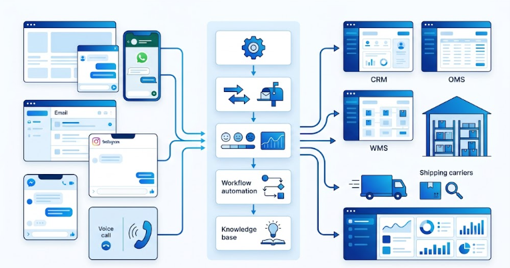
Sobot automates order tracking inquiries by allowing its AI Agent to recognize order IDs or tracking numbers directly within customer conversations. Through API integrations with order management systems (OMS), warehouse management systems (WMS), and logistics providers, the platform retrieves real-time shipment information without requiring agent intervention.
Instead of waiting for a support representative, customers receive instant tracking updates through their preferred communication channel, including website live chat, WhatsApp, email, or other messaging platforms.
Businesses can also configure proactive notifications that automatically inform customers when an order is confirmed, shipped, out for delivery, delayed, or successfully delivered. By proactively sharing shipment updates, businesses significantly reduce inbound “Where is my order?” tickets while improving customer confidence throughout the delivery journey.
2. Delivery Address or Delivery Time Changes
Customer Problem
Customers occasionally realize they’ve entered the wrong shipping address, need to change their delivery location, or want to reschedule a delivery after placing an order. Handling these requests manually often requires agents to verify customer information, contact fulfillment teams, and update multiple systems before changes can be confirmed.
Without standardized workflows, these requests become time-consuming and increase the risk of shipping errors.
How Sobot Helps
Sobot streamlines delivery modification requests by using AI to collect updated customer information before creating structured support tickets. Its Ticketing System automatically routes requests to the appropriate team based on predefined workflows.
Once a request is approved, Sobot’s Workflow and Rule Engine can synchronize updates with connected backend systems, helping fulfillment teams receive the latest delivery information without manual data entry.
If human approval is required, the conversation—including all customer details and previous interactions—is seamlessly transferred to an agent, allowing the issue to be resolved without asking customers to repeat their information.
3. Delivery Delays & Customer Complaints
Customer Problem
Shipping delays are sometimes unavoidable, whether caused by weather conditions, carrier capacity, customs clearance, inventory shortages, or unexpected operational disruptions. Unfortunately, customers rarely see these behind-the-scenes challenges. Instead, they experience uncertainty, leading to repeated support requests, frustration, and declining trust in the brand.
For support teams, delayed deliveries often generate multiple conversations from the same customer across different channels. Agents spend valuable time explaining the same situation repeatedly, making it difficult to keep response times low during busy periods.
How Sobot Helps
Sobot helps ecommerce businesses manage delivery delays proactively instead of reactively. Using AI-powered sentiment analysis, the platform can identify customers who appear frustrated or dissatisfied and prioritize their conversations for faster assistance. This ensures that urgent cases receive immediate attention before they escalate further.
Rather than waiting for customers to ask about delayed shipments, businesses can configure automated notifications that proactively inform customers about delivery changes through WhatsApp, SMS, email, or other preferred channels. Keeping customers informed reduces uncertainty and significantly lowers inbound support volume.
When a customer requires human assistance, Sobot transfers the complete conversation history, customer profile, and shipment details to the assigned agent. This eliminates repetitive explanations and allows agents to focus on resolving the issue instead of collecting information again.
By combining proactive communication, intelligent routing, and seamless agent collaboration, Sobot helps businesses reduce customer frustration while maintaining a positive post-purchase experience.
4. Lost Packages, Failed Deliveries & Delivery Exceptions
Customer Problem
Not every shipment reaches its destination successfully. Packages may be lost in transit, damaged during shipping, delayed because of customs inspections, or marked as failed deliveries due to incorrect addresses or unavailable recipients.
These situations are among the most complex customer service cases because they often involve coordination between carriers, warehouses, and customer support teams. Without standardized processes, resolution times become inconsistent, increasing both operational costs and customer dissatisfaction.
How Sobot Helps
Sobot enables businesses to manage delivery exceptions through structured, automated workflows instead of manual case handling.
When customers report a missing or damaged package, Sobot automatically categorizes the issue within its Ticketing System, ensuring each case follows the correct resolution workflow. Depending on predefined business rules, the platform can determine whether the case requires carrier investigation, reshipment, refund processing, or additional verification.
Its Workflow and Rule Engine standardizes every step of the resolution process, reducing manual decision-making and ensuring policies are applied consistently across all customer interactions.
Throughout the investigation, customers receive timely status updates without needing to repeatedly contact support. Agents also have complete visibility into previous communications and case history, allowing them to resolve exceptions more efficiently.
5. Returns, Refunds & Reverse Logistics
Customer Problem
The customer journey doesn’t end when an order is delivered. Many ecommerce businesses receive a steady stream of inquiries about returns, exchanges, refund eligibility, and return shipping procedures.
Customers often ask questions such as:
- How do I return my order?
- Is my product eligible for a refund?
- Has my return been received?
- When will I receive my refund?
Answering these repetitive questions manually places unnecessary pressure on support teams while slowing response times for more complex cases.
How Sobot Helps
Sobot simplifies reverse logistics by providing customers with instant, self-service guidance throughout the return process.
Its AI Agent can answer frequently asked questions about return policies, eligibility requirements, documentation, and shipping instructions using the company’s knowledge base. If a return request requires further review, the platform automatically creates a structured support ticket and routes it to the appropriate department.
Once a return is initiated, Sobot keeps customers informed with proactive notifications about return receipt, inspection progress, approval status, and refund completion. This transparency reduces uncertainty while minimizing repetitive follow-up inquiries.
By automating routine return communications, support teams can spend less time answering status questions and more time resolving high-value customer issues.
6. Multi-Carrier & Omnichannel Customer Communication
Customer Problem
Today’s customers don’t contact businesses through just one communication channel. They may begin a conversation through website live chat, continue it on WhatsApp, follow up by email, and later call customer support—all regarding the same shipment.
Without a centralized support platform, agents often work across disconnected systems with limited visibility into previous conversations. This forces customers to repeat information multiple times and creates inconsistent service experiences.
Managing logistics inquiries also becomes more challenging when businesses partner with multiple shipping carriers, each providing different tracking systems and delivery updates.
How Sobot Helps
Sobot brings every customer interaction into a single omnichannel workspace. Whether customers reach out through live chat, WhatsApp, Facebook Messenger, Instagram, email, voice, or other supported channels, agents can manage every conversation from one unified inbox.
Each customer profile contains conversation history, order details, previous tickets, and interaction records, providing agents with complete context before responding.
Because communication remains centralized, customers receive consistent support regardless of which channel they choose. Agents can continue conversations seamlessly without asking customers to repeat shipment details or previous issues.
Combined with integrations across ecommerce platforms and logistics providers, Sobot enables businesses to deliver a connected post-purchase support experience even when working with multiple carriers and fulfillment partners.
How Sobot Helps Across Common Logistics Challenges
| Logistics Challenge | How Sobot Helps | Business Impact |
| Order tracking requests | AI-powered self-service tracking with real-time logistics integrations | Reduces repetitive support tickets and improves response speed |
| Delivery address or schedule changes | Automated ticket routing and workflow synchronization | Faster request processing with fewer manual tasks |
| Delivery delays | Proactive notifications, sentiment analysis, and priority routing | Higher customer satisfaction and lower inbound inquiry volume |
| Lost packages and delivery exceptions | Standardized ticket workflows and rule-based resolution processes | Faster investigations and more consistent case handling |
| Returns and refunds | AI-guided return support with automated status updates | Lower agent workload and improved customer transparency |
| Omnichannel logistics inquiries | Unified inbox with complete customer conversation history | Consistent customer experience across every communication channel |
The Sobot Features Powering Logistics Support
Sobot’s logistics capabilities are built on a collection of AI-powered tools that work together to automate customer service, improve operational efficiency, and enhance the overall post-purchase experience.
AI Agent
Sobot’s AI Agent handles repetitive logistics inquiries around the clock. It can answer tracking questions, guide customers through return procedures, provide delivery updates, and resolve common issues without requiring human intervention.
AI Copilot
When conversations require an agent, AI Copilot assists by suggesting responses, summarizing previous interactions, and recommending the next best actions. This enables agents to resolve logistics cases more quickly while maintaining consistent service quality.
Omnichannel Communication
Sobot centralizes customer conversations from live chat, WhatsApp, Facebook Messenger, Instagram, email, voice, and other supported channels into a single interface. This unified approach ensures consistent support regardless of where customers initiate contact.
Ticketing System
Every logistics request is automatically categorized, prioritized, and assigned to the appropriate team. Structured ticket management helps businesses track progress, reduce response times, and ensure no customer issue is overlooked.
Workflow & Rule Engine
Sobot automates repetitive business processes through configurable workflows and business rules. Whether routing delivery exception cases, approving address changes, or triggering notifications, the platform minimizes manual effort while ensuring consistent execution.
CRM & API Integrations
Sobot integrates with CRM platforms, ecommerce systems, warehouse management software (WMS), order management systems (OMS), and logistics providers. These integrations allow customer service teams to access real-time order and shipment information without switching between multiple applications.
Knowledge Base & AI Intent Recognition
The platform’s AI identifies customer intent and retrieves accurate information from the company’s knowledge base, enabling customers to receive immediate answers to frequently asked logistics questions.
Sentiment Analysis
AI continuously monitors conversations to identify frustrated or high-priority customers. When necessary, cases can be escalated automatically to experienced agents before customer satisfaction declines further.
Analytics Dashboard
Sobot provides detailed reporting on ticket volumes, response times, customer satisfaction, AI automation rates, and logistics-related support trends. These insights help businesses identify operational bottlenecks and continuously improve their post-purchase support strategy.
Conclusion
Excellent logistics support is no longer just about delivering products on time—it’s about delivering confidence throughout the entire post-purchase journey. Customers expect immediate answers, proactive updates, and seamless support whenever delivery issues arise. Businesses that fail to meet these expectations risk higher support costs, lower customer satisfaction, and reduced brand loyalty.
Sobot helps ecommerce businesses address these challenges by combining AI-powered automation, omnichannel communication, intelligent ticketing, workflow automation, and real-time system integrations into a single customer service platform. From tracking orders and managing delivery changes to handling returns, delivery exceptions, and multi-channel inquiries, Sobot enables support teams to resolve logistics issues faster while reducing repetitive manual work.
As ecommerce operations continue to grow in complexity, investing in intelligent logistics support is no longer optional—it’s a key competitive advantage. With Sobot, businesses can streamline post-purchase service, improve operational efficiency, and build stronger customer relationships long after the checkout process is complete.