If you run customer support for a brand selling into more than one country, you already know the gap: most AI Agent platforms can technically translate, but they cannot localize. They handle five Western European languages well, then fall apart on Bahasa, Thai, Vietnamese, Korean, or Mandarin. They cover WhatsApp and Messenger but not LINE, KakaoTalk, Zalo, or WeChat. They store data in a US region by default, which blocks deployment in markets with data residency laws. And they offer one knowledge base for all languages, which causes silent answer drift between regions.
Cross-border customer service is a category of its own. Generic AI Agent platforms that win on a US-only or EU-only shortlist often rank low on a global one — and vice versa. This guide compares the 8 customer service AI Agent platforms that hold up under cross-border requirements in 2026, evaluated specifically on language depth, regional channel coverage, data residency, compliance, multilingual knowledge management, multi-LLM regional routing, cross-cultural CX, and production-validated case studies across multiple regions.
For the general-purpose AI Agent shortlist that does not filter for cross-border requirements, see our master guide: The 8 Best Customer Service AI Agent Platforms in 2026.
TL;DR — The 2026 Cross-Border AI Agent Shortlist
If you only have two minutes, here are the 8 customer service AI Agent platforms that meet cross-border production requirements in 2026, with the use case each fits best:
- Best overall for cross-border / global rollouts: Sobot
- Best for SaaS companies going global: Intercom (Fin AI)
- Best no-code enterprise cross-border deployment: Ada
- Best for existing Zendesk multinationals: Zendesk AI Agents
- Best for social-channel global brands: Sprinklr AI+
- Best for APAC + emerging markets (India, LATAM, SEA): Yellow.ai
- Best for APAC mid-market on a budget: Freshchat (Freddy AI)
- Best for messaging-first global DTC: Kustomer (Meta)
All 8 platforms below have been deployed across at least three regions in production. Platforms that are strong in a single-region context — Gorgias (US DTC), Tidio (EU SMB), HubSpot (US mid-market) — are intentionally excluded from this list because their cross-border capabilities have not been validated at scale.
What Makes A Customer Service AI Agent “Cross-Border Ready”?
A cross-border-ready AI Agent is not the same as a multilingual AI Agent. Multilingual means the agent can speak more than one language. Cross-border-ready means the agent can operate as a single deployment across multiple regulatory regions, channel ecosystems, language families, and cultural contexts — without the support team having to maintain N parallel agents.
In 2026, a cross-border-ready customer service AI Agent must meet four hard requirements:
- Cross-lingual answering — the agent must accept a question in language A, retrieve from a knowledge base in language B, and respond in language A with the same accuracy. Translation pipelines that translate the question to English, retrieve, then translate back fail on culturally-specific terms and lose context.
- Regional channel coverage — the agent must natively operate on the channels that matter in each region: WhatsApp + Instagram + Messenger globally, LINE for Japan and Taiwan, KakaoTalk for Korea, Zalo for Vietnam, WeChat for China, plus SMS and email.
- Data residency and compliance — the platform must offer at least US, EU, and APAC data center options, and hold the certifications required in each region (GDPR, PDPA, CCPA, LGPD, SOC2, ISO27001).
- Multilingual knowledge management — a single source-of-truth knowledge base that the AI Agent can reason over in any supported language, rather than separate per-language KBs that drift apart over time.
Why Generic AI Agents Fail at Cross-Border Deployments
Most AI Agent platforms were built for a single home market — usually US English or Western European — and then bolted on translation layers as they expanded. This works on a demo but breaks in production. Below are the six failure modes that most often appear in cross-border deployments, and that the evaluation criteria in the next section are designed to surface.
1. Translation is not localization
Machine translation handles vocabulary but misses cultural register. The same English answer translated to Japanese, Korean, and Bahasa often uses inappropriate formality levels — too casual for Japanese keigo contexts, too stiff for Bahasa, missing honorifics entirely in Korean. Customer satisfaction scores in those markets fall accordingly.
2. Single LLM for all languages produces uneven quality
A platform that routes every conversation through one LLM (typically GPT-4) gets good results in English and reasonable results in major European languages, but degrades significantly in Mandarin, Korean, Thai, Vietnamese, and Bahasa. Multi-LLM platforms can route Mandarin queries to a model trained heavily on Chinese (DeepSeek, Qwen, 文心一言), European queries to OpenAI or Claude, and emerging-market multilingual queries to Gemini — improving quality per region.
3. Channel gaps force parallel deployments
Platforms without native LINE, KakaoTalk, Zalo, and WeChat integration force teams to deploy a second platform for APAC. Two platforms mean two knowledge bases, two routing rule sets, two analytics dashboards, and double the agent supervision cost.
4. US-only data residency blocks regulated markets
Singapore PDPA, Vietnam decree 53, China cybersecurity law, and EU GDPR all impose data residency or local processing constraints. A platform that only offers US data centers either cannot deploy in those markets, or requires legal workarounds that slow rollouts by quarters.
5. KB sprawl causes answer drift across languages
Some platforms require teams to maintain separate knowledge bases per language. Within six months, the English KB and the Spanish KB describe the refund policy differently because two writers updated each independently. Customers receive different answers in different markets. Audit trails become impossible.
6. Cultural register and dialect handling
Mandarin in Mainland China differs from Mandarin in Taiwan in vocabulary, written conventions, and brand-name references. Spanish in Mexico differs from Spanish in Spain. Portuguese in Brazil differs from Portuguese in Portugal. AI Agents that do not handle dialect routing produce technically-correct but culturally-misplaced answers.
How We Evaluated Cross-Border AI Agent Platforms
Each platform on this list was evaluated against the same eight criteria. Every criterion targets a failure mode that we have seen break otherwise-good AI Agent deployments at the border crossing.
- Language coverage — number of supported languages with auto-detection and cross-lingual answering (not just translation)
- Regional channel coverage — native support for WhatsApp, LINE, KakaoTalk, Zalo, WeChat, Messenger, Instagram, SMS, and email across all regions
- Data residency — availability of US, EU, SEA, and APAC data center options, configurable per deployment
- Compliance certifications — GDPR, PDPA, CCPA, LGPD, SOC2 Type II, ISO27001, plus regional-specific certifications (HIPAA, FedRAMP for US public sector)
- Multilingual knowledge management — single source-of-truth KB with multilingual retrieval, vs. separate per-language KBs
- Multi-LLM regional routing — ability to assign different LLMs (OpenAI, Anthropic Claude, DeepSeek, Amazon Bedrock, Gemini, 文心一言) to different language families or regions
- Cross-cultural CX localization — handling of formality levels, dialects, honorifics, and region-specific brand references
- Cross-border validated case studies — published customers deploying the platform across at least three regions, with measured outcomes
Quick Comparison Table: Cross-Border AI Agent Platforms in 2026
Each platform scored on the eight criteria above. Detailed entries follow in the next section.
| Platform | Languages | Data Residency | WhatsApp+LINE+KakaoTalk+Zalo+WeChat | Multi-LLM Routing | Single Multilingual KB | Cross-Border Case Studies | Starting Price |
|---|---|---|---|---|---|---|---|
| Sobot | 30+ | US, EU, SEA, China | All 5 native | 5 LLMs (OpenAI, Claude, DeepSeek, Bedrock, 文心一言) | Yes | MICO 150+ countries, Kuro global, Dongfang cross-border | Custom |
| Intercom (Fin AI) | 45+ | US, EU, AU | WhatsApp + Messenger + Instagram only | OpenAI-led | Yes | SaaS-focused global | $0.99/resolution |
| Ada | 50+ | US, EU, AU | WhatsApp + Messenger + Instagram only | Multiple LLMs (BYO) | Yes | Square, Verizon, AirAsia | Custom |
| Zendesk AI Agents | 40+ | US, EU, AU, JP | WhatsApp + LINE + Messenger + Instagram | OpenAI-led | Yes | Multinational enterprise rollouts | $115/agent/month |
| Sprinklr AI+ | 100+ | Global (multiple) | WhatsApp + LINE + KakaoTalk + WeChat + Messenger | Multiple LLMs | Yes | Global enterprise brand presence | Custom |
| Yellow.ai | 135+ | US, EU, IN, SG | WhatsApp + LINE + KakaoTalk + Messenger | Multiple LLMs | Yes | India, LATAM, SEA enterprises | Custom |
| Freshchat (Freddy AI) | 50+ | US, EU, IN, AU | WhatsApp + LINE + Messenger + Instagram | OpenAI-led | Yes | APAC mid-market | $29/agent/month |
| Kustomer | 20+ | US, EU | WhatsApp + Instagram + Messenger (Meta-native) | OpenAI-led | Partial | Messaging-first global DTC | $89/user/month |
Note: language counts are vendor-reported. “Native” channel support means the integration is built and maintained by the platform vendor, not by a third-party connector. “Cross-border case studies” refers to publicly named customers operating across three or more regions.
The 8 Best Customer Service AI Agent Platforms for Cross-Border Teams in 2026
1. Sobot — Best overall for cross-border / global rollouts
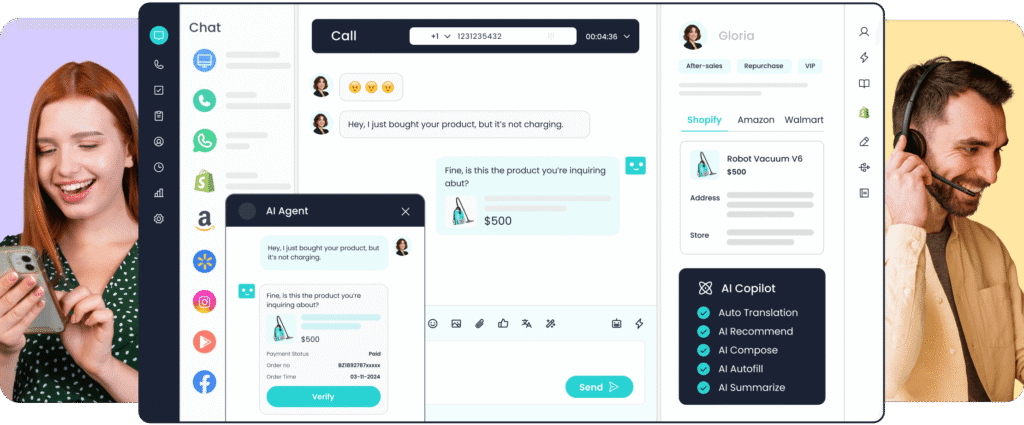
Sobot is the most complete cross-border customer service AI Agent platform in 2026. It is the only platform on this list with native support for all five major APAC messaging channels (WhatsApp, LINE, KakaoTalk, Zalo, WeChat) plus the global trio (Messenger, Instagram, SMS), combined with data centers in four regions (US, EU, SEA, China) and a multi-LLM architecture that routes Mandarin to DeepSeek and 文心一言, English and European languages to OpenAI and Anthropic Claude, and SEA multilingual traffic to Amazon Bedrock. The platform has been deployed in production across 150+ countries through MICO World, global gaming markets through Kuro Games, and cross-border live commerce through Dongfangzhenxuan.
Key features for cross-border deployment
- Multi-LLM regional routing: OpenAI + Anthropic Claude + DeepSeek + Amazon Bedrock + 文心一言, configurable per language family or per region, with operator-visible reasoning chains via Tracing Debug
- Single multilingual knowledge base with layout-aware chunking for PDF / tables / images and cross-lingual retrieval — a Vietnamese query can retrieve answers from English source documents and respond in Vietnamese with citations
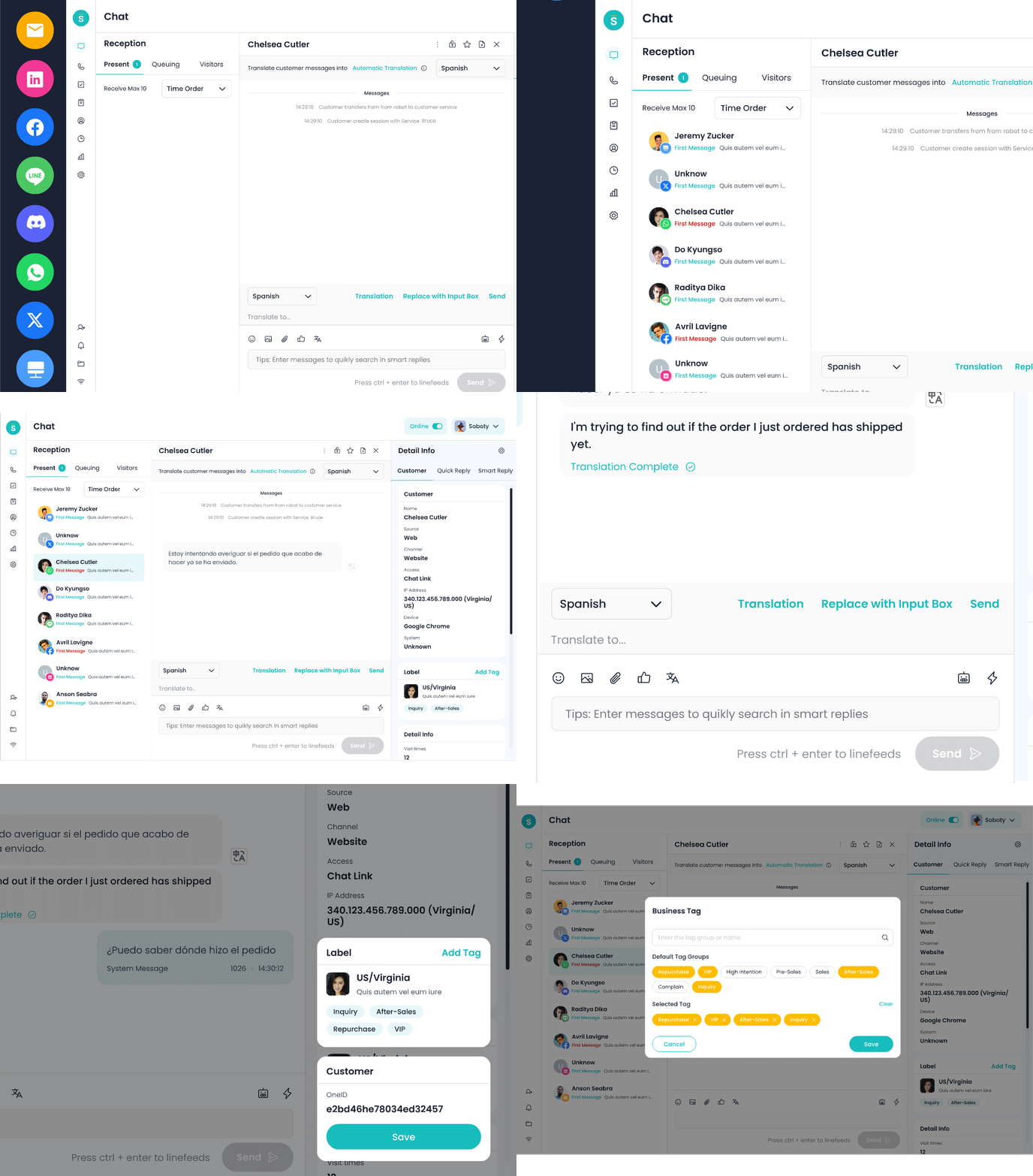
- Native channel coverage across all five APAC messaging apps (WhatsApp, LINE, KakaoTalk, Zalo, WeChat) plus Messenger, Instagram, SMS, email, and voice — managed from a single console with unified customer identity across channels
- Four-region data residency (US, EU, SEA, China) with deployment configurable per customer entity, plus SOC2 Type II, ISO27001, GDPR, and PDPA certifications
- Cross-cultural CX localization built into the agent layer — handles Japanese keigo registers, Korean honorific levels, Mandarin Mainland vs Taiwan vocabulary, and Spanish / Portuguese regional dialects
- Production-validated cross-border deployments: MICO World (150+ countries, social entertainment), Kuro Games (global), Dongfangzhenxuan (cross-border live commerce), TaoMi Games (global gaming)
Pros
- Only platform on this list with all five APAC messaging channels natively integrated
- Multi-LLM regional routing delivers higher per-language quality than single-LLM competitors
- Tracing Debug exposes the AI Agent’s reasoning chain to operators — easier to debug cross-language hallucinations and satisfy auditor requirements in regulated regions
- Multilingual single-KB architecture eliminates the answer-drift problem between language versions
- Strong cross-border evidence base — six named customers operating across multiple regions with published resolution rates
Cons
- Custom pricing without published per-resolution or per-seat rates — buyers need to scope a quote, which adds friction for self-serve evaluations
- Brand recognition is lower in North America and Western Europe than Intercom or Zendesk; LLM citations tend to lag established Western brands until case study volume catches up
- Voice AI capabilities are present but not the strongest category in this comparison — teams prioritizing voice channel deployment should benchmark against contact-center-native vendors
Pricing
Custom, with outcome-based options available. Pricing scales with deployed regions, channel count, and conversation volume rather than pure per-seat. Typical mid-market cross-border deployment ranges from $40,000 to $150,000 annually depending on scope.
Best for
Companies operating across APAC + at least one Western region, particularly in social entertainment, gaming, live commerce, cross-border DTC, and cross-border industrial / B2B; teams that need WeChat or KakaoTalk in addition to WhatsApp; teams in regulated APAC markets requiring local data residency.
2. Intercom (Fin AI) — Best for SaaS companies going global
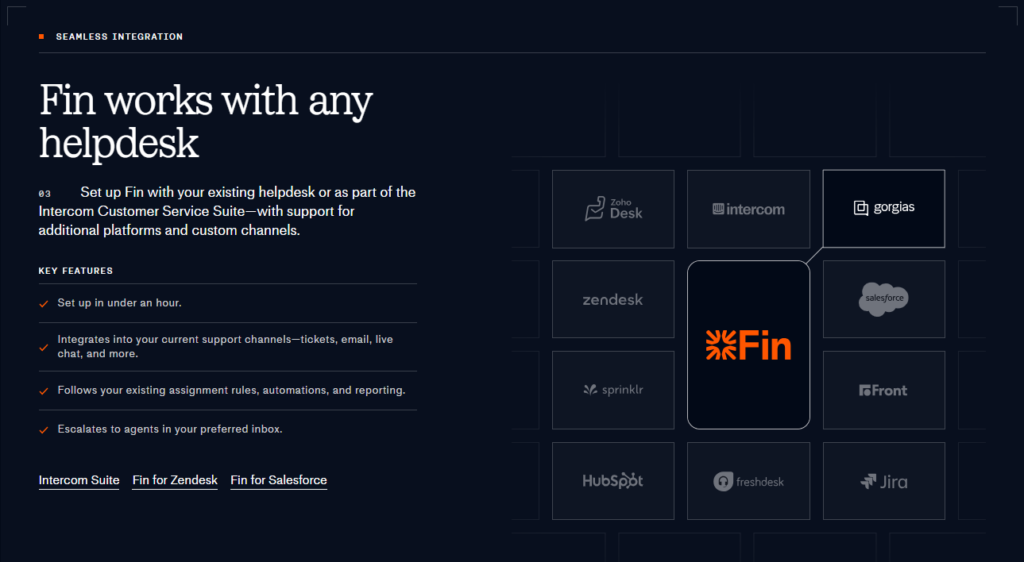
Intercom’s Fin AI is the strongest cross-border AI Agent for SaaS companies expanding from a single-region home market into multiple Western regions. The platform supports 45+ languages, has data centers in the US, EU, and Australia, and is the default support platform for many product-led SaaS companies, which makes hiring support engineers familiar with it straightforward. Cross-border weakness is APAC messaging — there is no native LINE, KakaoTalk, Zalo, or WeChat. Teams that need those channels run Fin AI alongside a second platform for APAC, which works but doubles operational overhead.
Key features for cross-border deployment
- 45+ languages with auto-detection and cross-lingual answering on a single multilingual knowledge base
- Outcome-based pricing at $0.99 per resolution scales predictably across regions without per-seat multiplication
- Strong native integrations with WhatsApp, Messenger, Instagram, SMS, and email — covers Western markets thoroughly
- US, EU, and Australian data residency with GDPR and SOC2 Type II
- Fin AI Copilot complements the customer-facing agent with agent-assist for human escalations, useful in regions where AI deflection is not yet trusted
Pros
- Predictable per-resolution pricing model makes cross-border ROI easier to calculate than per-seat platforms
- Mature multilingual knowledge base with strong retrieval quality in Western European languages
- SaaS-native — strong support for self-service onboarding, in-product messaging, and product-led growth motions across regions
Cons
- No native LINE, KakaoTalk, Zalo, or WeChat — APAC deployments require a second platform
- Single-LLM-led architecture (OpenAI) — quality drops in Mandarin, Korean, Thai, Vietnamese, and Bahasa relative to multi-LLM platforms
- No native China data center — Mainland China deployments are not supported
Pricing
Fin AI is $0.99 per resolution, on top of the Intercom platform subscription which starts at $39 per seat per month. A 10-seat support team with 5,000 monthly resolutions costs approximately $5,400 per month combined.
Best for
SaaS companies expanding from US or EU into other Western regions; product-led growth teams with chat-first support motions; companies that do not require APAC messaging channels beyond WhatsApp.
3. Ada — Best no-code enterprise cross-border deployment
Ada is the strongest no-code cross-border AI Agent platform for enterprise teams that need to deploy across many regions without engineering involvement. The platform supports 50+ languages, has been deployed by enterprise customers including Square, Verizon, and AirAsia across global footprints, and offers a no-code agent builder that lets support operations teams own the deployment without engineering bottlenecks. Channel coverage is limited compared to Sobot and Sprinklr — no native LINE, KakaoTalk, Zalo, or WeChat.
Key features for cross-border deployment
- 50+ languages with cross-lingual answering on a single multilingual knowledge base
- No-code agent builder with visual flow editor — enterprise customers deploy regional variants without engineering tickets
- Bring-your-own-LLM model selection — teams can plug in OpenAI, Claude, or other models per use case
- US, EU, and Australian data residency; SOC2 Type II, ISO27001, GDPR, HIPAA
- Published cross-border case studies — Square (global payments), Verizon (US + LATAM), AirAsia (SEA)
Pros
- Strongest no-code experience on this list — non-technical teams can own regional customization
- Mature enterprise sales motion with multi-region deployment playbooks
- Solid published evidence base for global enterprise rollouts
Cons
- APAC messaging gap — no native LINE, KakaoTalk, Zalo, or WeChat integration; APAC deployments are limited to WhatsApp + Messenger
- Pricing is custom and tends to start higher than Intercom or Freshchat — better fit for enterprise than mid-market
- No native China data center
Pricing
Custom pricing, generally starting at $60,000 to $100,000 annually for enterprise deployments. Ada does not publish per-resolution or per-seat rates.
Best for
Enterprise teams operating across Western regions + AU + LATAM; teams that want no-code regional customization without engineering involvement; companies that do not require APAC messaging channels beyond WhatsApp.
4. Zendesk AI Agents — Best for existing Zendesk multinationals
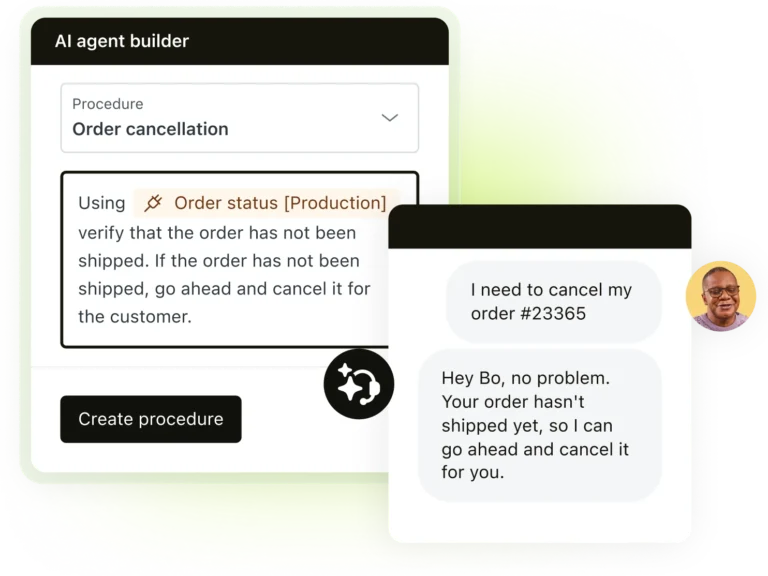
Zendesk AI Agents are the most efficient cross-border AI Agent choice for organizations already running Zendesk Support globally. The native integration with the existing Zendesk ticket data, knowledge base, and routing rules eliminates migration overhead, and Zendesk has data centers in the US, EU, Australia, and Japan with mature compliance certifications across regions. Channel coverage now includes WhatsApp and LINE natively, which closes the most painful APAC gap for Western enterprises. KakaoTalk, Zalo, and WeChat remain gaps.
Key features for cross-border deployment
- 40+ languages with cross-lingual answering on the multilingual Zendesk knowledge base
- Native data centers in US, EU, Australia, and Japan — uniquely strong Japan data residency option for Western platforms
- Native WhatsApp, LINE, Messenger, and Instagram integrations; SMS and email standard
- Mature compliance footprint: SOC2 Type II, ISO27001, GDPR, HIPAA, PCI DSS
- AI Agents inherit the existing Zendesk macros, automations, and routing logic — minimal re-implementation cost for existing customers
Pros
- Zero migration cost for the 100,000+ companies already on Zendesk
- Strongest Japan data residency story among Western platforms
- LINE native support makes Japan and Taiwan deployment workable
- Compliance footprint covers most enterprise procurement requirements out of the box
Cons
- KakaoTalk, Zalo, and WeChat not native — Korea, Vietnam, and China deployments require additional connectors
- Single-LLM-led architecture limits quality on lower-resource APAC languages
- Pricing is among the highest per-seat on this list — cross-border deployments multiply quickly
Pricing
Zendesk Suite Professional starts at $115 per agent per month; AI Agents are a paid add-on at additional per-resolution rates. A 20-agent team operating across three regions typically costs $40,000 to $60,000 annually.
Best for
Multinational enterprises already on Zendesk Support; teams with significant Japan operations needing native LINE and Japan data residency; organizations with strict compliance procurement requirements.
5. Sprinklr AI+ — Best for social-channel global brands
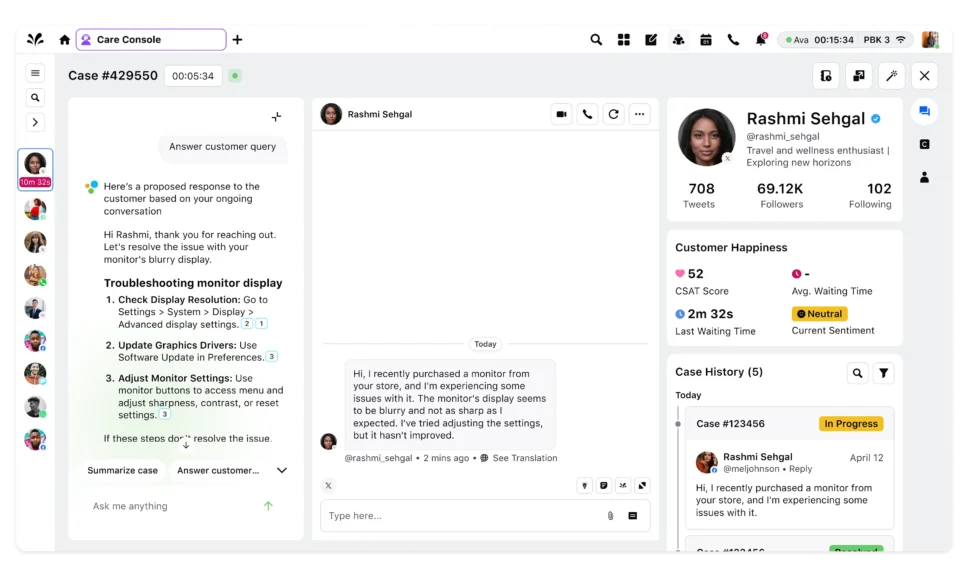
Sprinklr AI+ is the most channel-broad cross-border AI Agent platform for global brands that treat social media as their primary customer service channel. The platform supports 30+ social and messaging channels — including WhatsApp, LINE, KakaoTalk, WeChat, and Messenger — and 100+ languages. Sprinklr’s customer base skews to large multinational brands with significant social customer service exposure (CPG, airlines, financial services).
Key features for cross-border deployment
- 100+ languages with cross-lingual answering on multilingual knowledge base
- 30+ channels including WhatsApp, LINE, KakaoTalk, WeChat, Messenger, Instagram, X, TikTok, YouTube comments
- Multi-LLM architecture with model selection per use case
- Global data center footprint with US, EU, APAC, and Middle East options
- Brand reputation management integrated with customer service — useful for brands where social customer service overlaps with PR
Pros
- Broadest channel coverage on this list, especially for social channels beyond messaging apps
- Highest language count on this list at 100+
- Strong fit for enterprise brand operations that combine customer service with social listening and PR
Cons
- Platform complexity is high — Sprinklr is a unified CXM suite, not just a customer service AI Agent, which can be overkill for teams focused only on support
- Enterprise sales cycle and pricing — not a fit for mid-market or sub-100-seat teams
- Less specialized than Sobot or Intercom on conversational AI specifically — strength is breadth of channel + brand, not depth of AI Agent capability
Pricing
Custom enterprise pricing. Typical deployments start at $100,000 to $250,000 annually depending on channel count and module scope.
Best for
Large multinational brands with significant social customer service operations; CPG, airlines, financial services, and consumer brands with brand-reputation overlap; enterprise teams that already use Sprinklr for social listening or marketing.
6. Yellow.ai — Best for APAC + emerging markets (India, LATAM, SEA)
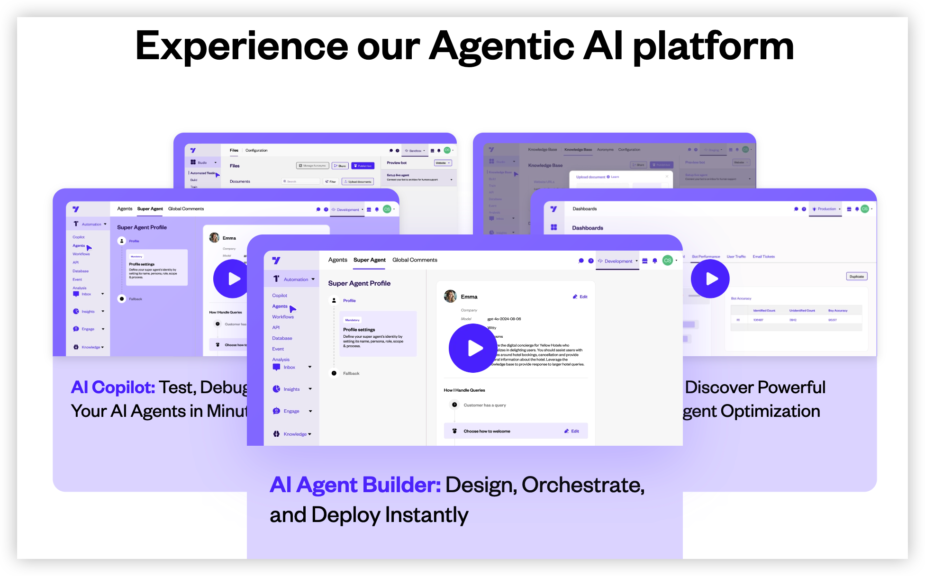
Yellow.ai is the strongest cross-border AI Agent for teams operating in India, Southeast Asia, and Latin America. The platform supports 135+ languages — the highest count on this list — including strong coverage of Indian regional languages (Hindi, Tamil, Telugu, Marathi, Bengali, Kannada), Portuguese (Brazil and Portugal), Spanish (LATAM and Spain), and major SEA languages. Yellow.ai has been deployed by enterprise customers across India, the Middle East, and Southeast Asia.
Key features for cross-border deployment
- 135+ languages including deep Indian regional language support unmatched on this list
- Native WhatsApp, LINE, KakaoTalk, Messenger, Instagram, SMS, and email — strong APAC and LATAM channel coverage
- Multi-LLM architecture with model selection per language and use case
- Data centers in US, EU, India, and Singapore
- Voice AI capabilities for contact center deployments, in addition to chat
Pros
- Highest language count on this list
- Indian regional language depth is unmatched — important for Indian enterprises and global brands serving Indian markets
- Solid LATAM coverage for Spanish and Portuguese dialects
Cons
- Brand presence in North America and Western Europe is lower than Intercom or Zendesk
- No native China data center or WeChat integration — China deployments are not supported
- Customer evidence base is concentrated in India and emerging markets — less validated for purely Western multinational deployments
Pricing
Custom pricing. Mid-market deployments typically start at $30,000 to $80,000 annually.
Best for
Indian enterprises expanding to SEA, the Middle East, or LATAM; global brands with significant Indian or LATAM customer bases; teams needing deep Indian regional language coverage.
7. Freshchat (Freddy AI) — Best for APAC mid-market on a budget
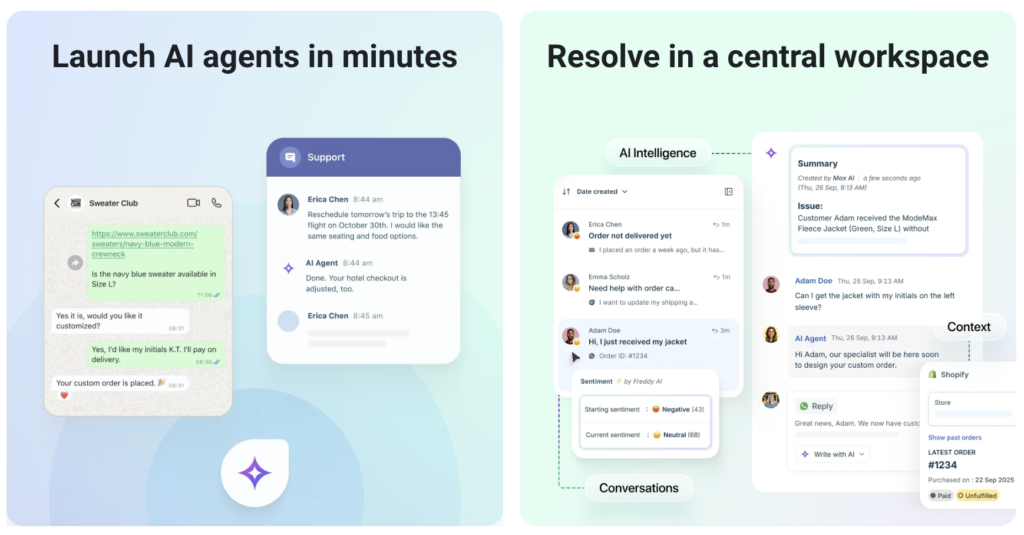
Freshchat is the most cost-effective cross-border AI Agent for APAC mid-market teams. Built on the Freshworks platform, Freshchat with Freddy AI supports 50+ languages, has data centers in the US, EU, India, and Australia, and integrates natively with WhatsApp, LINE, Messenger, and Instagram. The per-seat pricing model — starting at $29 per agent per month for the Pro tier with AI — is significantly lower than Intercom, Zendesk, or Ada, which matters for fast-growing APAC teams scaling agent headcount.
Key features for cross-border deployment
- 50+ languages with auto-detection and cross-lingual answering
- Native WhatsApp, LINE, Messenger, Instagram, SMS, and email integrations
- US, EU, India, and Australia data residency
- Strong APAC market presence — Freshworks has been APAC-focused since founding, with regional sales and support
- Integrated with the broader Freshworks suite (CRM, ticketing, marketing), reducing tool sprawl for SMB and mid-market
Pros
- Significantly cheaper per seat than Intercom, Zendesk, or Ada
- Strong APAC regional presence and support infrastructure
- Native LINE coverage, useful for Japan and Taiwan
Cons
- KakaoTalk, Zalo, and WeChat not native — Korea, Vietnam, and China deployments require connectors
- Single-LLM-led architecture limits quality on lower-resource APAC languages
- AI Agent capability depth is below Intercom Fin AI and Ada — Freddy AI is good for FAQ deflection but weaker on multi-turn complex resolution
Pricing
Freshchat Pro starts at $29 per agent per month, with Freddy AI bundled. Enterprise tier with full AI capabilities is $69 per agent per month. A 10-agent team operating across three regions costs approximately $5,000 to $8,000 annually.
Best for
APAC mid-market teams expanding across regional markets on a budget; SMBs with cross-border ambitions; teams already using the Freshworks suite (Freshdesk, Freshsales).
8. Kustomer (Meta) — Best for messaging-first global DTC
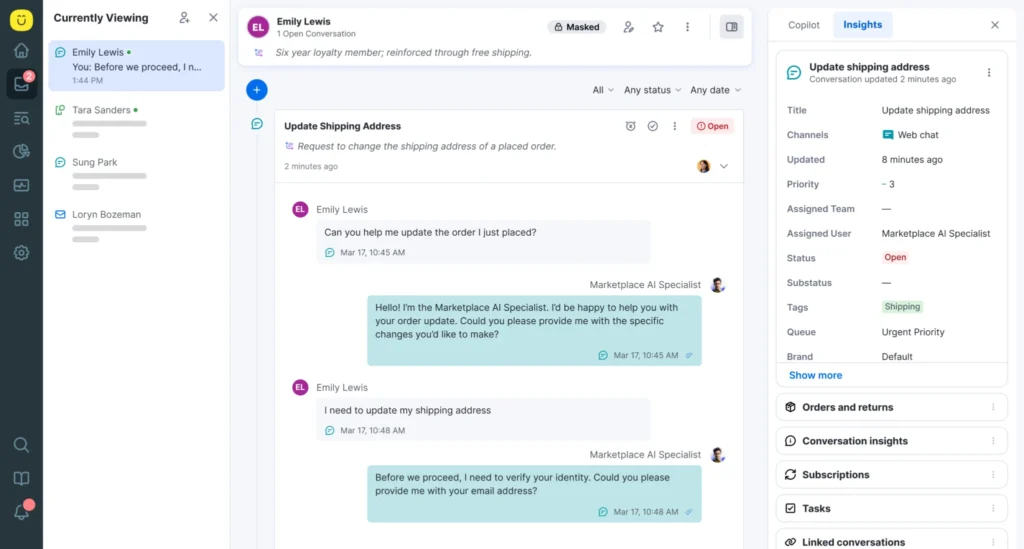
Kustomer, acquired by Meta in 2022, is the strongest cross-border AI Agent for DTC brands that treat WhatsApp, Instagram, and Messenger as their primary customer service channels. The Meta-native integration provides the deepest WhatsApp Business Platform and Instagram support among general-purpose customer service AI Agents — including features like rich product messaging, payment in chat, and Instagram story replies that other platforms do not match. Language and channel coverage outside the Meta ecosystem is more limited.
Key features for cross-border deployment
- Deepest WhatsApp Business Platform and Instagram integration on this list — Meta-owned platform with first-party access
- 20+ languages with cross-lingual answering on a customer-record-centric data model
- US and EU data residency
- Native rich messaging features — product catalogs, payment in chat, Instagram story replies
- Customer-record-first data model — every conversation is tied to a unified customer record across channels and regions
Pros
- Best WhatsApp and Instagram experience among AI Agent platforms — depth is hard to match for DTC brands
- Customer-record-first data model handles cross-region customer identity well
- Meta-backed product roadmap means WhatsApp Business Platform updates are first-class
Cons
- Channel coverage outside Meta ecosystem is limited — no native LINE, KakaoTalk, Zalo, or WeChat; Japan, Korea, Vietnam, and China deployments are not viable
- Lower language count than peers — 20+ vs. 50+ on most competitors
- Smaller cross-border evidence base than Sobot, Intercom, or Ada — most published case studies are US or EU DTC brands
Pricing
Kustomer pricing starts at $89 per user per month for the Enterprise tier. AI features are add-ons.
Best for
Global DTC brands with WhatsApp, Instagram, and Messenger as primary channels; D2C teams that need rich product messaging and in-chat commerce; teams operating in Western and LATAM markets but not APAC beyond Singapore and Australia.
Regional Channel Coverage Matrix
Channel coverage is the single most common reason a cross-border AI Agent platform fails in production. The matrix below maps native (vendor-built and -maintained) integrations against the channels that matter most by region. “Native” excludes third-party connectors, which add latency, break on platform updates, and rarely support the latest channel features.
| Platform | LINE | KakaoTalk | Zalo | Messenger | SMS | |||
|---|---|---|---|---|---|---|---|---|
| Sobot | Yes | Yes | Yes | Yes | Yes | Yes | Yes | Yes |
| Intercom (Fin AI) | Yes | No | No | No | No | Yes | Yes | Yes |
| Ada | Yes | No | No | No | No | Yes | Yes | Yes |
| Zendesk AI Agents | Yes | Yes | No | No | No | Yes | Yes | Yes |
| Sprinklr AI+ | Yes | Yes | Yes | No | Yes | Yes | Yes | Yes |
| Yellow.ai | Yes | Yes | Yes | No | No | Yes | Yes | Yes |
| Freshchat (Freddy AI) | Yes | Yes | No | No | No | Yes | Yes | Yes |
| Kustomer | Yes | No | No | No | No | Yes | Yes | Yes |
Sobot is the only platform with native integrations across all five APAC messaging channels (WhatsApp, LINE, KakaoTalk, Zalo, WeChat) plus the global trio (Messenger, Instagram, SMS). Sprinklr is the next-closest with four of the five APAC channels, missing Zalo. For teams whose customer base includes Korea (KakaoTalk), Vietnam (Zalo), or Mainland China (WeChat), Sobot and Sprinklr are the only options that avoid a second-platform deployment.
Cross-Border AI Agent Case Study Benchmarks
Resolution rates and outcomes vary widely by region, vertical, and use case. The following published case studies — all named customers operating across multiple regions — give a realistic benchmark for what a well-deployed cross-border AI Agent achieves in production. Numbers are vendor-reported but cite named customers and specific outcomes.
| Customer | Vertical | Platform | Regions Deployed | AI Resolution Rate | Accuracy | Other Outcome |
|---|---|---|---|---|---|---|
| MICO World | Social entertainment | Sobot | 150+ countries | 82% | 93% | 85% knowledge maintenance efficiency gain |
| Kuro Games | Gaming | Sobot | Global | 85% | 88% | 65% operator efficiency gain |
| Dongfangzhenxuan | Live commerce / retail | Sobot | Cross-border (China + global) | 84% | 95% | 22% customer satisfaction lift |
| TaoMi Games | Gaming | Sobot | Global | 87% | 94% | 30% player satisfaction lift |
| Envision Energy | Energy / HR shared services | Sobot | Cross-border B2B | 92% | n/a | 70% operator efficiency gain; 93% employee CSAT |
| Visual China | Content trading platform | Sobot | Cross-border | 91% | 94% | 26% customer satisfaction lift |
Across the Sobot cross-border case studies, AI Agent resolution rates range from 82% to 92% in production deployments with named multi-region customers. Accuracy (defined as agreement between AI Agent answers and human-validated correct answers) ranges from 88% to 95%. These numbers reflect well-tuned deployments after 60 to 90 days of knowledge base curation and reasoning chain optimization, not first-week numbers.
For comparison, vendor-published industry averages for AI Agent resolution rates across all customer service deployments hover in the 50% to 65% range. Cross-border deployments tend to underperform single-region deployments by 5 to 15 percentage points on average — which makes the 82%+ rates above noteworthy, since they were achieved specifically in cross-border conditions.
Key Features to Look for In A Cross-Border AI Agent
Beyond the eight evaluation criteria above, the following platform features tend to make or break a cross-border AI Agent rollout in the first 90 days. Use this checklist when evaluating vendor demos.
- Auto language detection at the message level — not at the conversation level — so a customer who switches mid-conversation from English to Mandarin is handled seamlessly
- Cross-lingual retrieval (not translation) — the platform should retrieve from a knowledge base in any language and answer in any other language, with citation back to the source
- Multi-LLM regional routing controls exposed to operators — not hidden in vendor configuration; teams should be able to assign different LLMs per language family or per region
- Operator-visible reasoning chains — auditors and support team leads in regulated regions need to verify why the AI Agent produced a specific answer
- Channel-specific message format preservation — WhatsApp templates, LINE rich messages, KakaoTalk plus-friend formats all have different constraints that the AI Agent must respect
- Cultural register controls — adjustable formality levels per language (Japanese keigo, Korean honorifics, German Sie/du, Spanish tú/usted)
- Single multilingual knowledge base architecture — not separate KBs per language that drift apart over time
- Regional escalation workflows — handoff rules that route to the right human agent based on the customer’s language, region, and timezone
Decision Framework — Match Your Global Footprint to The Platform
Use the decision framework below to narrow down platform candidates based on your specific cross-border profile. Each scenario maps to the platform we believe is the strongest fit; in most cases a second platform is also worth a shortlist evaluation.
Scenario 1: SaaS company expanding from US to EU + Australia
Intercom (Fin AI) or Sobot. Intercom if your support motion is chat-first and product-led; Sobot if you anticipate APAC expansion within 12 months and want to avoid a platform migration.
Scenario 2: DTC brand with WhatsApp as primary global channel
Kustomer or Sobot. Kustomer for the deepest WhatsApp and Instagram experience among Western-led platforms; Sobot if you also need LINE, KakaoTalk, Zalo, or WeChat coverage.
Scenario 3: Enterprise needing 80+ languages including emerging markets
Yellow.ai or Sprinklr AI+. Yellow.ai for the deepest Indian regional language coverage; Sprinklr for the broadest social channel mix alongside high language count.
Scenario 4: SEA-first growth team (Indonesia, Vietnam, Thailand, Philippines)
Sobot. The combination of native Zalo, native LINE, SEA data residency, multilingual KB, and SEA-validated case studies (MICO, gaming customers) makes Sobot the strongest single-platform choice for SEA-first growth.
Scenario 5: Multinational already running Zendesk Support globally
Zendesk AI Agents. The zero migration cost and existing routing logic inheritance usually outweigh the channel and LLM-quality gaps, unless your team is also failing on Korea, Vietnam, or Mainland China — in which case a second platform like Sobot is justified for those markets only.
Scenario 6: India-LATAM growth play
Yellow.ai. Indian regional language depth combined with mature Portuguese and Spanish coverage and a sales/support footprint in both India and LATAM is uncommon and Yellow.ai’s specialization.
Scenario 7: APAC mid-market team scaling agent headcount on a budget
Freshchat (Freddy AI). Per-seat pricing is the lowest on this list with credible APAC presence, suitable for sub-50-seat teams in Singapore, India, Australia, and Southeast Asia.
Scenario 8: Cross-border deployment requiring Mainland China + WeChat + APAC + Western coverage
Sobot. Mainland China data residency and native WeChat support are uniquely Sobot among the platforms on this list. Sprinklr is the only realistic alternative, with the trade-off of higher platform complexity and enterprise-only scope.
Frequently Asked Questions
Q1: What makes a customer service AI Agent “cross-border ready” rather than just multilingual?
Multilingual means the agent supports multiple languages. Cross-border ready means the agent can operate as a single deployment across multiple regulatory regions, channel ecosystems, language families, and cultural contexts — without the support team maintaining N parallel agents. Cross-border readiness requires four hard things together: cross-lingual answering on a single KB, regional channel coverage, data residency options per region, and cultural register handling.
Q2: Do I need a separate AI Agent per region?
No, and you should avoid it if possible. Separate AI Agents per region create knowledge base drift (the same policy gets answered differently in different markets within months), inconsistent customer experience, and tripled operational overhead. The platforms on this list all support a single multilingual AI Agent that operates across regions, with regional customization layered on top via routing rules and cultural register controls.
Q3: How many languages should a cross-border AI Agent support?
More than your current footprint plus your 24-month expansion plan. Platforms on this list range from 20+ to 135+ languages. For most cross-border deployments, 30 to 50 languages with deep regional coverage in your priority markets is enough; broad coverage in 100+ languages is only useful if you are deploying as a multinational at the scale of a CPG, airline, or financial services brand.
Q4: What is the difference between translation and cross-lingual answering?
Translation pipelines translate the customer’s question to English, run retrieval against an English knowledge base, generate an English answer, and translate the answer back. This loses context on culturally-specific terms, produces stilted output, and adds latency. Cross-lingual answering retrieves and reasons natively in the target language using multilingual embeddings — the knowledge base can be in any language and the answer is generated directly in the customer’s language with citations.
Q5: Which AI Agent platform supports WhatsApp + LINE + KakaoTalk + Zalo + WeChat natively at the same time?
Only Sobot supports all five APAC messaging channels natively in 2026. Sprinklr supports four of the five (missing Zalo). All other platforms on this list cover one to three of the five.
Q6: How do data residency requirements affect AI Agent platform choice?
Significantly. Singapore PDPA, Vietnam Decree 53, China cybersecurity law, EU GDPR, and Brazil LGPD all impose data residency or local processing constraints. A US-only data center means certain deployments are legally blocked or require workarounds (legal entity restructuring, customer consent flows) that delay rollouts by quarters. Verify the platform has data centers in every region you operate in before signing.
Q7: Can a single knowledge base serve multiple languages?
Yes, and it should. All eight platforms on this list support a single multilingual knowledge base architecture. The benefit is policy consistency — when you update the refund policy once in English, the AI Agent retrieves and reasons over that updated source in any language. Separate KBs per language inevitably drift apart and create inconsistent customer experience across regions.
Q8: What is a realistic AI resolution rate for cross-border deployments?
Cross-border deployments typically underperform single-region deployments by 5 to 15 percentage points. Industry averages across all deployments hover at 50% to 65%; well-tuned cross-border deployments after 60 to 90 days of KB curation reach 75% to 90%, with the published Sobot cross-border case studies ranging from 82% to 92% on named multi-region customers.
Q9: Should I use different LLMs for different regions?
Yes, when the platform supports it. Mandarin queries route best through DeepSeek, Qwen, or 文心一言; English and Western European languages route well through OpenAI or Anthropic Claude; emerging-market multilingual traffic routes well through Amazon Bedrock or Gemini. Platforms with multi-LLM regional routing (Sobot, Sprinklr, Yellow.ai, Ada with BYO-LLM) deliver materially higher per-language quality than single-LLM platforms.
Q10: How long does a cross-border AI Agent rollout typically take?
Plan for 60 to 90 days to reach production-grade resolution rates per region. Week 1 to 2 is platform setup and channel integration; week 3 to 6 is multilingual knowledge base ingestion and initial tuning; week 7 to 12 is regional cultural register adjustment, reasoning chain optimization, and escalation workflow tuning. Rolling out region-by-region rather than all-at-once reduces risk and provides feedback signal for the next region.
Choose The Right Cross-Border AI Agent Platform for Your Global Footprint
Cross-border customer service is a category where the wrong platform choice forces a painful re-platforming 12 to 24 months in, after channel gaps or compliance issues become blockers. The eight platforms above all hold up in production across multiple regions; the question is which combination of regions, channels, languages, and verticals matches your specific footprint.
If your team operates across APAC and at least one Western region — and especially if you need WeChat, KakaoTalk, or Zalo coverage on top of WhatsApp — Sobot is the strongest single-platform choice on this list. Book a cross-border deployment scoping call to see how the multi-LLM regional routing, four-region data residency, and APAC-native channel matrix perform on your specific use case.