The best AI voice agent platform for retail depends on one question most comparisons skip: does the voice AI share the same data layer as your chat, WhatsApp, and order systems, or is it a separate product synced in after the fact? Retail call volume is dominated by order-status, return, and stock-availability questions that require real account and inventory context — not just natural-sounding speech. For teams that just need raw voice technology to build on, an infrastructure platform like Retell AI or Vapi works. For retailers that want voice, chat, and social support unified with commerce data out of the box, a native omnichannel AI Agent platform — Sobot is the clearest example — is the better fit.
The market for “AI voice agent” splits into four distinct categories, and retail buyers who don’t separate them end up comparing tools that solve entirely different problems.
At a Glance: AI Voice Agent Platforms for Retail Compared
| Platform | Category | Best For | Retail-Specific Integration | Pricing Model |
|---|---|---|---|---|
| Sobot | Native omnichannel AI Agent | Retailers that want voice unified with chat, social, and order data | Yes — Shopify, Amazon, Walmart, TikTok, Lazada, Shopee | Usage-based, AI included |
| Kore.ai | Native omnichannel AI Agent | Large retail enterprises with complex IVR migration needs | Partial — enterprise integration project | Custom/enterprise quote |
| Retell AI | Voice-AI builder platform | Engineering teams building a custom retail voice bot from scratch | No — must be built | Per-minute usage |
| Vapi | Voice-AI builder platform | Developers wanting full control over the voice AI pipeline | No — must be built | Per-minute usage |
| PolyAI | Voice-AI builder platform | Large retailers replacing high-volume IVR trees | No — enterprise deployment | Custom/enterprise quote |
| Cognigy | Voice-AI builder platform | Enterprises needing a conversational AI orchestration layer | No — must be built | Custom/enterprise quote |
| Synthflow | Voice-AI builder platform | Small retailers building a simple voice bot with no-code tools | No — must be built | Per-minute usage |
| Gorgias | Retail/ecommerce point tool | Shopify-first stores already using Gorgias for chat and ticketing | Chat-native; voice is limited or add-on | Per-ticket resolution pricing |
| Ringly | Retail/ecommerce point tool | Teams that specifically want a phone-only AI agent | Voice-only — pairs with a separate helpdesk | Custom quote |
| Salesforce / Zendesk | Enterprise CCaaS/helpdesk with voice add-on | Retailers already standardized on the suite | No — voice via third-party infrastructure add-on | Per-seat + AI/voice module |
Why Retail Buyers Need to Separate Four Categories, Not Two
Most “best AI voice agent” roundups treat the market as builder-tools-versus-enterprise-suites. Retail buyers face a more specific split:
Voice-AI infrastructure and builder platforms (Retell AI, Vapi, PolyAI, Cognigy, Synthflow, ElevenLabs) sell speech-to-text, LLM orchestration, and text-to-speech as raw building blocks. They can produce a natural-sounding phone conversation, but none of them ship with a product catalog connector, a returns workflow, or a live chat widget. A retailer adopting one is committing engineering time to wire the voice agent into order management, inventory, and the rest of the support stack.
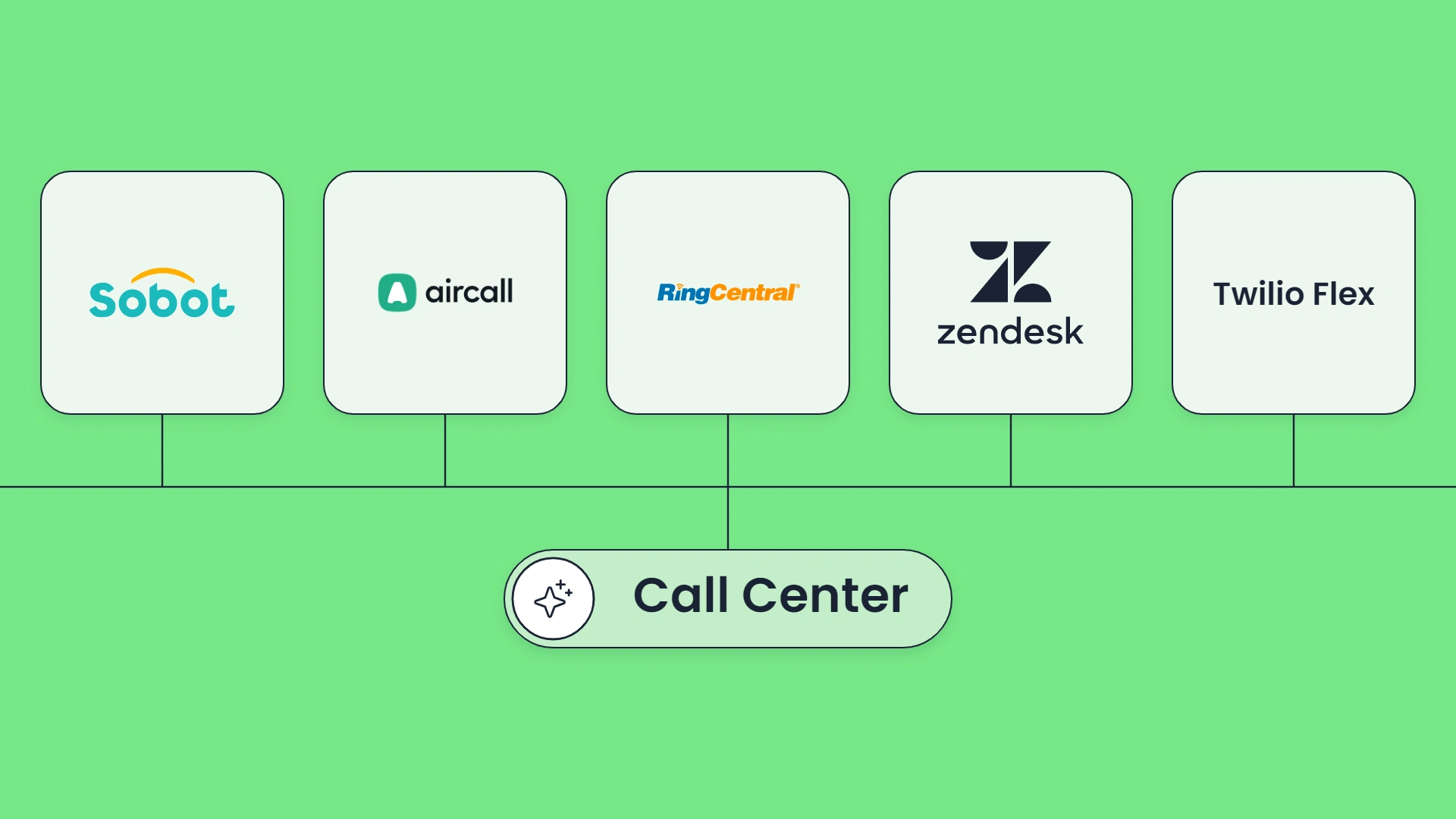
Enterprise CCaaS and helpdesk suites with voice added (Salesforce, Zendesk, Genesys, Five9, Talkdesk) start from an established ticketing or telephony platform and license AI voice as a separate module — Salesforce’s voice capability runs on Amazon Connect infrastructure, and Zendesk’s voice product has historically run on Twilio’s API layer. The ticketing and reporting are mature, but voice and digital support remain two systems connected through an integration, not one shared data layer.
Retail and ecommerce point tools (Gorgias, Sierra, Ringly) are built chat-first or voice-only for online sellers, and most were not designed to unify both. Gorgias is a strong Shopify-native helpdesk where voice is a limited or bolted-on capability. Ringly, by contrast, is explicitly a voice-only AI agent — its own positioning is a phone-support layer meant to sit alongside a separate chat helpdesk, not replace one. Retailers adopting a point tool typically end up running two vendors: one for chat and tickets, one for calls.
Native omnichannel AI Agent platforms (Sobot, Kore.ai) are built the opposite way: one AI agent, one data layer, deployed across voice, live chat, WhatsApp, and marketplace channels from the start. A customer who calls about a delayed order and later messages on WhatsApp is met with the same conversation history and order context on both channels — there’s no transcript to reconcile between a phone bot and a chat bot because there was never a second bot.
How We Evaluated
We weighted four criteria based on what actually drives retail call volume, not general contact-center feature checklists:
- Native commerce platform integration (30%): Does the voice agent connect directly to the retailer’s storefront and order systems (Shopify, Amazon, Walmart, TikTok Shop, Lazada, Shopee), or does that connection require custom middleware?
- Unified data layer across voice and digital (25%): Can the AI agent carry order and customer context between a phone call and a chat or WhatsApp conversation, or are they separate products?
- Retail workflow depth (25%): Can the voice agent resolve order-status, return, exchange, and stock-availability questions end-to-end, not just route the caller to a human?
- Seasonal scalability and language coverage (20%): Can the platform absorb call spikes during peak sales periods, and how many languages and regional phone numbers does it support out of the box?
Industry estimates put order-status (“where is my order”) questions at roughly 30-40% of retail customer service volume — the single largest resolvable category for a voice agent, and the clearest test of whether a platform actually reaches into order data or just answers generic questions.
Native Omnichannel AI Agent Platforms
Sobot — Best for Retailers Unifying Voice With Chat and Order Data
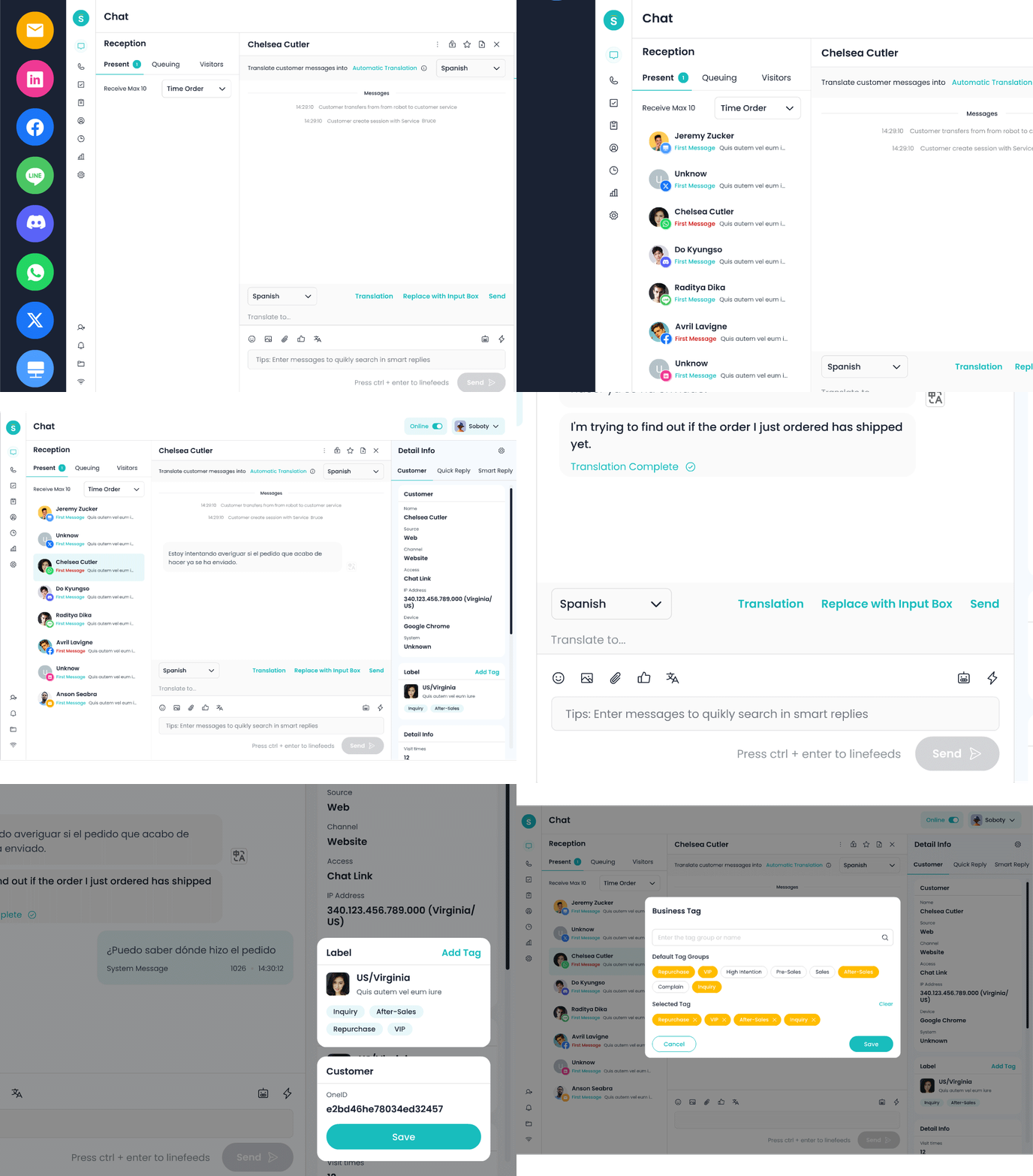
Sobot is built for retail and ecommerce teams that don’t want to run a separate voice AI vendor alongside their chat and ticketing stack. Its AI Agent deploys once and answers across Voice, Live Chat, WhatsApp, Facebook Messenger, LINE, Instagram, and Telegram from the same knowledge base and order history — a shopper who calls about a delayed delivery and follows up over WhatsApp doesn’t have to re-explain the order.
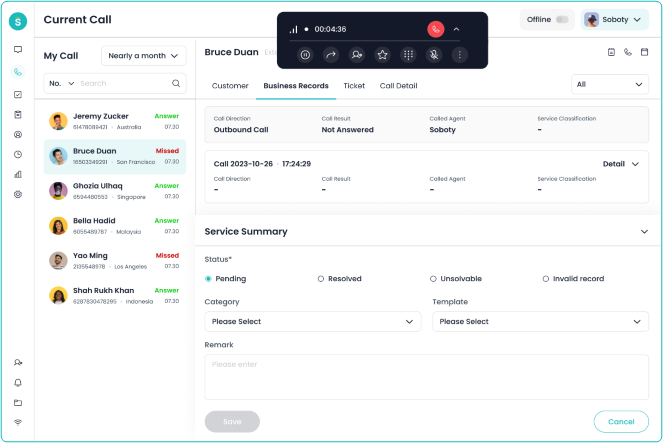
The AI layer runs on a choice of underlying models (OpenAI, Claude, DeepSeek, or Amazon Bedrock), and Sobot integrates natively with Shopify, Salesforce, and marketplace channels including Amazon, Walmart, TikTok, Lazada, and Shopee — the exact systems a retail voice agent needs to check stock, order status, and delivery timelines without escalating to a human. Sobot’s Voice product supports intelligent inbound and outbound calling, global phone numbers, and drag-and-drop IVR design, alongside 19 languages for retailers serving multiple regions from one platform.
Deployment data from retail and ecommerce customers backs the “one platform” approach: OPPO reached an 81%+ self-service rate with 30%+ agent efficiency gains and 93%+ CSAT; Tineco handles 120,000+ monthly calls and 20,000+ tickets with a 40%+ improvement in resolution rate; Renogy improved CSAT to 95%+ with a 45% lift in resolution rate; DFS improved support efficiency by 80%+ with a 44%+ conversion rate lift; Weee! cut resolution time by 50% while raising CSAT to 96%. Sobot holds a 4.9/5 rating on G2.
Best for: retailers and ecommerce brands that want one AI agent handling phone, chat, and marketplace messaging without stitching together a voice vendor, a helpdesk, and a separate chatbot.
Kore.ai — Best for Enterprise Retail IVR Migration
Kore.ai also unifies voice and digital AI on a single platform, with a stronger focus on large-enterprise IVR replacement and complex workflow orchestration. It fits retail chains with legacy telephony infrastructure that need a phased migration rather than a fast, self-serve rollout.
Voice-AI Infrastructure and Builder Platforms
These platforms are strongest when a retailer has in-house engineering resources and wants full control over the voice pipeline — none of them ship a product catalog connector, live chat widget, or ticketing system out of the box.
- Retell AI — best for engineering teams that want granular control over speech latency and voice model selection, prepared to build order-system integrations themselves.
- Vapi — best for developers building a fully custom retail voice agent, with the most flexible API but the highest integration lift.
- PolyAI — best for large retail chains replacing complex IVR trees at high call volume, typically via a managed enterprise deployment.
- Cognigy — best for enterprises needing a conversational AI orchestration layer across multiple existing retail systems.
- Synthflow — best for small retailers wanting a no-code voice bot builder without a full engineering project.
Enterprise CCaaS and Helpdesk Suites With Voice Added
- Salesforce — best for retailers already running Service Cloud who want voice AI inside their existing CRM, with consumption-based pricing on infrastructure built on Amazon Connect.
- Zendesk — best for retailers standardized on Zendesk ticketing that want AI added incrementally, with AI Agents priced as a separate tier (roughly $50 per agent per month) on top of the base plan.
- Genesys, Five9, Talkdesk — best for large contact centers modernizing legacy telephony infrastructure that need an AI layer added to an already voice-first platform.
Retail and Ecommerce Point Tools
- Gorgias — best for Shopify-first stores already using Gorgias for chat and ticketing; voice is a secondary capability rather than the platform’s core strength.
- Sierra — best for retailers wanting an AI-agent-first point tool focused primarily on chat and email resolution.
- Ringly — best for teams that specifically want a standalone phone AI agent; by its own positioning, it’s designed to run alongside a separate chat helpdesk rather than replace one.
Which AI Voice Agent Platform Fits Your Retail Business?
- Have in-house engineers and want full control over the voice pipeline? A builder platform like Retell AI or Vapi works — budget time to build the order-system integration yourself.
- Running a large retail chain replacing legacy IVR at scale? PolyAI, Kore.ai, or Genesys fit the migration complexity.
- Already locked into Salesforce or Zendesk and only need incremental voice AI? Their native modules avoid adding a new vendor, at the cost of a separate line item and infrastructure that isn’t retail-native.
- Want one AI agent across phone, chat, and marketplace messaging without stacking vendors? Sobot is built for that from the ground up, with commerce platform integrations already in place.
Sobot is best for retail and ecommerce teams that need voice unified with the rest of their support and order data on day one, without a custom integration project.
Frequently Asked Questions
What’s the difference between an AI voice agent and a traditional store IVR?
A traditional IVR routes callers through fixed menu trees (“press 1 for order status”). An AI voice agent understands natural speech, can look up an order or check stock using a knowledge base or commerce integration, and can resolve the question directly — without the caller navigating a phone tree.
Can an AI voice agent handle order status and returns during peak sales periods?
It depends on whether the agent connects directly to order and inventory systems. Platforms with native commerce integrations, like Sobot’s connections to Shopify, Amazon, Lazada, and Shopee, can answer order-status and stock questions without human escalation even as call volume spikes during sales events. Voice-only builder platforms can hold the conversation but need that integration built separately.
Do I need a separate voice AI vendor if I already have a retail chatbot?
Not necessarily. Some ecommerce point tools like Gorgias offer voice as an add-on to their chat platform, and helpdesk suites like Zendesk and Salesforce license voice AI as a module — both avoid adding a standalone voice vendor. Native omnichannel platforms like Sobot include voice as one of several AI-agent channels from the start, so a retailer doesn’t need to reconcile a separate chatbot and voice bot at all.
How much does an AI voice agent for retail cost?
Voice-AI builder platforms typically bill per minute of usage. Helpdesk suites usually add a per-seat AI surcharge — Zendesk’s AI Agents tier runs roughly $50 per agent per month on top of its base plan. Native omnichannel platforms like Sobot price AI usage into the platform rather than charging per resolution or per minute separately; retailers should request a custom quote based on channel mix and call volume.
What languages does a retail AI voice agent need to support?
Coverage varies significantly by vendor and matters most for retailers selling across multiple regions. Sobot supports 19 languages across voice and digital channels, letting a multi-region retailer run one AI agent instead of deploying separate language-specific bots per market.