Customer base classification through neural network algorithms


Neural network algorithms now drive a major shift in how you analyze your customer base. In customer contact and ecommerce, these algorithms help you understand and predict customer needs with precise accuracy. Market data shows rapid growth in neural network adoption:
| Year | Market Valuation (in billion USD) | CAGR (%) |
|---|---|---|
| 2022 | 0.2278 | N/A |
| 2032 | 1.4 | 19.9 |
Sobot stands out by bringing innovation to AI-powered customer solutions. Sobot AI connects all your channels, supports your customers, and protects their data. You can see how Sobot call center systems use generative AI for faster, smarter customer interactions. This guide helps you discover how neural networks classify customers and why this approach offers more value than traditional methods.
Customer Base Analysis with Neural Networks

Definition and Importance
You need to understand your customers to grow your business. Customer base analysis helps you group customers by behavior, preferences, or value. This process lets you see who buys often, who might leave, and who could become loyal fans. When you use neural networks for this analysis, you gain several key benefits:
- Improved accuracy: Neural networks analyze data more precisely than traditional methods, so you get reliable insights.
- Increased efficiency: AI processes large amounts of data quickly, saving you time and resources.
- AI scalability: As your data grows, neural networks handle it easily and keep delivering insights.
- Real-time insights: AI gives you up-to-date analysis, so you can make decisions fast.
- Predictive capabilities: Neural networks spot patterns and trends, helping you predict what customers will do next.
Customer base analysis is important for your business growth and customer retention. Studies show that keeping just 5% more customers can boost your profits by 25% to 95%. If you lose a customer, it can cost you an average of $243. Satisfied customers often become brand advocates, bringing in new buyers through word-of-mouth. When you focus on customer experience, you build loyalty and make it harder for competitors to win over your customers.
Sobot’s Approach
Sobot uses advanced neural network algorithms to help you analyze your customer base. The platform brings together all your customer touchpoints—chat, voice, email, and social media—so you get a complete view of every interaction. Sobot’s AI solutions include chatbots, AI agents, live chat, voicebots, ticketing systems, and WhatsApp Business API. These tools work together to automate support, answer questions, and collect valuable data for analysis.
Sobot’s unique approach uses several AI methodologies:
| Methodology Type | Description |
|---|---|
| Omnichannel AI | Covers every customer touchpoint for seamless interaction. |
| Scenario-based AI | Tailored specifically for e-commerce and retail scenarios. |
| Multi-faceted AI | Incorporates AI agents, copilots, and insights for versatility. |
| Generative AI | Utilizes multiple advanced LLMs for enhanced capabilities. |
| Secure AI | Ensures data privacy and compliance in all operations. |
Neural networks like Self-Organizing Maps (SOMs) and autoencoders help Sobot cluster similar customers and uncover hidden patterns in your data. Deep neural networks analyze complex relationships, making your segmentation more accurate. Businesses using Sobot’s customer classification have seen a 30% reduction in churn, a 40% increase in sales revenue, and a 20% drop in operational costs.
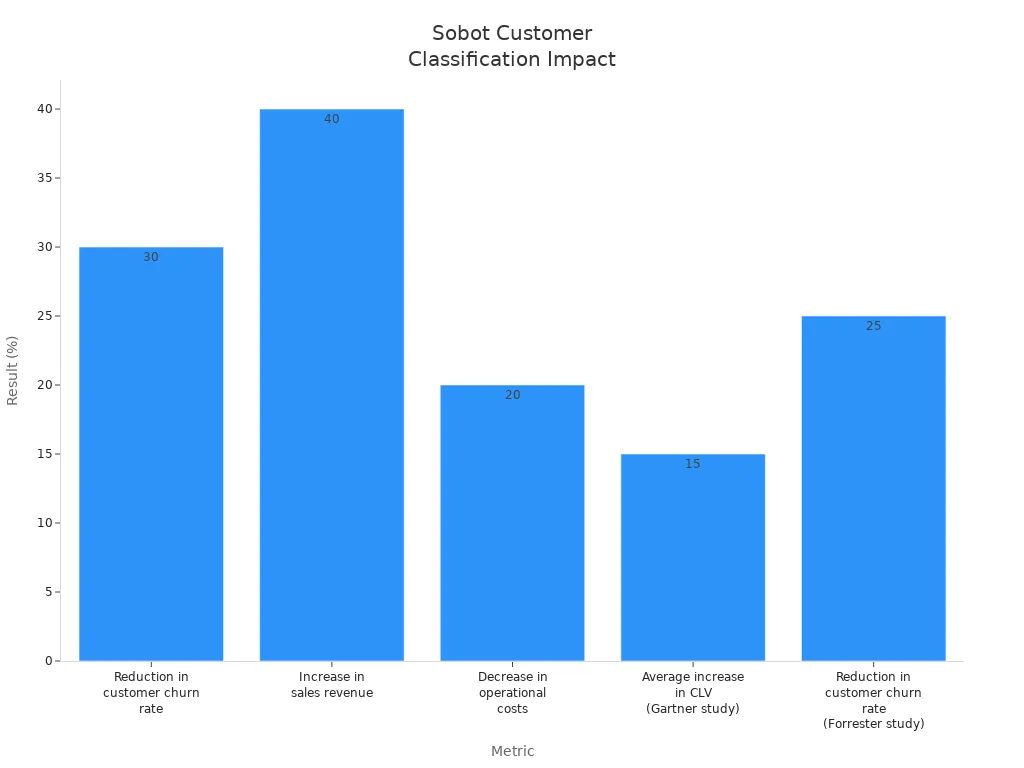
Sobot’s AI-driven analysis gives you the power to understand your customers, improve retention, and drive growth.
Understanding Consumer Behavior
Data Collection and Preprocessing
You need to collect the right consumer data to understand consumer behavior. In ecommerce, you often track many types of consumer behavior data. These include:
- Time spent on product pages
- Exit rates
- Bounce rates
- Visitor type
- User text comments
- Click behaviors
- Purchase history
You gather this consumer data from websites, apps, and customer service channels. Each piece of consumer data helps you see how a consumer interacts with your store. You can spot patterns in purchasing behavior and see what drives a consumer to buy or leave.
Before you use this consumer data in a neural network, you must prepare it. Follow these best practices for preprocessing:
- Data Cleaning: Remove errors and fill in missing consumer data.
- Data Reduction: Delete duplicate or irrelevant consumer data.
- Data Transformation: Change consumer data into the right format for analysis.
- Data Enrichment: Add new features to improve your model.
- Data Validation: Split consumer data into training and test sets.
Standardize each feature in your consumer data. This means you set the mean to 0 and the standard deviation to 1. Standardization helps your neural network learn faster and more accurately.
Feature Engineering
Feature engineering lets you turn raw consumer data into useful information for your model. You create new features from existing consumer data to highlight important aspects of consumer behavior. For example, you can combine time spent on a page and click behaviors to measure engagement. You can also track purchasing frequency to see which consumer buys often.
You might use these steps in feature engineering:
- Create new variables that show purchasing trends.
- Group consumer data by purchasing behavior, such as first-time buyers or repeat customers.
- Use text analysis on consumer comments to find common concerns or interests.
Good feature engineering helps your neural network find patterns in consumer behavior. You get better predictions about purchasing and customer loyalty. When you focus on the right features, you improve your customer base analysis and make smarter business decisions.
Classification Process
Model Selection
You need to choose the right neural network models for customer base classification. The model you select shapes the predictive power of your analysis and impacts how well you can segment customers. You want a model that can handle complex data and deliver accurate prediction results.
Recent research highlights several neural network models that excel in customer segmentation and prediction tasks:
- MNeuralTab models reach high accuracy rates, up to 99.62%, making them effective for customer churn prediction.
- Hybrid neural network models combine different architectures. These models overcome the limits of single models and improve prediction accuracy for customer segmentation.
- Advanced models like BiLSTM-CNN outperform traditional models such as CNN, RNN, and BiLSTM. BiLSTM-CNN models deliver higher accuracy in customer classification and prediction tasks.
You must pay attention to model selection strategies. The number of layers, the type of activation functions, and the choice of parameters all affect the predictive power of your neural network models. Incorrect choices can lower prediction accuracy and reduce the value of your customer base analysis.
When you select a model, you should consider these factors:
| Criteria | Description |
|---|---|
| Data Complexity | Choose models that can process structured and unstructured customer data. |
| Segmentation Needs | Pick models that support multi-class segmentation for diverse customer groups. |
| Predictive Power | Select models with proven high accuracy in prediction tasks. |
| Scalability | Ensure the model can handle growing customer data volumes. |
| Interpretability | Prefer models that allow you to understand how predictions are made. |
Tip: You can test several neural network models on a small sample of your customer base before scaling up. This helps you find the best fit for your segmentation and prediction needs.
You want to maximize predictive power and efficiency. Hybrid models and advanced architectures often provide the best results for customer segmentation and predictive modeling.
Training and Evaluation
After you select your neural network models, you need to train them using your customer data. Training helps your model learn patterns in customer behavior and improves its predictive power for segmentation and prediction tasks.
You start by splitting your customer base data into training and test sets. The training set teaches the model about customer patterns. The test set checks how well the model predicts new customer outcomes.
You follow these steps during training:
- Data Preparation: You clean and standardize customer data. This step ensures your neural network models learn efficiently.
- Model Initialization: You set up the neural network architecture. You choose the number of layers, activation functions, and learning rates.
- Training Process: You feed the training data into the model. The model adjusts its weights to improve prediction accuracy.
- Validation: You use a validation set to monitor the model’s performance and prevent overfitting.
- Testing: You evaluate the model on the test set. This step shows how well your model predicts customer outcomes.
You measure the performance of your neural network models using several key metrics:
- Accuracy measures the proportion of correctly classified customer instances.
- Precision assesses the proportion of true positive predictions among all positive predictions.
- Recall calculates the proportion of true positive predictions among all actual positive customer instances.
- F1 Score combines precision and recall, giving you a balanced measure of your model’s predictive power.
| Metric | What It Tells You |
|---|---|
| Accuracy | How many customer predictions are correct |
| Precision | How many predicted positive customers are correct |
| Recall | How many actual positive customers are predicted |
| F1 Score | Balance between precision and recall |
Note: High accuracy does not always mean your model is the best. You should look at precision, recall, and F1 Score to get a full picture of your model’s predictive power.
You can use cross-validation to test your neural network models on different segments of your customer base. This method helps you see how well your model generalizes to new customer data. You want your model to perform well across all customer segments, not just one group.
You should also monitor your model’s predictive power over time. Customer behavior changes, so you need to retrain your neural network models regularly. This keeps your segmentation and prediction results accurate and relevant.
You can use tools like confusion matrices to visualize your model’s performance. These tools show you where your model makes correct and incorrect predictions for each customer segment.
Here is a simple example of a confusion matrix for customer segmentation:
| Predicted Loyal | Predicted At-Risk | Predicted New | |
|---|---|---|---|
| Actual Loyal | 120 | 10 | 5 |
| Actual At-Risk | 8 | 95 | 12 |
| Actual New | 3 | 7 | 80 |
You see how many customers are correctly classified in each segment. You also spot where your model needs improvement.
You can use Sobot’s AI-powered tools to automate training and evaluation. These tools help you optimize your neural network models for customer segmentation and prediction tasks. You get real-time feedback and easy-to-understand reports.
You want to keep improving your model’s predictive power. Regular evaluation and retraining help you stay ahead in customer base analysis and segmentation.
Customer Churn Prediction
Neural Network Techniques
You can use neural network techniques to improve customer churn prediction in retail and ecommerce. These methods help you spot which customers might leave your business. You start by collecting and preparing customer churn datasets. These datasets include details like purchase history, browsing behavior, and demographics. Next, you use feature engineering to find the most important factors that affect consumer loyalty and customer retention.
Neural networks work well for the customer churn prediction task because they can handle complex data. You design a model with several layers to learn patterns in customer behavior. You train the model using historical customer churn datasets. The model adjusts its weights to reduce errors and improve accuracy. After training, you evaluate the model with metrics such as accuracy and ROC-AUC. These metrics show how well your model predicts customer churn.
Once you finish the customer churn prediction task, you deploy the model. This lets you make real-time predictions and take action to keep customers. You can use these predictions to create targeted retention strategies and improve consumer loyalty. Neural networks help you build strong churn management strategies that support customer retention and business growth.
Tip: Regularly update your customer churn prediction models with new data. This keeps your analysis accurate and helps you respond quickly to changes in consumer loyalty.
Sobot Chatbot Applications
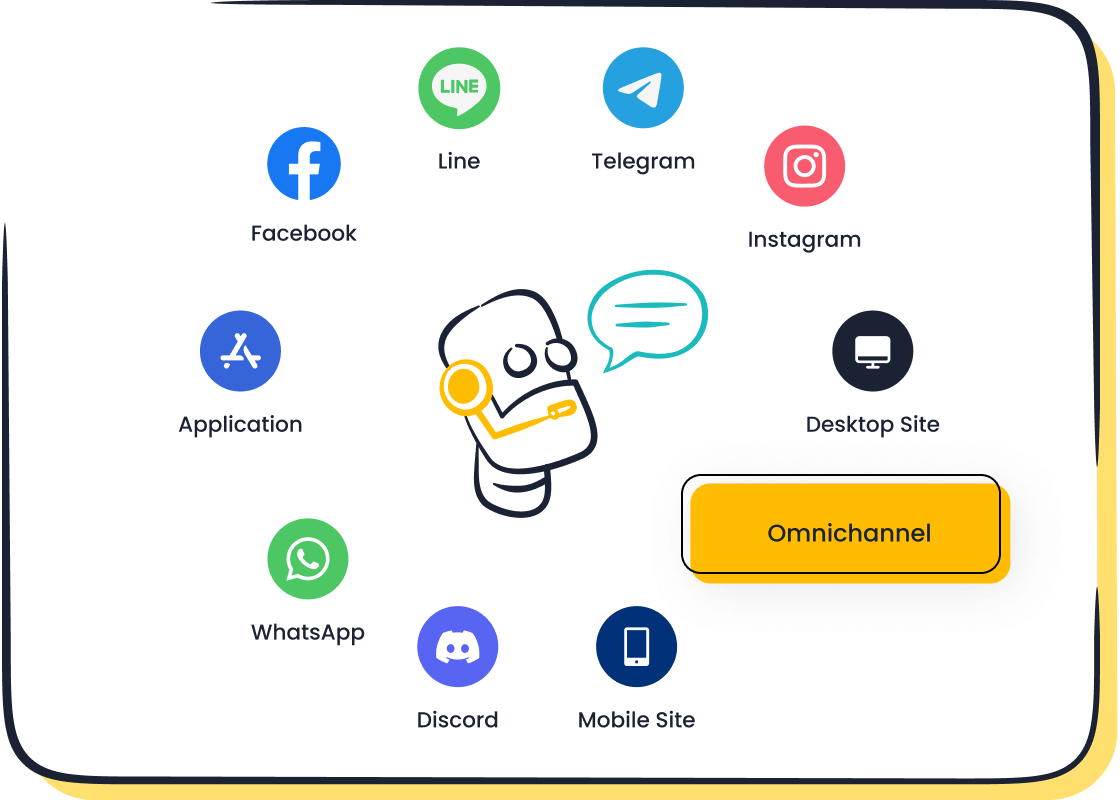
Sobot’s chatbot applications use neural networks to make customer churn prediction more effective. You can rely on Sobot’s AI to analyze customer base data and spot high-risk customers. The chatbot uses predictive analytics to engage these customers before they leave. It sends personalized messages and offers, which helps boost consumer loyalty and customer retention.
For example, in the retail and ecommerce sector, Sobot’s chatbot can identify customers who have not made a purchase recently. The chatbot reaches out with special deals or helpful information. This proactive approach supports customer retention and reduces churn rates.
OPPO, a global smart device brand, used Sobot’s AI chatbots to improve customer churn prediction. After using Sobot’s solutions, OPPO saw a 20% increase in customer engagement and a 15% reduction in churn. Customer satisfaction rose by 20%. By analyzing customer behavior, OPPO achieved a 25% reduction in churn rate. This real-world case shows how Sobot’s AI and chatbot applications help you keep customers and strengthen consumer loyalty.
You can use Sobot’s solutions to automate the customer churn prediction task, improve retention, and build lasting consumer loyalty. These tools help you act fast and keep your customer base strong.
Comparing Methods
Neural Networks vs. Traditional Approaches
You can see clear differences between neural networks and traditional methods when you analyze your customer base. Neural networks excel in handling complex data and deliver higher accuracy, especially with large datasets. For example:
- Neural networks reach up to 94% accuracy in tasks like image classification when trained on over a million records. Traditional algorithms often plateau at 70% accuracy.
- Neural networks scale well with growing data, while traditional methods struggle with large volumes and complex, unstructured information.
- Neural networks need more computational power, often using GPUs. Traditional models run on standard CPUs and work better with smaller datasets.
Traditional customer base analysis methods rely on historical data and economic indicators. These methods often miss sudden market changes, which can lead to lost revenue. Manual processes slow down response times and limit scalability. A McKinsey study found that companies using traditional analysis may lose 10-15% in revenue because they cannot adapt quickly to market shifts. Neural networks adjust to new data, helping you stay competitive and responsive.
When to Use Sobot Solutions
You should consider several criteria before choosing Sobot’s neural network solutions for customer service:
- Scalability: Sobot’s platform grows with your business and handles increasing customer volumes.
- Industry-specific features: Sobot offers tools tailored for retail, e-commerce, and other sectors.
- Integration: Sobot’s solutions connect smoothly with your existing customer service systems.
- Cost: Sobot provides a clear pricing model and reduces operational costs.
- Support and training: Sobot delivers comprehensive support and resources for successful implementation.
Sobot’s solutions stand out in customer base analysis. You can see the impact in real-world results:
| Company | Resolution Rate | Customer Satisfaction | Service Efficiency | Cost Reduction |
|---|---|---|---|---|
| OPPO | 83% | N/A | N/A | N/A |
| Samsung | N/A | 97% | N/A | N/A |
| Agilent Technologies | N/A | 95% | 600% increase | 25% |
| Opay | N/A | 90% | N/A | 20% |
You gain higher accuracy, faster response times, and better customer retention when you use Sobot’s neural network-powered tools. These advantages help you build a stronger customer base and improve your analysis.
Best Practices and Trends
Implementation Tips
You want your customer base classification project to succeed. Start with strong data preparation. Clean your customer data and use normalization to make sure features have similar scales. Feature engineering helps you highlight important patterns in customer behavior. High-quality data leads to better analysis and predictions.
Choose the right neural network architecture. Design layers that match your customer data complexity. Select activation functions that help your model learn faster. Use regularization to prevent overfitting and keep your model accurate.
During training, set a learning rate that allows your model to improve steadily. Pick a batch size that fits your hardware. Use early stopping to avoid wasting resources when your model stops improving.
Here is a table of best practices for implementing neural network algorithms:
| Category | Best Practices |
|---|---|
| Data Preparation | Normalization, Feature Engineering, Data Quality |
| Model Architecture | Layer Design, Activation Functions, Regularization |
| Training Process | Learning Rate, Batch Size, Early Stopping |
You may face challenges when deploying neural network models for customer analysis. Common issues include trustworthiness in AI, regulatory compliance, balancing accuracy and model size, scalability, integration with existing systems, model interpretability, and bias. You can overcome these by investing in scalable infrastructure, retraining models regularly, improving communication between teams, and using bias mitigation techniques.
Tip: Regular feedback loops and cloud solutions help you scale your customer analysis and keep your models up to date.
Future of Customer Base Analysis
Neural network technology will change how you analyze your customer base. You will see deeper insights from enhanced data analytics. Automation will make your operations more efficient and reduce costs. Neural networks will help you innovate faster, keeping your business competitive.
Here is a table showing how the future of customer base analysis will evolve:
| Aspect | Description |
|---|---|
| Enhanced Data Analytics | Deeper insights for better decision-making |
| Accelerated Innovation | Faster product and service development |
| Greater Efficiency | Streamlined operations and lower costs |
You will use recurrent neural networks to forecast customer behavior. You will focus on both historical transaction data and contextual factors to capture seasonal trends. Deep learning models will improve accuracy for individual customers and reduce bias for groups. You will personalize customer experiences and improve satisfaction through advanced data processing.
Note: Neural networks will help you predict customer conversions and understand complex patterns in customer touchpoint data. This will lead to better marketing strategies and higher retention.
Neural networks transform customer base analysis by uncovering patterns in large datasets and improving predictive accuracy. You can boost customer engagement and retention with personalized strategies. To adopt AI-driven customer classification, follow these steps:
- Establish leadership buy-in.
- Foster trust and address employee concerns.
- Create adaptive training programs.
- Balance innovation with human connection.
Experts predict that AI will help you forecast customer behavior, identify trends, and deliver faster, more personalized customer support.
FAQ
What is customer base classification?
You group your customers by shared traits or behaviors. This process helps you understand which customer segments drive your business. You use customer base classification to improve marketing, support, and retention.
How do neural networks improve customer analysis?
Neural networks learn patterns in customer data. You get more accurate predictions about customer behavior. This helps you spot trends and make better decisions during analysis.
Can I use neural networks for customer churn prediction?
Yes, you can use neural networks to predict which customer might leave. You analyze customer activity, purchase history, and engagement. This helps you act early and keep your customers loyal.
What data do I need for customer classification?
You collect customer data like purchase history, website visits, and feedback. You use this information to build models that classify your customer base. Clean data leads to better results.
How does Sobot help you manage your customer base?
Sobot uses AI to analyze customer interactions across channels. You get insights into customer needs and behavior. Sobot helps you automate support and improve customer retention.
See Also
Essential Tips for Selecting Call Center AI Solutions
Enhancing Productivity with AI-Driven Customer Service Tools
Key Considerations for Selecting Top Chatbot Solutions
Increasing E-commerce Satisfaction Through Effective Chatbot Use

