CSAT vs NPS A Complete Breakdown for 2025


The CSAT vs NPS debate highlights a key difference. CSAT measures a customer's immediate satisfaction after an interaction, often through a Sobot call center. In contrast, NPS gauges long-term customer loyalty. Improving the overall customer experience can increase revenue by 5-10%. This guide explains how to use CSAT and NPS to enhance customer satisfaction. Understanding how Sobot AI can leverage both customer experience metrics is vital for growth.
What is CSAT? The Transactional Metric
The Customer Satisfaction Score (CSAT) is a direct and powerful customer satisfaction metric. It measures a customer's satisfaction with a single, specific interaction or experience. This focus makes CSAT an ideal tool for pinpointing strengths and weaknesses at key touchpoints in the customer journey.
Defining CSAT
CSAT gauges immediate feelings. A business uses this customer satisfaction metric to ask a customer, "How satisfied were you with this experience?" The experience could be anything from a support call to a product purchase. The goal is to capture in-the-moment feedback. This immediate insight helps teams quickly address issues and improve service quality. High customer satisfaction often starts with excellent individual interactions, which is what CSAT helps you monitor.
How to Measure CSAT
To effectively measure CSAT, businesses must design a clear and unbiased survey. The question should be simple and direct. When creating a CSAT survey, follow these best practices:
- Use neutral language. Avoid leading questions like "How amazing was our service?" Instead, ask, "How would you rate your satisfaction with the service you received?"
- Ask one thing at a time. Do not use double-barreled questions. A question like "Was your agent fast and helpful?" is flawed. A customer may feel the agent was fast but not helpful. Separate these into two distinct questions.
The most common rating scales for CSAT are the 1-5 and 1-10 scales.
| Rating Scale | Common Use Case |
|---|---|
| 1-5 Scale | Very common for service, product, and website satisfaction. |
| 1-10 Scale | Provides more detailed feedback and is used for NPS. |
Calculating Your CSAT Score
It is simple to calculate CSAT. The process involves a straightforward formula. You identify the number of "satisfied" customers. A satisfied customer is one who chose a positive response (e.g., 4 or 5 on a 1-5 scale). You then divide that number by the total number of survey responses. To get a percentage, you multiply the result by 100.
The formula to calculate CSAT is:
CSAT Score (%) = (Number of Satisfied Customers / Total Number of Responses) x 100
This calculation gives you a clear customer satisfaction score. It shows the percentage of customers who had a positive experience. Businesses use this score to track satisfaction over time.
Benchmarking a Good CSAT Score
What is a good CSAT score? The answer depends on the industry. However, general benchmarks provide a useful starting point. For 2025, many industries are seeing scores rise due to AI-powered support. E-commerce and retail businesses average around 82% CSAT. The banking industry typically sees CSAT scores between 75% and 85%. A higher CSAT indicates greater customer satisfaction. Companies should aim to meet or exceed their industry's average to remain competitive.
What is NPS? The Relational Metric
While CSAT measures satisfaction with a single interaction, the Net Promoter Score (NPS) measures something broader: long-term customer loyalty. It assesses the overall relationship a customer has with a brand. This metric helps predict business growth by identifying brand advocates.
Defining NPS
Fred Reichheld of Bain & Company introduced the Net Promoter Score in 2003. He wanted a simple way to measure customer loyalty. His research found one question to be the best predictor of growth: "How likely are you to recommend [company] to a friend or colleague?" This single question forms the foundation of the NPS survey. It moves beyond transactional happiness to gauge a customer's overall sentiment and willingness to advocate for the brand. A high NPS indicates strong customer relationships.
How to Measure NPS
To measure NPS, a business sends a survey asking the "ultimate question" on a scale of 0 to 10. Based on their response, customers fall into one of three categories:
| Category | Score | Description |
|---|---|---|
| Promoters | 9–10 | Loyal enthusiasts who will keep buying and refer others. |
| Passives | 7–8 | Satisfied but unenthusiastic customers vulnerable to competitors. |
| Detractors | 0–6 | Unhappy customers who can damage your brand through negative word-of-mouth. |
Companies can distribute this survey through various channels. Email is effective for reaching a broad audience, while in-app pop-ups can capture feedback from active users.
Calculating Your NPS Score
The NPS calculation is straightforward. It converts the survey responses into a single, clear score. The score can range from -100 to +100.
The formula to calculate NPS is:
NPS = % of Promoters - % of Detractors
For example, if 50% of your respondents are Promoters and 10% are Detractors, your NPS is 40. This score provides a clear benchmark for your company's customer loyalty.
Benchmarking a Good NPS Score
A "good" NPS varies by industry. According to Bain & Company, any score above 0 is good because it means you have more Promoters than Detractors.
- An NPS above 20 is considered favorable.
- A score above 50 is excellent.
- An NPS above 80 is world-class.
For 2025, industry benchmarks show B2B SaaS companies averaging an NPS of 41. The e-commerce sector has an average NPS between 30 and 50. Businesses should aim to exceed their industry average to build a strong base of loyal customers.
CSAT vs NPS: The Key Differences

Understanding the key differences between CSAT vs NPS is crucial for building an effective feedback strategy. While both are powerful customer experience metrics, they serve distinct purposes. CSAT provides a snapshot of a specific moment, whereas NPS paints a picture of the entire customer relationship. Recognizing these key differences helps businesses apply the right metric at the right time.
Goal: Satisfaction vs. Loyalty
The primary goal of CSAT is to measure immediate satisfaction. It answers the question: "Is the customer happy right now?" This focus on short-term happiness is incredibly valuable. A high CSAT score often correlates with immediate positive behaviors. For instance, research from Bain & Company shows that increasing customer retention by just 5% can boost profits by 25% to 95%. A small uplift in a customer satisfaction score can directly increase revenue, as satisfied customers are more likely to make repeat purchases.
The goal of NPS, however, is to measure long-term customer loyalty. It predicts future growth by identifying how many customers are willing to advocate for the brand. This is one of the key differences between the two metrics. A high Net Promoter Score indicates a strong, resilient customer base.
In short:
- CSAT measures happiness with a past event.
- NPS predicts future behavior and advocacy.
Research supports the link between NPS and growth. Studies show that a 10-point increase in NPS can lead to a 3.2% rise in upsell revenue. Bain & Company also found that NPS leaders in an industry typically outgrow their competitors by more than double.
Scope: Transactional vs. Relational
Another of the key differences lies in their scope. CSAT is a transactional metric. It zooms in on a single touchpoint or interaction. This makes it perfect for evaluating specific parts of the customer experience. Businesses use CSAT to get feedback on:
- A recent interaction with customer support
- The checkout process after an online purchase
- The quality of a product upon delivery
- An in-store experience
In contrast, NPS is a relational metric. It zooms out to assess the customer's overall perception of the brand. This metric is not tied to a single event but reflects the entire relationship built over time. Relational NPS gauges sentiment on broader factors like brand reputation, product innovation, and the overall ease of doing business with the company. It provides a holistic view of customer loyalty.
Timing: Immediate vs. Periodic
The timing of survey deployment highlights another of the key differences between CSAT and NPS. Because CSAT is transactional, timing is immediate.
-
CSAT surveys should be sent right after an interaction concludes. This could be moments after a support call ends or immediately following a purchase. This ensures the experience is fresh in the customer's mind, providing accurate, in-the-moment feedback.
-
NPS surveys follow a periodic schedule. Companies typically send them quarterly, semi-annually, or annually. This regular cadence allows businesses to track trends in customer sentiment over the long term and gives the relationship time to evolve between surveys. This prevents survey fatigue for customers and provides a stable benchmark for brand health.
The combination of CSAT and NPS gives a full view of the customer journey.
Question: "How satisfied?" vs. "How likely to recommend?"
The questions themselves reveal the fundamental distinction in the CSAT vs NPS debate.
The CSAT question is direct and retrospective. It asks, "How would you rate your overall satisfaction with the service you received?" This customer satisfaction metric focuses on a past experience and the customer's feeling about it. It is an excellent way to evaluate performance at a specific touchpoint.
The NPS question is forward-looking and asks about intent. The "Ultimate Question"—How likely are you to recommend [company] to a friend or colleague?—is a powerful predictor of loyalty. The reason is psychological. Recommending a brand puts a person's own reputation on the line. This makes it a much stronger indicator of true trust and loyalty than a simple satisfaction rating. This question helps companies identify their most valuable advocates.
| Metric | Question Focus | Measures |
|---|---|---|
| CSAT | "How satisfied were you?" | Past feeling |
| NPS | "How likely are you to recommend?" | Future action |
Ultimately, the choice between these customer experience metrics depends on what a business wants to measure: the quality of a single experience or the strength of the overall customer relationship.
Using CSAT and NPS Together

The debate over CSAT vs NPS often misses the most important point. The true power comes not from choosing one over the other, but from using them in tandem. A combined strategy allows a business to see both the individual trees and the entire forest of the customer experience. Using CSAT and NPS together provides a complete feedback loop where short-term fixes drive long-term loyalty.
When to Use CSAT for Touchpoint Analysis
Businesses should use CSAT to get a high-definition picture of specific customer interactions. This metric is the perfect tool for diagnosing issues at critical moments in the customer journey. A well-timed CSAT survey provides immediate, actionable feedback.
Deploy a CSAT survey at these key moments for maximum impact:
- After a customer service encounter: Immediately measure satisfaction with the support received.
- After a purchase or checkout: Assess the ease and quality of the buying process.
- After a product or service delivery: Evaluate satisfaction with the final product.
- During in-app mobile use: Gather direct feedback on the user experience.
Leading companies use CSAT data to make targeted improvements. This focus on specific touchpoints leads to better overall performance and happier customers.
| Company | CSAT-Driven Action | Specific Touchpoint Improved | Outcome |
|---|---|---|---|
| Zappos | Empowered representatives based on feedback desiring personalized service. | Customer service interactions | Increased CSAT scores and boosted repeat business. |
| JetBlue | Implemented a real-time feedback system to address concerns promptly. | Timely resolution of dissatisfaction | Achieved a commendable turnaround in service perception. |
| Slack | Tracked CSAT scores to identify and fix user interface frustrations. | User interface (UI) | Saw positive changes in CSAT scores and improved retention. |
By focusing on these individual moments, a business can systematically enhance the quality of its service, one interaction at a time. A high CSAT score is often the first step toward building a loyal customer.
When to Use NPS for Brand Health
While CSAT fine-tunes the details, NPS measures the big picture. Businesses use NPS to gauge overall brand health and predict future growth. This metric reveals the strength of the customer relationship, which is built from all past interactions. A strong NPS score indicates a resilient brand with a base of enthusiastic advocates.
Companies leverage NPS data to guide major strategic decisions. This feedback helps them understand what drives customer loyalty. Strategic uses for NPS include:
- Product Development: Magoosh, an online test prep company, used a drop in its NPS to identify a flaw in its score prediction algorithm. Fixing the issue directly improved customer satisfaction and referrals.
- Customer Experience Initiatives: Slack's former CMO, Bill Macaitis, used NPS to refine every customer interaction, from ads to legal terms. The goal was to make every touchpoint worthy of a recommendation.
- Resource Allocation: Understanding what impacts NPS helps businesses invest wisely. They can allocate more resources to areas like support training if feedback shows it is a key driver of loyalty.
Studies consistently show a strong link between a high Net Promoter Score and a higher Customer Lifetime Value (CLV). Promoters are more likely to make repeat purchases and act as brand advocates, which directly boosts revenue.
For example, Warby Parker built a base of loyal Promoters by focusing on exceptional service and using NPS as a feedback loop. This strategy created strong customer loyalty and a high CLV. A high NPS is not just a score; it is a reflection of a healthy, growing business.
The Synergy of a Combined Strategy
The most advanced companies understand that CSAT and NPS are two sides of the same coin. They work together to create a powerful cycle of improvement. CSAT provides the "what" and "where" by flagging specific problems, while NPS provides the "who" and "why" by identifying detractors and promoters.
Effective customer experience frameworks integrate quantitative scores, like CSAT and NPS, with qualitative feedback. This combination reveals the essential "why" behind the numbers, enabling targeted actions to improve the customer experience.
Integrating CSAT and NPS data into a single platform, such as a CRM, breaks down data silos. This creates a unified customer profile where every piece of feedback adds context.
- Support teams can see feedback immediately and address issues proactively.
- Sales teams can understand customer sentiment before a renewal conversation.
- Marketing teams can segment campaigns based on loyalty levels.
- Product teams can prioritize features based on what customers truly want.
This combined strategy turns feedback into fuel. A business uses CSAT to fix the small bumps in the road. These small fixes add up, improving the overall journey. A smoother journey turns passive customers into promoters, which raises the overall NPS. Ultimately, a smart CSAT and NPS program creates a feedback loop where transactional improvements build lasting brand loyalty.
Putting Theory into Practice with Sobot
Understanding CSAT and NPS is the first step. Implementing them effectively requires a powerful contact center solution. Sobot provides the tools businesses need to turn feedback theory into a practical strategy for improving customer satisfaction and loyalty.
Measuring CSAT with Sobot's Voice/Call Center
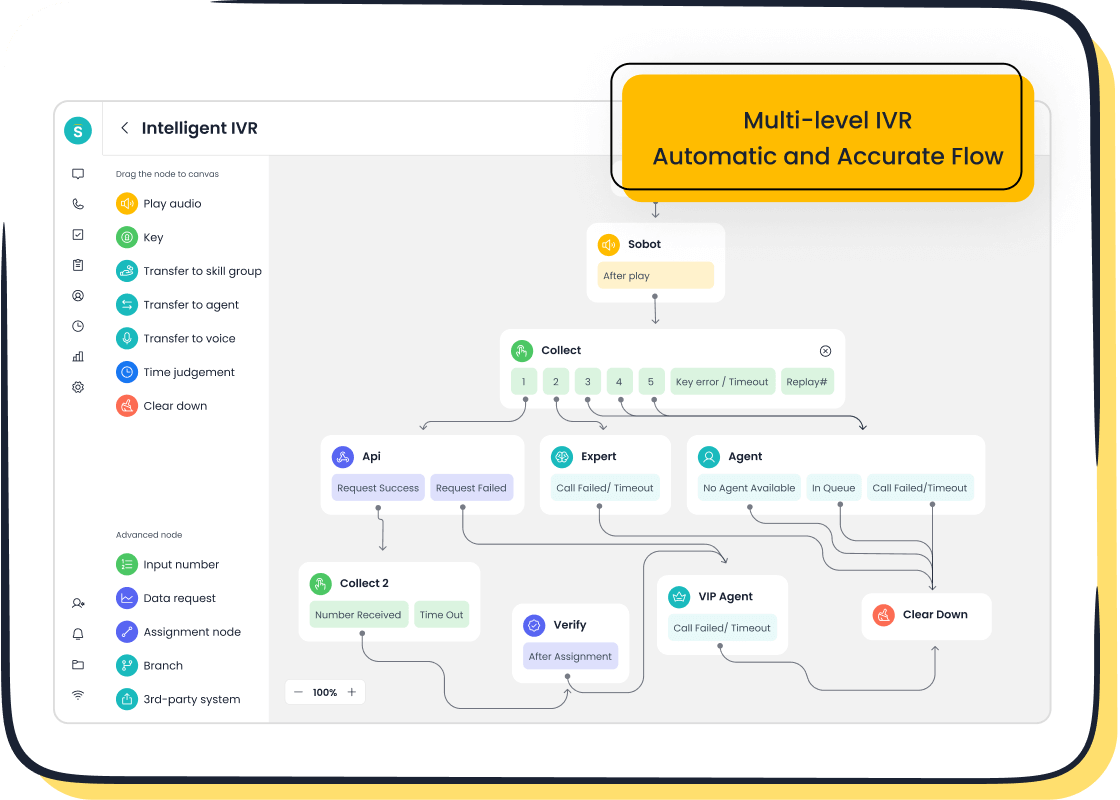
Businesses can capture in-the-moment feedback on customer satisfaction with Sobot's Voice/Call Center. The platform automates the CSAT process. For example, a business can configure its smart IVR to automatically trigger a short survey the moment a support call ends. This ensures the customer provides feedback while the experience is still fresh. Key features include:
- Automated Triggers: Use automated outbound tasks to send a CSAT survey via SMS or a follow-up call.
- Immediate Feedback: Route customers with low CSAT scores directly to a supervisor for quick service recovery.
- Data Integration: Feed all CSAT results directly into the customer's record for a complete interaction history.
This immediate feedback loop helps teams pinpoint and resolve issues at specific touchpoints, continuously improving service quality and satisfaction.
Tracking NPS to Guide Long-Term Strategy
While CSAT handles the immediate, Sobot helps manage periodic NPS campaigns to measure long-term customer loyalty. The platform can schedule and send the Net Promoter Score survey through various channels like email. This allows a business to track brand health over time. To maximize responses, it is crucial to keep the survey focused on the main NPS question and include an open-ended comment box. This qualitative feedback from customers is vital for understanding the "why" behind their score. Sobot's platform makes it easy to collect and organize this crucial data, helping businesses identify what drives loyalty.
A Real-World Example: How OPPO Boosted Loyalty
The synergy of using CSAT and NPS together delivers powerful results. Leading smart device innovator OPPO used Sobot to enhance its service efficiency. By implementing Sobot's solutions, OPPO achieved a 94% positive feedback rate—a strong indicator of high transactional satisfaction, similar to a CSAT goal. This focus on excellent individual experiences translated directly into greater customer loyalty. The result was a 57% increase in the repurchase rate, a key outcome associated with a high NPS. This success story shows how improving in-the-moment satisfaction builds a foundation for long-term growth. Furthermore, Sobot's AI Solution can analyze open-ended feedback from customer satisfaction surveys to uncover deeper insights, helping businesses continuously refine their strategy.
The CSAT vs NPS debate resolves with a combined strategy. A business uses CSAT to optimize each step of the customer experience. It uses NPS to measure overall customer loyalty. The most advanced strategies use both CSAT and NPS. This creates a feedback loop where improving a single experience boosts long-term loyalty. AI tools can analyze customer feedback to identify themes and prioritize fixes. This turns data into action.
Embark on Your Contact Journey: Discover how Sobot can help you implement a powerful CSAT and NPS program to understand your customer and drive growth.
FAQ
Which is better, CSAT or NPS?
Neither metric is superior; they serve different purposes. CSAT measures immediate customer satisfaction with one interaction. NPS gauges long-term customer loyalty. The most effective strategy in the CSAT vs NPS debate is to use both metrics together for a complete view of the customer experience.
How often should a business send NPS surveys?
Businesses typically send Net Promoter Score surveys periodically. A quarterly or semi-annual schedule is common. This timing effectively tracks long-term loyalty trends. It also prevents survey fatigue for customers and provides a stable benchmark for overall brand health.
Can CSAT be used for more than just support calls?
Yes. CSAT is a versatile customer satisfaction metric. Businesses use it to measure satisfaction after any key touchpoint. This includes website checkouts, product deliveries, or in-store experiences. It provides valuable, immediate feedback on specific parts of the customer journey.
Why is the open-ended question in an NPS survey important?
The open-ended question reveals the "why" behind a customer's score. This qualitative feedback is crucial for understanding customer sentiment.
This feedback helps businesses identify what drives loyalty or dissatisfaction. Companies use these insights to make targeted improvements and guide strategic decisions.
See Also
Best Contact Center Platforms: A Comprehensive Review for 2024
Unveiling the Top 10 Call Center Analytics Tools for 2024
Leading 10 Speech Analytics Solutions for Call Centers This Year

