Zendesk vs HubSpot vs Salesforce in 2026

Finding the right customer service platform for business can be simple. You should choose Zendesk if your main goal is best-in-class customer support. Pick HubSpot if you need an all-in-one growth engine. Your business should start with Salesforce for massive scale. For a unified contact center solution, Sobot is an excellent choice.
| Platform | Best For | Starting Price | Key Strength |
|---|---|---|---|
| Zendesk | Dedicated Support Teams | $19/agent/mo | Service & Support |
| HubSpot | All-in-One Growth | Free Tools Available | Integrated CRM |
| Salesforce | Enterprise & Scale | $25/user/mo | Customization |
| Sobot | Unified Contact Centers | Custom | Omnichannel Solution |
Platform Deep Dive for 2026
Zendesk: The Customer Support Specialist
Zendesk gives your team a powerful platform built for customer support. You get a system designed to manage tickets, chats, and calls efficiently. Its features focus entirely on improving the service you provide. This specialization makes it a top choice if your primary goal is to deliver an outstanding customer experience. Zendesk provides robust tools that help your support agents resolve issues faster.
HubSpot: The All-in-One Growth Platform
HubSpot offers you an integrated platform for growth. It combines a free CRM with powerful marketing and sales tools. This all-in-one model simplifies your workflows. You can avoid the "tool fatigue" that comes from using many different apps. HubSpot's key features are designed for ease of use, which leads to high user adoption.
A key benefit is its fast setup. Most small teams can start using the CRM within a week. This quick time-to-value is perfect for startups and SMBs that need results without complexity.
Salesforce: The Scalable Data Powerhouse
Salesforce is the platform you choose for massive scale and deep customization. By 2026, its Einstein AI will transform the CRM into an 'agentic system' that handles complex tasks automatically. This allows you to connect your data with powerful AI features without needing a data science team. Global companies use Salesforce solutions to drive growth.
- General Electric unified 11 different CRM systems into one.
- Boston Scientific saw a 400% increase in registrations with an automated campaign.
These examples show how Salesforce provides the features needed for enterprise-level success.
Sobot: The All-in-One Contact Center Solution
Sobot provides comprehensive solutions for unifying your customer communications. It offers a true omnichannel support platform, integrating channels like chat, voice, and email into one system. Sobot's 'AI-First' strategy powers its key features, including an advanced AI Agent, chatbot, and ticketing system. This focus on AI and integration helps you deliver better support and improve agent efficiency.
Comparing Core Customer Service Solutions

Choosing the right platform means looking closely at its core features. You need to understand how each of the customer service solutions handles support, sales, and marketing. This comparison will help you see which platform fits your business needs for 2026.
Customer Support Tools: Ticketing, Chat, and Knowledge Base
Your support tools are the foundation of a great customer experience. Zendesk offers a powerful system for high-volume, multi-channel support. HubSpot’s tools are built into its CRM, giving you context for every conversation. For a truly unified approach, the Sobot Ticketing System excels. It provides multi-channel ticketing that combines email, chat, and voicemail into one platform. Its key features include automated assignment and SLA management to improve ticket resolution.
A good self-service help center is also vital.
- HubSpot uses AI to help you turn successful support chats into knowledge base articles.
- Zendesk provides an advanced self-service help center with features that identify content gaps.
Sales & CRM Capabilities
A strong customer relationship management (CRM) system organizes your contacts and deals. HubSpot gives you a free CRM with solid features. This is a great starting point for small businesses. Salesforce and Zendesk Sell offer more advanced CRM features on their paid plans. For example, lead scoring is a feature you get on higher tiers of Zendesk Sell, while Salesforce includes it in its Professional edition.
Marketing Automation Features
Marketing automation saves you time and nurtures leads. HubSpot makes automation easy with a visual, drag-and-drop workflow builder. You can create campaigns without technical skills. Salesforce provides more complex automation solutions for large enterprises. Zendesk’s features focus more on support-related communication.
Reporting & Analytics
Data helps you make better decisions. Zendesk’s reporting features focus on agent performance and support metrics. Salesforce delivers deep, AI-powered analytics for sales and market trends. HubSpot integrates data from all its hubs, giving you a complete view of your business performance.
AI & Automation Capabilities
AI and automation are changing how you provide support. Zendesk uses AI for support-specific tasks like ticket routing. HubSpot embeds AI across its entire platform to assist with marketing, sales, and service. Salesforce’s Einstein AI offers powerful predictive analytics. Sobot also uses AI in its chatbot and automated help desk. This help desk automation streamlines workflows and improves efficiency.
Pricing & Value in 2026: Zendesk vs HubSpot vs Salesforce
Understanding the price of each platform is more than just looking at a number. You must consider the "true cost" for your business. This includes setup fees, add-ons, and how the price changes as your team grows.
Free Plans and Entry-Level Tiers
Your journey often starts with a free or low-cost plan. HubSpot stands out by offering a permanently free CRM with core marketing and service features. This makes it an excellent choice if you want to start without a financial commitment. Salesforce does not offer a free version, only limited trials.
When you are ready to pay, the entry points differ:
- HubSpot starts at $15/user/month for its Starter bundle.
- Zendesk begins at $19/user/month.
- Salesforce has a starting price of $25/user/month for its Starter Suite.
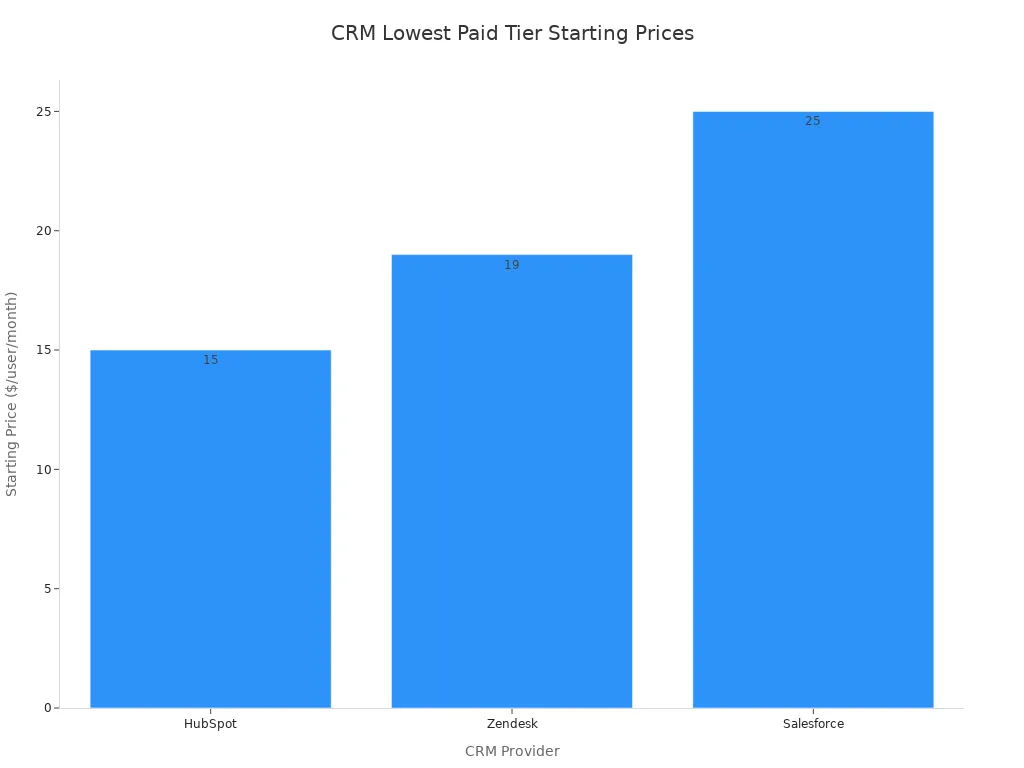
Each plan provides essential features to get you started, but your needs will likely grow beyond these basic tools.
Comparing Popular Mid-Tier Plans
Mid-tier plans offer the best balance of features and price for many growing companies. When you compare popular plans like HubSpot Professional, Zendesk Suite Growth, and Salesforce Professional, you see their specializations emerge.
For example, HubSpot Service Hub Professional includes an automated help desk and a knowledge base. Zendesk Suite Growth, on the other hand, provides key features for support teams like Service Level Agreements (SLAs) and CSAT surveys. Salesforce Professional shines with its customization options, offering a developer sandbox to build custom applications. These different features show how each platform prioritizes a specific area of your operations.
Uncovering Hidden Costs and Scalability
The sticker price is rarely your final cost. You need to account for implementation fees and per-user pricing models. For a 50-person team, the total cost of ownership can vary greatly.
Implementation with a HubSpot partner, for instance, can range from £8,000 to over £16,000. This is a one-time cost on top of your annual software subscription. As you add more users or need more advanced features, your monthly bill will increase. Carefully planning for these additional costs is essential for long-term success and scalability.
Real-World Scenarios: Which Platform to Choose?
Theory is helpful, but seeing these platforms in action makes the choice clearer. Your business model and growth stage are the biggest factors in finding the right fit. Let's explore three common scenarios to help you decide which customer service platform for business aligns with your goals.
Scenario 1: The Service-First E-commerce Store
You run an e-commerce store where a great customer experience is your main competitive advantage. Customers ask about orders, shipping, and returns across multiple channels. Fast, accurate support is not just a goal; it is essential for survival.
Your Best Choice: Zendesk
Zendesk is built for this exact challenge. Its powerful support features are designed to handle high volumes of inquiries efficiently. The platform's deep integrations with e-commerce tools are its standout feature.
- Shopify Integration: Your agents can see a customer's billing, shipping, and order history directly inside a Zendesk ticket. You can even process refunds and cancellations without ever leaving the platform.
- TikTok Shop Integration: If you sell on social platforms, Zendesk automatically creates tickets for all inquiries. It groups buyer conversations into single tickets, giving your agents the context they need to provide excellent support.
- Magento Integration: You can sync all e-commerce activity with customer profiles. This allows your team to track orders and returns from within Zendesk, leading to a smoother customer experience.
These features save your team valuable time and reduce back-and-forth communication, allowing you to deliver the fast, personalized service that builds loyalty.
Scenario 2: The All-in-One B2B Service Company
Your B2B company needs more than just support tools. You need to attract leads, manage a sales pipeline, and serve existing clients. Your sales and marketing teams must work together, and you want a single source of truth for all customer data.
Your Best Choices: HubSpot or Sobot
For this scenario, choosing the right customer service platform for your business depends on your primary focus: integrated growth or unified communication.
HubSpot is the classic choice for aligning sales and marketing. Its shared CRM allows both teams to work from the same data. For example, the B2B firm RubinBrown used HubSpot's CRM and automation tools to grow its organic traffic fivefold and build a sales pipeline worth millions. This shows how its integrated features drive business growth.
If your main challenge is managing customer conversations across many channels, you should consider Sobot. Sobot's Omnichannel Solution is a strong alternative to HubSpot, especially for businesses that need to unify customer contact channels. While HubSpot is a CRM-first platform, Sobot is an all-in-one contact center solution that excels at bringing voice, email, chat, and social media into one workspace.
This is more than just a theory. The financial service platform Opay used Sobot's solutions to manage its multi-channel customer interactions. The results were dramatic:
- Customer satisfaction jumped from 60% to 90%.
- Overall operational costs fell by 20%.
- Conversion rates increased by 17%.
This proves how an integrated omnichannel support platform can directly improve both customer happiness and your bottom line. If your business needs are centered on world-class communication management, Sobot provides the focused features and automation to succeed.
Scenario 3: The High-Growth, Data-Driven Startup
You are building a startup with massive ambitions. You anticipate handling complex data, scaling your team quickly, and needing a platform that can be customized to your unique workflows. You are willing to invest more time and resources upfront for long-term flexibility.
Your Best Choice: Salesforce
Salesforce is the undisputed leader for scalability and customization. While platforms like HubSpot offer a faster setup (often 2-8 weeks), Salesforce requires a more significant investment, with implementations typically taking 3-6 months. This steeper learning curve is a trade-off for nearly limitless potential.
Salesforce is the right customer service platform for this scenario because its data architecture is built for complexity and scale.
- Cloud-Native Foundation: It uses a microservices architecture that offers elastic scaling. This means the platform grows with you without needing a massive infrastructure overhaul.
- Metadata-Driven Architecture: Its core design ensures deep integration with all Salesforce applications, giving you consistent governance as your data models become more complex.
- Flexible Data Pipelines: Salesforce can ingest data from virtually any source, reducing your reliance on fragmented tools as you grow.
- Open Frameworks: It works with other data platforms like Snowflake and BigQuery without forcing you to move all your data.
These advanced features give you a robust foundation to build your entire business on. You get a powerful CRM and a development platform in one, ensuring you will not outgrow your software in a few years.
Choosing the right customer service platform for business is now clear. You should pick Zendesk for dedicated support, HubSpot for integrated growth, and Salesforce for ambitious scale. For businesses needing to unify communications, Sobot offers compelling all-in-one contact center solutions. Your final step is to select the customer service platform for business that matches your goals.
Ready to decide?
- Explore HubSpot's free tools to unify your growth efforts.
- Start a Zendesk trial to streamline your support.
- Book a demo with Sobot for a powerful, unified contact center.
FAQ
What is the best platform for a small business?
Your best choice depends on your main goal.
- HubSpot is great for an all-in-one solution with a free CRM.
- Zendesk is perfect if your top priority is customer support.
- Sobot excels at unifying all your customer contact channels into one system.
Which platform is the most affordable?
HubSpot offers the best starting point with its powerful free tools. For paid plans, you must look at the "true cost." Consider per-user fees and future add-ons. Always compare the features you get at each price level to find the best value for your team.
What if I need a true omnichannel solution?
You should look for a platform built for unified communications. Sobot's Omnichannel Solution integrates voice, email, chat, and social media into a single workspace. This approach helps you manage all customer conversations efficiently and deliver a consistent experience across every channel.
Can I switch platforms later if my business grows?
Yes, you can migrate to a new platform as your needs change. However, moving your data can be complex and costly. You should choose a customer service platform for business that not only fits your current needs but also supports your future growth plans to avoid a difficult switch.
See Also
Leading Cloud Contact Center Services: An In-Depth Review for 2024
Discovering the Foremost Cloud Contact Centers: A Comprehensive Look for 2025
The Ten Premier Customer Service Software Solutions: A 2024 Analysis
Evaluating the Best Contact Center Solutions: Our Expert Review for 2024
Exploring the Top Ten Call Center Analytics Software Options for 2024

