How Guest Service Philosophies Influence Customer Loyalty


What is great guest service, and why does it drive loyalty? Companies with a strong philosophy based on empathy and customer care see a clear impact on trust and satisfaction. Studies show customer trust shapes loyalty, while satisfaction boosts retention and competitive advantage. Sobot stands out with a philosophy rooted in customer-centricity and innovation. Sobot AI and Sobot call center solutions reflect this philosophy, showing the impact of service on business outcomes and customer loyalty.
What Is Great Guest Service

Defining Guest Service Philosophies
A customer service philosophy defines how a company approaches every interaction with its guests. This philosophy acts as a shared mission, guiding teams to deliver consistent, exceptional customer experiences. Most business literature describes a customer service philosophy as a combination of vision and values. The vision sets expectations for service, while the values shape employee behavior and attitudes. Service standards provide flexible guidelines, allowing staff to adapt to unique customer needs while staying aligned with the brand. Companies document their customer service philosophy in concise formats, helping employees internalize and apply it daily. Organizations like Apple and Ritz-Carlton use their customer service philosophy to empower employees, encourage personalized solutions, and build loyalty. Sobot’s customer-centric approach reflects this commitment, embedding its philosophy into every product and service. Sobot’s mission and values focus on innovation, efficiency, and customer-centricity, ensuring that every guest receives attentive, knowledgeable, and friendly service.
A strong customer service philosophy aligns with the company’s mission and values, guiding employees to create memorable experiences and foster loyalty.
Industry research highlights several elements that define what is great guest service:
- Speed, convenience, and knowledgeable help.
- Friendly service and human interaction.
- Employee training and empowerment.
- Customer-centric approach with sustainable practices.
- Responsiveness and proactive support.
- Accessibility across multiple channels.
- Consistency and feedback loops.
Core Values: Empathy and Kindness
Empathy and kindness stand at the heart of every effective customer service philosophy. Empathy allows employees to understand and address customer needs, while kindness ensures every interaction feels genuine and respectful. Research shows that empathy in the workplace leads to higher satisfaction, reduced stress, and better performance. Companies like Zappos and Apple empower staff to demonstrate empathy and kindness, resulting in loyal customers and positive word-of-mouth. Sobot’s customer-centric approach prioritizes empathy, training teams to listen actively and respond with care. Kindness builds trust, turning guests into advocates who return and recommend the brand. Organizations measure the impact of empathy and kindness through customer satisfaction scores, Net Promoter Scores, and first call resolution rates. These values drive the philosophy behind what is great guest service, shaping every aspect of customer service and retention.
Guest Service Philosophies and Customer Experience
Impact on Customer Loyalty
A customer service philosophy shapes every customer experience. Companies that build a customer-focused culture see measurable improvements in trust and loyalty. Research shows that a strong philosophy leads to higher customer satisfaction scores, increased retention rates, and stronger emotional connections. For example, American Express’s Relationship Care philosophy reduced customer effort scores by 30%, raised Net Promoter Score by 10 points, and improved first-contact resolution rates by 23%. These results highlight the direct link between philosophy and customer loyalty.
A customer service philosophy guides employees to listen first, solve second. This approach builds trust and encourages repeat business. In coffee shops, staff attitude and personalized interactions create experiential value, which drives loyalty. Customers who feel understood and valued are more likely to return and recommend the brand. Companies like Ritz-Carlton and Disney use philosophies that anticipate guest needs and personalize care, resulting in high satisfaction and retention.
Companies that focus on customer experience through a customer-focused philosophy achieve higher loyalty and stronger brand advocacy.
The impact of customer service philosophy extends across industries. The following table summarizes how different philosophies influence loyalty metrics:
| Industry/Brand | Guest Service Philosophy Description | Impact on Customer Loyalty Metrics |
|---|---|---|
| Ritz-Carlton | Luxury service focusing on anticipating guest needs and personalized care | High customer satisfaction and loyalty |
| Disney | Magical, detail-oriented experiences with emotional connections | Repeat visits and strong emotional loyalty |
| Southwest Airlines | Friendly, accommodating service with customer-friendly policies | Positive travel experiences and customer retention |
| Coffee Shops | Staff attitude and ambiance enhance experiential value | Improved retention through experiential value |
| Technology Impact | AI and machine learning enable personalized, efficient service | Enhanced customer loyalty |
Companies measure the effectiveness of their customer service philosophy using metrics such as Customer Satisfaction Scores (CSAT), Net Promoter Score (NPS), retention rates, and Customer Lifetime Value (CLV). These metrics quantify the impact of philosophy on loyalty and trust.
Continuous improvement plays a key role in strengthening customer loyalty. Organizations that allocate time for service improvement activities see a 45% increase in employee-generated innovation. Service excellence training returns $4-$7 per dollar invested in retention and cost reduction. Frontline employee involvement in service design makes service transformation 3.8 times more likely to exceed expectations. These practices reinforce the importance of a customer-focused culture and philosophy.
According to industry reports, about 50% of customers switch brands after a single negative experience. In contrast, 75% pay more for brands that consistently delight them. This data underscores the need for a customer service philosophy that anticipates and personalizes every experience. Companies that listen first, solve second, and practice empathy build lasting trust and loyalty.
Practice Empathy in Every Interaction
Empathy stands at the core of every customer service philosophy. Companies that practice empathy in every interaction create memorable experiences and foster trust. Service industry experts recommend several best practices for empathy-driven assistance:
- Acknowledge customer concerns early to make customers feel understood.
- Practice active listening by giving full attention, using feedback, asking questions, and paraphrasing.
- Avoid sympathy, which can harm professionalism and brand image.
- Maintain a cool head while understanding customer emotions to provide effective service.
Listening forms the foundation of empathy-driven assistance. Employees who listen first, solve second, and focus on customer experience build stronger relationships. Behavioral scientist Steve Maraboli emphasizes that starting dialogue from the customer’s perspective creates an immediate connection. Scientific studies show that empathy improves satisfaction and compliance, while empathy exercises increase business creativity.
Sobot’s Voice/Call Center exemplifies empathy-driven assistance. The platform uses AI technologies like voice analysis and emotional detection to identify customer emotions during calls. Real-time emotional recognition enables agents to respond with personalized and empathetic solutions. AI-driven recommendation engines support agents by providing insights into customer emotions and suggesting appropriate responses. This approach enhances the overall customer experience and builds trust.
- Sobot’s Voice/Call Center has led to a 30% increase in customer satisfaction and a 30% boost in customer loyalty.
- Emotional journey mapping and empathy scores measure and improve emotional engagement throughout customer interactions.
- The platform automates repetitive tasks and offers 24/7 support, improving efficiency and saving significant time.
Sobot’s integration of AI-powered emotional intelligence in its voice/call center operations has resulted in significant business benefits. Brands using Sobot’s emotionally intelligent AI tools have observed up to a 30% improvement in customer satisfaction and a 30% increase in customer loyalty. These results demonstrate that combining AI-driven emotional recognition with human empathy leads to more personalized, effective, and empathetic customer interactions, ultimately driving higher customer retention and business growth. Learn more about Sobot’s Voice/Call Center.
Empathy-driven assistance transforms customer service philosophy into action, creating experiences that build trust and loyalty.
Companies track changes in customer loyalty by establishing continuous feedback systems. They collect customer input through surveys, reviews, and direct interactions. Tools like LiveAgent centralize these interactions and regularly review key metrics such as CSAT and NPS. Monitoring social media, online reviews, and complaints helps identify issues and opportunities. This ongoing feedback loop enables companies to adjust their customer service philosophy in real time, ensuring continuous improvement and stronger customer loyalty.
Listening, empathy, and a customer-focused culture drive every successful customer service philosophy. By practicing empathy in every interaction, companies create experiences that foster trust, loyalty, and long-term business growth.
Sobot’s Approach to Guest Service
Omnichannel Solutions for Customer Contact
Sobot’s customer service philosophy centers on delivering seamless experiences across every channel. The company integrates AI-driven tools to unify customer interactions, ensuring that every guest receives consistent and efficient service. Sobot’s omnichannel solution connects websites, mobile apps, social media, email, phone calls, and SMS. This approach allows agents to manage all communications from a single platform, reducing confusion and improving response times.
- Sobot’s AI voicebots handle both inbound and outbound calls, automating routine tasks and freeing agents to focus on complex issues.
- The platform personalizes service for VIP and ordinary customers, enhancing the overall customer experience.
- Scenario-based AI provides industry-specific solutions, such as 24/7 pre-sales support and rapid post-sales issue resolution.
A real-world example of Sobot’s philosophy in action is OPPO’s customer story. OPPO faced high volumes of customer inquiries during peak shopping periods. By implementing Sobot’s chatbot and ticketing system, OPPO automated repetitive questions and empowered agents to address more complex needs. This strategy led to an 83% chatbot resolution rate and a 94% positive feedback rate, demonstrating how a strong customer service philosophy drives loyalty and satisfaction. OPPO’s story highlights the impact of Sobot’s integrated solutions on customer experience.
| Aspect | Before Sobot Implementation | After Sobot Implementation |
|---|---|---|
| Platform Integration | Agents switched among multiple platforms | Unified all communication channels into one platform |
| Handling Repetitive Inquiries | Agents manually responded to repetitive questions | AI-powered chatbots automated repetitive inquiries |
| Customer Service Differentiation | No distinction between VIP and ordinary customers | Personalized service for VIP and ordinary customers |
| Agent Efficiency | Lower efficiency due to fragmented tools | 30% increase in agent efficiency |
| Customer Satisfaction (CSAT) | Not specified | Achieved 97% customer satisfaction |
| Business Impact | Higher labor costs and inefficiencies | Reduced labor costs and improved customer satisfaction |

Voice/Call Center Enhancing Customer Experience
Sobot’s Voice/Call Center embodies the company’s customer service philosophy by combining advanced AI with human empathy. The AI Agent offers voice calling with natural language understanding, creating efficient and humanized experiences. AI-powered inbound voicebots answer questions based on a knowledge base, reducing transfers and improving first-contact resolution. Outbound voicebots make calls to customers, tagging them by purchase intent to boost marketing effectiveness.
Key features include:
- Intelligent quality inspection automates service checks, ensuring reliability.
- Emotion recognition personalizes interactions by sensing customer mood changes.
- Multi-language and multi-timezone support enables global customer service.
- Integration of AI and human agents improves service quality and customer experience.
Sobot’s Voice/Call Center reduces labor costs by 50% and increases efficiency by 200%. Real-time speech recognition and LLM reasoning enable seamless, human-like voice interactions. The unified knowledge base supports chat, email, voice, and social media channels, ensuring consistent answers and enhancing the customer experience. Continuous AI Agent improvement reduces errors and boosts resolution rates, supporting Sobot’s philosophy of delivering exceptional customer service.
Building Loyalty Through Empathy and Kindness

Empowering Teams to Practice Empathy
Empowering employees to treat customers like people forms the foundation of lasting loyalty. When organizations give employees the freedom to make decisions and show genuine interest in each guest, the service experience becomes more personal and memorable. Employees who feel trusted and valued respond with authenticity and empathy, which customers notice and appreciate. Open communication, autonomy, and a supportive culture help employees be genuine and authentic in every interaction.
Research shows that empathetic management practices—such as open dialogue, diversity, and work-life balance—improve employee engagement and retention. These practices foster a positive work environment where employees feel motivated to serve customers with kindness. Training programs that focus on empathy and problem-solving, including role-playing, equip employees to handle difficult situations with confidence. When employees have immediate access to customer data and AI-driven tools, they can show genuine interest and resolve issues quickly.
Sobot’s unified workspace empowers employees by providing real-time insights and customer histories. This technology allows employees to be genuine and authentic, respond with empathy, and treat customers like people, not just transactions. Quality assurance platforms and AI-powered analytics support targeted coaching, helping employees grow and deliver better service. As a result, empowered employees build trust, improve satisfaction, and turn service recovery moments into opportunities for loyalty.
Empowerment, trust, and empathy create a culture where employees serve customers with kindness and show genuine interest in every experience.
Personalization and Proactive Service
Personalization and proactive service drive repeat business and increase customer lifetime value. Employees who show genuine interest in customer needs and serve customers with kindness create emotional connections that last. Personalized gestures—like thank you notes or surprise discounts—make customers feel valued and understood. Intelligent personalization, powered by AI, adapts to customer preferences and behaviors, ensuring each experience feels unique.
Sobot’s AI-driven tools and unified workspace enable employees to deliver tailored recommendations and dynamic content in real time. These solutions automate routine tasks, freeing employees to focus on complex needs and show genuine interest in each interaction. Proactive service anticipates issues before they arise, using feedback and predictive analytics to prevent negative experiences. Employees gain the freedom to act quickly, resolve problems, and build trust with every customer.
Companies that measure satisfaction through surveys and Net Promoter Scores refine their strategies to treat customers like people and foster loyalty. Personalized and proactive service not only increases trust but also boosts retention and average purchase value. By empowering employees to be genuine and authentic, organizations create experiences that inspire trust and long-term loyalty.
Implementing Guest Service Philosophies
Steps for Businesses
Developing a customer service philosophy requires clear, actionable steps. Companies succeed when they align their philosophy with their mission and values. The following steps help organizations build and implement an effective customer service philosophy:
- Explore buyer personas to understand customer needs, preferences, and expectations. Tailor service channels and tone to match these insights.
- Provide employees with the right tools for fast, effective responses and issue escalation. Empower teams to act confidently without micromanagement.
- Translate company values into clear, single-action sentences using strong verbs. For example, use words like Listen, Help, and Offer to guide daily actions.
- Write a simple, clear customer service vision statement. This statement should reflect both current standards and future aspirations.
- Involve key stakeholders, including managers and department heads, in developing a customer service philosophy. Collaboration increases buy-in and realism.
- Share the philosophy across all departments. Leadership should model the philosophy in daily actions.
- Revisit and review the philosophy regularly. Adapt it as the company grows or as new customer experience tools emerge.
Companies like Disney and Apple use memorable acronyms and gold standards to reinforce their customer service philosophy. These methods help employees remember and practice the philosophy every day.
Training and Continuous Improvement
Ongoing training and continuous improvement keep a customer service philosophy strong. Companies empower employees by granting decision-making authority and providing regular training. Tailored programs cover both technical skills, such as using CRM and AI tools, and soft skills, like empathy and active listening.
- Sobot’s omnichannel platform centralizes communication, making training easier and analytics more effective.
- Automation tools reduce repetitive tasks, allowing employees to focus on complex issues and continuous improvement.
- Proactive AI provides personalized recommendations and a closed-loop feedback system, supporting ongoing adaptation.
- Customer feedback management systems turn data into actionable insights, accelerating service innovation.
Mentorship programs, one-on-one coaching, and regular refresher courses help employees stay current and confident. Quality assurance measures and customer service audits maintain high standards. Companies that encourage open feedback and adapt training content see higher engagement and better results.
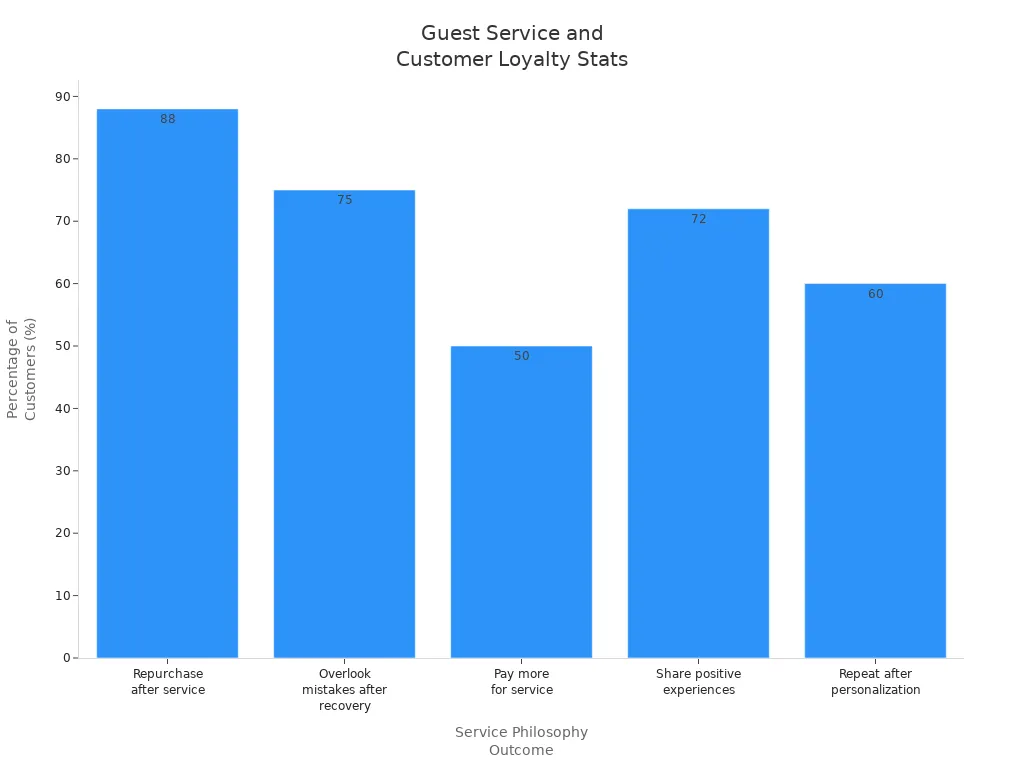
Guest service philosophies directly shape customer loyalty. Companies that prioritize empathy, responsiveness, and authenticity see stronger retention and advocacy. Research shows:
Sobot empowers businesses with AI-driven tools, unified workspaces, and proactive engagement features. To build loyalty, companies should:
- Define clear objectives and align with company values.
- Gather and analyze customer data.
- Continuously improve service based on feedback.
A strong guest service philosophy leads to higher satisfaction, better financial results, and lasting customer relationships.
FAQ
What is a guest service philosophy?
A guest service philosophy is a set of guiding principles that shapes how a company interacts with customers. It defines the values, behaviors, and standards that teams follow to deliver great guest service and build customer loyalty.
How does empathy improve customer experience?
Empathy helps employees understand customer feelings and needs. When teams practice empathy, they respond with care and respect. This approach creates positive experiences, builds trust, and increases customer loyalty.
Why is kindness important in customer service?
Kindness makes every customer feel valued and respected. Employees who show kindness create a welcoming atmosphere. This behavior encourages guests to return and recommend the brand to others.
How do Sobot’s solutions support great guest service?
Sobot’s omnichannel and Voice/Call Center solutions unify customer interactions. These tools use AI to automate tasks, provide real-time insights, and help teams deliver personalized, efficient, and empathetic service across all channels.
What steps can businesses take to build customer loyalty?
Businesses can empower teams, personalize service, and use feedback to improve. Training, clear values, and the right technology help companies practice empathy and kindness, leading to stronger customer loyalty.
See Also
Understanding Quality Management Systems In Call Centers
Top Ten Ways To Improve Live Chat Support Experience
Comparing Genesis And Genesys Call Center Solutions

