What Is a VoIP Call Center Solution? A Guide


A VoIP call center uses the internet for your business phone calls. This system lets your teams handle high volumes of customer calls efficiently from anywhere. With 75% of call centers now using VoIP, it is a proven technology. A modern VoIP call center solution can slash your costs, with some businesses saving up to 90% on overseas calls. This guide demystifies the setup process for a VoIP call center. Advanced solutions, like the Sobot call center powered by Sobot AI, provide a complete contact center solution to elevate every customer interaction. Improve your customer experience with VoIP. This VoIP technology helps every customer.
What Is a VoIP Call Center?

A VoIP call center is a modern hub for business communications. It uses your internet connection to manage phone calls, replacing old telephone lines. This technology powers a flexible and feature-rich VoIP call center solution. Let's explore the technology, components, and call types that define a VoIP call center.
Core Technology
The core of a VoIP call center is VoIP (Voice over Internet Protocol) technology. VoIP converts your voice into digital data packets. It then sends these packets over the internet to complete your calls. This is different from traditional phone systems, which use physical copper wires.
VoIP vs. Traditional Phone Systems (PSTN)
Feature VoIP (Voice over Internet Protocol) PSTN (Public Switched Telephone Network) Technology Transmits voice as digital data over the internet. Transmits voice as analog signals over copper wires. Infrastructure Relies on your existing internet connection. Requires a separate, dedicated network of physical lines. Devices Works on computers, smartphones, and special VoIP phones. Uses traditional landline phones.
A VoIP call center relies on key protocols to manage calls. These include:
- Session Initiation Protocol (SIP): This protocol starts, manages, and ends your VoIP calls.
- Real-time Transport Protocol (RTP): This protocol handles the actual delivery of audio for your calls.
Key Components
To set up a VoIP call center, you need a few key components. These include both software and hardware that work together to handle your calls.
- VoIP Call Center Software: This is the main platform your agents use. It includes features for routing and managing calls.
- CRM Integration: Good call center software connects with your CRM to give agents customer information during calls.
- A Stable Internet Connection: This is the most critical part of any VoIP call center.
- VoIP Phones or Headsets: Your agents need devices to make and receive VoIP calls. This can be a physical desk phone or a headset connected to a computer.
Inbound vs. Outbound Calls
A VoIP call center can handle two main types of calls: inbound and outbound. Your business may need one or both.
-
Inbound Calls: These are calls that customers make to your business. A VoIP call center helps you manage these incoming calls efficiently. Common uses include customer support, technical helpdesks, and processing sales orders.
-
Outbound Calls: These are calls that your agents make to customers. A VoIP call center can automate this process for tasks like lead generation, appointment setting, market research surveys, and customer feedback calls.
Why Choose a VoIP Call Center Solution?
Switching to a VoIP call center solution can transform your business operations. You can reduce expenses, grow your team with ease, and access powerful tools. These benefits directly lead to happier agents and a better experience for every customer. Let's explore why a VoIP call center is the right choice for your business.
Reduce Operational Costs
You can significantly lower your operational costs with a VoIP call center. Traditional phone systems require expensive hardware, dedicated phone lines, and ongoing maintenance. A VoIP call center eliminates these major expenses. Businesses often see average savings of 50% to 75% after switching to VoIP.
Your savings come from several key areas:
- Lower Call Charges: VoIP uses the internet for calls. This dramatically reduces costs for long-distance and international calls.
- No Hardware Investment: Cloud-hosted VoIP solutions remove the need for bulky, expensive on-site servers.
- Reduced Maintenance: With less physical hardware, you spend less on repairs and technician visits. Updates are handled remotely by your provider.
Providers like Sobot offer an economic SaaS rental model. You pay a predictable monthly fee per user instead of a large upfront cost. This model makes budgeting simple and transparent. A VoIP call center is an investment that pays for itself. For example, some businesses using Sobot's solutions have cut their average call handle time by 41%, a direct cost saving.
Enhance Scalability and Flexibility
Your business needs to adapt to change. A VoIP call center gives you the scalability and flexibility to grow. Traditional systems make it slow and costly to add new phone lines. With a cloud-based VoIP call center, you can add or remove agents in minutes through a simple software dashboard.
This flexibility is perfect for remote and global teams. Your employees can make and receive business calls from anywhere with an internet connection. This ensures your team stays connected, whether they are in the office, at home, or traveling.
Go Global with Ease
Expanding your business internationally is simple with a VoIP call center. Providers like Sobot offer global number availability. You can get local phone numbers in different countries, creating a local presence for your customer base. This helps you build trust with each customer.
Acquiring a new number is a straightforward process. You can order it through a dashboard, submit any required documents, and have it added to your account once approved. This makes a VoIP call center a powerful tool for global expansion.
Access Advanced Features
A VoIP call center unlocks a suite of advanced features that traditional phone systems cannot offer. These tools help you manage calls more effectively and improve team performance. Many features are bundled into your subscription at no extra cost.
Key advanced features include:
- Auto Attendant: This feature automatically greets callers and routes them to the right department or agent.
- Voicemail Transcription: You can receive voicemails as text in your email, making them easy to read and archive.
- Call Whispering and Barging: Supervisors can secretly coach an agent during a live call (whisper) or join the conversation to assist (barge). This is invaluable for training and resolving complex customer issues.
Modern VoIP solutions also use Artificial Intelligence (AI) to provide deeper insights. AI can transcribe calls in real-time and identify different speakers. It also powers sentiment analysis, which detects a customer's emotions by analyzing their tone and word choice. This helps you flag calls that need immediate attention and identify coaching opportunities for your team.
Improve Agent and Customer Experience
A better agent experience leads to better customer satisfaction. A VoIP call center provides tools that empower your agents and delight your customer base. One of the most impactful features is the unified agent workspace. This single interface brings together all communication channels and customer information.
With a unified desktop, your agents get a 360-degree view of the customer. They can see past conversations and purchase history without switching between applications. This saves time and allows for more personalized and efficient support. When agents have the right information at their fingertips, they can resolve issues faster, boosting customer satisfaction.
Success Story: How Weee! Enhanced Customer Satisfaction
Weee!, America's largest online Asian supermarket, needed a more flexible way to serve its diverse customer base. By implementing Sobot's VoIP call center, they used a flexible IVR and multilingual support to connect each customer with the right agent. The results were incredible. Weee! reduced its resolution time by 50% and achieved a 96% customer satisfaction (CSAT) score. This shows how the right VoIP tools can directly improve the customer journey.
Ultimately, a VoIP call center helps you build stronger relationships. Faster response times, personalized interactions, and quick resolutions all contribute to higher customer satisfaction and loyalty.
Your 3-Step VoIP Call Center Setup Guide
Setting up a VoIP call center is a straightforward process. You can get your team up and running with a powerful communication system by following a few key steps. This guide will walk you through the entire setup, from planning your needs to choosing the right provider.
Step 1: Assess Your Needs
Before you choose any software or hardware, you must first understand your business needs. A clear plan will help you select the right VoIP call center solution. Start by defining your specific requirements.
- Define Your Goals: What do you want to achieve with a VoIP system? Are you focused on improving customer support, increasing sales, or expanding globally?
- Estimate Your Call Volume: How many inbound and outbound calls does your team handle daily? This will help you determine the number of lines and extensions you need.
- Identify Key Features: Make a list of must-have features. Do you need an auto-attendant, call recording, or CRM integration?
- Evaluate Your Network: A stable internet connection is the foundation of a reliable VoIP service. You should test your network's speed and stability. If needed, you may have to upgrade your internet plan to prioritize voice traffic for clear VoIP calls.
Uptime is Non-Negotiable Your VoIP system is only as good as your internet connection. Look for a provider that guarantees reliability. For instance, top-tier providers like Sobot offer a 99.99% uptime Service Level Agreement (SLA), ensuring your service is almost always available.
Finally, prepare your team for the transition. Assigning roles to representatives from IT and operations is a great first step. Proper training is essential for a smooth rollout. Providing resources and dedicated training ensures your team can use the new VoIP system effectively from day one. Success depends on training your team well.
Step 2: Choose Your Hardware
With a VoIP system, you have flexibility in your hardware choices. You do not need complex on-site equipment. Your main focus should be on devices that ensure clear communication for your team.
Essential Hardware for Your Team:
- Noise-Canceling Headsets: In a busy call center, background noise can disrupt calls. High-quality headsets are a must.
- For Loud Environments: Headsets like the Epos Impact 700 series or Jabra Engage 50 Mark II excel at blocking out background noise. They keep your agent's voice clear for the customer.
- For Quieter Offices: The Blackwire 8225 offers good noise cancellation for typical office settings.
- Entry-Level Options: Basic headsets like the Blackwire 3320 are suitable for very quiet spaces but may struggle in noisy environments.
- VoIP Phones: If your agents prefer a traditional desk phone, you can use IP phones. These phones connect directly to your internet network to make and receive VoIP calls.
- Computers and Softphones: Agents can also use a softphone, which is a software application on their computer. With a softphone and a headset, their computer becomes their business phone. This is a cost-effective and flexible option for any team.
The right hardware empowers your team to deliver a professional and clear customer experience with every VoIP call.
Step 3: Select a Provider
Choosing the right VoIP provider is the most important decision you will make. Your provider is your partner in communication. You need a provider that offers a reliable service, robust security, and the features your business needs to grow.
When evaluating providers, consider the following criteria:
- Reliability and Uptime: Look for a provider that guarantees at least 99.99% uptime. This translates to less than an hour of potential downtime per year, ensuring your business stays connected.
- Security Measures: Your customer conversations are sensitive. Ensure the provider uses strong encryption for all VoIP communications, including call recordings and voicemails. Look for compliance with standards like SOC 2 and ISO/IEC 20071.
- Scalability: Your provider should make it easy to add or remove users as your team changes. You need a system that can grow with your business.
- Customer Support: When issues arise, you need fast and effective support. Check the provider's support options and reputation.
Tip: Look for an All-in-One Solution Managing multiple vendors for your software, phone numbers, and integrations can be complicated. An all-in-one provider simplifies everything. For example, Sobot offers a one-stop solution that includes the call center software, global phone numbers, and seamless integrations in a single platform. This approach streamlines your operations and reduces administrative work.
A comprehensive training program from your provider will also help your team master the new system quickly. Good training materials and support are signs of a quality provider.
Key Features of a Sobot VoIP Solution

Top-tier VoIP solutions offer powerful tools to improve your operations. Sobot's call center software provides advanced call center features that help you manage VoIP calls and elevate the customer experience. These tools are designed to make your team more efficient and every customer interaction smoother.
Intelligent IVR and Smart Routing
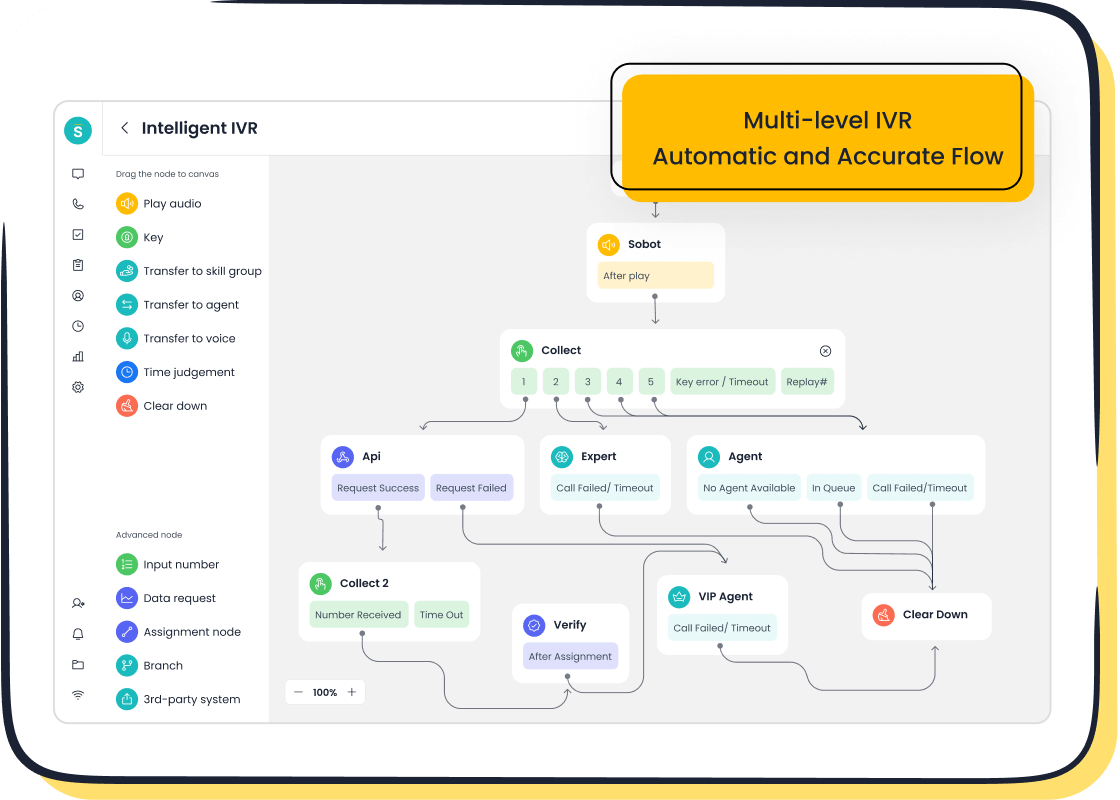
You can guide every customer to the right agent with an intelligent IVR (Interactive Voice Response). Sobot simplifies this process with a drag-and-drop interface. You can build and visualize complex call flows without any code. This allows you to customize greetings, create menus, and set up smart call routing capabilities for all incoming VoIP calls. Your customer gets a faster resolution, and your team handles VoIP calls more effectively.
Unified Agent Workspace
Your agents need a single place to manage all communications. A unified workspace brings together VoIP calls, messages, and customer data into one screen. This gives your team a complete view of each customer's history. Agents can handle VoIP calls with full context, which reduces handle times and improves service quality. This integrated view is essential for providing a seamless customer journey across all your VoIP interactions.
Real-Time Monitoring and Analytics
You can track your team's performance with powerful monitoring tools. Supervisors get access to a real-time dashboard to watch key metrics for all VoIP calls.
- Average Handle Time
- Call Sentiment
- First Response Time
These insights help you identify coaching opportunities and optimize workflows. You can make data-driven decisions to improve how your team handles customer calls.
Seamless CRM Integration
Connecting your call center software to other business systems is crucial. Sobot offers simple integration with platforms like Salesforce and Shopify. This syncs customer data in real time, so your agents see order history and contact details when they answer VoIP calls. Sobot is also an official WhatsApp Business Solution Provider (BSP), showing its strength in omnichannel solutions beyond just voice calls. This ensures a consistent experience for every customer.
A VoIP call center solution is a modern system. It improves every customer communication. Your business gets a cost-effective, feature-rich VoIP call center. Platforms like Sobot provide the stability and advanced VoIP features you need. This VoIP call center enhances your operational efficiency. It also boosts customer satisfaction. A VoIP call center helps every customer. The right VoIP solutions improve customer satisfaction. A VoIP call center helps your customer. This VoIP system helps your customer. VoIP helps your customer. VoIP helps your customer. VoIP helps your customer. VoIP helps your customer. VoIP helps your customer. VoIP helps your customer. This improves customer satisfaction.
Ready to embark on your contact journey? Explore Sobot's Voice Call Center solution today.
FAQ
Can I use my existing phone number?
Yes, you can often keep your current business phone number. This process is called "porting." Your new VoIP provider will guide you through the steps. This ensures a smooth transition for your customers and maintains your brand identity without interrupting your service.
What internet speed do I need for VoIP?
You need a stable internet connection for a quality VoIP service. A good rule of thumb is to have at least 100 Kbps of bandwidth per user. For a team of 10 agents, you would want at least 1 Mbps for your voice service.
Is a VoIP call center service secure?
Yes, reputable providers prioritize security. Top-tier solutions use encryption to protect your call data and recordings. Look for providers that comply with security standards like SOC 2 and ISO/IEC 20071 to ensure your business and customer information is safe.
How long does it take to set up?
You can set up a cloud-based VoIP call center very quickly. With a provider like Sobot, you can get your system running in just a few minutes. The simple setup process means your team can start using the new service almost immediately.
See Also
Your Essential Handbook for Omnichannel Call Center Software Solutions
A Ten-Step Blueprint for Deploying Omnichannel Contact Center Solutions Effectively
Understanding the Power of Call Center Voice Analytics Technology Explained
Leading Voice over Internet Protocol Software Solutions to Consider in 2024
Reviewing the Best Automated Voice Calling Software Options for 2024

