AI Customer Service for Mid-Sized Businesses in 2026


You want to adopt AI in customer service but worry about high costs and disruption. Over 60% of mid-sized businesses are already implementing AI, showing it is achievable. You can start small. A phased implementation with high-impact tools tackles your biggest issues first. Use AI chatbots to handle common questions. Equip your team with AI agents to manage high ticket volumes. This guide provides a practical roadmap for implementing AI in customer service.
Our goal is to help you select the top AI customer service tools for mid-sized businesses, like Sobot. We will show you how to scale your AI customer service solutions. This ensures a great return and a seamless customer service experience.
The Tipping Point for AI in Customer Service

The world of customer service is changing. Artificial intelligence is no longer a tool just for large corporations. Mature AI technologies are now accessible and powerful, giving you a clear path to improve your operations. Using AI in customer service helps you stay ahead of the competition.
Gaining a Competitive Edge with Mature AI
You can gain a significant advantage by adopting AI. Companies that use AI see real growth. For example, using AI can boost customer retention and revenue.
- AI-driven strategies can increase customer retention by up to 25%.
- Personalized AI recommendations often make up 31% of e-commerce revenue.
Many top brands already use AI in customer service to enhance the customer experience. This shows how you can apply these tools in your own business.
| Company | AI Application in Customer Service |
|---|---|
| Domino's | Uses an AI assistant for voice orders and predicts order completion times. |
| Starbucks | Employs AI for mobile orders and personalized drink recommendations. |
| Sephora | Implements an AI system for foundation matching and virtual makeup try-ons. |
Key AI Trends for 2026: Proactive Support
By 2026, the focus of AI in customer service will shift from reacting to problems to preventing them. Proactive support means you can anticipate customer needs. This approach uses data to find potential issues before they escalate. You can solve problems before a customer even contacts you. This trend is driven by rising customer expectations for fast, personalized service. Adopting this strategy now will set you apart and build strong brand loyalty. The future of AI in customer service is about creating seamless, forward-thinking support.
Cost vs. Benefit: Accessible AI Budgets
You might worry about the cost of AI. However, the return on investment makes it a smart financial choice. Mid-sized businesses can see savings of over 40% by implementing AI automation.
Note: Conversational AI tools like chatbots can deliver an average return on investment of 1,275%.
This data shows that the right AI tools do not drain your budget. Instead, they create efficiency and generate significant returns. Investing in AI in customer service is an investment in your company's growth and profitability.
Choosing the Top AI Customer Service Tools for Mid-Sized Businesses
Selecting the right AI tools is the most critical step in your journey. You need a solution that fits your budget, solves your specific problems, and grows with your business. This three-step process will help you find the top AI customer service tools for mid-sized businesses without the guesswork.
Step 1: Audit Your Current Service Pain Points
Before you can choose a solution, you must understand your problems. A thorough audit of your current customer service operations gives you the data you need to make smart decisions. You can stop guessing where the issues are and start using facts to guide your strategy for AI in customer service.
Start by looking at your support ticket data. Key metrics will reveal your biggest bottlenecks.
- Ticket Volume: How many tickets do your agents handle daily, weekly, or monthly? A high volume points to a need for automation.
- Time to Resolution: How long does it take to solve a customer's issue from start to finish? Long resolution times often signal inefficiency.
- First Contact Resolution (FCR): What percentage of issues do you solve in the first interaction? A low FCR means customers have to contact you multiple times, which causes frustration.
- Ticket Backlog: How many unresolved tickets are sitting in your queue? A growing backlog is a clear sign your team is overwhelmed.
Next, categorize your tickets to find patterns. Grouping them helps you see exactly what kind of questions customers are asking.
- Issue Type: Are most questions about billing, shipping status, or technical problems?
- Channel: Do most inquiries come from email, chat, or phone?
- Product Area: Do customers ask about one specific product more than others?
Goal: Your audit should clearly identify the top 2-3 most frequent and time-consuming problems. These are the perfect targets for your first AI implementation.
Step 2: Match AI Tools to Specific Problems
Once you know your pain points, you can find the right AI tools to fix them. Different problems require different solutions. The best AI customer experience tools are those that directly address your identified needs.
Problem: High-Volume, Repetitive Queries If your audit shows that agents spend most of their time answering the same questions over and over—like "Where is my order?" or "What is your return policy?"—an AI chatbot is your ideal solution. These AI tools and platforms work 24/7 to provide instant answers, freeing up your human agents for more complex tasks.
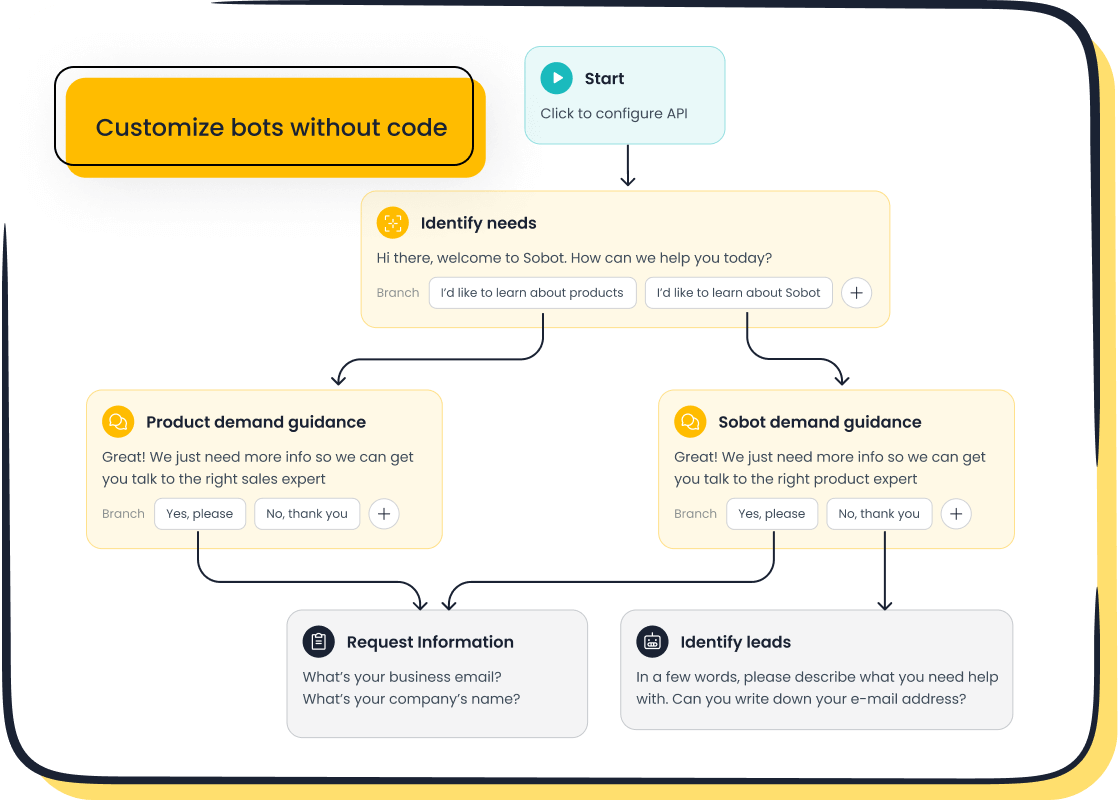
The Sobot Chatbot is one of the top AI customer service tools for mid-sized businesses facing this exact challenge. It is designed to handle a high volume of repetitive queries automatically.
- It features a no-code, point-and-click interface, so you can build and deploy it without needing an engineering team.
- By automating common questions, it can help you cut expenses by up to 50%.
While other platforms like Gorgias or Tidio also offer chatbot solutions, Sobot's ease of use and focus on ROI make it a powerful starting point for your AI in customer service journey.
Problem: Complex Issues Overwhelming Agents Sometimes, the problem isn't just repetitive questions. It's the time it takes for agents to research complex issues. In this case, you need AI that assists your team, not just your customers.
AI-powered agent-assist tools work behind the scenes to make your human team faster and smarter.
- AI Ticket Summarization: This AI feature reads long conversation histories and gives your agent a quick summary.
- AI Response Suggestions: The AI drafts accurate replies based on your knowledge base, which agents can use or edit.
- AI-Powered Knowledge Search: Agents can find the right answer instantly instead of manually searching through documents.
Step 3: Vet AI Vendors with a Mid-Sized Checklist
After matching tools to problems, you need to choose a vendor. Not all AI platforms are created equal. Use this checklist to vet potential partners and find one that understands the needs of a mid-sized business. This is the final step to selecting the top AI customer service tools for mid-sized businesses.
| Checklist Item | Key Question to Ask | Why It Matters for You |
|---|---|---|
| Omnichannel Support | Do you support omnichannel deployment across web, WhatsApp, email, and social media? | Your customers expect to contact you on their preferred channel. A unified platform prevents a disjointed experience. Sobot, for example, unifies all these channels into a single, efficient workspace for your agents. |
| No-Code Interface | Can our non-technical team build and manage the AI without writing code? | You need a tool that empowers your existing team. A visual, drag-and-drop builder means you can get started quickly without hiring specialized developers. |
| Integration Power | How does the AI integrate with our existing CRM, e-commerce platform, and helpdesk? | The AI must connect to your other systems to be truly useful. It needs to pull order data or customer history to provide personalized and accurate answers. |
| Scalability | Can your platform handle sudden spikes in traffic during peak seasons? | Your business is growing, and your AI tools must grow with you. Ensure the vendor can support your future needs without a drop in performance. |
| Analytics & Reporting | What metrics can we track to measure the AI's performance and ROI? | You need to prove that your investment in AI in customer service is paying off. Look for clear dashboards that track resolution rates, cost savings, and customer satisfaction. |
Choosing the right vendor is a partnership. Find a company that provides excellent support, training resources, and a clear roadmap for success.
A Guide to Phased AI Implementation
Adopting AI does not require you to overhaul your entire operation overnight. A phased implementation makes the process manageable and cost-effective. This guide breaks down the journey into three logical steps. You can build momentum, prove ROI, and empower your team at each stage of implementing AI.
Phase 1: Pilot an Internal AI-Powered Knowledge Base
Your first step in implementing AI support should focus on your team. An internal, AI-powered knowledge base is a low-risk, high-impact project. It acts as a single source of truth for your agents. This tool helps them find accurate answers quickly, which directly improves the quality and speed of their service.
A strong knowledge base dramatically boosts agent efficiency. Studies show that companies with best-in-class knowledge management see a significant reduction in Average Handle Time (AHT). Your agents spend less time searching for information and more time solving customer problems.
Pro Tip: Start by creating content for your most frequent and repetitive support issues. You can then expand to cover more complex scenarios. This focused approach ensures a quick and valuable return.
To build an effective internal resource, you should follow these key steps:
- Define Clear Goals: Determine the main purpose of your knowledge base. Decide what problems it will solve for your agents.
- Organize Your Content: Use clear categories, subcategories, and tags. This structure helps employees find information fast.
- Use AI-Powered Search: Implement a smart search function. This allows agents to find the right article instantly, even with vague queries.
- Create a Feedback Loop: Allow your team to rate articles and suggest edits. This practice keeps your content accurate and improves the AI over time.
- Integrate with Your Tools: Connect the knowledge base to your team's daily applications, like your helpdesk or internal chat.
Phase 2: Launch a Customer-Facing Chatbot
Once your internal knowledge base is strong, you can use it to power a customer-facing chatbot. This is a natural next step in your AI in customer service journey. You are extending the power of self-service directly to your customers. The goal is to automate answers to common questions, offering 24/7 support without increasing your headcount.
You can start small to ensure a smooth launch. For example, the University of Calgary Library successfully launched a chatbot by first focusing on just 50 common directional questions. This limited scope allowed them to train the AI effectively and achieve a high satisfaction rate.
This is where a tool like the Sobot Chatbot becomes invaluable for your implementation.
- Simple Setup: Sobot's AI can build a powerful knowledge base directly from your existing documents, like PDFs and articles. This feature dramatically simplifies the setup process.
- Proven Results: You can see the impact of this approach with companies like OPPO. By using Sobot's AI to optimize its knowledge base, OPPO reduced its maintenance efforts by a staggering 90%.
A well-implemented chatbot empowers customers with instant self-service. This frees your human agents to handle more complex and high-value interactions, improving both efficiency and the customer experience. This phase of implementation is crucial for scaling your support capabilities.
Phase 3: Integrate Predictive Analytics and Human Handoffs
The final phase of this guide focuses on refining your AI-powered customer service. Here, you will integrate more advanced AI capabilities and perfect the collaboration between your chatbot and your human team. This stage transforms your support from reactive to proactive.
Predictive analytics uses historical data to anticipate customer needs. This AI technology helps you:
- Resolve Issues Proactively: Identify and address potential problems before they affect customers.
- Optimize Resources: Forecast peak service times to ensure you have the right number of agents available.
- Personalize Interactions: Anticipate customer questions and offer tailored self-service solutions.
Equally important is creating a seamless handoff from the chatbot to a live agent. Nothing frustrates a customer more than having to repeat their problem. The transition must be smooth and preserve all context.
A successful handoff requires transparency. You should always inform the customer they are being transferred and provide the agent with the full chat history.
Sobot's platform is designed for this exact scenario. It enables a seamless escalation from the chatbot to a live agent within the same interface. The agent receives the entire conversation history, so they can pick up right where the AI left off. This creates a unified and efficient workflow for your team and a frustration-free experience for your customers. As you advance your AI in customer service, you can even extend this model to phone support with integrated voicebot and call center solutions.
Preparing for Implementing AI in Customer Service
A successful AI implementation depends on more than just technology. You must prepare your team, your tools, and your security protocols. This preparation ensures a smooth transition when implementing AI and builds a strong foundation for your new customer service model. Proper planning is key to a successful implementation.
Training Agents to Supervise AI
Your agents' roles will change. They will become supervisors of the AI, not just problem-solvers. This new role requires specific training. Your team needs to understand how to work with AI agents to deliver the best experience. A successful implementation of AI in customer service empowers your human team.
Your goal is to create a partnership between your agents and the AI. Training should focus on collaboration, not replacement.
Effective training for your AI agents includes several key areas:
- Technical Skills: Train your team to use the AI monitoring tools. They should practice watching live chats and updating the knowledge base.
- Clear Escalation Rules: Define exactly when AI agents should transfer a conversation to a human. Use role-playing to practice smooth handoffs.
- Empathy and Soft Skills: Since AI will handle simple questions, your agents will manage more complex issues. Focus training on active listening and emotional intelligence.
Making Your CRM and Helpdesk AI-Ready
Your current systems must be ready to connect with your new AI tools. A clean and organized tech stack is essential for a successful implementation. The AI needs access to accurate data to provide helpful answers. This is a vital step in implementing AI in customer service.
Start by auditing your existing platforms. Ensure your CRM and helpdesk have open APIs. APIs allow different software to talk to each other. You should also clean your customer data to remove duplicates and errors. A well-organized knowledge base is also crucial for a smooth implementation.
Addressing Data Privacy and Security
Protecting customer data is a top priority when implementing AI. You must follow data privacy regulations and adopt strong security practices. This builds trust with your customers and protects your business. The implementation of AI in customer service must be secure.
You need to understand rules like GDPR and CCPA. These regulations give customers rights over their data, including the right to have it deleted. Your security strategy for the AI should include:
- Data Encryption: Protects customer data when it is stored and when it is being sent.
- Role-Based Access Controls: Ensures that employees can only see the data they absolutely need to do their jobs.
- Secure Data Disposal: Establishes clear methods to permanently delete data when it is no longer needed, making it impossible to recover.
Measuring Success and Optimizing Your Strategy

After you implement AI, you must measure its impact. This helps you prove the value of your investment and find ways to improve. A strong measurement plan is essential for your long-term customer service strategy.
Key Performance Indicators (KPIs) Beyond CSAT
Customer Satisfaction (CSAT) is important, but it does not tell the whole story. To understand the full impact of AI in customer service, you need to track a wider range of metrics. These KPIs show you how the AI is performing and where it creates value.
You can group your KPIs into three main areas:
- Operational: Track the chatbot Containment Rate to see how many issues the AI solves without human help. Also, monitor the Escalation Rate to see how often a human agent is needed.
- User Experience: Use the Customer Effort Score (CES) to find out how easy it is for customers to get answers. This helps you improve the overall customer experience.
- Business Impact: Measure direct cost savings and any increase in conversion rates. This shows the financial return of your AI investment.
Real-world results show what is possible. For example, after implementing Sobot, the smart device innovator OPPO achieved an 83% chatbot resolution rate, a 94% positive feedback rate, and a 57% increase in repurchase rate.
These are the tangible business outcomes you can aim for with a solution like Sobot. They prove that AI delivers more than just cost savings; it drives customer satisfaction and loyalty.
Creating a Feedback Loop for AI Improvement
Your AI is a tool that learns and improves over time. You need to create a feedback loop to help it get smarter. This process involves collecting feedback directly from users and using it to refine the AI's performance. You can use your chatbot to ask for feedback in real-time during a conversation. This method is simple for customers and gives you immediate insights. This continuous improvement cycle is key to boosting customer satisfaction and making your AI more effective.
Future-Proofing Your AI Strategy
Your journey with AI in customer service does not end after launch. You must plan for the future to stay competitive. This means choosing solutions that can grow with your business. Look for AI platforms with predictable pricing so your costs do not increase unexpectedly as you scale. A successful strategy treats the AI as a partner to your human team. This partnership allows your agents to focus on complex problems while the AI handles routine tasks, ensuring your customer service remains efficient and effective for years to come.
Your success with AI in customer service by 2026 depends on a smart strategy. This guide shows that a phased implementation makes the process manageable. You can start small with targeted solutions like the Sobot Chatbot to see immediate value. This methodical implementation empowers your team and makes AI adoption both achievable and profitable. This approach to implementing AI is proven by real-world results. The right chatbot is one of the top ai customer service tools for mid-sized businesses. A successful AI implementation will transform your customer service.
Ready to see how AI can transform your support? Start by auditing your top three customer service bottlenecks or book a demo of the Sobot Chatbot today.
FAQ
What is the main benefit of using AI receptionists?
AI receptionists provide excellent self-service options for your customers. These AI receptionists offer 24/7 support and deliver instant responses. This frees your human team to handle more complex issues. AI receptionists improve efficiency and customer satisfaction through reliable self-service.
Will AI agents replace my human customer service team?
No, AI agents are designed to support your human team, not replace it. AI agents handle repetitive tasks. This allows your human agents to focus on high-value interactions. This partnership enhances your team's capabilities and improves the overall personalized customer experience.
How do AI receptionists improve self-service?
AI receptionists enhance self-service by using a knowledge base to answer common questions instantly. This form of ai-driven self-service empowers customers to find solutions on their own. Good AI receptionists make self-service fast and easy, reducing the need for agent support.
What are the first steps to get started with automated customer service?
Start by auditing your current support tickets to find common, repetitive questions. Then, you can select ai customer experience tools like AI virtual assistants or AI receptionists that target these specific pain points. This focused approach ensures a quick return on your investment in self-service.
See Also
Discovering Leading Cloud Contact Center Platforms for the Year 2025
Best Live Chat Solutions Tailored for Small Businesses in 2024
Comprehensive Review of Premier Contact Center Solutions for 2024
Evaluating Leading Cloud Contact Center Services: An In-depth 2024 Review
The Ten Best Customer Service Software Options to Consider for 2024

