Top AI Communication Tools for Your Support Team


Artificial intelligence (AI) is reshaping customer service. It helps teams meet rising customer expectations for 24/7 availability. Delivering hyper-personalization at scale is now a critical goal for an excellent customer experience. Teams are adopting platforms like Sobot to stay ahead. The Sobot AI platform offers powerful solutions, including the Sobot call center for voice and Live Chat for omnichannel engagement. These top ai-enhanced communication tools for customer support teams improve customer service outcomes for all customers. This shift toward AI ensures businesses can provide superior customer service and achieve hyper-personalization at scale.
Top AI-Enhanced Communication Tools for Customer Support Teams

The best support teams recognize that technology should empower agents, not replace them. The most effective top ai-enhanced communication tools for customer support teams are designed for human-AI collaboration. This approach combines the efficiency and data-processing power of artificial intelligence with the empathy, critical thinking, and nuanced understanding of human agents. By automating repetitive tasks, AI frees up support professionals to focus on complex, high-value interactions that build lasting customer relationships.
The Growing Role of AI in Customer Service
The role of AI in customer service has evolved from simple automation to sophisticated partnership. In this model, AI handles the predictable, high-volume queries that can consume an agent's day. This creates a more efficient workflow and a better overall customer experience. When agents are not burdened with resetting passwords or checking order statuses, they can dedicate their full attention to resolving intricate problems and providing personalized guidance. This human-AI collaboration is fundamental to modern customer service, ensuring that customers receive swift, accurate answers for simple issues and thoughtful, empathetic support for complex ones. This balanced approach elevates the quality of customer service.
AI Copilots for Real-Time Agent Assist
AI copilots are one of the most impactful top ai-enhanced communication tools for customer support teams. These AI agents act as a real-time assistant, working alongside human agents to enhance their capabilities and boost efficiency. Platforms like Sobot’s AI Agent provide a powerful example of this technology in action. It assists agents by instantly generating accurate response suggestions and summarizing long conversation histories, allowing agents to grasp the customer's context immediately.
This AI-powered support dramatically reduces response times and improves the quality of interactions. AI agents help teams deliver faster service in several ways:
- Instant Handling of Routine Inquiries: AI agents manage a large volume of common questions, providing immediate answers and reducing customer wait times.
- Real-Time Agent Assistance: They offer human agents instant suggestions and insights during conversations, enabling quicker and more informed decisions.
- Knowledge Base Suggestions: AI agents quickly search company databases to recommend relevant articles, giving agents prompt access to accurate information.
- Draft Response Generation: For frequent questions, AI agents create draft responses, allowing agents to reply more quickly and consistently.
- Optimized Ticket Prioritization: They help prioritize and route tickets, ensuring agents focus on the most urgent issues first.
The return on investment for AI-powered customer support is clear, as shown in several industry examples. Companies that implement these top ai-enhanced communication tools for customer support teams see major improvements in efficiency and conversions.
| Company | Challenge | AI Agent Solution | ROI Impact |
|---|---|---|---|
| H&M | Rising cart abandonment and overwhelmed customer service | AI-powered virtual shopping assistant for product discovery and FAQs | 70% of queries resolved without human support; 25% increase in conversions |
| Lufthansa | Handling high volumes of flight status queries across languages | Multi-language AI chatbot for FAQs and flight status updates | 80% of queries resolved without human agents; 60% shorter response times |
| Starbucks | Need for personalized customer recommendations | AI used to personalize recommendations and enhance the customer experience | 30% increase in overall ROI; 15% lift in customer engagement |
| ADT | Slow and impersonal customer responses | Integrated AI-driven tools for faster, personalized support | Customer satisfaction increased by 30%; conversions rose from 44% to 61% |
Predictive Analytics for Proactive Support
Beyond assisting in real-time, AI is also enabling a shift from reactive to proactive customer service. Predictive customer service uses data to anticipate needs and solve problems before they escalate. This is one of the most advanced top ai-enhanced communication tools for customer support teams. By analyzing historical data, AI can identify patterns that signal potential customer dissatisfaction or churn.
Predictive analytics helps support teams retain customers by following a structured approach:
- Calculate Customer Churn Rate: First, teams establish a baseline by determining the current rate of customer loss.
- Integrate Data: Next, they combine diverse data sources, including transaction history, call logs, and website activity, to build a complete view of past behavior.
- Build a Churn Prediction Model: Machine learning models then segment customers into those likely to churn and those likely to stay.
- Assess Churn Risk Score: Each customer receives a risk score, allowing teams to categorize them into high, medium, or low-risk groups.
- Segment Customers: Finally, teams group customers based on shared traits and risk scores to deliver targeted retention efforts.
This proactive strategy delivers powerful results. Organizations using predictive analytics for retention see an average 15-25% reduction in churn rates, according to research from Gartner. A McKinsey study found that companies using this form of AI can respond up to 80% faster to at-risk accounts. This capability transforms customer service from a cost center into a revenue driver, directly improving the customer experience and protecting the bottom line. This makes predictive customer service one of the essential top ai-enhanced communication tools for customer support teams.
Key Customer Service Trends in Automation
While AI copilots enhance human performance, another set of powerful customer service trends involves full customer service automation. These tools handle customer interactions from start to finish without human intervention. This approach provides immediate, 24/7 support and frees up the entire support team to manage strategic initiatives and the most complex customer needs. Customer service automation is no longer a futuristic concept; it is a practical solution for scaling support operations and improving the customer experience.
24/7 Support with AI-Powered Chatbots
Modern customers expect answers on their schedule, not just during business hours. AI-powered chatbots are the frontline solution for meeting this demand. These automated ai agents provide instant responses to common questions, guide users through processes, and resolve issues around the clock. AI-powered customer support through chatbots significantly improves First-Contact Resolution (FCR) by handling a wide array of inquiries in real-time. Industry estimates show that AI chatbots resolve approximately 50-60% of inquiries on the first contact, a figure that continues to rise with technological advancements.
Sobot’s AI Chatbot demonstrates the peak potential of this technology. It goes far beyond basic Q&A, offering sophisticated conversational AI that understands intent and provides accurate solutions. This empowers customers with effective self-service options. The success of this approach is proven by its implementation with leading brands.
OPPO's Success with Sobot: Global tech leader OPPO integrated Sobot's chatbot to manage high inquiry volumes. The results were transformative:
- 83% of inquiries were resolved by the chatbot alone.
- 94% of users reported a positive feedback rate.
These metrics show how advanced AI agents can deliver exceptional customer service. Furthermore, Sobot is an official WhatsApp Business Solution Provider (BSP). This allows businesses to deploy powerful customer service automation directly within the world's most popular messaging app, meeting customers on their preferred channel. Integrating chatbots into key messaging platforms is essential for a modern customer service strategy.
AI Voice Assistants for Call Centers
The evolution of automation extends beyond text-based messaging and into the call center. AI voice assistants, or voicebots, are transforming how businesses handle phone-based support. A 2024 Statista report shows that 61% of global businesses have already implemented some form of voice AI, signaling a major shift in customer service trends. These ai agents use natural language understanding to interpret spoken requests, answer questions, and perform tasks, creating a seamless and efficient customer experience over the phone.
Sobot’s Call Center solution incorporates an advanced Voicebot that handles inbound and outbound calls with remarkable efficiency. This technology offers more than just a traditional IVR menu; it engages in natural conversation to resolve issues quickly. The financial and operational benefits are significant.
Key advantages of implementing AI voice assistants include:
- Massive Cost Reduction: Businesses can achieve over 90% in savings compared to live agent costs, with automated interactions costing just 10-15% of a typical call.
- Increased Automation: Up to 70% of all incoming call inquiries can be fully automated, freeing human agents for high-value conversations.
- Reduced Manpower Needs: Voice AI can lead to a 90% lower requirement for human staff to handle routine calls.
- Scalable Operations: Teams can handle sudden spikes in call volume during peak times without hiring additional staff, ensuring consistent service levels.
By empowering self-service options through voice, businesses can dramatically lower operational costs while improving responsiveness.
Intelligent Routing for Efficient Service
Effective customer service automation is not just about deflection; it is also about connection. When a customer does need to speak with a human, ensuring they reach the right person on the first try is critical. Intelligent routing uses AI to move beyond random or sequential call distribution. It analyzes customer data, inquiry type, and agent skill sets to make the perfect match. This data-driven approach significantly boosts customer satisfaction by connecting customers with the agent best equipped to solve their specific problem.
Intelligent routing systems rely on several key features to optimize workflows:
- Skills-Based Routing: Directs inquiries to agents with specific expertise, such as technical knowledge, language proficiency, or product specialization.
- Data-Driven Routing: Uses real-time data from a CRM or other systems—like a customer's purchase history or location—to make smarter routing decisions.
- AI-Enhanced Routing: Employs AI to analyze the customer's natural language during an IVR interaction to understand their intent and route them accordingly.
- Omnichannel Capabilities: Extends routing logic beyond voice to channels like email, chat, and social media, ensuring inquiries are handled by the right team regardless of the platform.
This technology is a core component of a unified support system. For example, Sobot's Ticketing System benefits directly from intelligent routing principles. When a ticket is created, the system can automatically assign it to the correct department or agent based on predefined rules, issue category, and priority. This eliminates manual triage, reduces resolution times, and ensures a seamless customer experience from the first point of contact.
Unifying Customer Communications with AI
A disconnected approach to customer communications creates friction and frustration. Customers expect seamless omnichannel experiences where their history is remembered across every touchpoint. AI provides the tools to unify these interactions, creating a single, coherent view of the customer that enhances the entire customer experience. This strategy is essential for building strong customer relationships.
Mapping Paths with Journey Analytics
Understanding the customer journey is the first step toward improving it. Journey analytics uses data to map out every interaction a customer has with a brand. These touchpoints can include:
- Marketing emails and newsletters
- Website, app, and social media platforms
- Phone calls and online chatbots
- In-store staff and checkout registers
By analyzing this path, AI can identify pain points and opportunities. This proactive insight delivers powerful results.
According to Gartner, companies using journey analytics can increase customer retention by 25-30% and reduce churn by 20-30%.
Omnichannel Hubs for a Single View
Data fragmentation is a major barrier to great customer service. One survey found that 87% of organizations believe their data is fragmented across silos, making it difficult to manage. An omnichannel approach solves this problem.
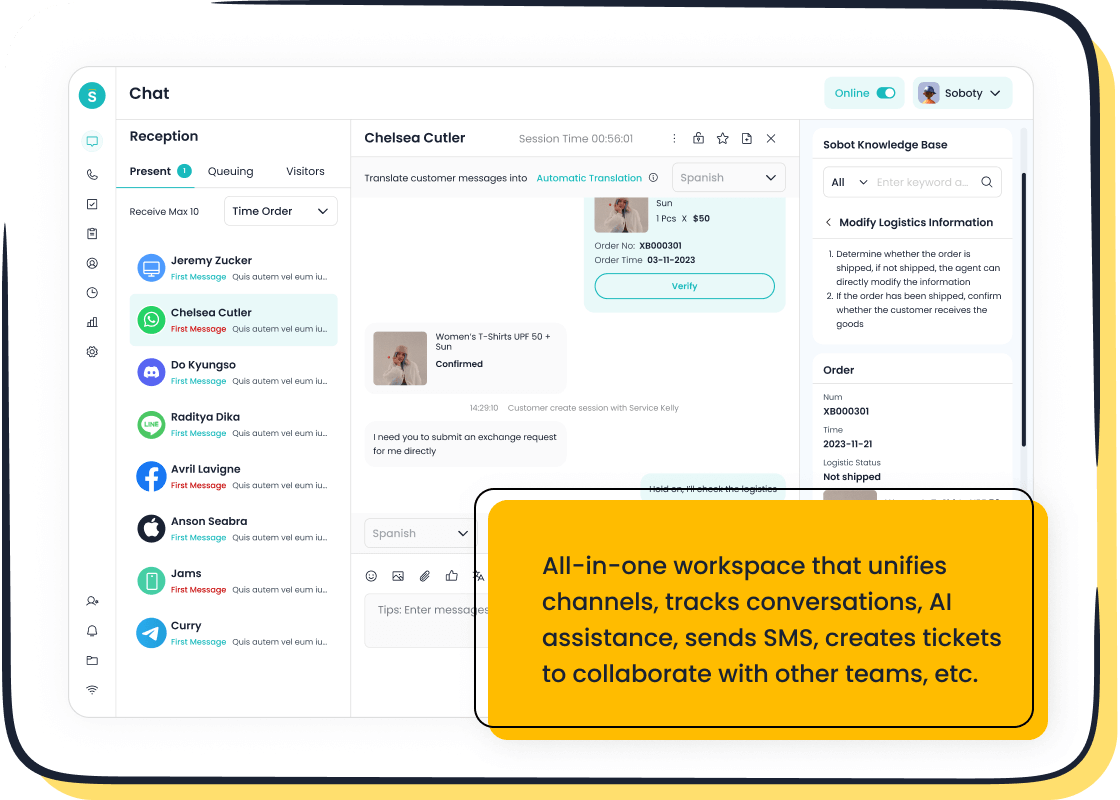
Sobot’s Live Chat platform acts as a unified customer contact center. It brings all customer communications from channels like your website, app, WhatsApp, and Facebook into a single workspace. This gives agents a complete view of every customer interaction, eliminating the need to switch between systems. A unified view empowers agents to provide faster, more contextual customer service, which directly contributes to a higher Net Promoter Score (NPS).
AI-Powered Personalization at Scale
A unified data hub is the foundation for true personalization at scale. With all customer data in one place, AI algorithms can deliver highly relevant and timely experiences. This AI-enabled personalization has a direct impact on revenue. Fast-growing companies, for example, generate 40% more revenue from personalization than their peers. Amazon generates an estimated 35% of its revenue from its AI-based product recommendations. This level of personalization at scale transforms customer service from a reactive function into a proactive driver of business growth.
How to Implement AI in Your Support Strategy
Integrating AI into your support strategy is a transformative step that requires a clear, methodical approach. Successful AI adoption hinges on careful planning, from initial assessment to ongoing measurement. By following a structured framework, teams can ensure that AI tools solve real problems, integrate seamlessly with existing systems, and deliver a measurable impact on both efficiency and the customer experience.
Step 1: Assess Your Team's Core Needs
The first step in any AI adoption journey is a thorough assessment of your team's specific challenges and goals. Instead of adopting technology for its own sake, identify the most significant pain points in your current customer service workflow. Common issues that AI can solve include long wait times, agent fatigue from repetitive questions, and customers struggling with self-service options.
To pinpoint your needs, consider the following framework:
- Review Support Processes: Analyze your current workflows to identify bottlenecks, such as manual ticket labeling or inefficient routing.
- Identify Core Problems: Determine if your team struggles with fluctuating demand, high resolution times, or keeping up with after-hours requests.
- Define Desired Outcomes: Set clear goals for what you want to achieve with AI, whether it's reducing costs, improving CSAT, or increasing agent productivity.
Step 2: Integrate with Your Existing Tech Stack
For AI to be effective, it must work harmoniously with your current technology. A smooth integration prevents data silos and empowers agents with a unified view of the customer. Your AI solution should connect seamlessly with essential platforms like your CRM and helpdesk. Common systems that benefit from AI integration include Salesforce, HubSpot, and Microsoft Dynamics 365.
A phased approach is the best practice for integration:
- Start with a Pilot Project: Test the AI tool on a small scale to validate its effectiveness.
- Prepare Your Data: Ensure your data is clean, accurate, and accessible for the AI system.
- Deploy and Monitor: Roll out the solution more broadly while continuously monitoring its performance and making adjustments.
Step 3: Ensure Data Privacy and Ethical AI Use
Trust is the cornerstone of customer service. As you implement AI, prioritizing data privacy and ethical use is non-negotiable. This means being transparent with customers about how their data is used and adhering to major regulations like GDPR and CCPA. Ethical AI also requires ensuring fairness and avoiding bias in automated decisions.
Key principles for ethical AI include:
- Transparency: Clearly explain how AI systems make decisions.
- Fairness: Audit AI models to ensure they treat all users equitably.
- Accountability: Establish clear governance and take responsibility for AI-driven outcomes.
- Human Oversight: Maintain human control to review and override AI actions when necessary.
Step 4: Measuring AI's Impact on Customer Service
To justify the investment in AI, you must measure its impact. Tracking the right Key Performance Indicators (KPIs) demonstrates the value of your AI adoption and identifies areas for improvement.
Focus on metrics across several categories:
- Operational Efficiency: Track Self-Service/Containment Rate to see how many issues AI resolves without human help. Monitor Average Handling Time (AHT) to measure efficiency gains.
- Customer Experience: Use Customer Satisfaction (CSAT) and Net Promoter Score (NPS) to gauge how customers feel about automated interactions.
- Financial Impact: Calculate the Cost per Resolved Interaction to quantify savings and determine the overall ROI.
By systematically measuring these KPIs, you can prove the value of AI and continuously optimize your strategy.
AI tools transform modern customer service. They empower teams with agent assistance, deliver full automation, and unify communications. Platforms like Sobot integrate these technologies to boost efficiency and improve customer satisfaction. Adopting AI is essential for enhancing the customer experience and driving revenue. The future of customer service is intelligent and integrated. Embark on Your Contact Journey today by exploring a free trial of Sobot's Live Chat and see how AI can elevate your team and support your customers.
FAQ
How does AI improve customer service?
AI tools automate repetitive tasks and provide instant answers. This frees human agents to handle complex problems. AI also analyzes data to offer personalized support. This combination improves efficiency and customer satisfaction.
What is an omnichannel hub?
An omnichannel hub unifies all customer conversations into one platform. It combines channels like email, live chat, and social messaging. This gives agents a complete customer view, enabling faster and more consistent service.
Can AI chatbots handle complex questions?
Modern AI chatbots, like Sobot's AI Chatbot, resolve many common issues. They use advanced AI to understand user intent. For complex problems, they seamlessly transfer the conversation, along with its history, to a human agent.
Why is integrating AI with messaging apps important?
Customers prefer using popular messaging apps like WhatsApp. Integrating AI allows businesses to provide automated, 24/7 support on these channels. This strategy meets customers where they are and improves the overall experience.
See Also
Leading AI Solutions: Elevating Enterprise Contact Center Performance
An In-Depth Look at AI for Enterprise Call Centers
Maximizing Efficiency: The Impact of AI in Customer Service Software
The Best 2024 Speech Analytics Tools for Call Center Optimization
Essential Guide: Implementing Artificial Intelligence Software in Call Centers

