The Upside and Downside of AI Calling


You want the efficiency of AI, but you can't risk losing the human touch your customers trust. This is the central challenge for modern businesses. With the AI for customer service market projected to reach $47.82 billion by 2030, the pressure to adopt AI is real. This guide helps you weigh the significant upsides, like the valuable data from ai powered call tracking, against the critical downsides. Making the right choice about an AI solution, such as a Sobot call center powered by Sobot AI, requires careful thought. Let's find the right balance for your business and customer needs with a trusted partner like Sobot.
The Pros of AI in Call Centers
Adopting AI calling technology offers powerful advantages that can transform your customer service operations. You can boost efficiency, provide constant support, and gain deeper insights into your customer interactions. Understanding these pros of AI in call centers helps you see the potential return on investment.
Drastic Cost Reduction and Higher Efficiency
One of the most significant pros of AI in call centers is the immediate impact on your budget and productivity. AI handles repetitive tasks, which frees up your human agents to focus on complex customer issues. This customer service automation directly translates into major cost savings and a more efficient team.
Industry data shows the financial benefits are substantial.
- 95% of companies using AI report reduced costs and time savings.
- On average, businesses see a 35% cost reduction in their customer service operations after AI adoption.
This efficiency boost comes from AI’s ability to manage calls and information faster than humanly possible. AI calling systems can route inquiries, answer common questions, and gather initial customer data in seconds. This lets your agents start conversations with all the necessary context.
Success in Action: America's largest online Asian supermarket, Weee!, implemented Sobot's voice product to streamline its operations. The result was a 20% increase in agent efficiency and a remarkable 50% reduction in resolution time, showing the real-world impact of modern AI calling solutions.
Other companies report similar gains from AI call center technology.
| Company | AI Application | Efficiency Metric | Reported Impact |
|---|---|---|---|
| Camping World | AI Assistant for phone/web | Agent Efficiency | 33% increase |
| Telstra | AI for agent assistance | Average Handling Time | 15% reduction |
| Telstra | AI for agent assistance | First-Call Resolution | 10% increase |
AI also dramatically shortens the time it takes to resolve customer calls. AI calling systems provide agents with real-time guidance and historical data, which eliminates the need to search for information manually.
| Company | AI Solution | Reduction in Call Resolution Time |
|---|---|---|
| Telecom Provider | Real-time call insights and self-service | 25% reduction in call duration |
| Vodafone Germany | AI voice bots for initial queries | 20% reduction in average handling time |
24/7 Availability and Instant Response
Your customers live in a 24/7 world. They expect support whenever they need it, not just during standard business hours. AI makes round-the-clock service a reality. With 24/7 customer support, you can answer questions and solve problems at any time of day or night. This constant availability is a massive advantage for building customer loyalty.
AI offers benefits that directly improve the customer experience:
- Immediate Answers: AI eliminates frustrating hold times. A customer gets instant help with order status, product questions, or delivery schedules.
- Always-On Support: You can provide 24/7 customer support during holidays, weekends, and peak shopping seasons when human teams are often overwhelmed.
- Global Reach: AI easily handles different time zones, providing consistent service to your international customer base.
The speed of AI is unmatched. Traditional support channels can leave a customer waiting for hours. AI responds in seconds.
| Metric | AI Chatbots | Human Agents |
|---|---|---|
| Average First Response Time | <2 seconds | 2-5 minutes |
This instant engagement shows your customer that you value their time. It can be the difference between a completed sale and an abandoned cart. Providing 24/7 customer support with AI calling technology ensures you never miss an opportunity to help a customer.
Enhanced Data with AI Powered Call Tracking
AI calling systems do more than just handle calls; they transform conversations into valuable data. Every interaction becomes a source of insight. With ai powered call tracking, you can move beyond simple metrics like call duration. You can understand what is being said and how it is being said.
Modern ai powered call tracking software gives you a complete picture of your customer conversations.
- Real-time Transcription: AI transcribes calls with high accuracy, creating a searchable record of every conversation.
- Keyword Spotting: It automatically identifies keywords and phrases, helping you spot trends, common questions, and customer pain points.
- Sentiment Analysis: AI analyzes the emotional tone of a call, flagging conversations where a customer is frustrated, angry, or disappointed. This helps you proactively address issues before they escalate.
This level of analysis provides powerful, data-driven insights. For example, AI sentiment analysis can detect subtle cues in a customer's voice that indicate dissatisfaction, even if they don't say it directly. By flagging these calls, you can have a manager follow up to resolve the issue and prevent churn. This is how you leverage customer data to improve service.

Platforms like Sobot's Voice/Call Center offer real-time monitoring and analysis tools. You can use this data to:
- Identify Coaching Opportunities: Use aggregated call summaries to find areas where your sales or support teams can improve.
- Track Competitor Mentions: See what customers are saying about your competition.
- Improve Your Products: Discover recurring issues or feature requests mentioned during calls.
Ultimately, ai powered call tracking turns your call center from a cost center into an intelligence hub. The insights you gain from this data help you make smarter business decisions and create an enhanced customer experience.
Scalability and Consistent Service with Sobot
As your business grows, your call volume will increase. With traditional models, this means hiring more agents—a costly and time-consuming process. AI calling technology allows you to scale your operations without a proportional increase in staff. AI can handle a massive volume of simple, repetitive inquiries, allowing your business to grow efficiently. For example, Grubhub managed a 100% surge in ticket volume by using automation, which shows how you can expand capacity without expanding your team.
Consistency is just as important as scalability. You want every customer to receive the same high level of service, regardless of which agent they speak to or what channel they use. AI calling solutions enforce consistency by standardizing workflows and responses.
Features within modern AI platforms like Sobot are designed for this purpose.
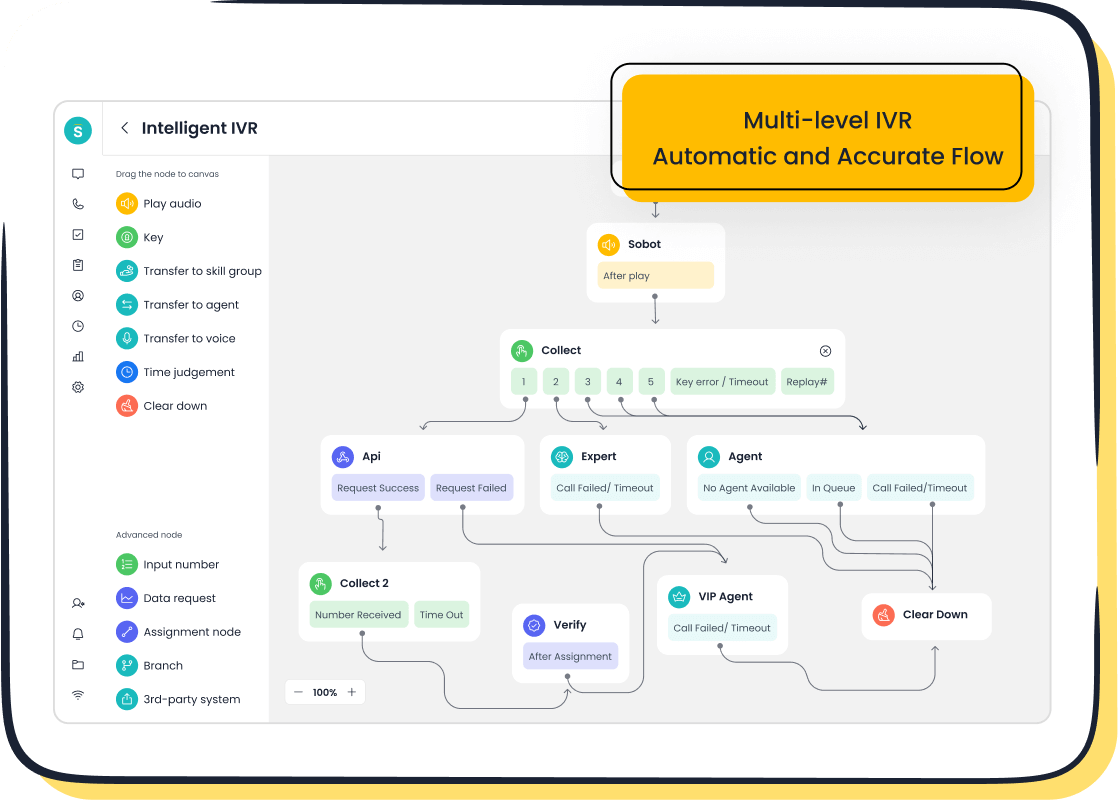
- Intelligent IVR: A drag-and-drop Intelligent IVR builder lets you create consistent and logical call flows. You can customize greetings, menus, and routing rules to ensure every caller has a smooth journey. Any changes you make go live instantly, guaranteeing a uniform experience across all calls.

- Unified Workspace: When an issue needs a human touch, AI ensures a seamless handoff. Sobot’s Unified Workspace provides agents with a complete customer history from all channels in one place. This means the customer never has to repeat themselves, and the agent can provide consistent, informed support.
This combination of automation and intelligent tools ensures that your customer service can grow with your business while maintaining the quality your customers expect. Using ai powered call tracking and ai calling systems gives you the foundation for scalable and consistent service. This powerful automation is a key reason why businesses are turning to AI.
The Cons of AI in Call Centers

While the benefits of AI are compelling, you must also consider the potential drawbacks. Understanding the cons of AI in call centers helps you create a balanced strategy. These challenges are not roadblocks but important factors to manage for a successful implementation.
Lack of Human Empathy and Nuance
The biggest challenge for AI is its inability to replicate genuine human empathy. An AI can process data and follow scripts, but it cannot truly understand a customer's frustration, anxiety, or relief. For complex or emotionally charged situations, this lack of nuance can turn a difficult situation into a negative customer experience. A customer needs to feel heard and understood, especially when they are upset.
Certain industries rely heavily on this human connection to resolve issues effectively.
- Healthcare: Patients calling about appointments or health concerns require a compassionate ear.
- Financial Services: A customer discussing a billing error or a sensitive financial matter needs to feel they can trust the person helping them.
- E-Commerce: When a long-awaited package is delayed, an empathetic agent can turn frustration into loyalty by acknowledging the issue and offering a solution.
Note: This limitation is the primary reason why a purely AI-driven approach is risky. The most effective strategies often use AI for simple tasks while saving human agents for moments that require emotional intelligence. You will see how a hybrid model addresses this later.
Initial Setup Costs and Integration
Implementing AI call center technology requires a significant initial investment. The costs go beyond the software license. You need to account for hardware, system configuration, and training your team. Many companies underestimate these expenses. A Gartner survey found that 54% of businesses misjudged their initial AI investment by 30-40%.
The costs can vary widely depending on the scale of your project.
| Deployment Type | Initial Investment Cost |
|---|---|
| Pilot Program (single department) | $150,000 - $200,000 |
| Full-scale Enterprise Deployment | $500,000 to several million dollars |
| Integration with Existing Systems | 25-40% of implementation budget |
Integrating the new AI with your existing systems, like your CRM, presents another hurdle. A successful integration depends on clean and organized data. Many businesses struggle with messy or incomplete customer data, which can hinder an AI's performance. Your team may also resist adopting new technology, fearing it will be too complex or threaten their jobs. Proper training is essential to overcome this learning curve.
Fortunately, modern platforms are built to address this challenge. For example, solutions like Sobot are designed for "Integration Made Simple," offering seamless connections with your existing CRM and business tools to streamline the transition.
Potential for Negative Customer Perception
Your customers may not be ready to fully embrace AI. Many people still prefer speaking to a human, especially for important issues. A 2023 Pew Research Center survey found that 81% of consumers believe AI companies will use their collected information in ways that make them uncomfortable. If your AI system is clunky, unresponsive, or misunderstood, it can lead to immense customer frustration.
A poorly implemented AI can quickly damage your brand's reputation.
- A customer stuck in a loop with a chatbot will likely hang up.
- An AI that misunderstands a request can give incorrect information.
- Forcing a customer to use AI without an easy option to reach a human is a common complaint.
A 2023 study by KPMG and the University of Queensland showed that about three in four consumers have concerns about AI risks. Building trust is critical. You must show your customers that your use of AI benefits them, whether through faster response times or 24/7 availability, without sacrificing the quality of your customer service.
Security and Data Privacy Risks
One of the most serious cons of AI in call centers involves security. AI systems handle a massive amount of sensitive customer data. This makes them a prime target for cyberattacks. A data breach can expose personal information, leading to financial penalties and a severe loss of customer trust.
The threats are varied and sophisticated.
- Poisoning Attacks: Attackers can manipulate the data used to train your AI, causing it to make errors or produce biased results.
- Prompt Injection: Malicious actors can craft inputs that override the AI's instructions, tricking it into revealing sensitive information or performing unintended actions.
- Data Exposure: If the AI system is compromised, confidential conversations and personally identifiable information (PII) can be leaked.
You must ensure your AI solution complies with data protection regulations like GDPR and CCPA. These laws require you to be transparent about how you use customer data and give individuals rights over their information. This includes data minimization, which means only collecting the data you absolutely need. Leading providers like Sobot address these security risks head-on. They use measures like encrypted data transfer and are built for compliance with regulations like GDPR, helping you protect your customer's information and your business.
Choosing the Right AI-Powered Calling Solutions
Selecting the right ai-powered calling solutions is a critical decision. You must look beyond the hype and find a tool that fits your specific business needs. This involves a careful review of your operations, budget, customers, and potential partners. A thoughtful evaluation ensures your investment in ai calling technology pays off.
Assessing Your Call Volume and Complexity
First, you need to understand your current calls. How many calls do you get? How complex are they? Answering these questions helps you see where ai can help most. Simple, high-volume questions are perfect for ai calling systems. Complex, emotional issues still need a human touch. You can analyze your customer conversations to find these patterns.
- Text analytics tools help you review chat and email data for common problems.
- Sentiment analysis uses ai to find the emotional tone in customer interactions.
- Conversation intelligence software spots keywords in phone calls to identify trends.
- Mapping the customer journey shows you where customers struggle.
This data gives you a clear picture of your needs.
Evaluating Your Budget and Technical Resources
Implementing ai calling technology involves more than just the software price. You must consider the total cost over time. This includes setup, training, and maintenance. A cheaper initial option might cost more in the long run. Comparing a traditional setup to modern ai calling systems shows a big difference in long-term costs.
For example, a three-year cost comparison might look like this:
| Solution Type | 3-Year Total Cost (Example) |
|---|---|
| Traditional 50-agent | ₹11.2 crores |
| AI Call Center | ₹1.8 crores |
This data shows how ai calling solutions can offer significant savings. You must also have the technical team to support the new ai calling systems.
Understanding Your Customer Base
Who are your customers? Their preferences matter. Some customer groups are more comfortable with ai than others. Forcing an ai-only option on a customer base that prefers human interaction can backfire. Research shows that age can influence this preference, especially for difficult problems.
| Demographic Group | Preference for Human Agents (Complex Issues) |
|---|---|
| Baby Boomers | 60% |
| Gen X | 55% |
This data suggests that older customers may want a human agent for important issues. Knowing your customer helps you design a better experience with ai.
Finding a Stable and Secure Partner
Your ai calling technology must be reliable. Downtime means lost sales and frustrated customers. You need a partner that guarantees high system availability. Industry standards for uptime vary, so you should look for a top-tier provider.
- 99.9% Uptime: This is the leading standard for ai calling systems in critical sectors like e-commerce and finance.
- 99.5% Reliability: This is a strong offering from premium voice ai solutions.
- 95-98% Uptime: This is more typical for basic ai systems.
A partner with a 99.99% uptime, like Sobot, ensures your service is always on. This stability is essential for building customer trust in your ai.
The Hybrid Model: AI in Customer Support
The best strategy for AI in customer support often isn't a choice between automation and people. It's about finding the right balance. A hybrid model combines the efficiency of AI with the irreplaceable empathy of human agents. This approach uses customer service automation for what it does best, freeing your team to handle what they do best. This creates a better customer experience and a more effective customer service operation.
Using AI for Initial Triage and Simple Queries
You can use AI to manage the first point of contact with a customer. AI voice agents are perfect for handling high volumes of routine requests. This initial triage is a key part of customer service automation. The AI can quickly categorize and route inquiries. This ensures the customer gets to the right place faster.
AI is best suited for:
- Repetitive tasks like order status checks or password resets.
- Routing technical issues to the correct specialist.
- Answering common questions with predefined answers.
- Classifying inquiries based on customer sentiment or complexity.
This automation lets your team avoid simple, repetitive work.
Escalating Complex Issues to Human Agents
Some problems need a human. The hybrid model knows when to pass the conversation from an AI to a person. This seamless escalation is crucial for customer satisfaction. Your AI should recognize triggers that signal a need for human intervention.
Common reasons for escalation include:
- A customer showing frustration or using phrases like "this is frustrating."
- Complex issues such as billing disputes or refund requests.
- A customer directly asking to speak with a person.
- The AI failing to understand a rephrased question after a few tries.
This ensures your customer always has a path to a human agent for difficult situations.
Leveraging AI for Agent Coaching and Analysis
AI in customer service also works behind the scenes to support your team. AI-powered tools can analyze call recordings to provide powerful insights. This helps you create personalized training for your agents. AI can identify gaps in agent knowledge or detect compliance issues. Studies show that companies using AI for performance management see a significant increase in employee productivity and engagement. This use of AI provides data-driven insights to improve your team's performance.
How Sobot's AI Solution Enables a Hybrid Approach
A successful hybrid model requires the right technology. Sobot's AI Solution is built to support this balanced approach to AI in customer service. It combines AI agents with AI call assistants to create a powerful system. The AI agents handle the simple, repetitive tasks, providing 24/7 automated customer service. When a customer has a complex issue, the call moves to a human agent. The AI copilot then assists your agent by providing real-time suggestions and pulling information from knowledge bases. This blend of automation and human support is the future of AI in customer service.
Choosing the right ai strategy depends on your business. The upside of ai is clear for high-volume, simple customer interactions. The downside of ai is a major concern for complex customer issues. A hybrid approach offers the best solution. It balances ai efficiency with the value of human interaction. This ensures your customer gets the best possible customer service. Solutions like Sobot's ai platform enable this balanced ai model. This ai approach helps your customer feel valued while your ai handles routine tasks.
FAQ
What is the main benefit of using AI for calls?
The biggest benefit of using AI is efficiency. An AI system handles many simple calls at once. This AI automation frees your team to focus on more complex problems. Your business saves money and your team becomes more productive with this AI technology.
Can AI completely replace human agents?
No, AI cannot fully replace humans. The best strategy uses a hybrid model. You use AI for simple, repetitive questions. Human agents handle emotional or complex issues where empathy is key. This approach gives you the best of both AI and human support.
Is AI calling technology difficult to set up?
Initial setup for any new AI can seem complex. However, modern AI platforms are designed for easy integration. You can connect the AI to your existing systems without major issues. A good partner makes the AI implementation process smooth and straightforward for your team.
How does AI improve over time?
AI technology uses machine learning to get smarter. The AI learns from every call and interaction. This process helps the AI understand questions better and provide more accurate answers. Your AI system continuously improves, making your support operations more effective with each conversation.
See Also
Evaluating Artificial Intelligence Solutions for Enterprise Call Center Operations
Comprehensive Guide to AI Software for Modern Call Center Management
Discovering the Best 10 AI Tools for Enterprise Contact Centers
A 2024 Review of Leading Automated Voice Calling Software
Understanding Call Center Voice Analytics Technology: A Detailed Explanation