NLU vs LLM A Simple Guide for Contact Centers

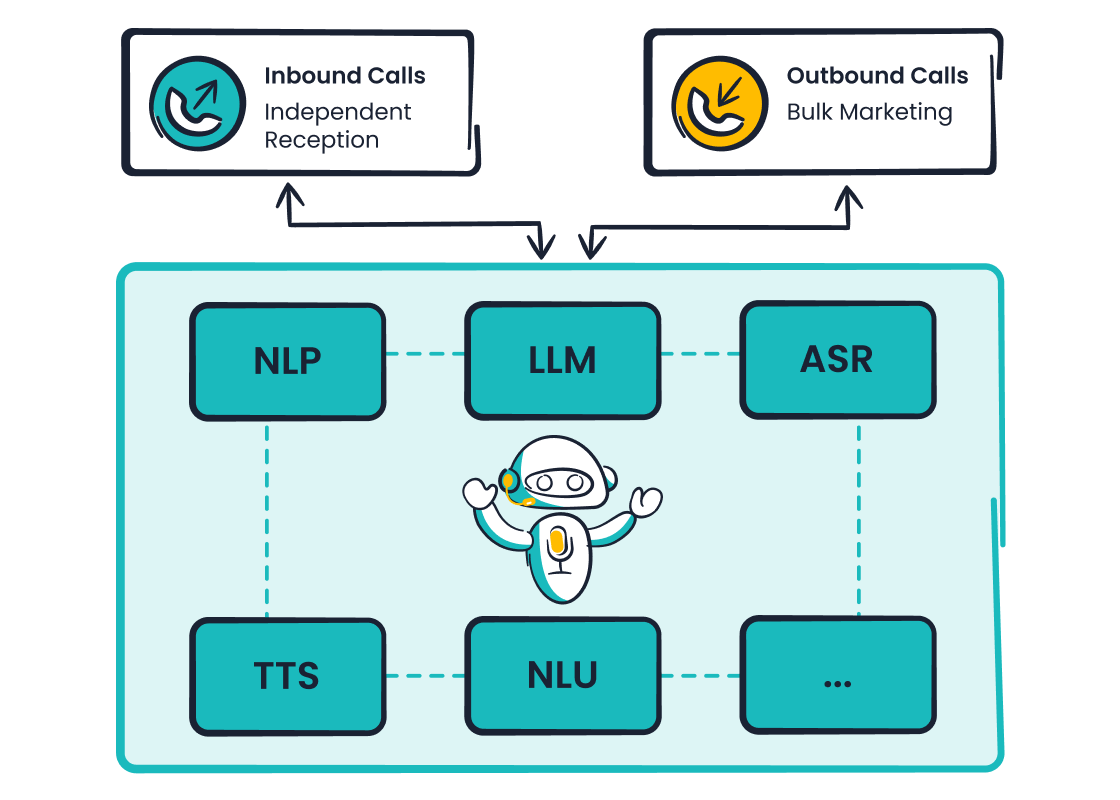
Contact centers are rapidly adopting AI, with chatbot usage reaching 37.5% in 2023. This AI growth presents leaders with new challenges. The key question is not a simple choice of NLU vs LLM. The real task is using each AI technology for its unique strengths. A successful strategy depends on understanding their distinct roles.
Natural Language Understanding (NLU) is the precision engine for understanding intent. Large Language Models (LLM) are the conversation engine for creating fluency.
The most effective solutions, like the Sobot AI platform, combine both. The Sobot call center uses a powerful NLU to first identify a customer's specific need. Then, an advanced LLM generates a natural, helpful response. This hybrid model uses NLU for reliability and an LLM for quality conversation, powered by a core NLU. Sobot champions this approach.
Defining the Core Technologies
To understand the roles of NLU and LLM, we first need to look at their foundation: Natural Language Processing (NLP). Both NLU and LLM are advanced forms of NLP, a field of artificial intelligence (AI) that helps computers understand human language.
NLP: The Foundation of Language AI
Natural Language Processing (NLP) gives machines the ability to read, understand, and interpret human language. The history of NLP shows a long journey toward this goal.
- Early Systems (1950s-1970s): The first NLP systems used strict, rule-based methods to translate sentences.
- Statistical Shift (1980s-1990s): NLP research moved to statistical models. These models used data analysis to handle language more flexibly.
- Deep Learning Era (2010s-Present): Modern NLP uses deep learning. This AI approach led to powerful tools like NLU and the LLM.
This evolution of NLP provides the core capabilities for today's advanced AI solutions. The field of NLP continues to push technology forward.
NLU: The 'Understanding' Engine
Natural Language Understanding (NLU) is a specialized part of NLP. The main goal of NLU is to figure out a user's specific intent. NLU software performs deep analysis to grasp the meaning behind the words. It identifies the user intent and extracts important details.
For example, when a user says, "What's the status of order #12345?", an NLU system identifies the intent as "check order status." It also extracts the key data: "12345."
This precision makes NLU perfect for structured tasks. The analysis from NLU enables reliable automation. NLU is the engine that drives accurate understanding in any user interaction.
LLM: The 'Conversation' Engine with Large Language Models
An LLM, or Large Language Model, is another powerful application of NLP. An LLM excels at language generation. These models use a "next-token prediction" method. They predict the next word in a sentence to create smooth, human-like text. This generation capability allows an LLM to handle open-ended conversations. An LLM can summarize calls, assist agents with responses, and manage complex user questions. The strength of an LLM lies in its fluent language generation.
NLU vs LLM: A Head-to-Head Comparison
Understanding the difference between NLU and LLM is crucial for any contact center leader. While both are powerful forms of NLP, they are designed for different jobs. The NLU vs LLM distinction comes down to a simple trade-off: precision versus fluency. NLU provides the precise understanding needed for automation, while an LLM delivers the fluent conversation that mimics human interaction.
This table offers a clear, at-a-glance comparison of their core capabilities.
| Criteria | NLU (For Precision) | LLM (For Fluency) |
|---|---|---|
| Primary Goal | Understand specific user intent and extract key data. | Generate human-like text and hold open-ended conversations. |
| Best For | Intelligent routing, IVR self-service, simple chatbots, data extraction. | Agent assist, call summaries, complex chatbots, content generation. |
| Accuracy | High and reliable for specific, trained tasks. | Variable; can "hallucinate" or create false information if not controlled. |
| Implementation | Requires training on your specific contact center data. | Can be used more quickly but needs strong guardrails to ensure safety and accuracy. |
Primary Goal: Intent vs. Generation
The most fundamental difference in the NLU vs LLM debate is their primary objective.
An NLU system focuses entirely on comprehension. Its main job is to perform a deep analysis of language to determine what a user wants to do. This is known as identifying the user intent. For example, NLU excels at distinguishing between similar but distinct requests.
- An NLU model can recognize that "What is the status of my lawn mower order?" maps to the
Check order statusintent. - It can also navigate ambiguity. A phrase like "order cancelled" requires the NLU to determine if the user is complaining about a past cancellation (
check order status) or requesting a new one (cancel order).
This precise intent analysis is the foundation of effective automation.
In contrast, the primary goal of Large Language Models (LLM) is language generation. An LLM predicts the next most likely word in a sequence to build sentences and paragraphs. This capability allows it to produce incredibly fluent and natural-sounding text, making it ideal for creating conversational experiences. Its strength is not in understanding a structured command but in continuing a dialogue.
Best Use Cases: Routing vs. Agent Assist
Because their goals are different, NLU and LLM are best suited for different contact center tasks.
NLU is the workhorse for structured automation where accuracy is paramount. Its ability to reliably identify intent makes it perfect for:
- Automated Ticket Routing: Companies like JPMorgan Chase use NLP systems with NLU capabilities to analyze millions of customer inquiries. This analysis allows them to route customers to the right support channel, achieving a 90% accuracy rate in intent recognition.
- IVR and Voicebots: Vodafone uses AI voice assistants powered by NLU to understand a caller's intent immediately. This allows 40% of calls to be handled without a human agent.
- Data Extraction: NLU can pull specific pieces of information, like names or policy numbers, from unstructured text to populate fields in a ticketing system automatically.
Large Language Models (LLM) shine in roles that assist humans and manage complex, free-flowing conversations. An LLM acts as a powerful "copilot" for agents.
- Real-Time Agent Assist: An LLM can listen to a conversation and provide agents with suggested responses, relevant knowledge base articles, and troubleshooting steps. This real-time guidance helps agents resolve issues faster and with greater accuracy.
- Automatic Call Summaries: After an interaction, an LLM can instantly condense a long conversation into a brief, actionable summary. This saves agents time and speeds up handoffs, as the next agent can get up to speed without reading a full transcript.
Accuracy: Precision vs. Fluency
When comparing NLU vs LLM, accuracy means two different things.
For NLU, accuracy is about correctness. When an NLU model is trained on specific data, its performance is highly reliable. It consistently identifies the correct intent and extracts the right data for tasks it knows.
Studies on Natural Language Understanding models show this clearly. On benchmark datasets like ATIS and SNIPS, well-trained NLU models demonstrate high precision and recall. One study even showed a 12.6% improvement in semantic accuracy on a specific dataset, proving NLU's ability to be fine-tuned for precise tasks.
For an LLM, accuracy is about fluency and coherence. While an LLM can produce grammatically perfect and contextually relevant language, it does not have a true understanding of facts. This can lead to a problem known as "hallucination," where the AI generates plausible but incorrect or entirely fabricated information.
A famous case involved an Air Canada chatbot that invented a refund policy. A tribunal ruled the airline was responsible for the false information its LLM provided. This highlights the risk of uncontrolled language generation. Research shows that factual incorrectness is the most common type of LLM hallucination.
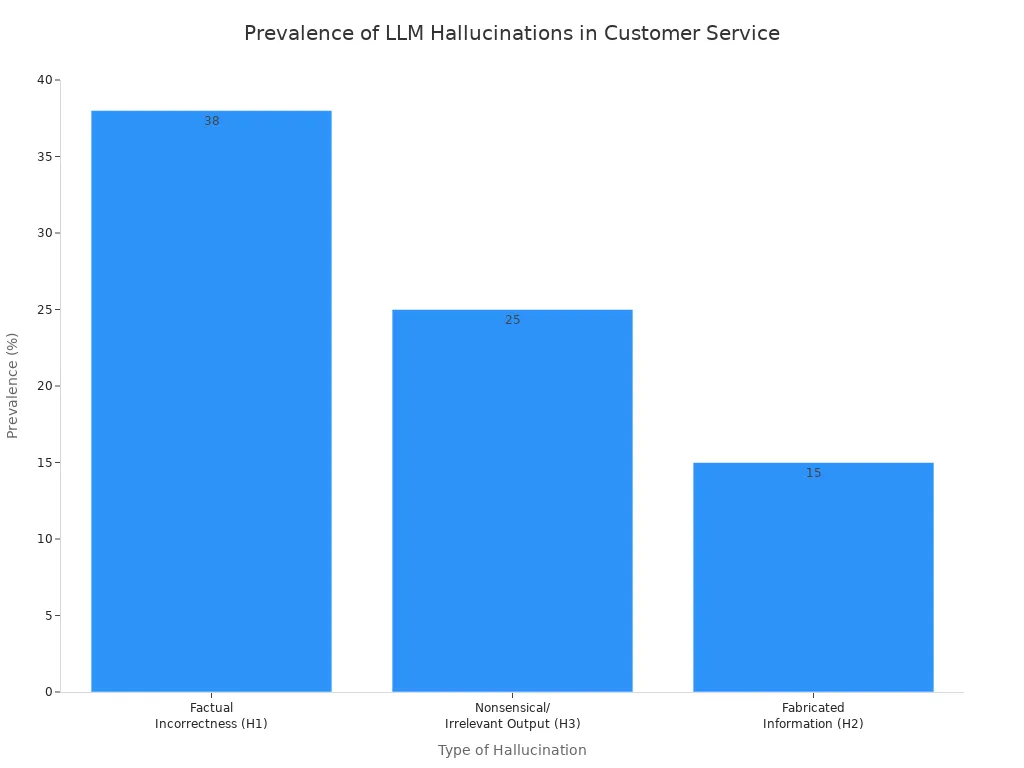
This makes a standalone LLM a risky choice for tasks requiring 100% factual response accuracy.
Implementation: Training vs. Guardrails
Deploying NLU and LLM systems involves different processes.
Implementing NLU requires a dedicated training phase. To achieve high accuracy, the model must learn from your specific data. This process involves several steps:
- Gathering and Preparing Data: Collect real customer interactions and clean the text.
- Building and Training: Choose an NLP algorithm and train the model on your labeled data, teaching it to recognize your unique customer intents.
- Testing and Improving: Measure the model's performance and fine-tune it to improve its accuracy for your use cases.
This upfront work ensures the NLU is a reliable expert on your business needs.
Implementing an LLM is often faster initially but requires a strong focus on control. Because Large Language Models are pre-trained on vast amounts of internet data, the main task is not training from scratch but implementing "guardrails." These are rules and filters that control the AI's outputs. Best practices for guardrails include:
- Input Validation: Rejecting inappropriate or off-topic user prompts.
- System Prompts: Giving the LLM a clear role and instructions, like "You are a helpful customer service assistant for Brand X."
- Output Filtering: Scanning the AI's response to remove sensitive data or fact-check it against a trusted knowledge base before it reaches the user.
These guardrails are essential to prevent hallucinations and ensure the LLM provides safe, relevant, and helpful information.
NLU Use Cases for Contact Center Automation
The precision of Natural Language Understanding (NLU) makes it a powerful tool for automation. Its ability to determine user intent with high accuracy opens up many business applications. These NLU applications streamline operations and improve customer support. A business can use NLU to handle repetitive tasks. This frees up human agents for more complex support issues. The core of these NLP applications is the NLU model's deep language analysis.
Intelligent Routing for Tickets and Calls
Intelligent routing is a primary use case for NLU. An NLU system performs an initial analysis of a customer's language. This NLP process identifies the user intent. The system then routes the ticket or call to the correct department. This NLP method avoids unnecessary transfers. It connects the user to the right expert from the start. This NLU-powered routing improves business efficiency and optimizes talk time. The accuracy of the Nlu analysis ensures the user gets the right support quickly. This is a key benefit for any business.
IVR Self-Service for Immediate Resolution
Interactive Voice Response (IVR) systems become much smarter with NLU. Traditional IVRs force a user to navigate rigid menus. An NLU-powered IVR understands natural language. A user can simply state their need. The NLP system's analysis identifies the intent.
NLU-powered IVR systems can resolve approximately 75% of customer interactions. These NLP applications are very effective for common tasks like checking an account balance or order status.
This level of automation provides immediate support. It boosts customer satisfaction for any business. The NLU model's accuracy is crucial for these NLP applications. This AI technology offers 24/7 support.
Automated Data Entry for Agents
NLU also provides powerful support for agents. During a call or chat, an NLU system can listen to the language. The NLP model performs a real-time analysis. It extracts key pieces of information from the conversation. This AI process can automatically populate fields in a support ticket. This saves the agent valuable time. The NLP system's accuracy reduces manual errors. This AI support helps the business maintain clean data. This is one of the most practical NLP applications for improving agent workflow.
The Winning Strategy: Sobot's Hybrid AI
The debate over NLU vs LLM presents a false choice. The most effective strategy for modern contact centers is not to choose one over the other, but to combine them. A hybrid approach, which powers advanced solutions like the Sobot AI platform, leverages the unique strengths of each technology. This creates a smarter, more efficient, and more human-like customer experience.
Combining NLU and LLM for a Smarter Experience
A hybrid AI strategy creates a powerful partnership. The NLU engine acts as the precise and reliable foundation. It first performs a deep NLP analysis on a user's request to identify the specific intent. Once the NLU confirms what the user wants to do, the LLM takes over. The LLM then uses its advanced language generation capabilities to craft a fluent, natural, and contextually appropriate response.
This two-step process ensures high response accuracy. The LLM is not left to guess the user's goal; it operates on the precise intent identified by the NLU. This model combines the reliability of NLU with the conversational skill of an LLM. Sobot champions this hybrid strategy, and it is becoming a standard for leading AI solutions.
💡 Industry Trend: The Rise of Hybrid AI Many top providers recognize the power of combining NLU and LLM technologies. This approach is shaping the future of enterprise AI.
- Boost.ai uses a hybrid NLU that queries its intent engine first. It consults an LLM only when a suitable intent is not found, ensuring accuracy and control.
- Cognigy NLU refines its NLP pipeline with generative AI for better semantic understanding. It supports over 100 languages and can enhance its interpretations with an LLM.
- Teneo Hybrid AI blends an LLM with business rules. This allows the AI to handle flexible language while deterministic steps ensure key actions are predictable and compliant.
This industry-wide shift confirms that a hybrid model is the most robust path forward for any business seeking powerful automation. The NLP analysis from the NLU provides the structure, and the LLM provides the style.
How Sobot's Voicebot Enhances Customer Service
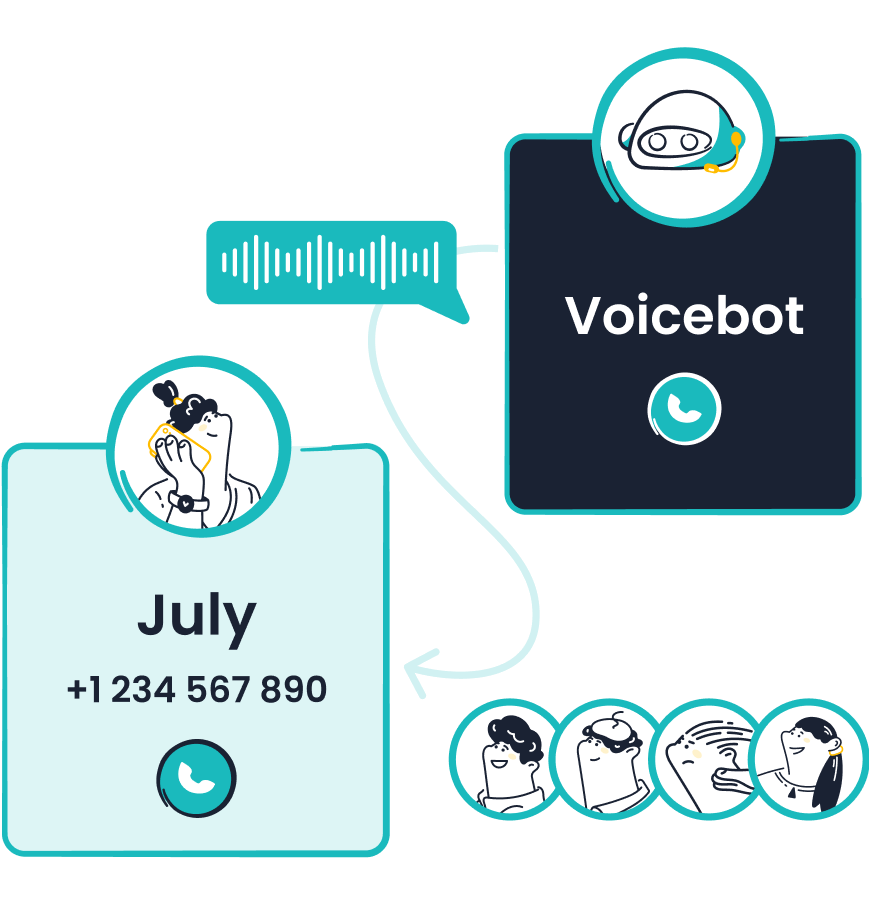
Sobot's Voicebot is a prime example of the hybrid strategy in action. It is designed to revolutionize customer interaction by providing a human-like experience through advanced AI. The Voicebot uses a sophisticated NLP engine to understand a customer's spoken language.
First, its NLU component performs a real-time analysis of the user's speech to accurately determine their intent. Whether a customer wants to track a package, pay a bill, or ask a product question, the NLU pinpoints the exact need. Then, the system's LLM generates a helpful, conversational response in a natural-sounding voice. This creates a smooth and efficient support interaction.
Key capabilities of Sobot's Voicebot include:
- AI-Powered NLP: The Voicebot leverages artificial intelligence and NLU to understand customer needs from natural language.
- Natural Speech Analysis: It can perform a detailed analysis of natural speech to determine customer requirements with high accuracy.
- Seamless Human Transfer: For complex issues, the Voicebot smoothly transfers calls to a human agent, providing the agent with the context of the conversation.
- Proactive Interactions: The outbound Voicebot supports proactive engagement, allowing a business to reach customers for marketing and service updates.
By using NLU for understanding and an LLM for speaking, the Voicebot provides immediate, 24/7 support that boosts customer satisfaction and frees up human agents for more complex tasks.
Real-World Success with Hybrid AI
The value of a hybrid AI strategy is not theoretical. It delivers measurable results for businesses. The implementation of Sobot's solutions provides clear evidence of this success.
OPPO, a global leader in smart devices, partnered with Sobot to enhance its customer support. By deploying Sobot's chatbot, which is built on a powerful NLU engine to handle repetitive queries, OPPO achieved remarkable outcomes. The deep system integration and goal-specific design led to an 83% issue resolution rate from the chatbot alone. This automation freed up human agents, improved efficiency, and directly impacted customer loyalty, contributing to a 57% increase in repurchase rate.
This level of success is seen across various industries that adopt a hybrid AI approach. The combination of NLU for routing and intent recognition with an LLM for agent support and summarization drives significant return on investment.
| Company/Sector | Key Improvement | ROI/Savings |
|---|---|---|
| Global Retailer | First call resolution rate jumped from 63.9% to 81.9% | Significant cost savings from eliminated repeat contacts. |
| Klarna | AI assistant handles work equivalent to 700 full-time agents | $40 million in annual savings. |
| OSF HealthCare | AI virtual assistant diverted calls and provided 24/7 access | Over $2.4 million ROI in one year. |
| Financial Services Bank | Reduced customer wait times by 75% | Increased agent productivity by 40%. |
These business applications demonstrate that a well-executed hybrid AI strategy, combining NLU and LLM technologies, is the winning formula for modern customer support. It delivers both operational efficiency for the business and a superior experience for the user.
The nlu vs llm debate reveals a clear path for any business. The best strategy uses nlu for understanding language and an llm for conversation. This nlp ai approach solves many business challenges. Sobot’s ai solutions demonstrate this hybrid strategy. The nlp solutions use nlu to understand language, then an llm generates a response. This nlp ai uses nlu for reliability. This nlp language model uses nlu and an llm. The nlu is the core of this nlp language model. The nlu is vital for any business. This nlp language model is the future for business.
A business can solve its unique challenges with the right nlp tools. Sobot's nlp solutions, built on a powerful nlu and a fluent llm, are the answer. Embark on Your Contact Journey by exploring a hybrid AI solution.
FAQ
What is the main difference between NLU and LLM?
An NLU system understands the specific intent behind user language. An LLM generates human-like text. The NLU focuses on analysis for precision. The LLM focuses on creating fluent language. This AI difference is key for any business. The NLU provides the core understanding.
Why can't a business just use an LLM for support?
An LLM alone can create incorrect information, posing business challenges. A powerful NLU provides the necessary accuracy for reliable customer support. The NLU ensures the AI gives correct answers. Without an NLU, an LLM is not a safe support tool.
How do NLU and LLM work together in an AI solution?
An NLU engine first performs an analysis of the user language. It identifies the specific intent. Then, an LLM uses this information to generate a helpful, natural language response. This hybrid NLP approach combines the strengths of NLU and LLM technology.
What are the main challenges NLU helps a business solve?
NLU helps a business overcome many support challenges. The NLU automates routing and data entry. This AI technology improves efficiency. An NLU system handles repetitive tasks. This frees up agents for complex problems. The NLU is a solution for common challenges.
Is it difficult to implement NLU and LLM technology?
Implementation presents unique challenges. An NLU requires training on specific business data for accurate analysis. An LLM needs strong guardrails to control its output. A good NLP partner like Sobot helps manage these AI implementation steps for any user.
See Also
Mastering Quality Management Systems: Essential Principles for Call Centers
Navigating Omnichannel Call Center Software: A Comprehensive Implementation Guide
Implementing Omnichannel Contact Center Solutions: A 10-Step Practical Approach
Evaluating AI-Powered Enterprise Call Center Solutions: An In-Depth Review
Best Contact Center Solutions of 2024: A Comprehensive Review

